Treasury Career Corner Live in London April 18th 2024 Final
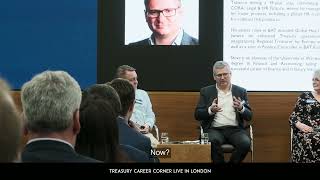
This is a YouTube video titled "Treasury Career Corner Live in London April 18th 2024 Final" containing a live panel discussion held in London on April 18, 2024. The event features multiple treasury professionals including Steve Burton, Diane, and Dan, who share their career journeys, experiences with treasury systems, education, and challenges in the treasury profession. The host/moderator leads the conversation, focusing on career development, qualifications, and practical insights for treasury professionals. The content is a professional panel talk rather than a casual conversation and does not include Mike Richards as a participant.
Welcome to this evening's Treasury Career Corner live in London. This is actually my fifth over the past month or so. I had to take some notes because literally got back from Texas yesterday. So literally one or two beers and I'm asleep in the corner. So did two in New York, a couple of Vegas, Texas now. Lovely London. Now I usually do. You've seen it in the previous one. I say, oh, you're all asleep. A long day, Good evening. Then you wake up a little bit and we do come on again, I'm not doing that corny live. So basically I'm gonna go, good evening London. Wait for it and then you're gonna give me a big bit of energy and you're gonna wake up. Good evening, London. Ah, you didn't let me down. Thank you very much. Couple of ground rules and actually I broke this in one of the first ones was actually to have your phones switched off. Why? Because you've made the effort to come here. Now, I know it's only because of the free booze and these are three amazing panelists, obviously.
Thanks.
There you go. But the key thing is you've made some time for yourselves. A lot of you work remotely and you've got out of your hybrid offices and you've come here this evening, so make the most of it. I see a few people looking at their phones now going, oh, I'll just check that email. It will wait. When was the last time you got to sit with three amazing treasurers and a great treasury recruiter? So I've just written that down here. Okay, you haven't. So before I get onto who am I treasure Career Corner live in London, some thank yous. Firstly, amazing Herbert Smith, I think you'll agree, Kristen at the back, put your hand up there, that's our host. Be very nice to him. Be even nicer if you can Be to the guys at Chatham Hands Up State street in Kariba. They're paying for the drinks. Be very nice to them, otherwise they will be taking your pink tickets away. So who am I? Bar being an extremely big headed man there. So I established treasury recruitment company 25 years ago. Placed before that the lucky Dan on the end. He still thanks me in treasury and I'm telling you that not as a sales pitch, more it's to explain why we created this event. In fact created the podcast and then this event came out of it. I started talking to treasurers 25 years ago, thought about doing my own podcast at some point, maybe about recruitment. I thought, God, that'll get boring. So I thought, no, I'll talk to treasurers. So, five and a half years ago, first ever podcast with Sarah Jane hall from glatosmithkline. Amazing lady thought, we'll do 10 episodes and it didn't stop. Why has it not stopped? Because of all of you. I was at Euro Finance recently and one of the delegates came up, said, look, how have you done 300 odd? Now we've done 320. So look, 10ft of me, 10 treasurers, right? They all do exactly the same job. No, not really, Mike. I went, no, they're cash rich, they're debt laden, they're a private company. And I said, all of you have the same tools, but you've all taken different career paths, you made different steps. And that's what we're going to talk about with our, our lovely panelists. As Tony Robbins says, success leaves clues. So if you can learn just one thing from this evening, and I challenge you to learn one thing from Steve, but that's because we're friends. I'm allowed to say that, but they're giving up their time, so listen in and get some good stuff from them. This is a bit more about the podcast itself. Hope you all listen to it. Every week you get to hear from amazing treasurers. Got the treasure of Harley Davidson coming up. We had some other New York lives. We had. We've got London. We'll record this as well for any of you, your friends and colleagues. And that's about it, really. I think I want to get on to what we're going to do this evening. We will run to time. So we're going to kick off, we're going to talk about how our panellists have built their careers. It's a bit on education, bit about hybrid. Don't want to do too much about that. Some Q and A at the end, takeaways and then free booze. I know a few of you looked up then, didn't you? I'll let the panelists introduce themselves. Steve Burton, over to you, sir.
Thank you very much. First thing, you will learn one thing from me. Okay? Mike invites you out for a quiet beer. Do not go, because you will end up on a panel or on a podcast of some description, or both. I'm not doing both. Yeah, so that's. If you know nothing else, that's the one. If you've not done the podcast or you don't want to do a panel, just avoid this, man. Beer comes up everywhere. Yeah, so my name's Steve Burton and you very kindly asked to do this I'm very old, I've got a very long career so keep me to time please. And even had to look up what I was doing back in the day. So let's start. I graduated accounting degree, I know, very boring but didn't know what to do, ended up in banking doing accounting which really actually wasn't for me quite frankly. But I qualified, did my thing and I'm allowed to tell a few of these in light hearted fashion so I will. One of my roles at Midland bank was to do the finances for the treasury sales team. Now I had no idea what that meant when I started but after a few months what it seemed to entail was doing a few things in the morning and going out for a long lunch, fantastic like that. So my question was who are they taking out to lunch? That is a very important question. And after a while I understood that there was this thing called treasury for corporates and other companies where apparently you were quite important and you could also do exciting things like foreign exchange and money market deposits was basically I am talking back in the day that is what treasury was then and I've now broken the whole thing after a bit of investigation and this seems like a great career but how do you do it? I was very lucky to be offered a role in a nascent Treasury Centre for Merksharp and Dome in central London and I still had no real clue what treasury was but this role seemed great and quite frankly Midland bank at the time was not a great place to be. So it looked like something to do that was a bit more interesting and I think that's a kind of theme in my career. If it looks quite interesting and I'm going to be engaged with it, give it a go, right. And you can do that when you're younger. Clearly the decisions become a bit more relevant later on. Joined Merck Shop and Dome, set up a Treasury center and became a treasurer, not an accountant which was great for.
Some of the audience that don't know who Merck were, a lot of us do. But that stage, what were they as a company?
They're a pharmaceutical company. It was Merck and Co, it was the European subsidiary. They had a lot of subsidiaries around Europe. So first cash management, first sort of realization what cash management and foreign exchange related to that was then once you were a treasurer you're into a different sort of area of recruitment I would say. And we're still talking the 80s I think here somewhere like that early 90s Bat Industries came along, needed a dealer in their head office and you may know BAT is tobacco. Now then they were multinational with financial services and tobacco. Another great story, when you have an interview with bat, HR literally light up a cigarette in the interview, blow it at you and go, have you got a problem with cigarettes? And if you have, you might as well leave now. Obviously I stayed because I then stayed for 19 years at bat. But it was that type of company at the time, a very kind of, I would say aggressive tobacco type company with what was quite frankly a bit of adult financial services. But that soon span out and became tobacco. Now what I found in bat was, and I stayed there 19 years, but it's a global. It was in basically every country in the world. It did pretty much everything. And what you found was if you made the right impression, you had basically three things. You had different product type jobs. So from fx, I ran the fx, I ran dcm, I ran bond issuance. You had geography, you get the chance to move overseas if you're in the right frame. And that was they basically had a regional treasury structure. You could get into where you go in Hong Kong or Americas and be really. So essentially you had an entire spread of jobs that you could do within one company. If you are willing to put yourself out there and basically take risks. There's a lot of, I spent a year or two in Russia, I've been in Vietnam. But if you're willing to be that person and you're willing to do that, you can get those opportunities. And from my perspective, that was what I wanted out of my career as well. I wanted some excitement and not just to be doing treasury, but to be meeting different cultures, meeting different people. And they're the sort of people they wanted in a true multinational. So again, be very careful who you're going to because expectations are different.
And Steve, did that accelerate your career by taking that? Because I get asked, should I move overseas in my company if I've offered it and because a lot of people are saying, do I bother? Do I not? Do you feel that I suppose there's.
An individual element to this.
Right.
For me it was a massively exciting. My first posting was Hong Kong. And you get offered this role, which there was two aspects to it. It's in Hong Kong. And they said, what's the role? I said, they said it's regional treasurer. Who's the current regional treasurer? There isn't one. Okay, so what do I do? You're going to go to Hong Kong and I'll give you a phone.
Make it up.
Go make it up. So that's where the risk comes. Are you willing to dive into that and take it on now? I think I had enough background of treasury and we'll talk about education and what you've done, that you knew more than the other people in Asia, and as long as you're confident enough to do the phone call and get on a plane, you're fine. But if you're not, you know. And also from my perspective, I really wanted to go and do something different outside of London and live somewhere else. But so there's two parts to that. One, they've got to have the confidence in you and you've built that credibility up from where you've come from. And two, you've got to really put yourself out there and make sure that when you get there, you grasp the opportunity. So a lot of that going on at BT, 19 years in, and I did other jobs. I wasn't just in Treasury, I was the finance controller for Russia. I did a bit of project work in Vietnam and things like that, which. So you get these opportunities to have different building blocks of skill sets and so don't keep it narrow. I love treasury and treasury is very wide and we'll probably talk about the future treasury and where it's got to. It's got so much broader than literally that first job I had, which was a bit of FX and a depot. Clearly, we've all been through this transition in the last 20, 30 years, but that doesn't mean being a finance controller in Russia will not give you skill sets that you're never going to learn in the treasury environment, because it certainly does, if nothing else, about managing different teams and different people. But we maybe talk a bit about that. 19 years in bat, I just ran out of enthusiasm, quite frankly, and I think, again, what had always. Every two years I kind of change role and I got this something else. So it became the end of that, that. That time at bat ended up basically doing something completely different. Moving into financial services. I worked for ICG plc. It's now FTSE 100 company. It is a basically essentially a listed private equity company, assets under management, 90 billion. And I joined it as a group treasurer and soon found out it was probably the dullest job in the world because there was nothing going on, quite frankly. But what was interesting was the funds were growing and they needed treasury services. So what became my role was my role is now 10% PLC treasurer and 90% managing debt at fund level and managing the risks and other funds. So I had no idea this was going to happen to you when I turned up and it became something that was going to be, after six months, the worst, dullest job in the world to a really important role within a very high growth company in the footsie. So, again, I didn't know that at the time. You took a risk. It was something different. I wanted to do something not corporate, not cigarettes, not widgets and financial services with that. And that is, by the way, some people think it's quite transferable. Financial services is a whole different beast once you get into it. I reckon three or four years, I got the hang of it. I've been there eight or nine years now and I may be touching the surface of some of it, but it is a completely different way of managing a business, especially with the regulator. Luckily we don't do retail, but it's still a highly regulated and a very highly managed business compared to the corporate experience.
I'm going to come back in some more questions there. I'm going to pass it to Diane as well. Diane, if you would take us back to the beginning for yourself and I'll give Steve his microphone before he loses it.
Thank you very much.
Yeah. So I started my career, I did a degree in engineering, maths actually at Bristol and left. And I hated it. I want. I loved the maths, hated the rest of it. And the very last term they did this module called the Engineering Society, which had a little bit of law and a little bit of finance and a little bit of business. And I was like, okay, that's where I want to be. And so I left, obviously left university. I went to London to make my fortune and I applied for a job at the Evening Standard, like you did back in those days. I started at Tate and Lyell in and my first job, actually my first title was treasury assistant, but that was actually writing the cheques and banking the payments. So I didn't get anywhere near treasury at first. I started doing accounting exams, I did my SEMA exams. I moved around within the company because again, it was a lot of young people there, there was lots of opportunities. I jumped onto their grad scheme because all their graduate trainees had left, which was great, ready to get my qualifications because they paid for it all. And once I was in Tatenhauer, then you again, you get that opportunity and you see this amazing world of treasury because I was always going down there with my payments and all the rest of it and I was like, oh, I desperately want to work here. And. And so basically that was what I did. And it's probably almost exactly 30 years ago now, when I joined the Technow treasury as the money market dealer. And, yeah, and I remember saying, everyone was like, oh, how's it going, Diane? How are you getting on? I was like, I'm getting paid to talk all day. I am nothing. Being the dealer, it was nothing better. I absolutely loved it. I then obviously went and did my treasury exams. I was quite fast tracked through it because of having done all the SEMA already and I was on a bit of a roll. I was like, oh, yes, I'm going to be so good at all of this. Didn't do very well in my second phase of the exams and realised then that actually, even if I had the exams, they weren't going to make me the treasurer. And then a few more things happened. I moved on to kingfish. I did 14 years at Tate and Lyne in various different roles. I then moved on to Kingfisher and. Which was three very intense years. I suppose this is that you spend the first five or six years individually learning your skills and then you spend the rest of your life trying to work out how you apply it to what position you're in right now. Yeah. Kingfisher was crazy. We did.
Can you tell again for the audience what were King?
Because Kingfisher, they were High street when I joined. They still owned Superdrug. They were Woolies, Woolworths on the High street Comet, it was a general merchandise company that owned an awful lot of retail. And of course they own B and Q. Yeah. And now Screwfix, which is obviously what they're left with now. And. But for the three years I was there, it was literally, first of all, first thing we did was just sold off Superdrug, then we sold off Bullies, which is a massive deal. Then we went through this whole other transformation. So it was literally three very intense years and coincided with a period in my life where we actually, within weeks of joining Kingfisher, I found I was having my third child and we got to that point where more kids than adults and it was all a bit complicated and my husband wasn't happy with what he was doing, so we decided to take the rather radical move and move out to Cheltenham, so left London behind us. So I then, to be fair, he went to university. He decided he'd never gone to university because time he went, he got a proper qualification, changed his career and so I was then just like jobbing treasurer. I spent three, four years then while he was at university doing temporary roles, basically some longer than others, I worked at vodafone I worked at Imperial Tobacco, I worked at rhm, I worked at Brambles and I would go into these companies and I ended up again, I didn't expect to do that but I ended up being the treasury systems expert because they were all putting in the same system that we'd worked with at Kingfisher. So that became quite interesting. And as that. What happened at the end of that period of time, which I didn't know was the end of the time was I joined TI Automotive, which is a company in Oxford. Completely different organization, privately owned company working in automotive, terribly highly leveraged and completely different to everybody because everywhere else I'd work was always a big PLC but they battered a little bit above where they should be. And so then I walked in there on a six month contract. I'm still there 17 years later. And a bit like you never know what you're going to get. And very much like Steve having lots of opportunities when he joined eit. What happened with TI was actually all the opportunities landed on us but having in that time we've had losing all the banks through refinancing scheme of arrangement, IPO owned by Sponsor finance, you name it, we've done it. And that was what I had to learn really from that was how to apply what I knew about things like cash management. I never worked in a company that didn't have any, didn't have any money and it was, it was interesting. But you, that's how you learn, isn't it? That's. And that's what's made. I suppose to be fair, I wouldn't still be there 17 years later if it hadn't been always something happening.
We're going to dig both into both of some of those elements. I think that these guys want to hear more. Dan, we'll pass to you Way back when.
Yeah, I think I'm. So I'm the only one who didn't go to university out of your panelists today. And that was really why or where I started in Treasury. I did actually go to university for one day, decided it wasn't for me. In my infinite Wisdom As a 19 year old I didn't like being told what to do and I'd been pushed into it by being told this was what you had to do. And so I left, I got a copy from my dad actually of something called the Sort Code Handbook which was like an address book for banks with all the sort codes and the addresses written in it and I wrote a load of letters to banks in London hoping that one of them would pick it up and bank of New York were the only one who got back to me. I'm not sure what that says about bank of New York, but there we.
Go, we can talk about that, ladies and gentlemen.
And so I joined bank of New York and this was 97. And so my job title had Clark in the title, which shows you what era it was. My job very broadly was a runner for the treasury back office. So I was absolutely terrified, I'll be honest, running into the dealing room to pick up the executed trade tickets, running back, putting it into a swift VDU to send off the swift message, doing the confirmations and the settlements. But it gave me a good grounding in the immediacy of it all the time criticality. If you make a mistake, you've got to own up to it, you've got to fix these things. Whether things are agreed between you and a counterparty were really important. And even in my 19 year old sort of naivety I recognize those things. What I would say is my friends who went to university had much more money than I did because they all got four or five thousand pound grants every year. And I was sat there for a little while wondering how I couldn't quite manage and my friends who were just studying seemed to have loads of money. So I did regret it for a little bit. Anyway, after that I spent a year at Lloyds. This was my one and only dalliance with thinking I wanted to be an accountant. I was a trainee accountant for a year. I had my first exam booked and thought actually this isn't for me, I want to get back into more treasury like work. And that was where I ended up at Ernst and Young. Ernst and Young was for a couple of years really treasury fundamentals, just learning the trade in quite a calm bit of a backwards environment compared to the treasury consultancy that you might expect from Ernst and Young. The internal treasury team was very much under resourced and stuck away in a quiet corner of the office. But I enjoyed my time there for sure. It was while I was at Ernst and Young that I was probably one of the first cohorts for the Certificate of Cash Management from the act. So my first journey of treasury qualifications I think they or one of the attractions at the time. This probably shows I probably needed to go on vacation more. They sent us to a Holiday Inn on the outskirts of Peterborough for the residential and I thought that was a bit of an adventure. Things have changed a little bit, but yeah, so two years at EY and then I Got a job, which I thought at the time was going to be my dream job, but at Thomas Cook, given the amount of time I've spent in financial services since then, which you could say is a little bit dull or a little bit harder to understand. Thomas Cook. We had aeroplanes, we bought jet fuel, we sold holidays. Every Friday we would get an email with the latest staff offers and discounts on holidays. They had a really funky office in a converted warehouse. You didn't have to wear a suit to work, which was quite unusual at the time. I thought it was fantastic. Really enjoyed my time there. Unfortunately, 911 occurred a year into my employment there. The bottom fell out of the tourism industry in the uk. Thomas Cook was eventually put up for sale. It was a great experience for me of watching how quickly cash can evaporate and the importance of cash flow forecasting. Ultimately, there was nothing we could do about it. We had to put ourselves up for sale. But watching the numbers slowly trickle down every single day, knowing that you've got nothing that you could do about it, the banks had withdrawn the revolving credit facility, et cetera. It was a good lesson in the importance of cash. So Thomas Cook made redundant. My first time I was made redundant, then I managed to get a job at Royal and Sun alliance as it was at the time, so my first foray into proper financial services. I spent 19 years at RSA and it's quite interesting to hear you both talk about the length of tenure at some of the companies you've worked at. It felt like to me, at the end of it, that I had to justify why I'd spent 19 years. Were you not ambitious? What was possibly going on there to make you want to stay there that long? And the answer is, some of it is, as Steve mentioned, financial services insurance is horrifically impenetrable and complicated from the outside. It takes a long time to come to grips with all of the subtleties, all of the regulations, all of the different bases on which we look at risk and manage Treasury. So it took a long time to get to grips with that. And I don't like doing things superficially. I like to truly understand what I'm doing. So that took a long time too. And I guess that was my kind of coming of age in treasury, if you like. I did all of the rest of my qualifications there. I made my way up from a Treasury dealer. So enjoying all the things that you've alluded to in terms of long lunches, et cetera, back when they were allowable. Treasury dealer, treasury manager and then about 2014, my boss at the time was thinking he might retire and I was told I was in the succession plan for group treasurer. So, fantastic opportunity for me. I had three or four years to build myself into that role, to learn everything I could from him, to sit in on every single meeting and really immerse myself, particularly in debt capital markets, which are quite unique for treasury companies in terms of the format of debt that we have to issue in dealing with the regulations. So that was a great opportunity for me and a great piece of luck, to be perfectly honest, and gave me my first shot at the Group treasurer position, made redundant for the second time in my career because RSA got taken over by a Canadian B and C company. And that was how I ended up at Resolution Life. And Resolution Life, for a slightly unique entity, probably one of the bigger companies that I can guarantee no one's ever heard of. We're a privately owned company, which is quite unusual, but we have a valuation of about $8 billion, so that will put us somewhere in the bottom half of the FTSE 100. We've got a balance sheet of about $100 billion of assets.
What we do.
And this is where I'll lose most of the room, so I'll try and not spend too long on it. We're a life insurance company, but we don't sell new policies. We help life insurance companies grow by taking books of their old policies and either reinsuring them to us, so we take on the financial risks, the assets and the liabilities, or we buy the company. A bit like a portfolio transfer of life insurance policies. So we specialise in legacy portfolios and run off portfolios for life insurance. We're just starting to expand into other products which have a slightly new business element to them. But fundamentally we help life insurance companies grow because we free up their capital for new business and we take those risks onto our books and manage them in runoff, really. And so it's been hugely interesting, notionally, it's all insurance from the outside. RSA was a general insurer, a PNC insurer, so houses, cars, Resolution is a life insurer. So the liabilities are much longer, which means the assets are much longer, and you need more assets to back those liabilities. So the balance sheet's a lot bigger. Yeah, it's been a. Been an interesting journey.
So we're going to go through some of these, not some in different levels. So we've got in the audience, obviously, quite a mixed audience in terms of experience and everything else, but I think one of the key things you've all touched on is education. Dan, you talked about there, you talked about that as well. And tell us for. We'll start with Steve and actually education, qualifications and if it's not just yourself also maybe in the hiring journey, when you're looking at people, is that a thing that you're looking for? Is that a nice to have or again for this audience so that they know, you know what part is played for you.
Yeah, I did all the exams, what was the mcts and this is again a very long time ago and they're quite challenging as well and took a lot of time. But I think we definitely look for the base levels of treasury or we expect people to take them if we're recruiting at more junior levels. And I think again to Diane's point, it doesn't make you group treasurer but it gives you the basics of what is. Actually there are complications with this thing, especially if you're going to be an FX dealer or any of that. So you really need to understand the maths and some of the around these products. You also need a bit of confidence and a bit of Chutsburg and stuff. You can't get that, but that's quite important. That's how you do your recruitment. So yeah, there really is a need for a base level, but it could be other, there could be other qualifications as well. Often people have an accounting qualification. Again, these all give you an indication of ability and base level. But it's by no means everything for me. Once you get past that after a few years it's about what development you've done, what sort of roles you've done and what experience you've got very quickly. And then especially in treasury, how you're dealing with people, it's to me it's very people orientated business. Depending on whatever role you've got, dealing with banks or dealing internally as a business partner, that's the key for me with that underlying knowledge.
Okay, Dan?
Yeah, I mean my experience of the exams, it was, it was complicated. I think I remember doing the basic level exams being quite straightforward and, and because I'd done the whole SEMA thing, it was just an extension of that, that yeah, you're used to doing a little bit of work on a Sunday afternoon or whatever and that was fine. I think the MCT that we did then, it was another level. It was hard and it was hard and it was also, it was, it was the irony that by the time you got to doing those kind of exams, you generally got quite an important job and you probably got a young family and actually it was really. That made it ten times harder. I did my final exams with a three month old baby. It was. I had some maternity in you, so I thought, oh, I'll use that during my exams because I know I time off. But it was. It was difficult. So for me, to be fair, the second lot I did when I did the mct, it was because the boss of Kingfisher told me that every other treasurer had it, so I'd better sort myself out. So it was expected. Whether I would expect it from people, I would still say, if you're into doing exams and you want to learn, then the ACT is a really good way to go. It does give you very relevant knowledge and it does also give you a nice wide. At that time we were thinking we were doing like an mba.
Yeah.
You were being told it was MBA level qualification and it did because I hadn't done a business degree and therefore it did just widen my knowledge of things from recruitment. I haven't, to be fair, I haven't done a lot of recruitment in recent years with a very small team, but I would definitely encourage the people who work for me to do the exams if they don't have them. I'm working in Oxford. It's really hard to get treasury people in Oxford anyway. In London it's completely different. Ball game.
Yep.
I would say it's a differentiator and if it's not too difficult, I would go and do them, but I don't think it should stop people.
And Dan, you touched on the fact that the pie is paid with yourself. Talk it through.
I could guess. A quick observation. I think that the day after I passed my mct, I had someone present to me an internal candidate for a role within treasury. And they said, this person will be fantastic. He orders all of his CDs in alphabetical order. And to be honest, I was a little bit insulted thinking I've just done this huge exam and someone else's perception of treasury was that if someone was pretty well organized and perhaps a little bit good with numbers, somehow they could do the role. Now, obviously those skills and qualities are important, but I do think that there's a very strong role to play for the qualifications as well. Whether it's to evidence a minimum standard, it's to evidence a level of commitment in terms of your commitment to the profession, because it is a profession and it should have qualifications for a profession. So I do feel pretty strongly about that. There's always circumstances and mitigations of course, you should never rule anyone out. But I think to see a level of commitment that someone's shown by studying, even under circumstances with children, etcetera, you know, that shows commitment to the profession and that's not to be underestimated.
D I'm going to start with yourself and then we'll come back through Steve and then go down for this one. I was going to talk about systems just briefly because obviously that was a strength of yours and that's then leveraged throughout your career and everything else. We got systems providers in the room. We've got. Everyone has different experience systems. Some are like, yeah, we're going to use this, the nth degree. Other people, they're still on Excel. With yourself, what have you seen? What part has hit played for you, would you say? And then Steve to yourself, and then.
Dan, for me, to be fair, I've always worked with a Treasury system. Technile had a Treasury system back in the day and Kingfisher had a new system, which I learned. And that's where we really went, basically where my knowledge came from. I didn't know how it worked in Kingfisher. I knew how to use it. But then when I went to Peel Tobacco and I was. There was attempt and I said, what you want to do then? And he said, you're putting the system in. And I'm like, oh, okay, what's the system? Yeah, because they bought it knowing that I'd used it before.
Yeah.
But I did learn how to put it in. For me, the thing that the system has always done is treasury teams are so much smaller today than they were back in the day when I joined Tate and our treasury, it's 14 people. Nobody has 14 people in their treasury now, unless you're a really massive company. We mostly run the TI treasury, the Central Oxford treasury, on one and a half to two and a half people for many years. And without a decent system, you just can't do that. You can't. We run a we. So for me, we're working with a new system now. It is to me, it's fundamental my worry about the old because I had put the old system in and therefore I was the person who knew it might do it best. And becoming the treasurer is quite difficult to then say, I'm not. I don't want to be that person anymore who knows exactly how. So it's not necessary to put in a new system, but it's really important that we get rid of the old one. So I don't actually own it. Anymore. But for me, I can't imagine a Treasury without a system. And actually that was what I thought I might end up doing one of these days. If I hadn't got the role I have now, I would just have gone up.
Is it because it's the visible, the visibility or is it the. That it just helps with the streamlining.
Of activity or whatever controls segregation of duties and making sure. Yeah, and just making sure that everything is right. This idea of if anyone ever goes into a bank system and starts putting in payment instructions. I'm starting. I'm going to go sweat. Everything needs to be locked down, everything needs to be totally secure and the only way to do that really, unless you're going to have some crazy Excel stuff you do. Leo, I always say you need to disagree system. You can have a very basic system and of course the brilliant thing is now is they're all on SAS stuff so you don't have to pay a huge amount of money. Not like when you have to invest half a million pounds in a massive great mainframe.
Yeah. Big system.
Yeah. I think it's the only way to go these days.
And Steve, I was going to jump into when you joined ICG and. And there what you're going into this new role they already have system and things like that. What was that?
I don't think you could class it quite as a system.
Okay.
But it was something. Yeah. Look, we spent and we. We've upgraded, we've got a proper system or for all the good reasons you said especially around the controls and the flows are massive. You just can't type them in Excel anymore, which is what we were doing. But I'd say systems. One of my career choices was to make sure I was never an expert in systems. So I didn't ever get told to go and put a system in. So I'm going to employ people who know what they're doing and that's two things. One a systems person and one a systems person who knows what treasury is. Because otherwise you're in deep blue, quite frankly. Excuse my French. And to really. And people do say, oh go and put a Treasury system in like it's next Tuesday. It'll be fine. This is normally a one or two year project with proper resourcing and a big budget and then I guarantee you, and we did it badly or not, two years later, you're still optimizing that system to make sure it does what's fit for purpose.
You're still really doing what you were doing two years before. You've all done. Replace your Excel spreadsheets.
Yeah. But in a very much more controlled environment. And I'm sure there are great system people here, but if you can get a system that actually puts a report out that actually looks like your nice presentation, that'd be fantastic one day. So you need them. They're a huge investment. Do it properly, don't shortcut it. And you do put something in that's going to last you 10, 20 years. Right. Because it's just a false economy. Otherwise, on risk and on investment. So go for it.
I was lucky, I guess. I showed up at Resolution partly to set up the central function. And so I already had a credit in my budget to spend on a tms, which I've never had that luxury before. Now, it wasn't a huge credit, but it did at least allow us to get going on the project. What I would say is this will sound slightly odd, perhaps, but I describe our TMS as a Ford Mondeo. It gets us from A to B. It does exactly what it needs to do, but we never spend any time or money. Gold plating stuff, because that seems to be something that you see quite a lot. There's a bit of temptation, particularly when you go into rfp. You come up with a load of must have requirements that are way, way away from what you do now or what you may even do in the future. But because you're doing an rfp, why not? List five pages of requirements? Why not? But all that really means is you pay more money, you take more time and you have a system that you never quite used. I like our system, don't get me wrong, but it's very much functional rather than something that I would do a huge showcase over.
We're going to mix up the order as well. I'll do Steve and then Dan and then yourself. Steve, when you got to icg, as you said, it wasn't really that much treasury per se, and then it wasn't a mature treasury function. You were having to go and sell. And a lot of the treasury folks that are in here go out and sell themselves. You're very good at relationships. You're talking to the business and sell, not tell, first of all. And then a bit later on it's give us your cash because we can do it, look after it better than you can in a nice way. What was it like for you at icg, trying to present that to also, at the same time understanding business that you were unfamiliar with?
Yeah, I joined as group treasure and the first thing they Said was we're putting you on the dealing mandate. And I said you are not putting me on a job. I haven't done an FX deal for 30 years. And the last thing about me is it'll be the wrong way around before you know it. And Jack's over there. That's why I recruited Jack. So he didn't, I know he didn't get, he didn't get anything.
We recruited Jack.
One thing, yeah it's a small treasury. When I turned I was the second person. So we had to sort things out. It was, didn't have any, we had no systems in it but. So the first two or three years was sort your cash management out, get a system in place, recruit a few people and deal with the growth we're in. And then realized actually there's a sort of only so much this going to the corporate structure. We have a balance sheet, it's small but everything else growth wise is our funds. We have about 50 different funds and we have 86 billion of assets under management. And what they needed was actually treasury services, but they didn't know it. None of them had any financing. I think my favorite one is I rang Lloyds and said oh, who does FX with you from ICG? We got a list of 18 people. So one person on each fund was ringing up doing a deal. Oh, I bet they're getting great prices. So we centralized foreign exchange, we centralized financing everything. And then, so then it just started growing ridiculously and but a lot of it was they didn't want help initially to your point. And it's a matter of again, this is the standard thing about business partnership, right? You've got to prove yourselves, you've got to have credibility and that takes time but it takes a lot of effort as well and it takes a lot of certain skills. So that's where we started the luckily I've done a lot of that at bat and I kind of knew how to do it.
But what the essential elements, one or two points that is it just about winning hearts and minds.
Look to you it's obvious, to them it's not. You've got to do it in a way where you can prove concept, you build a relationship and then what you find is once one person's bought into it and is doing it, the rest follow. And this isn't rocket science. This is simple basic management of people. But it means the stuff you do at the start has got to be right and you've got to be doing the right things. If you start making mistakes and Errors up front, you're never going to get anywhere with the rest of it. And then after a while, it's all about the incoming. It's not about you going out and finding it. That's just the way it works. And that's the same for being a business partner in a corporate with an operating company than whatever structure you got. Or for me, each fund or each set of funds or product has its own portfolio management team, which is like a sort of OPCO board. So you've got to have all of those relationships built over time to get. And then. And now we're trading billions of FX across all our funds and we're doing, as I said, multi. Billions of financing across. It's just expected now.
Yeah, it's more the norm.
Not great either. They just assume you can do it. But that's a whole different discussion.
Dan, more recently, when you got to Resolution Life, what was the norm then when you got in, or was there one?
There wasn't really one, to be honest. I think the company's only about four years old and it had grown by making three big acquisitions. A reinsurance vehicle in Bermuda, a big life insurer in Australia, and a big life insurer in the U.S. so all of those legacy businesses, for want of a better phrase, come with their own people, processes and systems and culture. And then we put ourselves in over the top as a holding company and said, now you need to listen to us, and now you need to listen to the tone that we're setting. And by the way, we're going to centralize debt management, we're going to centralize rating agencies. And so to be honest, that really works out very well. And it takes time to come in because everyone's got their embedded culture and position and we're on a journey there and it'll take longer, but.
But yeah, Diane, when you got there, you were the treasury expert, so every, as you said, everyone just was giving you everything. Was it just they'd thrown it off their desk or.
No, when I, when I joined ti, it was. TI is in very interesting place. And to be fair, I think the reason I joined TI as a temp was because everybody else had just left. It was, I won't say dodgy, but it was, it was a difficult company to work for. And most of the people who were leaving for jobs with more security, it was very much on a downward spiral. And so there was. The treasurer was there. It had been spun out of TI Group, so he had come out of TI Group with a few other people to set up this demerged entity. And it came with all sorts of stuff. It came with quite. It was quite a big business. They demerged out in all different countries. It was just basically the automotive bit of this whole TI group. And so they were setting things up. But yeah, they had set it up on spreadsheets. They were. But literally it was more the fact that everyone had just left and therefore I was just very much, okay, what do I do first? How do I work this out? And it was. It's the only way to learn. At the end of the day, it was really good. And then we carried on being a really small team and just put some good systems around it. But the good thing actually, though is also it's quite a nice group in that the people, the local people. There wasn't any resistance. I think everybody knew the company was struggling. And to be fair, I still. If I bring people up and say, look, you've got too much cash. Can I have some of that cash? They'll say, are we in trouble? I'm like, absolutely not. But they're just so used to that being the situation. That was where we were. But everybody has always been, the company is only as good as the people who work for it, isn't it? And everybody has always been totally helpful and totally understanding. I have been the world's expert on cash flow forecasting, which I hate, but it became our life. A bit like your Thomas Cook situation we were doing. Actually, we've only just now stopped doing weekly cash forecast.
And when we had our briefing call as well, before this, you talked about hearts and minds and culture and getting much more. How have you guys done that in the company as well? Because I know that you do various groups where you're explaining and I think the guys here could learn from that as well.
It's really just been about. I think an awful lot of it, to be fair, came from COVID and from the teams. That for us was a real game changer that I. That before that, my boss was in the states and I would never talk to her because you just didn't do that. And then suddenly everyone started having those. You talk to people if they were in the office and you go and find somebody to talk to, but you really wouldn't pick up the phone that often and talk to somebody else. Suddenly everyone was having those kind of proof of life calls, and they are now the norm. And it's great. We have a call now every week, cfo, all these direct reports all sit down. We go around the room and you know so much now of what's going on and I think. And everyone then know it's about knowing who to talk to. And that has really come together, I think, in recent times.
So I'm going to ask some more questions of you guys, then we're going to do Q and A. You get to ask some interesting questions, so get ready for that with the microphones coming around and then we've got some really great takeaways for you. And then also you get to meet the panelists in the bar afterwards. So that's a good time to make the questions.
Good.
Oh, you're paying extra for that?
Nope. No, that's our lovely sponsors. Thank you very much.
Sponsors.
I'll be name checking you in a minute. Don't worry. Again, I was going to cover Hybrid, but to be honest, a bit bored of it. We all know it. We, you know, remote is going away, Hybrid is here to stay and all that stuff. I think actually some of this. And we've already pre briefed you about this and I think actually start with Dan and work our way back from this. Many of the audience here. I love this question because I wrote it. I know, but it's a good one. I've already pre briefed you on it. Would love to achieve the level of success. But you all have here. And it's true, you guys, you're all very modest about it and everything else, but you're all treasurers at big companies, you've leveraged, you've gone through all the different career steps you made. But looking back at whatever stage it might be, or just picking out a couple of bits, what advice would you give to your younger self, sort of thing and. Or do you then. Or maybe then give to your team if they're going, oh, I should do this? Actually you could, but I've done this or don't need to worry about it so much. And I know that Dan, you and I talked about this on the podcast, so I have pre rehearsed this. Don't worry, I'm not being completely mean to me. It's all right, we've already done this. It's been a double point podcast. Very good. So his previous job in this one. So again, that was one of the things that came out from the podcast. And so over to you.
I'm trying to remember what I said.
Now, make it up.
I think it was around being curious and I was reflecting what were some of the events that led for me moving from slightly more operational roles to more managerial roles to more strategic roles. And I think breadth of experience is hugely important. Right. That's one of the attractions of this career, the sheer breadth of stuff you get to look at. But the reality is you don't get to move up unless you have the depth of experience, too. And so you have to immerse yourself in certain things. You have to start somewhere and just suck it up, read the documentation, get on with it. And you really only do that by taking ownership, making a proposal, being curious about something, following the line of questioning, thinking about where the process comes into your function. What do they do with this? Why do I get this piece of data? What happens after you hand it off to the next person? What do they do with it? Where does that end up? How does that get reflected in the report and accounts, etc. I think the curiosity bit is probably the key bit for me.
Okay, Diane.
Similarly, I would say it would be my younger self, tell me to sort things out a little bit, but I would say the thing, actually, one person once said to me, and he was probably what he was said, you don't expect everyone to know how good you are, because you don't, do you? And I would never have thought of going into an interview and saying, I could absolutely do this job. You'd be like, I don't know, I think I might be able to, and just having that confidence. And I think that was. Actually, he said that to me after I applied for the first job in Tateland treasury, when I applied to be the accountant, and they were like, oh, I don't know, not quite sure. And then when the job as a dealer came up, they did say to me, are you just applying for every job in Treasury? And I was like, absolutely, that's what I'm doing, because I think that's where I should be. But it is that. Yeah, it's curiosity and it's also building that confidence as well and knowing that stuff and making sure everyone else knows that you do stuff.
How do you follow that? I think career wise. Career wise?
Yeah.
The only person really bothered about your career is you. I think the amount of conversations I've had with people, oh, what do I do next? How do I develop myself? How do I get better? You've got to put a bit of effort in, quite frankly, and don't just sit, oh, I haven't been promoted this year.
Why?
Have a think about it.
Really.
You are the. The number one person interested in you is you. And you've really got to make the effort. You've got to develop yourself, you've got to push yourself. You've got to have confidence in yourself. And if you don't, other if you. Maybe you're a genius and people will spot you and go, oh, I'm gonna. Oh, it doesn't. Does not work like that. Have confidence in yourself. Go for it, but own it as well. Really own it, because then people will see you're owning it.
So I reflected on this when I was in Texas just a couple of days ago. I was talking about a speech I gave in Chicago, and we were. And it reflects on all of those, actually, and someone. And Steve and I, we're in. All the panelists, actually, but in particular with Steve recently, when I was persuading him, I said, look, I hate public speaking, and we'd stop this speech. And they were, what? No, you're great. You do this. I don't enjoy it. I don't enjoy it. I don't think, oh, yeah, I want to stand in front of you guys. I love being with my people, but I enjoy it because it grows the business. It means that I can help you with your treasury careers. I get to chat to these incredibly interesting people. But it was again, about getting out of your own way, about being confident, getting out of your comfort zone. I said to the panelists there or said to some of the audience, when was the last time you were asked to be on a panel and did anyone. And I said, I didn't want to ask him, but a few people raising their hand. And you said, no. And they were like, oh, yeah. And you could see. Get out of your own way. Particularly in the early years. It will. It's not just doing this, Be on the podcast, do other things. Just by doing that, it helps you develop as a Treasury professional as well. I know we're coming up for time and I want to run out of time and things, so we're going to go to some questions. So let's have some hands in the air. We've got Royston over there. We might come back. We'll go to. In the middle, we'll go to Mr. Clarkson.
There you go.
Who is it? Yeah. Hello, Nick.
Hey, guys. Firstly, it's great to hear your backstories. Really interesting.
So perhaps a challenging question with the dawn of AI.
I was just wondering how you guys think that might unfold in the treasury landscape.
Not an easy question to answer, but very interested to get your views, how.
AI is coming into your worlds of Treasury. And you see it's the top of the. It's on Every panel at the moment, it seems everywhere. So we'll start with Dan and then work our way back because I know again, Dan's got a good story about this. So.
Yeah, Dan, thank goodness.
I guess one opening remark, which is a bit of a personal remark, which is AI, whether it's AI, machine learning, etcetera, Various definitions and how you look at it, definitely a topic of interest. I'm a little bit mindful for a lot of use cases in Treasury. It's new and if you've got a lot of crap underneath it, there's no point putting AI or machine learning on top of it. Do you have a nice veneer that looks call and you can go and do your presentations, but unless you've got a baseline that sits underneath it that's structured and well ordered, there's no point to that point at Resolution Life. I think because we were a young insurance company, four years or so, the technology strategy was very much part of our ethos and where we started. And if I Compare that to RSA, which was 300 years old and some of the systems were 298 years old, it's like chalk and cheese. And so our data architecture is built on data lakes and each one of those three subsidiaries that we've got, the basic principle is you throw every single bit of data, no matter what it is, into the data lake. So it's just a huge storage vessel, if you like. And then there's another layer that kind of sorts and filters and structures that data. And then there's business intelligence that sits over the top and allows you to extract that data and do stuff with it. Yeah, because insurance is fundamentally a data game. It's a load of actuaries making estimates about stuff in the future at the end of the day. So the more structured you have that data, the better. And I wouldn't necessarily say we use artificial intelligence to sit over the top. We do use machine learning to make sure that that process is a lot quicker and slicker. If someone rings up with a claim, which generally means someone's died. So it's not a great event. You want to be able to pay that person or that person's family as quickly as possible. You don't want them sitting around for three months, six months, whilst the insurance company agrees to claim and pays it out. So I think that the data is a key part of our customer journey and shortening that claims time, basically.
Diane, I did actually sit in a meeting recently with our IT guys, who had obviously been tasked by the CEO that we need to have in our business. And so someone had suggested to them maybe the cash flow forecast was a good start, place to start. Really what they were looking at, it wasn't AI, it was automating a process, trying to. I would love somebody to do machine. Our business is very predictable. So really all you're doing is replacing the senior manager who looks at the numbers and says, yeah, this is how it's going to be for the next three years. With a machine that might be able to do that. I don't know how much it would learn. I'm not sure yet.
Okay.
I'm with Diane on that. I think it's very nascent for us. I think a lot of companies are looking at how the business can benefit from it more. I'm struggling a little bit with how it's going to help me in treasury at the moment. Maybe in the legal side on document.
Yeah.
But it's something we're not consciously avoiding at the moment, but waiting to see what happens. I think.
We were asked this question actually at New York eventually, couple of weeks ago, and actually I was interviewing Dana Laidhold, global treasurer for nasdaq, and she's all over it. And she was like, oh, yeah, we're using. Using it. But it was in a very controlled fashion. But what they were using it was in their cash flow and their forecasting. And what they were doing was iterating and iterating and saving days. And each time it was days, there was a lot of manual, not manual input, but there was, you know, using knowledge and actually a real interface and actually they were getting some really good benefits. I was just going to try and look up some of the quotes from her, but again, that was on the podcast a couple of weeks ago. Brilliant. Amazing stuff about what they were doing. And Chris Cocaine from Endeavour, they had wwe and they were doing the same in their treasury. But again, like you, it was the practical use cases and stuff like that.
Yeah.
So, Royston, I know you have one and anybody else would come to as well. We've still got a couple more minutes of Royston.
Thank you, guys.
It's really great hearing all your diverse stories and clearly you've all had very successful careers. Can you share any times in your career where you failed and what lessons you may have learned from it?
Biggest challenges, face big challenges failed. I'm not going to ask Steve that yet because he'll punch me in the face. No, actually, no, I will ask Steve. There you go. Because I can just move out the way. Go on. You've had a particularly planted that yeah, I know that's it. Well we talk smiling you can see.
How do you career M I stayed at bat too long if I'm honest.
Why?
You get sucked in a little bit. Define benefit pension scheme for a start. Yeah, you don't want anything I, I, I just think you you do given all the great things you still get a bit sucked into what would I do if I left? Best thing I did was leaving in the end but I think it took a year or two too long I think so personally I think that was We've all had difficult managers, difficult bosses and I think you know difficult things that come through they in bat they started putting non treasury people as a treasurer. Great, thanks a lot for that. Blocks you for a bit, doesn't it? And you got to adapt to that sort of thing and then that meant actually I left treasury and did other things so in the end it turned out to be a benefit. But look for the yeah, there's always challenges. Look for the best out of it if you can I think and yeah, don't wait too long.
Yeah and I certainly did that as well in in the early years usually and I've learned a huge amount I've been at TI and we learned a.
Huge amount of kingfisher takeaways coming up Dan.
I guess plenty of actual mistakes in the early years that have financial impact and obviously from those dealing with price stuff. Yeah, yeah, exactly. And to some extent that's one of the helpful learnings because you realize actually what I'm doing has a real economic and monetary impact every single day. So obviously you try and limit those because otherwise your career is going to be pretty short lived. I guess by far the most challenging part of my career was the end of my tenure at rsa so I knew we'd been taken over. I knew I had nine months to go. The team, as they always do under those circumstances starts fragmenting and people are pissed off. People don't really want to come to work. I think my boss at the time had a heart attack and left for six months. Two people were signed off sick out of a team of six and the company that bought RSA just wanted to get on with stuff. They wanted me to put in a new investment accounting system. All of these other big ticket projects for stuff that I was never going to be responsible for and I knew I was leaving so I had to just deal with the dynamics of all of the different people at that time, deal with the new owners who were notionally pleased at the company that they bought and wanted to make progress and deal with my own exit and trying to find a job because you've got a family to look after. So it was a very stressful period for what mostly should have been some nice gardening leave. And it wasn't. I had a week off between that job and Resolution, which was nice, but nowhere near enough. No to decompress.
Okay, so takeaways for this audience. Steve, we've got this with luckily a high res photo.
I can't remember what.
No, well, you've got them, you read off. Maybe just pick out your top two. You've said a lot of them anyway.
But the second one's quite interesting.
Yeah, people.
I'll get them out. People just want more money but honestly, you can end up in some rubbish jobs. They pay well. You last half an hour, quite frankly. And what you tend to find, if it's a challenging and fulfilling job and interesting, you'll do really well at it and then you'll move on to something even more worth more money. Again. It's just, it just you've got to have pride in yourself and do, do the right thing by yourself. There's a lot of that I've been on, I've been on a lot of training courses in my life and I only remember one line from one course and I reckon this is about 50 and that's the third one. But this guy said, look, if you really do a good job and you are, you do the best you can in whatever you're doing, it will be catching for your team and the people around you. And it's. I know this is. I'm trying to work with lecture now, but actually generally works right, people feed off other people doing them and they can see you doing the right thing and you doing the best thing. They will, yeah, I better do that. And then they'll enjoy it as well and you'll get better results from it. And I think the testament to that line is it is literally the one thing I remember from about 500 training courses.
Quite. Yeah.
Risk is a bit about the career thing and be respectful. I've probably visited 50, 60 countries, I've worked in five or six. And the first thing is be respectful to the people you're working with and you're going into a community, you're going into a company where you're an expat or you're visiting. Just be nice, learn the culture and funnily enough, you get to know people and they're really nice. You'll get results. It's not difficult. There you go.
Diane, those are yours? Yeah. Pick up one or two maybe, or just.
Yeah. It is that thing. Do something every day that makes you.
Scared, like, comfort zone.
Come take yourself out of your comfort zone. Yeah. And it is very much about putting your name down for anything. I've loved it recently. I say I've been in a really small team for a very long time, and I worked with basically one person for many years, and she never, ever in that whole time said, oh, I've run out of work time. What else can I do? She just, every day just did what she needed to do and went home again. And I've now got a team who come in. If I'm saying this is happening, they're like, can I do that? Can I have a go at that? And putting yourself out there, just volunteering for anything, really, because you never know what's going to come out of it. Challenging and. Yeah. And it is just the best thing. I'm loving the fact that I've got people now who just want to learn, want to do good stuff.
Cool.
And, Dan.
I would say that the first one is. My boss is saying perfection can be the enemy of progress. Very loosely translated, it means just get on with it.
Technically.
The third one, I do keep it simple and is really important. And to be perfectly honest, the only time I'm the smartest person in the room is when I'm with my four kids who are all under 10. So we're used to being pitched by investment banks, advisors, you name it. I think learning to know that it's okay to say no or I don't understand or ask more questions, because a lot of people will instantly go to the most complex solution. And actually, it's always better to start from the simplest and work your way up from there. So keeping it simple, I think, is it's allowed me to survive in my room, that's for sure.
And my takeaways that getting the best out of this evening, and actually we'll take that is, I said earlier, half the battle you've got here. So well done for doing that. But I talk about this quite a lot. Chris Fulton was in his offices in Times Square. He says he's not a networker, he's a networking genius. He's brilliant because one of his tips is that when he meets someone just like this evening, rather than immediately go, let's connect on LinkedIn what he does. By the time we get take a business card or take a moment, take a step, and he will just make a note, talking to someone, saying, oh, they're going to this unit, actually, I went to there, I can help out. And he will just show because he's genuinely interested. He actually empathizes and he's interested. So he will then do that and he'll follow up on it. So when you meet people this evening, you've made the effort to come here. Yes. Your train might be going or bus or whatever. Don't dash out the room. If you can network for 2 minutes, 5 minutes, 55 minutes, there are free drinks. Thank you, sponsors. But joking aside with that, do make the effort. You've made the effort to come here just to download all this great information. But then it means you do get to actually talk to people as well, and broadening your networks and come to the next one. There's so many people going, oh, dogs at my homework. Oh, can't come along, I've got sniffle. Do you know, I actually feel sorry for them. They've missed out on this. Yeah, you can hear it on the podcast. Yeah. But now this is where the work starts. You get to meet other treasury professionals because we've been through pandemic. That's why I didn't bother with the working from home hybrid thing. We all know it, we all live and breathe and now it's the new world of new way of working. Now you get to actually network. You've made this effort, so make the most of it. So we're going to go to applause in a moment, but there you go, you've got the amazing sponsors, you've got a lovely host as well. They should be on there. Our palace will be there for a few minutes or two, but let's meet them at the bar, give them a massive round of applause, please, so much. Thank you very much. And we're done. There you go. Right, and the bar's open, so free booze and there's freebies as well. Be careful with that. As a Treasury professional as well, I know we're coming up for time. I don't want to run out of time and things. So we're going to go to some questions. So let's have some hands in the air. We've got Royston over there, but we might come back. We'll go to. In the middle, we'll go to Mr. Clarkson. There you go. Who is it? Yeah, Hello, Nick.
Hey, guys. Firstly, it's great to hear your backstories. Really interesting.
So perhaps a challenging question with the dawn of AI.
I was just wondering how you Guys.
Think that might unfold in the treasury landscape. Not an easy question to answer, but very interested to get your views how.
AI is coming into your worlds of Treasury. And you'll see it's the top of the. It's on every panel at the moment. It seems everywhere. So we'll start with Dan and then work our way back, because I know again, Dan's got a good story about this. So.
Yeah, Dan, thank goodness.
I guess one opening remark, which is a bit of a personal remark, which is AI, whether it's AI, machine learning, et cetera, the various definitions and how you look at it, definitely a topic of interest. I'm a little bit mindful for a lot of use cases in Treasury. It's new and if you've got a lot of crap underneath it, there's no point putting AI or machine learning on top of it. You'll have a nice veneer that looks cool and you can go and do your presentations, but unless you've got a baseline that sits underneath it, that's structured and well ordered, there's no point to that point at Resolution Life. I think because we were a young insurance company, four years or so, the technology strategy was very much part of our ethos and where we started. And if I Compare that to RSA, which was 300 years old and some of the systems were 298 years old, it's like chalk and cheese. And so our data architecture is built on data lakes and each one of those three subsidiaries that we've got, the basic principle is you throw every single bit of data, no matter what it is, into the data lake. So it's just a huge storage vessel, if you like. And then there's another layer that kind of sorts and filters and structures that data. And then there's business intelligence that sits over the top and allows you to extract that data and do stuff with it. Yeah, because insurance is fundamentally a data game. It's a load of actuaries making estimates about stuff in the future at the end of the day. So the more structured you have that data, the better. And I wouldn't necessarily say we use artificial intelligence to sit over the top. We do use machine learning to make sure that that process is a lot quicker and slicker. If someone rings up with a claim, which generally means someone's died, so it's not a great event. You want to be able to pay that person or that person's family as quickly as possible. You don't want them sitting around for three months, six months, whilst the insurance company agrees to claim and pays it out. So I think the data is a key part of our customer journey and shortening that claims time, basically.
Diane, I did actually sit in a meeting recently with our IT guys who had obviously been tasked by the CEO that we need to have AI in our business. And so someone had suggested to them maybe the cash flow forecast was a good place to start. Really what they were looking at, it wasn't AI, it was automating a process, trying to. I would love somebody to do me sheep. Our business is very predictable. So really all you're doing is replacing the senior manager who looks at the numbers and says, yeah, this is how it's going to be for the next three years with a machine that might be able to do that. I don't know how much it would learn. I'm not sure yet.
Okay, Steve, I'm with Diane on that. I think it's very nascent for us. I think a lot of companies are looking at how the business can benefit from it more. I'm struggling a little bit with how it's going to help Mean treasury at the moment. Maybe in the legal side, it's something we're not consciously avoiding at the moment, but waiting to see what happens. I think.
We were asked this question actually at New York event a couple of weeks ago, and actually I was interviewing Dana Laidhold, global treasurer for nasdaq, and she's all over it and she was like, oh, yeah, we're using it, using it, but. But it was in a very controlled fashion. But what they were using it was in their cash flow and their forecasting. And what they were doing was iterating and iterating and saving days. And each time it was days, there was a lot of manually, not manual input, but there was, you know, using knowledge and actually a real interface. And actually they were getting some really good benefits. I was just going to try and look up some of the quotes from her, but again, that was on the podcast a couple of weeks ago. Brilliant. Amazing stuff. But what they were doing. And Chris Kocam from Endeavour wwe and they were doing the same in their treasury, but again, like you, it was the practical use cases and stuff like that.
Yeah.
So Royston, I know you have one and anybody else will come to as well. We've still got a couple more minutes of Royston.
Thank you, guys. It's really great hearing all your diverse stories and clearly you4 have had very successful careers. Can you share any times in your career where you failed and what lessons you may have learned from it?
Biggest challenges, Facebook challenges failed. I'm not gonna ask Steve that yet because he'll punch me in the face. No, actually no, I will ask Steve. There you go. Because I can just move out the way. Go on. You've had a particularly planted that one. Yeah, I know. That's it. Well, we talked.
He's smiling, you can see. How do you. Oh, career. I stayed at bat too, too long if I'm honest.
Why?
You get sucked in a little bit. Define benefit pension scheme for a start. Yeah. You don't want anything. I. I just think you do. Given all the great things you still get a bit sucked into. What would I do if I left? Best thing I did was leaving in the end, but I think it took a year or two. Too long. I think so personally I think that was. And we've all had difficult managers, difficult bosses and I think, you know, difficult things that come through in bat. They started putting non treasury people as a treasurer. Oh, great. Thanks a lot for that.
Sorry.
It blocks you for a bit, doesn't it? And you've got to adapt to that sort of thing. And then that meant actually I left treasury and did other things. So in the end it turned out to be a benefit. But look for the. Yeah, there's always challenges. Look for the best out of it if you can, I think. Yeah, don't wait too long.
Yeah. And I certainly did that as well in the early years usually and I've learned a huge amount. I've been at TI and we learned.
A huge amount of kinkfish takeaways coming up. Dan.
I guess plenty of actual mistakes in the early years that have financial impact and obviously from those dealing with price stuff. Yeah, yeah, exactly. And to some extent that's one of their helpful learnings because you realize actually what I'm doing has a real economic and monetary impact every single day. So obviously you try and limit those because otherwise your career is going to be pretty short lived. I guess by far the most challenging part of my career was the end of my tenure at rsa. So I knew we'd been taken over. I knew I had nine months to go. The team, as they always do under those circumstances, starts fragmenting and people are pissed off. People don't really want to come to work. I think my boss at the time had a heart attack and left for six months. Two people were signed off out of a team of six and the company that bought RSA just wanted to get on with stuff. They wanted me to put in a new investment accounting system. All of These other big ticket projects for stuff that I was never going to be responsible for and I knew I was leaving so I had to just deal with the dynamics of all of the different people at that time, deal with the new owners who were notionally pleased at the company that they bought and wanted to make progress and deal with my own exit and trying to find a job because you've got a family to look after. So it was a very stressful period for what mostly should have been some nice gardening leave and it wasn't. I had a week off between that job and resolution, which was nice, but nowhere near enough. No to decompress.
Okay, so takeaways for this audience. Steve, we've got this with luckily a high res photo.
I can't remember what.
No, well you've got the. You read off. Maybe just pick out your top 10. You've said a lot of them anyway.
But the second one's quite interesting.
Yeah, people.
I'll get them out. People just want more money but honestly you can end up in some rubbish jobs. They pay well. You last half an hour quite frankly. And what you tend to find if it's a challenging and fulfilling job and interesting, you'll do really well at it and then you'll move on to something even more worth more money. Again. It's just you've got to have pride in yourself and do do the right thing by yourself. There's a lot of that I've been on. I've been on a lot of training courses in my life and I only remember one line from one course and I reckon this is about 50 and that's the third one. But this guy said, look, if you really do a good job and you are, you do the best you can in whatever you're doing, it will be catching for your team and the people around you. And it's. I know this is. I'm trying to work with lecturer now but actually generally works right. People feed off other people doing. When they can see you doing the right thing and you doing the best thing. They will, yeah, I better do that. And then they'll enjoy it as well and you'll get better results from it. And I think the testament to that line is it is literally the one thing I remember from about 500 training courses.
Yeah.
Risk is a bit about the career thing and be respectful. I've probably visited 50, 60 countries, I've worked in five or six. And the first thing is be respectful to the people you're working with. And you're going into a Community. You're going into a company where you're an expat or you're visiting. Just be nice, learn the culture. And funnily enough, you get to know people and they're really nice. You'll get results. It's not difficult.
Diane, those are yours? Yeah. Pick up one or two maybe, or just.
Yeah. It is that thing. Do something every day that makes you scared.
Like, comfort zone.
Take yourself out of your comfort zone. Yeah. It is very much about putting your name down for anything. I've loved it recently. I say I've been in a really small team for a very long time, and I worked with basically one person for many years. And she never, ever in that whole time said, oh, I've run out of work time. What else can I do? She just every day just did what she needed to do and went home again. And I've now got a team who come in. If I'm saying this is happening, they're like, can I do that? Can I have a go at that? And putting yourself out there, just volunteering for anything, really, because you never know what's going to come out of it.
Yeah.
Challenging and. Yeah. And it is just the best thing. I'm loving the fact that I've got people now who just want to learn to do good stuff.
And, Dan.
I would say that the first one is my boss's saying, perfection can be the enemy of progress. Very loosely translated, it means just get on with it.
Technically.
The third one, I do keep it simple and is really important. And to be perfectly honest, the only time I'm the smartest person in the room is when I'm with my four kids who are all under 10. So we're used to being pitched by investment banks, advisors, you name it. I think learning to know that it's okay to say no or I don't understand or ask more questions because a lot of people will instantly go to the most complex solution. And actually, it's always better to start from the simplest and work your way up from there. So keeping it simple, I think, is it's allowed me to survive in my role, that's for sure.
And my takeaways that getting the best out of this evening, and actually, we'll take that is I said earlier half the battle you've got here, so well done for doing that. But I talk about this quite a lot. Chris Fulton was in his offices in Times Square. He says he's not a networker, he's a networking genius. He's brilliant because one of his tips Is that when he meets someone, just like this evening, rather than immediate, oh, let's connect on LinkedIn. What he does, take business card or take a moment, take a step. And he will just make a note, talking to someone, saying, oh, they're going to this unit, actually, I went to there, I can help out. And he will just show because he's genuinely interested. He actually empathizes and he's interested. So he will then do that and he'll follow up on it. So when you meet people this evening, you've made the effort to come here. Yes. Your train might be going or bus or whatever. Don't dash out the room. If you can network for 2 minutes, 5 minutes, 55 minutes. There are free drinks. Thank you, sponsors. But joking aside with that, do make the effort. You've made the effort to come here just to download all this great information. But then it means you do get to actually talk to people as well, and broadening your networks and come to the next one. There's so many people earlier on going, oh, dogs at my homework. Oh, can't come along or I've got sniffle. Do you know, I actually feel sorry for them. They've missed out on this. Yeah, you can hear it on the podcast. Yeah. But now this is where the work starts. You get to meet other treasury professionals because we've been through pandemic. That's why I didn't bother with the working from home hybrid thing. We all know it, we all live and breathe and now it's the new world of new way of working. Now you get to actually network. You've made this effort, so make the most of it. So we're going to go to applause in a moment, but there you go, you've got the amazing sponsors, you've got a lovely host as well. They should be on there. Our palace will be there for a few minutes or two, but let's meet them at the bar, give them a massive round of applause, please. Thank you very much. Thank you very much. And we're done. There you go. Right, and the bar's open, so three booze and there's freebies as well. Be careful with that.
More from Mike



Why Treasury Professionals Don’t Show Up to Events (And What Organisers Get Wrong)

AFP 2026 Las Vegas | Use My Exclusive DISCOUNT Code and Join My 2 Treasury Sessions

Treasury Technology, AI & Cybersecurity: Felix Meyer (ABB Capital) on TMS Projects and Future Skills




AI, Cybersecurity, and a Fast Track TMS Rollout with ABB Capital’s Felix Meyer