Category of One EP#1 - Welcome to the Category of One Podcast! Meet Mike Koenigs
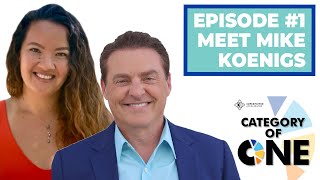
This content was created by Mike Koenigs. This content was uploaded by Mike Koenigs. This is a YouTube video titled "Category of One EP#1 - Welcome to the Category of One Podcast! Meet Mike Koenigs" created on June 22, 2021. It features a conversation between Marisa Brassfield and Mike Koenigs, discussing Mike's entrepreneurial journey, the concept of a 'category of one', and the process of reinvention and personal branding. The discussion includes insights into Mike's career, his experiences with business reinvention, and the strategies for creating a unique personal brand.
Chapters
Welcome to category of one, Episode one. I'm Marisa Brassfield from the Superpower Accelerator and today you're going to meet Mike Koenigs, founder of the Superpower Accelerator. It's hard to encapsulate Mike in a few sentences, so check out the full show notes for the full scoop. But here are a few highlights. He's a serial entrepreneur, super connector and prolific creator. He's built and sold five companies, two to publicly traded companies. He's a master of sales psychology, marketing strategy and product development. He's produced some of the largest and most lucrative marketing launches in online history and helped over 58,000 customers in 161 countries get noticed and productize their knowledge through his businesses. And he's also helped 1800 business owners become best selling authors. Tony Robbins says about Mike, he's an extraordinary man. He's brought me insights on how to reach people on the Internet that are so valuable. This is a man you should deal with, take advantage of what he has to offer. Mike, welcome.
Hey, thank you. So nice to see you.
Great to see you. And I'm super excited to interview you today because to my knowledge, you coined the phrase category of one. So can you explain what a category of one is for our listeners?
All right. Well, the best way to describe it is if you think of the word Elon, who I think is going to be the next trillion dollar brand. If you think of the word Oprah, Jay Z, Beyonce, you know exactly who they are the moment I say their words. If I say Elton, now they are musical individuals mostly. And of course, now we've got superstar business brands. I believe Elon will be the first trillion dollar personal brand. And when you are a strong personal brand and you can communicate a vision with clarity and confidence and courage and also that strong level of commitment, and those are the Dan Sullivan four C's. What ultimately happens is your value directly multiplies and amplifies the value of your business, of your products. And again, I'm going to go back to Elon. Elon Musk has never advertised at all. He's never spent a dollar on advertising. But look at what he's managed to do. He oscillates between the first and second.
Richest person on the planet right now. So here's what this ultimately means. I think anyone who can create a category of one for themselves, no matter what business, what industry, to be known for something. And I know we'll dive into this a little bit later, but you know, like one of our clients, this is Justin Donald. We Coined him the lifestyle investor and own Lifestyle investing. So both of those are trademarked. This became a book. It's a platform, it's a brand. And for Justin it means, first of all, he's already recognized he's built a considerable brand in under a year. But when you really, really think about this and go down just a little bit deeper, we are all one story, one connection away from whatever it is we want to accomplish. That could be speeding a sales cycle, selling your business, a new relationship to open a larger sales or marketing chann. And that also means attracting great teams if you want to build and scale a business. So whatever.
Transformation or a breakthrough you're looking for.
A category of 1 accelerates and amplifies that. And you can own an idea in someone's brain. It is, as Seth Godin says, an idea virus. So that was a big mouthful, I know, but that would be my version of the answer.
I love it. Thank you. And you know, when we're thinking about creating and crafting category of one brands with and for our clients, there are really six elements or amplifiers as you say to look for. Can you talk about those?
Yeah. Well, I think the first thing is.
What do you need to do to stand out, get attention, to attract high level prospects and then convert them into paying clients. That's really the nature of what a business needs to do. And you're creating value for the customer, you're creating value for your business brand and then your personal brand and of course for.
Everyone around you. And I always come back to the freedoms that Dan Sullivan talks about as well, which is the freedom of time, money, purpose and relationship. So with that in mind, here are the six. So the first one is getting attention. If you're not great at getting attention, you'll have no chance to have an opportunity to provide value to anyone. And then you've got to create trust and influence and you've got to get past the who the hell are you and why should I pay attention to you? Now that you have my attention, then you need to have authenticity. People can spot and feel a fraud in general, okay? Some people get along away with it for a long time. Bernie Madoff got away with it for a long time. There are presidents who have gotten away with it for a long time before they get caught. Right? So the key is you can't trigger distrust or come off as being manipulative, contrite or incongruent. Next, you need a platform. And a platform, if you think about it, is an audience. Whether it's an Audience of one or many. And you've got to find a way to become and remain top of mind to those people. And once you've got an audience around you and you're top of mind, it's easy to convert them into buyers. And then the last of these is scaling. So you want this to be consistent, replicable. You need it to be predictable. And I would also say that along the way, in the world we live in now, you've got to be constantly digitizing, virtualizing, dematerializing your business. But ultimately, if you combine all six of these amplifiers, it enables you to become competition proof and recession proof.
And that's the big thing here. One of your superpowers that I've observed is seeing others genius identifying where they are completely different from anyone else in their industry or even region. I remember for example, when we worked with Justin Donald and you just held up his book. There was a moment where he went from successful cash flow investor to the lifestyle investor. And then there was also Charlie Epstein where he went from 401k coach to the only financial advisor with a one man show. I've seen it happen again and again and again with each one of our clients. When did this skill and vision, frankly, start showing up in your life?
All right, now the truth is I've had this skill for a long time, but I was blind to it. So I think the first way I was able to express it is as a survival mechanism. In other words, I could be a chameleon. I could very quickly understand and recognize like a teacher's speech patterns and either mimic them or I'd find their weakness and be able to create discourse in classroom, for example. So I think it was my way because I wasn't the strongest kid or the biggest kid. My way of standing out is mimicry and pattern recognition. But the way it started getting expressed.
Was when I started Digital Cafe, the first agency and really my first real business. And what I was able to do is listen to a CEO. So we would be meeting with, let's say an executive from AT&T, for example, and I'd hear him say his story and I suddenly could tell his story but to a different audience. So you and I call it channeling when we're doing it together with clients. And then I think I just intuitively became pretty good as I started learning direct response marketing. I started doing videos, for example. Being able to enter into.
Someone'S head and being able to understand 60% of who they were, what they did, who they did it for, and Be able to communicate pretty competently. In other words, I'd learn the language of an industry or an individual, and then I'd learn how to think like their buyer. Now, I didn't know I was doing it. It was completely unconscious. And then I think a few years ago, when we started the Superpower accelerator, and there were times before it, but I started listening to people, and they'd be telling me all their business problems, and I'd ask them some questions about their business or industry, and I'd learn enough. I could ask enough questions, so I could basically fake it if I had to go to a trade show, you know, and then I'd ask about their perfect client, and for whatever reason, I would affect basically.
On the spot talk a script or a sales page or copy or content that was really accurate. They'd be like, holy crap. Now, unfortunately, it didn't get recorded or captured. And they'd say, can you do that again? I'm like, nope, it's gone. So now what we do is we do it together and we capture it all at once. But it is definitely a weird.
Unusual skill that I think is just a combination of 30 years of marketing experience combined with a book I bumped into recently that I've been digesting. It's called the Pattern Seekers. And the basic idea behind it. You and I haven't even had this conversation yet. But the author wrote this book, and he believes that it's actually autism and autistics who are responsible for creating the biggest developments in human history. In other words, the architects, the mathematicians, the astronomers, the scientists, they all have a certain type of autism. And the increase in autism that we at least are detecting. I don't think he's making the claim that it's just that now we notice it and we have a word for it, but it's the people who just can't help but see patterns. And the biggest pattern recognizer, like Thomas Edison, for example, he didn't read. He didn't speak until he was, I don't remember how old, but he was older. Einstein is another one, for example. And a lot of our geniuses of the day are on the quote, unquote spectrum. And as this author is saying, look, there's nothing wrong with it. It just means you're different and you're special.
So.
I don't think I'm on the spectrum necessarily. There are certain elements, but the net net is this author. His name is Simon Baron Cohen. The book, again, is the Pattern Seekers, and it's How Autism Drives Human Invention. And.
I had heard an extended version of this where this guy is making a claim right now that there are companies that are purposely hiring autistics, people on the spectrum, because autistics very typically will put their head down and focus for like five hours at a time. And then they'll get people who are dyslexic because they typically are better at language, listening and managing and, or manipulating people. And if you think about it, well, if a part of your brain doesn't quote unquote work, right, it'll work better in another place. So.
I think when you hear about a quant, a financial autistic, this just makes sense. And now businesses are recognizing this as a talent. And there are many Native American tribes who treated their crazy people with a tremendous amount of respect. And I think that there's something to all of this. So, boy, did I go down a rabbit hole here. But.
That'S.
My long version anyway.
Well, it's fascinating because these skills do show up early in life. As you were sharing about being a chameleon, I very much relate to that and my way of doing it. I was a very early reader and my dad had a recycling side hustle. And so he'd bring back all these interesting gadgets from studios and one of them was a cassette tape recorder that recorded in a little microphone. And I would just pretend to record radio shows at the time, you know, with, with made up. And I would pretend to be the, the guest and the interviewer because, you know, only child.
I did the same thing. That's so strange. We never talked about that before.
No, no, yeah, I did the same thing.
Yeah.
And that, that element of those companies seeking out and hiring people on the spectrum, it is, it's the programming and development world because that, that behavior, that single focus is so useful for development environments where one single. And you know, you've written code for video games for years, so, you know, one little comma can throw the whole thing out of, out of whack.
So how did you, how, how did you become an entrepreneur?
Well, I think part of that is.
Number one, I grew up lower middle class in a tiny town in Minnesota. Anyone who's heard my story before, there are 763 people in this little town. My dad was a barber. I'm the oldest of four kids. My dad grew up very poor. Both of my parents did. My dad grew up on a tiny farm and he was an exceptionally talented, do it yourselfer, fixer upper. And at any given time, so he had a barber shop. So he barbered nine hours a day. He's gone at seven, back at six every day. So it might be 10, sometimes 11 hours, and that's five days a week. He was also the city clerk of this little town, Eagle Lake. He was also the building inspector. And then he sharpened scissors and knives. And he also was exceptionally talented at building, constructing things. So I grew up with lots and lots of tools, so we didn't have money. That's how he made ends meet. And my dad never learned.
He wasn't a great marketer. He was a good word of mouth guy, never learned marketing and I think his own perception of self worth, just because he grew up a poor kid, never got past that. So he just didn't raise his prices.
Until towards the end. He barbered until he was 80.
And still I think charged maybe $14 for a haircut. It was unbelievable. So just imagine you do three haircuts an hour if you're on a roll and so you're doing 20, 30 a day and maybe making.
Five bucks a cut. It's just amazing. So the point of me telling that story is I saw how hard my dad worked. I mean, just worked his ass off for his entire life. Most disciplined guy, but never really got ahead. And.
Because he worked so much, we were late for almost everything.
Minnesota is cold as hell. Worst weather. I hate being cold.
So when people said, what do you want to be when you grow up? I'd say, I want to be rich, warm and first. So I started mowing lawns, shoveling, delivering papers when I was 8 years old, maybe 9 years old.
I always had a way of making money. And there was one gas station in town and one grocery store. The grocery store only hired adults. The guy who owned the gas station was on my paper route and he'd always ask me, how old are you? And I'd be like, well, I'm 12. He goes, when you turn 16, come and see me. So his name's Lee. And finally, the day I turned 16, I walked into the gas station. I said, I'm ready to start. And he goes, let's start today. So the day I turned 16, I started working full time. And right before that, I also taught myself how to code. So again, to make this long story short.
I always needed to make money. And I tried to find a way. And without knowing what the word was, I figured out that programming was the only way I was going to get the hell out of Eagle Lake, Minnesota. And my fantasy was to run away from home. I had a backpack packed in my Closet from the time I was probably 10 or 11 years old and my goal was to go work for Steve Jobs and Steve Wozniak. And I knew the only way I was going to get in there is I didn't know what engineering was. Again, I didn't have any mentorship to speak of. I was dumb about all these things. But I loved marketing. Even though I didn't know what it was, I loved to code. I figured, shoot, I'll just learn how to write video games and go work, move to Sunnyvale, California. And it wasn't until.
I was 18 years old, probably almost 19, that I dipped my toe in the ocean for the first time, actually got to California. So I mean, we vacationed in Minnesota. I never got to leave. And I felt completely isolated and trapped. So entrepreneurship was a mechanism for freedom.
And then from there it was I built businesses, et cetera. We can get into some of that. But it was a hard ride with a lot of hard lessons because again, I didn't have the know how, the access, the tools, and I didn't know how to ask good questions. I wasn't around successful entrepreneurs. So I really, really had to figure it all out myself.
And you today, I know you surround yourself with extraordinary mentors and we'll get to that a bit later. But I'm curious, how did you make your first million?
All right, here's what happened after Digital Cafe. I told you, it was my first real business. Before that, I wrote video games and I wrote code for a couple companies.
But I am an unemployable person. So.
That is the beauty of having a short attention span. But after selling Digital Cafe, I taught myself SEO and I learned about search engines. I was already doing the web. We were creating some of the very first websites at Digital Cafe back in 94. So we started doing electronic marketing with CompuServe, America Online, Prodigy, and some of the other really, really early, early systems. Delphi, for example, which is owned by the Murdoch family. They were actually a client, believe it or not.
James Murdoch, I got to meet him many years ago. That's another weird ass story. But here's what happened. Digital Cafe. Then I created a product called the Internet Infomercial Toolkit, which is how to sell with video online. I modeled television infomercials, created another product with a pretty famous person named Ariel Ford, who represented all the biggest personal development gurus in the world and was the gateway to getting them on Oprah. We created this product called Everything youg Should Know About Publishing, Promotion.
And Building a Platform, everything you should know. That's what we called it. So Next product, Traffic Geyser. Next product, Instant customer. But along the way we noticed something because these were automated tools that marketed.
With like push button marketing. And a bunch of our customers were making a lot of money and using our products like crazy. And they started. I wanted to shut them down. I'm like, you guys are stealing from us the machine cycles you're using alone. That was my attitude at first until I looked in their accounts. This is before privacy was an issue. Seem normal. Just see what your customers are doing. And I called them up and I'm like, you're really using a lot of our product. What are you doing? And they're like, oh, I've got a marketing agency. Really? So I start talking to them and ask them, what are you doing? And they showed me and they're like, your tool is putting food on our table. And a lot of these people are like hardworking, cash strapped kids like me who figured out a way to make a good living. But one of them was making millions of dollars using our tool to generate tons of SEO for his clients. He knew how to price. Okay. He knew how to package. Really, really fascinating dude.
So.
I asked a bunch of these customers if they'd do an event with me for our customers and teach what they were doing. And they were like, hell yeah, we'll do that. So they came out and they started teaching this. So first of all, I figured out leverage, which meant I got my customers to share their IP without me having to pay for it by giving them a platform, which is what everyone wants and needs. It's how do I get seen, how do I build visible success? And they saw me as the guru because I was the guy online. But really they were the secret to success.
And I saw all these patterns again, pattern seeking. And I'm like, holy cow, there's something here. And a friend of mine at the time was one of the best marketers in the world. He since passed. His name's Andy Jenkins. He was part of this whole collective group of other big online marketers. I was good friends with at the time, Time, Frank Kern, Mike Filsaime, Ryan Deiss.
And Perry Belcher. There were Jeff Johnson, Jeff Walker, some of the original guru dudes. And.
They said, you should make a big info product. So make a long story short, we created a product called Main Street Marketing Machines. And I'm getting to the million dollars. But it took a little backstory here. Bottom line, this was a tool that showed you how to create and start your own digital marketing agency and. And make your first $5,000 in a half a day or less. It was a hell of a promise, and it actually worked. So we packaged this up. Andy Jenkins, at the time, wrote our launch script. We built some great anticipation. Everyone in the online marketing world was signed up to promote this thing. And when we finally opened up the order page doing an online launch.
I got a call from my bookkeeper, the guy who ran our business at the time. And we were 43 minutes into.
The launch, and he just said, we just broke a million dollars. And I was driving at the time, and it was a brand new iPhone. It's like 2007 right after it came out. And I started crying. I mean, I was sobbing, like heaving sobs because it was the first time I. Even though it was a big. We made a million dollars, but it happened because of all this. What I was experiencing was just the pain of 15 years of entrepreneurship finally happening. So I pick up my little iPhone and I call my mom and I'm like, hey, mom. She goes, what is it, honey? I go, you know how I've always talked about how I want to be rich someday and I want to make a million dollars? She goes, uh huh huh. I go, well, we just did it in 43 minutes. And my mom goes, that's great, honey. Do you want to tell your dad? And I'm like, yeah, sure. So my mom has this very interesting character. She'd open up. I could hear the screen door go, you know, there's a big old spring on the screen. So I could hear the. I mean, I grew up my whole life hearing the. She opens it up, she goes, bernie, Mike's on the phone. And it was like November. And my mom's like, well, the grandkids are on their way over. We're going to have lunch today.
You know, and it's like she couldn't give a crap about money or anything like that. My dad gets on the phone and he's like, what is it, son? Hey, dad.
Got great news. We just made a million dollars in 43 minutes. And he's like, that's great, son. When are you coming home? That was basically. That's the extent of it. So then.
What happened next was we're just, blah, blah, blah, blah, blah. And I could hear my sister come over with the kids, and da, da, da. They're shuffling around, stomping their feet because there's snow.
Blah, blah, blah, blah, blah, blah, blah, blah. Oh, yeah, Ellen, Mike just made a million Dollars. She goes, wow, that's great. You know, it's like no one in my family just, they just, they don't care about money, they're about family. Which I should have figured that out a long time ago. You know, you get what you focus on. But what happened next, it was an hour and 14 minutes later, I get another text from Travis the bookkeeper, and we hit $2 million. And I go, we just hit $2 million. And what ended up happening is over the course of the week, $9 million in sales, including, we did a live broadcast that we went on the air for 14 hours, where I just brought in customers, had them tell their story about how they're using our tool and our system. Because we had done a little pre launch and let different people use it before we officially launched it. And they just came on and talked about how they made their first 100,000. They made their first $10,000 in a day. And there were unbelievable stories. And we had bank accounts, we had proof that this thing worked. And on one of the days, we earned $3.1 million in sales. So again, it's a long winded story, but it was filled with.
A lot of personal drama that was unnecessary, I think, to get there.
Well, it's so interesting in there. There's also the theme of an overnight success or a few days success, or a few hours success after decades of hard work. And that is the entrepreneurial journey for so many people that we meet and talk to.
Yeah, when you finally get out of your own way, you see the real patterns and what is necessary for success. And.
We definitely have a tendency to make it a lot more complicated than it needs to be. And I think the nature of being an entrepreneur is I have to go it alone or I'm alone. Because most entrepreneurs I know come from a place of a certain amount of self reliance, poverty or lack of mentorship.
Messed up value system that they're born into, but they inherently don't have. And they feel isolated and alone. That's a very common theme. And of course, when you have that gene, I think entrepreneurship to some degree is genetic.
And everyone and no one really understands your brain. They're like, why don't you just get a job? It'd be a lot easier. And then you can blah, blah, blah. But it's like, this is, I die. If I had to have a job. I mean, like I said in the beginning, I am completely unemployable. I'm pretty much formally uneducatable as well.
I did not do well, in school.
Because there was no doing and I didn't respect my teachers because I didn't see them as practical doers. And that's something that I'll say. I always loved and respected my dad for his exceptional resilience and discipline and resourcefulness. It's just unmatched to this day.
Yeah. And there's something else that I've learned from you and observed and that's come up again and again with clients. And it's the theme of reinvention. It's a significant theme. And it's also, incidentally, how you and I got back into each other's orbit after I stopped working with Peter Diamandis. Can you tell us about some of the biggest reinventions that you've experienced personally, professionally, and often both?
Yeah, I think with every business I've had, there's been a pretty significant reinvention. So here's what, I'll go through them shortly. Because there are little markers, there's little indicators along the way. And more importantly, I see this in so many entrepreneurs. And when an entrepreneur goes through their cycles, when they don't honor and respect the dark night of the soul right before a necessary reinvention, it's when I oftentimes see them bury themselves into addiction. Alcohol, drugs, failed relationships. And I think reinvention is a cycle. It's like an astrological cycle happening inside of you. You are the universe. The universe is in you. It's inside, it's outside. There's a fractal nature of, of this. And so having said that.
The first one I really noticed and knew was after Digital Cafe, which was an agency, my business partner and I had it for 10 years and it was really hard. Now the good news is we worked with Sony and 20th Century Fox. We worked on some of the very first websites, we produced a video game that shipped in 6 million boxes of cereal. We got tons of media and attention and we were really unique. Truly one of the first digital marketing agencies in the world. And that was awesome. And it also led us to selling it to a billion dollar a year agency called Campbell Methune. They're Minneapolis based and then they were owned by the Inter Public Group. So we went through double due diligence and were bought by a publicly traded company. All that's great. But by the time it was done, what I left out was that business cost me my first marriage. I got fat, I started drinking, I went through all sorts of just hell where we were at my worst, I was carrying around $250,000 personally in debt. I was buying groceries on a gas card at Super America in St. Paul and just horrible pain, mental anguish.
And I was creating the illusion of success beneath terror and sorrow and sadness and a fear of losing my dignity. And again, I didn't know at the time that's what all entrepreneurs went to. So when we finally sold it, I just needed a break. But I had committed to making a feature film with my business partner. Again, sounds beautiful and sexy, but I just needed to be off for a while.
And making that movie was really, really hard. It was challenging because we did it the Hollywood way, which meant we had to deal with unions. And like, it was horrible. It was horrible. Again, sexy on the outside. It was a poop sandwich.
And when the movie was finally released.
It happened like a week before 9 11, which decimated the indie feature market. We eventually sold it to Warner Brothers. But here's the bottom line. Over the course of that, I had a spiritual awakening during the dark night of it. I started following Tony Robbins, Deepak Chopra and Wayne Dy Neale, Donald Walsh, all the big gurus. And I went on a trip to Egypt with Deepak Chopra and Wayne Dyer, which was unbelievable. And that's where I met Ariel Ford in Egypt, who became my business partner years later because I reconnected through the woman who became my wife. So it's a weird ass story, but I'd say my first big reinvention came with a dark night of the soul and a spiritual awakening where I found.
Spirituality in a way that felt true and real to me. I was raised a Catholic and I went to Catholic school and I hated it. It did not resonate at all. I never considered myself a Catholic. So I'd say having my first big win, the spiritual awakening and also the anguish of losing a wife and the humiliation that went with it.
So the next one then was.
The million dollar experience and then being able to replicate it because we did nine multimillion dollar launches, gaining the courage and the confidence and the belief and know how that I could do it again and again. That was a major win. And then you fast forward a little bit. It was cancer. Cancer almost killed me. Coming back from that and a new level of awareness and reinvention and then.
The last major one and there have been probably seven biggies. But it's when again, a new dark night of the soul. And after being an entrepreneur for 30 years and the wins and the failures and the fear, I was chemically depressed and I wanted to die. Even though everything on the surface should have been great. And it was God banging on the chamber walls saying, it is time for you to grow up and quit screwing around.
And.
The way I describe it is when I realized that I had outgrown who I was, what I did, why I did it, who I did it for. And I suddenly saw a lot of business owners in the same state. On the surface, wealthy, successful, might have a nice family and kids. They have it all. And on the inside they're like, I feel shallow, I feel broken. And this everything I'm doing or I'm grateful for what's happened, but I don't feel true to me any longer. And they feel trapped and they don't have anyone to talk to about that. And so I think getting through that and getting on the other side and doing the reinvention, which frankly became the superpower accelerator and reconnecting with you was the last really, really big one. There have been some sub, you know, micro ones along the way, but not with the same level of force and energy.
That's so beautiful. And these experience, they bring such a depth and breadth of wisdom into the work that we do with superpower accelerator clients. And we take people through a process over several days that consistently works to help them reinvent and create category of one brands. As we wrap here, can you tell us about the six accelerators?
Yes, I can.
So I think you would totally agree with me if I said to you, Marisa, what are the mindsets that. So the first one is mindset, but there's a special kind of mindset when we know someone is ready to be accelerated and to have their superpowers recognized, acknowledged.
You know, we can play a little ping pong game here. So if I said, what are some of the mindsets that we find are consistently in the right fit? People who are ready to.
Reinvent.
Amplify, multiply who they are, what they do, why they do it, who they do it for, what are some of the things that pop out for you? And then I'll tell you my version.
Well, they're definitely growth oriented. They invest in themselves and their development. They're ambitious in that way. They believe that their best and biggest futures are ahead of them. That's for sure. One.
Yep. Yeah. Another one through my lens is they are freedom focused. So they have realized that the reason why they got into business in the first place. And again, I'm going to borrow from Dan Sullivan's language files here. It's freedom of time, money, purpose, and relationship. Those are certainly some of the biggies. But also.
They'Re at a point where they're looking for a personal reinvention. They know what being packaged and positioned can mean is again, they have some sort of a moment where either they wrote a book, they want to write a book, they have a podcast, or they want to start a podcast. Somehow they've got a message inside them and.
They want to make bigger impact. And they may feel as though in their current business, it's constraining, but they know if they got this working, it would elevate and amplify the business. So it's like this symbiotic relationship between injecting their DNA, knowing that they want to create value with their business, maybe leave it behind or make it a legacy or exit completely, but know that it's going to continue to work. It could be their retirement fund. Right. When they sell it. But the mindset is they value good advice. They probably belong to one or multiple masterminds or business groups or business coaching. They consistently have been investing in themselves. But that, I'd say is number one mindset.
Yeah, that's great. Next one is market.
Okay. And this one is who do you want to be a hero to? What we do at the Superpower accelerator is.
I always begin, and I say, not only who do you want to be a hero to, but tell me a story about the best client or customer you've ever had. Who are they? What's their name? How many kids do they have? What are their beliefs? What influences and motivates them? What do they love? What do they hate?
And here's why. When you get to know the one and you really do love the one and create the right fit stories for them, more like them will appear. I really do believe in the manifestation model of marketing, and everything is dependent upon the stories you tell, both yourself and the outside world as the character. Right. As that reinvented character, as the messenger, as you could say. So again, it's the who is the next most important thing after your own mindset.
I've even heard you ask for dog, like the breed of dog that they own, the types of charities that a client might contribute to. And it's amazing to uncover some of the data gathering that our clients are not doing. Sometimes they do a great job and they have really great rapport and relationship building, but sometimes that's a big area of exposure in their business.
Yep, absolutely. So.
That moves us to the next one, which is step three is the model, which is how you make money. And what we always do is we look at every product or service. And sometimes we just gotta kill one of them. But more importantly, we like to know if we know how to inhabit the brain of your idealized customer, we can craft a new product or service that speaks to them, an offer that's two to 10 times or even higher for that idealized client. And then we also look at and find ways to generate recurring income or turn your IP into new products, much like what we're doing with Decostin and Dakota right now. So step three is model.
And then we've got step four, which is message. And it's all about the Civitas moment, which I learned from you and Dan Sullivan.
Yes. So that is we call it the one word offer. And the best way of positioning is what are the fewest number of words that your ideal prospect needs to hear before they raise their hand and say, I've been looking for someone just like you. When can we start working together? I know you can help me. Where you grab their attention, you build trust, you influence them, cause them everything to happen in the amplifier section that we talked, the six amplifiers. And that's where you have that perfect moment. Of course, you have to deliver that in a way that they will find you and hear you, which is step five. And that's the media. So we always say, what do your perfect customers consume and trust? Do they watch videos? Do they go on social media? Do they listen to audiobooks? Do they listen to podcasts? Do they watch tv? Do they read hardcover, paperback, Kindle books? Do they like magazines or blogs? Do they like live or online events? Do they like quizzes or tests? This is really appealing to, first of all, how they gather data. In other words, are they a quick start or a fact finder? All of these things will determine where we're going to put the message and sometimes many messages. So, Justin Donald, we had the book, the audiobook, he's got a podcast now. We got him on a whole bunch of podcasts. We put him in Entrepreneur magazine. We called him the Warren Buffet of.
Investing.
So the bottom line is, how does your perfect customer consume content?
That's perfect. It's the right message, right person, right place all at once. Well, Mike, thank you so much. I love working with you. I love how your brain works. I love how you help people make a bigger impact. Thank you for your time today and I'm really excited to continue working with you and supercharging some more clients.
Absolutely. Thanks for the opportunity, for sure. And I love what you're doing with the new show. It is fun to watch. And you deserve this opportunity, too, just to really shine like the superstar you are.
Thank you so much. All right, see ya.
Bye. Bye.
Sam.
More from Mike


The 3x3 Framework That Changes How Entrepreneurs Think | Mike Koenigs & Dan Sullivan








Why Your Business Gets Harder As It Grows | Michael Walsh on the Hidden Danger Zones of Scale
