Coming Up For Air With Nick Sonnenberg - Stop Drowning in Work | Capability Amplifier EP#137
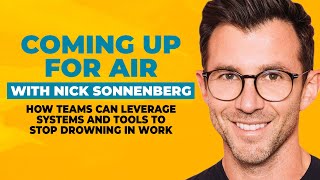
Nick Sonnenberg shares how his company lost 40% revenue when a cofounder left, prompting him to build a framework called CPR to help teams work more efficiently. He covers email management with Inbox Zero, documentation systems with assigned owners, and using AI bots for routine tasks. Small time savings of 3-5 hours per week per person compound across a team.
Chapters
You know, email for most people really is a source of stress, anxiety, time suck, you know, missed opportunities. Like, I can guarantee you listening right now, if you're not at Inbox Zero, there's money sitting hidden and just lost in your inbox.
The hardest is always, how am I going to get my teams to use this? How am I going to pass this on to my employees and be able to apply it in the organization efficiently without you having to babysit everything?
Ultimately, when I pass away, I want to be known for giving back millions of hours of people's time so that people can work on the best work of their life. Stuff that gives them joy and taps into their unique ability. And that's why you should buy my book, because it'll help you do that.
Welcome to the Capability Amplifier Podcast. This is Mike Koenigs and I have a special guest with me today. His name is Nick Sonnenberg. He's the founder of getleverage.com and author of the new book Come up for Air How Teams Can Leverage Systems and Tools to Stop Drowning in Work. And that's exactly what he does. Now, I've known nick for over 10 years. We mentor each other. And Nick is not only one of the smartest people I know, his heart matches the size of his iq. And this book, by the way, has been praised by Tony Robbins for cracking the code on operational efficiency. Good job on that, Nick. So in the book. Yeah, you got it. First of all, one of the things that Nick does is he and his teams have all sorts of tools, strategies, systems that help them optimize and automate their own work processes, but they actually bring that to their clients as well. And he's worked with some big, big companies like Asana and Facebook and others. So what Nick's going to do today, I think is cover some of his operational efficiency strategies, latest in tools, technologies, and if it's okay with you, Nick, I want to talk a little bit about AI and how you think that's going to affect your world and the world of all the clients you've been working with. So let's start with, why did you decide to write this book? That's always a good, good place to begin. And what are the biggest pains that you see over and over again in the smaller and mid size and large organizations you've been serving.
Well, first of all, Mike, it's an honor to be here and I just always just love having you as a friend and someone to be a mental sparring partner. So I've been excited to Be on, on your show in particular.
I wrote the book because I firsthand have experienced what it's like to drown in work and all the pain of running a company and a team. And kind of my little backstory was early on we were a totally different business model at Leverage. We were a freelancer marketplace. And kind of the way my story goes is one day I was having coffee with my business partner and he tapped me on the shoulder and he said he's out. And not in two weeks or two days, but he's out in two minutes.
A lot of people listening right now probably have had their horror story with a business partner that left or a key team member that left. And then you're like, holy crap, you know, this thing's a mess. Well, so we've all had that story and I'm not special. My mess though was we had grown very quickly. We were fully remote. We hit seven figures in the first year, 150 contractors. And a lot of people get impressed with that. But you know, when your business partner leaves in the way that you ran the company was he was the people facing person, you were the non people facing person. That's your org chart. It turns out there's issues with that. So I went through a lot of pain on the back end of that. For example, we lost 40% of revenue in three months. I cashed out my 401k. My dad's taking a second mortgage on a house to loan money for payroll, bank accounts frozen and you know, so on and so forth. We owed a lot of debt. We were losing half a million a year in profit. And so I had to decide do I want to bankrupt this thing or, you know, is there a path to turning this around? At night a lot of people thought we should just shut it down. And I ultimately I saw a path to cleaning this up. And after late nights seven days a week for a long time, I started slowly but surely cleaning things up and started with the foundations. We got over our skis, we scaled too quickly and we kind of neglected some foundational elements that I started acknowledging and started putting into practice almost too late. But we turned it around so it wasn't too late. But we were close. And so I started realizing all the different aspects. We were inefficient, all the complexity. I mean, me and you talk all the time how much easier it is to run a small team, right? Running a 150 person team after 18 months or so and you don't have all the systems and processes to support it. It's a cluster. And so ultimately I know firsthand what it's like to be drowning in work, quite literally. And that kind of set off this journey for me to create a framework that ultimately was for me to survive and not drown. And then people like you mentioned in the intro started reaching out, asking me to help. So Tony and other people started reaching out. And so I was running Leverage, this freelancer marketplace. And then I had a side consulting business where I was consulting them on their operations. And over time I just saw the aha kind of happened where I realized everyone's struggling in the same way is the same stuff that helped turn Leverage around all these other businesses found helpful. There's all these new tools available like Slack and Asana, and a bunch of tools no one's ever been taught how to best use these to get your team and organization efficient. And so over time we shifted the business model of Leverage to be training and consulting people in all this. And over time I've worked with thousands of teams, seven figure financial advisors, up to some of the big companies you mentioned and everyone had the same issues. And there was these three buckets that they struggled in. How you communicate with your team and clients, how you plan, how you manage tasks and projects, and then all of your resources, your digital ip.
That framework, cpr, Communicate, Plan Resource, has become the signature framework that we're consulting and training teams on and training how to use Asana, training how to get to Inbox zero, training how to use Slack. And ultimately I decided to write a book. My long winded answer to your question, I decided to write the book because ultimately everyone was struggling in the same way. So I felt the best way to make an impact and ultimately to try to get the message out to millions of people so that they don't also drown in work was to write a book. And so here we are and Harper Collins is my publisher and excited that we're launching.
In a few days.
Yeah, well, first of all, I've watched from behind the scenes and writing a book is incredibly difficult. What you've gone through is amazingly painful and it's necessary. It's like if writing a great book was easy, everyone would do it.
So your advice was very helpful. Like I started this book four years ago and you know, kind of a lot of our conversations and you know, all your experience with launching books and promoting books and you know, should you go self published or not self published and all that, it was very helpful. So I just wanted to say thank you for all of your advice and support through this journey.
You got it. You got it. Well, it's. I have a lot of pathos for you, my friend. You know, these past few months have just been hellacious. And at the end of the day, I think what you've got going on is awesome. Just the fact that you've got a lot of support, a lot of big businesses wanting to see you succeed and you went with a, you know, a traditional publisher, which there's, there's some real advantages to that, at least for you. So let's get into.
So I was never expecting it, but, you know, it kind of fell on my lap and I was like, okay, wasn't expecting this, but this makes sense.
Yeah, no, it's. It's good. So. So.
Let'S get into some nitty gritty and I want to ask you some questions that probably don't get asked all the time. Some of them are purely selfish because this is one of our sparring items. So, for example, I have a small business right now, team of about 10 people, and I have other people running all the project management stuff. I'm not an inbox zero kind of guy. Like, I'm super selective. For me, it's always been my file drawer and I like being able to access everything. I never delete anything because I can go back years and years and years. And I have my assistant do all the front end, so she monitors all that. And one of the things that still happens, though it is.
Is she will miss what I would consider some really important messages that come in, like requesting.
A meeting. And it's just because there's a certain level of overwhelm. And right now, for founder owners who do what I do.
Do you have any good recommendations for auto tagging and smart finding messages, creating notifications, tagging them? There's a bunch of tools out right now that actually write AI replies and responses. So I know I'm putting you on the spot, but I figured I might as well ask you a hard question.
No, this is great. Well, look, we train teams on all the collaboration tools that any modern team would need, right? So that could be Gmail and Outlook teams and Slack, Asana, so on and so forth. Probably the number and different. Every team is unique, but also not unique in the sense, you know, yeah, you've got, you know, maybe you have a constraint because you're in the health space and you're HIPAA compliant, or maybe some people are not tech savvy or some. Maybe tech savvy, et cetera. But at the end of the Day one pattern that I found is.
A big thing is Nick, where should we start? And another big thing is, hey, what's the best tool for this? I think people get distracted with shiny object syndrome with a lot of these things. So one of the most logical places to start with becoming more efficient is with email. When you think about it, not every team out there is using Slack or Asana or all these tools, but every single business, if you're listening right now, you either use Gmail or Outlo for your email. And the real benefit with starting with email is.
It'S, wait, hold on, let me shut that over. And the real benefit of dealing with email is as opposed to these other tools that are collaborative tools, meaning you only get value if other people are using them. Right? Email is a single user tool. So even if the rest of your team is slow to adopt kind of the new program of how to learn and think about and use these tools, if you just adopt the Inbox Zero methodology that we teach you, regardless of where the rest of your team are, you will get benefit. So usually email, which is what we're talking about here, is a great place to start. And depending on volume, we've seen on average three to five hours a week that you can get back if you manage email right. And it's not just the time savings. You know, email for most people really is a source of stress, anxiety, time suck, missed opportunities. I can guarantee you listening right now, if you're not at Inbox zero, there's money sitting hidden and just lost in your inbox. And that sucks because you probably spent a lot of time to generate whatever that opportunity is that just completely is getting lost and missed because of a bad system. So I'm just trying to set the the baseline here. Email management is really important. What we talk about in the book and what we teach in our trainings is a acronym called rad Reply, Archive and Defer. And so I'll just kind of go two minute rambling on email and hopefully it addresses your question. But you have to first understand when to use email and what email is. So email is an external communication tool that is basically a to do list that other people can add to.
Yep, totally.
And just like you want to knock off your to do list, you want to Inbox zero. A couple common misconceptions with email, people are deleting emails when they don't need to. You should just basically have your inbox and then you should archive the stuff you don't need. That way it's still searchable Most people are spending an extra few seconds deleting things. Should I delete this? Not delete this? Forget about deleting anything. You have so much cloud storage, you don't need to worry about it. You have an archive button and those emails are still able to be found in your all mail. And so basically you just have now, which is your inbox. And then you've got not now, which is all the other stuff in your all mail that's been archived plus your inbox. All right, so that's the first thing people are using their inbox, like their archive. And you need to create that separation of now, not now. Then most people aren't utilizing search. So typically, like if you needed to find an email from me, it's faster for you to just type in my name in the search bar, you know, from Nick Sonnenberg. Then a lot of people are creating a million folders with some complex tagging and foldering system. And at the end of the day, the whole purpose of those folders is to be able to find something you're looking for quickly. And 9 out of 10 times it's faster for you to find that thing utilizing the search bar than crazy tagging and foldering systems. And then the last thing that people aren't utilizing is snoozing. So if you're using Gmail, it's built in, it's a little clock icon. And snoozing is the defer part of rad. So the snoozing is, you know, you got an email right now, you don't need to deal with it right now. Fridays are your admin days, push it out to Friday or you're writing to a client or a lead. And if you don't hear back from them in a week, you want it to come back to the top of your inbox. But if they do reply in three days, you want it to deactivate the snooze and come back in three days. And so my long, again, my long winded answer to your question is if you just follow rad and every email you either reply, you archive or you snooze it. Defer, you don't have too many folders and you know how to utilize search. And if you're using Gmail, you enable kind of the, the machine learning that they've done on those different tabs like the promotions, the social, the updates, which kind of auto filter stuff and can kind of learn and adapt over time. I don't think you need any additional plugin or fancy Tagging system. Like I'm getting hundreds of emails a day. I don't have an assistant in my inbox.
I give people different email addresses depending on who they are so that it doesn't even hit my inbox. Right. So I do believe in like shared inboxes. Like we use HubSpot, which is a CRM that has a shared inbox functionality. But you know, I've got hello@getleverage, which is for marketing and sales purposes and I've got a whole bunch of other email addresses. So depending on the context, I'm not giving out my email to a whole lot of people, I'm pointing them in other directions and then I manage my inbox.
At some point I might experiment. I've tried having eas, but honestly, the auto filtering that Gmail or even Outlook does with focused inbox, it's pretty good. And if you do the RAD on stuff, I don't know, I find it really difficult. I think VAs and EAs are really helpful. But I do think that if you follow the inbox 0 principles, I think that you're probably going to get more of a return on investment with an ea. Having them do other activities and you just get back in your inbox. You manage your inbox. But I do know that that's not a popular recommendation. People just hate email so much that they want to just get it off their plate.
Yeah, I think what I've found for me is I.
For the most part, I go in and I skim real fast. I look for big hits. She does star stuff. That's important. And then we do occasional reviews. What I've, I've actually trained people I know. I'm like, look, if it's, I'll check email. When I do, if you want me, text me. And if you don't have my text, you're probably not important enough to be a real relationship. I mean, and that's, that's like, it sounds harsh, but it, it's just how I've organized it. But you know, it does. That's not how you build a Fortune 500 company either, so. Well, yeah, go ahead.
I know a lot of people that like, that's common and a lot of people like that. I personally, I personally hate the text as a solution because if text had the snoozing feature. So in rad, if you could defer a text, then I would completely change how my approach to answering this question or talking about this. But I think deferring is such a, it's not Utilized enough and it's so powerful. And so there's so many messages that come in that I want to remember to get back to that person in a week or in a month or in three months. Right. And so with a text you start like marking things on red and pinning it. And if you're getting hundreds of text messages, it's. I find that even more likely to slip through the cracks, at least with me.
Okay. Yeah, it's interesting. And to this day there still isn't, you know, the nature of imessage, for example. There isn't. They're not going to allow us to automate anything just because it's subject to shenanigans. Well, let's, let's switch gears a little bit. And I want to ask you, when you look at the big heavy stuff that you've been paid to deal with in the larger firms, the Asanas, the Facebooks, etc.
What is the highest perceived pain that the C suite has that you see reflected downstream into, you know, professional, let's say professional services, B2B businesses. So we'll call it the, you know, five to 50 person companies.
You know, I think what I found that's interesting is everyone's got very similar needs right now. Right now with like some of the bigger companies, especially tech companies, valuations have gone hammered. We're going through basically a recession. So there's hiring freezes, there's layoffs and so on that side of the market, what I'm seeing is.
They have resource constraints on the human capital side and their expectations and goals are bigger than they were previously. So it's like, how the hell are you going to achieve these bigger goals with fewer resources? And then my pitch is obviously, well, the only way you need to increase your capacity, there's three ways. One, you hire more people. Well, if you're in that bucket, you probably can't because of these constraints. Not to mention hiring people is the most expensive approach. You got to pay for recruiting, onboarding, training, plus all the extra complexity involved with adding an additional person. The second thing is they might try to ask everyone just to work harder. That's not a long term solution. People will burn out. And then the third is my pitch. It's like, well, you gotta achieve all these lofty goals with fewer people. Well, we gotta make them more efficient. And so. But ultimately, you know, I think everyone just needs to get more done with less. And that's kind of what big companies and smaller companies are thinking about. I think.
The whole remote thing and getting set up for remote. The stuff that we're talking about, whether you're remote or co located, you want to be efficient regardless. And there's new tools available in the last 10 years that can really help you be more efficient. So I think there was during the pandemic a lot of talk around, oh, help me get set up for hybrid or help us get set up for remote.
Yep.
Now I think that's less what we're hearing now. It's much more just, we just need to get more crap done and we can't hire more people. Help us.
Got it. So let's, let's switch gears a little bit and this, you know, the times are moving. I've spent a ton of time over the past few months really digging into all the latest in AI tools. I'm curious what your perspective is on.
Using AI. There are literally dozens of new tools are coming out every week right now and that in itself is overwhelming. But what, what are your recommendations? What are you seeing personally and where, where do you see AI tools being the most useful and helpful?
I think that we're, we're still really early days and I think that there's a lot of hype, but I think it is, I think it's justified hype because I think what has happened, which is interesting because look, my background, I used to be a high frequency trader and so my background's in machine learning and all of these different mathematical techniques. I think that the public has heard the term AI and it's kind of been this big mysterious word that people didn't understand. And I think the biggest thing that we're saying is it's because it's creating a lot more awareness and excitement around AI that I think is going to propel the movement to the next phase. I do think that there's some direct benefits people can get, take advantage of right now. And I know me and you have brainstormed it with, you know, creating content and copywriting and things like that. But I think that that's just scratching the surface. You know, I, I envision.
Well one, I'm already starting to see that employee IDs and HRIS systems, you'll start seeing bots with employee ID that's just treated like an employee inside of a company. Just like Nick Sonnenberg is employee number four, ChatGPT bot is employee number six or something. Right.
But I think, look, part of what we talk about is efficiency and documenting your knowledge. Right. And having like these digital knowledge bases. So you can imagine you could apply AI on Top of that, and start having employees talking to bots, asking them for help or questions, and the bot could look up answers, or look up in your knowledge base and answer the question to a reasonable degree of accuracy and start training that bot according to your core. Imagine if you loaded up a bot with your core values, all of the knowledge in your knowledge base, every response you've ever responded to an employee or a client, and now instead of bothering your manager, you've got a bot that's basically free that could actually inform you even better. Right. That's just one. You probably have bots starting to complete tasks and complete projects.
Do status updates on projects. So I think, you know, or we were talking about email. You could probably have bots better responding to emails than most EAs or maybe even yourself. So I think, I think that we're not there yet. But, you know, I could imagine in the next handful of years that that could be a world that we start living in. So I don't think it's an either or. I still feel strongly that AI is a tool. It's a tool to help you get more done, be more efficient, et cetera. Just like the stuff in my book is a framework and a tool to help you be more efficient. So.
I think that with anything, you have to recognize that what the purpose is and the hardest part with these things is really understanding what you can do with it and what problems you can solve. Right, for sure.
Well, I think just listening to you right now.
Getting back to the book. So there are fundamental principles in here that are going to work no matter what. Right. And thinking about how, what you focus on, what's going to have the highest value and applying that inside your organization, but also training your teams to think properly.
Yeah.
And you know, as you're talking about that, I'm going to get off on a tiny tangent here, but I think it's relevant. What I've seen are a couple plugins right now that work with Gmail that will go through your email and then it will actually write drafts and then you review your draft items and click and send the ones that you like or tweak them real fast. So it actually does a chunk of that. I don't know to what degree it learns for real. And I talked to the product manager for a company called Personal AI last week.
And what do they do?
What you can do is upload all your videos, all your content. Soon it's going to connect to your Google Docs and I would imagine Microsoft's OneDrive and it'll learn to be you. So it'll learn your voice, and then you can use it as a smart knowledge base or chatbot that you can either keep it private, just it's your bot to help you think better. And it'll remember, you know, it'll. It'll call back anything that you may have worked on. But then you could make it available to your team, or you could make it available to the outside world.
That's cool.
It's pretty interesting.
Is the back end. Is the. Is it powered by OpenAI?
They are. They're using a variety of hybrids, so it's not just one thing. And I spent just enough time to really figure out how to use it and how to onboard my own stuff until I can import all of my Google Docs. It has limited value to me because training it for me is just going to take too much time because I can basically upload all my videos and I don't know how well it discerns what's mine and what's someone else's. So knowing my voice, literally and figuratively.
Yeah.
So that's.
I'm gonna start playing with it. But again, I've just got my. My hands dirty. So I think going along with what you're saying.
It'S a matter of prioritization and.
Getting your employees to think about this properly. Which. Which leads me to the next big question. I want you to sell me your book. Okay, so I'm a founder. Why should I buy the book? What am I going to get into it? What can I expect to receive in terms of my roi? Because you talk a lot about how many minutes, how many hours you can get back by getting to inbox. Zero. But, you know, pitch us on the biggest benefits here.
I feel like it's like in Wolf of Wall street where they hand over the pen and it's like, sell me this.
Sell me the pen.
Um, before answering that, just to. Just to talk for a second about the AI thing, for just to close that loop. It's funny that you showed me that, because I pitched Jay Abraham, who I know we're both very close with.
Mm.
I pitched him years ago that because he does these Q and A things where people pay him a monthly fee, and then, like, people submit questions. I was like, let's take all the transcription of every Q and A that you've ever done, see how you've answered them. And the tool that you're showing me looks cool. I was going to go and build it. Build something. I'm like, let's create a jbot with understanding how you've answered the hundreds of thousands of questions. And then we have a jbot that can live beyond you living and can ask any question and get a J response. So that tool that you just showed is pretty cool. And also the common bridge, again, between AI and all the stuff that I'm talking about. At the end of the day, I want employees and teams and entrepreneurs to work on things that give them joy or tap into their unique ability. And I know we're both in coach and you're very close with Dan. Ultimately, if it's not giving you joy or tapping into your unique ability, how do we find a way to get it off your plate? Maybe it's being more efficient and using tools better. Maybe it's a who. And maybe AI is just a version of a who. Just like an EA or a VA is a version of a who. But whatever it is.
Imagine a world where all the people at work are working on things that give them joy or what they're uniquely gifted at, and everything else is somehow magically off their plate. What would the world look like? There's. And so the stuff that I'm passionate about with the book, and this is kind of a preamble to pitching the book, but ultimately, when I pass away, I want to be known for giving back millions of hours of people's time so that people can work on the best work of their life. Stuff that gives them joy and taps into their unique ability. And that's why you should buy my book, because it'll help you do that.
That's a good, solid pitch. Good, solid pitch. So talk a little bit about some of the resources that you include as well, because you've got a bunch of reasons why you put together a killer bonus package. In fact, one that's a million dollars. You're the first person I know who did that.
Yeah, we only sold three, but I can't complain. No.
So look, another thing about the book that's unique and when you look at the space of books in the productivity space, you've got Getting Things Done, which is decades old, and you got four Hour Work Week. And you could probably consider Cal Newport's book Deep Work, but there hasn't been anything in the last decade that's a significant productivity book. All of these books that I'm mentioning are all individual productivity books. There really hasn't been anything around how an organization could be productive or how a team can be productive. And individual productivity, it's necessary, but it's not sufficient for a team or an organization to be productive. It requires collaboration, coordination. People have to sometimes sacrifice their own productivity for the greater good of the team. And so my intention with this book is to really be foundational material that in decades to come, people still refer to this book as the go to guide for how any organization could be high performing and efficient. And there's a whole new way of working that people are starting to realize. There's, like I mentioned, you've got all these new tools. My book is really not specific to any particular tool. It's really about the theory and how to think about these things. And so it doesn't matter if any of the tools that I mentioned go bankrupt. As long as you understand when and how to think about them, you're still going to get the benefit. So if you go to comeupfor air.com We've created a page with additional information, free resources, bonus content. The book was already 320 pages long and not fluffy. It's not like, it's not like something like a blog that you could have summarized in five pages and then, you know, 20 stories around it. It's already very dense, but we didn't want it to be any longer. So there's, throughout the whole book we're like, look, if you want to go deeper, if you want to see the step by step playbook for this specific Strategy, go to comeupfair.com, download the, you know, download the free resource. So we've got on comeupfair.com a bunch of additional resources. It's probably another, I don't know, 100, 200 pages of bonus content there.
And then we have also a page for teams for different packages. And on that page we've got special bonuses where you get the books, but you also get discounted access bundled into these packages for some of our other programs. So probably the number one program that we do at Leverage is Inbox Zero training. You know, if you did nothing else but learned how to deal with email properly, it would change your life and the way that you run your business. So we've got 30 day group trainings where you get access to our content, a coat, a consultant in group calls, you can ask questions, and we kind of guarantee that you will get to Inbox Zero and stay. So there's different, depending on the package, you get different amount of seats to that, different amount of books. On the higher packages, like you mentioned, the million dollar one, twice a year I throw an event where I get a group of 35 awesome people, you're part of that group and go and have fun for a week. And we mastermind and we have fun and work on business stuff and so on the million dollar package, you get a ton of books, a ton of seats into the inbox, zero.
You get to come out to those events. And you'll have to go and check out the website for all the details. But yeah.
We really tried thinking through what would be the most helpful to people and compelling offers to help support all the learning in this book. And also, as opposed to those books I talked about before, which were the individual productivity books, you can get benefit reading an individual productivity book, even if your colleagues don't read it. With my book, we create these packages which bundle multiple books, because you're really only going to get the value of this if your entire team reads the book. The stuff that we're talking about here is a new language. It's like if you hire someone that speaks French and you speak English and the rest of your team speaks Japanese, it's going to be hard to get work done and projects done and move forward. And it's the same with this stuff. If not everyone understands all the different tools that you guys are using, when to use them, how to use them, and everyone's got their own preferences. And you like text, but I like email and someone else likes Slack, it becomes a cluster. And actually all the tools that we're talking about actually could hurt your business if not everyone's aligned on when and how to use them. So this is like speaking a new language. I would encourage you, if you're the business lead, you know, test it out, give it a read. But ultimately, if you want this stuff to add any value, you need to get this for your team. And that's why we created all these bundles for teams.
Yeah, I, I'm going to just echo through my lens the most important thing and again, the hardest is always how am I going to get my teams to use this? How am I going to pass this on to my employees and be able to apply it in the organization efficiently without you having to babysit everything? And I do think this is, you've got to enter into your own organization and be a leader. And I'm going to use a.
A metaphor that I found. So recently I've been talking to a lot of founders and business owners about AI and using it and I found that if they get their, they get exposed to it, understand like how ChatGPT works, how some of the how to look for solutions and Tools, use it for themselves and walk in to their own organization as the visionary leader that they really need to be and say, hey, let me introduce this to you. And then pass the torch on to someone like you and your team. When the, when the team sees how committed you are to an idea and they see a shift in behavior, results and outcomes, it's you got to begin with you to do this and then you can, you know, in your case, you've got really, really good trainings and tools and team members who can go in and help identify like where the top three to five time wasters are that if they get solved. And I like your approach of let me show you how many minutes back you get per day, per week, per month, per year and the impact that's going to have on the organization.
Well, totally. I mean think about what like an extra five hours a week is worth. You know, if your time is worth $100 an hour, that's 500 bucks a week. At the end of the month, that's two grand. At the end of the year, it's 24 grand.
And if you're a team of 10, that's like a quarter million dollars a year.
Very quickly that you could just go basically straight to your bottom line. But I totally agree with what you're saying. For this to work.
You need to have buy in from the top down. This can't be do as I say, not as I do type of stuff. And that's with any kind of big change in a company. It could be that you want to change your culture and you've hired a expert at core values that comes in and creates the best core values ever. But you don't want to adhere to them, you just want everyone else to, you know, it's not going to, it's not going to land. Also this type of stuff, it is a long term.
It is a long term strategy. This isn't a magic pill. Except for the inbox 0 these types of things, it does take weeks or months to get set up, to get benefit. And so people have to be willing to in the short term invest their time to get on this program knowing that in perpetuity later they're going to be saving all this time. Just like your programs, when people come and work with you for a vision, they have to be willing to carve out two, three days to work with you. And that's a short term cost for them, not just the investment to you, but there's an opportunity cost that they have to be willing to accept. Knowing that it's worth it. Because in X weeks or days or months, what you guys produce is going to yield a much bigger return than what they gave up for a few days of travel and time with you. And it's the same thing you have to find people have to be not just optimizing always for very short term, they have to be also balancing it and willing to make longer term investments that they know. And it's not that you have to be all or nothing, it's not that you're all short term or all long term. But I think that one thing that I've gotten better at over time and I encourage people listening to is what percentage of your energy and time are you spending on short term versus long term initiatives? And depending on where you're at in your profitability and your revenue and your scenario, there's different optimal ratios. But so I'm not here to tell you it should be 95 and 5 or 70 30. But just be aware of it and whatever you are spending your time on, just be, you know, do it in a meaningful way. Not just passively doing things.
Right. That makes a ton of sense. I'm going to ask you one more little bonus question here. Which one of the most painful things that every business owner and founder has is losing knowledge. Like if someone moves on, moves up, leaves the business.
Yep.
Creating documented systems so the next person can come in and hit the ground running. What are your biggest recommendations right now? What are you guys doing to make sure that you don't have the wisdom lose leaving when people leave?
Well, this one's near and dear to my heart because had I, I made a lot of mistakes early on in the company but had I not had been rigorous, rigorous, rigorously documenting when my, when my ex business partner left, we would have for sure gone bankrupt. And this is the whole R of CPR with resources. This is all part three of the book that you should go and check out. But a couple of things. It's impossible. You're not going to sit down in a dark room, stop your business and just document everything. This is a living, breathing document.
You need to tackle this in a strategic way. So not every piece of knowledge is equally important. So there's some things that are mission critical. Right. Start with those.
Right. Like if only one person knows how to do payroll and that person leaves and you literally won't know how to do payroll. That's a pretty important one. Like you want to start there, right? Or somewhere like that.
You need to have internally, you need to assign kind of who's going to overall be responsible for the knowledge base and then divide and conquer. So you have one person, that's the catch all. And then you have different people responsible for different parts of it. Because it's too big of a job for just one person to document every single little thing. But it's better that you document less stuff but it's accurate. Then a big mistake I see is people have all these pages and subpages and information, but you can't trust if it's accurate or not. So I would much rather see someone with a simple, not too complicated one. But it's got the most important parts of their business and it's accurate. And you need to encourage a culture of updating it. So when we make a change to something, I've got the whole team saying, oh, add it to Coda, which is the knowledge base we use. Right. Or people know that if they're asking a question that's in the knowledge base, people are going to reply, go and look in the knowledge base. Right. Or here's a link to the knowledge base in the future, please check it first. And so you need to build it into your culture too. It's not just knowledge base is only useful if people really are keeping it up to date. So you got to figure out strategies that work for you to do that. But the name of the game with all of this stuff with efficiency. The underlying principle of my whole book is how do you set up systems and processes to make it as fast as possible to retrieve whatever you need to retrieve, Whether that's a conversation, whether that's a status update on a project, whether that's a piece of information in your knowledge base. And so the underlying the whole thing, it's how do you create these drawers that you can easily open and pull whatever you need to pull in as few clicks or in as few seconds as possible. Because the real killer and silent productivity sucking companies is when you go on a scavenger hunt looking for something that's just disorganized and misfiled or you know, because someone was just quickly trying to get it off their plate, playing hot potato.
Yeah.
And so an example I use in the book is when you do your laundry, you're already kind of doing this, right? You don't take stuff out of the dryer and stick it into one drawer. You separate socks in one drawer, underwear in another, T shirts in another. Not because it's the fastest way to be done with laundry, but you do that because tomorrow when you need to put an outfit together, you're able to retrieve what you're looking for faster. And so when you're, when you are rolling out that knowledge base or any of these systems, be thinking in the back of your head, am I making this as easy as possible to retrieve whatever I need to find? And that usually is a pretty good guiding thought when you're thinking about knowledge bases and everything else.
That's solid, very solid. And back to.
A lot of good strategic thinking in the book. So let's send everyone off to grab the book. What's your preferred method of people getting it? Should they just go over to comeupfor air.com and click the links there?
Yep. All right, go to comeupfer.com we link out to every place you can buy the book. You could click on the teams button and see some special offers for teams. And then also you can just go and click on the free resources and get a ton of stuff that my team has spent hundreds, if not thousands of hours developing that's just free, good bonus content along with the book that you'll be able to get when you go to come up for air.com too.
Nice job. All right, well, let's finish it off here. I hope you got a lot out of this interview today, whether you're watching it on YouTube or you are listening from your podcast device. What I'd love you to do is again, head on over, get off Nick's goodies of links in the show notes, and if you enjoyed this podcast, of course, share it with some friends, like it, tag it and leave a comment. Especially if you're on Apple. The more comments, the more five stars we get, the more people we access and whose lives we can change for the better. So with that, Nick, thank you so much for your time, my friend.
Thank you for having me and for the friendship support, mentorship throughout this journey. Really appreciate you, bud.
Same. Love you, man. All right, see everyone. Thanks for watching. Thanks for listening.
More from Mike


The 3x3 Framework That Changes How Entrepreneurs Think | Mike Koenigs & Dan Sullivan








Why Your Business Gets Harder As It Grows | Michael Walsh on the Hidden Danger Zones of Scale
