Stephen M.R. Covey’s NEW Book: TRUST AND INSPIRE | The Big Leap #58
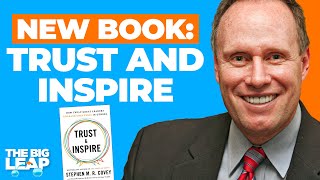
This is a transcript of a Big Leap podcast interview with Stephen M.R. Covey about his forthcoming book, Trust and Inspire. Covey argues that modern leadership must shift from command-and-control to a stewardship model—‘‘trust and inspire’’—centered on three stewardships: modeling (go first), trusting (extend smart trust), and inspiring (connect to meaning and belonging). The episode includes practical examples (Admiral William McRaven, Cheryl Bachelder, Muhammad Yunus), generational advice for leading Gen Z/millennials, and the book’s central takeaways that inspiring others is a learnable leadership skill.
Chapters
Mike and I are so excited for this episode of the Big Leap podcast because we have a person who has written a new book that will change your life if you really understand what's in it.
All right, well, here it is, Stephen. Mr. Covey. And while we were doing this interview, I realized there's this great saying, which is slow is smooth and smooth is fast. We live in a world filled with how to shortcuts and recipes, and this is the antithesis of that. This is really how to trust and inspire.
And I'll just say this, everything around our world has changed. And we need to make sure that our leadership style, our approach, who we are as leaders, how we lead, has changed with it. And I call this new way to lead trust and inspire. A better way to lead in a new world. That's the idea. Trust and inspire.
All right, here we are. Stephen, it is great to be here today. Gay and I are super excited. Both of us received our copy of your new book, Trust and Inspire. We're super excited to talk to you about this and also some of the latest goings on. So thanks for being here.
It's really great to have you here, Steven. I've been looking forward to talking to you. Since I got the book. I spent the weekend with it and actually read some of it, not just spending the weekend with it beside my bed. But the book isn't out yet, so I feel like I've had a sneak peek at some something that's just about to hit the street. So tell us a little bit about the excitement that's building about it.
Yeah, well, thanks, Gay. It's great to be with you and with Mike on the Big League podcast. Really happy about it. So, yeah, the whole idea behind this book is all about how the world has changed all around us in all the ways that we know. And yet our style of leadership hasn't kept pace with the changing world. We're still too much rooted kind of in the old model of what we might call command and control. We're just more. A more advanced, a more sophisticated version of it. I call it an enlightened command and control. But it's really, we haven't really shifted the paradigm of how we view people and how we view leadership. And until we shift that paradigm, we won't lead in a new way. And this new world of work really requires a new way to lead. And I'm calling this new way to lead trust and inspire. And it's all about how we as people and as leaders can see the potential in Others can see it, can communicate it to them, so they can come to see it in themselves, can develop it, and then can unleash it for their good and for our good, for everyone's benefit. And that idea that there's greatness inside of everyone, and our job as leaders is to unleash that greatness, not to try to contain or control it. That's the idea behind the book. And there's been an exciting response to it because everyone recognizes the world's changed, so we've got to catch up. Leadership to this changing world.
In your own experience, Stephen, you've been a leader for many years in your own right. How do you see your own leadership changing in light of what you learned in gathering the material to the book? The book, by the way, has a tremendous amount of research and background material in it. The notes section is bigger than most books I've written, so there's a lot of information, and it's all very carefully documented. But take it inside for a minute. And how has your own experience changed?
Yeah, well, my own experience has really been expanded through this whole process. It's impacted my leadership because it's very easy in how I've led in the past to sometimes really become good and efficient at managing things. And because you can become so good at that and efficient with it, and it becomes second nature to apply that same approach of management that works so well with things, to sometimes apply it to people. And, you know, where you try to be efficient with people like you are with things. And whenever you try to be efficient with people, that's where this breaks down, because people and things are different in kind. And the whole premise of the book is that you manage things and you lead people. And the moment we try to manage people as if they were things, we end up in the end with no people. And a lot of things, because people don't want to be a part of that. They'll move on. And it's very easy. I found in my life, in my leadership, at different times, I can get into an efficiency mindset. And again, there's nothing wrong with that, with things, with processes, with systems, with structures, with strategies. But the moment I gain, you know, I apply the efficiency mindset with people. That's where it breaks down. Because if you try to be efficient with people, ultimately you'll end up going slow, because with people, going fast is slow. But if you go slow with people up front, listen to them understand, show concern, demonstrate respect, build trust by going slow with people, you'll then go fast because you'll earn that trust. And nothing is as fast as the speed of trust. But you have to kind of think it through and not just allow kind of the pressures and the demands that tend to scream out for efficiency to become the way that we view people. People don't want to be managed, they want to be led, they want to be trusted, they want to be inspired. So that distinction between management of things, leadership of people, although I've known this for 30 years.
Actually applying it when the stakes are high and when the demands are great and not falling into the efficiency trap with people, that to me has kind of been the shift that I've become better at through the book.
You know, I really appreciated that point in the book. It actually forced me to put down the book for a few minutes and look back through several failures of leadership I experienced where things just kind of got out of hand or messed up or people were wounded by things I did. And almost every time it was because I overlooked a bunch of people related stuff in my bullheaded attempt to get something done fast. And it reminded me of another thing too. Back when I was working on my doctorate in counseling psychology, one of the things that one of our mentors said was you can slow a client down, but you can never speed them up. You get locked into that efficiency mindset and then things fall apart.
I love that. That's the idea. You can clearly slow them down, but you can't try to be efficient with them, try to speed it up.
And the exception would be that if you, by going slow, if you focus on building the relationship, showing that you care and building trust, that's what will speed it up. But it's not you doing it through your efforts, it's the client choosing it because they trust you and, and they give it to you, you know, so it's, it's, it's, it's a, it's a poll strategy, not a push strategy. It flows to you, you know, versus being something that you're trying to create on your own, compulsory means. So yeah, I love that.
I've got one for you which is, it has to do with your target audience. And it's a double question really, which is, I have a 19 year old, a 19 year old boy who grew up in the midst of the lockdown. These are definitely challenging times for cynical. Yet his, his generation is optimistic in a lot of ways. They do have. Generation Z is a very fascinating generation. But what advice do you have to parents with kids who are in this very transitional state and for that matter, we as business owners and founders are bringing in Gen Z into our workspace right now. Inspiring them, motivating them, generating and building trust is very challenging in a very different way. So do you have any advice or recommendations or suggestions on that level?
Yeah, first of all, Mike, I relate to it. I also have a 19 year old, a 19 year old daughter.
And so I do understand what you're talking about with Gen Z's and also with Millennials. And.
It'S interesting. The starting point is so interesting. As you look at some of the older generations, the traditionalists and the baby boomers, they tend to start from the premise that trust is earned, that you earn trust, you demonstrate it, you earn it, and then you can build it that way. And some of the younger generations, Gen Z millennials, tend to start from the premise that trust is given, that is given as a starting point. And you know what? They're both right, because trust is earned. We earn it through our credibility, our character, our confidence, but we also need to give it. We not only need to be trustworthy as leaders, we need to be trusting. And with these younger generations, the whole point is, look.
If you don't trust me, then why hire me? You know, you're bringing me in to give me an opportunity. And they also have a desire for some meaning behind what they're doing, some purpose that it's all about. You know, the millennials are often called the purpose generation. And yet the interesting thing is the data shows it's not just millennials. Every generation really wants some sense of meaning and purpose. And so to come in with this is where I think a new style of leadership is so vital. Because Gen Z's and millennials, they don't want to be managed in the command and control way. They want to be listened to, they want to be understood, they want to apply their skills, they want to have flexibility, they want to have options and choices. They have it and they want to be part of something that matters. And if they're not, they'll quickly move on to something where they feel more and more aligned. And so I think this is one of the main reasons why we need a new way to lead in this new world. It's not just all the technology and the changes that have happened, you know, with the shift in the, in what's happening in the workforce and the workplace and technology and, you know, all the advances and disruptive disruption, yes, all of that is vital, but it's this extraordinary amount of diversity that's now in our workplaces. Including in the generations. And the new generations don't want to be managed the way prior generations managed. And even we're led and expected it from people, the new generations won't tolerate it. It's not going to work anymore. And so we need a new way to lead in a new world. And this is trying to describe where we need to go. We're kind of more clear where we've been and what's not going to work. Command and control and even its more advanced version of it, enlightened command and control. I'm trying to just define what will work and where we need to go. And the whole premise is people don't want to be managed. They want to be led, they want to be trusted, they want to be inspired. Even more than motivated, they want to be inspired. They want to have that fire that is within them ignite and to have life breathed into them. That's the idea of inspire, to breathe life into.
And that's the possibilities, the opportunities with the younger generations. But the thing is, every time I highlight the younger generations and we step back, I find, you know what, even the so called older generations want the same thing too. It's not just Gen Z and millennials, but they're just more open and overt about it.
I want to read one of the recommendations, the blurbs on the back of the book who happens to be from one of my personal heroes, William McRaven.
He says every leader, every manager, every person interested in how best to connect with others should read this book. It will be the defining book for leadership in the 21st century.
First of all, congratulations on getting a book recommendation from such a fantastic human being as McRaven. Do you know him personally or was this a kind of a book thing?
No, I know him personally. I've been really honored to have a chance to work with him and his team when he was the Commander of Special Operations.
Aha. Great. Well, he certainly did a yeoman like job there.
Absolutely.
So what is Admiral McRaven looking at there when he says this is the defining book for leadership in the 21st century? Why do you think he thinks it has that potential?
I think it's because the fact that it's focusing on our fundamental beliefs of how we see people.
And how we see leadership. See, I'd like to. If someone asked me what kind of book is this? Is it a leadership book? I say yes. But it's also a book about people.
And about how leaders and leaders have a stewardship, an inherent responsibility, to see the potential and the greatness in people and to develop it and to unleash it. And so I think the fact that it's saying, look, there's greatness inside of people. And that's not just a platitude, it's a bone deep belief that if you have that belief as a leader that there's greatness inside of people, then it becomes clear that your job as a leader now is not to try to contain them or control them, but it's to try to develop, to see that greatness, to communicate it, to develop it, and then to really unleash it for the service of the mission, the purpose of what you're all about, both for the benefit of what you're trying to accomplish, but also for their benefit. And so it's always about two things simultaneously. One is getting the job done, you know, getting the results. We always want that. That's important in any aspect of leadership, but equal in importance to it is growing the person.
And I think that Admiral McRaven, what he saw in this is that this is a book targeted at the whole person, at seeing both the greatness inside of people and that people are whole people. A body, a heart, a mind, a spirit. So they're not just economic creatures where you just only motivate through carrot and stick motivation, but you try to tap into their heart by connection, through caring, through belonging, and then into their mind, meaning their desire to contribute and utilize, their talents and their expertise, their skills, their insights or knowledge, but also their spirit, meaning a holistic approach, a sense for meaning and purpose and contribution. What the two of you are all about. And this so that people, you know, what matters to people is mattering. And so it's a book that sees people that way. And that's the first reason is because it sees people in a more whole, complete, accurate representation of who people are. You know, where the map is more accurate with the territory, it's a more accurate map of people. And then I also think it's a more accurate map of leadership, the idea that there's enough for everyone. So it's not a scarcity, there's a scarcity. Maybe in some economic theory that's good economic theory, but not good leadership theory to have scarcity, there's an abundance. And again, this is your work as well. So we can elevate caring above competing. The whole idea that leadership is stewardship. So it's not about your rights, it's not your responsibilities. You have a stewardship, a responsibility to see the potential of the people that you Lead, and then you need to model. You need to go first. And so that's a way of thinking about leadership that's focused on stewardship, not rights. And it focuses on people around the idea that they're whole people with greatness, not fragmented people that, you know where there's hit and miss on the greatness. And so that you kind of contain some and, and, and prioritize among the people, but rather see the greatness inside of everyone. So I think it's because it's holistic and, and is why Admiral McRaven responded to it. But I will say this to your point, Gay, this is how he saw his people, his team is how he led. And he inspired them by who he was, by how he led, by the belief he had in them, by the affirmation he gave them and how they responded to it. And they rose to the occasion and they reciprocated and returned the trust that he gave back to them. You know, they returned it to him, but they all performed better collectively and individually because of being unleashed by an extraordinary leader.
You know, you've got Admiral McRaven on the back of the book and a number of other really top flight leaders, and I was just wondering, could you give us a story or two about leadership in action that you really admired when you saw somebody like Admiral McRaven or one of the other top flight leaders? Give us a little.
Clip of what you saw there.
I'll give you one on Admiral McRaven. Then I'll give you another one about a business leader. So Admiral McRaven.
You know, Commander of special operations, that's all the elite fighting forces. So Army Rangers, Navy Seals, Green Berets, you know, the best of the best. And here they are already probably among the best in the world at trust. Their unit runs on trust. You can't be operating at the level they're operating without an extraordinary trust as a currency for what they, you know, how they operate. And they trust in the character and the competence of their teammates and as a team. So here they are, the best in the world on trust already. And Admiral McRaven has me come in to work with him and his team to become even better.
And it's just humbling to see something like this, that the people who are already the best. He's the best in the world at trust, and he's saying, we've got to get better and I've got to get better. And he modeled it. I had a lunch with him as part of this session that we spent an Entire day with his team. And in the lunch I met with him and his wife and he talked about personally the things he was working on to become a better leader in all aspects of his life, at home, in the community as well as as a commander. And so it was never outside in with him, it was always inside out. And here he is, this prominent four star commander.
Working on himself, trying to become better, a better leader and being humble about it, recognizing there's more he can do and needs to do and wants to do, and then doing the same thing with his team. Best in the world at trust, trying to build more trust. I just found that remarkable.
He could be that open to learning, to be out there looking for somehow to go beyond the edge.
Absolutely. But that open to learning and that humble. Yeah, that humble that he's always believing that there's principles out there and he's always trying to get better, never arriving, always on the journey. And he's modeling it, going first with his own team and in his own home and in his own community. And I loved how later when he retired and then he became the chancellor of the University of Texas system and then he gave a commencement address at the University of Texas and it went viral. And you'll probably both know what I'm talking about here. He got up and he gave this speech where he said to all the graduates, so if you want to change the world.
Make your bed.
Make your bed. And the whole idea was that if you start with the small things, with small commitments that you can make and keep to yourself and no one can stop you from doing that, you can do that, you can decide to make your bed and commit to it, and then you can go from that commitment to another commitment to another commitment, to another commitment, another and another. You make and keep commitments to yourself as a way of building that self trust and that gives you a sense of clarity, of integrity and power. It helps you then build trust with others. And so, you know, summarize in one phrase, one sentence, if you want to change the world, make your bet. It's a beautiful illustration, powerful, simple approach. So he's a great example. I'll give you one other, and that's Cheryl Bachelder. She was the CEO of Popeyes Chicken, the fast food store. And when long story made short is they'd had four CEOs in a seven year period prior to Cheryl coming in and you know, it wasn't working fully. They were doing fine, but not anywhere near their potential. And they'd had all these different CEOs leading with the old style, the traditional style of leadership. Cheryl comes in trust and inspired leader, and right out of the gates, what does she do? She models the behavior through her humility, through her listening. She came in and not telling people, but rather listening to people. What do we need to work on? Why? What's in the way? What's working, what's not? And she especially made the goal to listen and learn from her franchisees. And this is a franchise organization. And she actually told the investors that you're not my top priority. My top priority are my franchisees, and I'm going to work on building a relationship of trust. And then she modeled it by listening first and demonstrating respect for what she heard and then responding to it and acting on it and delivering results for them and slowly built that relationship of trust with them. And then she modeled transparency and openness, and she modeled straight talk. And suddenly they got real and they began to trust each other. And they. And once they trust each other as franchisees and as the home office, they could collaborate. When they could collaborate, they could innovate, and they began to improve their business dramatically. Long story made short is that, you know, she took them from $11 share price to $87 under her tenure. Massive improvement in terms of performance, but also the energy, the joy, the happiness, the creativity, the culture, the inspiration that she brought into that was remarkable. And again, so it's always those two things, you know, getting the job done and growing the people, building the trust. And if you, you know, get the job done but don't grow the people or build the trust, you're only halfway there. You're not truly leading. If you're growing the people and building the culture, but you're not performing, that's not going to be sustainable either. You got to. You got to do both. But leaders like Admiral McCraven and Cheryl Bachelder do both because they're trust and inspire leaders, not command and control leaders that dictate and kind of, you know, are the boss and in charge and everything else. No, these people are seeing the greatness inside of people and communicating it and developing it and unleashing it.
Well, if you see her, tell her I said that. They make a darn good chicken sandwich, too, over there.
Oh, yeah.
That's why I'm saying their results are great.
True that.
Not just the financial results, the quality of the product. It's very good.
Okay, I've got one for you, which I thought was very interesting. So part two of the book, you talk about the three stewardships the first stewardship of modeling, which is who you are trusting, how you lead. The third is inspiring and connecting to why, which is something I'm a big, big fan of, is, you know, what's your why? But I'm more curious about your selection award, which is stewardship.
Which is usually used for, like, stewardship of public lands. It's used in civics. Why did you choose stewardship? What's the nuance behind that?
Thank you, Mike, for that question. It was a very deliberate and conscious choice to use that word. And there's a little bit of trepidation in using it because it's been more narrowly defined like you described in our society. It's more narrowly defined in either in a sustainability approach, you know, you have stewardship for the environment and such sustainability, or in a public setting of a stewardship of the public trust or the, you know, the commitment to the common good, that type of thing. And yet the word is so rich with meaning and with purpose. And really, the main point was that it really distinguished the difference between a command and control leader that operates on the premise of position.
And power and rights that are part of command and control to one that is a trust and inspire leader that operates on the premise of influence. And rather than position, they operate on moral authority. And rather than rights, they have responsibilities, inherent responsibilities, duties that are inherent in leadership itself. So the reason we chose the word stewardship is saying, look, rather than focusing on your right as a leader, these are your responsibilities, your inherent implicit responsibilities that come with the mantle, the responsibility of being called a leader that you have a duty to try to model how to, you know, the behavior that you expect others to see, to trust people so you can ignite them and develop them and also bring out their potential and to inspire people. That's actually a stewardship responsibility you have as a leader. That's not just left for the charismatic. That's every leader needs to inspire that idea. And so stewardship means a job with a trust.
Those three stewardships, modeling, trusting, inspiring, are three jobs with a trust that come along with the mantle of being a leader. And so the very fundamental belief that leadership is stewardship, if you buy that, then that's going to say we got to put service above self interest. And then rather than saying, these are my rights, it's these are my responsibilities. These are the stewardships, the jobs with a trust that come with leadership. Because why? Because leadership itself is stewardship, where you're trying to leave a person in a place better than you Found them or a team or an organization. That idea that comes from stewardship of the public trust environment, that idea is good, but rather than just seeing it narrowly defined, this is broadly defined to leadership and to people. And that was a conscious choice. And I believe that words will come in and out at different times, and I believe that the time is ripe and the time is now for stewardship to be seen for what it is. That this is not a soft word. It's not just a narrowly defined word. It is an idea whose time has come in our new world of work and our new way of leading. And it matches the idea of trust and inspire. Whereas, you know, rights is more tied to command and control. That's the idea behind that word. Very intentional choice.
You have another great quote here from another one of my heroes, Muhammad Yunus. He says, like the gardener described in the book, the job of leaders is to create an environment where the seeds of greatness within people are able to flourish, trust and inspire. Powerfully demonstrates how to. How to cultivate this kind of growth in any setting.
First of all, one of the reasons I admire Muhammad Yunus so much is that he is focused on the top and the bottom. At the same time, he has a perspective. You know, he can run a bank and he can win a Nobel Prize, both of which he's done. And at the same time, you know, one of the things that I contributed to was a project he had of giving very inexpensive cell phones to women who were conducting enterprises across villages in Asia. So that was their entry point to the commercial world, because if you had a cell phone, you know, you could pretty much connect with enterprise anywhere in the world. And so to be able to think. And another thing, I was once, my colleague, Kate Ludemann, we wrote a book back in the 90s called the corporate Mystic. And our contention, similar to yours, was that great business leaders often had more of the quality of spirituality than we found in spiritual organizations, because they had to have their spirituality make a difference on a daily basis. And one time we were having lunch with Bob Galvin, who was the founder. His father founded Motorola, and then he ran Motorola for many years. One of the most amazing leaders.
And everybody else had left the lunchroom there at the headquarters, and we were the only people at the table. And suddenly he said, listen, we need to finish, because I see the waiter over there, and he's waiting for us to leave so they can finish cleaning up. And, you know, he owned the place, you know, and yet he was concerned about a waiter. To me, that Touched me so deeply.
In fact, I'll say this. I quoted Bob Galvin in my earlier book, the Speed of Trust, about how his father gave him the toughest medicine of all. He trusted me, he said, and he called it the toughest medicine of all, because the whole idea was that wasn't an easy thing. No, to be trusted is the ultimate manifestation of belief in someone and a sense of stewardship. Back to that word that I trust you, so you need to rise to the occasion. He said, I've got to. I gotta be worthy of the trust. I've gotta live up to it and give it back. And, you know. And your story, Gay, is a good illustration of. He modeled this, of how he saw every single person see, how you treat the one has an effect on the many. So when someone like Bob Galvin shows that kind of respect for the waiter, that, look, here we are at a restaurant, but the waiter needs to move on. Showing respect for the waiter that communicates to everyone that's in that group the same respect that he will show toward them. What a remarkable example of modeling, of going first.
And his father was like that, too. Of course, I never met him. He was an earlier generation, but Bob said that his father would take him out into the, you know, where there was a factory back during the Second World War where a lot of the workers were women. And he said, we must never forget that every one of those is a mom or a grandmom or somebody's daughter, you know, that they're not just a person pulling a lever, making an airplane.
That's beautiful. Yeah. They're whole people.
Yeah.
And yes, they have work life, but they also have a home life and a family life and a community life. They have a body, a heart, a mind and a spirit. They have a desire for meaning, for purpose, for contribution. And the more we tap into that, the more we overlap, you know, our individual people's individual purpose, their own. Why with our purpose co purposing, you know, things that you're all about, the two of you and that, you know the better, will tap into that fire that burns inside of people and will truly inspire, and that's that. And that lives on far longer than motivation through traditional carrot and stick or command and control approaches to motivation with more rewards and more carrots, more sticks. Nothing wrong with that inherently, but it's just not the same level of an intrinsic inspiration that's already inside of people. And when we ignite that fire that's within by tapping into their passion, into a sense of meaning and Purpose and contribution. So let me say this about Muhammad Yunus, because.
Like you said, gay, he was able to operate at the highest level and at the personal level, you know, builds this world renowned bank, a whole new model. Grameen bank, meaning village bank, and it said, wins the Nobel Peace Prize, lifts tens of millions of people out of poverty. You know, is the seen as the creator of the microcredit movement, all of that. And yet it started because his belief was that there's greatness inside of everyone. Not just a few, but of everyone. And while most banks, understandably, they look at your collateral and look at your past and this and that, his whole thing was to look at your potential, what was possible and to do to build a bank on the basis of trust, human trust. No contracts, no collateral, no past track record, but just a belief in people and then a smart process so that you're not just blindly going about this to involve people with a committee and you know, making loans to each other with a committee being part of it and some payback along the way so they don't have this big bloom payment. So there's still some good judgment brought to it. But the basic premise was rather than a contract, it's a relationship rather than the past, it's the potential and the future. And rather than being a command and control, it's a trust and inspire approach. And here it did. And here's the great irony is the payback rate on these small loans, these 50 to $100 loans, 97% are made to women. The payback rate is over 98% and you know, which is the average payback rate on a small business loan is 88%. So it's way higher than a traditional small business loan with people with no collateral and no contract.
So it just shows you the power of the human spirit and what people are capable of when they have someone who believes in them. And rather than taking advantage of that person, they're inspired by it and they want to pay it back and prove it right and rise to the occasion that is inspiring of what's possible inside of each of us.
Well, Stephen, tell us a little bit about what you'd really like people to remember and keep in mind as they're going out and buying and reading your book.
I think it's back to those three stewardships. Is that simple and yet that difficult that what do trust inspires leaders? Do they model the behavior that they're seeking by going first? And that includes demonstrating humility and courage. We need that today. A good example Admiral McRaven, they demonstrate also authenticity and vulnerability. They're real, they're authentic, and they let people see into that authenticity. That builds trespass. You're a human being, you know that type of vulnerability and openness. Transparency builds trust. And they also model empathy, understanding along with performance, meaning we got to get the results, but we got to do it in context of understanding the situation, the people. And so that's Muhammad yunus getting a 98% payback, lifting people out of poverties, but understanding where people are coming from, the empathy so that you meet them where they're at, that's modeling the trusting. The whole idea here is that you could have two trustworthy people working together and no trust between them, even though they're both trustworthy, if neither person is willing to extend trust to the other. So to have trust, we not only have to be trustworthy, we also have to be trusting. And it's the job of the leader to go first. Someone needs to go first. Leaders go first. So leaders are trusting other people in smart ways. Not just a blind trust, but a smart trust, always with, always in context and always with expectations and accountability. Like Muhammad Yunus. Expectations and accountability. And in his case, he didn't even have a contract, but he had an implicit agreement of expectations and accountability. And people responded to it and they rose to the occasion. So we need to model, we need to trust, and then we also need to inspire. And maybe this is where there's a paradigm shift that inspiring is not just for the charismatic.
Everyone can inspire because inspiring others is a learnable skill. And you inspire when you model the behavior. You inspire when you trust people. And when you inspire, you inspire people. When you connect with people through caring and belonging, showing that you care about people, you create a sense of belonging on your team. And you connect to purpose and to meaning and to contribution. That inspires. And as leaders, we can learn to inspire others as part of our job to be done, part of our stewardship as leaders. And that's kind of a big idea, that inspiring others is a learnable skill. So those are the three takeaways. You model, you trust, you inspire. They're all learnable, they're all stewardships. That's what's going to define leadership in our new century. These are the stewardships of a trust inspired leader.
Great book. Thanks a lot for writing. And I know a book like this is a matter of years, not just months, so congratulations on bringing it out into the world. Mike.
Yeah, I, first of all, I was thinking through this whole thing where it's really the way I want to open the program is, you know, we live in a world that's filled with how to shortcuts and recipes and trusting and inspiring people is really all about nuance. And there's a saying amongst snipers which is slow is smooth, and smooth is fast.
And. But that goes for anything that's done right and done right the first time. And you talked about how you talked about that at the very beginning here. And as I was listening to you, I really had to rethink the questions I originally wanted to ask you. I got rid of 80% of them because I was looking for some formulas. And I realized, oh, this is a completely different mindset when you read this book. And great leaders are not memorizing a bunch of how to's. They're not looking for a bunch of silver bullets. They spend decades studying and modeling the greats. So that's, that's my take after listening to you today, is being, being an inspirational leader. Building a lot of trust is a shift in consciousness. It really is.
I love that.
Mike, what's your big takeaway? Stephen?
Yeah, my big takeaway is probably this, that inspiring others is a learnable skill. And it's where, it's where we're going as a society. We live in a society that is dangerously low in inspiration and in trust, for that matter. And that this is not just. We're not just waiting on the charismatic to do this, that it's a stewardship of leadership to inspire others. And it is learnable how, through modeling, how, through trusting, those two stewardships will inspire, they'll help you do the third stewardship. But when you connect with people through caring and belonging, and we all can do that, empathy and compassion, real caring, genuine concern. Demonstrate it, show it, connect with people that will inspire them. If all you did was connect to them as a human being through empathy, through compassion, through this sense of caring that will inspire others. And when they feel that inspiration from you, that can live on, that burns inside. And we can learn to do this. And we also can learn to connect people to purpose, to meaning and contribution. And as leaders, we can actually create and embed purpose, meaning and contribution into almost any role, into almost any organization. What if we got good at this as a leader so that our people felt inspired? And so people don't want to be motivated, they want to be inspired. That's where I think, to use the Wayne Gretzky metaphor, where he said he was asked, what makes you so great at Hockey. He says, I skate to where the puck is going to be, not to where it's been. I think the puck has been at command and control. I think it's going towards trust and inspire and inspirational leadership. And that's where it's going. And we can be there as leaders. We can. I love how you said it, Mike. We can really transform our leadership style to be relevant for our times, relevant for all generations, relevant for this new world of work with a new way to lead that's far more. It's going to impact on both levels. We'll get better results and outcomes, and we'll build a greater, better team and culture. It'll be better for the people. More energy, more joy, more inspiration. And that's exciting to do both. So that's the takeaway, is that this is learnable. These stewardships are learnable. Inspiring others is a learnable skill.
Well, thank you for sharing your time and expertise with us. You know, in the Big Leap, we talk a little bit about the genius zone and how to live in your genius zone. And I want to congratulate and appreciate you for living in your genius zone, Stephen.
Thank you, Gay. Thank you, Mike. Yeah, I certainly am trying. And the idea here is that the genius zone, just like you, the two of you talk about the big Leap, is that everyone has a genius zone. There's an opportunity for everyone. So the key to trust inspire is that it's not just that I have a genius zone, it's that my people do. And I see that my people do. So my job as a leader is not only to unleash my own, but to unleash theirs. And to see that as a stewardship that I have. And that's a different mindset than just my own only. But I've got a model, my own. I've got to. I gotta start here. Then I'll be better prepared to help others really, you know, achieve that in their zone, too. So inside out.
Well, here's what I'll make sure we do is I'll make sure in the show notes, we've got links to get a copy of the book. Do you have a dedicated website up or coming up for the book?
Yes, it'll be up by April 5th. It's called trust and Inspire. Dress.
All right, well, head there, grab a copy of the book. We'll make sure there are links inside the show notes as well. And thank you very much, Stephen.
Thank you. It's wonderful to talk to both of you.
More from Mike


The 3x3 Framework That Changes How Entrepreneurs Think | Mike Koenigs & Dan Sullivan








Why Your Business Gets Harder As It Grows | Michael Walsh on the Hidden Danger Zones of Scale
