Steven Sashen, The Creator of Xero Shoes: The Evolution of A Renaissance Man | The Big Leap EP#77
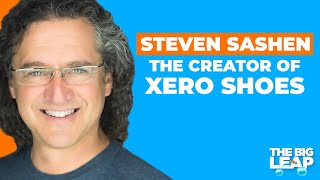
This is a transcript of a Big Leap podcast episode (recorded March 17, 2023) featuring Steven Sashen in conversation with hosts Mike Koenigs and Gay Hendricks. Steven recounts his varied career — standup comedy, acting/voiceover, Columbia film school (master's in screenwriting), founding Scriptware (screenwriting software), early internet marketing (starting ~1991–1992), and eventually co-founding Xero Shoes ~13 years ago with his wife Lena. Xero Shoes grew from DIY sandal kits to a global natural-movement footwear brand (reported ~1M+ users, ~74–75 employees, presence in ~400 stores with planned expansion). Steven describes his first-principles, skeptical approach (testing urban myths, using probability/counterfactual thinking), his barefoot-running discovery that led to the shoes, and relationship/business dynamics with his wife (she manages operations/finance). He also announces a recent diagnosis and treatment for a rare eye cancer (choroidal melanoma), reflects on the gratitude and present-moment appreciation it produced, and describes philanthropic intentions to fund research and give back.
Questions this video answers
March 17, 2023 (recording date noted in metadata).
About 13 years.
Over one million users worldwide; roughly 74–75 employees; in about 400 stores globally, with plans to add ~100–150 US stores in the year mentioned.
Around 1991–1992 (early days of internet marketing).
A form of eye cancer—choroidal melanoma (retinal/choroidal melanoma); treated with plaque brachytherapy; diagnosis received a few months prior to the interview.
Chapters
I've started doing more things that I just flat out enjoy.
If you're doing something that lights you up, it kind of has its own way of kind of beaming its way out into the world.
The gratitude that I feel and the amazement that I experience literally hundreds of times a day, including right now, is, is the greatest thing that's ever happened to me.
Here we are on the big leap. My name is Mike Koenigs. I'm here today with Gay Hendricks and our special guest, Stephen Sashin. One of the things I love so much about this episode is Stephen is a first principle thinker. He really, really thinks a lot about a lot of things and he's got a wild, wild background. So the way I was thinking about naming this is imagine what do you get when you combine a comedian, sprinter, filmmaker, archer and entreprene all in one while you get a Stephen session? That's what Gay.
Yes. Well, I admire Stephen from many different angles, but one thing is I always admire his willingness to take a clear eyed look on a search for the truth, to find the bottom line thing that's important about any situation. And he does this over and over again and you'll see how he does it in this episode. And it's something that I think we all can learn from. Steve, what's your takeaway?
I was going to say, I hope my thing isn't about saying nice things about me because that would be ridiculous. But I appreciate each of you. Mike, I've known you and of you and watched you for years as you've built your career around Internet marketing and technology and really helping people find ways of making a living, making a life. You know, I was very instrumental in some things I was doing before I started Xeroxo's and Gay. I can't think of anyone who's a better example of someone whose guiding principle for what they want to do to make a living is how much fun can I have? And that was something where we definitely merged minds. And it's been wonderful seeing the places that you've gone. And I have just a vivid memory of when we were in workshops together and we're just like doing things to make each other laugh. And those memories are quite fun, especially when someone said, how do you guys do that? And we had to break down how you come up with a joke. And of course the breakdown fell apart because part of it was just I just wait till something funny shows up in my head and then away we go. So it's just been a pleasure to watch how You've evolved.
Well, here's what's great.
Thank you.
Yeah.
I was just gonna say this is what the show's like. You're gonna enjoy this episode. Gabe, what else were you gonna add to that?
I had so much fun. I am looking forward to. I'm gonna be out in your part of the world, Stephen, in the next few months sometime, I think. I just signed up to do a keynote at a conscious entrepreneur conference. I think it's in May or June, but I'm looking forward to it because I'm hoping you'll be there at the same time and we can sit down and have a brew together.
That would be delightful.
Hi, everybody. Welcome to the Big Leap Podcast. I'm Gay Hendricks, and we have some very exciting action for you today. I've invited one of my very favorite people in the world and somebody that I've been admiring and cheering on for the last probably quarter century or so, and I'm about to hear something from him that even I don't know what he's about to say. But, Mike, how are you doing today?
Great. Just got back from a fun trip to Hollywood. A good friend of ours is having a birthday party, and we had a crazy sunset Hollywood.
Trip that was. It ended so well, and we met a whole bunch of interesting characters like you always meet in Hollywood. So I'm super excited to be here with a stable, grounded man like Stephen, I think.
Yeah. Well, without further ado, let's.
We're about to prove that wrong really fast.
So welcome to our Roundtable Stephen Session, Steve.
Thank you. Thank you, thank you. First of all, I'm going to make you feel a little bit older. We've known each other for about 33, 34 years.
Whoa.
We've known each other so long that when we first met, my hair was the length that yours is right now.
Nice.
Well, that's amazing. That means we go back to somewhere around the time when Conscious Loving came out and we were on Oprah for the first time.
Yeah, yeah. Right around then. Yeah.
Yeah. Whoa. Okay. Well, I've known you through several different incarnations, and we can get into all that. But as you probably figured out, our show is about big leaps in your life. And so I want to just kind of, before we kind of get to the pinnacle of what you're up to now, which is kind of mind boggling to me, I want you to tell us some of the big leaps that you made along the way. In the early days, you know, where did you come from and what did you do before you're doing now. So take us through some of those that I know about and maybe some that I don't.
Holy smokes. You know, this is like when my wife and I would go to parties and somebody would say, ask me, what do you do? I would turn to Lena and say, why don't you feel this? And I would leave because there's many things, and that's in no small part because I'm old enough that they hadn't invented Ritalin when I would have gotten it. So I have never had a job, I've never had a resume or I've never interviewed for a job. I want to interview for a job at some point just to see what it's like. And then of course, since I don't need the job, have a lot of fun by giving all the wrong answers, which I think would be very entertaining. But e gads so I grew up outside of D.C. i went to. I went in Bethesda, Maryland. If anyone wants to go visit my parents house, knock yourself out. It's there, they're not. And oh boy. After college, I was a pre med that whole time. And then my last semester of college, they opened a comedy club down the street in Raleigh, North Carolina. And I somehow became the house emcee at that comedy club. And at one point the guy who booked that club said to me, when you graduate college, I can give you 10 weeks on the road. And that 10 weeks turned into 10 years as a professional standup comic. During that time, I also was doing a bunch of acting and voiceover work and just having a good time might set a fun memory. My dad sent me an article from the New York Times about how actors make very little money. And there's a thing where if you make enough money, you get free insurance from the Screen Actors Guild. And I had to call him and go, how do you not know? I'm one of those guys he just never really understood. So it went well for me, but I was also bored because I worked for an hour or two a night and hung out with my friends and did fun things in New York, as one does. And then one of the guys that I met was going to was applying to go to Columbia University Film School. And I liked that idea of writing, directing, producing and being involved in film. And so I applied and I think because I had the money, they let me in. But suffice it to say, went to Columbia University Film School, got a master's in film specializing in screenwriting, won some awards with some scripts but was really frustrated with how difficult it was to type in this really ridiculously archaic format that screenplays need to look, need to be in. In part, it's sort of like we called it the transom test. If you threw your script over the transom, people would look at it. If it didn't look right, they wouldn't read it. And the things you had to do to make it look right were really, really ridiculous. And my undergraduate research was cognitive psychology. And I'm. And I somehow figured out that there was a way to essentially extract from what your fingers would be doing if you were typing on a keyboard or on a typewriter and extract information that would allow the different script elements, character name the character's dialogue, the action that you're seeing on the screen, the location, and do all that crazy formatting completely automatically. Now I know nothing about computer programming. I can't write a line of code, couldn't then, couldn't now. But I figured out a way of doing this where the different script elements knew how they related to each other and related to the page. And I mapped this out accidentally found a programmer like literally at a comedy club that I was working. I've got a laptop case because I would sit in the green room writing scripts for when I was in film school. And I bumped into a guy with a PC magazine T shirt. And he said what are you doing with a laptop? I said what are you doing with the PC magazine T shirt? And he became my partner. We developed a product called scriptware which changed the entire screenwriting industry in the, oh gosh, 30 something years since I came up with that. No one has been able to replicate what we did with that product. And so that took the next 10 years of my life. I realized that I didn't need to be in New York and I was going to go into the full time software biz. So I escaped Manhattan and moved to Boulder, Colorado, thinking there would be like minded people not realizing I would come to not like their minds. And.
Ran a software company for 10 years. And then in the process of doing that, got into Internet marketing in the very early days. So I started doing that in 1991, 1992. Met a bunch of people who Mike knows I'll drop names for the fun of it. So me and Jonathan Meisel, Marlon Sanders, Declan Dunn, I mean the OGs in that world. And then I just started doing a bunch of things in Internet marketing. Kind of bounced around for quite a while playing with different ways of making a living and not having to have A job, and then cutting to almost the end of the story 13 years ago. Actually, the biggest leap, frankly, is that I, in that process ended up meeting the woman who became my wife. More about that if you want. And then, in fact, wait, I'm going to do thing that you're gonna have to. We're gonna have to remember, you called me one day and said, how'd you like to write a book with me? And that was sort of shorthand for how would you like to get paid a whole lot of money because you were getting really big book advances. And I said, what's it about? And you said, it's about single people who don't want to be single anymore because they don't want to listen to me. I've been married for however long you've been married at that point. And you know, let's talk about that. And I said, send me a couple chapters. And this is in 19. This is right before 9, 11. I said, send me a couple chapters. And you sent me a couple chapters. And I called you back and said, yeah, I can't do it. And you were like, what? Knowing that you had just offered me a boatload of cash. And I said, yeah, I just don't believe anything that is in here.
And you said, well, what do you think? And I wrote a couple chapters that weekend and sent it back to you. And you're like, holy crap. So we can talk more about that. But suffice to say that was right around the time that Laina and I, she had just moved in with me, in fact, just after ignoring me and been thinking, treating me like the plague for a number of years prior to that. But that was frankly the biggest thing that happened to me. And then 13 years, a little over 13 years ago, Lena and I completely, accidentally, we can dive into all these if you want. Started a footwear brand. We started a company called Xero Shoes. Xero Shoes. And for the last 13 years, we have built a brand of lightweight, barefoot, inspired, natural movement friendly boot shoes and sandals that over a million people around the world use for everything from taking a walk to running ultramarathons to climbing Kilimanjaro, to hanging out with their friends and. And here we are. That work.
That, that's great. I appreciate that. And also we can put in the notes, the link to your site because it's a really interesting site to look at, the Zero shoes site. It's just a lot of fun to cruise through it and look at the different pictures and the different testimonials and things like that. And I also, in the spirit of transparency, own a number of zero sho of them in pairs and, and I particularly use one of them. It's like the perfect dancing shoes. Katie and I go out dancing a lot. In fact, our foundation sponsors the ecstatic dance program here in, in my town. So we put our, our own ecstatic dance every Thursday night and for the whole community.
And you'll see me there in my. I think they're called Hana. Is that what it is? Yeah, they're perfect dancing shoes, folks, if you need a great pair of shoes to dance in. Okay, so.
Stand up comedian, software guy, scriptware guy. By the way, I used that program. It's the only one that makes intuitive sense and it's just natural. And I wrote many scripts on that and it's much easier to use than the one that a lot of other people use. All this.
Pretty cool. Well, you know, it's interesting, the thing that happened with that product in the company is that competitor that you're not mentioning by name. And that's good. It's sort of Voldemort ish. They did something that I had never thought to do. I've been an individual sport athlete my entire life and I sort of work most of my life on the idea that the best thing wins. And it took me a while to realize that in business that's not the way it works. Works. If you threaten someone's business and livelihood, they don't just go, hey, congratulations, you won. The first thing they try to do is shut you down, because that's easier than anything else. And these guys called the biggest retailer, in fact the only real retailer that we both shared at that time and said, you know, how much money do we need to give you to not buy Sachin's program anymore? And they had an answer. And so that was sort of, that was one kind of little glitch in the, in the ointment there. And the next was that I was kind of bored, frankly by that time. And the third was that there was a company, three guys who wanted to buy the company from me. And to make a semi long story semi short here, actually, here's the fun part. They were investigating and doing their vetting to see if what my company had. And one of the guys said, well, I wanted to check out your list. And so I called a whole bunch of people and your list is horrible. I said, well, how many people did you call? And he said something like 700. I said, when did you do this? And he gave me Some period of time. And I said, well, two things. One, based on the math you just gave me, you were having to make a phone call every three and a half seconds, so that seems unlikely. And secondly, you were using. Were using my office phone. And he goes, yeah. I said, that's a voiceover IP phone. So I just looked at all at the call records. I don't see one outbound call from you during that entire week. And he starts screaming at me about, you know, who do you think you are? And I pulled a gay Hendrix line on him. I said, you know, self righteous indignation is usually a sign of guilt. And there's a long pause and he starts screaming some more. And then he hangs up. And two days later, the other two partners called and said, yeah, we just found out he'd been embezzling us for embezzling from us for the last five years. So that deal did not go through. But we're possibly relaunching that product because the Academy of Motion Picture Arts and Sciences said they wanted to give me a technical achievement Oscar if I did that. So fingers crossed. We'll see.
Really good. Okay, well now.
What was the original inspiration for the shoe move? Because when I heard you were into shoes, I said, what? Because I had never even had a thought that you would create something that visible in the real world.
An actual physical thing. Yeah.
Actual physical product.
Yeah. I don't recommend it.
The through line from all these various things that I've done really is that I just like to investigate and find out what the sort of essential truth is as far down the bottom of the well I can go. And this, ironically, this business has put everything I've ever done together. It's sort of a perfect storm in a positive sense. So what happened was 15ish years ago, I was 45, I got back into sprinting after a 30 year break and I was getting injured pretty much constantly for about the next two years. And one day a guy that I know who's a world champ runner, which in Boulder, Colorado is saying, my neighbor, because they're everywhere. I mean, you can't throw a rock without hitting a guy with an Olympic medal. And he said, why don't you try running barefoot, See if you learn anything from doing that. Now I'm not suggesting people run barefoot. That's all. Others, we'll talk about that. But he said, you know, see what you learn. And it just so happened there was a guy doing a workshop on barefoot running that weekend. So I went out and did this workshop where we ran, oh, gosh, on grass and roads and trails and every surface you can imagine. Now, as a sprinter, I had never run more than a mile and never enjoyed one step of that. I like going very fast, very straight, short line and. But this particular run, I was so entranced by the feeling of what it was like to have my bare feet on the ground. And I was just experimenting. What happens if I move my feet faster but don't run any faster? What happens if I move my feet slower but don't run any faster or slower? What happens if I run faster and move my feet? Just like playing with that. What happens if I land on this part of my foot or that part of my foot? And it was just. Just utterly fascinating and we stopped and run. I could have kept going, but we just stopped as a group. And I turned to someone who had a GPS watch and I said, how far was that? And she goes, that's a little over 5K. It's like, sorry, what? I mean, I had never run that far in my life, and I loved every minute of it. But when I got in my car, I noticed I had a big blister on the ball of my left foot. Many people I have discovered in that situation would have said, oh, see, this is completely crap. I got a blister. For whatever reason, I thought, huh, how come my right foot is okay? And also, how come it's my left leg that gets injured more often than my right? So that's interesting to me. So the next week, we had another barefoot run. And I thought, I've still got a gaping hole on the bottom of my foot. And I thought, if I can find a way to run that doesn't hurt, then I'm probably not doing the thing that caused the gaping hole to begin with. So I'll give it 10 minutes. If it doesn't work, maybe I'll try again. Maybe I'll throw it away. Don't. Don't know, don't care. Nine minutes and 30 seconds of agony later. In one moment, it just changed. Literally in one step, my running became faster, easier, more effortless, my breathing relaxed. Everything was better. And I didn't know at the time, but what was going on was that as a sprinter, you're supposed to land on the ball of your foot. What I was doing was reaching out, so my foot was landing in front of my body and then pointing my toes to land on the ball of my foot. So I'm putting all that abrasive friction force on the ball of my foot more on my left than my right. And during that, that 10 minute run, I was just trying to pay attention to the good side, pay attention to the right side, and then the left side just kind of came along for the ride and figured it out. So as a result, my injuries went away. I became faster, I became a masters all American sprinter. So for, at that time, men over the age of 45, I was like the 15th, 20th fastest guy in the country. That's continued. Now I'm 60 and I just had an all American time about a month ago. But anyway, that barefoot, that natural movement experience was so profound. I wanted it all the time. But I got tired of arguing with people who owned restaurants about whether it was legal to be barefoot. It is, by the way. I got tired of my wife complaining that I was walking into our house that had white carpeting with my dirty feet. And so I made a pair of sandals based on a 10,000 year old design idea and people started asking for them. I mean, I was just like buying sheets of rubber from a shoe repair place and cord from Home Depot and we'd sit on the ground and I'd make sandals for people. And after maybe I'd done that for, I don't know, 50 or 60 people, the coach that did that first workshop said, I have a book coming out on bare. If you had a website and treated this little hobby of yours like a business, I could put you in the book. So I mean, I'd been doing Internet marketing since 19, whatever, 91, 92. I built literally thousands of websites. I rushed home, I pitched this brilliant opportunity to my wife who assured me that it was a complete waste of time, wouldn't make any money whatsoever. In fact, here's where things come full circle. The business that we had started just months earlier was using one of Mike's programs to make and syndicate videos. And we had started a search engine marketing business. I was one of the first guys teaching search engine marketing in 1993 when it was really easy. Just had a lot of white text on a white background and read a couple of articles. But we had started this search engine business and she says, it's just another distraction. It's one of your add things. Do not do this. Do not build a website. She was very adamant and I agreed that I wouldn't do it. And then she went to bed and I built a website. So the next morning she kind of growled at me and I said, it'll be a good case study, you know, maybe I can own this market in about three months. And I was completely wrong. It took six weeks and within six weeks I had. I'll to find the screenshots. Mike, you'll love them. I have screenshots showing that we had 40 of the top 50 search results for some of the keywords that I cared about. And within a matter of weeks it was very clear this was going to be our full time business and to jump, you know, way, way ahead. We had no idea that we'd be doing this for now 13 years. We started out thinking we would just be doing this do it yourself sandal making kit, which is what we sold, that maybe we had a sandal something based business we didn't think we'd have. I think we're now at like 74, 75 employees and you know, growing one of the fastest growing companies in America and we never expected to be here. This was, I mean all of this was like so unpredicted and so based on crazy good fortune and luck that I don't even know where to begin. Wow.
Well.
That'S a great thing to mention too because it's one of my big principles. Of course you probably know that if you're doing something that lights you up, it kind of has its own way of kind of beaming its way out into the world that it's a lot about linking up what you love to do with something that makes a contribution to somebody else. And it must be a good feeling to go to sleep at night knowing that a million people are out there in enjoying your product, you know, and, and a lot of, from the, from the website. A lot of people are very passionate advocates for your products.
Well, let me back up. I'll never forget something that you said when you were putting the first, what was then the Mastership group together and you said it's really easy to make a million dollars. Just find a way to change people's lives and ask for a little bit of money in exchange. And Lena has a line, she goes, there's no reason to have another shoe company in the world, more than enough shoe companies, unless your shoes change people's lives. And what we're doing by getting out of the way, by not having all the things that make up a modern athletic shoe which are demonstrably bad for you by letting your body do what's natural. We have literally hundreds of thousands of reviews, testimonials and phone calls from people saying that we changed their life by letting them do things either they haven't been able to do for years or they've never done before.
It's what gets us out of bed in the morning. Because running a business like this is very difficult and full of stress and challenge. Making things as hard, making shoes is really hard. So it's that that motivates us. In fact, someone asked me recently, what do you want to do personally? And I said, well, nothing much, just change the world.
And I say it not because I'm being. Oh, I don't know what it would say I'm being. I say that because that's what we hear people saying we're doing for them and we know the value that we provide and it really is. I can't think of a reason, personally, I can think of many reasons to run a business, but personally I can't think of reason to run a business if you're not changing people's lives. And so that is really, really gratifying.
It's really good to hear too, that you've mapped out that territory of having a physical product have a meaning that inspires people.
It's like our mission is our mission because some companies, they start, they go, ooh, we're running this company because we're trying to help, you know, one legged unicorns and whatever. And our mission is our mission, it's helping people discover the comfort, the benefits, the demonstrable benefits and of course, the fun that you have with natural movement. And it just so happens we're making footwear to help with that.
That I'm curious and. Oh, go ahead.
I'm sorry.
No, go ahead, Mike. I was just going to make a.
Yeah, oh, go ahead, make your point. Because I've got a, a question. I want to go deep on a couple things.
I just wanted to make it clear to our listeners that we are not in any way denigrating one legged unicorns.
No, no, we love them. We think they're sexy.
Unicorns. They are. They are amazing.
They are.
They're the best.
I can see a new shoe line coming.
Well, I send it to our product team. I'll see where they go with it.
Yeah, yeah, they're the ho. They're the happiest and the best. Okay, so two things that pop up. First of all, are you doing just direct? Do you have retail also?
So we started out as an Internet based business entirely, since that's what I did. And very quickly we'd have people saying, hey, can we sell this in our store? And we weren't really ready for that for a number of years. We didn't have our first actual shoe, a closed toe shoe, till 2016. So six years in to the process and we, you know, seven months into doing this, we had some guys sitting at our kitchen table or dining room table, oh no, sorry, for tax purposes, conference room table, who'd been in footwear for about 35 years. And they said, we believe in you guys and we believe in what you're doing. Natural movement is really important and we would love to start this company with you, but we've been in footwear so long that we're not stupid enough to try and start a shoe company. And Lane and I said, yeah, we know we're hyper optimistic and naive, but that's how things get done. So away we go. And we were really hyper optimistic and naive about what it would be like in a retail. And it took us till, oh boy, we didn't really have our first major presence anywhere till like four years ago or so. But that part of our business is expanding very quickly, especially in Europe. We have a European office now and our European wholesale business is growing crazy fast. In part because in Europe they have a long history of people understanding the value of natural movement and a footwear that actually fits your feet. And so we're filling a niche there that's going really well here. We have to argue a little bit more with people, but then we continually outperform other much, much, much larger brands. In fact, we had a one and a half million dollar order in our system from a major retailer. They called us in the morning and said, we're going to hit submit by the end of the day. It's going to be great. We're going have a lot of fun. And by the end of the day nothing happened and we were a little confused and we called to see what was going on and we found out sort of through back channels that coincidentally a multibillion dollar brand, this is when we were about a 2 million do, a multi billion dollar brand had called them saying we don't want zero shoes in your store because we had outperformed them during a sale in a little iconic store that they use to sort of test the waters and see what's going on. So we're in about 400 stores around the world and we have distributors in a number of countries as well. And we're opening especially now that spring is springing and people are starting to get inventory. We're probably going to be in about another 100 to 150 stores in the US alone this year. It's growing very quickly. We don't have any zero shoe specific stores, but we did Try that in a mall. We had a mall kiosk. And that went really well technically, but managing it was really difficult. So we have to find the right team to make that happen at some point.
Okay, so the next question I have for you, you said something interesting, and it just makes me want to go a little bit deeper because you and I have. What we have in common is just a technical background. I don't know if I can't remember if you and I talked about this when we first met, but it seems like it would have been a rabbit hole. We'd. I'm a software guy before I became a marketer and also made a feature film in between. So that's how I knew about your software.
Right.
Yep. So before Traffic Geyser, there was a movie called Bill's Gun Shop. And you said.
Something along the lines of the through line from all these things. So that tells me you're a first principles guy. And I'm curious. Curious. Do you have operating first principles you live by, or is it just that you happen to be a logically minded thinker and you process that way? Or do you. What are your first principles? Do you have a defined set?
No.
I have a good ear for bullshit is the best way I can put it. In fact, this is another Gay Hendrix story. And fact, I credit this moment to when things really solidified for me. So I got to do this in two parts. I've never thought of it this way. When I went to college, I somehow ended up in a cognitive psychology class, like a year, year and a half before I was supposed to be in it. Like, it was only open to juniors, and I was in there as a second semester freshman or something. And what amazed me about cognitive psychology and my then mentor, a woman named Dr. Ruth Day, was I discovered that my particular way of thinking, the way my. My unusual way of sort of introspectiveness, was actually an academic pursuit. And I had so much fun. I mean, I just lit up. It was the first time I really was engaged intellectually and academically. In fact, Ruth pulled me aside one day and said something. I told her the way I tell this story, and she was almost offended because she doesn't use the language that I use. But I told her my version's more true than hers. And she says, everyone in the class thinks you're a complete ass. And I was like, what? She goes, well, because I'll say something, and it gets you, like, so excited and gives you so many ideas. You can't just, like, you have to blurt them out. And it gets me excited and gives me a lot of ideas. And we're just going back and forth and back and forth, and no one even knows what we're talking about. So they just think you're kissing my butt because they don't even. They don't think you should even be in this class. And I said, what do I do? She goes, well, independent study, of course. So I did a couple years of just doing primary research in cognitive psychology. So. So I was always just curious about. About finding things out. And I could just hear where there was something else to be found. I know that sounds weird, but here's where it really literally solidified. I'm visiting a friend in San Carlos, California. That part is completely irrelevant. And there was, for the umpteenth time, I had seen someone report that there was a study from, like, the 1953 class from Princeton where they tracked these people over time and found out that the top 3% were more successful than the other 90%, 7% combined. And the only difference between those two groups was the. That 3% had written down their goals. For some reason, that just registered in my brain as complete bullshit. And I did two things. The first thing I did is I emailed Gay, because I remember you had said something akin to that. When we worked together, we had to think about writing down our goals in various ways. And I figured if anybody had seen this study, it would have been you. So I emailed you and asked if you had a copy of this study. At the same time, I built a spreadsheet and just did some probability ma on the likelihood of that happening. And frankly, the likelihood is higher that there was the son of the Sultan of Brunei in that class from Princeton, and he made more money than everyone combined from day one. And that never changed. But also I realized, I started searching and I kept finding the same idea. Writing down your goals, guarantees, blah, blah, blah. And the story was changed every time. It was Princeton, it was Yale, it was Harvard, it was wherever it was. 1953, 1954, 1968. It was just all these things. And when Gay replied, you know, I've never actually seen the study, it was like, from that moment on.
I developed a sort of ear for urban mythology. In fact, I wrote to the guys who started snopes.com, the fact finding website, and I said what I had done. I put a thing out online saying, I'll give $1,000 to anyone who shows me the study, or I'll give $1,000 if you can prove that it didn't happen. And within five minutes, the guy who started Snopes emailed me and said, here's an article from Fast Company magazine where they investigated this and found that there's no there.
Said, wow, you did that so fast. I feel a little anxious about my thousand dollar reward. And he said, I never expected you to give me anything. I said, oh, then here's 500 bucks.
So no, I just like to. I don't know what it is. I wish I could describe it any better. It just sounds really horrible. But it's just I can kind of hear where someone has gotten lazy and hasn't looked one step underneath to find if there's some common factor that Lisa. And actually, there's one other part that I also figured out, and I know people have been doing this for years. I didn't know it, which is I just started looking at what I thought of as a probability matrix. So if someone says A leads to B. So imagine A grid two by two, and in the upper left you have A. In the upper right you have B. Lower left you have C. Lower right you have D. So someone says A leads to B. And I'm thinking, okay, how many times does C lead to B? D? How many times does A lead to D? How many times does C lead to D? Let's look at all the other options to see what seems most likely. And for whatever reason, that's just kind of how my brain works. And that's the way I view things. I'm always looking for counterfactuals and always looking for alternative explanations and always looking to find something more essential that's simpler, that makes sense. And in my world, now, in the footwear world, this couldn't be easier because everything about modern athletic footwear makes no sense if you think about it for a split second and try to divorce yourself from the propaganda that big shoe companies, aka big shoe, aka BS, has been saying for 50 years. I'll give you the simplest example. Everyone thinks that cushioning is really good. It's really important. Okay, well, you have 200,000 nerve endings in the soles of your feet. That's to tell your brain what you're stepping on or stepping in. So your brain knows how to then control the rest of your body and have let you have balance, agility and mobility. How much can you feel through all that foam? When is. When is numb better than smart? When is dumb better than smart Never? And I can go down every feature of the modern athletic shoe in particular, but Regular shoes also, and highlight things where if I tell them to, you're gonna. You're gonna go, oh, my gosh, that makes sense. Very simple, very obvious story. Unlike the. The admittedly brilliant marketing big shoe companies have done to convince you of stories that are patently false and proven to be false.
One thing caught my ear a while back when you were talking about Lena, your wife, kind of pooh, poohing the idea at the beginning. Now, at what point did she become an enthusiastic recruit? And the larger question, I think a lot of people that listen to this and watch the podcast are interested in relationship things. And how's your relationship with her been throughout this whole process? Process.
So when Lane and I met, I was effectively retired. I had done some Internet marketing things that were throwing off enough cash that we really didn't have to work. So we never knew each other as working people. And when Lena realized this was going to be an actual business, she's just a brilliant operations finance person. I'm a product marketing person. So she knew out of the myriad things that I had done in the time that we had been together, if this is going to be for real, she's going to have to step in and handle the business part. So I like to say I built a company, she built a business, and that's how that began. But when she really, really kind of stepped in was after we had that meeting with those guys who said, you know, we'd start this with you, but we're not idiots. And she literally walked into the kitchen and with the appropriate hand gesture, said, okay, I'm all in. Because they really showed her there was something there. And also by that point, this was seven months in, we were getting a lot of feedback from people saying, holy crap, this little do it yourself sandal kit has changed my life. And the best thing I can say is watching her over the last 13 years go from being smart to being a brilliant business person, and just working with her is the most gratifying thing in my entire life. It has been just utterly wonderful. And I.
We partly because we just respect each other's skill set and we don't step on each other's toes in that regard. I mean, she's says, my job is easy. I think of all the cool stuff to do and how much fun it'll be, and her job is hard. She has to tell me why we can't afford to do it and why it's not going to work. And then my job is to get on board with her because she's Right. And so I have to figure out a way around it or figure out something to do. But, you know, she's in charge of the checkbook, so. One of the happiest days of my business life was when she said to me, if there's anything you want to test and it costs under $1,000, you don't need my permission at anymore. Oh, my God, that was awesome. So it's been good. You know, we have. We have a fight about every three years. It's always the exact same fight. We're both stressed out and tired. She gets really micromanaging and I become a complete asshole. And it takes us very little time to realize we're just doing that. And happily, we have the same pattern around conflict. We like to walk away till things get calm and then we can come back together and find a way through it. We've never had to say, you need to know what I'm feeling. We've never had to say, I need to process something. We just figure out what's going on. And really, I make it my job to see how I'm fully responsible for what happened. And so, unrelated to the business, I remember this is my favorite one that happened. She asked me to make some behavioral change. I don't remember what it was. Let's say it was put the toilet seat down. Which I know it's not that because I like to sit when I pee tmi. But nonetheless. So whatever it was, it was some. It was some behavioral change. And I was very upset because I don't ask for behavioral changes. It's just not. Not a thing that I do. But then I was thinking, okay, so what is it that I do? If I don't ask for behavioral changes, what do I do? And for whatever reason, it immediately popped into my head. Laina is super neat. At the end of the day, her desk is clear. She. Everything is in its place. She is really organized. I am not that guy. So I have piles of things, things that were in five or six locations around the house. And I said, oh, I'm not asking for a behavioral change. I'm asking for her to put up with my piles of crap that must be so unbelievably offensive to her sense of organization and propriety and whatever. What I've been asking her to do without ever asking her is way worse than what she just asked me to do. And so I went and told her that and apologized profusely and not apologize. I mean, I just explained it and said, yeah, you know, sorry. I really wasn't aware of what I was doing to you. That's way worse than what you were asking. I'll do the best I can. I can't promise it because I don't know, but I'll do the best I can. In fact, I just realized at the beginning of our relationship, we. We'd known each other for years. She avoided me like the plague. Then we became friends. Then we became a couple. Then the day we became a couple, asked her to marry me. She said, what? That's the future. I don't know what's gonna. I don't know if I'm gonna marry you. I said, what? She is. I'm getting on an airplane. It. I have no idea if I'm going to marry you in the future. I'm thinking, oh, my God, I got the right one. And when she moved in with me, she said, I don't think I should get a job. I don't think that would leave me enough energy for our relationship. I think you should just pay me to manage the things you're doing.
Two weeks later, when I started breathing again.
And it happened because I literally spent two weeks just wondering why this upset me so much, much. And then it hit me that I had way in the back of my brain, like, completely unaware, never articulated in any way, had this idea that whomever I was going to be with, we'd be kind of equal and just sort of share financially. We'd be kind of equal, financially equal, whatever we were doing, just some sort of equality, and we would just share things. And then I realized I had that idea because my parents had a more unbalanced relationship around money in particular. And then I realized there's an infinite number of ways for couples to handle money. And then I realized she was totally right and she was asking for 50% too little money. So I went in and said, brilliant idea. You should be getting paid twice what you asked for. And that's how that all began. So working together as a couple has been.
The happiest, one of the happiest things I've ever done. And I could not be more grateful.
I'm so glad to hear you say that, because so many people have the exact opposite experience when they're in business or in that kind of relationship with their partner, that they end up fighting a lot. And I know that because many of them come here to work it out.
Well, I'm curious. I mean, what kind of things do they fight about?
Well, it's never the thing. It's usually control issues that never have been worked out about who's boss in the relationship. And that gets piggybacked onto business decisions, that it contaminates business decisions because that's an unresolved issue. And when two people are fighting over who's boss, there's no winners. Because if one does win and becomes boss, then that's a whole different kind of troublesome relationship dynamic. And so that's.
That's never been a question for either of us.
Well, that's. That's great. Well, that's probably due to some of your early training in my seminar that made the idea of taking responsibility, responsibility for things. Hey, we're kind of getting a little tight on time, but I wanted to hear. You tantalized me when we originally booked this and said you had a big announcement or some news, and I specifically asked you not to share it with me so I'd be just as surprised as the audience. So let's hear it.
Well, as life changing things go, this has been a really unexpected one and I'm trying to see how much I want to.
Set you up. No, I'm just going to do it this way. As of last week, I'm pretty sure I am done with what I am literally and affectionately calling the best cancer ever.
Wow.
Wow.
I paused there because I wanted to see what your response would be. So, not that I think I'm special, but I was diagnosed a few months ago with a rare form of eye cancer. I had cancer in my retina. And.
It'S not a good one. It's one that if it's left, like it's called, well, retinal or uval or in my case, choroidal melanoma. And it's not like skin melanoma, but it's one of these things that can, you know, like, hang out, go slowly, slowly, and then it just grows exponentially. And by the time it does that, you're probably screwed because it's probably metastasized. We caught ours, mine, pardon me, very minute early. And I was lucky enough to be able to get treatment where as far as we can tell, I'm now fine. But that's not the important part. The moment that I got the diagnosis, I was, let's say, partially surprised. I expected that when I imagined something like that happening to me, I thought I would handle it with a certain kind of pleasure, if you will, Because I've always loved the idea of knowing if you're going to die. I was in tiananmen square in 1989. I had six guys pointing machine Guns at my head. And my only thought was, I just want to know that if I'm dying, I want to know that it's happening. In Buddhism they say your rebirth is determined by your last thought. And I kept thinking, I hope I get a good one. I just want to know. And I'm well known among my friends for if someone says I got cancer, for responding by saying something like, like that's probably really interesting. And they usually respond by looking around somewhat conspiratorially and saying, it's amazing. Like, I'm only doing what I want with who I want for as much time as I want. I had that with an ex girlfriend. She had an inoperable form of cancer. And I called her and told her how upset I was that she hadn't gone to see a real doctor a year ago when that was treatable. And she goes, yeah, I'm over the guilt about that. I said, yeah, me too, but you're also living my fantasy because, yeah, I know I'm dying. It's amazing, amazing. And I said, and I'm mad at you for one other reason. She goes, what's that? I said, well, you adore my wife. You've known her for a while. I can't imagine ever being leaving Lena, but I imagine like if she died or something and I was alone, you were going to be my first booty call. And she goes, oh my God, that's the nicest thing anyone's ever said to me. So. So. But I didn't anticipate that. Literally from the moment of my diagnosis, everything was hyper vivid. And I felt so unbearably lucky and grateful and little things or nothing. Just seeing. I felt like an alien. Like I either just came to the planet and I was seeing all these incredible things, or I'd been living on the planet for a little while, but I might have to leave. And I was going to miss things like clouds and my dog and, and anything. I mean, random things. The corner that I'm about to turn on, the bush that just showed up in my field of vision, and I'm very happy to report happy is not even the right word. I can say that that has persisted. And the gratitude that I feel and the amazement that I experience literally hundreds of times a day, including right now.
Is the greatest thing that's ever happened to me. And one of the weird effects is that for whatever reason, I've had a habit of postponing enjoyment. Like as an individual sport athlete, you work for years to get to the thing where you do the thing and then you're allowed to hold the gold medal or hold the trophy and enjoy it. As an entrepreneur. It takes years to build something and then maybe you make enough money where you can enjoy it or build a business where maybe you can take a vacation, whatever it is. And I used to eat cake by saving the icing for a time, long last. And I've stopped doing that. I've started doing more things that I just flat out enjoy. And I stopped being so. I remember when I was maybe 7 years old, my dad found that I had $60 in my piggy bank because I'd been saving it from all the little chores that I did. And he said you're not supposed to. Six year olds aren't supposed to have $70 or whatever the numbers are in your piggy bank. And I just would hold on to money just waiting for something thing that I didn't even know what it was instead of using it along the way for things that I would enjoy. That's mostly stopped. And I.
Could not be more grateful for this. Now I know there are many people who have various forms of cancer or other diseases.
For whom it's very, very difficult. I mean, for me, they had to sew a radioactive thing to my eyeball for three days and that was difficult for a couple of weeks. But I didn't have to go through chemo, I didn't have to go through, through all those very difficult things that many people do. But I have spoken to many friends of mine who are dealing with life threatening problems right now. And when I talk about this, they said, you know, you've reminded me that that's actually what my experience is most of the time. But then I get uptight about something like what about how are my kids going to be when I'm gone? Or what's going to happen with fill in the blank. And it's been very sweet. I've had a number of people say, can I call you back? When I'm in one of those challenging modes like right after chemo and you can remind me and I can't think of anything that would be more pleasant.
Yeah.
So you know, I'm trying to. My goal, if anything, is to have people not when someone says something like I have cancer. Have some people not respond immediately by saying I'm sorry because I don't know what their experience is. They may not be sorry. So why are you? Why are you sorry? You might miss someone when they're gone. That's true. So you may be sorry for Yourself, but. Or don't say. You know, I. I tried to stop people when they said things about beating it or fighting it or whatever. It's like cancer. Yeah. I never had an adversarial relationship with my body. Why would I want to have that? And it's been.
It's the greatest gift I've ever gotten.
Wow. Well, congratulations. I relate to retinas. I go to a retinologist twice a year because I have this macular degeneration. And we're very excited because this year, for the first time, there may be a treatment that slows macular degeneration down. So, anyway, my blessings to your retinas.
Yeah, it's going to be. It's really. It's really wild. And there's a high probability that I'll lose a lot of visual acuity from my. My left eye right now. There's a big blank spot in the upper left hand portion of my.
Field of vision, my peripheral vision. So I'm pretty much okay unless I'm attacked by a hawk from that angle.
But.
But it'll be fascinating to see what happens because they said your brain will adapt and you won't know that you're losing vision in your left eye unless you look at an eye chart with just your left eye and you're gonna go, oh, geez. And, I mean, the whole thing is utterly, utterly fascinating. And if you ever feel like you need to vomit, but you can't just do a search on YouTube for plaque brachytherapy surgery video because, oh, my God, it is free.
Okay, I'm going to leave that one alone.
Yeah, yeah.
But let us all draw inspiration from the way Stephen went about inquiring into this whole thing, and I really admire that. Well, we're coming to the end of our time with you. Any other thing that you are feeling a burning or a soothing desire to express.
Oh, my.
There's something I said to the various surgeons and doctors that I've worked with over the last few months. Since this is a very rare condition, there's not a lot of money going into research for it. And I said I'm looking forward to at some point because of what we're doing with this business, having enough money that I can pretty much double the amount of dollars going into research for this pretty much overnight and more at some point when I die, which I assume I will, but not from, I'm going to leave you guys what's affectionately referred to as a shit toad of money. So I really can't be more excited about Again, doing something to help try and change the world. And this will not be the only thing that I want to do, but I'm looking forward to continuing to do everything we can with zero shoes to help people have better experiences, but also being in a position where we'll have enough capital, enough financial resources source, to do more philanthropic things, which I'm. I. I can't wait for. Something that I started doing with you, actually, where you gave me the idea to take a percentage of what I was earning gross every month, find ways of donating that to various places. And it was so much fun doing it then with a very small amount of money. I mean, we were doing it with a thousand dollars a month because Lane and I are kind of frugal people to begin with. And when we were in retired mode, we still had about a grand a month to play with, and. And it was so much fun. One of my favorite memories was going into one of Those Humane Society RVs where they have doggies and kitties to adopt. And we weren't adopting, but we like to pet doggies and kitties. And on the way out, I said, can I give you guys a donation? And they said, sure. And I had $500 left in our monthly fund, so I wrote a check for $500 and folded it up and handed it to the guy. And we get about three steps outside the door, and I hear, oh, I mean, they had never seen anything like that. And I'm really looking forward to being able to just be more helpful and have more fun by helping other people.
I like the way you think, my man.
Thanks.
Well, let's do a quick roundtable. Mike, can you lead us through that?
Sure thing. Well.
Let'S officially end it first, and then we'll do the intro. Well, I took a back seat this time. I had a lot of fun listening. I had a lot of ideas. I did want to say one thing thing that I picked up on, too, Stephen, about.
The way you interacted with your teacher when you had that moment. And the reason why you work so well is you are very much an enthusiastic collaborator. What I like to call a yes and guy. It's the way that inventors and improv people work so well. And it's clear that that's the way you think. You're very much. Yes. And. And here's how I can apply this science or this experience to making a better thing. So it's been fun watching the way you and Gay have played. Yes. And I felt comfortable just taking a back seat today. So with that, here's how we'll end the show. First of all, thanks for being here and for you, our friends who are listening or watching. You can learn more about Steven by going to zeroshoes. Com, that's X E R O shoes. Com. Learn more. And of course you can go to Stephen's website, which is Steven Sashan with a v in steven.com as well.
Oh, there's nothing there. No need to go there. It's old.
I know it's old, but I thought, well, what the hell? I had to do my research. You can tell you started buying domains a long time because you even own your last name, which is a great sign.
As a matter of fact, Stephen told me to grab Hendrix when I didn't even know what that was exactly. And here we are.
Years later, back.
When registering domains was tricky, difficult, and it required paper.
And $70.
Yeah, yeah, the olden days. Yes. Oh, and back then you're like, what am I buying? It felt like buying bitcoin in the early, early days. You're like, what the hell is this crap?
Good for somebody. A business. That's just a word. Why would you buy that?
Precisely. Remember looking stuff up and like, McDonald's wasn't gone yet. That was too stupid, you know, I mean, I thought that would be evil. Who would ever steal a brand's domain? What a fool. What a fool I was. All right, so with that, well, Stephen.
Thank you so much for being with us. Katie and I love you and appreciate you and speak of you fondly always, and. And I'm looking forward to your next chapter. You've come a long way, so I'm really eager to see what's next.
Thank you. Thank you.
All right, well, this is the big leap. Make sure you share this with someone you like, even if someone you don't like. But really, we always appreciate the comments, the feedback, and the five gold stars on Apple. And we'll see you in the next episode.
Bye. Bye.
It.
More from Mike


The 3x3 Framework That Changes How Entrepreneurs Think | Mike Koenigs & Dan Sullivan








Why Your Business Gets Harder As It Grows | Michael Walsh on the Hidden Danger Zones of Scale
