The Secret To Auditioning Your Dream Team and Why You Need to Start "Casting, Not Hiring" | EP#176
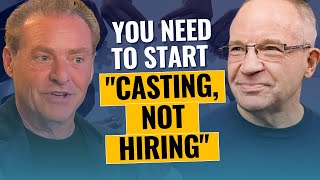
Dan Sullivan and Mike Koenigs propose replacing traditional hiring with casting: personalized role descriptions, audition-style selection, and focus on ensemble chemistry. They use a 4x4 tool measuring attitude, performance, heroism, and deal-breakers, and plan to turn the idea into a quarterly book by Labor Day.
Chapters
He says automatically the word hiring has problems with it. And he says, in theater, you don't hire people. You cast people. Yeah, we should have casting, not hiring.
You don't just seek someone for their character. You're looking for charisma and compatibility with the other characters. Right. So the job of a casting director.
What you want to do is you want to be fully engaged and energized by your work and the people that you're working with. Yeah, there's great meaning in that. There's great meaning. The problem with meritocracy, it's pure competition.
But theater is not pure competition.
Yeah.
Theater is pure teamwork.
Yes.
Well, Dan, you and one of my favorite people, people in the world, Jeff Madoff, are working on a book called Casting Not Hiring. And first of all, it's a super catchy idea. Super catchy phrase. It just turns out. I was just talking to Jeff a few days ago, and. Why don't you talk a little bit about what the big idea here is, why this is such an important book and how it's going to be unique and different compared to the traditional mindsets of finding and hiring and growing teams.
Yeah, well, first of all, Jeff and I have backgrounds, so we're both from Ohio, and we were both born in the 1940s, and so we've got lots of decades of experience, and we're interested in a lot of the same things. History and culture and politics and all sorts of things. And so about two years ago, we created a podcast series called Anything and Everything just to not nail ourselves down.
To that option Junkies.
Yeah. So. So anyway, and we have great podcasts, and it usually happens on Sunday afternoon because I find Sunday afternoon just about the most boring part of every week. And. And so we go and, you know, we produce, you know, usually two per session. We've done over a hundred podcasts. And. But he just dropped a line because he's very interested because he teaches at the New School. I mean, Jeff is a documentary filmmaker. He's a great organizer of big events like the big Victoria's Secret.
Ralph Lauren, their, you know, their new wardrobe, the new new season of wardrobes, and he would video it and help organize the events. And. And he's a great interviewer. And he's. Right now he's in the midst of a.
On the Way to Broadway musical called Personality. Yeah. Which is a life story of Lloyd Price, who was the first real crossover artist from whatever was before rock and roll to rock and roll, I think. 10 number one hits on the hit Parade. Great, great story. And so anyway, but we were just talking about, and he was talking about, you know, the difference between great employers and really bad employers. Yeah. You know, and he was, because he's interested in entrepreneurism, he's interested in theater. And he says, you know, he said, I think the, the problem is in the word hiring. He says, automatically the word hiring has problems with it. And he says, in theater you don't hire people, you cast people. Yeah. And that we should have casting, not hiring. So I just wanted on record that it was Jeff's phrase. Jeff's phrase. But I like new ideas and once I get engaged with a new idea, I, you know, I just start. So I went back and I said, jeff, I think we have a book here. And I put together structure of the book, which I sent you. I sent you sort of the.
Yes.
You know, you know, just an outline of what the book might contain. He got real excited. So it's in the schedule for our next quarterly book. We're just finishing up one now. So this will be book 39 in the, in the small book series that I've been at for almost 10 years. And so. But you find the phrase catchy. What's catchy about it for you?
Well, I, for many years, one of my best.
Things I ever did years ago is I wrote an advertisement called Mr. Or Mrs. Moneypenny wanted for secret missions. And it was. And it opened up and it said Mr. M seeks. And it described the secret missions that I wanted you for. And then it described all the qualities and capabilities of this person. And it, it ended by saying, okay, here's, here are the rules of engagement. Here's the mindsets you need to come. And that was really specific. Like this would not pass traditional HR rules. Like, for example, I said, and at that time I needed someone who is in person. And I hate the smell of hard boiled eggs and I don't want to ever be around a smoker or.
You know, I, I wouldn't hire someone who's an addict, for example, you know, an active addict. But I was like, if you smell like tuna fish or hard boiled eggs or have perfume, I can't work with you if you walk in and smell like cigarettes, well, that would be considered discrimination by someone. But it's like, I won't do it. And anyway, part of the application process was casting a sort. But I had them go through a whole bunch of hoops in order to even communicate with me. So you had to start by filling out a survey. And then I gave you five tasks and you had to notify me when you started. Started the five tasks and then.
Notify me when you finished and then send the results. And you wouldn't get the tasks until you started. And I'd say, you're going to need 30 minutes for this. And so right away. Well, I had people who. Some of the responses were, you know, agent Melissa.
Here for, you know, showing up for service, sir. You know, it was like they actually responded in character. And then I had some people who like, just automatically ripped and bitched about how can you possibly ask someone to do something? You know? And so. And I ended up augmenting the. The. The application to say something along the lines of, if you're a whiner, a complainer or a malcontent, and you respond, I will never see your bitch. Okay. Because I have someone else filtering this and. And a. Holes don't get through. And that's. By the way, you're going to be. Your job is to protect my time and my. So anyway, the whole point is I created a performance that someone had to make, but I never would have thought about it as casting. It was test. It was not digestible.
Yeah, you're. You're auditioning.
Yeah, I just.
No, it's just exactly what you just said. You not only described how it works, but you also described why. Why you would do it this way rather than hiring.
It shows up in character. Yeah.
Well, we have a tool in coach called the 4x4. Yeah, okay, right there. And it's got four categories. So it's four categories, and each has four.
Things that you fill in. And the first one is attitude. That if you're going to work with me, you have to show up alert, curious, responsive and resourceful. Okay. You have to show up like that. And then I describe exactly what it means in terms of the actual work to go. You're alert to. You're curious about this. And then performance things have to get done faster, easier, cheaper, and bigger.
Yeah.
Okay. So with that, after six months, the thing that we're casting you for, it has to happen faster. It has to happen easier. It has to. So you got to bring some innovation and. And creativity to the job. You've got to actually form the job and create the. Create the job or the role. You say the role, to use theater terms. And then the third one is called being a hero. You can be a real hero to me if in the first six months, you achieve this, you achieve this, you achieve this, and you achieve this. Yeah. And. And then the fourth column is. Drives me crazy. Do not do these four things because it drives me crazy. And I don't care if you're acing the other three categories, I'm still going to fire you. Yeah.
So.
So good.
So Gord Vickman was the first one to go through that process.
Yes, I remember. Yeah.
And he showed up for the final. So he had gone through screening. He had gone through five levels of screening.
Yeah.
Then I gave him the four by four before he came to the final meeting. And he showed up, and he says, well, first of all, I want to tell you that.
I think the reason I'm meeting with you is because you want to hire me. So I've laid out what I'm going to achieve in the first six months, and I'm going to achieve this. I'm going to achieve this. I'm going to achieve this. He says, that's what I get from your description of what you want. And he was bringing a lot of his radio background and knowledge that he could bring to the job and everything else. So we were halfway through the meeting, and I said, I just. The answer is yes.
Yeah.
And he says yes. And I said yes. I said, I thought probably sometime during this meeting you'd want to know whether you have the role. And I said, yes. Yeah. And.
Oh.
Oh, that's. I said, so, thanks for coming in. And Eleanor will let you know.
Yes.
How to. How to show up, when to show up.
Yes.
And everything else. But I. That's pure casting.
Yes. Well, and. And, you know, I was just thinking about this. So, first of all, I'm going to lay some compliments on Gord. He's actually listening and watching us right now.
He's a perfect character for the role. Right. And he has the perfect backstory. He has the right mindsets, temperament.
You know, the way he shows up is.
He'S perfect for the role. And you don't just seek someone for their character. You're looking for charisma and compatibility with the other characters. Right. So the job of a casting director.
Think about, like, what it takes to cast the right people with the right on camera charisma and the ability to work together in one of the most intense environments. Like making movies is freaking hard. Really hard.
Theater.
Yeah.
So theater is even tougher because you have to do it live every day. Yeah. Yeah.
You got no margin. You got no margin. And in the world now, where it's augmented with a whole new generation of tools.
On top of it, in this case, you know, much of Gord's role is in media, so he's looking for congruence. He's here to protect your brand, the brand of strategic coach. Make sure that things are produced in a certain way, making sure that you show up and, you know, the preparation that took place, even for this episode right now, you did your fast filter.
I just love the mindset. It shifts the way you behave and think.
Yeah. And so let's look at it from the standpoint of the person receiving the, you know, the.
I don't know what you would call it in the theater world, but we're casting for a person. I guess that's what is, you know, the casting description that we're looking for an individual to play this part. So rather than a job description, which is impersonal, you're. You're doing a very, very personalized, uniquely targeted description of who the person has to be and why they're important and what they have to achieve. So what's the difference of. Of responding to a job description that is completely impersonal and doesn't really relate to you? It just relates to a series of qualifications that don't really tell you much about the job or anything like that. And receiving a description, you know, I use my 4x4. But you gave the example of Mr. Moneypenny. Yeah. And so what do you think? So in your case, it did two things. It totally attracted to some people and drove other people away.
Yes.
Yeah. It infuriated people. It was sort of like. It was, how dare you? And it was, I believe, the kind of person that would have a reaction like that are the frauds who know they'd be found out fast. You know, they couldn't play the part.
And in the world where you like the. The rules of engagement, they want to play.
They want to play their part, not your part.
Yes. Yeah. Which is as a victim right from the start. Right. So I just love how that.
Feels. And. Yeah, and I think that's, like. When you have. When you start with something that resonates right from the beginning. God, that really. That really works. It just really works. So that's what my reaction right away is, that it changes the behavior.
I've tested this on about 20 people, both team members, inside coach, and entrepreneurs in the program. And everybody got it the moment I said it.
Okay. Yeah.
I got a new book idea. It's called Casting not hiring, and everybody got it. It was just like. Everybody just instantly responded, which is always a sign of a good name. Mm. Yeah. Yeah.
It's really good.
And you can see some categories that I put together on the book description.
Yeah. So that. Yeah, let's dive into that right now.
You know, you brought up something very, very interesting in our previous podcast where we talked about AI. Mm. I'm gonna just put an idea. I'm just doing this off the top, but I'm just gonna talk about it. Is that AI properly used, allows your work and your life to be like theater.
Yes.
Yeah. And free humans to be.
Theatrical. It allows humans to have. Be part of a great story for humans to be great. Of a great entertainment. Those humans. Yeah. Where the hiring. The whole hiring process, especially dictated by government regulations and HR process, is actually turning human beings into machines.
And humans are really terrible at being machines.
Yes. I'm looking at your words while you're saying them, and I'm. I'm trying to formulate where to go with this, so I want you to just repeat that. AI properly used, allows your work in your life to be like theater, like artistry.
You know, it's like a.
You have unique abilities and allows you to be part of your story or somebody else's story and take part in a. It makes life become like a theatrical story. It's got a middle, you know, it's got a beginning, a middle and an end. And, you know, it's got drama to it. It's got emotion. There's entertainment and everything to it. And I would say that, you know, one of the things that we do in Strategic Coach, we tell people, you can't use the retirement word. You can't use the R word. What I. I have never understood. What is it about your work that makes you want to retire from it?
Oh, yeah.
It's when you fall out of love with it enough that you feel the fatigue of life and you assume they're both the same thing, you know, and that fatigue kicks in versus waking up excited about creating a new transformation, innovating something new, collaborating.
And I think, again, that's what great actors do is they elevate each other. They look at every appearance as a performance.
And I changed my whole psychology about speaking several years ago when I really, really became aligned with the idea that I am. I am there as an entertainer to perform and create excitement and elevate the passion of the room. That as a. I am there to elevate that audience. And even my team, when we do our superpower accelerator experiences, they know that we are on stage performing and collaborating and creating art together. We treat everybody. And I know when I communicated that the psychology of My team changed and I realized now, and part of this is I was looking at these words and I realized the areas of my business right now that are not exciting for me or my team or don't feel like they're hitting is because we are not using that metaphor. I think this is a opportunity to shift the mindset and the metaphor you operate within.
So if I reflected that back to you, Dan, to articulate metaphor isn't a strong enough word to represent.
What this could mean. But like Disney's done it for a long time. Right. They've always worked at that until recently.
Until recently.
Yeah, yeah. No, it turned into poo. Poo.
Yes. Huh. But the big thing, big thing that I see about it is the. See I'd like to bounce this off against the big development in today's world, which is artificial intelligence.
Yep.
Okay. What I'm saying is that if you.
You see, you can say that you, you're freeing people up from work they don't like doing, but you're not telling them what they're freeing up to do. You know.
In other words, it's giving freedom from, but it's not giving freedom too. What you want to do is you want to be fully engaged and energized by your work and the people that you're working with.
Yeah.
There's great meaning in that. There's great meaning.
Welcome to the world of 3 second attention spans and fewer than 20 seconds to get a prospect's attention, engage them, get to know like and trust you, and say I want and need what you have. Let's make a deal. Introducing Digital Cafe AI. A relationship building AI that will take your hard earned leads and make them feel like you're sitting down with them for a cup of coffee. Listening to their needs and responding to them with a personalized, useful, resourceful solution. It's the perfect AI team. A digital Cafe AI does hours or days of work that normally requires an expensive team of specialists in minutes. It's the fastest, easiest automated way to get attention, engagement and trust to close bigger deals faster. A digital Cafe AI is a done for you service that can be adapted to any B2B or B2C business. Money loves speed and time kills deals. So visit Digital Cafe AI to see how it will work for you.
We notice in our company because we hire a lot of 20 year olds that one of their requirements in going into the workplace, usually after college for most of our, our team members. Yeah. Is they want the work to have meaning.
Yes. Oh, for sure.
And it's Almost like it's, it's. They're. They're actually auditioning you. They're. They're actually auditioning you. Yeah. Does your, does your company have meaning? You know, we brought up an issue in a previous podcast about what's putting. What's, you know, what's going to unify this new technology, what's going to. And I think it's a sense of theater about your life is going to be possibly.
Oh, for sure.
So. So let's go down that path a little bit more. Give me a let's pretend use case how that might show up.
Well, I grew up just after the second World War and I have to tell you, the requirement that your work have meaning would be.
Yeah, yeah.
Not under. Not understood.
Yes.
Now you have a job and you're going to be able to pay the rent, you're going to be able to pay the mortgage and you're going to be able to eat three squares a day and maybe you'll get some luxury around with that.
Yeah.
Liking the job or having the job meaningful, that was important. I mean, I mean it would be bizarre. You'd be laughed out of the room and not invited back if you ever made that requirement. And what it was now that 20 year olds and 30 year olds and teenagers are starting to make this a requirement that I won't come to work with you.
Yeah. Because I don't see that what you're doing as a business is actually giving any meaning. There's no meaning. I don't see. I don't see what you're doing here. That doesn't seem to be any value except making money here.
Yeah.
And everything. Well, that's a big jump from 1950-20. 2020, the 2020s. But it shows you how much people have been freed up.
So here's where I went as I listened to you, Dan.
If you approach this. So it's like working with meaning.
But if the metaphor. Again, again, I want to find a word that's stronger than a metaphor, is a good word.
It's all metaphor.
It is, but it'd be like something.
That we live in a world of metaphors.
I want a brand. You know, it'd be like something with punch, something with longevity, something that no one else has, you know, trademarkable. And. But if the, the way to approach it, again, I'll just use the word metaphor. It's we're going to make a movie together. And you'll be judged at the box office by the critics and by the.
Fans and by Your fellow.
Totally. Yeah. By your. Not just the ensemble, but the industry. It's the equivalent of the Academy Awards, Right. Where you're peers judge you.
And the ensemble, which. The ensemble is the cast. Maybe it's by the cast.
Yeah, it's the cast.
Yeah. So we've got box office, critics, fans, peers, cast. And again, what. What this doesn't feel. This could shift. Like my son, who's 21.
Was, who is raised in a very capitalist environment where anything I talk about would be based on a meritocracy. You know, I've always said I don't care what suit you wear or what your. Even your beliefs necessarily, as long as you don't bring that drama into my environment. But I'm going to judge you based upon your performance.
I'm going to judge you now. I want to like you. So that's not entirely true. You know, there's values, compatibility. But I think, again, it's box office critics, fans, peers, cast that could change the conversation you have with young people and make what is now capitalism's been butchered by social media and, you know, a politicized agenda.
Well, capitalism, you know, from my perspective, I wrote one of my books on that. It's just a method.
Yeah.
Capitalism doesn't create meaning. It's just a method for achieving. Achieving things, you know, and, you know, and I don't know too many teenagers who understand that the whole way the world works is based on a particular method. And some people are better at the method than others, so I'm not sure. But what they really want is that life have meaning. You can have a conversation with them about meaning and excitement. But the other thing is the problem with meritocracy, it's pure competition.
But theater is not pure competition.
Yeah.
Theater is pure teamwork.
Yes. Right. So if we. Okay, that's a great.
Distinction I wasn't paying attention to.
In a movie or a play. What do you call teamwork.
When you're performing? That's judgment by the cast. But.
The teamwork is. Is like the performance. It's the applause, but it's.
It is the magic. You know, the. The teamwork is magic. I mean, one of the things that impressed me so much about Jeff's play personality was just how much the cast. And I've seen it. How many times have I seen it? I've seen it once, twice, three times, four times, five times. I've seen Five, five times. And every time, the. The togetherness of the team just got better. And they. They really. You could tell they really liked doing what they were doing, and they really liked doing it with each other. They, they, they really.
Yeah, yeah.
That has a lot. That has a lot to do with Jeff. And the whole backstage team went together.
So they call it the on camera magic or the charisma between the characters. What's the word that it's used for that? It's. But we'll just call it magic for now.
Yeah, yeah.
But when you. When you genuinely can see that there's electric. It's electricity. God, I'm trying to think of what that word is. Siskel and Ebert would say it when they'd say they had chemistry. Yeah, yeah. And I think that is another way to. To articulate that.
I was looking at.
We were at a French restaurant that's longest surviving French restaurant in Toronto called La Cele.
I've been there with you.
And they've had posters on the wall.
But the right across from me was one of my top three movies of all time, Casablanca with Humphrey Bogart and Ingrid Bergman. And it's very, very interesting because.
There.
Was a magic about that film. And I saw a documentary on it. They said nobody expected this film to do anything when it was being made. Okay. And it was in the editing room and it was in the. You know, how the play was put together. And it was one of those movies that was put together in about five, six weeks because MGM and the. The movie studios. I don't know if it was MGM, but it was. They. They have 50 movies going on at the same time that they're making 50 movies. And nobody expected, as a matter of fact, the casting for it was supposed to be Ronald Reagan as Rick and Susan Hayward, as it was. And so they brought. They said, we can't get them. So we had to get Humphrey Bogart and Ingrid Bergman, you know, and that's just magic. There's just magic there. The cast and not just the two of them, but all the supporting characters and everything else. That was real magic. And, you know, and it's memorable. I mean, I've watched it 20 times, you know, in the last 50 years. I've seen it 20 times. Yeah. And it. It's just. I mean, I fell in love with. I think I saw that movie the first time when I was 5 years, 6 years old, and Ingrid Bergman was absolutely my first love in life. Yeah. Unattainable, but yeah, you know. Oh, yeah. Guys.
Guys got to have something to look up to. That's for sure. I love it.
Yeah. Yeah. So I think that the. The. We could identify 10 things that cast, being cast in a theatrical performance has that being hired into an organization doesn't have.
Yes, well, that, that is, I've been writing these down. So, you know, it's again, box receipts, critic, critical acclaim, fans, peers, magic, chemistry and press. You know, it's sort of like, are you sureable? But also.
You'Re just talking about Casablanca. Right. You saw it when you're five, that's an old movie that still retains its magic. Or six. Okay. But it, it retains its magic. So there's the longevity.
And, you know, it's the value of the property. But I, I, I think you're so onto something here by changing the entire conversation about what it's like to be part of a business. And again, I haven't deconstructed Disney to see how, how deeply they used to go with the metaphors, and maybe they did. You know, we always heard about behind, you know, backstage and front stage. Right. You got a backstage team and a front stage team.
I know Peter uses that to some degree, but. And so does, I think Tony Robbins does. Or they used to. I don't know if they still do, but.
Maybe just for.
Well, anything else to add to that when you think about the criteria, because I like the model. This is a very, you could get an employer excited. You can get the applicants excited, you can get the existing teams excited and get them to think differently. The exercises you could build. It just feels more fun.
Yeah, but I think it's happening, you know, and I think it's more resonant today than it was 20 years ago. And the reason is because technology is forcing people to make some decisions about who they want to be in their life and how they want to live their life. And I, it's, you know, I liken it to, you know, how eagles teach their little ego. It's how to fly.
They throw them out of the nest.
Yeah, yeah, of course. Yeah. It's like the cuckoo, you know, they, you have to get pushed out before your head's too big and you can't get out. Out of the hole. Yeah, huh?
Yeah. But the big, big thing about it, the ones that don't hit the ground can fly.
And I think the technology sort of started putting humans in a position. Can you fly or are you going to hit the ground?
Yeah, the cuckoo, while they're cuckoo, is they've had massive head trauma on the way down. Clunking down. That's why they're cuckoo birds.
Anyway, I'll tell you what, I'm really happy with is that you really instantly went deep with this concept.
Oh yeah.
Well, it's fun. It makes a part of business that I just, I've never liked any part of hr. Like I, I have. I'm a, I'm a one circle deep team player. Like as soon as there's multiple rings, I am not good at it. I don't need to be good. I don't want to be good at it. Now I should be, but that's what operators are for in my experience. But I love the idea of having cast meetings and back of stage, in front of stage meetings and exciting them about not just the performance. I love the idea of the play, but I'd love to make the documentary. I'd love to make the movie version. I'd love to create the franchise. You know, how do you Toy Story this, you Pixar ify it. And there's so many useful metaphors to excite different types of people and make them feel like they matter and they belong. And back to when you talked about the need. Work with meaning, but it's also work with purpose. And it inspires. Like how do you not you, you can't. No one's interested in your one man show. And unless you've been doing, doing something, you know, like comedians, that's the ultimate one man show. But you don't need a cast if you have a stool and a microphone. Right. This is a different, different type of performance that's for the one person, billion dollar company. Whenever that happens, great. But this is not for.
As a way different type of person. So that. Anyway, what else did you get out of this and what other takeaways do you have?
The big thing is that we'll send this to Jeff because we're starting the process.
Four weeks. We have our. And so I'll be writing fast filters for each of the chapters and then we get interviewed by Shannon and then. But it'd be. Jeff and I together will be interviewed. Okay. And. And then the transcript goes to the writer, they've got the outline and back come the chapters. And. But also Jeff has tremendous connections in the entrepreneurial world and also in the theater world, the entertainment world. So he's gonna, he's gonna do a lot of interviewing. And I have, you know, I have 50 years of entrepreneurism under my belt. And you know, and so we each have about 50 years of experience.
Yeah.
In the business world. And I've always been very, very attracted to theater. And one of the reasons why we, you know, we invested in the play is it gave me a chance to actually be on the inside of something that I set off in life. When I was 18, 19, I thought I was going to go into theater, and. But I ran the entertainment program for a army base in Korea, and, you know, and so I got that sort of. I. I knew I couldn't make a career out of it. Yeah. But I love the. The whole atmosphere of theater.
Me too. Me too. I would have loved it a lot more if I would have been able to think this way and felt like I was part of it in the past. And that, again, is where I used to go, ew, theater people. Because it was like, I just wasn't interested in the drama. But this can actually remove that yucky yuck that I used to feel like when I see Jeff in his performances, I'm like, I want to be part of that. I want that director. Like, I want to be part of that show. And again, I just think there's so many positive.
Mindset and mental tools that can come out of this. And.
You know, I couldn't think of two better people to partner on something like this because of your, you know, joint love of theater and films. Like when. When Jeff and I talked. And here's. Here's our typical scenario. He'll reach out and we wind up. I've always said he's my longest coffee date ever. If we meet up at 9, 9 o' clock in the morning in New York City, we finish at five because it's time to go home. And the other day when we chatted, I'd have to look at my phone log, but our conversations usually last 90 to 30 minutes to three hours. And. And what we're doing is trading shows to watch and talking about movies and plays and actors and actresses. So the mental models that he's formulated from decades of thinking about this and immersing in it, I just think that you'll come up with so many great thinking tools, like, there's a library of exciting things you can do here. This. This upon itself is a franchise and a product and a. In a bigger book.
Yeah, well, I think it's a major book. You know, I think it's one of them. I think it's a major book. And I. The moment he got the words came out of his mouth saying, casting, not hiring. I said, that's a book. Yeah, that's a book. Yeah. Yeah.
Oh, it's.
And I. I know books.
Yes, you do. Yes, you do. So this is. I agree. I think this is a.
It's a Great book. I can see a lot of worksheets and tools and thinking tools and being able to establish lots of little boxes and mindsets that go along with each one and ratings and values. So I can't wait to see.
Your first iteration and your next iteration.
We'll have the quarterly book out on Labor Day.
Okay. Oh, what a perfect celebration.
Interesting. Yeah.
I hadn't thought of that.
No, that's a great celebration.
Yeah. All right. Well, this was extraordinarily valuable to me and I think Jeff will find it, you know, very gratifying your response to it. But, you know, the going into all the different dimensions that we covered in the podcast, I think it was fantastic.
You know, and that's good. Well, here's what we're going to do. The good news is I've got some great AI tools. I'm going to plop this into which transcribe. It's going to create a whole list of all the questions, all the big ideas, call outs and I'll have that sent to you just a couple hours from now along with a rough cut. So he'll have it. You guys will be able to review it and share it and you'll have what I hope, I hope this will be useful for the development evolution of the book and oh yeah, whatever you create.
But sure, we're going to be bouncing things off you as we, as we develop this. Yeah. Anyway, but I told him, you know, you don't go to the publisher unless you, they can see the whole book, you know, so, you know, and my publisher has been after me because we did three.
Yeah.
And that, that was a complete project. We had the transformative trilogy but they've been phoning us pretty well every month and they say, you know, what's next? You want something.
This is it. Because who not how gap in the gain 10x. This is just a natural to me. It's the unifier. Because.
Who not how is a great book, but it doesn't get you to team. And this, this is.
This will be delightful and timeless.
Gap in the game keeps you from having an overdose. Dying of an overdose.
Yeah, yeah, there you go.
Yeah.
Yeah. Every addict. This should be in every. Yeah, this should be in every attic book. Interestingly, like I went over to my friend John Astra's house on Sunday. We spent hours together, six hours in his bible. In his company right now is 10x multiplier. And he, he showed me it was completely dog eared and written all over. And, and I do think it is time for the next big book. So little book first, big book second. That'll give you some time to tweak this a little bit and for Jeff to give it the.
Thought that he puts into everything he touches as well.
Yeah. Yeah. All right, good.
Well, a big hooray for you.
Thank you.
All right, well, I'll wrap this one up with. If you're as excited about this book as I am, make sure you comment. And this is a great thing to share with your teams right now, even before the book is ready. And as this thing gets closer, we'll update the descriptive copy so you can go get the book, which, of course, you can go to strategic coach and just get on the list so you get notified when the book is out. And you can download some of other Dan's other quarterly books, which are always mental transformers. And by the way, if you're not in strategic coach, you want to be in and get your butt over there right now and apply, because for me, it's the best investment I make every single year that I will do as long as I'm alive and my best friends, connections, relationships are part of that community. So thank you, Dan Sullivan.
Yeah. And we'll see you at Tacos Sunday. Tacos Taco Sunday.
Coming right up.
Sam.
More from Mike


The 3x3 Framework That Changes How Entrepreneurs Think | Mike Koenigs & Dan Sullivan








Why Your Business Gets Harder As It Grows | Michael Walsh on the Hidden Danger Zones of Scale
