Three Professional Poker Strategies from Wayne Yap to Give You an Unfair Business Edge
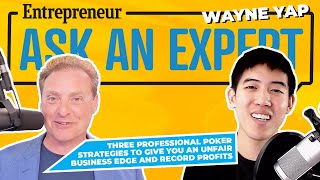
Wayne Yap, a professional poker player and business advisor, shares how poker strategies apply to business. He turned a $50,000 bitcoin investment into $120,000 and won $719k at a high-stakes Macau tournament. He explains strategies like Edge Finder and Brand Bluff from his book Zen and the Art of Business and Poker.
Questions this video answers
ugadvisory.com/free
About $40,000
~$50,000 buy-in; roughly $719,000 first prize (reported as $719,000+)
Bought about $50,000 worth; it rose to about $120,000
About $300 per month
Chapters
So what's the most powerful game you can play that trains your brain to win at business? In a moment I'll give you the answer. But imagine giving your business record profits through an unfair edge that would enable you to make difficult high stakes decisions in seconds with limited information. If you said poker to my first question, you win. Poker is easy to win, notoriously difficult to master, and Warren Buffett once said, if you've been playing poker for half an hour and you still don't know who the patsy is, you're the patsy. Now, in the world of professional poker, the most winning players use eight core strategies to overcome their fear of loss, make multimillion dollar decisions in 30 seconds or less, and outsmart or world class competition in a zero sum game. Now, it's very similar to succeeding in business where you need to manage your fear, have a statistician's brain, see invisible opportunities, and know exactly when to move in a perfectly timed and coordinated fashion. Now, in a business's lifespan, there are thousands of ways where you could lose your reputation, net worth or get ambushed and decimated by the competition. So what if you could increase your odds of success three to 10 times for any of these decisions? So today you'll learn how a professional poker player's mind could be the secret weapon you need in your business. You're going to meet Wayne Yap. He's one of the youngest multimillion dollar earning poker players and winner of the high roller event at the acop. He's developed eight non obvious strategies based on years of playing professional poker that he applies to startups and established businesses as an investor in and advisor. Today he's going to share three of his eight strategies from his new book, Zen and the Art of business and poker. 8 Professional poker strategies to give you an unfair edge. So Wayne, thank you for being here, my friend.
Yeah, hey Mike, it's good to be here.
All right, so you've made the big transition that not a lot of people get to do, which is you go from an award winning, multimillion dollar, multimillionaire poker player to becoming a full time entrepreneur, advisor and investor. So I want to open up today and ask you what's the biggest lesson you learned from playing professional poker to transitioning to business?
Yeah, the biggest lesson I've learned is that you need to know where you have an edge in any business or in any game that you play. And that strategy is called edge Finder. It's kind of like what you said about Warren Buffett. If you can't Spot the patsy. You are probably the patsy.
All right. And what do they call that in poker? What's the equivalent of patsy in poker?
If you are like, usually people call it a fish, but if you're a really big one, you're kind of wheel.
Okay. All right. So why don't you talk a little bit about how your edge translates.
From a business perspective?
Yeah. So when you go into business, quite often you don't actually. You just kind of do something. Like if you go and buy some Facebook ads, you're like, okay, I'll buy some Facebook ads and see what happens. And quite often when you go into something like that and you don't know where your age is, you're really just relying on luck and it's probably not going to work.
Yeah. One of my friends and one of my mentors, Tony Robbins, calls it smoking hopium. You can't make hope your strategy. So why don't you talk a little bit about. You told me a little bit about a trip that you took to Dakar, Senegal, and how you got yourself in some trouble.
Yeah. Wow. So my Swedish friend wanted to go down to Dakar because he saw that there was a tournament there and he heard some rumors that there was going to be really good games. So I was like, okay, I've never been to this country before. I was probably 23 at that time or so. And I was like, all right, I mean, let's do it. We went there. I very quickly busted from the tournament and I went to look for the cash game tables. I went to the cash game tables. The only high stakes game that was running was five card pot limit Omaha. So I usually play no limit hold' Em and I played a little bit of Omaha, but never played the five card variant before. But there was a big game. I think it was around close to 10,000 US buy in. And I was like, all right, I'm in. So I played for, I think, four hours and I lost $40,000.
And really, after I left that table, I started reflecting. I was like, wow. I was actually the only one who never picked this variant before. And I was probably the fish at the table. And that was a really expensive lesson for me to learn.
All right. Yeah. No, it's like, I can't imagine that experience. I hate losing money. It's one of the reasons I don't gamble in the first. It's like I don't have an edge. I know I don't have an edge. I know better. And every once in a while, I'll Walk in. But that's awesome. So why don't you talk a little bit before we get into some of your other strategies? Let's give everyone a little bit of a background, because one of the reasons why I wanted to interview you in the first place is when I learned about your background, I was like, okay, this is a great story. It's a great story of transformation, and it's also a great story about shifting and reinventing as well, especially at an early age. So where are you from? And tell us your story about how you got into poker in the first place.
So I'm born in Singapore, and if you've never been to Singapore, it's really an East, Midwest. It's very modernized. It's the nicest country, maybe in the world, in my opinion. And yeah, I really love it in Singapore. But really, I started getting into poker when I was about 17, 18, and when I played with my friends, then we would be so into the game that we would skip our classes. We would go to an empty classroom and play poker. We would climb out of the school gate because my friend lived opposite school and he had some poker chips. So we would go there and play. And the more we started playing, we are competitive. My friends wanted to get better at me. They went to pick up some books. I wanted to get better, better than I picked up some books as well. And I realized that I was coming ahead winning much more often than I was losing. So I really thought, like, hey, maybe I'll put a bit of money online and try to see if I'm actually as good as I think I was. And I put some money online, I started winning, but then A levels came, which is our pre uni exam. And then I had to go to army after.
So I really know when you live in Singapore, you have to go serve in the military, correct?
Yeah. So it's mandatory. We have to serve for two years. And my first few months I went in, I was like, okay, I'll just kind of be a good soldier. And so my army camp officer actually wanted me to go to officer school, but I was like, wow, if I go to officer school, I wouldn't be able to go home as much. I wouldn't be able to play any poker. And that was the only thing I could think about. So I was like, no, I'm not going to do this. I'm going to try to slack off in army as much as I can to get good at the game. I was so extreme in the slacking off from the army part. That I would sneak in my ipod touch with me when I went to camp, even when I went to the jungle, so I could listen to training videos. And at that time, my pay was 300 US a month. And, I mean, Singapore is not a cheap country that doesn't get you very far. And I wanted to get good at the game, so I went to buy some training videos. But I remember I was like, wow, this training video, one month is $50. I can't really afford it to kind of have it on ongoing basis when I didn't have much time. So I was like, okay, I'll go in, sign up for one month, download as much as I can, the entire library, and slowly study it in camp. So I would be in the jungle doing my gut duty in the shell strip and listening to the tracks for how to get better at Poker.
Awesome. So let's talk a little bit about how you started to apply that then. So you're making 300 bucks a month in the military. You're basically playing casual games. How does that translate then, into actually making money and what happened next? And I also know that you had a moment with your family that really changed your life too.
Oh, yeah. So the moment with my family. Right. So right before that, I went to Brunei. I was forced to go to Brunei, even though I was trying not to go. I mean, it's mandatory to go. And we had to go to the jungle for training. It was, wow. Like, that was one of the worst memories in my life. I remember thinking to myself once, like, wow. Like, maybe I should break my arm. It would be better to be in the hospital than in army or in prison. That was kind of my headspace at that time. And in Brunei, it was so hot. If you've been to Las Vegas in the summer, that's basically what it is.
Except it's a wet. It's a jungle hot, not a dry hot, right?
Yeah, but it's the same hot. But you're sweaty and dirty and. Oh, man. And, I mean, we didn't have proper places to sleep. We had to dig a shower strip to sleep in. Because when we do the duty and stuff, and then we would go to the other side and poop and dig a hole there to poop. So when we were digging the shell strips, obviously, like, somebody else has trained here before, and they would look for the cleanest ground, so it always smelled like somebody else's poop. And there would be insects. I even have scars to this day that itch right now.
Okay. So I had a Terrible experience in the Brunei army. I was like, okay, I want to get better at poker. I want to make sure I don't have to live this kind of life forever. And then I go back to Singapore. My parents were supposed to pick me up from the airport, and I called them. My dad said, hey, come back. Take a cab home. Mom and I are at home. So I went back home. When I walked into my house, I saw my mom kind of sitting at a corner crying. And I was like, hey, what's going on? I spoke to them. They told me, oh, their business had failed and the bank had to take their car away. And yeah, like, as an Asian family, yeah, it's. I mean, I guess everybody feels really hurt by it, but Asians kind of have that pride around them that made it even worse. And I was like, okay, I've been making a few thousand dollars now. I was like, okay, I can help them a little bit. I gave my mom a thousand dollars, and that was a moment that really changed my life. Because when I gave her the thousand dollars, the look on her face.
Really changed everything. And that really made me want to. Want to get good at the game of poker.
Got it. So here you are, some of your first winnings. You give them to your mom, turns things around. They look at you and what did your parents want you to become when you got through university and got out of the military? It must not have been a professional poker player, but what did they think?
Well, I mean, most Asian parents want their kids to be doctors, so that's probably what they wanted. I mean, they didn't explicitly say it. And I was kind of a rebel growing up, so I guess at a certain point they knew I was not going to do that. Throughout my university life, so many of my high stakes poker friends, people that knew I was already making money playing not that many hours because I had to study for school. They asked me to quit school, but I was like, I felt this inner thing that's like kind of from my parents, like years and years of telling me that I had to finish university. So I pretty much finished university and never used my degree just because of my parents. So they really wanted me to finish my university, but they were actually okay with the fact that I would play professionally. I guess it helps that I was already giving them money and they knew I was actually making good money by then.
That's good. That's good. So what happened when you left the military? And how did you really get into professional poker? And then how did that end up Transitioning into business for you?
Yeah. So when I first left the army, me and a few friends, we went to Macau. I remember reaching the airport in Macau, first casino I see, it's called City of Dreams. And I'm like, wow, this really feels like a dream. And I went there, played a bit of poker. I went to another casino to win, and I saw a bunch of high stakes tables, and I was looking at the big boys playing in that big boy game, and I was like, one day I'm gonna be there. So I started thinking about how to improve in poker, but I had to balance school as well. So I flew back and forth from school, but at the same time I was playing semi professionally. I started making a few hundred thousand while in school, and when I graduated, I studied even more. I made it to the high stakes games. And eventually I kind of realized that.
The high stakes poker game isn't what I thought it was. It's actually quite stressful. You win and lose a few hundred thousand dollars all the time. And the reality was that if you wanted to play with the fish, the bad players, sometimes you have to play 20 or 30 or 40 hours non stop in order for you to actually make pretty good money.
And so, yeah, that's kind of how I my poker experience.
Okay, so why don't you talk about how you started using some of your skills from poker in business and you also started dabbling in investing and you really realized that you needed to get out too. I'm really curious about that transition.
Yeah, so somewhere along the way, I realized that many of the things I learned from poker, I can just apply it to everywhere else in life. I mean, I've always thought poker as a microcosm for the world. Anything that exists in the world, you can kind of learn it through a very complicated and imperfect game like poker. I mean, a game with imperfect information. So I started doing some business, I started doing some investing, and I got pretty fortunate with the investing. I mean, there are some really smart minds in poker. And we would talk about stocks, we would talk about our strategies in choosing stocks. I picked Amazon, had a pretty good time, and we played a lot of games. So I bought Activision Blizzard. I think it doubled in a short period when I bought it. And then I also got bitcoin because I wanted to move money from Macau to Australia. So I think I bought it at about, I think I bought about $50,000 worth. But by the time I got to Australia, it was worth 120,000. So I was like, okay, maybe I Can do some things apart from poker as well.
Good. Now, I know you told me before we started rolling that one of the things you started struggling with was that poker was a zero sum game. And you also started doing a lot of inner work. And why don't you talk about how you started investing in your personal growth and where you went and took things from there.
Okay, so. So about 2013, when I was still in school.
I wanted still not playing the high stakes game. I realized that if I wanted to play high stakes, I had to have peak performance. So I started doing meditation. I started reading a lot of personal development books, like the Power of Habit. That was one of the first books I read the seven habits of successful People.
So I read a bunch of books and tried to get better at poker. Along the way, I got deeper into meditation, and I realized that meditation to get good at something or to be effective, it's just one layer of meditation. There's many deeper layers of meditation. And then 2016, 17, I started going for courses. I did a lot of live events. And the last few years, I actually joined a whole bunch of masterminds. I invested close to a million dollars going for masterminds, coaching courses, that sort of thing. I've done Tony Robbins platinum partnership, which actually led me down the inner journey even more because I found some schools in India. I found another meditation guru that was teaching cool stuff. And for business stuff, I really learned a lot from Dan Sullivan. I read all of his mini books. He's in your background over there. I went for his 10x ambition course.
And another guy that I studied a lot was Jay Abraham. His marketing stuff, I thought it was, yeah, he's brilliant. Yeah, I thought it was profound. And as I learned these strategies, my friends also started asking me, hey, you learned so many of these strategies, why don't you come and help me in my business? So I went to help their business, and I realized that actually, not only can I apply those strategies, I can also apply the poker strategies that I have learned and apply to their business. That's kind of how this whole eight strategies thing came about.
All right, so when I listened to you and you said something to me really, really profound, which was when you started making this transition, you bought time and shortcuts so you could spend more time thinking and more time making smart decisions, which is something wildly advanced for your age. But it's also something I hear a lot of older, brilliant entrepreneurs talk about. And so, you know, what I hear in here is you just went through a great hero's journey and reached this point where you had that moment, you got out of poker, you managed to walk away with millions of dollars to start doing the business stuff you're doing now. And after working with businesses as a consultant and advisor, you decided to step out and write this book, which is called Zen and the Art of Business and Poker. So what I thought would be interesting is, why don't you take us on a little journey and teach a couple lessons? And I went in through the book, and I picked out a couple that I thought would be interesting. And principle number nine is called brand bluff. And first of all, this is a book that's supposed to be eight strategies. So number nine is in there. What's the deal with nine strategies instead of eight? And what is brand bluff?
Yeah, so the reason there's only eight is because I thought it would be cool to show how you actually use strategy within the book. So it's kind of embedded within the book. And strategy number nine is brand bluff, where the strategy basically says that if you're a pro, you have a lot of incentive to look like an amateur. And if you're an amateur, you have a lot of incentive to look like a pro. So quite often, if you're a big company, you're a monopoly, you want to act like you're not. You want to act like it's a bunch of you so that you can manipulate things. And when I was creating this book, I realized that if I said 20 strategies, it's kind of overwhelming. Like, people don't really want 20 strategies because it confuses them. But if I said it, people will be more likely to pick up their book. And I could show that, hey, this is a brand buff. This is how you actually use it.
Cool.
And by the way, I think it's worth mentioning.
The money you made in your big brand bluff experience, because when you came in and you did your big brand bluff, you bought some funky clothes, you wanted to look a certain way. How did that turn out, and what did the win turn into?
Yeah. So how I use brand bluff, Right. Is basically because I was getting into some. I was getting to know some very rich Chinese bosses that played the big games. And I realized that if I went there and dressed in a cheap H and M T shirt and hung out with them, I'm probably not going to fit in. I needed to kind of elevate my brand to be kind of like them. And how, like, if you've been to China or you've been to a cheesy dim sum restaurant before, you've probably seen these guys wearing really loud clothes. A big Phillip flying skull or a big star Red and dragons and stuff. And I was like, okay, I'll go to Philipp Lyon, I'll go to Givenchy, Gucci and stuff. I bought a bunch of T shirts, sweaters, pants that cost $1,000 plus each.
So I could get and play in that game with them. So the part I like even more about it is when I actually did that, I realized that, wow, now I'm one of them. And if I went to play a tournament where people didn't know who I was, I could use the same trick on them in a different way. And I generally played cash games. I didn't play much tournaments, but if you play cash games, tournaments become like. Cash games is much more difficult than tournaments to play. And I spent some time hiring a coach to learn tournaments. And when the high stakes Macau tournaments came about, people from the US and Europe, they would fly to Macau. And the beauty is that I didn't know them and they didn't know me.
So.
So if I went in dressed like one of Those Chinese rich VIPs, they would think that I was one of them. And this is something kind of embarrassing and shameful to admit, but I went so extreme that I even went to buy a sunglasses that was really reflective and shiny and purple that sometimes these rich bosses would wear so that I could fit in even more and look like one of them. So what happened is that I joined the 50,000 U.S. bayern tournament, and at the final table, I was one of the middle stacks or maybe third or fourth in the tournament. And I played this hand against a very famous professional. So what happened then was.
He made a big mistake against me in that hand. And he only played that way because he clearly thought I was an amateur. And that allowed me to kind of trap him and get one step ahead of him. And that made me win a really big pot, that made me the chip leader, which eventually led me to win that tournament for $719,000 and, I don't know, $84 or something.
That's great. 720 grand at a table. That's a hell of a story. And I know someone I'm never going to play poker with, and he's sitting on the other end of this camera. So why don't you talk a little bit about how when you're working with your business, how you use a strategy like brand bluff with them?
Yeah, so I've already showed you one way that I use brand bluff. Which is the book. And another way that I use it, I used it myself, is when I got into business, I realized that building a brand and credibility is really important. And I asked myself, what's the quickest shortcut here? How can I buy some time that I didn't spend in business to elevate my credibility or to borrow credibility from others? And so I decided that joining masterminds and meeting a lot of smart people there and successful entrepreneurs would be one way, because if I met them, I associated with them. Now if they give me intros to other people, I already have that association with them. Next. Actually, this is just a few months ago. I realized that Covid just came. A lot of people are spending more time at home now. I could go and find a bunch of people that I could interview. So I went to find some of the. The people that I love their content the most, like Jay Abraham, like Roland Frazier, and they're super smart. And I just asked them. I crafted a nice pitch and messaged them and said, like, hey, yeah, I'd like to interview you for a virtual summit that I have. And after interviewing them, I got to, actually, now I have those videos that I can use in my marketing to position myself alongside them. And actually, Mike, you know, it. You are one of the people that I interviewed, and that's kind of why I'm here doing this interview with you now as well.
Yeah. And I. I'll have to say the reason why I even said yes, you sent me a good pitch. I investigated you. You looked young and hungry. I was like, all right, I guess I'll give this kid a chance. Might as well support him. And, you know, I liked you. And, yeah, it led to this place where we reversed the tables. And now you're elevating even further by getting an entrepreneur magazine because, you know, we had a great conversation. So congratulations, Very successful. And it's also reminds me of someone I know, Peter Diamandis, who started xprize, and he's got a principle he calls super credibility. And that's when you use someone else's credibility and someone else's money to build a brand, which is really how XPRIZE came into being. How commercial? Well, private space flight, really. He's one of the instrumental people to get that started. It got Richard Branson involved in his prize. And I also think it's one of the reasons why celebrities marry other celebrities and other, like, rap artists will work with rock artists, for example. It's crossover to audiences, and it's a great way to build partnerships so let's dig into another one of your strategies. Here's one that I picked out. It's strategy number eight, which is desensitized big money. So why don't you talk about first of all, what is that? And also how you came up with the strategy in the first place.
Okay, so desensitize. The big money basically is you want to get used to asking for big money or playing the big game as soon as you can. So the best way to tell you about this will tell you my journey. So the first time I made a thousand dollar bet, I remember that feeling. I was in army, I was making $300 a month and I was putting three months of my pay on the line. If I lost this pot, I might not have food to eat. I mean it wasn't that bad, but it felt really horrible. Next. When I made my first $10,000 bluff, I remember at that time I had a little bit of money, I was thinking, should I buy my first nice watch? And when I bluffed away 10,000 I was like, wow.
Am I really bluffing away that watch that I really want?
Yeah. And then next, the $100,000 level, when I got to that level of actually having to, I sat down in a game with hundred thousand dollars and I had to put it all in one hand. That was pretty scary. I won that hand but.
I felt so nervous, my stomach was churning. It was really like. Yeah, I mean the first time you bet big money it's always really scary. Next.
Well, here's another one which is 100 grand's a really nice car and for a lot of people it's more than they make in an entire year. So yeah. And just knowing that, yeah, desensitization is true. Okay, how about a million bucks? How many times have you done that? How many times have you lost a million bucks? And how'd that feel?
Yeah, so I think in my career I've been in three or four million dollar plus pots. It's kind of close because, I mean I think one was like close to a million and three was above. So.
Yeah, I mean I can tell you about the first one, I lost a huge pot and the moment that happened, one of my friends, he said like, hey, smoke this cigarette, you'll feel better. And I didn't smoke, but I was like, alright, sure. And the next thing I know, I smoked four cigarettes, I ordered three ice creams and I was eating it, I was just so miserable, I couldn't really believe it. Like when I went back that night to my Hotel room, I realized that, wow, I really just lost a pretty nice house.
And yeah, I mean, to be honest, up to this day, I have not desensitized myself to the million dollar stuff yet because I actually left poker before I played enough of those big pot.
But the point and the lesson here is that when I started making thousand dollar bets and $10,000, $100,000 the first time, second time, third time, it was kind of difficult. But when it comes to the fifth time, the sixth time, you become desensitized to it and then it becomes kind of basic. So even when I did, even when I asked for my first $10,000 check in business, I was selling a coaching program and it was $10,000, I was like, wow, this feels so uncomfortable. I did it once and I did it twice, and a few times later it's like, wow, this is just easy. Like, why wasn't I doing this before? And then I realized that, oh, actually it's the same principle in poker. I just need to keep asking for bigger and bigger checks.
So true. And that comes up all the time. It's like going from 10,000 to 100,000 to asking for a million dollars and having someone take you seriously and give it to you, it really is exactly that. So you've got another strategy here, and it's strategy 10, it's called close call. So why don't you talk a little bit about what that is, what it means and how you use it in business and in poker.
Yeah. So close call says that if you have a close decision, take the one that has more perceived short term pain or that you feel more pain. And the reason for doing this is because your brain usually compensates a lot for short term pain and that actually sways the decision. So, for example, when you play poker, it's very common to get to the river, which is the last batting round in poker. And you have a bluff catcher. So what that means is either you have a hand that beats your opponent's bluff or you have a losing hand. So in those situations, you're usually in a closed spot. And a decision making heuristic that I learned along the way is to really reflect on myself and my inner feelings. Sometimes they're just opponents that you really hate calling against them and losing because, I mean, you don't want to give the guy more money. And I mean, okay, so some people prefer, some people hate calling more and some people hate voting more. So some especially more beginner players, they're like, I don't want to fold because I want to know the other guy's cuts. And if that thought is in your head, then the decision actually isn't that close because you hate one decision so much that your kind of middle line isn't an accurate middle line and it is actually very biased by your perception. So.
When I play the high stakes game, I always ask myself, how can I be as honest to myself about which decision I hate more if it's a really close spot, and then use that to sway my decision if it's close. So how I apply that to business is that quite often in business you're going to be in that situation where you have to make a tough decision. I mean, if you've been in business for any time at all, you've probably had decisions which took you a week or a few months to make because it's sitting at the back of your mind. You're like, ah, I really don't know about this one. I don't know how to do it. And what you want to do is really ask yourself, why haven't you made the decision yet? And then you weigh both options you look at, is it because there's a lot of pain associated to one of the decision? Maybe you have to queue a project, maybe you have to let someone go, or maybe you have a whole bunch of admin work that you hate to do. If your reason for not killing the project is something to do with short term pain, that's when you use close call and that's how you make the decision.
It's really, really advanced thinking. And I got to give you a lot of credit for it. I, I know when I first looked at this and read it, it didn't register as heavily as it does on me now. And every one of your strategies is really deep psychological.
Inner wisdom. So good, good on you for that. And that leads me to the next big question, which is what's the most difficult poker decision that you ever had to make that ultimately changed your life and it affects the way you do business with your clients and your investing life as well?
Yeah, the toughest decision I had to make in poker, I think it's probably the toughest one. For many poker players, it's when to walk away from the game. So I was sitting in Queenstown, New Zealand, by this gorgeous house overlooking the mountains and the lakes, having a nice holiday with my friends, drinking nice New Zealand wine. And then all of a sudden I got a text from the guy that organizes the $100,000 buy in game. WeChat messaged me and said, hey, bro, come back to Macau. We have a good game starting tomorrow. And the moment I received that message, a part of me was excited, but most of me was just really stressed out. I'm like, do I really want to give up on my holiday and go back there to chase money again? I thought, I'm making all of this money to buy myself freedom, but do I really have freedom? If a text message would make me have to fly somewhere, it's almost like I'm just on call 24 7. And I ponder on it a lot more. Eventually, I decided not to go. And.
That was actually the time where I decided to leave poker. And it was really a close call decision for me because I've always done that. I've habitually flown from one place to another just to chase the good game because I could make a lot of money. And going outside of my comfort zone and doing something new and actually saying no. That time was such a painful thing in the short term, but I did that. And yeah, that's how I use close call in my life.
You ask how I use that for my business decisions and how I use that on my clients.
So it's like kind of how I explained it earlier to you. When I help people to think about their toughest decisions, because everybody has this one or two decisions that they're like, oh, wow, if somebody could give me advice on this, a lot of things would be better. So I go in and look at this decision and actually see what kind of biases that they have that they're not compensating from. And I'm not telling them what decisions to make. I'm just telling them, hey, these are your biases, and why don't you consider these biases? And then maybe your decision becomes obvious.
So great. Because I think what I've learned in talking to you and studying your material is you've really built a pretty foolproof system for changing the way you think, installing a new operating system. And it just consistently works because there's so many parallels and similarities to poker in business. And unless they've done what you've done the way you've done it, it's hard to understand this. So I really want to congratulate you on just spending the time thinking like you think. And that.
Brings me to the next question, which is you hinted at this, where you really walk in. And when you're working with your clients and you help them understand their biases, bring in these principles, help them to think differently and upgrade their operating systems. But what do you do with your clients? And why don't you talk a little bit about UG advisory?
Yeah, sure. So I help my clients with mainly two things or people like me, because of two things. First, I'm one of the few people that have invested close to a million dollars in my education. So if you want strategies, you want tools, you want the best things to use for your business, I will probably be able to introduce them to you. I'll probably be able to explain them to you in a way that works for you. Second is I'm taking a lot of my principles that I have learned from poker. So these are strategies, these are mindsets, these are philosophies. And I find things that can immediately add windfall profit to your business. Because when we played poker, we made money by finding the weaknesses, blind spots and holes in other people's strategies. So when I go into business, it's very natural for me to see, hey, what could be improved to actually capture the maximum amount of expected value in the business right away. So that's what I do with my clients.
Okay, so when we talk a little bit about who's a right fit client, who are the ones who are going to get the most out of working with you? Who do you notice get the fastest results, increase in profits, increased value, and are able to use these principles over and over again.
Yeah. So there are really two categories. The first is the business owner that has made that is doing 5 million plus revenue a year. This is somebody that also likes strategy and thinking and maybe even playing strategy games of poker. Because it becomes a lot easier to understand these things if you have already some kind of strategic thinking. Because some of the things that I teach can be a bit advanced and it's better if you have that brain. Plus it's a lot better if you've also done a lot of personal work. Whether that's meditation, whether it's optimizing for your health, your peak performance. It's just a lot more fun to work with you if you're that kind of person. And another thing as well that's important to me is that you really wanna, you really feel like you're in this world for more than yourself. If you're there, you just wanna make money, then you're probably not the right fit. If you're someone that wants to make money but also wants to do more for the world, then that's you. So that's the first type of client that I work with. The second type of client I work with is a poker Player that was in a similar spot to me a few years ago. And I've recently started doing more acquisitions type stuff and investing in more companies. And so the perfect poker client that I have would be someone that wants to get into investing or acquiring businesses. This is somebody that's pretty decimate, a few million, 2 million or more in poker and kind of tired of.
The upswings and downswings, the crazy amount of things that go with poker, the irregularity of poker, like flying from one place to another at somebody's car and getting really bad sleep and crazy hours. This is also somebody that deep down they know that they were in poker. They know that deep down eventually they're going to leave the game, they are in poker to make some money and move on to something else. But they feel that.
There'S a big drop in utility or the amount of money that you can make before you move to something else. So I want to make the gap easier for you to go on to the next thing. And yeah, so that's the next kind.
Of person that's smart. And one of the things I make a note here that you said in your book that really grabbed me about the folks that you work with and think about are future focused people looking for their next big play and see their life so far as being research and development for a bigger, better them. And I think that you really captured something in my mind when you wrote that that was really, really smart. So one of the things that you put together too, that I really appreciate is you're offering to give away your book for free to everyone who's here. So where do they go to get the free book and also learn more about working with you.
So the free book is available on ugadvisory.com free. And when you go there, not only will you get the eight plus strategies that I wrote in a book, you also get my attached videos that explains these concepts at a deeper level.
Okay, thanks. I appreciate this, Wayne. So if you watching right now, hopefully you've gotten as much out of this as I have because the more you study Wayne's thinking, it really can change the way you play your inner game, your outer game, and your game with business. And I'll tell you, if you ever get a chance to work with Wayne, if he's got availability, take him up on it and do it. And you'll get more information about working with him at his website. Again, that's ugadvisory.com free. Grab his book, learn a little bit more about Wayne drop him a note after you've gone through the materials, too, and let him know what you think of his book. So, Wayne, thank you so much for taking time out of your busy schedule. I know you've got a lot of client activity going on right now, and I'm looking forward to staying in touch with you, too.
Yeah, thanks for the interview, Mike. I look forward to keeping in touch. All right.
Thanks.
Sam.
More from Mike


The 3x3 Framework That Changes How Entrepreneurs Think | Mike Koenigs & Dan Sullivan








Why Your Business Gets Harder As It Grows | Michael Walsh on the Hidden Danger Zones of Scale
