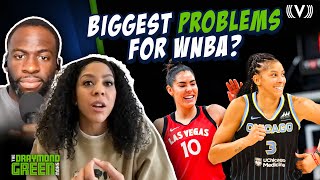
In this episode of the Draymond Green Show, host Draymond Green interviews WNBA legend Candace Parker to dissect the league’s biggest business hurdles and potential pathways to growth. The conversation opens with a critique of the current revenue‑sharing model, with Parker echoing Kelsey Plum’s stance that the WNBA should aim for equal revenue sharing rather than equal player salaries with the NBA. Parker argues the league’s structure—paying coaches and general managers more than star players—undermines its product perception and suggests that a salary cap may be unnecessary, even proposing de‑unionization as a route to financial flexibility. Parker highlights operational shortcomings: limited jersey production, high app pricing, and inadequate merchandise availability that signal a lack of confidence in the product. She stresses the need for deeper ownership investment, likening successful NBA franchises to billionaire owners who can fund long‑term growth, and points to the WNBA’s “fork in the road” moment where strategic decisions will determine its future. Marketing and storytelling are identified as critical levers. Parker criticizes past marketing that targeted indifferent audiences and urges a focus on authentic local narratives—e.g., emphasizing players’ hometowns like Naperville for Parker—to build community connection. She proposes leveraging grassroots events (AAU tournaments, regional showcases) to convert fans into season‑ticket holders. The dialogue also touches on the league’s alignment with the NBA. While acknowledging benefits of shared resources, Parker warns that constant comparison (e.g., scoring totals, game length) diminishes the WNBA’s unique identity. She advocates for differentiating the product rather than positioning it as a subsidiary. Charter flights emerge as a symbolic “luxury” that should follow, not precede, higher player compensation. Parker argues that improving player salaries will elevate the brand’s prestige, making perks like charters more meaningful. Throughout, both guests stress that early‑stage losses are inevitable, but sustained billionaire‑level investment and a clear, differentiated brand strategy are essential for the WNBA’s long‑term viability.
Chapters
Your now teammate Kelsey Plum recently went on a podcast and everyone's been outspoken about the flying private, which I wanna ask you about. But also she recently went on a podcast and she was discussing revenue sharing and, or the revenue. And she said, I don't, I'm not asking for equal pay in the NBA. And I can appreciate this, Kelsey, because I actually said some things very similar to some things that I'm starting to hear these days. A couple years ago, and I caught a lot of flack for saying what I was saying, and I was just like, wow, that's interesting. But I'm starting to hear more of those things so I can appreciate what Kelsey said, which was, I'm not asking for equal pay as the NBA players. I'm asking for equal revenue sharing as the NBA players. Right. What is your feeling on that as far as like getting the equal revenue share? You and your business acumen and what you know about business and numbers, what's your take on the revenue sharing situation?
Yeah, I'm on the Draymond Green podcast, so I can't hold back here.
Absolutely not.
So here's the thing, and I'm in agreement, and I heard what you said, and I'm in agreement with the fact that in a lot of areas, the WNBA tries to do things like the NBA, right? In their business plan. Except that. Let's just be honest.
Right.
Right? So I guess to me, I was big on, if I'm being 100%, I feel as though we should not have a cap. I don't think we should have a cap. And I also think maybe to get to that point, maybe we have to de-unionize. Maybe we can't have the same setup as the NBA. And I say that in— the NBA is made of stars, right?
Mm-hmm.
And this is no knock because I think If I'm an employer, if I'm a coach, or if I'm a trainer, I'm trying to go and do what's best for me and my family. And if somebody wants to pay me all this money to come do something, I'm going to do it. I'm going to try to work out ways to carve out things where I can be successful, right? But what's happening now is, as a league, a lot of times, we're setting ourselves up to look like a charity. And I say that in a sense of we're paying our coaches more than our star players. We're paying our GMs—
That's crazy.
More than our star players. And so then what does that say about the product? Right?
Absolutely.
Like, they're not coming to see Steve Kerr call plays. They coming to see y'all. You know?
Absolutely.
Steve Kerr, great. He has an amazing blueprint, but you can't have him make more than your star player.
Mm-hmm.
Draymond Green. And there's no league, no successful league, that is, in the United States, even abroad, that pays their coaches more than they pay their star players. So I think we're already set up not in the best light. I also say this, I think that the way you have the product on display says a lot about the product. Right. So even the pricing of the app is like, you're telling me it's like $14.99 or $29.99, $29. What is that saying? Like a product. So I just think that all in all, even the jerseys, right? I went to Chicago and it's like, get to Chicago, everybody's excited about it. Can't find my jersey, can't get my jersey, can't buy my jersey. There's no production of my jersey. Right? Won the championship. People still can't find my jersey in an entire season. So I just think sometimes we set ourselves up not to be successful.
Mm-hmm.
And, you know, there's a lot of things that have grown in the WNBA, right? But there's also a lot of things that need to change from a business standpoint. And I think that, you know, we ourselves have to hold ourselves to a higher standard and ownership does as well. You know, like you talk about in the NBA, can't have millionaires, you gotta have billionaires, right?
Absolutely.
Gotta properly invest in stuff to see where it's gonna really end up. And I think we're at a fork in the road right now. And I think people that choose the right way, like women's sports is gonna be here, whether it's people filling a quota, whether it's television, whether it's streaming. But I guarantee you like, the visibility element. Why did it take so long for the Women's National Championship game to be on ABC? Why are two of the hottest teams competing against each other on Super Bowl Sunday?
We set our power back. Yes.
That was crazy.
I couldn't believe that.
But Draymond, if we would've went game 5 in our series in the WNBA playoffs, we would've went up against baseball, the playoffs for baseball. Do you know what I mean?
Yeah.
So there's certain things strategically that I understand you kind of have to take what you're given, but also there has to be a line in the sand at some point where, you know, we start having a better blueprint for what we're trying to accomplish, you know? And I could go on and on about marketing as well. 'Cause for so long when I came into the league, we were marketing to knuckleheads that were in their mom's basement talking about how women can't play basketball. Why are we talking to them? Like, let's love it and let's love and embrace our supporters and our crowd and the people that really like women's basketball. So, I mean, last thing, 'cause I'm gonna go on this rant forever, but, you know, I always suggest and I'm like, everybody, similar to how you all go overseas and play, right? Everybody should go play. We could go sell out TBA. If I'm playing a home game at Thompson-Bolin Arena in Knoxville, Tennessee, Let's go play in Orlando, Florida when they have their big AAU event.
Mm-hmm.
You know, I just feel like let's go to Portland when they have their event and we're able to take a WNBA team who are future stars in the grassroots program. Let's play there. And then guess what? All those girls will go home with their parents and maybe buy season tickets where they're from. I just think that there's been so many ups and downs and we're still here and we're still here for a reason. So yeah.
Absolutely, I agree. And I think like the marketing, 'cause I'm a strong believer in that. When I went on my little rant, that's really one of the things I was talking about. It's like, how is it that, because, and I want to get into this, which I said in that rant, let's focus our argument to who we should be talking to. Who can tell these stories? Because the fact that like people immediately say Candace Parker from Chicago. And if you ask Candace Parker, where's she from? Number one, you're gonna say Naperville. Now that story should be told. Like that would be the equivalent of saying, now a little different, but it'll be the equivalent of saying, LeBron's from Cleveland and not telling the story of him being from Akron. Let you tell, like, I'm from Naperville. Now that's Chicago, right? Like you still Chicago through and through, got the pride, grew up in it, all of that. But you still gonna put on Naperville because that's going to get, it's going to do way more for Naperville than if you just say Chicago because Chicago is a made city, right? Okay. Now who's telling these stories? Who's telling that Diana Taurasi's from the IE, right? Like, why does no one know these things? Because there are people out here that are in positions to tell these stories that can help grow these games. I actually went, ironically, it's Women's Empowerment Month. I went on this rant during Women's Empowerment Month, but I feel like there needs to be more of that. And if we can do that, Now you start to grow the pot, which is now you start to grow— if you're growing the revenue, you start to grow the dollars that goes to the athletes. I feel like we— like what needs to happen is need to go at those people. And that's just my opinion. I don't know how you feel about that, but—
Okay. I really feel like why the NBA is great is one, because you guys are the most talented in the entire world at your craft, right? So you have to be good, okay?
Mm-hmm.
To what you just said in terms of telling stories and people being able to own who they are and tell their version of things. And you're encouraged to be you. Now, there was an era in the NBA where it wasn't, where they were like, okay, you can't be this, can't be that. We've had that in the WNBA, okay? Then you move into this era where they're like, social media, wow, people fall in love with these players for different reasons and you're not wearing a mask, you're not wearing a hat and they're able to see you and you're able to have the tunnel fits and be who you are and walk in with your son and people fall in love with that, right? And I just feel like to some extent that we're in, we're back in the '70s and '80s when Dr. Buss took a chance on investing in a product that nobody wanted. And the players were pretty talented, right? Players could ball and it was cool, but it was bigger than the game. It was the experience. It was the Laker Girls. It was the club. It was feeling like you're a part of something.
Yeah.
It was getting stars to come and sit courtside and make it cool and be, you know, fashionable and all these things. And I think the WNBA needs to capitalize on that. Like, the WNBA needs to capitalize on that blueprint of being able to make it more than just the game of basketball. Because listen, y'all play— I watch— y'all play a hell of a lot of basketball. And guess what? There's some games where it's not the best.
Like, it's just not. Absolutely.
But it's still the experience of it all.
Mm-hmm.
And I think having Adam Silver, love him, hate him, whatever, I feel like he listens to both sides in the way that you all do the All-Star Game now, in the amount of time you have off after the All-Star, in not having a dress code, doing things like that. And that has grown the game. It doesn't have anything to do with rules. I mean, stupid take foul rule, I guess, was an adjustment this year.
Mm-hmm.
But it doesn't have anything to do with the game. It has to do with the stuff outside of the game. I would like the WNBA to do that. Like capitalize on that.
No, I, and I think your example of Dr. Buss is incredible because if you look at it back during those times when he made that investment and took that chance, they were losing money at that time. And so I think everyone's argument is always gonna be, but you're losing money. But if you get an owner And I've been outspoken about Mark Davis before with the Raiders. And I'll give credit where credit is due. I'm always just giving my opinion and tell the truth. It's not really biased. It is what it is. I think what Mark Davis has done and is doing with the Aces, like I have the utmost respect for it because he's investing. He's investing into the product. And so, and I mean, let's face it. Yeah. In any business that you start, you lose money to start it. That's any business.
It doesn't matter what you do. It doesn't matter.
Any business.
Yes.
You're going to lose money at the inception. There's no way around it. If you are someone out there that can start a business and not lose money at the start, contact me. I got some money for you to start a business. But you're going to lose money. And so everyone's argument is always, but you're losing money, so how can you ask for this? And what you're saying is Be willing to invest the money and know that it will be a loss ultimately to grow the product where it can go. And so you may need new owners.
Yep, exactly.
Like, that may be an issue.
And that's a seamless transition into the elephant in the room. The hot topic of the latest offseason has been chartering. And you know what my question— my answer to that? Yes. Do I want a charter? Yeah. But similar to the person that has $5 in his pocket but has a Lamborghini that he gotta fill up and do all this stuff, I don't want the Lamborghini. I want more money. And so I think before that happens, players have to make more money.
Absolutely.
Because the product is going to be seen as better and more and exclusive the more money the players make. I mean, let's be honest. Like, somebody walks in, you can be nobody. If you— a billionaire walks in a party, he gonna get in. A billionaire gonna get into the party. So I just feel like, I think that that is— yes, I do want a charter. I think it would make the brand great, whatever. But let's talk about dollars and cents first. You know?
Absolutely. And one thing that you just spoke of, and I wanna get your take on this, I feel you, you spoke on how the WNBA is aligned. Do you think, and I wanna specifically ask this question because it'll take me somewhere else and you'll get where I'm going in a second, but do you think aligning the WNBA right next to the NBA Is it ultimately beneficial? Because for instance, you know, wanting guys to come to the games and support, right? Like I understand the support thing, but is that actually what's going to help drive the product, which is a great product, but gets overshadowed?
Draymond, can I ask you, 'cause we talk about verbiage a lot and usage of races. Right? We always talk about the way people use to describe, even somebody that's Black and is a shooter, the verbiage people use to describe that person is way different. Or when you're comparing players. I was trying to find a comparison to Grady Dick, right? And I was immediately going race. And it's like, no, let's compare him to who he plays like, not race. Like, you know? Yes. Absolutely. And I think the verbiage that we use for women a lot is support. Like, when I go to your games, I'm not— I don't type in my caption, I'm supporting the Warriors. Right? I don't say that.
I say, yo.
Absolutely. I just pulled up to the Warriors game. It's dope. Like, I brought my daughter. We're sitting courtside, whatever. And it's like constantly— The WNBA uses support in their caption. So I don't think aligning the WNBA with a league, one, that is the NBA, two, that has been in existence for 76 years. It's just not a good comparison to begin with. And so while we do lean on other ballers, it's other basketball players. I don't think we need to, like, have that because I think comparison, what do they say? The comparison, comparison is the thief of all joy.
Absolutely.
'Cause it's like, you're not gonna get joy from this if we're constantly comparing our All-Star Game, our signature shoes, our brand of basketball, our brand of basketball and points. Everybody wants to talk about we are low scoring. Well, we play, we play 40 minutes, y'all play 48.
Mm-hmm.
You know, like, Okay, so let's get into this. And so then all of a sudden we're sitting there comparing like, okay, well, how many points do you think you scored? You played 48 minutes. It's not going to end up well for us. And so I think it would be better to just differentiate ourselves from the NBA. Yes, for a while we needed all of this, but I think it would be better. We have to some extent, there's not many teams that are affiliated with the NBA, but those teams usually are doing better. So, you know what I mean? So it's just, I don't know, it's the chicken or the egg, man. You know, it's like, it's beneficial, but it's also hurtful.
What's up everybody? It's Draymond Green. Make sure you subscribe to the Volumes YouTube channel below so you don't miss any more of this great content going forward.