Dray reacts to Phoenix Suns owner Robert Sarver's suspension & fine | Draymond Green Show
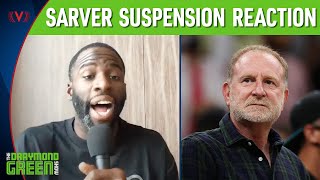
Draymond Green says the NBA's one-year suspension and $10 million fine for Phoenix Suns owner Robert Sarver's use of the N-word is not enough, since owners can't be fired. He calls for a two-thirds vote to force Sarver to sell, like the league did with Donald Sterling, and warns that the penalty contradicts the NBA's stated values of inclusion.
Chapters
What's up everybody? It's Draymond Green. Make sure you subscribe to the Volumes YouTube channel below so you don't miss any more of this great content going forward. What's up everybody? Welcome back to the Draymond Green Show. We have a very important topic to discuss today, and I think you all know what it is. I've sat back on this topic and just kind of watched for a few days or a week or so of statements, of reactions, actions taken. And it's been very interesting to me. And obviously the topic that we are going to discuss today is Robert Sarver, the governor of the Phoenix Suns, who was recently suspended one year. One year., by the NBA and fined $10 million for his, or how he conducted himself in the workplace, how he ran the organization. And I think it's very interesting because to get suspended for one year and fined $10 million, I mean, the only way you get suspended for 1 year and fined $10 million is if you are the owner of an asset and you can't be fired. Because I think anyone else in the NBA who— Mm-hmm. And especially from a front office standpoint, like maybe not a player, Although we've seen players get thrown out of the league for less, but I think anyone of that's an employee of an NBA team, not NBA player, although you could possibly throw them, us in there as well, would 1,000% be fired if half of the things that came out of the investigation into Robert Sarver came out about anyone else. And as I said before, I've sat back 4 or 5 or 6 days and just kind of watched different people's reactions. And a lot of things around this or surrounding this is very interesting to me because— Mm-hmm. Number one, if you use the N-word to redescribe something that someone said or telling a story that someone has told you or using the word because someone else did, Stop it. That's ridiculous. Because the level of comfort that you have to have to even use the word again does not validate or make it okay for Robert Sarver to use the n-word. I saw the report also said he used it at least 5 times. Okay. At least 5 times could be 100 times. At least 5 times could be 6 times. At least 5 times could also be that is just a word that you use and are comfortable using. Now, Quite frankly, I'd have a hard time believing that he's using the word with an -a ending and not an -er ending. However, not really that that matters or not, but er does get a little harsher than -a, and quite frankly, I can't imagine that in his vocabulary is the n-word ending in a. I can't imagine in his vocabulary is the n-word ending in er. What significance does that have? Zero. The significance that, or the relevance that it had is that it baffles me that people try to decipher the difference in between the two. Well, if that guy used it ending in ER or A, it's less discriminatory, or it's less of a gut punch, or it's less meaningful if it's used with ER or an A. It's absolutely ridiculous. What also— what else is ridiculous is— And by the way, I say this as someone who actually uses the word. When I am amongst my friend groups, when I am amongst people I'm close with, I may use the word. I do use the word at times periodically. I too am a little out, or just say wrong. I too am a little wrong for using the word. I too am a little out of touch because, and here's why I say this, the fact that I myself and others, um, will use such a word as an endearing term It's a little fucked up, it's a little messed up in itself. I grew up using that word, I grew up as the word being okay, and I'm also not going to sit here and lie to you and say I probably won't use the word again. That would probably be a lie. I'm kind of not into lying, like it is what it is. Yeah. I have gotten better at about using the word, but the reality is, is I still do use it. But I think it's actually sad that like, you don't really hear words in that vein for other nationalities, for other races used as an endearing term. So why is it that the term that's been used for us as African Americans to degrade us, to disrespect us, to call us everything except for our name. Why is that term used as a term of endearment? I think it's actually insane. I've been doing more thinking about this, especially since all of this stuff came out. I've just been thinking about it, but let's not get off topic. Yeah. Because that's a totally different conversation. But the conversation that needs to be had is how can someone that's leading an organization like Robert Sarver, which let's face it, the reason your organization thrives the way the organizations thrive is pretty much built on the backs of African Americans because, I mean, you could just look at the team roster. Um, this is also, this is also a team that has an African American coach. Um, this is also a team that has an African American general manager. So the thriving that's going on this or in, in that organization is 100% being heavily driven by African Americans. So, okay, let's say Robert Sarver gets a 1-year ban, as he did, and a $10 million fine. So when he returns next year, because it's only a year, is— does everything just go back to normal? Are those guys supposed to unsee everything that they just saw and heard? Are those guys supposed to feel comfortable with continuing to work with this guy. And quite frankly, I think it'd be absolutely insane if they were, but to each his own. I can't judge how they feel or how they may or may not feel. That's not up to me to judge. But I do think it's absolutely insane that, you know, you— Robert Sarver's just going to receive a 1-year ban and $10 million fine and just return to the sidelines next year and return to the building next year. It actually goes against everything that the NBA stands for. The NBA stands for inclusion. The NBA stands for diversity. The NBA— Draymond Green. Definitely stands against bigotry and racism. And I commend Adam Silver, our commissioner, and the entire staff at the league office for the stands that they have taken over the years. I don't think there's been any other organization or league that supports their players like the NBA supports us. So this does not erase, like one thing you do, I know we live in a world of where you can do like a million good things and one bad thing and people paint you to be be a bad person. Let me say this, this does not paint Adam or the NBA as like these bad people, as if all the decisions that they've made up until this point have been incredible, and this one kind of fell short of what should be. This does not paint them as that, but— For everything that the NBA stands against, and stand for. This report that came out last week is the total opposite of everything that the NBA stands for. And so to think that someone like Robert Sarver that's acting in that manner can continue to represent us, that's bullshit. You can't continue to represent way more people than yourself with those views, with speaking to people the way he did, with treating African Americans and women the way he has. That's not okay. Because the moment, the moment any of us do something wrong, it's always, ah, we, you know, we don't support that, we don't do this, we don't do that. And we're kind of left out on our own to figure it out. This guy gets to just come back in the fold as if he's still representing us and as if he's a part of one of us. That can't be so because for us, especially as African Americans, I'm uncomfortable. I'm very uncomfortable in knowing that in that position, you could just essentially do whatever you want, and because you own an asset, you can't be punished. And so I saw where Commissioner Silver said, I've taken the steps that I can take the maximum penalty that I can hand out, I hand it out. And now it falls on, you know, in order for him to be kicked out as an owner of a franchise and forced to sell, that that vote would fall on two-thirds of the other owners of these assets. And so what I would say is then why don't we pose a vote? Because that is definitely an offense that is probably grounds for being forced to sell. I personally, myself, was actually a part of the game that was about to be played Right after the Donald Sterling press conference, which if you remember back, it was Commissioner Adam Silver's first thing that he really had to take a stand on as the commissioner of the NBA, which was a tough one. And I remember we were not going to play that game that night if Adam, if we, the players didn't think that Adam had taken the necessary steps that should be taken, that if the hammer that he dropped was not as tough or as hard as it should have been dropped, we were not going to play that night. Looking back on that, I, even with that, I still didn't think we should have played. However, I was super young. Probably think I was in my second year in the NBA, had no say. [FOREIGN LANGUAGE] whatever was gonna happen was I just had to go along with. I had no say. But I was a part of that game. And I remember us seeing that announcement that Adam made and was like, "All right, well, I guess we're gonna play." And so a part of me wonder why was it okay then but not okay now? I would really need some clarity on that of how was it able to, like, how was it that Donald Sterling could be forced to sell and he's not? It's the same thing. The only difference is we don't have a recording, but we do have a ton of people. And if you've read the interview, if you haven't, you should. And if you have, if you have, you know the amount of people that were interviewed as a part of this investigation. Now let me say something. I do not support cancel culture. I do not believe in cancel culture. I think, quite frankly, if you want my opinion, I think a lot of it is a bunch of bullshit. I think a lot of cancel culture are people that didn't work as hard in life or didn't make it as far in life and think they're just allowed to punish those that did. So let me make it clear, I do not support cancel culture. This is not cancel culture. This is not like— I'm sure most people that are basketball fans can't walk past Robert Sarver and say, oh, that's Robert Sarver. So canceling him is like— canceling someone, that's like two totally different things. So I want to make that clear, but it's a little baffling to me that we'll walk into the arena next year, the Phoenix Suns will walk into arena next year, he'll sit on the sideline, and we'll just continue on playing. So the one thing that I'm going to need is someone to explain to me why is it that it was okay to get rid of Sterling, but it's not possible to force Robert Sarver to sell after what we read. And secondly, why isn't there just a vote being like, all right, so let's have the vote. Yeah. Because then also what we'll know is who else may be standing behind closed doors. That's something that I would love to know. And based on these votes, maybe we'll know that, or maybe we won't. Just because someone votes no —doesn't necessarily mean they are using that word behind closed doors because be that this, that is a fireable offense, I would never just throw that on somebody. I would never say, hey, if one of the other 29 voted no, they're using the word behind closed doors. I don't believe that. I don't believe that at all. But what you will know is Values, like what are the values of others that, you know, quite frankly, we're playing for? What are their values? What they believe in? You know, morals, like you'll just have a better picture of all of those things and you'll know how to operate yourself. I think that's one thing that we would learn from a vote. And quite frankly, We will simply know who stands with us and who don't. Because it's easy to sit back and not say nothing. We all can sit back and not say anything. That way, your opinion just isn't heard. It's not that you had an opinion and it was against the popular opinion or not. It's just not heard and no one's really asking for it. I'm asking that There be a vote. If that's the only way, then let's see what those numbers are. Let's see what they are, because what I did see was a minority owner of the Phoenix Suns say, if he's going to continue to be there, I'm out. I did see PayPal say, if he's going to continue to be there, our sponsorship's out. So be that these— those things are happening, it's— It's not happening. Definitely grounds for a force to sell. Now it's how would that take place? Because it 100% needs to take place. So how do we get to a space and to a place of where that's going to happen? That is my question. That's what I need answers on. I think more of my brothers in the NBA need answers on. And I am looking forward to hearing that. Lastly, before we get outta here, and this is to guys in the NBA, this is to agents, this is to anybody who may hear this and it may concern. I recently read, I know everybody's caught up on the news of, oh man, we're gonna get high school players going back from high school to the NBA. Great. I have no problem with that. Yeah. Have at it. It's your business. Don't get so caught up in the big headline that you, that you miss out on the fine print. And what I read in the fine print was, harsher luxury tax penalties are being discussed. Why is that important? I think that's important because don't for one second fool yourself and just think harsher luxury tax penalty don't have anything to do with me. That's not true. Harsher luxury tax penalties, that just falls on the owners. They got the money, they can pay it. Let me explain something to you. What I've learned in this league and what I've been taught in this league, it's normally there's 3 to 4 teams per year really trying to win a championship. And quite frankly, if you're really trying to win a championship this year, unless you just overhaul the roster, you're really trying to win a championship next year. And after next year, unless you just overhaul the roster, you're really trying to win one that following year. So you really have 3 to 5 teams per year that is really trying to compete for championships. Why does that matter? That matters because harsher luxury tax penalties just mean those teams that aren't winning, which is the vast majority, of the NBA, they're just not going to go into the tax because there's harsher penalties. Well, guess what, guys? If those teams aren't willing to go into the tax, what do salaries do, or the amount of people getting bigger salaries? They go down. Why? Because teams aren't going into the tax. So don't make the mistake of saying harsher luxury tax penalties That ain't got nothing to do with me. It has everything to do with you. It has everything to do with me when you speak of harsher luxury tax penalties, because most won't be willing to pay those penalties. So in turn, most won't be getting paid. And so that's something that I wanted to throw out there. Read the fine print. Don't just read the headline. Don't get so caught up on the pretty headline that you miss the fine print and the things that really do matter. Because quite frankly, if high schoolers start coming into the NBA, what, I mean, there'll be 7 of them drafted in a great year. Okay. So if there's 7 drafted in a great year, realistically there may be 3 or 4 in a year most of the time. Okay. That's 3 or 4 spots of the 60. Harsher luxury tax penalties. That's 60 to 80 guys not getting paid what they could possibly get paid. So don't let that go over your head. Pay attention to those small things and don't get it twisted and think, that don't bother me. I don't gotta pay the luxury tax penalty. 'Cause you do. So. Keep your eye out for that. That's a wrap on this segment of the Draymond Green Show. This was obviously, I wanted to share my opinion, my thoughts, and my, most importantly, my questions based on this Robert Sarver thing. I think it's, we all know what needs to happen. I've said what needs to happen. I've been a part of a very crucial game that happened right before a Force the Sale. I've kind of seen it all unveil. Yeah. And I think it's time that we see this one as well. That's a wrap from the Draymond Green Show. Peace. Peace.
More from Draymond


Draymond Green on Brandin Podziemski Extension, Darius Acuff Interaction, & Weird Rudy Gobert Talk


"I Was Waiting for You All Game!" | Deni Avdija & Draymond Green Recall Iconic On-Court Moment

Deni Avdija on Becoming an NBA All-Star, Playing In NBA Playoffs & Hilarious Draymond Green Story


Draymond Green on Warriors Preseason, NBA Push-Off Rule, & LeBron's Fanatics Helicopter Deal


"Awful Representation" — Draymond Green Sounds Off on Dalton Knecht's Lakers Purgatory

Draymond Green Explains How Micah Nori Handled Damian Lillard & Ja Morant Lineup Controversy Wrong

Draymond Green Exposes How Contract Drama Destroys Locker Rooms After Jalen Duren Re-Signs