Jalen Rose on New Media, Fab 5 stories, state of NBA | Draymond Green Show
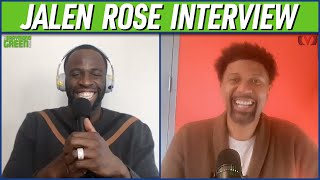
In this episode of the Draymond Green Show, host Draymond Green interviews former NBA star and media personality Jalen Rose. Rose recounts how he began working in television while still an active player, emphasizing the importance of authenticity and the challenges of speaking candidly about teammates and coaches. The conversation shifts to the concept of "new media" versus traditional "old media," with Rose championing player‑driven, truth‑telling coverage. They discuss the Fab Five legacy, the ongoing debate over NCAA sanctions, and the impact of recent NIL (Name, Image, Likeness) rules, critiquing how schools and the NCAA retain most revenue. Rose details his founding of the Jalen Rose Charter Academy, the funding and facility hurdles faced by charter schools, and his vision for expanding the campus to better serve Detroit youth. The dialogue also covers current NBA topics, including MVP candidates, playoff predictions, and personal reflections on Rose’s absent father, Jimmy Walker, and how that shaped his identity. Throughout, both guests blend personal anecdotes with broader commentary on media, education, and basketball culture.
Chapters
What's up everybody? It's Draymond Green. Make sure you subscribe to the Volumes YouTube channel below so you don't miss any more of this great content going forward. What's up everybody? Welcome back to the Draymond Green Show. I am excited to have this next guest. In my opinion, the founding father of the Fab Five, the leader, the person who really embodied that spirit. Now, as you know, I can't really be too fond of that being that it's from the other school. However, you know, you grow up in the state of Michigan, really you grow up anywhere and you watch basketball. If you know anything, you knew something about the Fab Five. And obviously growing up in the state of Michigan, it's all right there from Detroit Southwestern High School, the 13th pick in the NBA draft by the Denver Nuggets, Jalen Rose, my brother. More like an uncle of mine. I appreciate you for coming on. Welcome to the show.
Appreciate the love. You killing it. Keep doing your thing.
Absolutely. I appreciate you. I mean, just getting right into it. I get a lot of credit for being the first active player doing TV. That's actually you. That's actually you. How did you go about way back, I think in 2006, you did the playoffs. You were still playing.
How did you go about way back then and saying, "I'm gonna start doing media right now as an active player." So the crazy thing is like growing up in the city, being a fan of the game, looking up to the Bad Boys, looking up to Magic Johnson, but also my favorite athletes had personality. They were flamboyant. They'd not only dress loud like Deion Sanders or Clyde Frazier, but they also talk loud like Muhammad Ali. And those voices is something that I always appreciated following Kareem Abdul-Jabbar and Bill Russell and just how they were athletes, but they were more than jocks. And so when I got to college, when it was time to pick a major, I wanted communications to be that. So radio, TV, film, became my major and I took those classes at Michigan, went there 3 years, eventually went back and got my degree. So while I was playing in the league, and it's crazy how this works, I remember feeling like, like you a good player, but you ain't Magic. You know what I'm saying?
Absolutely.
And that hit me one day. Like, like you got a chance to do this for a while, but You need to find something else to do. You know what I'm saying? And my first couple of years starting and coming off the bench and then getting traded to Indiana where Larry Brown gave me 15 DNPs, I was like, I don't know if I'm gonna have a 13-year career. So I started to figure other things that I could do in the game that I love. And once I got traded from the Pacers to the Bulls, it was February. This time of the year and the team had 9 wins.
Wow.
And like, I'm like, we ain't going to the playoffs for sure. So this was 2002. I reached out to a contact at BET Mad Sports 'cause I had just done the show and I had just done 106 Park. And I pitched the idea for BET to let me cover the finals for them. At the time it was New Jersey Nets and the Lakers.
Absolutely.
I was like, just send the camera, I'll get the access, I'll do all of that. So they trusted me, they did it. So they sent the cameras, we cut it, we spiced it, we edited it, they showed it on TV. And then I pitched that same idea to the Best Damn Sports Show the next year. And they already had big bro John Salley who was doing TV. And at the time, Jason Williams from the Nets, I saw him doing some stuff with NBC while he was still playing. And Ahmad Rashad, I saw him kind of morph from doing football to doing basketball. So those are guys I was like, you know what? I'm about to try to do this while I'm playing. So they hired me. So I was in the league 2003 to 2007 playing while I was still working for Best Damn Sports Show, MTV Movie Awards. I was doing halftime with Bill Walton and Snapper. I was doing boxing for Top Rank. Mm-hmm. I was doing all of that stuff. And so when I retired in 2007 and I was doing sideline for TNT, I worked for TNT for a couple of years. The famous video of Nick Van Exel, my brother throwing the towel at me when I was standing on the sideline and I just kept going. And so in 2007 when I retired, that's when I started working full-time for ESPN. That's—
I actually didn't even know about all the BET stuff. So I appreciate that. I think, When I started this podcast last year, and you know, maybe a little different because I was doing it after game, but I caught a lot of heat for actively doing a podcast and providing the content that I was providing during the playoffs, during the finals. I caught a lot of heat for it. When you first started doing that, did you catch a lot of heat? And I know it was different, but it wasn't social media and all of that stuff. But did you catch heat for that when you first started doing it?
Absolutely. Because as you know, in order to be colorful and/or good at this job, that mean you gotta say something. There's a lot of people that's vanilla and don't say nothing. But you and I are strong-willed, strong-opinioned, and we ain't scared to stand on it. And what ends up happening is while you still playing, I'm still running into these players, into these coaches, into the managers, into the agents and the fans also. And so guys used to sometimes take it personal. Oh man, how you gonna call me out like that or whatever? I'm like, dog, you had 6 points and 8 turnovers. Like, what you expect me to say? You know what I'm saying?
Like— Absolutely.
And what ends up happening is people start to earn your res— you start to earn the respect of the players and of the coaches and of everybody. When they know when you speak, not only are you knowledgeable, but it ain't personal. Like, I ain't got nothing personal against you. I'm just saying what I see, giving my opinion. When you do poor, I'm gonna say it. When you do great, I'm gonna big you up. And I know you notice this quick. You can big up people all day and they never shout you. They never say thank you. They never give love. But soon as you criticize 'em or call 'em out for some BS that they did, Then they wanna at you, then they wanna get butt hurt. And so that's when I learned at that time, I'm gonna just stay authentic, be authentic to myself. And when I started to do that, I started to see me get results.
You know, one of the things that I wanted to do, especially that I'm actively playing is, I felt like I needed to find a balance of like, authenticity and telling the truth and being very critical, but doing it in a way where, like, I still gotta play these guys. I still have to play possibly with some of these guys.
Right.
And I felt like that was one of the biggest things that I, adjustments that I had to make in going into TV right now. And I've spoke about this before. One, one instant that made me really happy because it was actually my first time doing TNT. I was doing the segment on, and we were doing the Denver Nuggets game. They were in the playoffs, it was during the bubble. And Joker.
Mm.
And I pointed out his defense, that he's the low man, he's the back, he's the center. He has to be everybody eyes. He has to be the communication. He has to cover up everybody mistakes if somebody breaks down the defense. And he was missing his rotations. And so I pointed it out on TV. And I tried to do it in a way of like not bashing him, but letting the world know like this is an issue. And when I saw him the following year, he said to me, he said, "Hey, I saw your comments about my defense. I've gotten better and I appreciate it." Mm. It gave me so much confidence in TV, like in doing TV. Like, oh, so I can do it.
Yes.
It gave me so much confidence. That was a very huge moment for me.
That is huge.
Very huge moment.
That is huge. But here's what you also know, and you know this balance. Anytime you see a player doing this job, we only really saying like 40% of what we really know.
Facts.
You know, like we know everything. So it's like if I'm on TV and I'm talking about somebody had a bad game, I know where they was at last night. I know who they was with. I know what time they got out. As a matter of fact, I probably was with them. You see what I'm saying?
That's funny.
So now when I'm on TV, if I'm speaking on what happened in the game, they know it ain't personal, but they know I ain't saying everything that I could say. And that's what the Joker felt about you. He saw you breaking it down and giving knowledge, but it wasn't like you was trying to clown him or disrespect him. And so that to me is when I started to draw the line because I don't like media members that name call. And so I remember when I was making my bones and I was doing First Take and I was doing the show with Skip Bayless, I used to sit back and take notes and it's a debate show. So I'm like, wait a minute, he calling— Draymond Green. Chris Bosh Spice? Like, like, like, like, this is really happening? Like, that bugged me out, you know what I'm saying? And so I'm like, all right, I'm gonna have to have some material ready for this dude because if he come at me like that, I got the jab, I got the headshot, I got the body blow, I got whatever he gonna need because I don't like the name calling. I think that went too far. Yeah. Like I seen him do this recently with Dak Prescott when he had just lost a family member, I believe, and he was dealing with some issues. And homie was like basically saying, I don't care about his mental wellness.
Mm-hmm.
And so those are the examples for me that give us a different level of credibility that can never be matched because we can be authentic and say a portion of what we know without saying too much, but yet know what not to say to make it personal.
And speaking of that, I always talk about this term new media and old media. And quite frankly, people has always assumed that when I say new media, I'm talking about basketball players, current players, or like it's this actual thing of new media. And the reality is, When I speak of new media, I'd be speaking of a way of going about the job. Because I think the way people used to go about the job and the way people go about it today, it's totally different. And so I speak of new media and I always say like, it's truth telling. It's being upfront and honest. You know, it's actually analyzing the game and not just going with this stat sheet and saying, oh man, this guy played bad because he missed shots. Like, no. Yeah. He could have played an incredible game and missed those shots. You know? And so when I speak about new media, but there's also this new way of doing things. And then there are the Skip Baylesses of the world that are old media. Like it's tired. It's all of that.
Right.
What do you make of new media and also, but player-driven media as opposed to the old-fashioned way of media and kind of how we're seeing a change of the guard, not in a sense, because there's still a space for that. But there's a space for both. What do you make of that whole thing?
The thing I make of it, first off, is I love the term. And it reminded me, like, this is my 20th year covering the Finals, right?
That's right.
And so what ends up happening is when you come onto the scene and you say the term new media, it reminded me of like an old school rapper for example, or somebody that been out for a while and then somebody else come into the game and people try to put us against each other. I saw that happen when LeBron started his school. And if I'll be on TV and I'm like, yo, LeBron did this, they lost the game or whatever, whatever. People be like, oh, he just jealous because LeBron started a school. I'm like—
What?
Like, I want all people to, to give back to their community and start a school. I'm not quote unquote jealous because his school got more hype. Like, he's one of the most famous people to ever walk the earth. Like, I'm happy that he did it because now it hot. It's almost like this. Michael Jackson wasn't the first person to do the moonwalk. He popularized it. And that's what LeBron now can do for people like me when he starts a school. Mm-hmm. It's the same thing when you say new media. People's coming to me like, "What Draymond talking about? You was doing that 20 years ago." I'm like, first off, that's family. We ain't even doing that. Second off, he's right. And what you're talking about is the ability, A, to articulate the game and be unapologetic. See, at first when we got into this gig, kind of had to walk on eggshells. There was times where, fam, I stopped wearing earrings. Because they was frowned upon. I always wore long sleeves because tattoos wasn't necessarily welcome. I wore my hair a certain way. I always wore a tie and a blazer because the game was different then. Now for me, new media is saying what you feel, dressing how you feel, driving how you want to whip, and then having a way to articulate yourself that you're speaking the language of the people that you play with. See, when you see me, I'm rocking what y'all rocking.
Absolutely.
I'm listening to the music that y'all listening to. And so for me, it's up to the guys that's been doing it a long time to stay current.
Facts.
Not the other way around.
Facts.
And so when I saw CJ get eliminated with Portland and he was covering y'all, I pulled Nephew to the side. We got numbers, we exchanged. I remember when he got drafted, I said that he was gonna be that. Same with JJ Redick, same whatever. And so the more of us that get into it and the more we support one another, that now changes the entire narrative when we're all pulling together and we're all saying it.
Absolutely. I agree 100%. You just spoke about school. I got a couple questions about school. Number one, the Jalen Rose Charter Academy. How did you get into starting that? And what do you need to continue to make that the success it's been, but also continue to take it to new heights? Because you've continued to get it better and better and make it better and improving it. But what do you need to continue to take that to new heights to give these kids the opportunities that you've been affording them?
So you and I from the hood hood, And like when you be out there balling, there's a reason why I be singing Saginaw Pride since the day you got drafted. Because I remember you in high school and in college and I know where you from. And when you come from where we come from, you know the difference is money.
Facts.
The quality of your education, unfortunately in the United States, is defined by your zip code. And it ain't just education, it's the protection from the police. If you make a 911 call, it's fire, it's deserts where you can't get a quality supermarket. When you in the hood, it's fast food, funeral homes, flower shops, gas stations, party stores. That's what we see. We see depression.
Mm-hmm.
We see poverty. And so I was like, how can I give back to my community And I'm gonna be frank with you, in a way where mass media and people who don't look like me can't block me. Even if they don't want me to do what I'm doing, when I say I'm doing it for the sake of education, even if they not gonna give me a dime, and even if they don't wanna see me educating the kids that I'm educating, they can't say it out loud. It's almost like when white people listen to rap music, at some point when you saying the lyrics, you gonna say all of the lyrics.
Mm-hmm. That's a fact.
You gonna say all of the lyrics. You just gotta watch where you saying 'em, right? And so I realized that inner city students in Detroit were getting like $8,000 a year while their suburban counterparts were getting double that. And then the families who are fortunate enough to put their kids in private school, that costs like $40,000 a year.
Absolutely.
And you can start doing that K through 2 or 3 years, K through 1 or 2. So now that's like a $500,000 investment in that student. Or the suburban student, that's like a $250,000 investment. Where the students from my community were only getting like $96,000. So how do I put them in position to compete for the same jobs, for the same careers, for the same opportunities, and put themselves in position to be successful? I'mma start a school. Open enrollment, tuition-free, public charter. I'm not a part of a network. I don't test students in before 9th grade. I don't test students in after 9th grade. And here's the kicker. United States don't look at us like we're cute and cuddly when we in high school. Mm-hmm. Anymore. A lot of times when people wanna influence us, they wanna do it when we small because you still got parental involvement. If you acting out in class, I could call your parents. But when you get in 9th grade, these young people been exposed to life, sex, drugs, violence, gangs, poverty. And so these relationships are a lot different when they on social media now. They know what WWW is and they can go anywhere in the world. So we influencing 400 high school students and I'm influencing another 600 in what we call secondary education. So I'm influencing them in a model called 9 through 16 because after 12th grade, just think about it. What does your high school do for you? Nothing.
Nothing.
But the job ain't done. If I just came from poverty and I just graduated from high school, I'm throwing my hat in the air, but I can't put my resume nowhere and get a gig.
Absolutely.
So now I'm helping those students in community college, trade school, military, 4-year college, and now we're helping them be in position to be successful in life. So the thing that we need is money and awareness, and I'm continuing to try to do that. And I'm really proud of what we've accomplished over 12 years. We're fundraising right now to expand our facility. I took over a middle school, converted it into a high school, and sadly our basketball team has never played a home game because I took over an elementary school.
Mm-hmm.
And when you look at our budget, I'm the founder, I'm the president of the board, I'm the chief fundraiser. And shout to my co-founder, Michael Carter. Shout to all of my board members, the founding team, our students, our staff is amazing. Our, our school leader, Principal Lewis, our parents, they all believe in my vision. And so now for me, it's to expand the facility so I can get 3 more classrooms. I wanna create a health and wellness space for mental health. I wanna create a space for yoga where young people can be stretching and getting exposed to things while they're in the building. And I want to have a gym so that now when people come play college games or high school tournaments or pro teams or whatever, we have the kind of facility that they can come enjoy.
So you took over an elementary school. There's been 30 high schools in Detroit closed.
Correct.
Are, are you not able to get access to those buildings that they've closed down?
I'm about to give you some game that people don't know about education. First off, I remember trying to open the school and this was a, a political cycle that people were going back and forth about public school, charter school, magnet school. I'm like, first off, I don't care what kind of school they go to. You can homeschool 'em. I'm just trying to put 'em in position to have a quality school to go to.
Mm-hmm.
And then there were people like, well, charter schools are stealing students from the public schools. Newsflash, a charter school is a public school. That's just cap. And why do people say that? Because one of the largest donors of the Democratic Party is the teachers union. And so why is that so important to both of those things? Because if you're a part of the union, you get something called tenure as a teacher.
Mm-hmm.
That means you could go to school for 2 or 3 years and basically never get fired. And that has nothing to do with your results. But when you go to a charter school, you give up your tenure opportunity. And so that's what they're fighting against. And then they're also fighting against the numbers of students that are in a public school building that you are talking about. You ready for this? Because a public school building is gifted. A charter school building, we get zero state funding for the facility. Zero. Not for improvements, not for expansion, nothing. If something happens with the boiler at the school right now, if something happens with a light bulb at the school right now, my phone ringing.
Wow.
You see what I'm saying? And so that's one of the dirty secrets about education is that we get zero state funding for our facility. And so therefore that's why writing and raising and me creating awareness for the school is so very important.
That's incredible. I'mma, I'mma send y'all a $25,000 check in sometime— Oh, that's love. —in these next couple weeks.
That's love.
I'll get with my financial team and get that out.
Thank you.
So I think it's absolutely amazing. Like the amount of, like me knowing you personally, the amount of time that you give to that. Like I've seen you at times where you in your Ferrari and you hustling like, yo.
No doubt.
I need to go raise this money for these kids. Like you really hustling.
Yes.
Going to do that. I got so much respect for you.
Thank you. Appreciate that.
'Cause I think that's absolutely amazing. But continuing on along the lines of school, you said, you ended up going back to finish your degree. Why was it so important for you to go back? You Jalen Rose, you're the 13th pick. You going into TV. Like, why was it so important for you to go back and finish your degree?
Because school was actually always important to me. I never wanted to be considered a dumb jock. I hated that term. I used to see people get called that and I was like, I'm gonna make sure nobody ever called me that. And then, you know, the whole stigma, like, oh, you play athlete, you're an athlete, you talented. So now people hooking you up with your grades or people doing your work for you and that type of stuff. So then I was like, you know, I started to take pride. And one of the funny things that happened in high school is I got a chance to take some accelerated classes because I was an honor roll student. And I heard that if you got if you had a certain GPA and your attendance was this, that you got a chance to meet a special guest that was gonna come to the school at the end of the year for a seminar. And then I found out that guest was Earvin Magic Johnson.
Oh wow.
Right? So I couldn't be on the basketball team, an All-American, and Magic come to the school and I can't go to the gym and see him.
That part.
You know what I'm saying?
That part.
That would not have been a good look. So I really started to buckle down on my academics. Same when I was in Michigan, was a Dean's List student at Michigan. And so at that point, I done went to school for 3 years in the middle of winter. You know, it's cold outside. I might as well finish.
Absolutely.
You know what I'm saying? I might as well finish at that point. I'm in the league taking correspondence courses. I'm like, I'm gonna finish. And Michigan at the time, and this showing my age, wasn't even offering the classes I needed for to allow me to graduate unless I went on campus. I'm like, I can't, I can't go on campus. So I eventually took my courses online at the University of Maryland University College, and that's actually where I got my degree from.
Wait, so your degree today is not from the University of Michigan?
Correct. They didn't even offer the classes that I needed. And I love Michigan and I hope somebody hear this. They should be getting at me to give me some sort of honorary degree and putting the banners back up. Like I go to games, fam. I go ahead. Correct. I, I, I didn't grad— I didn't, they didn't offer the classes that I needed.
Just so you know. Just so we're clear, mistake you made in life, that would've never happened at Michigan State. I'm just saying.
I know.
That would never happen at State. That's ridiculous.
You know what? I know. And let me just be real with you. You know I love Izz.
Absolutely.
And I took a visit to Michigan State. I looked up to Magic. I looked up to Steve Smith, 6'8", Big guards.
Motor City Smitty.
No doubt, I idolized them. But I couldn't turn down the chance to be the 5th member of the Fab Five. That part. That's why I changed my number. I didn't wear 5 in high school, I wore 42. I changed my number 'cause I was the 5th member of the Fab Five to sign. That's why I changed my number.
That's interesting. Because like I said, it's almost like you took it over though. Like the 5-5, it became your thing, but it would make sense because you essentially made it the 5-5.
Yes.
But that's, I find that very interesting. So a lot of laws have changed in United States of America. Drug laws have changed. We've seen people that you and I know who had life in prison get out because laws changed and they're no longer subject to that time. The things that y'all got in trouble for, kids can now do.
Correct.
No problem. They can make money off their likeness. They got endorsement deals. There's kids in college making $1 million a year, which I'm happy about. Like, get your money. It's great. I wanna talk to you about the NIL too. But now that making money is legal in college, Why hasn't those banners gone back up if you're being punished? As I was thinking about this about you guys, the Fab Five, I was thinking about this about Reggie Bush. Like, these are— y'all worked to become the Fab Five and accomplish what y'all accomplished. Reggie Bush worked.
Yeah.
And it got snatched away because some poor kids needed some money. Now that those laws have changed, why haven't all of those banners gone back up?
So, and by the way, that's a Michigan thing at that point, not an NCAA thing, 'cause they can do it right now. Just like UMass did it for Coach Cal, and Memphis did, just like Maurice Claret at Ohio State. They could do it right now. For whatever reason, it just hasn't happened. And now that Juwan's leading the program, I have faith that it will happen. But to be honest, and I probably shouldn't say this, but it's true. Since we didn't win it, I don't really care about those banners. I feel like it should be one banner with all of our numbers on it, or like retire our numbers, or like give us a statue or something. Like truly immortalize what we've done. And When you talk about what we got disciplined for, let me tell you what's crazy. It was a thing that's happened in sports because it's a remnant of slavery. And I know as soon as I say this, people that don't look like us sometimes shoulder shrug and like, oh, here we go. But here's what happens. The Black sports, predominantly football and basketball, You're put in a position as an athlete where they could profit off of you longer.
Mm-hmm.
And you get paid less. If you notice in tennis, in golf, in NASCAR, in hockey, in all gymnastics, whatever, golf, whatever other sports, it ain't no restrictions after high school.
Mm-hmm.
Ain't no restrictions. They can have sponsors, they can go play, They could do what they love and they can earn money. And by the way, you've been on a college campus, just 'cause you wasn't getting paid, guess what? The people from the student council was.
Absolutely.
They was getting paid. Other students could have jobs. So the remnants of those sports make it to where they can profit off of us as long as possible while paying us the least. And so when you have a high profile team like UNLV, or John Thompson's teams at Georgetown that all of a sudden play with an attitude. Oh man, we gotta muzzle them. We gotta, we gotta allow them to perform, but we don't want our kids dressing and looking like them.
Mm-hmm.
Like I remember being one of the most hated athletes. Now Jalen is a common name. Like literally. And so what happens is it's one thing for Ray, it's one thing for Draymond Green, Chris Paul, and Jawan to go on and play long careers in the NBA and make the kind of coins that we did. It break my heart when I look at UNLV and Anderson Hunt, the Final Four MVP, didn't profit off of his likeness. Or Jimmy King and Ray Jackson. Members of the Fab Five. Huaraches were a shoe that we popularized. We popularized black socks. They didn't even sell black socks at the mall. Imagine if we had the trademark for long shorts.
Yeah.
Imagine if we had the trademark for Fab Five then. You see what I'm saying? And so with all of that taking place, it just hurts me that those gentlemen ain't able to profit off of what blood, sweat, and tears that they've been able to do. But I know, and it makes me smile that the young people now can, because I remember being a champion for that for like 30 years. And people looking at me like, "Oh, you should just be happy you got a scholarship. If I had a scholarship, I would da da da." No. But you ain't talented. And making the school money. And therefore they're profiting off of you with selling your jersey and selling tickets and doing all of that and making money off the shoe company. You know this, you sign a letter of intent, you might as well sign a shoe deal. You can't go to Michigan State and whatever, wear whatever shoe you want. You gotta wear whatever you can't. And here's the dirty secret about the NIL. It ain't true market value.
Mm-hmm.
Here's why. None of your sponsors could compete with the ones that the school already have.
And they got the best ones.
Correct. Correct. So they already getting top dollar from the radio, from TV, from the advertisement, from the shoe company. And so now you could get like, all right, you know, we gonna get you something at the local gym. You know what I'm saying? We gonna get you a membership for the next 12 months. That type of stuff. And we've seen some quarterbacks, you know, get paid. And, and, and the young lady, Paige, Paige Buckets from Connecticut get paid. It's been some individuals, but for the most part, if you notice in totality, it ain't become the mushroom effect for players getting paid to then want to go play in college like the headline is, because you're really getting a secondary market for the sponsors.
I think when I look at the NIL, and like I said, it's great that these kids are making money, but that, for instance, I think is a huge thing that'll probably have long-term effects that guys don't realize, or not even guys, just students in general, guys, girls. And that is this. If, which they are, you're not allowed to partner with the premium brands, essentially because they're gonna be, In East Lansing, the top brands are going to be a sponsor of Michigan State. That's just a fact.
Correct. Of the school before and after you.
Absolutely. So in most of these college towns, I mean, in most of the, where most of these colleges are, college towns. So it's in East Lansing, it's in Ann Arbor, it's in blah, blah, blah, blah. You endorse these second tier, third tier brands for a year, two, three, or four years. Your name becomes synonymous with that brand. Say you then go on to the NFL, you go on to the NBA. Your name is synonymous with second-tier brands. If I'm Mercedes-Benz, I'm not coming to give you a deal. You don't have a premium brand. So why would I come give you— why would I come give you a deal and you haven't been aligned with premium brands? And I think that's something that— that's one of the effects of— Mm-hmm. Of the NIL that we've yet to really see because it's so fresh. But I'm interested in seeing if people will find if that will happen.
And that's a great point. And that's why, like, imagine the revenue streams that the coaches get. They get money from TV, from radio, from the school, from the shoe company, endorsements and appearances.
Yeah.
Just give us that.
Absolutely.
Right? Imagine if these schools had a shoe brand that was sponsoring them. It's X amount of football players on the team, say 100. It's X amount of players on the basketball team, say 15. If the school getting $150 million, $200 million, Why each player can't get a million.
Mm-hmm. Mm-hmm. I agree 100%.
You— they— the, the, the school can do that. They're choosing not to. They're not sharing their revenue stream from their premium endorser with their student athletes. And also they can't say it out loud, but there's still coaches that don't even want the players to get that.
Mm-hmm.
It's still coaches in college football, basketball, all of these sports that still don't want the players to profit off of their name, image, and likeness. And that's crazy.
I think it's absolutely ridiculous. And like, you talk to those coaches, you know, they'll speak on the challenges that it presents. But a challenge that's presented if you don't have that is how are these kids eat?
Correct.
How are these kids' families eating?
Correct.
And all of those things. So I think, you know, no matter what, you can look at it from both sides. But in speaking of, you know, these schools or the NCAA in general, I think it's time that we get rid of this amateurism word. This is no longer amateurism. These guys are now, they're making money off their name, image, and likeness, which is great. Like, you're getting some money. So, and for majority of these kids, and like you just talked about Anderson Hunt, like you just talked about Ray and Jimmy, for majority of these kids, they won't be in the position that we'll be in. That'll be the most money they'll ever make.
Correct.
From basketball. Now, whether you go on and do something, you know, down the road, that's a totally different thing. But from basketball, That'll be the most money that they'll ever make. And for these schools and the NCAA not, like, I felt like the NIL for the NCAA was just a cop-out for everybody to shut up and say, for everyone to stop saying, "Let's pay these athletes." And guess what? I am guilty of this too, 'cause I was very outspoken about athletes getting paid. And sure enough, they did the NIL, And I shut up too.
Mm.
I shut up too.
I remember being on TV the day the ruling got paid and I literally stood on the table like, I am not about to bust my arm patting myself on the back for being a champion of the NIL happening because of my voice. Because all that is is a bandaid.
Yeah.
All, that's all that is. The true money is if I can make money off my name, image, and likeness, or I can make money with the school.
Absolutely.
The school got the money.
Absolutely.
You know what I'm saying? I can't use their logo.
At all. At all. But the block M is very synonymous with Jalen Rose and the Fab Five.
Correct.
No question.
Very synonymous. Yes.
If you took the block M right now and sold 5.5 gear, it'd sell out like that.
Yes, absolutely. Or they'll sue me so fast I wouldn't get a chance to do it.
Yeah, yeah.
And that's what the athletes are kind of realizing, which is why people aren't lining up. To necessarily go play in college no more. They going to the G League, they going overseas. It's players that's like, I'd rather just work out for a year and enter the draft versus going to college and be a part of that system. That's, that's what this has become.
Absolutely. Jay, I know you gotta get outta here. We haven't spoke NBA at all. Just a couple NBA questions. Number one, who is your MVP? This year, who will walk with the MVP?
Mm-hmm.
And number 2, who do you think the finals come down to when it's all said and done this year?
So a couple of things, and I'm really fortunate to be an actual voter, and I vote for all of the NBA awards. I just recently did an All-Star ballot. And as somebody whose biological father played in the league, and you know, being from Michigan, we, play whatever sport it is that season. We play football, baseball, basketball, ran cross country, whatever. Like I take it serious. Like I'm literally trying to make sure that I'm a student of the game and I'm rewarding people that deserve it. And as I look at this year, there's some amazing candidates, but you can't ignore what the Joker's doing.
Incredible, man.
Like, like, It, it, and, and I know Bill Russell and Larry Bird are the only people to win the MVP 3 times in a row. And so what ends up happening is it becomes an award about storyline. It becomes an award about a perception of doing the most with the least and or having a historic year to go with your numbers. And so after he's won it twice, it's like, all right, we should be trying to give it to somebody else.
Mm-hmm.
That's what the, the, the lazy prevailing thinking becomes. And so I love what Luka's doing. He putting up historic numbers, flirting with leading the league in scoring, giving supersized triple doubles. But I just don't know if his team's record is gonna be, you know, top 4 in the West. I love what Ja's doing. He's spectacular. You know how explosive he is and He'll eventually win it one day. You gotta always talk about Steph in the conversation. I know he's dealt with some injuries and y'all didn't get off to the start that y'all wanted to get off to, but he's still out here flames. LeBron is out here killing this shit.
Yes, he is. You know what I'm saying?
Yes, he is. Like LeBron is out, the first time I've ever watched LeBron be down by 20 and be mesmerized was the other night against the Clippers. Like I was watching that game like, yo, he is really killing. Mm-hmm. Doing threes off the catch, off the dribble, dunking, spinning. Like he gotta be in the conversation. And then Jason Tatum, how he's elevated. And the Celtics are our number one seed.
Absolutely.
Giannis is gonna make sure that the Bucks are flirting with a top tier seed in the East and then in BE also. So like there's all of these great candidates. So now what's gonna separate 'em? Team record. Right now Denver's number 1 in the West. Historic stats. This dude about to average a triple double. As a center. Playing center.
Jesus Christ. As a center.
That's just mind-blowing. And so right now if I had to, select a betting choice, it has to be the Joker. He getting 25, 12, and 10 assists on a nightly basis, shooting 60% and like 30-some, 40% from 3. Like, and they got the number 1 seed. It's a lot of ball to be played, but right now I would have to say him. As it relates to the Finals, I still feel like y'all gotta run in y'all.
Yeah, we do.
You know, I, I just saw Kaminga float to the left the other night like Connie Hawkins. You know what I'm saying? I'm like, all right, young fella. That's what I'm talking about. That's what they need. And the beautiful thing about the West race, in the East, I feel like Boston, let me just say that Boston is the best team in the East. They the deepest team in the East. They got two wing scorers that could get you 25 or 30. They got great guard play, multiple guards with White and Brogdon and Marcus Smart. They got multiple bigs and Robert Williams and Horford. Like they, they just, they just loaded. So I'll say Boston, if healthy, should win. Here's why the West is intriguing. The people that's been there and done that are lower in the standings today as we speak. The Warriors, as you know, LeBron, the Clippers, the Suns. Like these are all people that have done it recently. So now it's New Jacks at the top, Denver, Memphis, Sacramento is third.
Sad. Sad.
In the West, Sacramento.
Shout out to Mike Brown.
No doubt, he ballin', he got 'em ballin', doing his thing. So, but here's the thing, when the Kings play against one of the teams I just mentioned in the first round, like the Warriors or the Lakers, They ain't gonna be favorite.
Yeah, they not.
They ain't gonna—
You haven't been there before.
Yeah, they ain't gonna be favorite. And so that's gonna catapult you veteran-laden teams into position to do it. So I'm just excited about the West. I'm excited about covering the West 'cause we have the West this year and I ain't ruling out being in Golden State for at least the conference finals.
That part, I respect that. Actually, this is the last question we gonna get outta here. Here's a very personal question. Jimmy Walker.
Mm.
Number 1 pick.
Yep.
Your biological father, you never met him. The number 1 pick in 1967. What impact did that have on you growing up as a kid? Growing up as a kid that played basketball, to know my father, the number 1 pick, but I never had the chance to know him. Yet I'm essentially walking in these footsteps. Like, it's just in me. Like, what impact? Because that's like— having dad issues is one thing. Not meeting your father is a totally different thing.
Yeah.
We know the traumas that come with that. But to actually walk in that light and say, no, I'm a basketball player. I'm from Detroit. Basketball is a big thing. I'm chasing this dream. Oh, and by the way, my father was a number 1 pick, and I don't even have a chance to talk to him, meet him. What impact did that have on you?
A lot of pain, a lot of hurt, a lot of anger, a lot of disappointment because a lot of times you start to think, he don't wanna meet me? You see what I'm saying?
Mm-hmm.
And then it's when I'm at St. Cecilia and people are referencing him and showing him love, but I'm standing next to my mother who just brought me there and we're poor and they talking about him, I resented that. You see what I'm saying?
Mm-hmm, absolutely.
And it became where I never talked about him. When I was very young, I used to carry his basketball card and I used to take it to the park and be like, "Yo, this is my dad," or whatever. And then as I started to get like in middle school, and you know, kids say mean things. And so having his name, the first thing a kid would do when they try to joke on me was act like J.J. from Good Times was my father.
Wow.
You know what I'm saying? To try to disrespect me. You see what I'm saying? Like, you don't know your father. There he, Jimmy Walker. Nah, nah, it's J.J. from Good Times. So that used to be fist fight right off.
Absolutely.
You know what I'm saying? And as I started to get older, I was like, he was my inspiration to follow in his footsteps, but he was also my motivation that he was gonna learn my name one day.
Mm-hmm.
And when I got to high school and he wore 24 when he played with the Pistons, I purposely picked number 42 because I'm like, I'm gonna be the opposite of how he was with me.
Wow.
And so that was my number in high school outta spite, literally. And so once I got to college, and I'm not mad at Mitch Albom now, but as I look back at it, I'm disappointed. And he literally gave me a letter as he was writing the Fab Five book the night before we played the national championship game. And I had never met my father. He gave me this letter 'cause he had just talked to him for his book. And so I remember just sitting there staring at this letter. Ain't no excuse, by the way, we got waxed. And you know, I ain't got no problems talking about bad games or whatever, but I just remember like thinking about this years later and understanding that this has such a profound impact on me.
Mm-hmm.
That I kept that letter for like 7 years with me and never even opened it.
Wow.
Like Linus in a blanket on Charlie Brown. Like I just kept it with me, just always in my bag, always with me, always with me. And then after we made the finals when I was in the league and after I got paid and I won most improved, I was like, now I'm ready. And I remember being at Dale Davis crib. They was in the front playing poker and I went in the back in his bathroom And I opened the letter and I read it and it was a number on there and I called him. I'm like, I'm about to call him right now. And the first number, he wasn't there. They gave me a second number. Second number wasn't there. I ended up talking to like his sister and she was giving me some game about him. Some good game, some bad game. Good game, he's a great man. He would love to meet you. It's all, you know, he whatever. Then there was some dubious things like he had 13 kids by 11 women and da da da da. So it was all types of like just Nothing. And so I finally got him on the phone. First thing I told him is I loved him. I thanked him for the genes. I thanked him for the inspiration. And I told him, I ain't got no hard feelings. I made it. And however the journey took us, this is how God meant it to be. And so I want to meet you. I want to celebrate you. I want us to be able to start a relationship. Mm-hmm. And the crazy thing about this, Day Day, a couple of years go by, I'm playing in the league, I'm working in the media, I'm talking to him on the phone in like 2007. And I'm like, I'm coming to see you this summer. He died before the playoffs ended and I got a chance to see him. I believe he died, like I was working the Finals as you know, and I was gonna go see him like in July. And I believe he died before I got a chance to actually go see him. But I did go to his funeral with Dave Bing. And for all you youngsters out there that's having a lot of babies and choosing not to be in their lives, let me tell you something. His funeral was the coldest thing you ever want to see.
Mm.
It was like, I'm not making this up. It was like in a cafeteria And it was like 30 people there. It was so chilling. I was like, yo, whoa. I was like, I'm just dropped to my knees and just like ask for forgiveness to any of my sins because I, whatever this is, I don't want this.
This ain't it.
You know what I'm saying? Like you can have an infant have a funeral and it could be hundreds of people there. You see what I'm saying?
Mm-hmm.
And so that experience did teach me a lot. But being a part of the NBA family and Kareem Abdul-Jabbar coming up to me, talking to me about, "Hey, I went to your grandmother's house. She cook real good. I used to hang out with your dad," or whatever. And Clyde Frazier telling me stories and Jerry West telling me stories and stuff like that. I appreciated how they still treated me, those OGs, Like I was in the family then, even though I wasn't. Because I was blood.
That's deep, man. That's deep. Wow. You know, I've had my little fair share of dad issues. And when you going through it, nobody talks to anyone. And so until you start talking to someone, you realize, yo, it's so many more people going through this same thing. But when you're going through it by yourself, it feel like you the only person got that issue.
Correct.
And I applaud you for your approach to have, to be man enough to call him and say, man, I ain't mad at you, I love you. Like, and I appreciate you. That's so powerful. What I will say to people out there is, If you having those issues, talk to somebody. You'll be very shocked on the guy that you talk to next to you got the same issues.
Yup.
And also— Same exact issues.
But also here's the other thing I wanna say. You don't realize how much anxiety and pain and hurt that you have from that. So if you can fix it, do it. That's the other thing. Like there's certain relationships that for whatever reason that just you can't repair. But if you can fix it, do it.
Mm-hmm. J-Rose, I appreciate you, my brother. Thank you for coming on the show.
Always. I love you, my brother. One call away. I'll see you in the playoffs.
Yes, sir. I love you too, bro. Thank you.
Yes, sir.
What's up, everybody? It's Draymond Green. Make sure you subscribe to The Volume's YouTube channel below so you don't miss any more of this great content going forward.
More from Draymond


Draymond Green on Brandin Podziemski Extension, Darius Acuff Interaction, & Weird Rudy Gobert Talk


"I Was Waiting for You All Game!" | Deni Avdija & Draymond Green Recall Iconic On-Court Moment

Deni Avdija on Becoming an NBA All-Star, Playing In NBA Playoffs & Hilarious Draymond Green Story


Draymond Green on Warriors Preseason, NBA Push-Off Rule, & LeBron's Fanatics Helicopter Deal


"Awful Representation" — Draymond Green Sounds Off on Dalton Knecht's Lakers Purgatory

Draymond Green Explains How Micah Nori Handled Damian Lillard & Ja Morant Lineup Controversy Wrong

Draymond Green Exposes How Contract Drama Destroys Locker Rooms After Jalen Duren Re-Signs