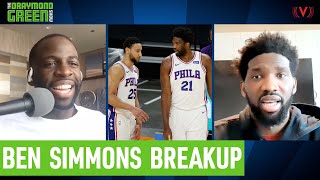
In this episode of The Draymond Green Show, host Draymond Green sits down with NBA star Joel Embiid to dissect the ongoing controversy surrounding Ben Simmons' departure from the Philadelphia 76ers. Green opens by criticizing the media’s tendency to manufacture drama, noting that players often feel compelled to defend the organization. Embiid clarifies that he never advocated for Simmons' exit and admits he still doesn’t fully grasp why Simmons chose to leave, despite their regular‑season success together. The conversation shifts to Embiid’s post‑Game 7 press conference, where he recounts offering a candid, play‑by‑play breakdown of the loss, only to have the media latch onto a single line that seemed to single out a teammate. Green commends Embiid’s willingness to own his turnovers and call out teammates constructively, emphasizing that true leadership involves honest self‑critique and peer accountability. Embiid expands on this, explaining that his feedback to teammates like Matisse Thybulle and Tyrese Maxey is never personal but driven by a shared desire to win. The dialogue culminates with Green challenging Embiid’s notion that he “doesn’t know what it takes to win a championship,” arguing that winning a title requires a complex alignment of talent, health, chemistry, and situational factors beyond regular‑season success. Throughout, the interview blends personal reflections, critiques of media narratives, and insights into the culture needed for a championship run.
Chapters
What's up everybody? It's Draymond Green. Make sure you subscribe to the Volumes YouTube channel below so you don't miss any more of this great content going forward. But I want to ask you this question, and I more so want to ask you this question, you know, and me doing this media thing, one thing I hate about media is how they try to stir controversy. I think it's unnecessary. I think it's pathetic. But I wanna ask you a question about this situation for my own personal sake. And what I wanna ask you is, with the Ben situation, I feel like at times we get thrusted into this position of like, where you're almost defending the team. Yeah.
Mm-hmm.
And I feel like some of that happened to you in the Ben Simmons situation, because the reality is this. I think some of it happened in the Russ-KD situation. Like, we see it often. It's not like it was just you and Ben. It happens all the time. And the reality is, I think we lose sight, and ultimately, like, with you and Ben, like, you express your dismay with the situation. You express, like, get him out of here then. Like you expressed all of that, but there was a point—
I never said that to get him out of there. I just didn't understand what was going on, honestly. Like I didn't understand like what happened and you know, what led on to that whole situation. To this day, I don't understand. I mean, even, You know, when you look at, and I don't have any problems with him. And like I said, obviously we didn't win a championship together, but in the regular season, we were dominant. Every single season, 50-win seasons. I always believed that we had a chance to win together. I always believed it. Even to this day, I believe that we had a chance to win. And what we were able to accomplish, obviously winning matters the most, but I feel like, you know, we had a chance and that's why I don't get, I don't understand, you know, what was going on on the scene. What caused, you know, him to want to leave. I understand, you know, his explanation, but you know, a lot of things don't make sense.
Do you think your press conference after game 7, was it? Do you think that had any effect on him?
I don't think it did. Because, but this is what, you know, you a member of the media and all that stuff, but this is what, you know, this is what you just mentioned, you know, that they always gonna try to pick up little stuff just to make them, you know, look right or just to cause like controversy and all that stuff. If you look at the whole press conference, They asked me a question, you know, "What happened?" You know, "What happened?" Like, "What caused this loss?" And then I literally mentioned a bunch of events that happened. I mentioned, you know, where it really started. And, you know, I was being honest. Like, we all, like me and you, like, you know, I say what I wanna say, and I'm not gonna, you know, just hold myself just because I gotta, you know, make people feel better. And I feel like I didn't hurt anybody's feelings. You know, I mentioned, I was like, Obviously the pass of Dirk, I didn't even mention that. I said, you know, we just, we missed an opportunity. And then I actually called out Matisse for missing the free throw. And then I was like, I didn't call out by his name. I was like, we missed the free throw. And then I called out a bunch of events that happened after we had, you know, we fought a 3-point shooter. And then I turned the— I mentioned me turning the ball over when we were down 4 at that point. They ended up scoring the fast break, which, you know, pushed the lead up to 6 points. I mentioned a bunch of other events where we made a mistake. I mentioned myself. But, you know, the media is gonna be the media. They all—
Absolutely.
They all take, you know, that one part where I said we passed up, you know, a layup. And we missed the free throw and all that, so which doesn't make sense. I didn't call out anybody specifically. I just listed a bunch of events that happened that led to us, 'cause at that point, we, the score was tight, or we were down by 1 at that point when, you know, we missed the free throw. And then I called out a bunch of events that happened after, but they just had to pick, you know, that one part where it seemed like I was calling someone out when I wasn't willing to. And I was talking about like the sequence of, you know, the events that happened.
For sure. And I think as a leader, one of the things that I do respect is you calling out yourself and saying, "Oh, I had too many turnovers." And especially that one down the stretch. Like as a leader, you have to be able to do that. And I have the utmost respect for that because I think that's very important. And it's also very important that you can talk about your teammates as well. Like we all struggle, we all go through it.
It's never personal. Like even this year, like you look at, you know, my press conference with Draymond Green. When he's not taking shots or he's missing shots or he's not taking wide open shots, I'm like, yo, I'm calling him out. I'm like, you gotta be better. But like as teammates and because we so close off the court, he understands that. That I want him to be better. Not just for me, but for the whole team and for himself. Because I understand, I don't, you know what it takes to win. I haven't won, but I feel like I have an idea of what it takes to win. You know, I've lost, you know, on the buzzer beater when we had a great team. And you know, who knows, we could have had a chance to win a championship or play you guys in the finals that year.
Yeah.
So like, I feel like I have an idea of what it takes to win, but I haven't gotten there. So like, and as you know, you can't win alone. I can't win one on five. Like, that's impossible. Like, I need my teammates' help. So like, when I'm calling out, whether it's, you know, Matisse or Tyrese, like, they know that it's not personal. They just know that I just care about them. And I wanna win so bad that like, you know, I just want them to be better. And they understand that. And you know, it's never personal.
No, 100%. And I must say something to you. We've had this conversation on the podcast before where I was speaking about winning and losing. And you don't know what it takes to win a championship because you haven't won a championship. You know what it takes to win because simply just because you— it's hard to win a championship, man. Like people don't realize all of the things that has to go right in order to win a championship. It's not just about who got the most talent or who had the best year. It's so many things that have to go right. And so I would love to correct you here. And you know how to win. You've won since you've been healthy. You've won. Like, you know how to win. Winning the championship is a different thing that takes a bunch of things to align in order for that thing to actually happen.