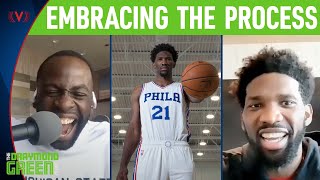
In this interview segment from The Draymond Green Show, Joel Embiid discusses why he adopted the nickname "The Process," a moniker originally tied to the Philadelphia 76ers' rebuilding strategy under former general manager Sam Hinkie. Embiid explains that Hinkie’s draft philosophy gave him the opportunity to be selected and accumulate valuable picks. He recounts how the NBA effectively forced Hinkie out of the organization during Embiid’s second season, a move that angered him because the league criticized the 76ers for "tanking"—intentionally losing games—which Embiid argues is impossible for players who always try to win. Feeling the organization and media were trying to distance themselves from the "Process" narrative, Embiid deliberately embraced the nickname to defend Hinkie’s vision, rally the fanbase, and demonstrate player influence. He also mentions receiving requests from others to stop using the nickname, but he persisted, seeing it as a way to keep the original rebuilding ethos alive and empower players to shape the team’s identity.
Chapters
Hi, it's Colin Cowherd. I started The Volume to bring you some of the most authentic voices in sports. While you're here, make sure you hit subscribe. Thanks.
So you go through that entire journey. You go to the 76ers, and I thought you did one of the most— you made one of the most genius moves when it came to Philadelphia as a city. And when it came to the 76ers as an organization. And all these teams has something that they go by, some slogan that they're kind of where their season is or where their team is that they're going to build on throughout the year. Ours has been strength in numbers and blah, blah, blah. And the 76ers was the process, embrace the process. You then took that name and made it your nickname, say, "I'm the Process." What made you do that? Because I thought that was genius. And to me, it felt like once you did that, everybody else in that city, everybody else in that fan base, everybody else in the organization was like, "Oh, there's our guy right there." I thought that was genius. What made you do that?
There was a couple things. The first thing was obviously I got drafted by Sam Hinkie. And you know, he's the reason why, you know, we were able to, whether it's draft me or have this many picks and all that stuff, you know. And then I got to the league and my second year, it was basically forced out by, I don't wanna say names, but you know I'm outspoken, so I'll say it, by the NBA. I would say, I don't know, But I think that's what it was. And then, you know, that pissed me off because I felt like, yeah, sure, there was a lot of losing, which I wasn't part of because that was before I started playing. But I knew that eventually once I started playing, it was gonna change, which it did. So they basically forced him out and I didn't like it. And then—
Mm-hmm.
During the time, the process didn't actually start with me, but I was like, you know what? Around that time, the league did not like the Poshers because it was a bunch losing. Like, they say it was like tanking, you know, they were losing on purpose, which in the NBA, like, no one loses on purpose. Like, you're not gonna put NBA players out there and tell them that, "Go lose a basketball game." Like, they're gonna go out and they're gonna do their best and— Mm-hmm. Sometimes, most of the time, like if you're not talented enough in the NBA, you're gonna freaking lose if you're playing against, you know, more talented players.
Absolutely.
So you're not gonna put guys out there and tell them that you're gonna lose. So to me, they weren't losing on purpose. So I got pissed off because, you know, they ran Sam Mickey out of town and I knew that they didn't like the process, all the losing stuff. And then I was like, you know what? I'm gonna piss some people off. Like even around the team, like there was a bunch of people that didn't like that award. Like I remember, like I won't say names, but I used to get calls about like, "Can you please tell Draymond not to mention, you know, the process name? Like we're trying to move on from it." And I was like, "All right, watch this." So that's why I started pushing the agenda about like, you know what? I'm gonna support my mans because he drafted me. He had, you know, coming out of college before I got drafted, like he believed in me. I was hurt, but he still believed in me. So I was like, you know what? I'm gonna support him too. That's why I took on, you know, that whole process thing to try to, you know, try to keep what he was doing and really show them that, like, yeah, like we got power. Like it doesn't matter if they don't wanna talk about the process or if they wanna forget about it. Players, you know, have a lot of power when they speak. And I started understanding that. That's why I was like, "You know what? I'm gonna keep pushing that." And that's why it stuck. Draymond Green.