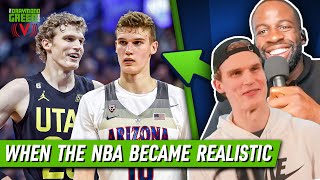
In this episode of the Draymond Green Show, host Draymond Green interviews Finnish NBA All‑Star Lauri Markkanen. Markkanen explains that growing up in western Finland he could only watch NBA highlights because live games aired at 3–4 AM, making it impossible to follow the league. His early goal was simply to become a professional player and earn a spot on Finland’s national team. The turning point came after he committed to the University of Arizona; a few months into his freshman season his name began appearing on mock drafts, and by January he realized an NBA career was realistic. Markkanen discusses his mindset shift from a “one‑and‑done” expectation to a multi‑year development plan, and how the confidence he built at EuroBasket—where he was a leading figure for Finland—translated to his role with the Utah Jazz. He credits the Jazz’s lack of established superstars, the coaching staff (especially Coach Hardy), and his own mental resilience for allowing him to adapt quickly and thrive. The conversation also touches on the broader evolution of NBA accessibility worldwide, noting that today friends and family can watch his games via League Pass, a stark contrast to his childhood. The interview ends with Draymond prompting viewers to subscribe to the channel.
Chapters
Growing up in western Finland, at what point in your journey does it come to you that the NBA is a realistic goal?
Yeah, I mean, wasn't able to watch like live NBA games growing up and it was just all highlights. And so it doesn't really seem realistic. It's just so far away. And my goal was to, be a professional player and get to the national team level in Finland. That was my main goal. And then the college sport opened for me. And once I got to Arizona, I still wasn't on— I don't think I was on any mock drafts or anything. I don't know if that matters a lot, but I mean, I didn't— I wasn't seeing my name anywhere. So just first couple months at Arizona, just started playing pretty well and then my name starts popping. Man, this might be a real possibility. That was right around January, maybe.
That's crazy.
Really, I was going for college. A lot of guys say that they knew I'm a one-and-done, but in my mind, I was going there to get better, and I thought I'm going to be there multiple years. So I didn't think I was that close yet, but then season progressed, and I thought I have to take the leap when you have the opportunity. So it really happened quickly in my mind, 'cause you just keep worrying about every day and grinding it out. And then 2 months before the draft, you're like, "Oh, I can do this." So.
And you, you just said, and growing up in Western Finland, you couldn't watch the games live. Explain that to me because number one, I think it, Goes to show how far the NBA has come. I think Adam Silver does an incredible job. But explain that to me, why you couldn't watch the game live. Was it a TV capability thing or compatibility thing? Or was that the time difference was so dramatic that you just weren't able to stay up and watch the games?
Yeah, just as a kid, the games come at 3 or 4:00 AM, so I just wasn't able to stay up. And I can't remember exactly, like if I really wanted to wake up, I'm sure there would've been a way to some, stream, just get online and see the games. But I think it's easier now. And that's just so what you just said, just availability of the league, just it's all over the world now. And like, I know my friends and family are easily watching my games. They can watch it on League Pass, whatever. So just, I didn't have the opportunity and I think it was mostly the time difference, obviously. Just can't be waking up at 3 or 4 AM and going to school at 8 AM. So.
Absolutely. Okay. And you just spoke about like, my goal was to be on the national team. And I think it's, I wanna dive into that a bit. So just number one, how beneficial you getting traded to this, to the Utah Jazz opened up a space where you know, you're coming in and it's like you said, it's a bunch of good players on the team, but not anyone that's become a superstar until, you know, you now, you, you become an All-Star. But coming into this season, no one's a superstar. Everybody, you know, y'all got a bunch of good players, but no one's a superstar. You come out of Euro Championships, European Championships, —where you are with your, your national team and you are a superstar, you are the star, you are the go-to guy. How did coming out, coming immediately from there right into the NBA season in a position to where you could actually jump into that role, how much did that help you blossom into who you've grown into in this year in the Utah Jazz? And you know, who you will be now in the future as the NBA continues to go, as your career continues to go.
Yeah, I think it's just about everything really clicking. Obviously, my confidence was super high going to Eurobasket and being the guy and seeing all different coverages and trying to lead the team over there. But then just getting into Utah and, like you said, no real superstars. Everybody trying to figure it out. And I always give a lot of credit to coaching staff and teammates, obviously. The first thing Coach Hardy was like, yeah, we just need the same version that you were playing over there. We need it here. And, uh, I think that, that was a really big thing for me, just being the guy in Cleveland who I took the challenge to guard the best players on the team and really try to do whatever a team needed me to do. And they still traded me. So that, that, that was just the business of basketball. That kind of switched my mindset too, that I got the confidence back up and in the Eurobasket and just coming in with that and just try to keep that going. So that was a big mental switch for me too.
What's up everybody, it's Draymond Green. Make sure you subscribe to the Volumes YouTube channel below so you don't miss any more of this great content going forward.