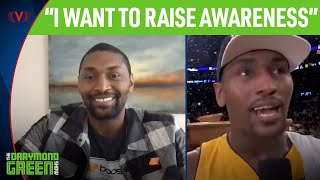
In this episode of The Draymond Green Show, host Draymond Green interviews former NBA player Metta World Peace about mental health in professional sports. Metta explains why he publicly thanked his therapist after winning the 2014 NBA championship, emphasizing that vulnerability is a form of strength that can help others. He clarifies the difference between a psychiatrist (who prescribes medication) and a psychologist (who provides talk therapy), noting that his own work evolved into sports‑specific therapy to maintain focus on the court. The conversation turns to the NBA’s slow adoption of mental‑health initiatives, the high cost of therapy (often $100‑$150 per hour), and the stigma that prevents many, especially in urban communities, from seeking help. Metta argues that public acknowledgment of therapy can reduce stigma and inspire change, even if financial barriers remain. Throughout, both speakers adopt a conversational, reflective tone, expressing optimism about growing awareness while acknowledging ongoing challenges.
Chapters
One of the biggest moments I personally think from that moment was afterwards, you said you wanted to shout out your therapist. And that was a big moment because number one, we had never heard a guy come out and speak on his therapist, let alone one of the toughest, no disrespect, one of the most insane guys we've seen in our league, And you come out and speak on your therapist. What gave you the confidence or made you wanna speak on that?
That's actually true, man, the confidence. Because at that time, your most vulnerable states, one would take that for weakness and things like that. And I just felt like the strength was in, you know, improving yourself. The strength was in being vulnerable. And that's what's gonna help other people, you know, that's going through things and don't really know quite how to get through it. When you're trying to improve yourself, that's big. And I just wanted to give credit where credit was due. That day in game 7, we playing against the Celtics. Me and Paul got a long history. And my whole thing was stay in the game, don't get a tech, do not get ejected. Stay in the game, right? So the night before that, I called my therapist. She lives in Houston.
Okay.
And meanwhile, I've been ejected from like 4 playoff series against the Spurs, Against the Lakers with the Rockets, against the Celtics in Indiana, against the Pistons, a game to go to the finals. I get a flagrant, they have, they, they, they, game is tied. They go up 4, free throws score and win by 4, go to the finals and win, right? So this is like, I'm like, how can I gain control over this? So I call her up and I say, hey, I need you to come in the morning 'cause I just don't feel right. And she comes that morning, I go to shoot around, I come back home, we have a quick session. And we just talked about it, like, be ready for anything and enjoy the game and stay in the moment. And then we win the championship, you know, which is like crazy to me. I never thought I'd be in that situation to win a title after like my career. And now I got this championship. I was just like, you know what? Let me just thank my psychologist. I said psychiatrist, I ain't even know the difference. I said, let me thank my psychiatrist. And she called me up and she was like, hey, "Hey Ron, I'm not a psychiatrist, I'm your psychologist." I said, "Oh, okay, cool." Sorry about that.
Well, for those of us that don't know the difference, can you explain that?
Yeah, the difference between psychology and psychiatry, a psychiatrist or psychiatry, they normally provide, you know, medication, right? A psychologist is more therapy, talk it over and talk it through. So I was doing, at that point in time, I was doing psychology, which is therapy, which later went to like sports therapy. 'Cause for me, the game was everything to me. And how can you be effective on the court if you're not focused? So that's like sports therapy, you know? And I think sports therapy for a professional athlete's like huge.
And like I said, it wasn't, no one spoke about it before you did that. And I think you kind of, you pulled the lid off some things when you did that. Do you, did you see a change in the way the league started attacking mental health after you did that? Or do you think it still took a while for the league to kind of catch up?
You know, I think it took a while for them to catch up. You know, in terms of making it public that we gonna help our players. And in terms of the players, like, I'm actually gonna help myself and I'm gonna help others, you know, by just saying I'm doing therapy. Just by saying you doing therapy or whatever, I'm not saying force it on yourself. I'm saying if you doing it, And you know, it's really expensive, right, to get therapy. And also it's a stigma attached. So it's just so many different things. And it's so many cool things about people coming out and saying, you know, yeah, I see a therapist, this is okay. You know, you're actually helping someone indirectly and maybe they never have to see a therapist because like I said, that's $150 an hour, $100 an hour. Everybody don't got $100 an hour, you know, to see a therapist.
No, that's interesting. It's also very interesting that, It's so expensive. And yet I think for most people, like we all go through trauma, right? In life. Like no matter who you are, you go through some sort of trauma. Most of the times it being unrealized or undealt with trauma. And you kind of just learn how to compartmentalize it and continue to carry on. A friend of mine has this art piece and I'm gonna butcher the saying. A little bit, but it's right along the same lines. And it says something about, why is a funeral so expensive? A broke man ain't got no business dying. And it's along the same lines of therapy. It's like, it's so expensive. Yet we go through all of this, all the things that we go through in life. And the reality is, you go through those things and you go through those traumas, A lot of people, especially in the urban community, we deal with these traumas and you don't have the financial resources to get that therapy.
Right.
On top of the stigma that comes along with the therapy, you don't have the financial resources. And now it's really a thing that you never see. You never had an opportunity to speak with a therapist, to correct those faults or to learn from those things, to learn how to deal with those things. And then you're just stuck living that life.
Right, right, right. You stuck living that life and you probably seen it. We seen it, you know, with the people we have living in our neighborhoods.
Right.
Just can't get outta that rut, you know? And you, you know, you walking out your house mean mugging, you know, once you wake up in the morning, something's bothering you, right? Like how can we, you know, change that and, you know, give you a different perspective on life where you can go on with your life, you know? You know, whether you get educated, whether you taking a trade, whether you wanna build a family, different things like that versus having this blockage, which is kind of mental health issues or mental health illnesses, whatever the case may be, that's blocking you from moving on with your life and your career and different things like that and your family. So I think, I just think it was very important that I came out and definitely gave some exposure and released the stigma.