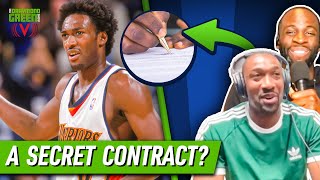
In this interview segment, Draymond Green sits down with former NBA guard Gilbert Arenas to unpack the "Gilbert Arenas rule" that reshaped contract negotiations for second‑round draft picks. Arenas recounts his early‑career contract limbo, explaining how the lack of Bird rights limited Golden State's offer to a $49 million, 7‑year maximum, while Denver dangled a $51 million, 6‑year proposal. He describes an alleged under‑the‑table arrangement with the Warriors—a secret 1‑year, $4.9 million deal that would have been rolled into a $79 million, 7‑year contract—ultimately abandoned when Washington’s Wizards presented a $60‑$64 million offer. The conversation shifts to how the rule altered the landscape for second‑rounders, allowing them to bypass the mid‑level exception and secure more lucrative, longer‑term deals. Arenas cites players like Carlos Boozer and J. Crowder who later leveraged the rule, detailing Boozer’s maneuvering from a modest team‑option contract to a $80 million deal with Utah. Throughout, the dialogue touches on salary‑cap pressures, roster composition (e.g., Antawn Jamison, Jason Richardson, Troy Murphy), and the strategic use of team options versus player options. The segment ends with a reminder to subscribe to the channel.
Chapters
I'll let Gilbert Arenas explain the Gilbert Arenas rule to you, but you go on to sign a 6-year, $64 million contract after your second year in the NBA. Can you explain to us the Gilbert Arenas rule and what you went through during that period and your contract ending and signing that new deal as a restricted free agent?
Okay, so, you know, like they had the bird rights, meaning like after 4 years, you know, you get some type of rights, right? So with a second-year player, no second-year player basically played over the mid-level.
Yeah.
Exception, right? So, you know, the best second-rounder within 2 years, they're gonna sign mid-level. So what ended up happening is I played above that. So like, I think it was $49 million. Right, was the— that was the cap of Golden State.
Okay.
And midway through the season, I was already being like— I remember Kiki Vanderway from Denver was like, "We're offering him 51. Whatever they can't go, we're gonna go above that." So it was already being said that y'all not gonna be able to afford him. So during that season with Coach Musselman, that second season, they were trying to try to hold the contract down by putting me in 3 minutes, putting, you know, that was going on. Oh yeah, the bullshit was going on. Yeah, that was going on.
Wow, that's crazy.
Yeah, because the first part of the season, I was averaging about 18, 6, and 6.
Wow.
You know, I became the second option at that point. I'm the last 5-minute guy. To who?
Huh? Second option to who?
Antawn Jamison.
Okay, okay.
Yeah, so Antawn Jamison. So he was being told to, hey, keep him down. So they was trying to play me 3 minutes and then, you know, think my man Earl Boykins. Earl Boykins and Coach Musselman had a great relationship. And Earl Boykins was like, if you want him next year, You don't think he's gonna remember this?
Yeah.
Right? If you're losing games, you don't think he's gonna fire you? Play him. Play him, right? And then, you know, that's when Coach was like, "Yeah, my bad, I'm just—" And then so he put me out there and I ran with it. So when we went to free agency market, you know, the doors already opened up. I think I was either number 2 behind Lamar Odom.— in the free agency market. So, because of— because of I only played 2 years, I didn't have my bird rights, meaning that Golden State can only offer me a certain amount, which was $49— it was basically 7 years, $49 million. Oh, wow. Yeah, so a 7-year, $49 was the max that they could offer me. Denver already came out with 6 years, $51. So I went to go, I went, listened to everyone, and Golden State was the last one. And I ain't gonna lie, they had a hell of a pitch. [LAUGHTER] They had a hell of a pitch, you know what I mean? We were all young, we were young. You know, they had like a Viper Ferrari, the Lambo downstairs, the Corvette, you know what I mean? So what we were trying to do is we were trying to sign an under-the-table deal. You know, 1 year, $4.9 million. And then have the contract already signed, 7 years, $79 million.
Yes. Okay.
So that was the deal that I was gonna sign now. And then we was both gonna hold it in a vault. Like by the time I got to them, Goats, Wizards already offered me the max that they can offer me. So the owner's like, "Whatever, whatever I have, you know, 58, 61, 65, 75, whatever I have, it's yours. Just come." So, you know, the number was, the number from Washington was coming around 60 to 64. It was somewhere around there. Okay. So when we did the calculations, you know, you take the $4.9 plus the $79, came up with about $83 million. By the time the money matched, I would have already been out of my Washington deal.
Yeah.
You have Jason Richardson, you have me, you have Troy Murphy, right?
Yep.
You have Yuriy Wellston next year, you have Dunleavy. Someone was gonna get screwed. All of us wasn't gonna get our money. And you know, it was basically like, the only one that can get screwed who don't have a name is you. And I had to really take that in consideration. Like if I got hurt that next year and didn't perform, you know what I mean? So I was like, you know what? As much as I wanna love to stay here, I need to go and branch off myself.
That's very interesting. Like I said, for those of you that don't understand, as a second round pick, I actually benefited off of the Gilbert Arenas rule. Because you're, if you're a second, so if you are a first round pick, for those of you out there, you have 2 years guaranteed, then you have 2 years of player option and the team controls everything. I mean, it's not player option, I'm sorry. It's 2 years team option.
It's team option.
So the team controls everything. As a second round pick, you can get back to the money faster. But prior to Gilbert Arenas rule, you could only get the mid-level. And then that rule changed with you, which was huge. It changed a lot for myself. It changed— I think J. Crowder was able to take it. There's so many guys now.
So what happened was after me, who benefited first from it was Carlos Boozer.
Yes. With Utah, right? Yeah.
Yes. So, which, so what happened was they did the, they did "You Can Match It," then they added another year. So they, so, you know, back then it was 1-year deals. 1, 1, or the max 2. That was it for the second round. There was no option 3, and there was none of that.
Yes.
So after the rule, they added an option 3, right? Like, okay, just in case. So with Carlos Boozer, Boozer, after his second year, it's the team's option.
Yes.
So he already got a deal from Utah. He got a deal from Utah. So basically he went into the office and convinced them that, you know, let me out of the deal and I'll just sign right now for the $24 million. All right, I'll sign right now for the $24 million. This is where I wanna stay. You know, and they was dumb enough to do it. They was dumb enough to do it and he took off.
And he like, he left and went and signed where?
He went to Utah, like 80, it was like 80-something million.
Okay, so who was he with prior to Utah?
He was with Cleveland, he was with LeBron. Oh, okay. Yeah, so he was ballin'. So he was basically saying like, "Like, if you sign me this year, then I go to next year, I'm gonna be worth all of this. So right now, you know, $24 million, I'll sign at $24, 5-year, whatever." And they was like, "Oh shit, okay, we'll get him for the $24." So they let him out and he took off.
That's crazy.
Yeah. That's crazy.
Yeah, yeah, yeah. He went to Okie Doke. I wonder who his agent was. I know Cleveland forever hate him.
Yeah.
What's up everybody? It's Draymond Green. Make sure you subscribe to The Volume's YouTube channel below. So you don't miss any more of this great content going forward.