Warriors Sound Podcast | Moses Moody on His Prep for NBA Season
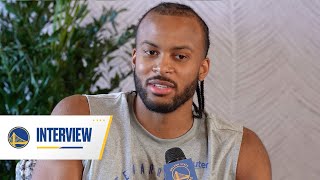
A Warriors Sound podcast interview (recorded at Warriors training camp in Turtle Bay, Oahu) in which Moses Moody discusses how he defines his role as a versatile swingman, the specific skills he’s worked on (shooting cadence, footwork, coming off screens, ball-handling), his summer training routine (lifting, treatment, court work, boxing), and his mental approach to patience and preparation. Moody also describes his community work through his foundation Motivate One, a youth summit and trades partnership, a chess workshop, and his Basketball Without Borders experience in South Africa. He closes with positive remarks about the team’s depth and his readiness for the season.
So we're here at warriors training camp in the grounds of the beautiful Turtle Bay resort on the island of Oahu in the great state of Hawaii. I'm Tim Roy, joined by warriors swingman Moses Moody. I use swing man because you can go guard, you can go forward, but let's, let's first of all get your definition. How do you define yourself as a basketball player?
Yeah, multi purpose, whatever the situation calls for.
Tell me a little bit about this situation. Now, you've had, you've had kind of a tough spot because you've been in a crowded position for the Warriors. What things have you worked on to try to ease that up and try to get yourself full time into the rotation?
A lot of different stuff. You know, changing up the cadence of my shot, being able to get into it quicker, coming off screens, being able to find my feet, as well as ball handling movement, cadence. I've been working on a lot.
Tell me what you mean by changing up the cadence of your shot.
It's a rhythm thing. So, you know, just, you want to, you want to get to the spot and make it, make your shot feel good. So if you, if you have to stop and set your feet to do that, then that's what you need to do. But that's a slower shot. But if you can step into it and find that same cadence off of, off the move, then that's the fastest shot.
How important is it for you when you're doing that and stepping into that shot? And especially if you're off ball, how important is your hand position?
Hand position? I don't necessarily think about that as much as much as footwork and like, just. Because that's where you find the feel from. You. If you got the, if you got slower footwork and you're trying to get your shot off faster, that's when the shots rush. But if you're, but if you're already there and on balance, then a slower shot looks faster.
I got you jumping into a little bit of the, the X and O part of the deal, I guess, emotionally. How do you feel heading into the season?
I feel really good. I really like the team we got. And then just the. You know what they say, like, you prepare, you prepare. So then when it's game time, you don't rise to the competition. You fall to the level of your preparation. So I've done the preparation, I've done the hard work part. Now it's time to have fun.
You did that all throughout the summer. I know you were down in Los Angeles. You Told me. But working out. What's a typical workout day for Moses Moody this summer?
I was working at it proactive with my man Dash and on both sides. I would wake up, go to the gym, do my lifting, then do my treatment. Then I'll probably get on the court. I was doing some boxing training. After I get done working out, I go play a little pickleball sometimes. I was working on a little golf, too. I ain't challenging nobody. I ain't there yet, but I'm getting there.
Yeah, you're on a team with a couple of really good golfers. So I would wait a little bit on that. But the boxing training, I'm kind of curious about. What are you trying to do there? What can that do to help you?
Nothing special. I really just always liked boxing. And it was a fighter at the gym that was doing my lifting at. So he would just put the hand, put the gloves on and show me some stuff because I've done it since I was a kid, just playing around.
Yeah. My dad put a bag down in our basement because I grew up with a bunch of brothers. And so when we get into fights, he would send us down one at a time on the bag until we were too tired to go any further.
That'll do the trick.
It worked out pretty well for us. But, you know, the training part is really interesting because training camp, when I first got the league, you know, guys were getting into shape at training camp. Now guys show up in shape. So you mentioned you have the confidence right now. You've been around the league for a few years. What do you know now about the NBA that maybe you didn't know when you first stepped on the floor?
That's a good question. A lot. A lot of it is just the. This observation part of basketball, like, physical capabilities. You kind of got what you got. When you get to this point, you can get stronger, you can get faster. But for the most part, what you're going into the season, what is what you got to work with, but just being able to know footwork where I want to get my foot past your foot or on defense, like, oh, I need to get to his body right here. And then I just. The just picking up on cadences and picking up on things like that. That's how you make a big jump, rather than just thinking, I'm going to just do a whole bunch of drills and get better that way.
Or is it easier now because, you know, personnel as well.
Yeah, that helps a lot, too. And it's surprising, like, a lot of times it's harder guarding, like when the young guys come in and you don't know who they are, then it's like, you know, you don't know really know how to guard and where they shot, pocket is and stuff like that. But as you get, as you get in the league for a while, you get, you pick up on tendencies.
I know you did some things off the floor, which has always been, I think is so impressive about you, Moses. And I think it starts with your family. And you know, I've had a chance to meet your dad and I know you've carry around a couple of quotes from him in the past that help you. How important is that family structure as you were heading into your pro career, knowing that you had a family behind you?
Yeah, yeah, it's so important and I appreciate and value that now more than any. Like growing up, you kind of just, you're around it. Like I have a tight knit family, which you kind of think everybody does. But being like getting out here into the real world and being exposed to different people and seeing how different and how rare that is, a lot of times just having that a genuine dynamic that we have. So yeah, I couldn't ask for it better.
It seems like you're giving back through that. What, what is Motivate One and why is that so important to you?
Yeah, Motivate One, that's my foundation. You know, just when much is given, much is required. Like I'm blessed to be in a position to be in the NBA, have the finances, have the opportunities that I have. But what does that mean if I'm not helping nobody else and sharing that? I'm also a believer that, you know, I have to get to a point to where I can give back. So it's not even necessarily to where I'm distracting myself from my goal because of it. But in the meantime, in the summertime, I'm able to go back home and put on different events. My favorite one this summer was my youth summit. It was an event that we put on and I invited like my brother was there from the media department here, some people from Klutch, my agency was there, we had a stylist there. And it was really exposing kids to different career paths, especially athletes. You know, so many athletes get to college or whatever, basketball don't work out and now they're, now they working on becoming something that has nothing to do with basketball. But there's so many jobs. Like you can be a chef, you can so many things. Right, right. One, one pivot Away from. From your goal, but you're just not exposed to those things. You don't know about them. And we also partnered with a group called Trades for Life, teaching kids different trades. We had them out there laying brick. Oh, wow. Changing tires. We had a barber out there. And it was just. It was a really good time.
You know, it's funny, too, because even. Even for guys who end up getting to play professional ball, you know, knowing that they could do something else after ball is very important, I think, because, you know, it's going to end someday at some point. And, you know, with. With kids, it's interesting. I always find that, you know, that the kids, you know, when you do work like that, you know, you end up learning as much as you're trying to teach. Is that true for you?
Yeah. Yeah, definitely. That's why I like to do it so much. Like, I'm out. I was out there with the kids learning how to do a lot. Like, I ain't know how to lay brick. Like, I'm out here teaching it kind of, but I'm learning it too. But that's something that I enjoy doing. Picking up on tasks, picking up on different things. Because when you. When you learn more now, you can have more fun in life because you have more things to do. Because you know how to do more things.
Absolutely. And one of the things I heard that you're doing as well is you're doing a chess workshop.
Yeah, I did that in the bay. We were partnered with Hidden Genius. A lot of really smart young men just came through teaching them a game to play. That's just something I grew up doing with my uncles and my dad. Are you good? Good is relative in the chess world, but from my level, I think I'm solid.
Yeah, it's really interesting. One of the things that forces you to think ahead. You have to know what's going to happen three plays down the way.
And then, too, one of my favorite parts about it is everybody talks about that thinking ahead. And that is a big part. But my favorite part is that there's always a solution. Now, you might not see it right now. Your first reaction might not be the best one. So slow down and think about, like, where everything is at. And there's three different scenarios that this can go down. Now pick one and make something out of nothing.
Well, unfortunately for me, usually my solution is to tip the king over. But that's.
That's the last option. That's the last one.
And I know you did some Basketball Without Borders. I read about that you went to South Africa. Tell me about that experience and what did you most enjoy about that?
I loved it. I loved South Africa. I love Basketball Without Borders. So I was in camp most of the time. My parents and my family, they went with me and they got to. They did a different excursions and all that while I was in camp. And they was talking about like, oh, I'm sorry, I feel bad that you're missing out on all the stuff we doing. They going to do stuff while I'm in camp. But I was telling them, like, we getting two different experiences in South Africa because at the camp there's kids from all over Africa. I had kids on my team from Ghana, from Botswana, Libya, Algeria. And so I'm getting. I'm not even talking to the kids about basketball. I probably should have been more. But I'm asking about where they from, how they live, what they eat, what they like to do. So I got to experience Africa in a different way. But then I stayed a couple extra days so I could. I could go. Because when I like to go places, I don't want to go to all the touristy spots within. And Africa has those places. But we went to Soweto, that's a impoverished area. And it was just some dudes on the corner just selling stuff and they salesman, they grab. They coming up to you, they trying to sell you. They sell you the shirt off their back. So just experiences like that is what I loved about it and the reason that I'll be going back.
You know, it's interesting too, because the NBA is now, you know, investing into Africa as the African league. And as we've seen with, you know, the Europeans coming into the league, I'm excited to see in 10 or 15 years, you know, how many Africans we'll have in the NBA.
Yeah, yeah, that's. I realized after being over there, I'm talking to some of the kids and they're saying, oh, I've been playing ball. I've been playing ball for three years, you know, and they 17 years old and then they just up here. I. I had to jump up and check and see if that rim was 10ft. The stuff they doing on the rim, they doing dunks I ain't never seen before. But they don't watch as much basketball, so they just being creative, but it's just all that raw talent. If it's molded at a young age, who knows what it can become?
Well, as long as they're not dunking on you, it's okay. Are you aware that you're kind of a Warrior fan favorite that people are always clamoring to get you more minutes.
I don't really be on social media a lot to get into it, but I do feel the love for sure.
Yeah. Tell me, how do you stay upbeat and patient? You haven't really cracked the full time rotation. You've had some great moments and some great games for the Golden State Warriors. How do you stay patient in that regard and how much is that with, say, communication with head coach Steve Kerr?
I feel like a lot of it is I'm a grown man in the world. It's perspective and it's realizing just because everybody else is mad doesn't mean I need to be mad. Just because everybody else say that, oh, you're doing, they doing you wrong. They doing you this. Like, pay attention for stuff for yourself. Like, there's extra, there's, there's, there's. If you don't want to be upset about something, then don't. And there's different perspectives you can look at. There's stuff that I can do. There's areas of my game that I can clean up and work on to make, to make, to. So I can get what I want. And as I've been like over the summertime too, I did an internship and something cool about and I've been watching some shows. I like real estate. That's what I did my internship with. But just seeing in the world, like not just basketball, but in the world, in companies and all that, it's the same thing. Like, young people come into the business and then they gotta take on more work. They gotta do the hard part so they make their self more valuable and then you can get a higher position and then you don't, you don't get it. As soon as you feel like you deserve it, you got to deserve it for a while first and then you get it. And that's just the way that the world works. That's the way the basketball works. So it's keeping everything in perspective.
Well, I think that that day is going to come for you. Let's start to wrap this up by talking a little bit about the team this year. Got some new faces in town. You know, it seems like there's a good vibe going on. I know that you were working out very well here at Turrell Bay the first couple of days. Tell me what your thoughts on this year's version of the Warriors.
I really like what we have to offer. We're deep, we got a lot of talent. We can knock some shots down. We can run, we can play in different ways. So I've enjoyed it so far.
Well, enjoy an afternoon of relaxation here in the great state of Hawaii.
Oh, yeah. Thank you.
More from Moses
Moses Moody on What He's Learned From Steph Curry, Draymond Green, and Klay Thompson
Moses Moody on funny Steph Curry stories, playing defense with Draymond Green & Warriors Finals run