MAD HATTER SUMMIT VIDEO 2023 PART I - Mental Health & Beyond - Unity In Neurodiversity
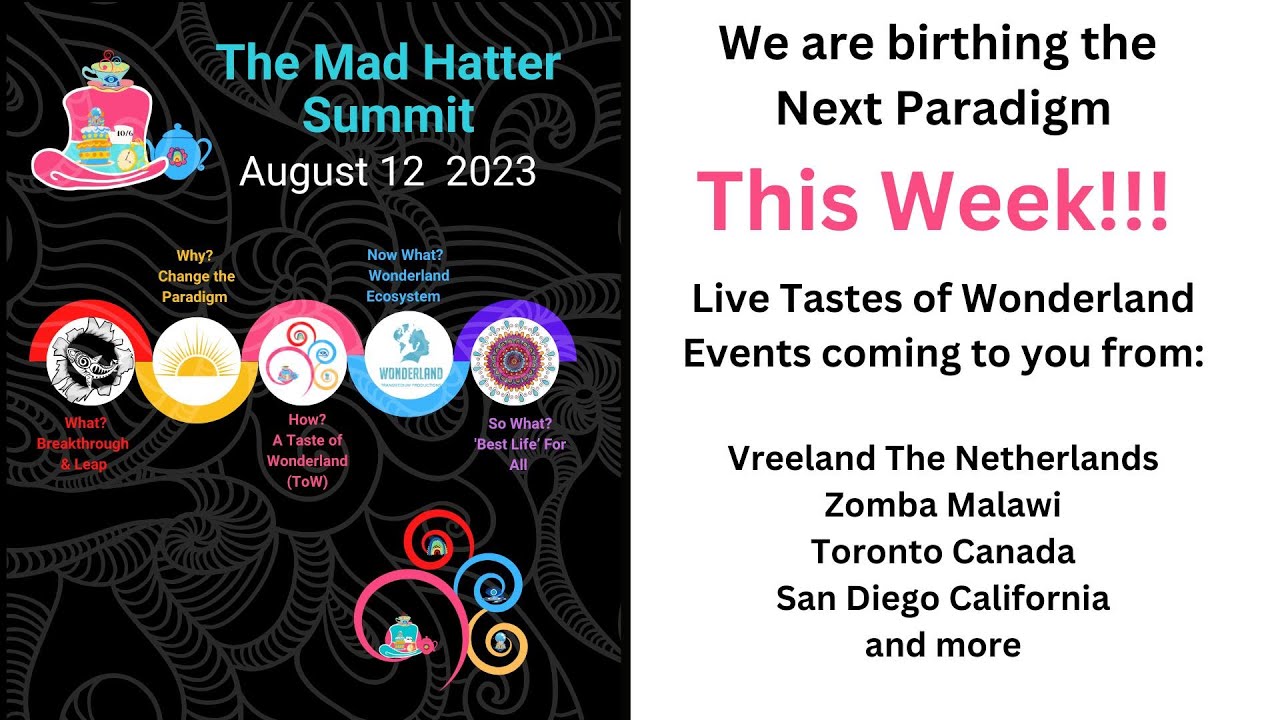
Bret Warshawsky and others frame mental health reform as a civil rights movement, sharing stories of spiritual emergencies and psychosis. They introduce the "Taste of Wonderland" process and "Call to the Mothers" project to reframe mental illness as collective healing, plus plans for a decentralized Alternative Reality Summit with a documentary and grassroots funding model.
Chapters
With who I am at all times. So I think life, think love, think righteous. So lean deep, all in together, all about we, all we'll remember, 'cause it's all beyond me. All about free, so my spirit flow at ease. Light is beyond my pride, just to carry over to shine inside my life.
I like you.
Maybe it was all the exception or a different perspective. Maybe I just had to learn a lesson, a confession, or get a sense of direction. Playing the game so limited simply was the process involved. So we suffered, fought us failed lovers, covered and concealed, not revealed who we truly are. And through the light years, so many stories we told. But no matter how intense or the depth, nothing keeps the truth unexposed. Nothing keeps the truth unexposed. Nothing keeps truth unexposed. Nothing keeps truth unexposed.
Nothing keeps truth unexposed.
In a mind far beyond all space and time, a phenomenon lives ever crystallized, thought victimized in the The infancy, love always rules, there is no other dependency. Exposed how my throne stayed aligned, just to open up so that a storm may arise. Maybe I could catch it, maybe I could spare the pride. Humbly in greatness, I'm no longer surprised. Rise in the mind, I don't have to jump ship. Living what I'm not holds molds that don't fit. How does it exist? It's something like an art. Only way to shift it be to know it's art. Why? I just wanna live my life knowing that I'll be alright. I just wanna play with my heart still major. Playful creative nature. Never meant to feel No pain, so I danced when the rain came. All the stories and the change, worth it every time. Never meant to cause pain, but it still served in my mind frame. All the roles we had to play, still living, loving life.
I see myself in the mirror, loving my reflection.
Expect desire, growing higher on the connection.
My heart's fire in the PM when I remember who I am.
I am, I am, I am who I am. Oh, oh, oh, oh, oh. Oh, oh, oh, oh, oh. Never been afraid to fly till your wings got torn out of the sky. Looks so far away from the ground below, and it feels like there is nowhere left to go. Remember that you can be fearless. You can be fearless.
When the whole world falls and everything Everything breaks and you're standing alone.
You can be fearless. You're not alone. For you, for you, for you, for you. You always knew how to fight until they knocked you down. Now's the time to show them that you will survive. And know that I'll be right by your side to tell you that you can be fearless. You can be fearless. When the whole world falls and everything breaks and you're standing alone, just close your eyes and take a breath, and then you'll know you can be fearless. You can be fearless. You're not alone. You're not alone. You're not alone. You're not alone.
You can be fearless.
You can be fearless. When the whole world falls and everything breaks and you're standing alone, just close your eyes and take a breath, and then you'll know you can be fearless. You can be fearless.
Yes.
Remember, you're fearless. You're not alone. Never been afraid to fly. We'll find a way of living. We'll find a way of forgiving. Somewhere. There's a place for us, somewhere a place for us. Peace and quiet and open air wait for us. There's a place for us.
Somewhere.
There's a time for us. Someday there'll be a time for us. Time together with time.
Time to spare.
Time to learn. Time to care. Someday, somewhere, we'll find a new way of living. When Find there's a way up the hoggy field. Somewhere, somewhere, somewhere, a place for us. A time and a place for us. Can you see me? Why can't I get the camera on? Can we turn the alarm off, honey?
I'm just trying to get I can't get my video on. Can you hear me, Bret?
Good afternoon.
Hey. Hi, I'm trying to get my video on.
Okay, let's see if we can figure it out.
Okay.
I'm just gonna announce us to anyone who might be out there. This is the global launch of the Mad Hatter Summit 2023 prototype proof of concept. We're going to be checking in live around the world. Toronto, Canada, California, U.S., Vreeland in the Netherlands, and hopefully our friends in Malawi in Africa. So we're just trying to see if my original co-founder Hillary can get her camera working. We're going to introduce today and what we're up to. I'm going to tell you all about the Mad Hatter Summit. About the taste of Wonderland, which is a part of that. The outcome, which is called Story Living Studios, and why we've done this and what we're all about. And yeah, it's gonna be great. So we've all done this, by the way, on a super shoestring budget. It's amazing how everyone has shown up to participate, and it's gonna be really super exciting to. see all these places around the world implementing this Taste of Wonderland journey that Hillary brought to the world with one of her friends named Alex. So there she is, Hillary, in Toronto.
Hey, hi everyone. Yes, well, we have had a very busy, busy morning setting up. So let me turn the camera around and just show you our setup while we're— that's easier said than done. Well, how do I turn my camera around? How do I turn my camera around? I don't really know how to do this.
You can either look for the button, or if you're on your phone, just turn it around and you should still be able to hear you.
Here's our beautiful volunteers. Say hi to the world.
They're shy.
They're shy. Yes. So we'll actually be doing introductions at— Ramallah.
Oh, there's one of our key philanthropists, spiritual philanthropists, who made this part happen. One of our few funders. Good for you, Romy.
Thank you.
I wouldn't miss it. This is great.
So did you show them?
I'm just going to show the room now.
So hi everyone.
So here's, here's our opening setup.
Hillary, tell everybody where you're at, like more specifically.
We are in the University of Toronto, and, and we are showing Alice in Wonderland on the big screen. So we're in the, in the Science and Technology— Rami, we're in Information— we're in the Information Technology Center. Here is our setup for our opening. And these rooms have multi-use. So here is where we're going to open. It's also where we end with the Mad Hatter tea party. Over here we have hidden underneath these beautiful sarees, we have our questions for our pool of tears. And now let me take you to the other classroom, which is set up. Or the hallway of doors, which are— you can see on the— all of the questions are sitting on the walls. There are cards here where a person will pull a card and then go and write their answer and post it on the corresponding clipboard. And then what you see covered up By the saris are our last station, which is the— or our second to last, which is our looking glass, which are our hats. And so they're covering up— each one of the saris is covering up the instructions for the hats activity. So let me just show you, take you a little bit into the dark just to show you the staging. But here's all our hats. We have a bucket hat.
Hold on, Hillary. Hold on, Hillary. We need you back on camera. Okay, light somewhere.
All right. Whoop. Um, all right, I'll come. I'll show that later.
Yeah, because what we want to do is our friend Annalise has actually run her process today in the Netherlands, so she's going to be stopping by soon to give us a report. We couldn't get the time zone straight. We didn't do a 24-hour thing this time around, but next year we will. And we'll have everybody live, all fully footage. But Hillary, let's start from the beginning while we have you, because Hillary's gonna have to go soon. Let's start with a little bit of the introduction. I want you— I mean, I want us both to share. I want you to especially share your understanding, perception of why we're doing this and what the Taste of Wonderland is about, what the summit's about. Um, so first of all, thank you. Uh, without you and all the other amazing friends and people in my life, I wouldn't be here. This is— I'm on complete on purpose with this. I'm excited. Uh, it's been an amazing week leading up to this, and I just want to say thank you, Hillary. I love you, and you're an inspiration to me.
Wow. Well, I love you too. And, um, I got so excited about the showing you the details of the process because this is the first time I've run it in person. So we had our first physical pilot. We did it virtually. We were virtual. They were in person in Zambo Malawi. And we've run many of them, you and I, virtually, the Tastes of Wonderland. But this is the first time I've done it in a physical setting. And so I'm incredibly excited about what it feels like, what it looks like. So sorry for getting carried away with all the details.
That's okay.
But, but, but I'm here because of my 30-year-old son. And it's really clear, my 30-year-old son is a gifted, highly gifted sage, prophet, inventor, creator, writer, artist, who is now trying to find a way to repattern his brain because of the pharmaceutical drugs that he was put on and the trauma that he experienced at the hands of the mental health system here. So I acknowledge that the mental health system may help individuals. I'm not, I'm not suggesting it doesn't. I'm just suggesting, but did not— it did the opposite for my son. And I have a sense that it's the opposite for maybe 60% of the population that is currently under the, um, under the watchful eye of the mental health system. So I came into this, um, with a, with a desire with you, Bret, to explore what was really happening. We had a gut feel that something was amiss. that too many people were experiencing very difficult circumstances as a result of the mental health system, not necessarily as a result of their initial condition that got them into the mental health system. And so you and I went on a journey to do research to find out really what was going on, and we used A Taste of Wonderland as the vehicle to do that. And what was so absolutely phenomenal was what we found was that in our gut, we knew that there was another emergent perspective that was coming forward as we did the research. And as we did the research, we started to realize that rather than looking at individuals that were dealing with diagnoses such as schizophrenia, bipolar disorders, all of that, which now there's 1,000 different disorders in the DSM, in the 5th version of it, These individuals, many of them are not having psychotic breakdowns. They're having evolutionary breakthroughs. And rather than being diagnosed with all these different disorders and pathological diagnosis, they are in fact demonstrating fundamental signs and signals of human evolution. So rather than putting them under medications and all kinds of other institutionalizing, incarceration, all of the things that we currently do with individuals that are— that enter the mental health system. We are now exploring what is a whole different ecosystem of care, of support that doesn't— that helps these individuals, first of all, move through the original trauma that they experienced, plus the trauma at the hands of the mental health system, but at the same time unlock their gifts. So here in Toronto, our focus is on, on people exploring what is a best life and how do you release your genie to be able to have that best life. So that's in a nutshell, my, my little context for why I'm here.
Thank you. I'm just gonna— I'll add in the historical context that last year around this time I went on Facebook, and Hillary and I had been working with Romy on a project called Call to the Mothers, which hopefully we'll get a chance to maybe mention today or show a video tour about. And we came together through this question of mental health because of Hillary's personal experience. Personal experience that Romy, who you'll see in the background there, has had with her family potentially, and then myself when I had a spiritual emergency all the way back in 1994 and spent a decade in and out of the psychiatric wards, all every time against my will, being forcibly admitted and forcibly drugged ultimately, which is ultimately incarceration. So I'm not here to compete with suffering. I'm sure prison prison is even much worse. So that's another topic to get to and to honor. And in my life, it was incarceration. We've got our friend Mark here. We'll be talking a little bit later about his experiences. So last year I went on Facebook because Hillary and I— well, I felt frustrated because we kept trying to get traditional funding like VC or find some philanthropists. And I just kind of was frustrated a bit. And I went on Facebook and I went on a 45-minute rant about wanting to create a new kind of summit. where we weren't just talking heads, but we were experiential and we were innovative and we were creative. And here we are a year later, thanks to an amazing group of people, again, from 4 different countries, 3 different continents. So hardly any funding, no marketing, nothing, just sweat equity. And we still— of only 4 locations, we've covered 4 countries and 3 continents. That's amazing. So perhaps later I may fill some time and show some clips from me, from that original call-out.
Mm-hmm.
But let's get beyond that for a moment, Hillary, before you would have to go. And while we're waiting for Annalise to come in live from the Netherlands, tell us something about the summit and Taste of Wonderland process-wise. Like, what are we looking at here?
What are we doing?
And remember again to emphasize what I know is important to you, which is what I where I was heading is we started with this question of mental health, but where we've arrived is mental health and beyond, mental illness and beyond. This is about best life around the planet. This Taste of Wonderland process is cathartic. It's collective intelligence. It's community building. It's movement building. It's a database from the grassroots, and it's just inclusive in that way and diverse in that way. So, one of our taglines is unity and neurodiversity. Because this framework and this journey of A Taste of Wonderland can be used under any condition where people care about taking responsibility and making changes in their communities from the local to the global. And this Mad Hatter Summit, although it might allude to the famous Lewis Carroll and Wonderland and Alice and mental health, we're talking about a more expansive trans— Trans-reality definition here of mental health, mental well-being. But we're also making the point that on this planet, the subculture of highly neurodiverse people who end up in these situations quite often need to be listened to in a new way and need to be supported in a new way. And technically speaking, and I was inspired by a guy named Eric Weinstein last week when I saw his video talking about how the neurodiverse may have the answers to some of of our civilization's greatest challenges because of the nature of the way our minds work, because of the nature of the way our hearts work. It's not just about mental. That's why mental illness is a misnomer. That's a feature of this experience. But to put all the emphasis on mental has been one of the gravest learning lessons of our civilization in the last 100 years. I think it had to happen. And then we all have to come along and course correct. that semantic yet real-life consequence of pathologizing experience rather than honoring it, celebrating it, and addressing it. We're not bypassing the experiences that we're all having. Some of us deeply— you might want to even use the word disturbed, diseased. I don't care. This is not about that. But we need to understand those are not pathologies, in my opinion. I know we can debate that throughout the years. But nonetheless, we're here to celebrate. We're here to find genius. We're here to co-create. We're here to innovate and understand that we can heal through co-creation because that's the fabric that brings us together. So Hillary, give us your enthusiastic or whatever floats your boat. Tell us about, tell us about what it means to you, the summit. And well, and tell us a little bit about Alex, who the, who you created this table.
Yes. So So the process of Taste of Wonderland came as a result of a very— this whole initiative is built on synchronicities. And I happened to be at a conference online during— at the beginning of the pandemic, and I made a comment in a chat and Alex saw it and he reached out to me through LinkedIn. And we ended up striking up an amazing conversation and that went into a lovely relationship where we would meet weekly. He was in Melbourne, Australia. I was just north of Toronto in Canada. And one day I said, Alex, it feels like we've fallen down the rabbit hole. And he said, you know what, a couple of years ago in Melbourne, there was an exhibit based on the lost map of Wonderland. So he said, I think I'm good. I think I know where I can find it. So he did. I had never seen Wonderland on a map. So I got really excited because the moment I saw it on a map, I went, this is a discovery process. This is a treasure hunt. This isn't just chapters in a book or a movie. And so I created A Taste of Wonderland, taking 4 of the different locations on the map and creating a process with it to explore. First of all, in the Hallway of Doors, when Alice gets really frustrated, she gets angry. That's— we talk about where our breakdowns are happening and where the cracks are happening. She cried so hard she created a pool of tears. Our pool of tears is looking at where we're holding grief and pain. And then after going through that very difficult 2 stations where we— where individuals share their, their, their responses to questions that help us look at those areas in research ways, we go into the looking glass. And the looking glass is a phenomenal place where it's stocked with very different, beautiful, different exercises, activities, ideas, all of which are real. There's nothing that says future. The future's here. The future's already born, and we're just bringing lenses to see it. And then the pièce de résistance is at the end when you take a crack, a pain point, and a wow idea from the looking glass, and you put them together for a strange brew inside the Mad Hatter's tea party. And that's where we see some amazing co-creation and amazing ideas that are emerging. And so Alex Pantilla was my soulmate on this. And unfortunately, well, unfortunately Alex isn't with us physically anymore, but I know that he is with us and has been guiding this process to see how it could show up in so many places. And we decided when we looked at doing a summit in a different way was that we knew that Taste of Wonderland worked. We had seen it work in its pilot. We had seen it would work online. And so we did the Live Aid thing. We're both very much moved by Bob Geldof and and Live Aid, why don't we try to do something on the same day in different places? And so that was our shout out to the Live Aid concept. And so we are running it in different places. And so we're waiting for Annalise now to come in from the Netherlands. They're just finishing theirs up. We were greeted this morning. We know that there was dancing and celebration in Benali Village where our pilot it was in Zomba, Malawi. And then Annelies and her team has been running a beautiful process on a farm just outside in Vreeland, the Netherlands, just outside of Amsterdam. We're located here in downtown Toronto doing a very urban sort of version of Taste of Wonderland with a lot of twists and surprises in store for people. And then tonight we'll be handing over to Josh Roberts just outside of San Diego, where he's running a Taste of Wonderland inside another initiative. So we're showing the diversity of this process of how it can be run with different lenses, with different perspectives. Ours in Toronto is very much about best life. It's about, it's about new forms of mental health in, in, in the Netherlands. And it's a very different, it's a very spiritual experience out on the West Coast of the States. So that's what basically we're doing today is we're experimenting. We're the big prototype. Same process run in very different ways in different places, in different communities with a very— with the garner amazing research, which is what this is all about. Warm data. Where are the breakdowns? Where are the tipping points? Where's the possibility for change? But we don't just do that. We say, here are ways of mobilizing best lives. So we're all about bringing the solutions in. They're coming from a very neurodiverse perspective.
And in that sense, everything is synergistic. Everything is interdisciplinary. Everything is transdisciplinary. So, Hillary, I'm happy to have a quick conversation, but if you feel like you've got something you want to say, I want to basically ask you to tell us and tell me again about how you understand these new archetypes for business, these new ecosystems, and how these new ideas that come out of the strange brews, whether they're art pieces, businesses, enterprises, operas, or social activities, whatever those new ideas— it's art ultimately, but the art of business, the art of commerce, the art of science, So I don't mean to use art in a restrictive, particular way, as Mark might say. It's a more universal use of the word art because of creativity being so fundamental to the source of inspiration that we're all part of and aspects of. So Hillary, when you shared that piece with me a few months ago and you explained to me how all of these pain points and grieving We're coming from the actual people rather than like institutional studies or pharmaceutical-based studies. We're gonna get this like cream of the crop data, which means the new— these new art pieces, these new artifacts, businesses, whatever, they're actually deeply connected and responding to the actual needs of the people. And I finally— the light went off for me. I'm like, now I can pitch this. Like, now I can represent this because this is my need.
need.
Again, going back to this Eric Weinstein video I saw, I have not been able to fit in. I have not been able to bring my gifts fully to the world. And ultimately, that's about me growing and learning, not about the bad guys or someone holding me down. But this process— this, this is the necessity is the mother of invention. I mean, Hillary, the mother of her son. Necessity is the mother of invention. And we therefore had to create the thing that we need ourselves for us and our So we're going to hold that thought because Annelies is coming in from the Netherlands. She's going to be very tired, so we're going to welcome her in.
Right. I just want to say that what we're doing here is we're looking at the 14th century definition of business, which is to go forward with purpose. And so all of these ideas that are getting generated are all potential business concepts with different markets and different marketplaces. So I'm just going to say that's the part I'm going to finish on, and I'm going to say Hello to Anneliese.
There she is.
Let's see if we can get her on video. On the way.
Hello, guys.
Hello.
Hello.
Hello.
I do not know how long I I will be with you, but here we are in the Netherlands. This is Abachi. He's a photographer, and he's also filming, and he's also from the the new world. He does not want. They only want chaos, chaos, and it was chaos here. We had a lot of chaos, but we had a wonderful time. So let us know if you're— No, I lose my Wi-Fi, so I'm coming here.
How are you?
Wow, Hillary, this is synchronicity, and I love it because I asked the team which hat should I wear to pass the baton. Oh, here's the wizard. Hi guys, can you come over for saying hello? The team and whoever wants.
Wow, hello! How is it gone?
Hello!
How is it gone?
I made the stick for you.
Yes, we do.
We had a— we started with, uh, we started in the rain this morning and we had a lot of closed doors.
Hello!
And we had, uh, amazing, uh, answers to all the, the doors. Everyone was so concentrated, and so, um, there was a lot of attention and concentration during the whole day. And then we went to the Pool of Tears at the Waterside, and we really lost our way also as a team. We were a little angry in ourselves.
Yeah.
And while the team was working that out, The people at the waterfront were working that out for themselves. So, well, how was it?
The sun was shining.
The sun became shining.
Came back, yeah.
So is there anyone who wants to share something about the Pool of Tears? How was that for you, Jojo?
The Pool of Tears is very interesting. It really takes you to a deeper level of what you have been through during your life and what you have overcome.
Right, yeah, right. Absolutely, absolutely. Yes.
Can you can you say that in Dutch so we can have your your home language on the video?
Ja, het was een hele mooie ervaring.
The pool of tears, het meer van tranen. En we came to the conclusion.
We kwamen tot het tot de ontdekking dat de tranen waren. Waar Alice over zich heen krijgt, of die zij huilt, dat dat in feite een soort meer vormt, wat hoger en hoger werd, zodat zij door het poortje kon wat boven in de muur zat, waar ze dus op de grond niet bij kon. Dus zij moest eerst door dat meer van tranen heen tot het volbracht was, en daarna kon ze door de opening die naar een nieuwe dimensie ging.
Wow!
Well, that's Germany.
No, sorry.
Perfectly understood that. Yes, yes.
You will get that remotely.
This is we do not need any language anymore. We we know that now.
Yeah.
Beautiful.
So let me introduce Sabine. She's our sound healer.
Hello.
Maybe you can.
She was one of the immersion givers, and we had three immersions. This is the feet woman. She brought people to their feet on the ground. And do you want to say something? Is there something to share?
Well, everyone after the emergence was relaxed and smiling, so it was a very nice experience.
Wonderful. I hate to tell you, I'm gonna have to dash now because mine is about to start. So mine starts at 11. 11:30, so I better, I better head it into there, take my— take off my wizard hat for the moment. I just want to say I cannot tell you how deeply, deeply, deeply grateful I am for what you have done today and, and what you had done to lead up to today. And I'm going to thank you in advance for everything that's going to emerge from this, because it's going to be magical, and it couldn't have happened without you.
Thank you.
So I'm sending huge kisses from Toronto, Canada, and say— and stay on please with Bret because I would love to see the recording of— I'll get to check in on this, um, when I can sit down and watch it. So I'm gonna say—
So more of Taste of Wonderland.
One second, one second, one sec, one second. Hillary, remember to try to find someone to tune in from their phone on this Zoom with the mute on. Like, okay, even if they put the phone down and we see you all in the background with music, it gives a nice visual while like me and other people are talking and people can see stuff just happening in the background. If you can make a filter, great. Have an awesome time.
Thank you everybody. Thank you so much. Check in later.
We will check in with you. We check on, uh, we check in with you through the Zoom on a mobile and then you, then we'll be with you for 10 more minutes or so because we're ending our premiere.
Okay.
I just want to honor you both being co-founders and just saying what a wonderful, wonderful play we can do here, which has a great expansion and a great depth. And you both are bringing this, holding it, and making that we can make the next step as flamingos and hedgehogs. So thank you for that, both of you. Firebrand! And here in the suburb is Andrea, and Andrea is our word wizard. She's a beautiful person, and hi! I do not know the lovely face and the heart. We met not before, but I'm happy to meet you.
Hi, Andrea!
She wrote this amazing book about how it is to have many, many voices and to be your own person.
What's it called?
The title, please.
The Bipolar Game Changer.
Again?
The Bipolar Game Changer.
The Bipolar Game Changer.
Okay.
Thank you so much.
Thank you so much. Okay, probably we are going to lose the connection now. Is there someone? Do you want to say something? Because there's something profound here. Great light.
It was one big crack.
It was one big crack.
Okay, but a crack in a good way, in a good sense. Only then. Okay, wonderful. Look at those beautiful sun and blue skies. Wonderful.
Yeah, this is the, this is the place. We have all these, these little, um, we had this, this kind of— I don't know if you can see that, but this is the rabbit hole where we were having our lunch and our, our, um, starts and, uh, the reception. It's a beautiful place. Hi there! So this is—
What a beautiful place!
It's a beautiful place.
Geez!
Geez!
Oh my goodness!
Oh my goodness! So you see, we had a we had an amazing day here, and of course, we all came through our own cracks. We we even have team persons. We had so many cracks. So Abachi is seventeen. He said to me, "You're a corporate woman. You're too dominant for this program." Well, it's good that anyone.
If someone could say it, then I can hear it.
Okay, but it's not about me. But you see, we had all these doors here so people could, could find their door.
Beautiful.
And then opening the doors. So what makes you cry to the moon, or feeling vulnerable, and the wish that your, your longing is going to be heard? And that was one of the questions. And so we had 12.
Well, wow, wow.
So, so now we're sitting here. This is, uh, our Mad Hatter tea party. It's still going on. People are eating tea and we had just—
Nice. Yes, I love that we've done this all in person and not having to go into the metaverse and VR, which is all fun stuff. But to see you all actually at the table like that in the sunlight, that's just beautiful. Yes, it is.
Thank you.
Annalise, let me— so let me take a second to, to celebrate Annalise, who, you know, at first single-handedly catalyzed all that is happening right there. Of course, she now has teams and friends and allies and everyone there.
I don't know if I have friends still, but I do.
Maybe she doesn't have any friends left after all this. That's a good one. That's true. But no, let's just— I mean, one second. Round of applause. Come on, Mark. Round of applause for Annalise for all that you do and to helping make that moment on Facebook last year when I made that statement. You are the real heroes. Like, you, everyone on the ground. I just talk. I'm good at that. And I'm not diminishing that. But really, honestly, the people on the ground, like, you know, I'm calling this a civil rights movement for the soul in honor of the author Neale Donald Walsch. And I'm sure back in the '60s and beyond before that when they had social— Mark, we can tune into this when once we get to the next stage, hopefully before your call. You know, during a civil rights movement for the soul, we need everyone. We need activators, we need community builders, we need people that put in the hours and do a lot of work that maybe someone like me is not used to or not good at. That's the whole idea of teamwork and co-creation. So Annalise, thank you. I'll never forget, never forget this.
And we bring all our gifts to these places. So in the space beyond time, we just have to bring our gifts, know what our soul's gifts are, and then we fly in synchronicity. I love to be with you guys. I say goodbye and have a last celebration with, with the team and with the people. So we eat some tart, and I wish you could be here. Love to see you all, all Andrea and all other people who are behind their videos. So grateful for you checking in here. Love, love, love from the Netherlands. Have a wonderful day. See you later in the night.
Bye-bye.
All right, lots of love.
Lots of love.
Wow.
Wow.
Take care.
Thank you.
Wow.
Thank you.
Um, Mark, what do you make— before we get into anything else, just what do you make of this situation?
Like, what do you make of that as an activist as well?
I mean, and Someone who's pretty hardcore around getting things going and starting revolutions and movements. What do you make of all this?
When she said that she might not have any friends left, that's the true thing. It's hard to organize huge things like this. Like, it looks simple, but the amount of work it takes, the technical skill to pull together a movement across the world, uh, Helen Milan, and to have more than one or two participants at any of these events is already like Now, this is the first one, so I really feel like just meeting her now that she's a bit of a superhero to pull off what she's pulled off. And for me, it's very inspiring because even the way you're talking about it, the way we're introducing it, feels right. It has authenticity to it. It has embodied experience. It's virtual. It's all the moments. It's all the different opposites and extremes coming together in a nice, gentle, beautiful harmony. And I'm pretty impressed. I'm pretty inspired and very happy to be a part of this, even with my name. Like, I had technical issues and I'm not even a big organizer. Like, it says Spirit Man 2. I had to download, uh, I had to remove Zoom and re-download it when I came in here and I didn't have time to change it, so it's uploading my old information. But I do like the spirit of this place and, and this initiative, so I'm gonna give my energy and love to the civil rights movement of the soul as much as I possibly can.
I'm just gonna do a quick time check to see who can stay and who can't, so I know how to— who to call on first. And for those that are joining us, we're going to do more popcorn if you can just be patient and hang out and enjoy the thing. I'm just feeling into it. I don't have a superstructure. I'm just going with my instinct. Andrea, how long are you able to hang out? Can you stay, hang around for another hour or so, or what's your schedule I'm here till the end, so you can call me later.
Right on.
Awesome. Milan, are you able to hang out for like an hour? What's your schedule like?
Yeah, yeah, I can definitely stay till the end. An hour, an hour and a half for sure.
Awesome. And Marlene, if you can hear me, let me know if you're going to be hanging out for a little bit.
Uh, yeah, I should be. I might be popping in and out a little bit, but I should be able to hang out till the end.
Okay, cool. In that case, Mark, you are going on your other call, right, in 20 minutes? All right, so if everyone wouldn't mind, and it's also valuable to hear Mark's story. I mean, that's why we're all here, to start getting to know each other and to hear some stories. It won't be like this all day, but Mark's a very good friend of mine, new friend of mine, but good friend of mine now, and his story is quite incredible. So Mark, let's do 10, 15, 16, 18 minutes, whatever that might be. I'll just ask you to try to start, maybe start at the like high level first. Like somehow, and then we'll go deeper. But let's just say, first of all, what draws you, you know, beyond maybe a natural inclination for activism and good works in the world? Like what actually would draw you to something that's like mental health and beyond, and best life for all, and creativity, and all these different things? What role do you have in that? What's your life experience that would make this relevant for you?
Yeah, lots. And, uh, it's hard to keep it brief, so I'm glad we're putting time limits on things because, uh, we've, we met each other, uh, sort of recently now, but with synchronicity, things get deep and, uh, meaningful very quickly. So now I feel like I've known you for much longer than other people who've been with me, uh, for years. But I would say that's what this event means to me and why I'm drawn to this and the way you're doing it. and Hillary's doing it. The way is also important, is that we need this right now. Humanity is going through a polycrisis, and the root cause of it is a lack of cooperation because the internal world, the mental world, is experiencing a sort of inflation, a separation. We have a lot of external connection but not a lot of internal, and the mental health system doesn't understand this at all. And it's pathologizing what could be solutions to this incredible problem instead of helping the people who are intimately connected to it, who understand it on a lived experience level. So we're silencing the voices that might have the answer, and that's the very scary thing. And I don't mind modern medicine. I think there's good parts to it. I think there's bad parts to it, but we're veering into a very dangerous place, especially as human nature expands into this higher spirit of who we are. We're going through a transformative moment. where it's like a holistic transformation. It's a whole change. We're talking from like our logic to our self-identities to the relations to lands to each other, interpersonal ethics. Then you get into civil society, and then you get into families, and then state politics, international politics. And all this is all happening simultaneously, and it's really overwhelming to our old way of thinking because we're used to thinking in particulars and fragments. And now we're being forced to develop a new whole. And I feel like, um, the Taste of Wonderland, the Mad Hatter, uh, Mad Hatter Summit is a beautiful marketing tool to like the innocence of Disney to say, no, we need to do something much more open, even though it might look a little bit unusual at first, and reclaim this word crazy and all these pathologies and say, no, here's a new way of listening. And that's what you guys are doing. And you're saying we need to process the grief, we need to process the pain before we can get to the revelations. 'Cause hold us back. And I really feel like all the right elements are coming together here from tens of thousands of hours of experience from people who've been through this. And now it's just coming together in this nucleus and this spark that is addressing all areas of society simultaneously. And I'm multi-solving. We have a powerful idea that's solving sort of fractal issues, right? They're repeating orders of things. And I think that if we can get the pain sort of externalized, we can start seeing ourselves in this, in what's toxic and what's happening to us. We can see it and we can grasp it, and then we can start listening to it in a deeper way and then transmuting it into these, you know, like she— like Hillary said, these kind of peaceful revolutionary moments that are transformative in an evolutionary sense, a paradigm shift. And so that's what makes me really excited in terms of why I'm, uh, sensing an urgency. Go ahead.
Yeah.
That was awesome, dude. Very, very, very concrete and like powerful and understandable, even as it was true intense and high level, but also awesome. Make sure you talk about your, your experience with the hunger strike And the before you leave and that real, the real, you know, that real part of it too. So yeah, just make sure you bring that in before you have to go.
Yeah, I was just transitioning to that. Um, and I wonder how much detail I should go, but the brief of it is that I got—
Start first, make sure you cover that. Yeah, make sure you cover the, like, the details so everyone knows, and then I'll try to bring it back and ask you questions to allow you to maybe go deeper or like a second iteration, just, but make sure you to kind of COVID the first story somehow. I don't know how, it's hard, but go for it, dude.
Yeah, there's, uh, I got sucked into the, the mental health system in a strange way. It's kind of unconventional, but it was half intentional. I knew it could happen because I've been doing activism for about 20 years, and, uh, you have to have one foot in the system and one foot out of the system. So I'm very careful mediating that, but I've— the crisis we're going through is escalating so rapidly that I went on a I went on a protest, and the protest was to unionize all these Uber drivers because AI is being used to create modern slavery internationally. And so this is exacerbating the mental health strain and the anxiety. And if you haven't experienced working for an AI-driven app, you don't understand what the future is going to be like if this goes the wrong way. But there's There's about 3 million people around the world who work for this corporation that are experiencing it right now. And it is quite concerning because it's a mental thing. And so we thought before they change all of our laws that protect labor rights and the humanity in labor, we're being alienated in some sense from ourselves when our labor isn't meaningful to us. That's happening en masse because we have a global paradigm that doesn't understand human nature. And so a bunch of drivers who are mostly immigrants, because these big transnational corporations are exploiting loopholes in the labor codes and all this stuff, most of the guys that did this were immigrants. And we had to be very careful because when you don't have that much power, you're even more oppressed. And we did the impossible and we pulled off this unionization event, but we knew that unionizing wasn't enough. We needed to do something more. more, just like the Mad Hatter Summit is doing more. And so they thought, we need to make our own app, our own AI that has a higher spirit, and then grow that in tandem with the support from the older union structures and create this oneness, a newer sort of cognitive belonging together while we work. And so this unionization went very well. We had hundreds of people. They said we did like 5 to 10 years of unionizing in 8 months. And, um, it culminated into a strange place where politics kind of came in to silence the movement because it was growing so quickly. And we had predicted that because the old movement is trying to protect itself, the old mental models, the old paradigm is trying to do this sort of like, um, sort of preservation. But we need to create a new organism. And so we saw this coming because the guys we're working with are so experienced that they've been marginalized for so long, even in rich countries. never mind developing countries, that we preempted this. We actually had a plan to get around it, to keep pushing the spirit this new way. And, um, we ended up getting into a hunger strike, and the hunger strike was to force the hand of some of the participants to, to take on this new model, this new cultural model that we were ushering in with our own app. And this is where the mental health stuff came in, is when we need to change the way we think about ourselves and, and what it means to do labor. When it means to participate in goods and services in the economy. It's not just a, a dead version like we have now, where we have a separation from the real world with this speculative sort of money world, um, that's slowly kind of entrenching us in this debt slavery that's increasing the anxiety and depression that we see going up all around the world for rich and poor, actually. So it's not even just a money issue, it's just like a mental, spiritual issue. So this hunger strike was to really try and get outside of this trap we're in and do something that could not be predicted by an AI or Uber or anybody. And it ended up getting so serious that I ended up getting into the hospital, into the hospital to change my goals of care so that the hunger strike had a real chance of urgency. And this is where the doctors came in and started pathologizing the politics and the spirituality, and the old mental health model couldn't understand what we were And this is where I had the really the direct experience of not being listened to, even though I have no mental health history, I have no criminal records, all my activism was peaceful. You're just erased, even when you're prepared. And that was the thing that shocked me, was how bad it really was that you couldn't even challenge the system at all. It marginalizes you, it, it dehumanizes you. It gives you these, these stigmas, these words on a piece of paper that stigmatize you, and then you have no voice anymore. Anywhere you go, anywhere with power, you have no more, no more voice. And so this is the dynamic that I want to play a part in addressing. And I think the Mad Hatter Summit can expose how much of a rabbit hole the, the pathologizing process is in a hospital that is supposed to be highly respected. And so I think in a way we're actually creating, we're manufacturing mental illness now. And this big movement that needs to challenge the system in a peaceful way, this whole movement is going to get pathologized. And I think we can, we can transmute that negative energy into a positive transformative moment so that the activism is seen in its true light, that it actually has a potential solution that the current paradigm can't see. And so this is sort of how I got into the, into the rabbit hole.
Let me ask a clarifying question, Mark. Let me ask a clarifying question. Let me ask a clarifying question. So for those of us in different countries around the world, tell me if this is wrong or add what needs to be added. So from what I understand, because you were on a hunger strike, at some point you were taken to the hospital, or you decided to go to the hospital because you realized there's something— in America we call it like a DNR, do not resuscitate. So before you die, you can make a will out saying, like, if everything— something were to happen to me and extraordinary measures stop working, like, you don't really want to be resuscitated, maybe, or, or whatever that might be. So basically, you realized because you hadn't had the right legal DNR of some kind, they could kind of detain you or something. And then you went to try to say, well, actually, I'd like to change it or something. And before you know it, they started taking you as an intake as a psychiatric patient. And going through that whole process. Meanwhile, first of all, you didn't have a family history that was clear to them. Like, you didn't have a personal history. Like, you weren't brought in for violence or even delusions or anything.
You—
it was all related to, like, you didn't have the right DNR in a sense. And before you knew it, you were probably— and you can clear this up— like, admitted against your will. You were shot up 32 times with an antipsychotic. Like, tell us before you go a little bit about that actual experience. Don't tell me about the legal stuff right now. We'll come back to it.
that.
Tell me about like actually what it felt like to be taken away, that moment when you realize— because this has happened to most of us, a lot of us, and me— the moment you were like, holy shit, I just got fucking incarcerated and lost my freedom. I mean external freedom, not your mental freedom. But tell us about that fucking moment and then getting shot up and what it felt like to be given intravenous shots with, I think, uh, probably, who knows, Seroquel or Thorazine or whatever the heck So tell us before you go about this.
It's, uh, it's kind of intense, but, uh, yeah, I'm still— I still can't believe it happened. I'm a very high-functioning person and I have lots of activists. I've studied poverty, I've studied the 21 determinants of social determinants of health. I know how these systems operate, and I thought I had enough protection to sort of get through this moment, and I was just amazed at how they just bulldozed everything. That's why it's actually turning into a lawsuit, and we're trying to make this a class action because it's sort of a once-in-a-lifetime case where all the things that most patients don't have to prove the marginalization, I put recording mechanisms in place to make sure we can expose it. So we're going to expose this really incredibly entrenched system where even—
so to be clear, so Mark, to be clear, there were instances where you actually like on your phone recorded the conversation?
Yeah.
And for people out there who don't understand, maybe you could even address it quickly, Mark, while you're wrapping it up. Normally, most of us that get caught in these situations don't have our phones on us, or we're not in a great state to think practically, because we are in an intense state. So don't get me wrong, we usually end up in— a lot of us, because we're having an intense experience, it's all about how it is responded to. So most people aren't able to document the lunacy, the absurdity of the actual process. And I think Carolyn, we'll get to you, Carolyn.
Yeah.
Mark can't— Mark is leaving. That's why we're going in a circle, Carolyn. So you had, again, 2 unusual experiences compared to many of us, which is really, you weren't actually even having even a spiritual emergency, even anything. You weren't really having anything in that sense. And And you were able to document it in some way. So just finish up. So continue, please, and also just finish up with weaving some of that in.
Yeah, I mean, if I couldn't do it and I was rational— I just wasn't eating or drinking, really. I was, I was on a dry hunger strike, it's called, to really make things move. Um, it would be impossible for somebody actually going through, uh, an ungrounding state. It would be impossible for them to get through this system So I did record. Like in Canada, it's legal to record your doctors without even telling them. As long as you're part of the conversation and you're not recording other people eavesdropping, you're allowed to record even without telling people. So before they took my phone away, I was recording the conversations and I was telling them too. So I got some of the pathologizing on tape, and that's actually helping me behind the scenes because what I thought was going to happen did happen. That if you don't have an objective voice recording. It's just the doctor's medical notes, and they're extremely subjective. And we're proving that with the voice recording now that they didn't know I had. So I think number one is we have to get a sense of objectivity in the subjectivity or in the processing of patients and what they're saying and doing. And we need a deeper kind of logic. So I kind of went through the system totally lucid. I just wasn't eating. And I recorded all this stuff that happens. It's like, it's like death by a thousand cuts. It's like you can't point to one anything. But it's like when you take them all off, it's—
yeah, it's not torture.
Mental and physical. For me, it was mental torture and physical torture they did to me.
How many times did they shoot you up?
So this all led to 32 injections of something called a drug called olanzapine, or otherwise known as Zyprexa. They renamed it because there's all these lawsuits against all the bad stuff that happens to you on these drugs. Like, we have data now from decades showing that the recovery rate in 1970 was like 77%. from a psychotic break or just natural. After a month in the hospital, you just recover and live a normal life. Now it's like 5% and everybody's drugged up. Oh, you're on mute, Carolyn.
Carolyn, Carolyn, Carolyn, we're just finishing something up. I'm gonna bring you in.
Yeah, yeah, no, but I wanted to correct something here, if I may. Zyprexa is a brand name and olanzapine is a generic name. So they're, they're, they're— yeah, so I just want to clarify that.
Okay, okay.
The drug has a really bad reputation and they're trying to run away from it. And we're lucky to have this lawyer, uh, Jim Godston, who's, um, an expert sort of in this, trying to help make the case, uh, as big as possible because we're going up against billions of dollars really. And that's why medical malpractice cases, like, less than 1% succeed. But I think this will sort of blow the top off and say the reason why they're not succeeding is because there's no objectivity for the patients. The patients are totally vulnerable. Totally powerless. And if you try and file complaints, the complaints are always dismissed as subjective testimonies.
It's a strange loop, isn't it? Right? We never have the evidence we need, and then the bullies win the game because they always get to say, "This is what happened. Here's our report." Blah blah blah. There's never any counterfactual evidence of wrongdoing, let's say, or mis mis what do they call malpractice? And to me, this is this is for real. This is malpractice. And yeah, I don't need to get into personal like the doctors who made these mistakes. Like bless them. them, and I hope they have a change of heart and a change of mind and all, but they do need to be held accountable.
Like, you can—
you—
they can have a good soul and still be held accountable, and this must stop.
And one of the things too that people don't think about is to pull doctors. And we love you too, doctors, you're part of the solution. Um, my sister is a doctor. The, the real problem is that how do good people do bad things like this? Like, I was telling them to the face of like, wow, I'm having an allergic reaction when they were injecting me. When you take it orally, you don't get the pain, but when you get injected Your body has these like spasms. Like it's a full— for me it was full body. I didn't know what this drug was because I've never been injected with drugs. And so I was like, hey guys, I'm not— this is not normal. Like I'm not a normal patient. Something's happening to me. I'm getting these seizures. Like it's horrifying. Like 2 or 3 hours a night. And they just kept doing it. Like the nurses and the doctors. And one doctor listened to me and did decrease the dose. And it was down to 2 hours of spasms a night. But they— good people. We're doing that. And it's because I think the system puts so much liability on the doctors that they just like erase you, because if you go off and hurt yourself or do something afterwards, they're protected. So it's really more of a protection for the doctors.
Yeah, the ends justify the means. Unfortunately, they're looking at it as the ends justify the means. This is not overcomplicated at the end of the day. Groupthink and good people doing wrong things is not overcomplicated. And this is, this is also partially what we're all here to do, is to change systems and take the power back ourselves.
And then it gets really murky because when doctors get angry, then they start doing intentionally bad things. And this is where it— my case is turning into an unfortunate criminal case. So it's guaranteed to have court, Supreme Court potential. And if we get a Supreme Court declaration, it actually forces nations to make the policies a lot faster. And that's the real win-win, is to change the system, not necessarily to just destroy human beings, because that's what our system is doing already, churning out pain. But we need to get this listening happening. Like, the Taste of Wonderland is— and the Mad Hatter Summit is correct. It's really a listening problem, and it's a superficial human interaction that's occurring in all aspects of society that I think the summit can address. And if we get the legal component going, then it kind of has some teeth to make these systematic changes that are allowing these systems to continue. and literally torture people, even politically. Like, what's even more incredible about my situation here is that it was a spiritually motivated and politically motivated hunger strike for a union event, which is a bona fide— it's a recognized event. These are protected human rights grounds, and they just bulldozed over those. And we found where the cracks in the system are that allow them to do that. And it's really— it really robs you in every possible way. I was violated around 47 times, it looks like, and it compounded about 1,200 times. And I think the average patient in the psych ward is going through this systematic process. Like, we're all going through somewhere between 1 and 47 violations that just destroys your humanity. So I really feel like, um, you know, it was an incredibly horrific experience for me. Like, I still can't believe it happened to me, uh, but it did. And that's why I have a passion, like, uh, on top of my original passion now, I feel like like I know what the problem is in a deeper sense, a lived experience sense, and I can recognize which movements are, are having the right solutions in this holistic manner. And the Mad Hatter Summit has those elements, the people gravitating around it, the scientific gravity, the spiritual gravity, the political gravity. I, I feel like we're in the right direction and we have the right spirit. So with 2 minutes to go, that's my story. I hope it helps somebody out there. And if you go in Know that you can protect yourself with objectivity. Try and get them to get a voice recording. You have it right. If they try and take your phone away, question it, and document everything with dates and times to be usable in court and all this stuff, it has to be like objective in some way. So try and make it as accurate as you can so that when it's compared against medical notes, it can actually be shown that it's not totally delusional like they try to make it out to be because you're in a vulnerable state. These are a little bit of simple tips that if I was to go through it again, I would try even harder to do these things. This way you don't get stuck in the infinite loop, we're calling it. And I really feel like we have a solution here that's not been tried before if we put all these elements together in holistic, paradigm-shifting way. So thanks for giving me the time to chat, Brett. I better jump off to this other call, but maybe I can come back here after my call because I want to hear these incredible stories. Carolyn, especially you, you have have a great story. So, um, thanks, Brett. I appreciate you.
Thank you, man. Thank you for sharing. Thank you for being vulnerable. Thank you for standing up for what's right. Thank you, man. Lots of love.
Okay, peace.
I'm just gonna check in with everyone here. Carolyn, I did a check before you came on to see how long people could hang around because I'm trying to judge when I call on people depending on how long they might be here. So Carolyn, what's your time today? You have another half an hour, 40 minutes, or do you need to go sooner?
I have a little bit of time. I was actually driving and I pulled over in a rest area.
Nice.
I'm traveling today, so I have some time.
Okay, cool. I'm just gonna— I'm gonna kind of go in a little bit of this order of who showed up because they've been like, we're waiting and it's all this.
Oh sure.
Yeah, I'm just gonna see how that goes. Um, yeah, so Milan, you mind, uh, Don't mind your chewing.
It's cool.
Keep going. It's all good. All good. I'll just go— I'll go simply, like, how did you end up here? What matters to you that you might be here?
Okay, so—
Do it like a shorter version this time, and I'm gonna try to— this time I'm gonna try to like come around, and then I'm gonna go to Carolyn because I know she has a longer story. So I'm gonna try to manage the flow a little bit. So don't feel like you have to say everything, but don't feel like you won't be able to talk again.
Right.
Okay.
So, so my name is Milan V shortened last name just because it's South Southeastern Slavic, so not a lot to pronounce that. I'm an author, speaker, certified breathwork and meditation teacher, but more general a holistic health practitioner and facilitator. How I got here is on Telegram, Brett Zeke brought me to the group. But, um, what group did you post in?
Oh, it's my friend's called Awaken Dream Synergy.
Awaken Dream Synergy. Yeah, my friend Zeke brought me there. Zeke is a— I don't even know how to call— visionary, like totally. He's like out of this world, and I really resonated with him, and he brought me to this group. I really don't take on new groups like that likely because I have— I'm a part of like like a bunch. But once I started— I'm not really active in that group that much, but once I started like paying attention to what, you know, people are posting, I've noticed that a lot of these things are outside of my day-to-day, you know, talking with people that I hang out with.
Yeah.
And, uh, just that, like, I'm a holistic health practitioner. I can see myself as someone that reminds people how to ground themselves, because I really truly believe that healing others is a thing of the past. It's space holding for people to tap into what heals, you know, them. And that's— I would see that as my role. That should be enough for now.
Thank you. Beautiful. We'll come back around, or I'll send you a video, or when you watch the documentary of this whole day, you'll that the Taste of Wonderland has this 3rd step called the Looking Glass. The Looking Glass is like an inventory of artifacts. It can be a business, it could be a physical framework, it could be breathing, it could be holistic coaching, it could be Chinese medicine, it could be crypto, it doesn't matter. Any kind of lens that you can look at the world through as your passion is what's in this inventory called the Looking Glass. If you think like looking through the looking glass, so you have like these cracks and these pain points, you put them in the looking glass, you look through the lens of, say, something strange, like, I don't know, tourism travel. It doesn't matter because it's not confined just to mental health or just to entrepreneur. It's just any kind of awesomeness, right? And then you go to this strange brew where you look through that looking glass and you come up with like a new idea. So we're going to be looking for people that can offer things into this looking glass. So when people come through this process, they have the ability to then create their new lives or new ideas bring it— bring the innovations that the world needs into the world. So it's going to be this whole ecosystem of facilitation and funding and philanthropy and creativity and, and everything like that. So it's awesome to have you here. It's awesome to meet you in this way and to also weave the webs because this is again for me. I know nobody wants to join the one global movement and there's no such thing like that technically. But this is for me a launch of the civil rights movement for the soul. And everyone can identify with the soul pretty much no matter what religion almost. almost they're a part of, no matter what color or heritage or culture. It's cool enough for now, and it's not the thing, but it's our thing here at the Mad Hatter Summit. So thank you for showing up. Thank you for listening to everyone. I'm sure it's edifying for you as well, because a lot of people that go through these experiences need the type of services and skills and expertise that you have. It's not readily available for a lot of people. They get sent to the psychiatric ward and the police stations Or they can't afford it. So we also have to make these things super accessible so you can make a living, but the people that need your services can't— need to be able to access them. How do we bridge the gap? You need to live and pay your bills. They need your service. They don't have money. Quite often it's too expensive. Health insurance doesn't cover it. So how are we gonna— we're gonna— those— that's one of the problems we're gonna actually solve. So thank you.
Yes.
Yep.
Yeah.
Marlena, hi. What brings you here in simplicity, or what turns you on about the event or whatnot. Tell us a little bit.
Yeah, um, so hi, I'm Marlena Okłoszynska, and, um, so I have lived experience with ADHD and Bipolar I diagnoses. So I've been hospitalized involuntarily, um, after mania and psychosis, so-called. And, um, I also have a background in physics and psychology in my undergraduate And my, my first episode of mania happened after, right after I graduated in my last semester, kind of. So very tied in with that, with meditation, and with meeting a transpersonal psychologist in that altered state. So I've spent a lot of time kind of traveling around and meeting with different people that are sound healers, meditators, psychedelic practitioners, going to like psychedelic conferences even, and very interested in the work that you guys are doing here in this, you know, kind of launch summit. And I've like been following a lot of work that say like Project Let's has done, if you're familiar with them, or other—
Yeah.
Yeah, I think you guys would like Project Let's and their Their political and radical peer support group kind of education.
Yeah, yeah, this is definitely like a peer revolution thing, because I actually got put through those crappy day programs. I don't know if you did. I'm from central New Jersey, like middle class, and it's just like One Flew Over the Cuckoo's Nest and Girl, Interrupted. Like, I got warehoused like in this day program that's hopeless, and the peer, the peer support is very co-opted, just like hip-hop was, just like music gets co-opted. Almost like anything. And I'm not anti-peer support, by the way. I'm just making the point that if we're not strong enough and we're not grassroots enough and decentralized enough and co-creative enough, it always gets co-opted. So this for me is an extension of the peer support revolution, but it's more of a real evolution revolution because it'll be a peer network for co-creation where we don't really like get well and need to go back out into the jungle of insanity, which which is the world we kind of know. It's like we stick together and we build out from the inner, the inner, that inner impulse of all of us to, you know, to make the world a better place, for lack of a better word. Where are you calling from, Marlene?
Um, first of all, that was beautiful. Um, yeah, I resonate with that. Um, I'm calling from Fort Mill, South Carolina, just below Charlotte, North Carolina, if anyone's from the US.
But nice. Milan, were you all in Eastern Europe now? Are you somewhere else?
So I'm currently in Miami, Florida. I was born and raised in Serbia, Europe, ex-Yugoslavia, but I'm currently in Miami, Miami Beach.
Yeah, go Dolphins! Um, uh, Andrea, give us a little bit of a hello and tell us what brings you here, if you're, if you're on. Yep, right on. This is our good friend Andrea who's helped this summit happen as well. She's one of the— in the back, in the back end with some of us making this happen. So Andrea, blessings on all that. Everyone's important. Thank you.
Yes, thank you, Brett, and everyone. And, um, I was connected with the Mad Hatter Summit and Taste of Wonderland through synchronicity. I wrote a book in 2021, I released it, self-published it. And for some reason, I got this email from Facebook. I don't even use Facebook. And it said somebody commented on a comment saying, I'd love to read your book. And I'm like, I didn't put my book on Facebook. So I went on there, and it was something I did say, um, like in 2015, I said to somebody that I'm going to write a book. And, um, this person, Jen, replied Saying I'd love to read your book, and somehow this got to my email. So I felt okay, this is synchronicity. I'm going to reach out to her and send her a copy of the book in the mail. So I did that, and then months later I was just watching a Mad in America movie like together, and in the comments somebody said, you know, oh, change process. If you want to be involved, email me. So I emailed, and and I emailed Hillary. And so, um, I told her a little bit about myself and I wrote this book, and she emailed back and said, oh, I've read some of your book. And considering I was just not doing marketing, I was just waiting for synchronicity and like going about it in a different way, um, it was pretty incredible to me that she had seen some of it through Jen, actually. So to me, like—
Jen McDonald?
Yes.
Andrea, are you able to hold your thoughts for a sec as a bipolar? Specialist?
Of course, yeah.
And not lose your train, right?
No, I won't lose it.
Awesome. I'm just— me real quick, Jen McDonald is a community member, and she literally catalyzed this summit a year ago when she shared the heck out of this video I talked about in the opening. I did a 45-minute rant last summer saying we need to create this new kind of summit, and she single-handedly— honestly, Jen McDonald out there, First of all, she made a little small but significant, small but rightful donation according to her capabilities. But more way more important than the money, which was nice to help at the moment. She literally shared in fifty, a hundred groups. She made every connection that Hillary and I have today because I was not specializing, let's say, in mental health. I had been working for the last ten years in other fields of co-creation, conscious evolution, all this other stuff. Even though I was healing my own. like all of us, but it wasn't like my lifeblood or my main project. So I was unaware of all of you amazing people out there. I thought I was alone for so long because this happened to me in '94. So thank you, Jen McDonald, and you are a synchronicity awesome superstar. Thank you for letting me say that. Andrea, go ahead.
Yeah, so, and that plays right into what I'm saying because she connected and I felt like, you know, okay, now writing this book has already done its job. It felt to me like, like a proof of work, like I did this work, book, to share with others, but it also is a way to connect myself with all these activists who have been doing this work for years and years and years. So I felt very blessed to be invited to the meetings and participate and listen and share and talk, and that's been going on But I'm in Vancouver, Canada, so I'm not really close to any of the locations. So, um, this year I wasn't able to be present in person, but I feel very grateful to be here. Um, tiny bit of background, I was diagnosed bipolar 1 with psychotic features in 2011. My immediate thought after a 2-month or more spiritual emergency was like, that's not it. But I also knew I was trapped, so I didn't say anything out loud, and I had to go through the system and, you know, do the whole recovery thing. You know, I was stuck in it in a different way. Like, I wasn't injected all those times, but I had this slow roll process of going through supported housing and everything. And I really did have a lot of fun, actually, because, you know, in the movement there's so many amazing people. I wouldn't trade connecting with all the people, like the psychosocial support workers and also the peers. I wouldn't trade that. But at the same time, when I became a peer support worker and started working in the system, I became very, very traumatized very quickly because I felt I had like fairy tale process. And yeah, it was really bad. And I ended up being rehospitalized 6 times. But now I've created a process and that's what I wrote about in the book of sort of a self-directed and decentralized way of exploring all the content and context of extraordinary experiences and learning iteratively in order to, you know, build like herd immunity. So by building out my whole memeplex, I'm able to just allow whatever the system and psychiatry might throw at me to kind of bounce off. Not because it's not valuable and it didn't have value at the time, but because I'm growing and evolving. And I feel by learning Um, from it in this intentional process, I'm able to adapt. And so I can handle stronger things and it doesn't feel as strong. And that's the process I've gone through. And right now I'm in a process of, you know, deciding now what, what I like to do. Is it relevant to write books in the world of AI and ChatGPT? Um, like, am I a speaker? I know I'm an author. I feel I'm a channeler for sure. And I have a very strong relationship with Gaia in the present moment, you know, with cloud formations and things that represent exactly what's going on in my life. So I find that I'm able to collect artifacts myself. And so my process has been very like self-fulfilling and self-directed. And it doesn't actually require anyone per se, and that's how I've designed it. But at the same time, it still connects by doing this work. I found it still connects with exactly that wish which I would wish to explore with other people and co-create. So I'm really excited. Yeah, my background is biology degree, and yeah, I'm just excited to be here and really blessed. and really grateful. I know, Bret, I saw your videos years ago before you connected with this, and we connected on Facebook probably like 8 years ago or something, like just briefly. So I know you've been at this a long time. I really appreciate the work you're doing and everyone is doing in this area because I'm riding on that work and on that content. And now like the waves have kind of merged and I'm just grateful that everyone is doing the best they can where they're at.
Awesome.
So, I'm doing the inverse superhero thing. Whenever I wear my glasses, that's when I'm actually the superhero. When I take them off, that's when I'm like Clark Kent, you know, just for clarity of anyone that was confused. Thank you for sharing, Andrea. I want to— it helps me, reminds me to, you know, again, make this point. The Mad Hatter Summit, the Taste of Wonderland, is about mental health and beyond. It's one of the key portals that a lot of us are coming through with neurodiversity and being outsiders, being rebels, nonconformists. The list goes on and on. Again, this is more about creative, the creative subculture and the freaks and the geeks and everyone, and it's inclusive to anyone anyway. But nonetheless, it's the Mad Hatter Summit, like Mad Hatters, right? So nonconformists, rebels, whatever way you might want to put it, the misfits, the famous Apple ad. But what people will begin to notice when they start clocking the civil rights movement for the soul is that you can't pigeonhole things. Like most people here have professions, degrees. So for people that respect those kind of things, you know, Hillary, our co-founder here, has been in, you know, worked for governments, an entrepreneur, ran her own businesses for 50 years. There's, you know, Josh, who's coming up later with his Taste of Wonderland. California's got a master's in theology. You know, there's just so much interdisciplinary and genius and fun and life experience that's part of this movement. That's what makes it inclusive. It's what makes it resilient. And it— what— it's what makes this all possible, that we're going to do this. We're going to use Web3. We're going to use crypto. We're going to use DAOs. We're going to use AI. We're going to use media. We're going to use transmedia. We're going to use art. We'll use operas, we'll use businesses, we'll use particle accelerators, we'll use telescopes. We're just going to take all of those things, put them in a stone soup. We're going to bring it to that stone synergy soup. And what comes out of that is a singularity that no one has a clue about except for the Mad Hatters, I would say. So let's see who else is around. Let me just go in order. Stacy, let me know if you're there and you want to say hello.
Hi, Brett.
And then I'm gonna go to Carolyn and then Mimsy. So I'm just gonna give Stacy like 10 more seconds to see if she might be available, or I'll assume she'll wait.
Yeah, no, I just put in the chat, I'm just here, I'm just here listening today.
Thank you though.
Okay, right on. All right. Carolyn, did you feel like you wanted to introduce yourself and share a little bit?
Where are you at?
And give— I'll give you I'll give you a little few seconds here to tune in and decide or activate your camera and all that. Mimsy, you're on hold if Carolyn's not available. You pulled a— are you cool to give me a sign? Yeah, you're cool to say hello. Cool. All right, we'll go with you now for Mimsy, and Carolyn, I'll come back to you, which I promise. And then I'm gonna see if Milan and Marlene are still here. After Mimsy shares, I'm going to come back to the both of you. I've got more questions and interest. And again, broadening this thing out. And I do want to throw the word for all of us in here, if you feel inspired to use it. I call it artivism, right? Like, so for me, like, I want to even transcend activism and art, like, being kind of separate spheres, because I don't know if we can get to where we want to go without a lot of fun and novelty. Like, we have to— like, Douglas Rushkoff, this writer, once wrote an article saying we have to out-weird the algorithm.
algorithms.
So one of the slogans of the Mad Hatter Summit is a quote by Hunter S. Thompson, which is, when the going gets weird, the weird turn pro. And right now the planet needs the weird to turn pro, and I think that's the mission basically. So, Mimsy, tell us where you're calling from and what draws you here.
So I'm from Shreveport, Louisiana, born and raised here my entire life. Um, I was in the mental health system for years and years and years. Matter of fact, When we first met, I was busy coming out of that system, totally misdiagnosed. The final product was post-traumatic stress disorder, which makes a lot of sense. And so I'm just here to support where I can, here to listen and observe and, you know, to add input where necessary. Thank you.
You up? Make sure you queue up one of your videos in the back. Mimzy is like a hip-hop— I mean, I don't know how you can describe as a hip-hop artist or whatnot. Yeah, queue up one of my videos in case, in case we have time. And if anyone else has a video that demonstrates somehow their work in the world or something they do or a movie they've made, a little clip, like, we're going to be opening the space. Um, again, the Mad Hatter Summit, like, the big vision, which is on the website madhattersummit.com— that's a little website I made. I'm not a web designer. website I love it.
developer.
Um, you know, but the dream, again, starting with what I said last year, I hope it's next year, is a big— actually, like Live Aid. Live Aid. I'm dating myself. I know all the millennials out there won't know what I'm talking about. So it's basically a planetary-scale benefit concert where on the same day, in all different locations, we're all doing the same thing. We're celebrating with music and story and this process. And, um, hold on, Mindy. Um, go back. Yeah. Thank you. I'll let you know. So music and art and food and everything is really a big part of the Mad Hatter Summit and Taste of Wonderland. That's why we're seeing the physical locations today. And we started earlier with Annalise. You saw them all eating together, right? We all know what that does when we all eat together and we sing together and we play and have a good time. So right now we're in a transition state, by the way, because of time zones. We're going to be coming back later around 5 PM EST. where Hillary will have finished her Taste of Wonderland in Toronto. So she's going to tell us a little bit, a bit more about that, and then we're going to hand that off to Joshua, who's running a version of this within his own event, uh, in California. So that's what's coming up from 5 to 7 PM Eastern. And for the next half an hour, hour, if more people show up or we're having good conversation, we're just now dipping into the topics of mental health and beyond, and genius and innovation in the world that we all want to create, the world that we want to live in, acknowledging the darkness or whatever words you want to put, but in acknowledging that, integrating it into the world that we want to create. So, Melandi, did you have any other thoughts or anything you wanted to relate to with the other— since you've heard other people share? You're welcome to pass or not, it's up to you.
Oh, yes. So you said the we were about to start broadening everything out a little bit. And, uh, so as I already told you, like, for example, what, what was the guy's name? Mark, that was sharing his experience when he was in the hospital. Like, and also a lot of the things that you guys share in Awaken Dream Synergy. I'm, I'm a very— I, I feel like like an innocent kid often in, in like spiritual communities because I'm— I am not afraid of being hurt. I'm not afraid of being used. I got burned so many times. I know that I'm limitless. I'm tapped into the limitless source of energy. Some people, uh, laugh at that. Some people are actually afraid of me sometimes because they think like, you know, I'm, I'm, you know, talking about like black magic and stuff. You know, you guys probably understand, but I, uh, oftentimes I don't understand everything that, that's been, you know, talked about in the group Awaken Dream Synergy. And also when Mark got technical, I think about like the political side or whatever. But what I do know, this is what I believe, I always want to say, I, I saw how like everyone in this group is very good with, for example, what you, Brett, said, like, I'm not against peer-reviewed, or someone else said I'm not against, like, doctors. I feel like this is the way that we flow towards showing people that, uh, an ideal way of living or an ideal community that is in harmony with nature is actually natural. It's not like out of this world. It's not metaphysical.
It—
but I do feel how we get there. And this is what I feel my role is. I personally believe that everyone has to have a certain habitual sequence of rituals that they do by themselves, even if it's 5 to 10 minutes a day, that grounds themselves. How I call it connects them to God or source or nature, whatever. Some people don't really like when I'm— I was born Orthodox Christian. I was never really religious. I always considered myself agnostic. When I came to the States, I always used to drink a lot of alcohol, smoke cigarettes, really not caring about what I eat. When I moved to Miami, very like— this is how I feel with a lot of things in my life. I'm like the opposite of how general people— how in general people flow. When I moved to Miami, I stopped going out. I made the decision, no more, no more drinking, no more nothing that's not serving me.
So you moved to Miami.
It's— yeah, yeah, man. Like, also another thing, just before I forget, I really was blessed with a beautiful childhood. I see how a lot of times people have like, you know, issues in childhood and stuff. I can say too.
Yes.
Yeah, man. I've had the most beautiful childhood. Parents, family, friends, family, friends. And, you know, and maybe that's why I was like confused, like not really knowing what I'm gonna do in my life in Serbia. And then when I moved to the States, when I moved to Miami, I told you when I stopped going out like 7 years ago, that's when I started implementing.
So you went in instead of going out, you went in.
Yes, and then I started doing like breathwork, prayer, meditation, fasting, yoga, ice baths, sleeping on the floor, never using AC. Like people look at me like I'm a weirdo, man. Like my dad calls me like an ascetic, and I'm like, I don't really know. Even though my last name is Vracharic, the root Vrach is my nickname, which not only in Serbian but also in a lot of other Slavic languages and literally translates to shaman. So my dad and my mom were kind of afraid when I kind of said this to them years ago. And I'm like, this is not something that I chose. I came to Miami wanting to do modeling. They told me you have to make social media for the purpose of modeling. I never had social media before that. When I made my first social media, when I started, you know, thinking of the captions for the posts, I just started drifting towards mindfulness unintentionally, really. And this is what happened. Now I really truly feel, man, that I'm always connected, that I'm always connected to source, because I always think that God or source or whatever the ideal is always a possibility or probability, a potential in any given moment. And it's up to us to just be it.
Yeah, yeah. Thank you. Thank you.
That's a little rant.
Thank you. It's an And an important piece that we're going to learn throughout the summit, throughout the database, through the States of Wonderland over the year, when we create the DAO and we have this massive amount of information that's going to be extremely valuable on many levels, is what we've all learned. I think you said, Marlene, I'm like you. I went— I started going around the world doing my other work, but technically I was also doing R&D. Like, what are other people's experiences? What works for them? And there's no question, the only silver bullet Or the cure to perceive mental illness or suffering. So again, to broaden it maybe beyond mental illness is holisticism. Everyone has different things. Like you use the ice bath and the yoga and breathwork. Maybe other people use a deprivation tank and marijuana, and other people use this and this and this. It doesn't— there is no one answer. And that's why the DSM and psychiatry can't keep up. They cannot keep up. Because they're out of their depth. They're not actually psycho— like, they don't deal with the real soul, which is psyche. A psyche— it would be called a psychiatrist. But a psychiatrist and a psychoanalyst, they're psycho. I mean, we're using the word psycho. That's— there's must— I don't mean they're crazy like sociopathic. I mean just— but the word, it's like, it's a misunderstanding almost of the soul. It's completely inverted, which again is a beautiful I like the way you kind of talk, um, hinted at being inverted. Things are inverted. Alice in Wonderland is all about the inversion. And even biologically speaking, we have Andrea here, maybe you're familiar. I always am fascinated by the idea that when we see, things are backwards in our eyes, and then our mind has to turn them upside down. So in the story of perception compared to receiving information, there's a story that happens because you have to flip literally invert reality. And so is it any wonder that we're all confused, that we're all mad here, and everything is inverted? We let people starve, we kill people in Ukraine and China and all these different places, we unleash bombs. We're confused, and there's nothing wrong with that. That's just an evolutionary thing. But we're all here now, all of us physicists. I'm friends— I'm sure all of you are— with physicists, psychologists, biologists, educators, moms, dads, athletes, whatever. Again, there is— everyone has genius. Every archetype has genius. Everyone has something to offer to— in my— well, at least this movement. That's— I'll say that. I won't speak for other things, but anything I'm involved with means everyone is talented. It's a form of like, bring— take what you need and give what you can. Like, that's the kind of flow we're going to create. Marlena, so I wanted to check in with you again. Can you tell me any relates you have or anything you want to share related what's been said?
Yeah, um, I definitely had a lot of different directions I could have gone. I might have forgotten some of them, but, um, I think first of all, co-creating this space right now is very powerful and very special, and I'm, uh, really happy to meet all of you guys and to have this conversation. Um, but, um, well, I guess let me start with this, really. quick, um, that I have this photo that I figured would be, um, you know, on brand for a Mad Hatter Summit, as I kind of made this like little Mad Hatter version of myself.
Totally.
So I figured I would share that just as like a funny thing. But yeah, um, so I guess for me, like So like I had mentioned, my background was in physics and psychology, right? I was super interested in our inner and outer worlds, our psyche, and how that relates to visual perception especially. I was kind of more of a neuro-reductionist originally, kind of more neuroscience and neuropsychology oriented, and I think a lot of my professors were too, right? Um, I think that's kind of a lot of qualms I have with Like the psychology programs is some of them are really great, really good, really broad and expansive. I think there was the options for that, but it wasn't required to be all expansive. So you could go through this program and be just strictly pretty neuroscience-oriented, which misses a lot of stuff, right? It misses a lot of, you know, psyche exploration. Like, how could you be in psychology and not even like explore the psyche? just explore the gray matter lump in your brain.
You really hit it there. I'm gonna bookmark that one because all the psych— like 90% of the psychiatrists that most of us deal with have never had the experiences they're treating. And worse off, they've never taken the medications they offer. And any responsible shaman on the planet— and I'm, again, I don't mean to appropriate, I'm not a shaman. I understand, like, I respect indigenous, so I'm using the term lightly. But any shaman worth their weight in gold doesn't just go around supporting people by giving them medications that they had themselves not taken. If you think about the ludicrousness of these people shooting people up and, and, and handing out prescriptions to drugs that they— and then furthermore, when they are in medical school, most of these drugs can be taken without killing you. If they really wanted to know, they could take lithium for 3 months.
months.
They could take, um, Depakote for 3 months, and yes, it might affect them, but they should— they should be affected by the things they're giving to other people, and it wouldn't kill them. Where insulin is different, right? Like, if you don't have an insulin problem and you take a bunch of insulin, obviously you'll kill yourself. But technically, if you're not depressed or not in a mood swing or not hearing voices, you could actually take these drugs just to see, like, how they make you tired, like, how they blunt your emotional body, how they you do other things, and then the damages. So it's totally ludicrous to me from an actual logical, an actual logical. So they call themselves logical, practical, and rational. But again, the inversion happens to me. So that's what I'm hearing more, you know, think, and you went there, you were there. Like, so just please pick up on that. You're saying, how are they studying psycho— How are you supposed to study the fundamental nature of reality without knowing the mind that is the source of the fundamental nature of reality.
Right. Yeah, yeah. And that's, that's something I can speak on a little bit with what you mentioned was, um, my high school particularly was like a boarding school and basically churned out doctors for the most part. So a lot of people that I know are in med school or finishing up med school, and that's something that a lot of my friends have had to be careful with was They want to know what these medicines do to them, so they have had to do it kind of in secrecy, um, because if they don't— if they—
So they were willing to do that? So they were actually that dedicated? They actually did want to know, and they actually did it in secrecy because they were that, uh, um, committed?
Some of my friends, yes. But then some of the others that I've kind of cut off a little bit, they're actually the ones that would turn in other people for self-medicating, self-experimenting, right? And, you know, I don't really associate with them so much anymore because I'm not really about policing and dogmatic, like, frameworks like that, you know? Like, I think it's super important, right? Like, it makes the most logical sense that a doctor should know what they're prescribing and, like, how this affects them, how it feels, at least on their own subjective level, right? Which makes sense to me, but— Yeah, I'm really happy that there are, there are actually a lot of doctors who do kind of secretly take these meds, but I don't know to what extent, like, all of them, right? Because there are a whole bunch of them. And, you know, I would, if I didn't have psychosis, I too would probably be a little hesitant to take an antipsychotic that has horrible side effects, right?
Yeah.
But, um, but I mean, that was even something still just within My psychology program, and a lot of these people weren't necessarily going to be doctors, but they were— a lot of them were going to be therapists within the system, right? And they would take very focused classes just to get where they were going, but not necessarily to learn the depths of the psyche. To, like, we didn't talk about altered states very much. Like, it was kind of just like brushed past. And like, the the abnormal psychology class was very intro level and pathologized and just like, oh, like, take these like multiple choice tests from a textbook. And I'm like, this isn't even interesting at this point. Like, I wasn't interested in abnormal psychology, um, at first, right? Like, I was just interested in altered states of consciousness, visual perception. But, um, yeah, that's something that on an academic level I think needs to change a lot is, you know, Not just churning people out for the sake of, you know, A, the institution gaining money, but also like, you know, trying to get them to go where they need to go professionally. But, you know, really taking the time to explore the depths of the psyche, you know, bring in that physics philosophy kind of crossovers with the social sciences, with advocacy work and activism and the history behind like Dad Pride and neurodiversity movements. Um, all of that has been left out. That's all been like self-educated and through stuff that I found through peers, you know, and like people that are subverting the system, which is incredible that it's happening. But it hasn't yet, to my knowledge, reached academia in the way that it really should be doing so.
It just did. It just did because we have And we have the firsthand thing, and we have more, and we have people like me who are now ready to play— for part of my language— balls to the wall. Like, it's gotten to the point where Martin Luther King once said, which is actually, I think, when he got to the— started talking about economics, not even the other stuff— when he finally said— got threatened, and he said, at this point, if I'm silent, I'm part of the problem.
Yeah.
And I've basically reached that point now. Like, if I'm silent, I'm part of the problem. So we're definitely coming back to that. Let me ask you a quick question.
Marlena.
Yeah, physics, physics, psychology, neuroscience, visual. Are you a fan of Donald Hoffman? Do you know Donald Hoffman, the scientist who's working on a theory of consciousness?
The name sounds familiar, but I've also heard of a few Hoffmans, so I'm not sure.
Go look up Donald Hoffman, user interface theory.
Can I just jump in?
Watch his newer videos. Mind-blowing.
For one second. Yes, I watched Donald Hoffman and I think Lex Fridman. And the most mind-blowing, simple— because I am a man of simplicity— simple thing that shatters the status quo, academia and everything, is how he said the act of observation is the act of fact creation. Contemplate that for a second. That totally, totally shifts How we were taught to live upside down.
I'm glad he got through to you because he's very complicated. But he also, by the way, meditates 3 hours a day. When I watch Donald Hoffman talk, like, I feel the heart connection, and I'm like, I'm watching like a Schrödinger or Niels Bohr. Like, this guy is going to win the Nobel Prize for the right reason. Like, he is so on the case. He was a neuroscience cognitive Visual perception specialist, MIT AI. Now he works with mathematicians on a theory—well, on a theory of a mathematical theory of consciousness based on all that going beyond space-time. So he's got the physics, the psychology, and he's like a secular spiritual, and he's talking about how the spiritual needs to come together with the science in such a beautiful, non-threatening way. And there's other podcasts with him talking to a Hindu guy named Swami. Severin Pananda, I can never say, Rupert Spira, and this guy Bernardo Kastrup, who's a physicist and AI guy. And they're kind of like, you get to see live what they're doing is they're working together through podcasts because they all work at different universities and then there's no funding for this stuff. So if you actually pay attention from a decentralized, distributed, you know, postmodern perspective that we're all, a lot of us are tuning into, they're kind of doing the research together through podcasts by getting to know each other. And it's like they're on each other's team without having to go through the red tape or bureaucracy or moving countries or whatever you might want to say. So I highly, highly recommend. Yeah, I think if I'm not wrong, you're going to be like, yeah, you're going to be like on fire when you, when you understand. And you'll probably understand it better than me. So I'd love to someday have you also teach me more or help me, tell me your perspective about it. Because again, that's also, I want to bring together everyone. Mad Hatter Summit is fun. It's, again, it's, it's global, it's inclusive. It's like, get shit done. Spirit-motivated social action. Civil rights movement for the soul. Like, we're bringing everyone together. We're gonna win all— Mark, that was here earlier, has a vision and a project where we all win all 6 Nobel Prizes at once as a way to make a dent in the universe and as a strange attractor. Because if you can win all 6 Nobel Prizes, it means you've reached like 2 billion people in terms of reach. and messaging because they're so popular and famous, and it would get academia. And it's also a way to, I hope, you know, change the citadel of academia, science. All of these institutions obviously have dogma at this point that is so detrimental, in my opinion. Again, we're talking relatively now, not all the amazing people that are part of it that do wonderful work, but somehow the sum total of all those parts is creating something greater than the sum of those parts that not cool for a lot of us. Let's just keep it, you know, simple. It's not the world we want to live in. Again, it's not to fight anything. It's, as Buckminster Fuller said, we don't need to fight reality. We need to create something that makes this, the other one, obsolete. So we don't have to worry about being violent or, or negating anything. It's just like, this is an invitation, not an obligation. An obligation, excuse me, the Mad Hatter Summit. It's an invitation to co-create and to experience what true healing is, because it's more about the safe brave space, like you said, Milan, the true— in the acceptance and love of each other and honoring the different gifts and lifting each other up where we need it and sharing resources so everyone could be in their best whole self, like you said, Milan. In our work, we have a saying that's whole people create whole systems. So there is no whole system, there is no group, there is no congregate of people without individual real human beings being whole, because that's what a group is. It's a, it's a collection of individuals. Otherwise, it's a word that means nothing, right? Black people, Jewish people, this people, that people— what does that word even mean? There's no such thing as Jewish people or Black people. No, that's ridiculous. It's so reductionist, right? It's a, it's a reductionist use of language compared to science. Anyway, I was ranting there. I don't want to do that. Um, uh, let me just put it out there. Oh, Andrea, pitch in here. What do you, what do you make of all Of all the— let's see if she's still there. Yep. You have any input or reflections?
Um, I don't know. I'm just listening. Feel a little bit blank, which is good.
That's a— that, that might be a miracle.
Yeah, I think so.
I've never heard her be Lost for words. We've done something today.
Yeah, yeah, I think so. It's very complete. It's very, like you said, very whole. And it's actually nice to not feel like I need to say something. Maybe if you check in later, I will, if there is a later. But at this moment—
All right. Does anybody want to jump in and say anything? I'm going to start heading towards a wrap-up for 1 PM because obviously it looks like no one's coming for this segment, and then I'll be back at 5 PM Eastern so we can, uh, chill out for another 18— I mean, whatever. So Milan, you want to chip in?
Yeah, so first of all, like, even like when you were mentioning, I want to like add to what you said, like, you know, what's Jewish people, Black people, blah blah. First of all, the word racism is invalid because we all know Homo sapiens is one race. Like, that to me, like, that just shatters Because coming back to like, it is mine really. I'm happy that you mentioned Donald Hoffman because I don't know if you guys know, I think in 2022 the guys that won the Nobel Prize in Physics are the guys that proved exactly what Donald Hoffman's talking about, what I mentioned, his statement. Uh, they got the Nobel Prize in Physics for confirming this guy, his last name is Bell. He's a Northern Irish physicist. He, in 1970, man, like, he was doing research on the objectivity of reality. And these guys got the Nobel Prize in 2022 saying that they prove that there's no such thing as objective reality. What does that mean? That means the exact opposite. That means that literally what we ever choose to project, anything is possible. But what you said, uniting with like-minded people, being as a whole, as an individual, but also connecting with others in different ways, right? Anything can be accomplished. This is, this is like the— for me, this is like scary for a lot of people. I believe that this is probably the— I believe personally that for the status quo, for the system, this is the scariest thing. If people start being aware, oh my God, so I don't have to do this job, I don't have to do this. Obviously we do need facilitators and space holders for people to not freak out. Like, it's okay, your day job is okay, nothing is wrong with the world. You're just becoming aware that you were just living the way you thought you had to for a reason, and now you see that reason is no more really and turned into this new thing, and it empowers you. How do you feel? It's weird what you said. It's kind of weird sometimes being yourself. Right? You don't always feel fantastic. Sometimes you're like, what is this feeling, emotion? You know, so this is why I'm so passionate about this whole thing, because we be human beings or whatever, we are very nonlinear. And in order to stick to doing good, we need to remind ourselves regularly, you know, because easily you can share to doing something that's not so good. Because I truly believe that natural law— I don't know if you guys know who Mark Passio is, but he talks—
I hung out with him like 10 years ago. I'm from the same area originally.
He's a little extreme for some people, but for me—
He's a little extreme, I think. Yeah, yeah, yeah. He's got some great points and then some stuff I'm like a little bit like, little paranoid.
He's extreme, but natural law, man, I believe we need need a reference to remind us, you know, what's good in this world, you know? Because it's cliché for a lot of people, right? Haha, be a good person. What does that even mean? Most people don't even know what that means. So this is why, you know—
Mimzy, we're gonna ask Mimzy what's it like to be a good person, because Mimzy's always out in the community. Mimzy, tell us what you do in the community. Yeah, because I want to get together with you to run one of these Taste of Wonderlands your community next year for this big event? We got to get you running one.
We, we could potentially, uh, create that some way, somehow. Right now I'm doing a lot where it comes to the children. Um, there is a coalition that I have really taken an interest in. They're called PROTECT, and it's an acronym, and I don't know exactly what the acronym is, but what they—
Yes, you do. Tell us. Make it up. Make it up.
Well, what they do is they are helping children 17 and younger who are gunshot wound victims. I live in probably the most deadly state of the 50 states. We rank up there with Puerto Rico. It's very, very dangerous where I live. There were 5 shootings day before yesterday. And it's, it's just a regular thing that occurs. And it is children primarily who are doing these shootings. And sometimes, you know, little 2, 3, 4, 5-year-olds get caught up in these shootings. And so outside of my music, I'm still doing my art. So whenever there is an event called to my attention, I like to go out and be part of the community with the law enforcement agencies, with these different agencies that are catering to children who have disabilities, families with disabilities. You know, we have a very large population of autistic children also. And so we have a lot of parents that don't understand the importance of how to raise an autistic child. And so what I do is I just go out and I spend time with the people and I show them how I create my art. You know, I talk to them about making my music. I also do my best to create music in the hip-hop genre that is not violent. I'm more on the terms of like, well, I'm going to lyrically shoot you, but I'm not actually going to shoot you. Shoot you. We have a coalition of DJs currently here in the city, and we have started the Put Down Your Guns, Pick Up a Mic campaign. It's in its very, very early stages. And also with that is Kill a Verse. Learn how to pick up a mic and kill a verse. Back in the day, they had dance battles. If somebody stepped on your turf in hip-hop, You would have a dance battle, and whoever could, you know, do the best dance moves— if the other person couldn't do the dance move, okay, well then you need to carry on because I can dance better than you. So now we're really pushing for unification when it comes to our hip-hop community. We are making sure that we as a hip-hop community are showing ways of sportsmanship Versus that competitive, like, oh, this is what do they call it, the drill and op music, all that weird shit that has been recently created. And this is coming from people who have been incarcerated at a very young age, and so they don't— or have been incarcerated from a young age until, let's say, in their 40s. And so all they know is commissary. All they know are people coming in with their war stories. And that is where this evolution has occurred in this switch of extreme violence in this particular genre. And so here locally, I myself, as well as many, many others, there are many hip-hop artists, there are many— and when I say artists, like painters, and we are really forming this this safe space because it is important for us as artists, no matter how old, to be able to express ourselves. And those of us who rap, you know, it's— we need that safe space to be able to express ourselves. And so that's what we're busy recovering. That's what we're busy repairing. We're making sure that nobody feels left out. I, you know, I was working with my mentor Dale Blomey, who has either passed away or is extremely ill at this point in time. You know, him and I had spoken about creating mentorship programs in schools. So everywhere I go, when there are people who have access to put these and implement these mentorship programs, I make sure that I speak on that. You know, if you have a problem child in the school, okay, well, not everybody is a rocket scientist. You know, not every child is going to be good at math and science. Some children are creatives. So if you send somebody in and say, you know, hey, hey man, what's going on with you? Well, I'd rather be shooting a basketball. Okay, cool. I got a basketball in the car. Let's go shoot basketball. You know, we're gonna take the kid and go out to the court. You know what I'm saying? Go shoot the basketball. basketball. Well, I'd rather be painting a picture. Hey, I got some paint supplies in my car, bro.
Let's go, little sister, you know.
And so that's, that's kind of where I'm at. And, and I, I just, you know, it, it's, it's spreading, it's gaining traction. This has been something that I have been meditating and manifesting for years and years and years now, and it's finally taking roots and it's finally spreading. And we're in a detrimental area where it's so important that we grab these children and we pull them in and we first and foremost show them sportsmanship. Second off, we make sure that us who are rapping, like with my 2 children, and I know other female artists also, they might not make the most appropriate music, but it's up to us to express to our kids like, hey, This is Mommy, this is Mimsy, this is what I do on stage, this is what I do at home. You know, that way it is setting that example and then setting that to spread to their friends' bubbles. So it can create a, a vortex of more of an understanding of the separation of artistry versus Um, actual humanity. Um, you know, and that's basically where I'm at.
Thank you for sharing, Mimsy. I want to just say I see you. Mimsy and I have been Facebook friends for 5, 6, 7 years or something like that, and I've watched her for a long time. I see you, Mimsy. Thank you for all you do. Thank you for sticking with it like all of us. It's the only way to get it done. Mimsy, look up something called the Gun Institute in St. Louis, a woman named Marty J. Casey. Try writing her like through her website or Facebook and just say Brett from the Hollow Movement said that you guys should connect on the gun thing and start there. If you don't make any traction, let me know. She's a new friend of mine, so it's not like we're best friends, but like if you don't make traction just with that, I will message her personally, and I think it would be really great for you guys to talk.
Okay, that's the Ungun Institute.
I think it's if you just look up Ungun Marty J. Casey, it's an African American woman, maybe in her 50s or so. Like you probably can't miss it in a sense. And then if you can't, just let me know on Facebook. No problem. And what's her name? Marty who? Marty J. Casey. K C A S E Y Casey. Okay. You you will miss her. She's very vibrant. Hopefully you find some videos watching. speak. She's super inspiring. Met her in March, and she's literally working on something very similar. Super, super inspired, massively important, also in St. Louis. So it's like connecting the Midwest there with you in the South.
Perfect.
Like, that would be really cool. Um, and if anyone has a tab open and can do a search for me, there's a saying by either Carl Jung or Nietzsche. It's something like, the reason we have evil in the world is because people aren't able to tell their stories. So that's what I thought of when you said about about, um, Mimsy, about, you know, self-expression.
Well, and that's something else. That's something else. We're really wanting to— we're really wanting to create a, a space for, okay, well, you know, hey, why is it that you are saying this in your music? Because first and foremost, First Amendment right, you know what I'm saying? We're allowed freedom of speech. So that crosses over to the music. But why, why do you feel that you need to express yourself this way? Why, why so violent? You know, because at the end of the day, revolving back to mental health, I really feel violence is a mental health issue, and I feel it's more of a spiritual crisis than mental health, which is a whole other loop of Down the rabbit hole that I won't go into later.
By the way, at 5 PM, when we come back, we're also having a friend of mine named Janet. I'm contributing to her, Hillary. She's making a movie calling God to the Witness Stand and a documentary called Breakdown or Breakthrough, all about misdiagnosis of mental illness for spiritual emergency. One of her tags— one of her taglines is, this could happen to you, because she was put through something. Mark was— all of us, like, this could happen to So again, not to fully focus only on like mental health, mental illness, psychiatry. I want to, in case someone's just tuning in now, that's not exactly 100% what we're talking about. And it does exist. And the stories are now in the millions of people who find— end up finding themselves admitted against their will, drugged against their will in a psychiatric ward, given a label. And then you're already up against it in so many ways. And then it causes more trauma. than the thing you were experiencing anyway, blah, blah, blah. Hopefully Janet will be here at the 5 to 7 hour to share more about that. Maybe she'll have some clips from the little documentary we're making. That would be awesome. Nimzy, you're a rock star, hip-hop star. I can't wait to talk more about it. I'm gonna open up the floor for a few more minutes. Let's— I'll just say be mindful, like if anyone wants to shout out something, let's just kind of do popcorn a little more. I'm not going to call on anyone.
In case anyone wants to step in, go Yeah, um, so I guess I have a few things I can mention. Um, one of them is I'll share my screen again real quick. And so I also make art, and I just started writing music recently. Um, some of this is like, you know, we mentioned going down the rabbit hole a bunch of times, but the one I wanted to share Was, uh, this one, because you had mentioned, like, you know, the individual versus the collective and, like, the parts and the whole. And, like, to me, this is kind of a little bit more of a Buddhist-sided artwork. Mm-hmm. It was the very first thing I painted after I came out of the psych hospital, and I was trying to integrate my experiences. Um, so to me, this kind of represents mutual co-rising and, like, you know, a piece of the whole and, like, like the, the kind of inner-outer world, like, distinction, right?
Um, it's amazing. And same with talent for graphic design. I love that you have the ability to express your, you know, philosophical, metaphysical insights into art. I love it. It's amazing. Beautiful.
Thank you. Yeah, it takes a long time for me. I'm pretty slow with it, but thank you.
It's such a gift that you can even do that, like, they can get— that you've gotten that far. I mean, I've got— that's why need to be in teamwork, you know? Like, I can describe something I'm seeing in my head for like a commercial or a meme, but I actually— and I don't— I just can't represent it. Like, I don't have a hand-eye— whatever. I have never developed it, whatever. Like, same thing with playing guitar. I want to be in a rock band. I suck at guitar. But hopefully that will change through the Mad Hatter Summit over the years. That's my— basically my goal is to somehow have the community figure out what's blocking me or what's just not work and help me get to the point where we have the big concept concert that I can come out and play a couple songs, like, with some of my heroes, um, and stuff like that, and actually just live out this dream of, of music and using music and expressing myself. Because I made a record in 2005 or so, um, that saved me from suicide, basically. Like, it's the worst recording. Like, I mean, honestly, when I hear the songs, I hear what their potential is, but like, my singing's rough and the musicianship— it's like kind of— it's almost torture. If we wanted to torture the psychiatrist, in a funny movie, we would make them listen to my, my record. Um, but the lyrics are still awesome and all that. So like, it's not like I'm, I'm not all the way there, but I actually need a band. I need people that can listen to that and say, okay, let's put this into the chord structures, and I could play a solo, and then I can learn to sing because the music will be what I'm hearing, you know? And then I'll just keep singing. And of course, I may never sound like Bono or Frank Sinatra, but I think I can sing my own songs. If I just learn like breathwork— so that's from Milan. Like, I have a short breath right now. Like, so I need singing lessons and I need some guitar. So that's like all of us uplifting each other and everyone living their dream. I mean, who doesn't want to do that, right? Like, I'm putting it out there. Like, that's my dream, to have this massive festival, billion people, and Brett's on stage playing with Pink Floyd, you know? Like, what could be cooler than— and for in my world, that's the coolest thing that could happen. And I want to— I mean, Beyond the infinite potential to honor Milan, like don't get me wrong. I just mean my ego. My ego-based infinite potential is like I want to be a rock star. But again, not for the ego, but for the I want to give back what I've been given. So when I go see Radiohead, for example, and when I move by music, the Free Tibet festivals in the '90s, Adam Yauch, who passed away from the Beastie Boys, is one of my heroes. I channel as well. So my thing is called transmedium production. production. So I'm working on new media and Fractal Impact Entertainment. So that's going to be my role in the summit. It's like Story Living Studios, Fractal Impact Entertainment, Story Living, and then you get to the big like regenerative filmmaking where we turn the planet into like a regenerative, you know, film immersive film set and things like that. So I'm gonna have so much fun playing with all of you. I hope, I hope all of you kind of follow and stick around, and at some point when we manage to figure out how to elbow grease and/or proper aligned resources and funding, we're going to create a decentralized autonomous organization. Like, we are going to have people get paid to go through the Taste of Wonderland process and share their data and their pain. They're going to get paid to share the cracks and the pain and go through the process and heal. They're actually going to get paid to do that. And then if they want, we'll have this collective clearinghouse of the most cutting-edge data on the fucking planet because it's everyone's grassroots and it's not being run by the pharmaceutical or the, or the institutions. It's being run by us, so it's our data. It's real. And technically, if people want to even anonymously sell their data to the pharmaceutical companies, so be it, but they're going to have to pay an arm and a leg to get to the database. And, and maybe, I mean, I don't know, I'm just trying to be nonviolent and stuff. Like, there could be even a way for us all to get paid to let them have our data, because they can have our data if we're strong people. It doesn't matter. So I don't care about Facebook, for example. I don't care how many ads they me. I don't care if they're watching me. I don't care if they have my voice on tape because I'm a sovereign being. I'm way more powerful than a Facebook ad or a Google ad just because they have my profile and they know what I like and what I don't like. What does that have to do with anything? I'm not that. That's my avatar in the game, right? So what an amazing conversation today. I mean, Marlena and Milana have never met you. Mimsy, we have— we haven't had a lot of times to talk. We mostly, you know, message on Facebook. And Stacy and Annalise, if you're there, thank you for listening. Andrea, thank you for for hanging out and pitching in and and sharing your story as well. If you don't mind coming back on camera because we're gonna we're gonna do like a one sentence check out each. And then I'll be back at five p.m. If you're still awake, Andrea got the energy. Join me then. We'll see Hillary coming out of Toronto, and we'll see Josh in California again. This is all happening on the same day. It's literally a microcosm prototype. prototype proof of concept for the big one. And I really believe by next summer we can do the big one. When Live Aid happened in 1984— again, I'm dating myself here, go look it up if you're young— this guy Bob Geldof, who was the lead actor in the Pink Floyd movie called The Wall, actually, in 1980, and he was in like a punk band, he was, um, I don't know the whole story, but he had an inspiration and he was in the music business, unlike me. So that's my extra challenge. But literally, once he had the idea to run this big massive concert to end poverty. And, and it was a big thing, like Live Aid in Africa and end poverty and blah blah blah. But once he had the idea, it only took him a couple weeks to call in, you know, a couple favors. And like, once one band said yes, it was easier for the second band. And before you knew it, Live Aid was getting set up. So there's absolutely no reason why together— and maybe the community supporting that dream of mine, so be it, it's not about me— but But there's no reason by next summer we can't have like a couple stadiums around the planet actually having these music, but the painting and the presentation. So it's like Burning Man meets Lollapalooza meets Coachella meets like Disneyland meets the World's Fair, all that good stuff. Literally like David Bowie— I'll go, I'll leave it with David Bowie— has a song called Memory of a Free Festival. So this thing's going to be free because we're going to show world what philanthropy really means, and that we are smart enough and crafty enough and intelligent enough and genius enough to figure out how to have the resources flow in such a way that people around the world can access, at minimum freely access, most of this healing and most of the process, or even get paid for it. And again, Milan, any people that are part of that process and serving that healing also will get paid paid and are supported. Again, it's also about resources. The new philanthropy and the feminine, as I call it, is also about resource flow. So there's a lot of times we don't need money if we have a nice beautiful home and we have nice healthy food. We don't always need to have this much, this much. So I'm not anti-money. Again, I'm just saying we are all smarter than this. We're all better than this. We are more capable of this. We are more— we have that infinite potential, as Milan said. And that's— Ultimately, what this is here for. I'm gonna let everyone check out with a try to do a minute or less. So take your time to say what you need to say, but please don't go on too long. I thank you all for coming today. I thank everyone out there who's been watching. This is literally just the beginning. We're going to be making a documentary. We're going to have tons of footage from these different locations. Everyone's got a videographer, their iPhones, and I'm and then this broadcast will help. You know, we we gave the introduction earlier about what is the mass. And I'll probably leave the camera on and play some videos just so we have it all in this one kind of live video for later. And I believe this documentary is going to get to the right people, inspire the right people, inspire the wrong people, maybe even. That's good too. And, and as my friends and their projects say, it's the unusual suspects rather than the usual suspects. So calling all the unusual suspects. and Mad Hatters. Thank you so much, everyone. Um, I guess I'll call on one— I'm gonna call on somebody. When you're done, call on someone else, and if you can't do that, I'll fill in for you. So, Mimsy, give us a minute of gratitude and, and good cheer and whatever.
So I'm going to leave us with the words of Dale Blomey, and that is, if it is not breaking the law, if we're not breaking the law, If you're not breaking the law, if you're not hurting yourself, if you're not hurting somebody else, and it makes you happy to do it, then do it. And that's it. And I'm gonna hand the mic over to— I cannot call his name. Last name starts with a V.
V for Vendetta, man.
I'm assuming that's me. Yes, you, you, sir.
I think what you said, Mimsy, goes hand in hand with what I said, Brett, about the natural law. You said it beautifully, Mimsy. I really like simplicity, so I'm just gonna say ancient future now, guys.
Beautiful. How about Marlena?
Yeah, um, so first of all, thank you guys for all of this and for being here. Um, you know, someone who's gone through psychosis and literally tried to time travel and all sorts of wackiness. It is beautiful to be in this space with others who understand and can feel the weight of that. And I just also wanted to speak to what you had said about creating like a giant free festival like that. Yes, I like— yes, that's amazing. And like, I went to a version of like Renegade Burning Man Man. I used to live around the Reno Tahoe area, which is straight burner territory, right? Um, and I experienced like the free version of Burning Man, and that was—
Yeah.
Beautiful because you— it wasn't the capitalist kind of hellscape that it kind of can be sometimes. And you don't have to pay that entry ticket, and it truly was gifting and free. And, you know, I think that is possible to happen elsewhere. And if there's any way that I can get involved With anything that you guys are doing, please let me know. I would love to. And I spent some time with like a bass music collective too, and art collective. So would love to get involved for sure.
You can find me. Are you on Facebook? I assume, right? You found us there or something, or?
Yeah. So on Facebook.
Just find me there. If it, if, and I assume you'll find me, but my email in case it's easy would be just, uh, uh, B-R-E-T 55 at pm.me, protonmail pm.me, um, just in case it helps you right now. But I'm sure you can find me on Facebook, like, okay, Brett Allen Warshawsky. Uh, and yes, like, we're gonna take the gift economy, which has been my specialty, and all praise to Burning Man setting the example. And of course, as all things do, I think they kind of start to degenerate unless they regenerate. And of course, everything to me gets corporatized to some degree. We've been talking about that throughout, whether it's into education Science, da da da da da da. But we are with this movement, generally speaking. Yes, we're gonna scale up the gift economy and a new type of philanthropy and resource-based gift giving power, whatever you want to call it. We have the abilities now. We have the skills. We have all the technologies, inner and outer. We can bring them all together. Andrea.
Yes. So I just want to check out by sharing my book because I didn't actually say. But this is it. It's called The Bible Game Changer. Um, just putting out there for city because I'm not really doing marketing.
Go into the Facebook, make sure you go back into the thread where this was live, you know, on the Facebook Mad Hatter's group and put a link for the book. Everyone should put links to their, their work. Don't be shy, like promote yourself in a healthy way. Whatever you want to do, just be healthy and cool and generous about it. But we are here to innovate. Don't get— don't be mistaken. We are here to be the next versions of the next greatest combination of entrepreneur, philanthropist, game changer, humanitarian, hardcore awesomeness. So more power to everyone. Um, everyone, I'm gonna— I am gonna welcome Laura in, um, and give a moment. You're welcome to stay or not. I may not go keep going around, but if you do stay and there's a space, then we might keep going. Uh, Laura, we were gonna, we were gonna shut it down for now and come back at 5, but now that you're here, I'm— I've got the energy, so I don't want to lose that opportunity. Um, and I'm not going to set any context really. Why don't you just say hello, where you're calling from, and let's just start off the conversation by like, how— why are you here? How did you end up here? Just so we have a way to get into things.
Okay. Um, well, first of all, hi, greetings everyone.
Hi, everyone.
From Minneapolis, Minnesota. My name is Laura Lee Scott. I am a writer, graphic designer, a book designer, a mom, and a firsthand experiencer of a lot of spiritual phenomenological experience events, STEs, spiritually transformative experiences. And I'm also a surrendered follower of Jesus Christ, so I don't walk in a place of religion, but I follow him. I just follow him. I think the Bible is full of a lot of stuff that I'm— I freak out about all the time. I'm all about equality. I'm all about— I'm a strong Democrat. I'm just gonna say that I'm somebody who has had to take a look at all my values and go, are my values actually lined up with my actions, and it has been a long cathartic process that is, you know, one of awakening more and more. I would also call that an ascension process, uh, purgation, purification, um, also sanctification. And it has led me on a journey that has been nothing short of extraordinary, uh, very painful, but also incredibly empowering at the same time. And every day I feel like I'm just this student in this vast and complex school of life, a multi-dimensional being that is a we and not an I. And yet I know that not all spiritual energy is positive or what has our best interests at heart. So God has raised me up to be— I do call the higher power God— someone who is standing on the front lines of prayer And really trying to use my voice to say to all the spiritual realms that the way the people of the earth are being treated, with the if there is a spiritual war, which I know I've been standing, you know, like hit hit with it over and over again, just pummeled with it for years. That it's unjust, that it's that it's absolutely egregiously inhumane, and that war, you know, God's led me to recognize that war is never the the answer. And so I'm a peacemaker, I'm a bridge builder, I'm a unifier, and I'm so grateful to be part of this group because I know that's kind of the place that God, or your whatever you want to call your connection with higher power, is leading all of you, you know, to be the bridge builders, to be the waymakers, to be the people who show up, roll up their sleeves, and, you know, understand what it means to truly suffer in this world. And then can identify with other people's suffering so that we recognize that pain is pain is pain is pain, you know. But we need to alleviate people's pain. We need to stop judging. We need to stop looking at our lexicons of language and saying, I say things a little differently than you, so I'm right and you're wrong, and getting caught up on that kind of bullshit— excuse my language— because it is a way that, uh, powers of darkness, uh, cause us to be divided every day. From our loved ones, from our friends, from our community members, uh, from other experiencers. And I'll tell you, spiritual forces would love nothing more than for everyone who's an HSP, highly spiritual or highly sensitive person, um, as well as anyone who is walking through the stages of that and doesn't even know what it is but has been wrongly pathologized, had their experiences pathologized, and told that it's nothing more than mental illness. The enemy would want nothing more for us to all remain in these silos and be divided from each other and not look for ways to truly extend ourselves beyond our comfort zones and, you know, to stay in these kind of cocoons. You know, we need to come out. We need to be okay with people naysaying and not believing us and continuing to plow forward because I believe that we are truly in the midst of a beautifully cathartic global awakening, and we are kind of at the front lines of that to some degree. So I hope, um, I hope that, I hope that you feel blessed by this experience, this Mad Hatter Summit. You know, uh, any amount of pain that you're experiencing, um, I would highly recommend that you continue to just plow forward as peaceably, as kindly, taking that high road, not, uh, you know, not turning to violence, violence, or if like you ever feel like, like angry and bitter and resentful and this isn't fair and all that stuff, you know, life's not fair. So we got to get over that. We got to keep moving forward. And, and I believe that we will get to the other side and the other side will be full of sunlight. The other side of the storm, you know, will be truly full of sunlight and breathing room and respect and dignity. And, uh, we're all going to be able to participate in, in that in an equitable and, uh, and increasingly loving way.
Thank you, Laura, for sharing. Suffice to say, the Mad Hatter Summit, the Civil Rights Movement for the Soul, the Taste of Wonderland— what I'm— I'm not going to speak for everyone or speak for the summit as a whole. I don't necessarily believe in that. I will say That my part in initially catalyzing this and taking the leap to try to do this, that I basically only stand for one thing, which would be unconditional love. People can take that any way they want. This is a place of multiple perspectives. This is a place of inclusion. It doesn't mean we're going to take shit from people. If someone's in a space and needs to be helped or supported, it doesn't mean we don't have boundaries. or something. This is not like some namby-pamby space where everyone just gets to say or treat other anyone. That's not inclusivity. There are boundaries and there are values and ideals, and I know we all have different versions of these things, as everyone's mentioned today. I personally use the word God. It doesn't bother me. That word makes sense to me to speak to the thing that I come from and that I am. But all left, right, center, you know, people of that we all use language differently. We don't, you know, it can sound divisive sometimes or one-sided. And but ultimately, this is a place of unconditional love, exploration, curiosity, and just do your best to keep it real. Like, you just do your— like you're saying, do your best. Just do your best. Show up, do your best. No one's perfect. Um, no one's going to be ostracized or kicked out. But if you're kind of do something that's hurtful or mean And like, we're all gonna be accountable to those things as we go along together, but we'll do it from unconditional love. We'll do it, you know, and speaking of Jesus, it's nice to be in a space where we can talk about whatever— Buddha, Jesus, doesn't matter— just without really thinking, I can't do that, or I have to have a filter. That's the most, to me, exciting part about what this community or this movement can become. And, you know, And at 5 o'clock when we tune back in, Hillary will be finishing in Toronto and Josh will be getting the baton and he's in California. And if you go on madhattersummit.com and go down and see the venues, there's a link for Josh's event. And Josh is actually running an event that includes neurodiversity, mental health, and his love of Jesus. So there's someone already doing that there. But in Toronto, it's more secular. Let's say it's about uncovering your genius. And then underneath it, there's the currents of like neurodiversity. And then the Netherlands was strictly about like kind of mental health reformation, strictly more traditional. And then we didn't get to check in with Malawi today, but in Malawi this morning, and I assume there'll be video hopefully for the documentary, they were singing and dancing to kind of call in and evoke this Mad Hatter summit energetically and celebratory. And, and also from to bring that part of the world in and to bring more diversity and all that good stuff. So yeah, this is an open, free, humble, beautiful, devoted space in general. I'm sure somebody is going to edit me out someday where I'm talking. It's going to sound like I'm a Nazi or something like that somewhere, but that's okay. That's for fun too. I'll be happy to take that on when that happens. And show them the love. So, um, let's see, um, uh, Marlena, did you have anything that, uh, Laura's share, uh, inspired for you at all? No obligation. You can just say yes, no, or thank you or something. You don't have to necessarily— put you on the spot a little bit.
Same thing that happened to Andrea earlier kind of just happened to me now. I kind of blinked out a little, so pass for now.
Right on. Laura? What I did mention, I'm hoping at the 5 o'clock hour, I mentioned Janet, I'm hoping she'll be able to show up. That— so we're connected through a woman named Janet who's making both a— in pre-production for a feature film based on her spiritual emergency experience and working on a documentary. Is there anything you want to share about that experience or what it's been like to, you know, meet some people like all of us and to be focused and working on these types of initiatives? And again, I assume you seem pretty talkative, so I assume I can throw anything at you.
You, you absolutely can. Thank you, Bret. I can always stumble over my words, and that's okay, because what I've learned in my own process is that making mistakes is part of life, and it's important to learn from our mistakes as well as our successes, for sure. And not to be fear-based, right? We got to get past that. So yeah, it's been It's been marvelous, incredible, serendipitous to meet people. Every time I— it's very similar to, I think probably all of you feel this, the serendipity that you experience when you just go out into the general public, right? Where you just feel like you'll just meet somebody. And if you put yourself out there, you will like have this meaningful connection and you'll talk about things that are way deeper than your typical like weather, sports, and— Whatever the third one is. And so it's very similar to every single time that I— and I think that's where human choice comes into play, because, you know, we can choose to not participate and do other things. But every time I can try to connect with people, it's like feeling led to making connections at these deeper levels and recognizing how much we have in common. And how incredibly empowering it is to to add our voices to the collective, you know, consciousness, but also to recognize, like you mentioned earlier, our diversity and the need for pluralism, right? We just, we need to have a variety of experiences and be able to hold space and grace for each other, given our own cultural differences and biases and all of that that goes into it. But as far as the project In particular that you're talking about with Janet. Yeah, so I actually just got done trying to just help edit. I'm also— I'm doing elder care issues. That's why I'm in Minneapolis. Normally I live in Portland, Oregon. I've got 2 parents. Both of them are in severe cognitive decline. One is at a worse stage than my— than the other. So I'm trying to balance that. But, but just finished wrapping up doing some story editing. And help with, uh, trying to get some grant funding, as you have been as well, Bret, um, with this documentary that we're trying to put together as a, as kind of a preliminary piece that will lead to a movie, uh, that will be about the, uh, injustice of pathologizing our spiritual experiences and treating them as nothing more than psychosis, you know, hallucinations.
Yeah.
um, dementia— or not dementia, the wrong category. That's my elder care people.
Um, yeah.
And delusions and that kind of thing, you know, trying to, trying to say that, um, that our brains are broken instead of the fact that we— the truth that we are truly all spiritual beings having a human experience. And, and I would even go so far as to say that when we are coming into a consciousness where we are feeling that we are, you know, able to identify more and more, this is a spiritual experience, this is a spiritual experience, this is a spiritual experience. The further you go, the more you recognize that actually, it's all spiritual. There isn't a single extraordinary experience in our, in our lives. Every breath we take, and every step we take is connected with the higher power. And we are really, truly we's and not, and not I. So Knowing that at this place where I'm at on my spiritual continuum and trying to participate in this project makes me someone who is excited to see where the spirit will lead. And by spirit, I do mean like the Holy Spirit of our— of God will lead in positive and healing ways that are like more collaborative and able to kind of weave together that tapestry of human human experience in ways that can really resonate with the general public. I don't think that a movie that talks about the truth that we are spiritual beings, but that we all have, you know, our cultural biases and our different approaches to that, could not resonate with the majority of this world. You know, I think we're ready. I think it's time. I think it's absolutely imperative that we step forward and say you know, together, that we are not willing to, um, to be treated, uh, like interchangeable and disposable pawns on some type of cosmic chessboard. I think that's, you know, we see so many people who are suffering so horrifically in all sorts of different ways, but especially with like the hearing of voices that are telling us to do awful things and that kind of thing, and trying to work through all of that, or feeling our bodies being attacked. I mean, all of that is happening to people in a lot of people are unwilling to talk about it. I'm hoping that we can discuss that in either the documentary series with Janet's project or in the movie as part of that whole project, that we can address issues that make people uncomfortable. But I'm sorry, there are too many people it's happening to, to ignore it and to not at least have a rich, colorful discussion around it that feels like it's in a trusting and And, uh, loving space.
Yep. Again, the movie, the, the feature-length, uh, semi-fictional movie will be called Calling God to the Witness Stand. And actually, part of that screenplay will include the Mad Hatter Summit and Taste of Wonderland. So the movie is going to be fictional account of things, but it's also going to start interweaving modern-day pioneers and interviews. And like this, the third act of this film is more about What's happening now and what we can do differently. Because it's a little bit of a time travel movie, Marlena, it's going to take place in like 2011, and it's kind of going to be like— I think it'll turn out to be, what if we would have done this Mad Hatter Summit and things like this in 2011? Where would we be in 2023? So I think the movie can show that in a fictional sense. So we sort of catch up to time where then people meta-modern, like, start to see This as an actual thing that comes out of a fiction. It's gonna be quite trippy, I think, but also highly effective. Um, so that's something to look forward to too. And again, another example of synergy, of co-creation. It's time, as we all say, to start coming together as much as we possibly can, take care of each other as much as we possibly can. Stop duplicating platforms as much as we can. We want everyone to shine. So like, if you've got to do your thing, you got to do your thing, but there's always a way There's never not a way to really cooperate. Let's call it cooperate, even be instead of collaboration or co-create. There's always a way to cooperate. There's always a way to lift each other up. There's always a way to complement each other. Like you said, Laura, for me personally, if there's only wholeness, there really is nothing. You can't have separation, which is what V was talking about earlier. You know, cutting edge of physics. So for the right left brain people that really believe in metrics. And quantification and materialism. Even cutting-edge science right now is showing that with entanglement and non-locality, that technically that's just an illusion of separate parts. They're real as in our experience, but fundamentally there's wholeness, undivided wholeness. So we can't possibly be different, yet we have unique expressions, which is magic. It's a miracle. It's the miracle for me of creativity. It's the miracle of God that we're all here. Looking apparently different, having apparently different passions, playing different parts in the game, but yet there's some kind of wholeness there. So I'm going to throw it to Andrea, and then I'm going to wrap it up. Laura, I'll give you a chance to say a last statement, and then I'm going to show some videos as a kind of filler so people can see some of the Taste of Wonderland process. I'll show a video of what we did in Malawi, which is amazing. I hope some people, at least on the replay, I hope people get to see that. I'll show a couple videos that Hillary made about the summit and the, the idea of Story Living Studios. Maybe I'll play the old video when I came out last year and made this announcement that we were going to do the summit of some kind, just for historical purposes, and because I need to take a break before I come back at 5. So, Andrea, is there anything— again, you don't have to, you can just check out with the last word or 2 in that sense too, if you want.
Um, I'm guessing you saw that Brown messaged some Malawi stuff. Um, on WhatsApp. And yeah, I'm wanting to come back at 2 or 5. 2 is my time, so 5 your time.
Yeah, 2 PM West Coast.
Yeah, and, uh, see what happened with the Toronto event. So I will be back.
Thank you for everything.
They didn't come. I told— I, I thought I got the message through because I thought it would be possible. I wanted them to set a camera up or a phone in Toronto and kind of show us what was going on with the mute button. So like, as we were talking, there was like the context, like, so people could see that the event was going on. So I guess we'll have to edit that in, in the future documentary. But I'm sure they're having— most importantly, I'm sure they're having a good time. And I wanted them to focus. So that's the most important thing. Marlena, I'm gonna have Laura take us out. So Marlena, if you have a last sentence, word, or gratitude or anything, just go ahead and knock it out.
Yeah, I have a question. If there— because I've heard about Janet's documentary a little bit. Um, especially through Jen McDonald, um, who seems to kind of have a lot of synchronicities here.
She is the synchronicity effect. She's the Pauli effect for all the physicists out there. And maybe Marlene, you know, she's like the Pauli effect personified.
Oh, exactly. Yeah. Um, but yeah, I was gonna, I was gonna ask if there was, if anyone knew if there was any room for involvement with the documentary slash movie still at all.
Okay. Yeah. Just get in touch with me. I'll— we can— I'll connect you into whatever you need to be or want to be connected into.
Okay, perfect. Yeah, that sounds good. Um, and then, yeah, I guess finishing, uh, thoughts would be once again, thank you so much. This is super informative and powerful to connect with you all and have this space. So thank you.
Thank you for being here.
God bless, Marlena. God bless.
Um, all right, Laura, give us the last, uh, minute of celebratory gratitude for, for everyone out there who is carrying on and keeping on keeping on, and all the devotion and commitment, and people that have been waiting 50 years and 60 years and 30 years and 40 years for this moment, this actual moment where you— like you said, so for me, I'm 48, so I'm in the— I'm Generation X, so I grew up like more like you and my parents than I did the, you know, on a computer. So I've had both experiences, which is amazing. And my experience is like, what happened to the damn '60s? I'm being facetious a little bit, but it was like, it seems so close. And then disco happened. So like, um, I'm just, I'm just joking, disco. I know we're all inclusive. Disco's the best. Um, but just for fun, I like to have some fun. But in terms of that arc, do you feel any— I do. I actually feel, again, everyone, we always believe our time is the best time. And I know that's all good. I understand that. But qualitatively and quantitatively speaking, historically speaking, even with what's going on with climate change and cryptocurrency, and Moore's Law, you know, innovation, exponential innovation, and some of the science out there, and all these things happening, what, what's your sense of the moment in regards to what you care about as well?
Yeah. Thank you, Brett. I I agree with you. I am right in that generation too. The sand— it's like a sandwich generation, right? Which is, which is comical because I honestly hear like the spiritual realms talking about sandwiches a lot. Like, like I joke, I joke with the spiritual realms all the time. So that's kind of a little nod to, to that. But anyway, I will say that, uh, every generation builds on the generations that have come before, and we have been on a trajectory of of human evolution, you know, since the inception of humanity here. And that has always been part of something greater. We've just not known about it. And I think that we're now at a time and place on the spectrum of human evolution, human growth, you know, this continuum, if you will, where we can understand the subtle nuances of the way higher powers work, of the way this multidimensionality can come together more, you know, works together rather seamlessly. And also of the fact that science and spirituality are, are not even remotely incongruent, but are actually completely interwoven to the point where, if you think about what prayer is, prayer would be 100% dependent upon science. I mean, how else is God connecting with us but through science? You know, we are, we are organic beings, but we are absolutely scientifically explained, and we are scientifically understood, and we are, we are scientifically connected with a higher power. And so that can, can look like, you know, something as simple as, you know, recognizing that, you know, our third eye exists and is almost like some type of of portal. Like, there's, there's so much more that I want to learn than I don't. I started reading a book on quantum physics. I'm a— I'm an artist and a writer that specializes more in fiction and, and poetry. And, you know, that— see, I see the artistry more, more than the science by, you know, that's my natural inclination. But boy, I, I absolutely have such incredible, profound respect for those who are seeing the science and able to understand the science. science because I want to learn more about it. Without a doubt, it is all interconnected. And the further along we go, the more we will be able to rise up to a higher level of consciousness that will help us understand these complexities with increased accuracy. And, and I'll just finally say that, um, I definitely know that we have to be careful about connecting to, you know, out of an excitement and enthusiasm to be connected to uh, spiritual energy, or, you know, and being sensitive enough to experience it, to just connect to anything and everything that says it's of God, or it's, you know, it's— I mean, honestly, uh, there's a lot of nefarious— there's been a lot, a lot of nefarious, um, you know, manipulative energy out there that I think has been profiting, quite frankly, if you want to talk about science, but, you know, profiting from us, uh, being, um, being able to be divided, being turned against each other in ways that would cause, you know, wars to come about and all of that, and really truly seeing us like, like pawns on a chessboard. And so that's, you know, that's ending. And what, what God has had me doing truly is— has been to become a spiritual warrior in a really traditional sense, and then raising me beyond that because I'm an innovator, I'm a creative. I walk outside the confines of what would be considered, you know, cultural norms a whole lot, and I've done that since I was born. And so, you know, we need, we need our outside-the-box thinkers, we need spiritually sensitive people, we need people to keep striving for, for knowledge. You know, these, uh, whoever knocks you shall find, you know, uh, uh, ask and, and you shall be given, like Like, God is knowable. God is knowable. Just be careful that you always align yourself with your, with your highest and your best. And that means like really, really kind of like making sure that what you do is, as Bret said earlier, out of a place of agape love, the highest, purest, most honorable, unconditional, and, and really selfless form of love there could possibly be. And, and really to, to recognize that we all deserve space. space and, uh, a place at the table of, of God or whatever we want to call, um, the higher power.
And be kind to yourself on the way. You cannot love the world if you don't love yourself first. You can't give compassion in this extroverted, like, selfless way until you give compassion to yourself. So as much as we might say be your highest self, be your best self, please don't ever forget, at least in my opinion, and I know you're not saying the opposite, Laura, I'm just making it very explicit for sake of posterity and video. You will always, like you said, fail, quote unquote. You will always have bumps in the road, whatever words you want to use, doesn't matter. So everyone, please love yourselves. And then you'll easily love everyone else. You just got to love yourself, I think, first and foremost.
Yeah, absolutely. Oh gosh, that's such a good ad. That's such a good ad.
I'm gonna go to the videos and go get some food. And thank you, Laura, for coming. Um, thank you, Marlena, for coming from since the beginning. Andrea, thank you for coming and staying the whole time and holding space. And for anyone who's back later, if you come back, we'll be here at 5. And yeah, we'll pick things up with Hillary back in Toronto for the Mad Hatter Summit global launch prototype, proof of concept of awesomeness, artivism, music, technology, science, spirituality, religion. The list goes on and on and on. Everyone gets included. It's all part of the stone soup. And we're— and it's the end. It's the end of those days that you refer to, Laura. I'm not opposed to talking about what some consider the dark, bad, whatever. I acknowledge it. And simply put, it's the end of— it's the end of that time. End of story. Like, end of story.
Yes.
I'm sure they— some of them will hear this and—
100%.
Whatever. But end of story. Done. I mean, there's going to be echoes and everything, but we are I, in my own way, again speaking only for myself, making that sort of proclamation. There's no question about it. That story's over. We are conscious enough to be architects of the future, not its victims, as Bucky Fuller once said. So everyone's invited to that damn party.
Love it, love it. Thank you, Brett, so much. And peace, peace be with all of you. Peace in, peace out. Take care, you guys. Rest up, Bret. I'll see you later.
Lots of love.
Likewise. Thank you. And is it okay if, um, we show up at a little later? Because I have another meeting that goes until like 5:30-ish.
Oh yeah, you do whatever you need to do. Yep.
Okay, perfect. All right, I'll see you guys later then. Thank you.
See you later.
Alrighty, take care.
Fly, fly. Never been afraid to fly till your wings got torn. Now the sky looks so far away from the ground below, and it feels I'm sorry. When it feels like there is nowhere left to go, remember that you can be fearless. You can be fearless. When the whole world falls and everything breaks And you're standing alone. You can be fearless.
You're not alone.
For all the glory, for all the glory. For all the glory, for all the glory. You always knew how to fight until they knocked you down. Now's the time to show them that you will survive. And know that I'll be right by your side to tell you God. You can be fearless.
You can be fearless.
When the whole world falls and everything breaks and you're standing alone, just close your eyes and take a breath and then You'll know you can be fearless. You can be fearless. You're not alone. You're not alone. You're not alone. You're not alone. You can be fearless.
And this is around mental health reformation, transformation, revolution, and evolution. So when I was 19, I'm 45 now, I had what some people would call a psychotic episode and what other people might call a spiritual emergency, and it really depends on what culture And what paradigm you are from and brought up in. Being that I grew up on the East Coast and I was in New York and New Jersey when it happened, I got the typical response of being considered mentally ill and diagnosed with bipolar disorder. And I went through 10 years of the mental health system, which is really terrible. So I know we all have our different crosses to bear, and this is not about a competition of suffering, but in my life it was a terrible Uh, time. Of course, on the flip side of that terrible time, there was a lot of blessings involved, like the time I had to make my own studies and to learn what I wanted to learn and to do self-inquiry. So I'm super passionate about systemic change for mental health and addiction, and I'm not in it to play small. It's been a long time coming for me. I've had to do a lot of my own work and my own healing and reframing and understanding what happened to me and what it means to me. And now that time has gotten a lot closer to really be a leader type. You know, I think we're all co-leaders, so I'm using that word loosely. If that's what the universe wants from me, I'll certainly take the mantle because changing the mental health system is of the utmost importance. Number one, it's a symbolic macrocosmic expression because there's so many facets involved with mental healthcare, from politics to health insurance to institutions and families and the judicial system. And it's really a beautiful microcosm. So it's an important topic and it has to do with oppression and labeling and myopia and many other things. So I'm on a mission personally, I call it to transform perceived— important— perceived mental illness into a blessing. So I no longer talk about bipolar disorder or bipolar disease. I talk about the bipolar experience. And it's important to say that because I— it would be disingenuous for me to bypass or ignore my actual experience, which does involve the altered states of mind and the emotional ups and downs that have been part of the bipolar experience, but to call it a mental illness or disease has been one of the greatest, in this context, travesties of the modern era, to call things mental illnesses because they're not mental and they're not really illnesses. So because of all that, I've recently met 2 wonderful women from the Toronto area in Canada, Hillary and Romila. And they both happen to be mothers, but they also have their own experiences in different ways, whether personally or by, you know, friendship and family with mental health and addiction. And we have launched this project called A Call to the Mothers. And to be clear, that is not just women or the female gender. It's about the idea of unconditional love and nourishment. and even Mother Earth. So it's a call to the mother in all of us. It's a call to the mother, the great mother, the Mother Earth, or the great mother of the cosmos. And Hillary has a process she just designed called A Taste of Wonderland, based on Alice in Wonderland. And some of you might be familiar, Alice in Wonderland is kind of involved in mental health, so to say. You know, they got the Mad Hatter, and there's this inversion in this Wonderland. So she's created So we created this beautiful process that has 4 stages. First, we, we go through an exploratory process. So we did one prototype conversation, which was amazing, with a small group, just 5 of us. The 4 stages are simple. Name the cracks in the system. What are the issues we see, the cracks in all the different places? The second step is to grieve. There's a lot of wounding and grieving and reconciliation that is part of this entire process. So what do we feel like we've lost? What do people feel hurt and pained about? The third part of the process is understanding and recognizing and acknowledging and seeing all the different possibilities that are out there now, different modalities and ways to transform this perceived mental illness and addiction, whether it's equine therapy or HeartMath coherence or virtual reality or holistic healing or traditional Chinese medicine. A whole buffet, panoply, spectrum of different things that can work together to help people find out who they are and find out what has happened to them and why in these states that are called mental illness and to work with that. And through my own experience, I can— and also meeting other people, I can pretty much guarantee there's no one-size-shoe-fits-all, which is one of the issues obviously with the Western medical system, the idea that we can just take some drugs or do some cognitive behavioral therapy. It's a very personal experience, so therefore it calls for very personal responses. So the 3rd step, again, in this Call to the Mothers process is going through and seeing all these different possibilities. And the 4th step is called the Mad Hatter and the Strange Brew. So we have people pick one of the cracks in the system, one of the grieving points, and one of these possible innovations/solutions and put them in and say, well, what would that be like if we had, for example, a healing center that worked with creating art therapy for people who feel like they've lost their ability to be creative? And it was an amazing, amazing time. It was clear to me we're going to create one of the most comprehensive and amazing databases, number one, of research and development and all of the different solutions. solutions. And it was clear to me we can do this process over 6 hours or over a day or over a weekend, over months, that we can make this an ex— an immersive experiential thing using XR and VR and domes and dancing and, and all the different things. So for me, it's a watershed moment in my personal history of getting to a point where I can actually have a more widespread global impact with all of experiences I've had, and I've had some pain and wounding around feeling a little bit impotent, you know, that I wasn't making a difference, that I have all of this to give and I couldn't find a way to give it. I'm almost an expert in psychosis. It sounds strange, you know. I called myself a natural PhD, you know, because of all this wisdom and experience I've had firsthand basis.
I also went back to school when I was 30 for something called psychosocial rehabilitation.
So I spent 2 years in academics and an internship also doing something called the Happiness Agenda. So I've really seen all sides. I've seen how the people who help people are suffering with poor conditions. I've seen how the people being supported have these poor conditions. So the Call to the Mothers is just getting started. If people are interested in partaking in one of these 2.5, 3-hour first processes to help us actually refine the process and have this experience. People are getting it. People want it. And hey, here's the bottom line. In the world of decentralization and sovereignty and being, you know, able to respond, I like this idea of responsibility is actually the response ability or the ability to respond. We're all learning that It's, it's the end of the days of, you know, relying on mommy and daddy institution, mommy and daddy government, and mommy and daddy of this, and outsourcing our hopes and dreams and outsourcing the care we need. It's time for all of us as, as coming into our own maturity and, and really being models for the younger people that we can, from the grassroots up, create the new mental health and addiction system, and it's going to look a heck of a lot different than what the world has seen so far. And it's going to be freely accessible, I can tell you that now. There will be no money or, or conditions that get in the way of people getting what they need. And my personal dream is to create what I call the Liberation Foundations, which is really a networked group of holistic, regenerative next level community healing and creative, co-creative spaces. So rather than helping people get well and then sending them back into a world that's actually quite unhealthy with all of the systems breakdown, I wanna see people get well and then work together. So incubate, you know, their ideas together. There, there's so much creativity for people that are neurodiverse or that have these perceived mental illnesses and I'm just super excited about seeing what happens when we all take the responsibility to change, to be the change we want to see in the world, as the famous saying goes. So that is one of my super passions. And Arie, thank you for inviting me to share today.
All right. It's been a long time since I've gone live, and I'm actually hoping I can get some people to join me here. I've got to check back into that possibility. I forgot add viewers to be in your broadcast, so I can add people into the broadcast. That's cool. So if someone out there really wants to converse with me and explore the topic we're gonna about to get into, let me know in. Comment and I can add you, so that would be cool. All right, I think I'm gonna chill out for a minute and gather my thoughts. This is going to be a spontaneous sharing about my emerging vision and intention to help catalyze and co-produce a different kind of mental health summit. So I'm just gonna tune in for a second. So I have this new vision emerging. It's new because it's a fresh take on something that I've already been thinking about, talking about, working on, manifesting to different degrees in different ways for many years really. But I've been really inspired the last few days by a few different posts A few different comments from friends and other synchronicities. So I'm here to talk again spontaneously and extemporaneously about my vision, intentions, and desires for what I'm calling the Alternative Reality Summit slash Mental Health Reformation. I want to help catalyze And co-produced a type of summit that really we haven't seen before, as far as I'm concerned, when it comes to raising awareness and social activism, especially in the realms of mental health. And specifically, I'm really interested in reimagining how we understand perceived mental illness and addiction. And not only Having a new and fresh and better, deeper, more consistent, accurate, and enlightened understanding of perceived mental illness and addiction. That's just the starting point, right? Having a better, a newer, better, fresher understanding, a new conception, a new framework, a new ground from upon which we act and behave. So that's number one, creating that deeper understanding together with With the community, using our collective intelligence, our collective wisdom, and our collective experiences. So the summit will be familiar to some degrees to other summits in that there will be a version of awareness-raising and education and sharings and presentations and talks and conversations. Where we're going to step Yeah. Into a new zone is the second or complementary side of this summit, which is really action-oriented, innovation-oriented, co-creation, collaboration-oriented. This summit will not be held just to raise awareness or help destigmatize beliefs around perceived mental illness and addiction. This summit will not be a handshaking exercise or for people to just talk incessantly at the audience. This summit is actually, for me, a launchpad for a social movement for what I call mental health reformation. The author Neale Donald Walsch once used the line, a civil rights movement for the soul, in one of his books, and I resonate with that For what I'm talking about here. So this for me is a launch of a movement of innovation for deep systemic change of the institutions that make up this ecosystem of mental health around the world. I was thinking yesterday, you know, if this were the '50s or '60s and Martin Luther King were around and the Black Panthers and all that, and they had the internet tools I don't think they would just be putting on summits with fancy graphics, you know, with offers. And at the end of the summit, I think they would be using these tools to create change, to demonstrate, to demand differences. Now, in 2022, I think we're faced with a little bit of a different scenario where we've realized going to the White House or going to the politicians or the business people or the churches or synagogues, etc., etc., is really not getting it done. That's why we have this rise of obviously decentralization and cryptocurrencies and socioeconomic change and climate activism. You know, I think a lot of us have realized that we need to be the ones we've been waiting for, as the saying goes, that we need to take responsibility for changing the things and impacting the things that mean the most to us. We, we can't wait around for mommy and daddy government or mommy and daddy investor or mommy and daddy religion to do what might be considered the right thing or the courageous thing or the radical innovative thing. There's just too much dogma, stagnancy, and groupthink in the systems and institutions of this planet to count on any kind of support in that way. So I'm here to pick up that responsibility. And I know there's a lot of people like me out there and a lot of my friends and allies. And that's what this summit is going to be about. It's also going to be a little bit different this summit because I'm going to bring 2 projects. I'll be bringing these 2 innovations to the table, and I'll be asking the participants of the summit and the audience of the summit to get involved and find a way to be part of this mental health reformation movement and to help manifest these innovations. You know, Most summits, I guess, don't have a kind of personal agenda, but this one does. Again, this is not an education or just awareness-raising activity. This is because the world needs what people like me have to offer when it comes to the topic of mental— excuse me, perceived mental illness and addiction. So I'm very excited to start thinking about What would a summit look like that included this co-creative collective intelligence piece? What would a summit look like that actually was looked back on as a moment in time when a movement truly was born? What would, what would that be like? So I'm calling it the Alternative Reality Summit because I'm really trying to create an alternative reality. here for the way we again understand perceived mental illness and addiction, and then our response ability to that understanding. And I'm trying to understand and starting to think about how I can pull this off. I'm starting to think about who I can invite to support in different ways and how do I produce an online event like that and find a space? How do I inspire a small team to help me create the organizational structure and framework and the spreadsheets so I can organize this and also so I can stay in my fast lane and play the roles that I think I'm meant to play? But until I can figure that out, I'm gonna wear every hat and do my best to manifest enough material and descriptions and understanding so people want to support. This current iteration really started a few days ago. So I've been working on some slides for about a year. I, you know, I come back to them, I leave them, I come back to them about a transmedia social documentary TV show that I want to make. That would simultaneously be a little bit of a biography of my journey, but that's the least important thing. That's just a platform and a vehicle. Really, this transmedia social impact documentary would be a vehicle itself for this mental health reformation. I've got some really amazing ideas. I've got a network around the world of people I know, medical doctors, shamans, psychadelic practitioners, other people with these diagnoses, healers of all kinds, entrepreneurs. So I've got a wonderful, wonderful network. I think a lot of people will want to and be happy to show up and bring their gifts and be part of this summit. So it's mostly about me creating the best container and exciting invitation to start with. So I've been working on this idea for a TV show and had been a little bit down about it, and I talked to a couple of friends last week and they got me reinvigorated. I'm so grateful. That's Kai and a new friend Jeff, who she introduced me to. And really, the conversation was just glorious, being around people, you know, that understand you and have similar experiences. That's always wonderful. But it also had me realize that my slides, although they're too complicated right now, As far as being a normal pitch deck, you know, they're too complicated. They need to be refined. But at the same time, I realized, wow, I am. I'm actually closer than I think. I've got about ten people I could easily spend a weekend with each one of them filming together, and the footage from that could easily make an extended trailer, which I believe would inspire and interest a lot of people. So I had been reinvigorated thinking about this TV. Show idea. Bring them on camera. Well, hopefully. I, I feel like I want to stay in flow instead of messaging. I should have had my laptop open, Melissa. Um, hey, but if you want, you can look on my friends list. One is Kai, K-A-I Henderson, and Jeff. Oh, Jeff is a new friend. I don't know if I know his last name. I think it's G-E-I-S. But if people want to tag them, yeah, I'm happy to bring Kai and Jeff online on, uh, right now. But instead Schedule it another time. But yeah, if you guys see this, happen to see this, you're more than welcome to to come on. That would be great. I did want to really have a group conversation rather than talking to camera so much. But I felt like expressing myself today and feeling optimistic and hopeful. And I was asked, you know, what do I envision the summit being like by somebody? So wanted to create a little bit of a video. So I had some footage of me. Ideating with all of you and sharing more about the inspiration and the essence than the fine details at the moment. So like I was saying, I was reinvigorated about this TV idea. So then I went to my friend Jenny, who is an awesome friend who also has a life journey similar to mine, and she has a nonprofit in the US. So I went to her and said, can we sign an agreement for you to be my fiscal sponsor? so I can receive tax-deductible donations. So I put a post out just saying, hey, great, I took a small step, I've got a fiscal sponsor, I can get donations now. And a friend of mine named Gino tagged some of his friends and they tagged some of their friends. Gino is an amazing networker. He always shows up to help me and others by just tagging and making connections. So that led to a flood of a bunch of new friends that are Yeah. Working in the field of mental health reformation, really, and shining in their own ways. One of them even donated $100, and I wasn't really seeking donations with that post. I was just saying, hey, I took a small step, celebrating that kind of little, that little move. So someone donated $100, actually. So now I've reached out to a couple of friends saying, can I make a humble gesture of sending you $25 to spend an hour with me to to teach me some things I'm going to need to know about putting on a summit, maybe creating a DAO as well. That's another piece of the summit and activity and having a container and having governance and actually getting on with innovating. So, so, so that was that. I was talking about the TV show, then I got the fiscal sponsor, then I got a $100 donation, um, from a beautiful woman, and she's been tagging people and sharing my posts. She's— I mean, my donors to me are my co-producing patrons. So this beautiful woman Jen has been sharing my posts around and tagging people. So I just feel excited to be doing what I love to do, you know. And then I'm working— I'm already working on a project called Call to the Mothers with 2 good friends of mine out in Canada in the Toronto area, Hillary and Romelia.
And we've got a project called As I, as I mentioned to you at the outset, we were looking at this thing called the Call to Mothers, and we started it by a call to mothers. And as the introduction says, that in the communication, is to mothers in a generic term. So, it's not necessarily just to mothers. It's to anyone who wants to nurture and cultivate a different way to look at this whole realm of mental health and addiction. And I've already sort of given you the sort of thumbnail on why it's called The Taste of Wonderland. Because the whole idea is about transforming mental health and addiction. And we basically, as Bret puts it, the revolution is on. We're not here to tinker. We're not here to create awareness. We're here to actually revolutionize because we believe not only is there a need, but there's also a massive opportunity. So when I was first, when I was first looking at this, it was, it was fascinating because this is the introduction. This is though, this information comes from this quote from the newest book by Thomas Hubl, who does a lot of work in transgenerational healing. And it's his newest book called Healing Collective Trauma. And he writes about the call is a clarion invitation that is always sounding but can only be heard in the heart of great longing. At this time in human history, there is a new calling, a powerful invitation rising from a sense of deep collective longing. It calls us towards a shared quest, one that will entail both practical and spiritual action. And, and, and so it's, it's at its core, it is a journey of collective healing. To succeed, we must begin to make whole the rift between the worlds of science and spirit, to create a sacred marriage between vital yet formerly contradictory domains. Its fulfillment brings unity in place of division, integration rather than separation. And as with, with all heroic journeys, our very survival depends on it.
Yeah.
So this is very much what we're all about, is that we're not about to go and tinker again, you know, just sort of play around the edges. We believe that it's— this is what we want to do through the mental health and addiction lens, is truly revolutionize thinking that is happening in all the realms right now. This is only one of them that it's happening in. So this is the one that we're talking about today, but it's happening everywhere. And, and one other thing that was interesting is that I was playing around with a, with a graphic for today, and I created the graphic on the right. And then when I was reading his book on the weekend, I read about the Enso, which I had not known about, which is— it's the, it's the sign of enlightenment.
Yes.
Right, exactly. So it was fascinating how similar the, even the textures were. And it's about— it reveals the path of energy as it seeks transformation through substance to return to peace more fully developed. And it's about seeing one's true nature. And so our— and so represents a sphere, a spiral energy that takes on a new form. So that's what we're all about, is creating a new form. And we're, we're looking at the idea of— so we will look— we refer to mental illness, mental health, addiction. We feel those are old terms. We don't have the new terms right now. We don't have the new vocabulary. But that's what these sessions are all about, is creating the new vocabulary and creating the new land that we really believe can really emerge through the kind of work that we're embarked on. So we asked the question, what if those who are deemed to have a mental illness and addiction are in fact the pioneers and adventurers of an era of well— a new era of well-being? What if these individuals are the brave souls whose purpose is to clean up the widespread and deeply systemic intergenerational and collective traumas so we can co-create a better world for all? And what if the solutions we so desperately need are currently percolating in the field of the preposterous? And, and as, as, uh, um, Bret has this wonderful graphic that's on the left that looks at how potential can go beyond, how we can take things into beyond the present moment, going from preferable to probable, projected, plausible, possible, and right out into, into the preposterous, which is where we believe it already is in terms of the possibilities are already there, even though they might sound totally crazy. So today, where our little process is, and we might zip through this a lot faster because there aren't as many of us, but But it is based on Alice in Wonderland. And so the first stop on the, on the, on the tour of the, of the Taste of Wonderland is the Hallway of Doorways, where we're going to look at the cracks in the current system. And when we use the word system, we're also referring to the, the, the whole— it's not necessarily the medical system or the hospital system or the community system. It's all of that. So it's any, any experience with, with mental health and addiction. We're going to spend about 30 minutes there. We're going to spend about 30 minutes in the pool of tears, which is looking at where, where, where we're grieving, what we're grieving, what we need to let go of. Then we have a little break, and after that we're going to look at some of the exciting things that are happening right now that are very different than the current approaches to, to mental health and addiction. And the last step is, is putting together the the ingredients that come from the hallway, from the Pool of Tears, from the Looking Glass, mix them together at a Mad Hatter's tea party and see what we come up with. And then we have our closing.
The crack in the system was the issue of addiction makes me think very deeply because it is a crack into our most evident weaknesses. And then the grief was watching my son rage and feeling absolutely powerless. And then the solution, HeartMath. So I thought it was interesting when I read that because one of the key tenets of like Alcoholics Anonymous, for example, or Narcotics Anonymous is number one is that we're powerless against our addiction.
Mm-hmm.
Yeah. So the fact that watching my son rage and feeling absolutely powerless was the grief was synchronistically interesting for me. And then I started thinking about this statement that the issue of addiction, you know, it's a little bit of a vague statement. So I had to, you know, think a little bit and be a little bit creative. And then when I thought of HeartMath, which is sort of getting centered, when you have heart coherence, it's about a sense of relaxation and being in tune. And kind of being what people call a zero point or a little bit of a meditative state. So the strange brew was when we reclaim our power, our abilities to decide and choose. So when we attune with the heart, when we can relax like that, we actually can reclaim our power and our ability to make choices. So, and then we're really no longer powerless. in that state. We're creators, you know, we're, yeah, we're creators. So that made me think how even scientific studies are actually showing that addiction is more about this idea of separation and feeling disconnected than it is about— they've done, you know, with heroin and stuff, it's not necessarily about the neurotransmitters getting triggered and all that. It's about this potentially this feeling of isolation and disconnection. So I thought when we use things like HeartMath, we start to feel more connected to ourselves, first of all, which makes it easier to connect to other things and other beings. And all of that starts to provide a sense of empowerment. So that's— that was the story I kind of told with all those things.
I love it. I love it. Because I also love the fact of you've used the relief of coherence. That to me really stuck out. It wasn't coherence just as a, you know, the Zen state to get into. It was the absolute relief given everything else that's going on. Anybody else?
In the non— in the— yeah. I was just gonna say in the non-dual traditions, Our natural state is of peace.
Yes.
And happiness. And we're always seeking the relief of the limitations of our finite mind and our illusory self. That's what the longing to return to is actually what love is. It's a return to that wholeness and non-division. So that's actually what that longing is about, actually. And it's a relief in that sense, because we're always looking for a relief from these things because we want to be whole. We want to be in that state of infinite eternal awareness, which actually is unlimited and boundless in a state of joy naturally.
Yeah. So here the focus becomes returning to our natural state versus the, you know, what the fabricated one that we, in fact, what may, what mental health issues and addiction are, can very much be that separation, as you said, And it is more about going back to or finding our natural selves and our natural state. And it is, it's very, it's, it's really exaggerated inside those states, the other states, because it's, it's demonstrating how separate we've become and how that, that longing, that bridge needs to be created to get back to our natural self.
Yeah.
Very, very cool. Anybody else want to say about, about Bret's? I totally agree with the— what you stated about the feeling of isolation and disconnection, and it's not necessarily, you know, the cocaine or the addiction. I, I, I would very strongly believe that that is, uh, the heart I, I love that, that sentence. We are no longer powerless over our addiction, and that's the narrative that needs to be talked about. Take back the power.
Yeah, I agree.
I love it.
Beautiful job. Thank you, Bret.
Yeah, I also like that Bret picked them at random, so that's basically allows you to see that you can, you can make something out of anything.
Anything, in a very organic way.
Yeah, it all came together.
Beautiful.
I'll just have a little outburst. I'll just have a little outburst very quickly. I have friends that have something called X the Game, and they make these cards, and it's based on synchronicity and things like this. So in the future, we're gonna connect with them and create a deck It's 320 cards. You have life circles, you have challenges, and you have relate cards. So we're going to take 320 of these answers at some point and make the Call to the Mothers X the Game version of that. And we'll take that into the— wait, what?
Yeah, wait till you guys see this. It's amazing.
Yeah, so there's another little piece.
That's amazing. Beautiful. It's amazing. Very good. Beautiful, beautiful, beautiful. Putting a big circle around that in my notes.
Yeah, we'll play a game with them as well, just so you guys get to see.
Yeah, get a sense of it.
Yeah, beautiful. Actually told—
actually, that's how I met your sister, by the way, Hillary. I was trying to get her because she was into this.
What new truths are about mental health and addiction are emerging now?
So we have the Hi, everybody, and welcome to our webinar. This is part of our Compassionate Approaches to Crisis webinar series.
This webinar is going to be called A Taste of Wonderland: Birthing a New Story of Best Life for All, and our presenters are Hillary Vaughn Welter and Bret Warshawsky.
I'm Shira Collins, and I'm the youth coordinator for the National Empowerment Center. I'll be moderating this webinar, so I'm just going to go over a few housekeeping things and then we'll go ahead and get started.
So this webinar was developed in part under grant number SM-06-2560 from the Substance Abuse and Mental Health Services Administration, SAMHSA, the U.S.
Department of Health and Human Services.
The views, opinions, and content expressed in this presentation do not necessarily reflect the views, opinions,









