Tom Morgan argues Western civilization overvalues left-brain abstract thinking at the expense of right-brain intuition. He proposes curiosity is not rational analysis but an emotional, relational impulse that evolved to navigate a world too complex for pure logic. Following your curiosity requires faith against the left hemisphere's skepticism.
Chapters
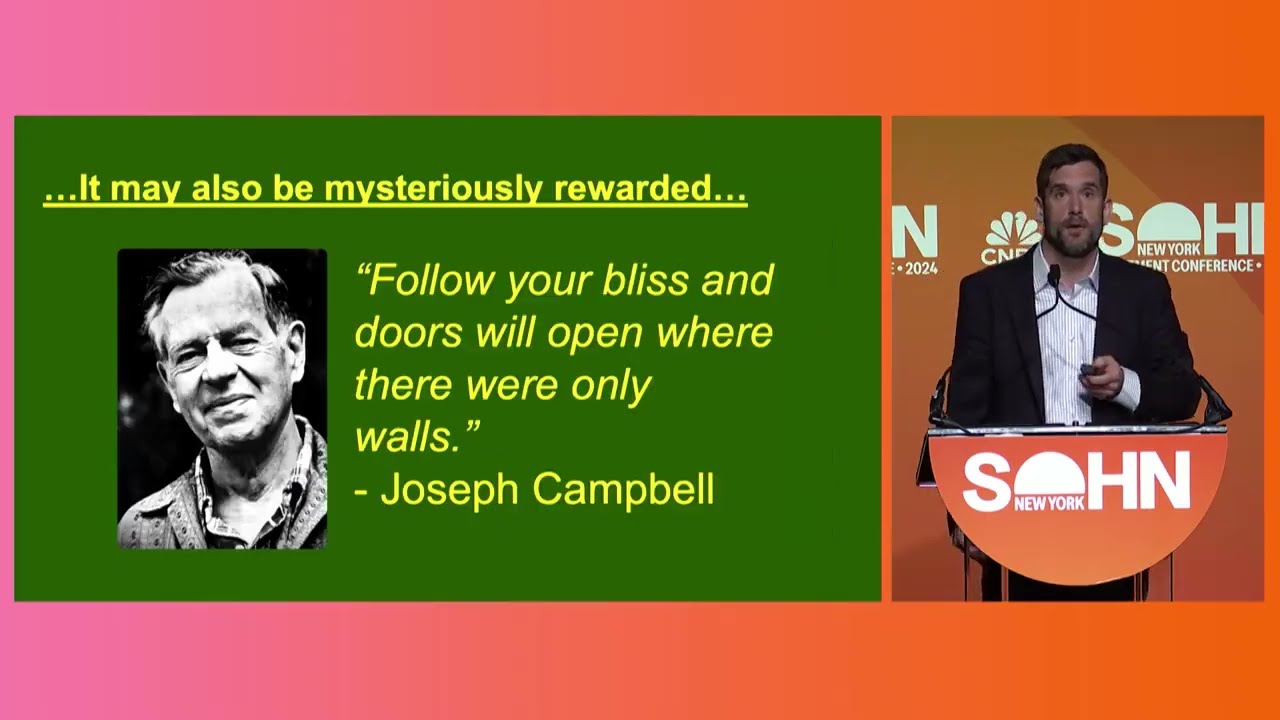
And finally, we have Tom Morgan, who is going to talk with us from Sapient, who's going to talk with us about curiosity. So I'm, I'm not going to talk about a stock today. Instead, I'm going to talk about the most offensively taboo idea in Western civilization. This is Dr. Iain McGilchrist. He wrote probably the most interesting book I've ever read, The Matter with Things. His focus of his very long career has been the 2 hemispheres of the brain. Now, you're probably thinking this brain hemisphere stuff has been debunked. It hasn't. It's just nuanced. The brain's left hemisphere is narrowly focused. It uses language. It is linear and it is logical. The brain's right hemisphere, it sees the whole picture. It has very little use of language. It is emotional and intuitive. I like to think of the left hemisphere as like a junior analyst. Amazing modeling, but lives in the model. The right hemisphere is the intuitive, Druck Soros type that makes these amazing instinctive decisions but can't always explain why. Now, you need both of them, but you don't let the junior analyst run the hedge fund. He will burn it down. Which is unfortunate because McGilchrist's diagnosis is the world is imbalanced towards the brain's left hemisphere. The brain's left hemisphere deals in abstractions, and there's nothing wrong with that. That's why you're all sitting here today. But taken to an extreme, abstraction leads to disconnection, disconnection from our environment, our bodies, and each other. And frankly, when I look at the world and its various problems, I can see almost no crisis that isn't being caused in some part by disconnection. How does this happen? Well, if you experimentally suppress the brain's left hemisphere, for 10 to 15 minutes, people start to see things they would ordinarily see as dead as alive. So the sun going across the sky giving you energy, the world becomes more animate. But if you experimentally suppress the brain's right hemisphere for 10 to 15 minutes, people start to see living things as dead. So other human beings become like zombies or machinery or furniture. The implication if we're already too far over on the left, is that the world is more alive and we are more connected to it than we typically think. And so the taboo. There might, might be an intelligent benign force guiding our attention. Why is this so offensively taboo? Well, we reject any external challenges to our intellect. The left hemisphere by nature It's competitive, it lies, and it denies the existence of anything more intelligent than itself. I think we all know those people. But there is a problem, which is our intellect alone cannot navigate the world. The world is what's called combinatorially explosive, which just means too many choices, too little time. Rational trial and error cannot have worked. If we weighed up the pros and cons of every decision, in high-stakes environments, the tiger would have eaten us. The analyst knows all the numbers, but the PM knows what's relevant. But how do we know what's relevant all the time? Our environment helps signal it to us. What we are attracted to narrows our options. We all intuitively understand this in romantic relationships, but I believe the same applies to information. Evolution's solution to combinatorial explosiveness is curiosity. Now, the dictionary definition of curiosity is a strong desire to know or learn something, a definition that I find rubbish. It doesn't tell you anything. A strong desire, where does it come from? To learn something. To learn what? Question, please ask yourself, and I do mean please ask yourself, this is not a rhetorical device. Can you force yourself to be interested in something? Can you force yourself to be interested in something? Wine tasting, accountancy, cricket, The Real Housewives of New Jersey. The fact is, is that everything we're interested in and passionate about exists upon a continuum, but we're not in full control of that. If you don't fully control your interests, what does? I believe that curiosity is a relational, a two-way force between you and your environment. Evolution, in the form of curiosity, helps guide you into a unique niche. It's why you don't have full control of it and why pursuing it feels good. Curiosity is a right hemispheric impulse. It connects you to the world. It is emotional. It is non-logical. It is intuitive. but it also sees the whole picture. In fact, McGilchrist's conclusion: the right hemisphere is responsible for, in every case, the more important part of our ability to come to an understanding of the world. But don't forget, the left hemisphere always denigrates the contributions of the right, particularly as they're fuzzy, emotional, nonverbal. So following your curiosity requires faith. But I will leave you with probably my most heretical belief. Curiosity may also be mysteriously rewarded by your environment. The favorite quote of my life is from the great mythologist Joseph Campbell: Follow your bliss, and doors will open where there were only walls. I can't prove anything in 5 minutes, but I hope you might now take your curiosity more seriously. Thank you. Thank you, Bret.