Are You Ready For Jesus’ Return? | Revelation Overview
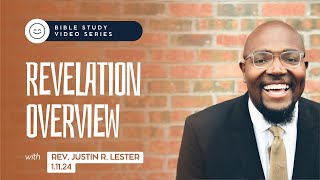
Justin R. Lester begins an eight-week study of Revelation, explaining that the book reveals who Jesus is and was written to comfort first-century churches under Roman persecution. He covers the authorship (John on Patmos around AD 95) and previews the verse-by-verse study ahead.
Chapters
Well, hey everyone, I'm Justin and thank you all for coming to my YouTube channel to continue this journey of living life and living life the way God's called us to live. I'm so glad that all of you are subscribers and a part of what we do. And thank you to all of you who also suggested what we should study this month and to study for the next couple of weeks. So we're going to spend eight weeks in the book of Revelation. Now, before we get into all of that, you guys already know what to do if you haven't taken a chance to like the video. It helps get the word out. My goal with this channel is to spread the gospel by any means necessary. And so if you can hit the like button, that'll help the algorithm and help get the word out about just sharing the gospel. We're going to go verse by verse and we're going to study the book of Revelation. And so if you would do that for me and if you haven't already subscribed, subscribe and then share this with one person that you feel wants to learn more about the gospel and is happy and excited to learn more about Jesus. That's the whole goal of this channel, is to share the good news of the gospel. Now we're going to jump into this. One thing those of you who are new to my page may not know about me is I've written a few books and it's on my website, jrlester.com I have a book. Really the one that really applies to this conversation is a book called Sermon Notes. And Sermon Notes is a book that I wrote as a pastor. I believe we don't do a very good job of taking notes during sermons. And so this book I wrote is an opportunity for us to take better notes. And so it talks about where your emotions are, what is sung, what is said, what is engaged with you to dive into the word of God together holistically so we can share the gospel. And so if you go to jrlester.com and you see all my books, I have a book written about mental well being. I have a book, my son and I have written some children's books. This is one behind me. Brown dad, Brown boy, Brown basketball. I have a number of other channels, but I love to engage with you and just to do life together. This one I love to keep Christian and just show this part of my life to share the gospel. But I have one for kids, my son. And I have a Brown dad, Brown boy, Brown basketball channel. And then I also have one called that Tech Pastor, where I talk about technology and the church and small businesses where my passions are now. You didn't come for a commercial. You came for the gospel. But before we dive into the gospel today, would you pray with me? God, I thank you for this opportunity to talk to my friends. I pray God, that your word will go forth. I pray God, that you will share with us the future as you've already shared it with John. Allow us to get ready, prepare ourselves. So God, do me, do us, do us something that we cannot always do for ourselves. And let's open our eyes that we might see you, open our ears that we might hear you, and break our hearts as we learn to love you. It's in Jesus name we pray. Amen. We did a poll online. The number one book that everyone wanted to study is the Book of Revelation. And so what I want to do is we're going to talk through an overview today of the Book of Revelation. And then we're going to spend the next seven weeks going through the seven letters to the churches at Asia Minor. So I want to do an overview of the Book of Revelation today. And please do me a favor, engage in the comments below. Let me know if you have any questions so I can follow up to your questions in our shorts. But however this assists you. My goal is to help Christians be better Christians. And so if you can do that, do me a favor, put that below. But let's jump into the Word of God. So here's everything you first need to know about the Book of Revelation. It's going to come up on the screen. The big idea of the Book of Revelation. Revelation reveals who Jesus is, his power and his plans. John uses poetry and symbolism and imagery to describe what will happen when Jesus returns to earth, an ongoing battle between good and evil, and what eternity will be like for Christians and non Christians alike. In Revelation, we're going to see a couple things. Number one, we're going to see that Jesus is coming back soon. God and Satan are not equals. God will make everything right in his time and his way. Jesus is king over everything and everyone. And listen, you're going to spend eternity someplace. It's your response to Jesus is going to determine where you spend eternity. So that's the main things I want you to see. The main scripture that we're going to see in the Book of Revelation is Revelation, chapter 21, verse number three. It says these words, I heard a voice from the throne saying, look, God's dwelling place is not among the people. And he will dwell with them. They will be his people, and God himself will be with them and be their God. So we're going to see this. And as we jump into Revelation, I want you to think about this question and please put it in the comments, if you would. What does it mean to be blessed? When you hear that statement, what does it mean to be blessed? I want you to think about that and write that down. For sometimes I think about the word blessed. And for us, those of you who are Christians, it could mean everything. It could be anything. Like, you know, when someone sneezes and say, I bless you. Like we throw the word blessing around, like the word love. Right? It's just everybody's blessed. Everybody's loved. I want you to see this like we see the word blessed as gifted, good, forgiven, peace, favor, and joy. I hate questions like this. I hate statements like blessed, because in the back of our minds, I want you to keep that. Because I think we have to redefine some things and really then get to define what it means to be blessed. As Christians, we are blessed to read the end of the book and know the answer book. And the end of the story tells us everything's going to be okay in the Book of Revelation. And that's what we're going to see in the Book of Revelation. Revelation is the consummation of God's divine program of redemption brought to fruition by the holy Name of God, when God is vindicated before all creation. Now, in the Book of Revelation, we're going to see numerous prophecies that fulfill the Gospels and the Epistles. Now hear me. Revelation is the only book that focuses primarily on prophetic events. Now, we see this a little bit in the Book of Daniel. We see some things in the Old Testament, but now we see everything from the New Testament coming together to then be revealed as Jesus is revealing himself. Remember, the Book of Revelation is the revelation of Jesus to the writer of John, right? This is Jesus speaking to us. It centers around visions and symbols of the resurrected Christ, who alone has the authority to judge the earth, remake the earth, and rule it in righteousness. That's the goal of Revelation. Jesus Christ alone has the authority to judge the earth, to remake the earth, and then rule it with righteousness. So who wrote the Book of Revelation? Great question. So John the Apostle wrote this book in AD 95. He was in a prison, political prison, in exile in the island of Patmos. Now, to understand the island of Patmos, a picture is going to come up on the screen. The island of Patmos was a volcanic landscape. It was not a resort. It was essentially a Roman penal colony. And more than likely, John was sent there because his preaching and teaching was considered an affront to Rome and. And the political reign of Titus Flavius Domitian. Titus was threatened by John. He considered him a political enemy of some kind. And so he exiles him to Patmos. Patmos was a small rocky island in the Aegean Sea. It's a place where many criminals of Rome were sent to serve their prison terms under harsh conditions. So when John arrives, he begins to have visions about what God is sharing with us and what we get in the Book of Revelation. Now, a common Roman penalty of banishment to an island because meant you lost everything. A loss of rights, a loss of property, and you only received a small allowance to give life on the land. The penalty that you received was usually a lifelong. And persons of some wealth were allowed to live there on the island, but they were cut off from the outer world. So they weren't. They weren't treated with cruelty. They just didn't have anything. So John's exile, but what we can tell historically was actually a little more serious punishment because he did not have the wealth to begin with when he went to the island. So he was one of regular people in Ephesus. And so banishment then for him meant probably hard labor with typical penalties that would go to Christians. And it seemed like John might have had a little bit of freedom. And what we see here in another historical writ is this. During John's trip to Patmos, a large storm started and a passenger was sucked into the sea. When John started praying, a wave brought the man back on the boat. This miracle gave John a chance to preach the Gospel. When he arrived at Patmos, the Roman governor Laurentius set him free, and Myron, his father in law, allowed him to stay at his house that would soon become the first church on the island. John also healed Apollonides, Myron's son possessed by the devil, which led to the conversion of some members of Myron's family. Banished to Patmos, St. John lost a connection to the world, so he could not know what was going on in the province of Asia. It'd be difficult for him to write visions in a book and send it to churches. He could only think about them, see them, and read them in heaven. So it's in Patmos then, where John begins to the Holy Spirit, sorry, reveals to him, and he writes the Book of Revelation. Domitian dies in AD 96. And though John is able to Go back to Ephesus after his release and his lifelong punishment ceases because all those things Domitian had put in place were gone. And now John has his revelation from Jesus. He begins to share with the churches. So today, where John was coming up on the screen is a cave of the Apocalypse in Patmos. It's a museum and a World Heritage site hosted by UNESCO. Where John was, we believe, was about 7 meters long and 6 meters wide, with silver lamps to light the space. Nowadays people use it as a sanctuary to say, this is where John laid his head. That rock, according to John, to old belief and old stories, is where we believe John laid and listened to Jesus. And Jesus ministered to him in Patmos. So Revelation then is a book that is written to seven churches that were in Asia Minor at that day. Now it's modern day Turkey. And he speaks to them in a counterclockwise geographic line. So when you look at the map on the screen, you see that he starts at the bottom of the seven churches and goes back counterclockwise to the top. There's nothing like deep there. He just writes seven letters. The way we receive them in the book is the way the seven letters are given. Each of these churches were comprised of people not only from a Jewish background that had come to Christ, but also Gentiles who come to Christ. And as we get into the letters, and that'll really be very important to understand, they represented Turkey and Asia Minor. So understand, each one of these churches had different issues. Each one of these churches had different cultures. Each one of these churches had different things that influenced them. So that's why to one church, he tells them, giving you an open door. He tells another church, I'm going to spew you out of my mouth. He tells another church, you've lost your first love. Because these messages he gives them are hard. They're full of love, they're full of care, they're full. And they're all a signature to that church and a message to all of us about the love and the heart of God. So what does that mean? Well, we get this prophetic literature, and oftentimes when the stories of Revelation are brought up and people want to talk about revelation, it's about what about prophetic literature. So I want to give context and definition to prophetic literature. So what is prophetic literature? Prophetic literature must be understood like this. It meant something then and it means something today. It meant something then and it means something today. So keep in mind, at that time, Greece and Rome were the Superpowers, Therefore, not only did they impose a taxation on the people, but they also had military garrisons. And we're going to hear this all throughout these different letters. So think about it. They were taxed heavy. They had military bases where these churches were with those taxes and the burdens that they had to pay Caesar to live under the government that had grown so large. They were concerned about one thing, Rome. So these churches were under Roman persecution. They were embroiled in sin. They had a culture that was rampant in idolatry and sex. And then we get the book of Revelation because here's the good news of what Jesus does. No matter how bad the culture is, Jesus still has a word for his church. And that's the purpose of this book. The purpose is to confront, comfort the churches and believers who are trying to live a righteous life. It serves to correct those who are living poorly and to warn them and admonish those who are evil in corrupting God's church. So the book of Revelation is a lot of theology. Let me speak to two huge spaces of theology in the book of Revelation. The first big part of theology we've seen in Revelation movement is Christology. Christology, right. There's no book that teaches us clearer on who Jesus is than the book of Revelation. We see a couple of different motifs in this, right? So we see that he's the Son of man. Revelation chapter 1, verses 13 through 16. We see he's the Lamb of God. Revelation chapter 5, verse 6. We see he's the conquering king. Revelation 19:11, 16, Revelation 17, 14. We see he's the Alpha and the Omega. Revelation 1 and 8. We see he's the Revelation 22:13. We see he's the first and last. Revelation 1, 17, 18. We see that Jesus is the faithful witness. Revelation 1, verse 5. We see that Jesus is the man on the white horse. Revelation 19:11. What does that mean? What we get in Revelation is the multifaceted nature of Christ's role, Christ's nature and Christ's significance in the battle against good and evil. Be sure to go back and screenshot those scriptures and go read those. They're powerful scriptures. But what we get is the multifaceted nature of who Jesus is and his significance in history. Now John Walford writes these words. He said, if for no other reason, this book is important as the final chapter of Scripture in the self disclosure of God through Jesus Christ. You want to know who Jesus Christ is after his ascension? Look at Revelation. We have more Christology in the Book of Revelation. Than any other book of the Bible. So Revelation teaches us who Jesus is prophetically. Not only does Revelation teach us who Jesus is prophetically, but secondly, it teaches us about God's wrath and his justice in the Scriptures. Now we have domesticated the wrath of God in our world. We don't want to talk about hell or the wrath of God or punishment. We are all love, love, love, love, love. Frankly, Scripture is very clear about the wrath of God that's going to come. God's love brings wrath. And if you don't understand that, think of the cross and the crucifixion and death, the burial resurrection of Jesus. The death, the burial resurrection of Jesus is the ultimate expression of the wrath of God. God poured out his wrath on his son. He loves us, so he took his wrath out on his son. So the book of Revelation is very clear about the wrath of God and the justice of God. Let me give you a few. It's going to come up on the screen. Please screenshot this. And I did a lot of work on this. So please screenshot this, hope this is helpful. So we see first of all the sea, the trumpet and the seal, the trumpet and the bowl, judgments. That's Revelation 6, 16, 17. We see natural disasters and catastrophes. Revelation 8, verse number 7. We see the punishment of the wicked. Revelation 16, verse number 2. We see the wrath against false worship. That's Revelation 14, verses 9 and 10. We see the final judgment in lake of fire. Revelation 20, verse number 15. And we see demonic forces unleashed. Revelation 9, verses 3 through 4. We see the great day of wrath, Revelation 6, verse number 17. And we see the final destruction of Babylon. Revelation 18, verse number 8. There are some others that I didn't get to where it's the great tribulation, the battles, the serpent of old, the great harlot, the minions assigned with Satan. Here's the thing. The goal of Revelation, the goal of our faith, is to be conformed to the image of Jesus. Our goal is for us to be like Christ, to be conformed to Jesus. And the reason Revelation, I believe, is so avoided, is used for fear mongering, is that this book makes us fear death and worry that we're all going to hell. The book of Revelation is Jesus great love for us, to reveal himself to us with clarity so we do not have to wonder what the future is like, what heaven is like. And in Jesus great love for us, he corrects us. Because in love, that's great love. That's it. It's theological. Now, there are many ways to approach Revelation. But I want to talk this book is otherworldly because the goal of this is literally just to give us a person and the work of Jesus Christ. So to answer the question about the end times and is Jesus coming back tomorrow and is the world ending tomorrow? Maybe, maybe not. Maybe our challenge and our issue is that we are so concerned with Jesus coming back tomorrow that we're not choosing to live for Jesus today, that we don't Ephesians chapter four live in a manner worthy of the calling we've received to be prepared for his coming. So my question to you is, have you said yes to Jesus? Great. Then you know the future. And that is those who said yes to him will die and be resurrected in life in Jesus. You have nothing to worry about. I want you to be consumed with your lives, living in alignment with the will and the work of Jesus, to be conformed to his image. Have you not said yes to Jesus? Well, that also tells you your future. That tells you you should be afraid of the Antichrist and damnation to hell and eternal separation from Jesus. The book of Revelation is significant because it tells us and concerns us with things that will soon take place. So that's a general overview of the Book of Revelation and I want to stop there today and engage and next week we're going to jump into Revelation chapter one, verses one through three. And I'm just going to go verse by verse. Revelation Chapter one, verses one through three. If you have any questions about Revelation, please feel free to leave those in the comments. I would love to engage with you as we go through this series of Revelation. It's going to get difficult, it's going to get hard, it's going to get rough, it's going to get fun. I love studying this. I love engaging with this because Revelation is the one time Jesus takes tells us who he is and we can trust what Jesus says about himself without having to make assumptions about it. So please like this Please subscribe to our channel if you haven't already share this with someone. And next week at the same time we're going to jump into Revelation Chapter one, verses one through three. We're going to spend some time just diving word by word, verse by verse what God is saying to his church in the Book of Revelation. Thank you guys for tuning in. I'm Justin Luster. I'm so glad you guys are part of our team. I part of our community of Christ led believers and I'm grateful that I have a chance to share the Gospel with you by any means necessary. If you have any questions or want to connect with me, please go to my website, www.jrlester.com. i love to get to know you, love to connect with you. Please let me know how I can pray for you and I look forward to engaging with you. So God bless you. Until we meet again and hear this, I want to tell you this. The light in me honors the light in you. May God show you amazing favor and grace that this week. I'll see you next week. Bye.
More from Justin





AI gives you hours back every week. Most people's first move is to fill those hours with more work.



Most people stall out on AI at the exact same step. They don't know where to start.

Thank you for the follow-ups, the messages, the emails, all of it since the New York Times piece. Gr

The New York Times spent a weekend with me. Digital twins, AI, the local church, all of it.
