Made for Mondays Podcast, Special Guest Tara McClary
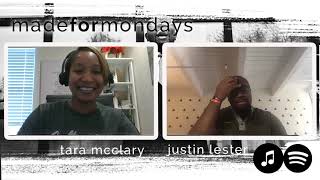
A recorded conversation between host Justin R. Lester and guest Tara McClary (assistant vice president, Amica Insurance). Tara describes her 16-year career at Amica, frequent early-career relocations, and progression into leadership overseeing special claims and investigations. Key themes: value of stability and hard work (contrasted with ‘hustle’), flexibility and networking from relocation, practical Monday routines (Sunday planning, sleep, scheduled meal/prayer/Bible time), and retrospective financial/emotional advice to her younger self.
Chapters
Hey everyone, Justin here. So I'm here. I have a very, very special guest with us, Tara McClary. And so I'm happy to have Tara with us. Welcome to Made for Mondays, Tara.
Hey Justin, thanks for having me. Pretty excited to be here.
Cool. Tara, if you don't mind just telling us a little bit about you. So who are you and what do you do and why? Really? So the why behind the what? So who are you and what do you do?
So I am Tara McClary, recently married. So sometimes I too say my maiden name. I have to catch myself. But very recently married. I am from, originally from New York City, Queens. Both of my parents are still there and I am one of two children. I have an older sister only by one year, so that doesn't really count. And I currently live in Massachusetts and am an assistant vice president for Amica Insurance on, on the claim side. So I oversee special types of claims across the country such as our recovery claims, our medical payments claims, and I also oversee our special investigations unit across the country. So why do I do that? I do it because, funny thing, when I got out of college, I needed a job that was going to take me out of New York City because I, I couldn't afford it myself. And Amica was the place I put all my eggs. And here I am 16 years later, still doing it, moving along. It's a great company and it's also a good, great company to work for because we do great work in our communities and insurance is a product that helps people. So pretty, pretty rewarding.
Yeah. Well, I guess one of the questions I do have for you then. So when she said you've been there 16 years, so five years in, when you were like in the entry parts of it, what made you stick in after the five years to get to where you are 16 years later?
So in all honesty, when I joined with the company, when I interviewed with them, I remember telling who's now my boss's boss's boss when he interviewed me at the time I said if I get this position, just so you know, I plan on retiring from this company. So I'm hopeful that that made a difference because they said yes. And I still stand with that position. And during my first maybe two years, I remember I have a colleague and we would joke as we progress in our careers. And finally when I got to this position, he called me and said, I remember when we were working and you would just say I want an office, a hard walled office on the fourth floor of that building. That's where I'm gonna go. And he said, look at you, you did it. So I knew early on that I wanted to do this, wanted to be here, wanted to move up in the company and be an important executive that makes some decisions not only about the talent, but the direction the company may be considering. So I've been invested from day one to make it through to the end. And it was just staying committed with hard work and putting a lot of work in.
Yeah. So why is it important then? So like we're in the same generation, so we bounce around in different jobs. Right. So like I'm hustling. I got this nighttime job. I got the side hustle, I got this. I'll be to pursue a passion that I haven't named yet. What it sounds like what you have so far was like, I'm going to build an organization, building something. Why is it important to you for longevity and investment in the, in your. Not just in your field, but for you to be invested for the long term and all of that.
Yeah. You know, that actually ties to a lot of personal experience and growing up. So I'm a inner city kid from Queens, New York. Not the best place to grow up in. I grew up in a poor household and so it was very important to me that I had stability at all times. So I am more of a risk averse person. So I don't. It makes me uncomfortable and it gives me anxiety to think about bouncing and it's something I need to grow through because that's not always a positive. But for me, I needed to know that I had consistent stability at all times because I cannot. I was not a fan of the up and down and the potential that I could experience what I experienced growing up. Wow.
So with that. So with as you grew into this and even grew into the person you are today, what are some, I guess like things you learned as you grew into leadership, like moving from. With the entry place to where you are now, where you're making it sound like earlier, I mean, worldwide decisions. What are some things you learned on the journey of growing into leader to becoming the leader you are today?
Yeah, so I've learned to be flexible with my job. I've been with the company 16 years, but I've moved maybe five or six times out of New York City to Rhode Island, Rhode island to Texas, Texas to Michigan, Michigan to Rhode Island, Rhode island to Baltimore, Baltimore back to Rhode Island. And those moves actually happened in the first. All five of those moves. Five or six happened all in the first seven years of My career. So I was averaging maybe being in a location for a year, no more than two years, and then moving. So I got really good at making friends. I got really good at making friends. And I have a large network across the country of some really strong, solid people who've been through ups and downs, have some great character traits and things I can pull from and that I talk to and hang out with still. And so I learned that I need to be flexible with myself and adapt to new locations, not really get too stuck. And I was able to do that also knowing that I had the comfort and stability of my employer. So that. That makes it a lot easier. It's not like I had to get a new job while moving into a new. A new location. I always had the comfort of the. Of a very financially stable company that kept me, held me together. I also learned that I am a really hard worker, and that that sounds amazing, and it is amazing. It got me here, but it comes with its cons. I was a tradition, or what we consider what the professional woman, the young professional focused on the career. Career woman focused on the care. Gotta move up. I wasn't really thinking about a husband. I was thinking about partying and working hard. So I would work hard, party harder, come to work with maybe the same clothes I left work at yesterday. Then I got smart, and I would keep a change of clothes in the trunk. Yeah, but those were my younger days. But I definitely worked hard and enjoyed life. And I think me being able to put in that all the extra time that I did at work really did help me to get here so with.
That, too, because I love your journey. Tara. It seems like I've been wrestling with these. This language myself, like, the difference between hustle and hard work. Right. And it seems like you're mentioning being a hard worker. And to me, that's a lot different from, like, when I think of hustle. I think of. I think of, you know, like, basketball. I'm jumping out of the. I'm jumping out of bounds to grab a ball. I don't really need to do this when I'm hustling. And I guess. Would you mind explaining a little bit for you, even the difference between being a hard worker and being a hustle?
Yeah, that's funny. I've never been asked that question. But what I can say is when I hear the word hustle, I think of someone who is creative, who is going out of their bounds, out of bounds, out of their comfort zone to seize opportunities that if they don't do It. It's lost. And that takes a lot of courage. It takes a lot of freedom and agility and ability to go and do that and pretty much seize the day. Carpe diem, right? So when I think of hustle, that's what I think. Someone who really is a risk taker is not afraid or will take calculated risks. Where I think of a hard worker as I know what I need to do, I'm going to make sure it goes well. I have the ability to plan and manage it properly. It's a little more controlled and contained, and it's. It's just more effort me than it is requiring as much creativity. There could be creativity in the hard work, but for me, for instance, I wouldn't say I am a hustler because I can work. I can do the work. I might outwork someone, but I might not out hustle someone.
No, I get that. No, I get that. And I think that's so real. And I guess that's one thing I've been thinking about in terms of we're going to be focused individuals. I think hard work is the important part there. I think this hustle culture, even, like, what's gotten us in this moment, employment going so high. I think hustle, hustle, hustle part time, part time, part time. Do this, do that, and then we look up and can sustain that. So no, thank you for this, Tara. So the thing we do here, everyone, is we then have three points of purpose. So, like, purpose, things that we can. That we are challenged with, to live into all that we are and all that we can do in the world. And so I'll turn it over to Tara. Tara, what would be your three points of purpose? To challenge people to own their Mondays, to own their weeks, and to be all that God's called them to be.
All right, three points of purpose. One, planning. I know it seems weird to say to plan for your Monday, but your Mondays go so much better when you even Sunday night, look at your calendar, know what might happen, know where your free time is, and then if you can look beyond Monday, see what the week is looking like, where you have your breathing room, because sometimes you'll realize if you just did that on Sunday, it sets you in a different mode on Monday. And if there's something that you're like, oh, my, I probably should prepare for that, you now have the opportunity to do some planning versus no planning at all. And that's been really significant for me because at one point I didn't do it. And Mondays in the Insurance world is crazy. Think about how every Sunday night the first 15 minutes of any news segment is what car crashed on the highway, who drove the wrong way, what house burned down, like everything that's insurance related. And so I would wake up, I would get to work and some of those claims would be on my desk. So it definitely helps to plan to know what you're going to walk into and try to set yourself up mentally and also get rest. It's so underestimated how much value 8 hours of sleep is for us. I think we're so used to running on Dunkin and running on just energy and emotions, but we really do need to rest. And your mind is so much clearer in the morning. One other thing of purpose for your Mondays, and I would strongly encourage this for any day of the week that ends in day, is to make sure that you're allowing yourself a defined time to eat and or spend time with God. So at work, at my desk, I have two monitors and in between I have my. I have my own Bible there. And there have been times when I take lunch, I have to make sure I turn away on the other side of my credenza and I will have my lunch and I'll pull out my little mini Bible and go to whatever scripture I'm trying to memorize or I think might need to ground me with whatever I'm going through. And I've had people walk in and they're like, hey, I guess I'll come back. And I'm like, yeah. And it seems weird because we don't really bring church to work. I know you've talked about this several times, Justin, and actually I think it was maybe in 2017 you did a sermon on that. And that's when I was like, I'm bringing my Bible to work. But it's amazing how even in that time when I'm eating, if I'm reading the Bible or I simply just say a prayer because I am stressed or anxious about whatever's coming next. Saying, having that 10, 15 minutes of prayer time definitely does make a world of difference. And was that more than three points of purpose?
I think it was three.
I think it was three. Yeah.
That's perfect. And that's amazing. I guess that's one thing I'm wrestling with. And finishing up another book I'm reading about boundaries and accountability and actually having coworkers that keep you accountable to those things, whether they're saved or unsaved. Right. And so hearing you say that just agitates something. I read a Couple of days ago, about. I think it was Patrick Lincolni talked about having unsaved co workers keep saved people accountable and then saved coworkers keep unsafe accountable. Because it was like that. They're the ones that are just like, no nonsense. Right. And how that's a way to build accountability among teamwork, team players. And I did a practice like that in our office, and I was like, wait a minute, we all go to the same church, and so let's just look a little bit different. And so thank you for that. I think that's. That's powerful and wonderful, and that takes a lot to actually sit in a space like that and actually turn like Jesus, to turn our faces and be focused. So thank you for that so much, Tara, and thank you for your. So the last thing I would ask you. Actually, I didn't ask you this, but it made me think about it. When you were talking, what is something you would tell to yourself or someone like yourself 10 years ago? Right. Someone who's getting into something, making decisions for their family, kind of like you were making decisions of, where am I going? What am I doing? Do I make major purchases? Do I not make major purchases? What would you say to them? Based upon everything you said today, what would you say to you 10 years ago?
What would I say to myself 10 years ago? I would say. I would say all of what you think is important now is emotional. And it's easy for me to say it now. I have to give a lot of this credit to my husband because we have a lot of talks about emotional responses and thoughts and things, and it's really difficult to grow into really learning those. Those items when they come up. But I can look back at some of these decisions and was like, you know, ooh, bright red, brand new, fresh off the lot. Mercedes Benz 2009. Like, this is me. Not good.
Yeah, yeah, I get it. I get it.
Yeah. Just. It's a. There are. I was. I was extremely emotional.
Got it. Wow. No, that's powerful. That makes me reflect on some things. Like, I remember buying. I went and bought a suit. It was the cheapest suit I ever could buy, but it was $99 suit. There was a two for sale. And I was like, I just need this suit. Suit so bad. I bought a thing ripped. My mom laughed so hard. She's like, you better keep wearing it, because she said you had to get it so bad to save it for the thing that you really need. And so that's amazing. Tara, thank you so much for your time. Thank you so much, and this was such a blessing, and I really appreciate.
More from Justin





AI gives you hours back every week. Most people's first move is to fill those hours with more work.



Most people stall out on AI at the exact same step. They don't know where to start.

Thank you for the follow-ups, the messages, the emails, all of it since the New York Times piece. Gr

The New York Times spent a weekend with me. Digital twins, AI, the local church, all of it.
