Psalm 8:1-4 Identity
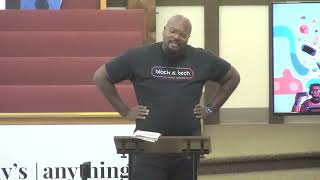
Justin R. Lester preaches on Psalm 8:1–4 (YouTube sermon). He reads the passage, asks two framing questions—"Who are you? What are you doing here?"—and draws three pastoral points: we are under God and deeply loved; we are equal to others but choose to serve; we are caretakers of creation. Exegetical focus centers on God’s majesty (Yahweh/Adonai) and the verse "out of the mouths of children and infants" as the source of pure praise that silences enemies. The sermon mixes Hebrew notes, cross-references (Matthew, 1 Corinthians), practical spiritual steps (recover childlike dependence, deny craving for recognition, reclaim creativity/play), and personal testimony about childhood trauma and pastoral care.
Chapters
And let's play church this morning. I hope you're ready to engage with me. Psalm 8, beginning of verse number one. And we'll read for today for this service verses one through four. And next service, verses five through nine. I taught this text in Bible study last year. I want to take a deeper dive into this text. It'd be a lot of fun. Psalm 8 says these words. Lord, our Lord, how majestic is your name in all the earth. You set your glory in the heaven. To the praise of children and infants. You've established a stronghold against your enemies to silence the foe and the avenger. When I consider your heavens, the work of your fingers, the moon and the stars which you've set in place. What is man? That you are mindful of them, human beings that you care for them. You may be seated. What is man? That you are mindful, human beings that you care. I want to ask you two questions this morning to begin our sermonic conversation. Who are you and what are you doing here? Who are you and what are you doing here? Life is this ever evolving movement to understand and discern oneself. And as we keep moving forward, I want you to answer not just those two questions, but a couple of the questions like number one, who are you in relationship to God? Jesus had this conversation with his disciples. He brought them to them and said, who do people say that I am? They began to have all these words. Well, some say you're this and some say you're this. And some say you're this. And some say you're Elijah. And they all have these. They had a whole conversation. Some say you're this and this. Everybody had a name for God, and then God. Jesus said, hold on. Who do you say that I am? What is your name for God? When Jesus asks you, who do you say that I am? Don't tell me what everybody else is, but who do you say that I am? Who are you and who is God to you? Here's three things I want to tell you and teach you this morning. Number one, we are under God, but deeply loved by God. We are under God, but deeply loved by God. Number two, we are equal to others, but we choose to serve. We are equal to others, but we choose to serve. Number three, we are over creation as caretakers and not consumers. Let me break this down for us, and I hope this is helpful. This. This is how the text breaks down. Number one, verses 1A. And verse number nine teaches this piece about Jesus. That God is excellent. We're going to see here. Oh Lord, our Lord, how majestic is your name in all the earth. Verses 1A and verse number 9 tell us the same thing. Verse number 2 is going to teach us perfect praise. Verses 3 through 4 we'll talk about next service, how God cares about everything. Verses 5 through 8 Next service, how God's calling for us with and everything and then we'll end again with God is excellent. And if we're going to find our place in the world, if we're going to understand identity in the world, we're going to try to answer that question. Who are you? What are you doing here? Because God is excellent. We can give him perfect praise. God cares about everything. And there's something he's calling us to do with it. So let's walk through this text this morning. Psalm 8 is a continuation of Psalm 3:7. And you see the beginning of the text in your Bibles more than likely said it was written upon the giddh. Being written upon the giddith is more than likely a flute that the Hittite guards marched to in 2nd Samuel chapter 15, which probably means it was a musical performance. That was according to a tune of that name derived from the word gath or wine press, which denotes a tune that has some rhythm to it that's going to bring joy. So it's coming from the gittith, from the gath. It's a tune of a wine press. The wine of that time is going to do one thing. It's going to bring you joy. So when they say it was written to play to the tune of a Get it. This psalm was written to a playful, a joyful tune. And all the psalms with this prefix on it. Psalm 8, Psalm 81 and Psalm 84 are all joyful psalms. And so what the psalmist does is he begins to vent out loud how much he loves all that God creates. And here's what he calls what God created. He says God's creation is verse number two. I believe God's manifested perfection. And what he does is by venting out to God. But all that God created, he is celebrating God's authority. And he is celebrating that God has literally manifested perfection. I don't want us to miss that that out of God's hands did not come a mistake. God manifested in the earth perfection. And what God called us to do is to manage perfection. Glory to God. And so what David comes along is he celebrates the authority of God one to even create perfection. Then he celebrates that God calls him to manage what God has created. And then he celebrates that God, even after we Fell in the garden still wants us to manage God's perfection. The fact that you are living and moving and having your being is a place to rejoice. Because God, in spite of all of your fallen nature of sin, is trusting you to manage the gift you that God gave into this world. As we believe this text was written by David at night. How do we know this is written by David at night?
Well, we see this how David we.
Believe was in a field at night because the stars for David were like theater. And we can surmise this because in Psalm 6 it was also written at night because David found comfort with with God at night. Psalm 42 David saw that morning moments and joyful moments were for him found in the presence of God under the stars at night. Here's the first question I want to raise to you this morning. Where do you feel the most connected with God? Like, I really want you to think about this. Whether that's morning, whether that's night, I can tell you like, hey listen, I want you to study scripture in the morning. You don't feel connected with the God in the morning. I can tell you to study scripture at night. You need to on focus connected with God at night. Maybe you feel connected with God as you're working out. Maybe you feel connected to God when you're driving. Where do you feel the most connected with God? That your words to God are the first things out. God, thank you for trusting me with what you've given me to manage your manifested perfection. For some of you it's not church. For some of you it's home. It's your car, it's working out, it's running, it's at night, it's in the morning, it's in the middle of the night. When is the best time? Time you connect with God. Do that. And here's what you learn in that moment. The first thing David says, he says, oh Lord, Verse one, O Lord, our Lord, how majestic is your name. Let me work this, let me work through these words. He uses two words. He says, number one, O Lord, Yahweh, our Lord, Adonai. It's two different words there. Over the course of time they added it to Lord, Lord, because they didn't want to say Yahweh. But the Hebrew there is Yahweh, Adonai. And see this relationship with David that David had with God birthed him to give God two different words. One that speaks of God's general nature and the second that speaks of his personal relationship with God. Yahweh. Adonai, how majestic is your name in all the earth. And then he says, because I have that relationship with you, because I'm acknowledging your creative ability, Father. He then says, God, here's why I acknowledge and love you. God has set his glory above the heavens. Yeah. So what the text is teaching us here is that many scholars believe that this text was corrupted here, like writing out the name of Yahweh because they didn't want to say it. But mainly what David is showing us here is that it is impossible to name the glory of God, to look.
At the Hebrew of this text.
The Hebrew of this text puts it like this. To God whose glory stretches over the heavens. So he says, God's glory is so non quantifiable that, non qualifiable, that instead of me hear me trying to figure out God's glory, I thank God that his glory stretches beyond my imagination. Let me tell you this. God is not recluded to my language about God.
So God's glory deserves praise.
And so what David is using here is the biggest language he could use. It's like the book of Jonah. When Jonah.
When Jonah bought the ticket to go to Tarshish, what Jonah was doing was.
He was going to what they believed was the other side of the world. Because for them, they thought the furthest they could go was.
Was tarious. Yeah, was tarious. So he bought a ticket to go to the other side of the world.
For David, northern Palestine was the farthest that he could think of.
So he says, God, you are so amazing. Your glory stretches beyond my language. Is God bigger than your language? Or is God only as big as.
What you think about God?
Is God bigger than your praise? Or is God only as big as as a song you listen to as a sermon? If God is only as big as what you think, we serve a small God. Did you know you only really have.
Access about 15% of your brain?
And you really think that God is as big as 15% of your brain? David says, God, you are so massive that I thank you that you don't sit to the small minds of my vocabulary. But think. Thank you. That you are bigger than my imagination. You are bigger than my past. Your glory is bigger than anything I've ever gone through. Because you are bigger than my vocabulary. I don't want a God who's only.
As good as what I've learned in the dictionary.
I don't want a God who's only as good as the school I went to. I don't want a God who's only as good as the college my parents could afford I don't want a God who's only as good as student loans But I'm so glad I serve a powerful non quantifiable Bigger than my vocabulary that's how you got over cancer that's how you got through that pain that's how you healed your God healed your body Cuz God is bigger than your.
Vocabulary he says oh Lord Yahweh, our Lord Adonai how majestic is your name in all the earth how majestic is it your glory stretches over the heaven. So then, because I know that verse two gets me, look at what verse two says. So because of that truth, through the praise of children and infants, you have established Hallelujah, a stronghold against your enemies to silence the foe and silence the avenger. I'll give you the new living translation. You've taught children and infants to tell of your strength, silencing your enemies and those who oppose you. I'll give you the English Standard version. Out of the mouths of babies and infants, you've established strength because of your foes to still the enemy and the avenger. Berean Study Bible from the mouths of children and infants, you've ordained praise on account of your adversaries to silence the enemy and the avenger, those of you so holy. King James Bible out of the mouths of babes and sucklings has thou ordained strength because of thine enemies. Let me tell you this, your enemies are not yours. They're God's. So what do you do? You tell of God's strength. That's the text. Because God is mighty against his enemies. The reason you are fighting so much is because you don't trust God to win. I ain't scared of none of y' all this morning. So you over here fighting and God says, that's mine. Because the enemy is not a person. It's your insecurity personified. So you are fighting what, you feel inferior to God because you don't trust that you can do what God tells you to do.
In this text, God says, how do you overcome every enemy?
You give God perfect praise. That's it. Now, some of you really quiet to me this morning, and I knew this coming into this because, ooh, baby, you like fighting. Oh, you like it? I mean, you. Ooh, baby, you like it. You. You show up to work ready to fight. Show up church ready to fight. Go home, read, fight, go to work tomorrow ready to fight. Right now you've been thinking about your to do list, Ain't Your to do list. Your to do list is your to fight list. Who am I going to fight this week? I better show them who I am. I got to control them. Because your worst enemy is not a person. It's your arrogance and your self control. So what do we do? We go back before money came into our lives. We go back before sin came into our lives. We go back to when we trusted Jesus. We see here. Where does perfect praise come from? God says, forget the adults. Send me those children. That's why Jesus said, I want to.
Build the kingdom of heaven. How do I build it?
Jesus says, send me the children. Because the adults are so consumed with how they make money off me, they forgot me. Send me the children. The adults are so consumed with how they do things with my name, they don't trust my name. Send me the children. I want to talk to the inner child and all of you. Because a child is more capable than you think. We exist. You were created to do one thing. Colossians 3 To glorify God. We were created to praise God. Children praise God with a pure heart, from a pure place. And God's glory says that I don't want the adults praise Send me the children because they're grateful for creation, because they know that if it's not for their parents, they don't live. Send me the children. They're grateful for life because they know that if their parents don't give it to them, they won't live. Do you trust your heavenly parent? This word here, the word that he says out of the mouths of children, the Hebrew there is the word mumbling sweet says out of the incomprehensible language of babies, God gains the most glory. Why? Because virtual they were suckling onto God the word there in the text. Children from one to three Hebraic women were accustomed to suckle their children for a long time. It was a unique dependence on the child had on the mother that the child knows, I won't live unless I'm close to the heart of my parent. So from those mouths who trust their parent, from those mouths, those pure mouths, those dependent mouths, those careful mouths that God says, here's what I do to people who praise me from a pure dependent place, God says, I will create a fortress around you that your enemies will never find the key to. Holy. Oh my God.
God says, I have chosen you that when you give me glory from a.
Pure place, place I will make a fortress.
Psalm 91 around you so that your enemies can't come in. And if your enemy tries to get close, I will put them to shame.
That's the Bible.
And that's why Jesus quotes this in Matthew that God says, I want people who are pure and dependent that praise me. Because your only trust is not in.
A person, it's in God. And, and that's why Jesus said In Matthew chapter 11, God, I praise you because you've hidden things, but you revealed them to the children.
Matthew 21. Don't you hear what these children are saying?
They said, yes, from the mouths of children.
God has called forth your praise. First Corinthians, chapter one. But God chose the foolish things of.
The world to shame the wise.
He chose the weak things of the.
World to shame the strong. Is that the reason we don't want kids to worship with us in this church? Is that the reason we got to kick them off the church? Is that the reason we want to.
Make sure children don't hear the gospel?
Don't teach that. Put it in Bible study, don't engage this.
Because if we ever were to elicit the perfect praise of children, maybe they'll show us that they'll praise harder than any of the adults will because we love the name of Jesus.
When Jesus does something for us.
Jesus says, not Justin. Jesus says in Matthew 11, you don't understand what I'm doing because you want to do it. And you've forgotten to trust the one who knows everything. Jesus said, I created everything. Don't tell me how to be Jesus because I created you in the first place. So maybe you ought to give me glory in season and out of season. Maybe you ought to give me praise in season and out of season because I've got this thing figured out.
So what does he want? Unique dependence on him. Like a child that hear this.
You are able to pull something from.
God and speak boldly about God. So my question for you church this morning is how dependent are you on God? No, seriously, how dependent are you on God? Are you more dependent on who you were, who you were at one point in your life? Are you more dependent on your reputation? Are you more dependent on your bank account? You more dependent on what people know about you, what they think about you?
Are you more in tune what people think about you? That you don't even know who you are? That you are living a lie? Because you're more in tune what people think about you? That you've forgotten the one who created.
You in the first place?
Where does your trust lie? Does your trust lie in the opinions of people? Let me tell you something. You're standing on shaky ground. Does your trust line what people think about you?
If I post this, I put this.
Up, how popular I get. Let me tell you something. I work in tech, and let me tell you this. All we do is change the algorithm, baby. That I'll change who you see to make you feel better or more insecure about you. Because all social media and newspaper and mass media has done has promulgated a system to make sure that we profit.
Off of your insecurity.
So if you trust what people think about you, it's literally because somebody wrote a code to show you things, to buy things, to keep you insecure. But your perfect praise does not come from someone's opinion. Your perfect praise comes from the one who knits you and called you fearfully and wonderfully made, who called you out of your mother's bosom, who knew you before you were born and called you to the nations. I'm talking to people in the building. The reason that life is so difficult is because you're running in the wrong lane.
I. I read this book years ago called Leading from the Sandbox. And it talked about this, this notion, this piece called the Theology of Play. And that's where I rooted my research in ungamification. What they suggested in Leading from the Sandbox is that leaders in Christian spaces much must have a place place where they invite church people to come into the sandbox. And in the sandbox, you have boundaries, but you're building something. You're always. The purpose of the leader is to stand on the outside of the sandbox and say, listen, don't, don't, don't. You cannot mess up because you're building something in the sandbox. The worst thing you can do is stop being creative. That was life in the. In the sandbox. And I find it interesting that we tell children to play in the sandbox, but we tell adults to leave recess. We take more time Edison off of recess. We take time off of recess for our children, but we want them to be creative. We take time from the play of our children, but then in order for them to play, you got to send.
Them to really expensive Montessori schools. An expensive school. So they got to. It's only privileged to a certain segment of people who have a certain amount of income. We tell them them play.
But now we're taking recess away. But then when you become a CEO.
When you're leading, people get back in the sandbox. Maybe the reason we don't know how.
To build things is we killed creativity as a Child and I ain't got.
To go to school.
That trauma, that divorce that your parents had. Yeah, that. That killed your creativity. That pain inside of church. Yeah, that. That. That killed your creativity.
Because you know what?
We stop growing and at the place of our greatest trauma. Oh, I'm talking good today. I said we stopped growing at the place.
So many of us in the room.
You're 40, but you're really 14. You're 70, but you're really 12 because.
You were stripped from the sandbox of.
Your childhood when your parents said, I'm getting divorced.
You were stripped from the sandbox when you walked in on your father cheating on your mother. You were stripped from the sandbox when you saw your. Your family overdose on something. You were stripped from the sandbox when your uncle invited you into that back room at the family reunion and said, this is a rite of passage that you stop growing at the place of your greatest trauma.
That happens in church as well. A pastor did this. A meeting went this way. Some of us have not grown since 1977. Some of us have not grown since 2001 here at Friendship. Some of us have not grown since 2018 because the great trauma that happened.
Even in these four walls made you say, I've got to get back to something. Can I tell you something? The good old days are the gone.
Old days.
Because your trauma is telling.
You like an addiction.
You've got to get back. But I say this all the time. Nostalgia is a great place to visit.
It's a terrible place to live because nostalgia says, let's get back before the trauma happened instead of trusting that God can still heal you in spite of all the trauma that happened. God says, do you really want freedom?
Do you want a fortress that your.
Enemies can't get into?
Do you want strength that you don't, you know you can't handle, so all you can do is worship.
Then he says, here's what I want you to do. I want you to think about your walk with Jesus as a child. I want you to think about your walk with Jesus as a kid. What made you say yes to Jesus the first time? I really want to ask you this. What made you say yes to Jesus the first time? What drew you to Jesus the first time? It's in that wonder. I want to leave this sermon with you because that is perfect praise. That's the moment you said yes and didn't care what anyone else said about you. That's the moment you said yes to Jesus. I could care less about all the no's in your life. When you said yes to Jesus the first time, before anyone else told you what you had to do, all you cared was I got to get to Jesus. I want you to pursue and praise God from an honest space. From that praise and from that praise, God will give you strength. From that praise, God will silence your enemies. Because your identity in Jesus starts with trusting him as the one who made you. So how do you do that? Pastor Justin, very quickly quit disliking who you were as a child. No, no, no. I know like you know. Let me tell you this one thing about me. I'm not afraid to share my story. I was a pudgy kid. I went to an all white school and oh man, I hated. One kid told me in school, we were finishing basketball practice, he said, you look like an alien because you're so fat from the side. And I was like, you know what? For years I told myself I must be an alien because I'm so ugly, I'm so fat, I'm so stupid. I thought my parents divorce was my fault. I walked in on my father cheating on my mother in fourth grade, sixth grade, sorry. I can tell you the day and the time I walked in and I said, whose car is that?
And you know what happened?
I came to church that Sunday and the musician's car was in the parking lot. And it was the same car that was at my house on that Thursday you talk about. Pastor Justin, do you have a story? Yes. Oh yeah. I can tell you the day, the time my father made me shovel the entire driveway of our 8 car driveway with no coat on because he was mad I decided to come home from school while he decided to commit adultery. And he blamed me for their divorce. He blamed me for the stuff he did against my mother. I had to heal from the place where I thought my parents divorced. My childhood, my knees, my problems with church.
I hated church.
The worst thing I wanted to do was pastor people because I saw what a pastor did.
So when I'm told, pastor, you're not.
This, you don't do this. No, baby, I've seen some terrible pastors.
I lived with one.
Don't tell me I don't know what this thing is.
I lived with one.
But I had to heal from the place where I had to quit disliking.
Who I was because I wasn't the cause your sin was.
And what my father did and what life did was steal your curiosity by telling you who you were without giving you a chance to learn who you were. I'M talking to people in the building. I want you to quit disliking and let me say this. I swear, if somebody uses that story against me, you will see a side of me you don't want to see. I'm still healing from that. I hope we are a space where we can heal people and not wield their stories against people. People. Someone say yes. I swear that's a part of me that. I don't know why that came out, but because I'm showing myself today.
I hope that you trust your story.
The way I'm trusting a hard part of my own story. That's why I take this pastoring thing so serious. That's why I give my own resources to make sure that you.
That's why I.
Everything from membership appreciation month, Pastor Justin personally purchases to not tax the church because I've seen pastors tax them. I lived with one, so please don't throw that in my face. But I hope we can heal other people who have similar experiences, who've had their life and their childhood stripped from them because of people who were insecure in themselves. I want you to quit disliking who you were.
Your parents.
Divorce is not your fault. You. The. The. The loss of that school. That school shutting down that house, shutting down that church, falling apart is not your fault. Your fault. Quit disliking who you were. Number two. Deny the desire for recognition. You know this. My praise recognizes God. And the moment I get off focus on God and the moment I get more focused on me is the moment I have taken light from the giver of light. Yeah, perfect. Praise is focused on God. So let me ask you a question. It's always a who behind the what. So who are you waiting on to tell you that you're successful? You know, humble people never tell you they're humble. You ever notice that, like, humble people don't go around like I'm humble. No, that's arrogance, right? Like, who are you waiting on? And a lot of us, the reason we cannot see how that God is a great parent that desires us to be children is. Is because we're designing recognition from parents that they never gave you. So your feeling of inferiority has caused you to lead children create more generational bondage that can be stopped. How? By you praising God from childlike wonder. When's the last time your children saw you in worship? No, no, no. Not going to worship. But in worship. The desire for recognition. The desire to live and feel from someone's recognition. So you are not living for Someone to recognize you. You are living the life that God called you to live. Because let me tell you, if you don't live your life, who will? If you're seeking recognition from other people and concern yourself with other people, you are how you're judged by them. Hear this. In the end, you're living from the judgment of a broken person instead of living from the truth of the one who created you. Thirdly, and finally, I want you to have the courage to celebrate yourself. No, no, no. I want you to. You throw parties for everybody else. Like you do. Like, oh my God, like you throwing parties and all. When's the last time you took time to see who you are? I love when my son goes to the park. Because my son goes to the park. They make up stories. Like, they go to the park and the slide becomes like this big airplane and the, the little horsey becomes this massive horsey. And they're all just going crazy. And the people, basketball, the court is lava and the ball is a big thing you gotta throw. And they create all these realities because they find ways at the park to just literally say, I am so free. I'm going to create something. Trusting God means my creativity, my courageousness, my uniqueness is not rooted in someone's opinion about me. It's rooted in who God called in the first place. God did not make no mistake when he knitted you and made you like that you like certain colors. God didn't make a mistake when he did that because your enemy is not a person. It's your arrogance and your self control. So I want to challenge you to have access to the kingdom by reminding yourself that I don't have to hate who I was as a kid. And let me say this, some of you can't hear this because you're mad at me, because you're remembering certain things for you as a child. And maybe you. You need to hear this from me this morning. You have had a really good year. No, no, no, no. I mean, like, I want to tell you, like, it's September and you've had a decent. I know, like, life has hit you, but you've had a solid year so far. To every parent in the room, I know your child is not the next LeBron James, or maybe they are. But I want to tell you it doesn't matter. You've done a really good job with your children. You've succeeded in. And you failed. But failure is just an opportunity to see another opportunity for success. Jesus says, I want to build the kingdom. I want you a part of it. Get rid of your hate, your frustration against other people. Come to me. It's not your fault. It's not your fault. Come to me. You've done a good job. Now let's see what else God has in store.
More from Justin





AI gives you hours back every week. Most people's first move is to fill those hours with more work.



Most people stall out on AI at the exact same step. They don't know where to start.

Thank you for the follow-ups, the messages, the emails, all of it since the New York Times piece. Gr

The New York Times spent a weekend with me. Digital twins, AI, the local church, all of it.
