Rev. Justin Lester 12.29.13
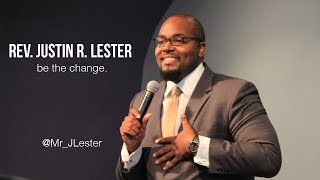
Rev. Justin R. Lester argues that Christians face modern persecution through culture, institutions, and media, then turns to the black church's internal problems: lack of mutual support, colorism, and misplaced standards of preparation. He uses the Passover metaphor to say believers are made to be broken and shared, urging listeners to turn hardship into testimony.
Chapters
I was made for this. I was made for this. You may be seated. Understand, you're persecuted nowadays. It's no longer like it was in the Bible days. No longer people are hung on crosses. You're not dragged into prison cells. You're not brought into public places where animals to eat your flesh. You're not beaten for your stance in Jesus Christ. But do not ever believe that you don't pay a price for the life you're trying to live to walk with Jesus Christ. If you did not know in 2013, going into 2014, Christians are still being persecuted. I might as well preach in this place. From pressure from governments to eliminate any mention of Christianity from public discourse. Let me tell you something. Christians are still being persecuted from eliminating all that it means to what it means to be Christian from governmental meetings. Let me tell you something. Christians are still being persecuted when there's political intent to remove Christianity from school openings before and after school programs. Let me tell you Christians are still being persecuted. Pastor. When a country that's become more and more unchristian gets mad at churches when they take prophetic stances for what the Bible says and not what culture says. Let me tell you something. Christians are y' all gonna talk to me? Are still being persecuted when they're removing everything that it means to know God our Savior from television shows and movies. Let me tell you Christians are still being persecuted when black actors like Tyler Perry take authentic African American worship and turn it into nothing more than comedic fodder for dramatic interpretation. Let me tell you something. Christians are y' all gonna make. Are still being persecuted. Passover, a Jew. Jesus does what a Jew is supposed to do. He celebrates Passover. And here, at this moment, Jesus takes some unleavened bread. You know, unleavened bread is nothing more than stiff, flat bread. It's not leavened because it's made without yeast. It doesn't rise. Unleavened bread, Pastor. Here it is. Was made to be broken. It was made to be shared. Uh huh. It was made to be destroyed. So here Jesus is at the table. Jesus takes the bread he blesses. It says, here I am. With all the parables I've shared with you, I was made to be broken. With all the ministry I've done to you, I was made to be broken. With all the stories I've shared with you. I was made to be broken. Jesus says, my entire ministry, at the end of the day, here I am at the table. And you were made to be taken by God, blessed by God, broken by God and shared by God. I think I'm setting this thing up. See, Pastor, when we look at our communities, when we look at our churches, we look at where our black communities are today. Pastor I think we got a whole bunch of people who want the blessings of God. But when they get to the table, God picks us up and we fall apart because we're not ready for consumption. I ain't scared of none of y'. All. This morning, practical theologian, practical theologian Walter Fluke suggested that black church's pastor exists in what he called the American dilemma, where black folk don't know what it's like to exist and live in predominant white culture. Therefore, Pastor, when God picks us up, we don't encourage family life. We don't encourage understanding African American history, We don't encourage being present with other black people. So, Pastor, therefore, as God looks at black culture and looks at the black church, God says, y' all ain't ready for consumption. Because the problem is, Pastor, we define preparation by the world's standards, forgetting we were birthed out of a culture where what normal society does doesn't work for us. Now, y' all can sit here and look cute at me all you want to, but don't act like you got here cause you so fine. Cause you so together you had to fight through some stuff. And black folk forgot the fight they fought before they got here. So God looks at us and says, are you ready? I told you I ain't scared of none of y'. All. Pastor, Anytime. Black people don't want to work with other black people. Matter of fact, light skinned folk hate on dark skinned folk. And dark skinned folk hate on light skinned folk. And the person sitting over here at Christ the King hates on the person sitting over here at Christ the King. And you want God to take your church to another level. Let me tell you something. You aren't ready for consumption. Preach, Justin. I'm doing the best I can, Pastor. Anytime. The black bourgeoisie talks about college students coming out acting too crazy, acting too stuck up. But we don't do anything to help our college students while they're in college. So when they get out of college, you make fun of them for working at McDonald's when you got the power to get them a job.
Let me tell you something, you aren't ready.
I ain't scared of none of y' all this morning. Huh?
Anytime.
Anytime. School. Anytime. Suburban schools want to get rid of chapter 220. When it's your babies that are now taken out of suburban schools.
And the Reason they say they don't.
Want chapter 220 is because they're too diverse already and black folks on their hands. And don't say anything against the system.
That'S oppressing our babies and our next generation. Let me tell you something. You aren't ready.
Pastor. God hit me with this. As I was preparing this sermon. I'm sorry, I feel something moment when God hit me with this and I was preparing this sermon, God said, justin, share with them. When I pick you up, here it is. You've got to learn to tell yourself, I'm not next. I'm now. Y' all missed that right there. I feel something on me. I said, am I talking to anybody in the building?
I'm not next in line. But I'm right. My breakthrough is right now. My finances are right now. My relationship is right now. My joy is right now. My peace is right. Am I talking to anybody in the building? I can say I'm not next.
I'm now.
Now unto him.
I wish I had somebody who said.
Am I talking to anybody who can say I'm not next? I'm now.
I wish I had about 25 people. Tilt your head back and say, now, now.
Now. My relationship now. My peace, now. My joy now. How do I know I'm now? And he walks with me and he talks with me and he tells me I'm not next.
I feel like preaching in this place. I dare you to look at someone around you. Just say, now. Now. Now. Now. He says. He says, I'm sorry. I didn't mean to go there. I go to Vanderbilt. He. He says, number one, there's necessary. Am I preaching in this place? I'm finished. Jesus share. You see your reflexive response to every situation. In 2013, if you want to make the devil mad and every enemy mad in your life, your reflexive response to your situation is to testify. See, the blessings you're taking are so Jesus can get your testimony out of you. The breaking you endured was so Jesus could get the testimony out of you. The whipping you had is so Jesus could get a testimony out of you. See, Pastor, the secularization of our current culture is because we've got too many quiet Christians. It ain't media's fault. It ain't culture's fault. It ain't music's fault. And it's the way our children dress. I'll tell you what it is. It's the fact we got too many silent saints. But when you're expo. When you're not exposing your light, that's when darkness finds its way in. But, pastor, God is breaking you in 2013. God is testing you in 2013 and putting you on stage to see can you. Putting you on stage so everyone around you can see Jesus as an alternative. See, Pastor, there's no such thing as a silent saint because you're not being victimized, you're being sacrificed. God is not being unfair. God is teaching you how to do ministry. Because here it is, I told you all sermon. God took you through it, so you can minister to it. Okay, I'm done. I'm done. I wondered, pastor, I wonder how to close this thing. I wonder how to close this thing. And I wondered, and I was remembering putting some things on my mind. I wondered, how can I close my way out of here? How can I make sure that exeges the text correctly and gave the right anecdote? And I thought about this, and it took my mind back a couple months ago where, pastor, I had to preach at a large church in Nashville. Never forget this. Never forget this. This is what my testimony is, how to testify, what testimony really does. I was preaching at a large church in Nashville, and, pastor, I was going to preach at the church and I was going to take, you know, preachers got, you know, you got that stick sermon. You know, it works. So I was going to take a sermon, but I know it's done correctly. I did my right research. It has the right stuff in it. I'm going to preach it. And that pastor and I had a conversation, and the pastor said, just. He told me there's something going on in his church. And I was like, I cannot take that sermon because that would be an injustice to God and injustice to those people. So, pastor, I sat down, I started crafting what God was speaking to me for that church. And, pastor, when I got there, there was some stuff in that sermon I did not want to share because I was scared. I'll tell you right now, I did not know them. They're looking at me like some of you looking at me right now. I was frightened. Pastor, Pastor, never forget this. True story. It's on YouTube. I got up. I got up on. I got up to preach at the pulpit. True story. I get there, pastor, and I'm doing what I have to do. I'm making sure the text is together. I'm preaching. I'm preaching. And pastor, I got to this point where true prophetic preaching, because I've learned true prophetic preaching calls people out and calls the God out of people. And so I'm doing True prophetic preaching. And I'm preaching. I'm preaching. And Pastor, I get to the point that they don't like, and they give me this death stare, and I'm like, I gotta get home. I want to eat something. I don't want to get hurt because I don't even go to this church. But I'm preaching what God has called me to preach. And, Pastor, I never will forget. And y' all heard me say it today. This is the testimony why I say it. I've sat up there, Reverend, and I was praying in my spirit as I was preaching. I said, God, why am I doing this? And how can I have the strength to keep doing this? And this is why I've learned what testimonies do, why God takes you, why God blesses you, why God breaks you, so you can share you. Here it is, Reverend. Here's my word for all of you in 2014. I stood there, looked at them, and they gave me these death stares. I looked at them and said, you know what? I ain't scared of none of y'. All. And, Pastor, that's all I came to tell somebody. When you learn to really share your testimony, because everybody in the building, your story ain't the same. Some of us got some ugly stories. But the truth of the matter is, when you learn to tell your testimony after all the breaking you've endured, after all the blessings you've endured, you know what? I ain't scared of none of y'. All.
More from Justin





AI gives you hours back every week. Most people's first move is to fill those hours with more work.



Most people stall out on AI at the exact same step. They don't know where to start.

Thank you for the follow-ups, the messages, the emails, all of it since the New York Times piece. Gr

The New York Times spent a weekend with me. Digital twins, AI, the local church, all of it.
