Speaking at First Unitarian Church
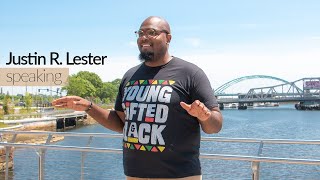
Reverend Justin R. Lester argues New England Black churches risk becoming museums of their own history. He proposes renewal through gamification, tech integration, and intersectional leadership across age, technology, gender, and finance. His book Necessary Endings emerged from personal crises that shaped his approach to pastoral vulnerability.
Questions this video answers
32
Five years
2019
Sundays at 9:00, 11:00 and 1:00 (livestream to YouTube, Facebook and Twitter).
cogdonstreet.org (spoken as cognonstreet.org/cogdonstreet.org in the talk)
Chapters
Wonderful speakers like Reverend Lester. So thank you, Beth. And also I bring greetings from Reverend Liz Lerner McClay, welcoming you to our virtual congregation. Let me tell you a little bit about Reverend Justin Lester, who would describe himself as a pretty average guy. He met Jesus for the first time at 12 years old and he's been meeting him ever since. He has an extreme love for people, ministry and coffee. I believe. He grew up in Milwaukee. He attended Marquette University and Vanderbilt University, earning two bachelor and two master degrees. Currently he's a Doctor of Ministry candidate at the Boston University School of Theology. Reverend Justin is ordained in the Baptist Church and for the past five years is the pastor at Congdon Street Baptist Church in Providence, which, by the way, in 2019 celebrated its bicentennial. It's been in its current building since 1875. He and his family live in North Providence. So welcome, welcome, Pastor Lester. We look forward to hearing from you.
Yes, thank you guys so very much. Do I just jump right in?
No, absolutely.
Awesome. No, thank you guys so very much. This is such an honor. And to Reverend Liz, who is becoming a colleague and a friend, and to all of you here, this is great. I will share two things with you all. I shifted a topic I had just ever so slightly from when we first talked back in last July to really thinking about what it means challenges to laypersons in this context about pastoring and leading through a pandemic. Also during the era of Black Lives Matter and a pastor's critique and challenge. And at the same time, this is the first time, you guys are the first group, actually. So I defend my dissertation in like three weeks. And. And so you guys are the first group of people outside of my professor and my wife who are hearing really any of this research because I've been under a rock for the last couple of months really trying to put this together. And the good news is it's really taken off. And so I welcome any sort of feedback because next time I talk about it being a group of seven people deciding whether or not I get a doctor in front of my name. So I feedback. I'm going to talk a little bit about try to contextualize black church from my perspective. The work I'm doing is addressing what I sense and research has shown a culture of stagnation in religious and humanist discourse here in New England among volunteer and lay led spaces and how we can change that really through technology. And so I speak about a black church context and all of that and I welcome any of your feedback and I pray that if anything else, this just gives you another lens and a way to engage even in black church spaces as well. So let me establish who I am and where I'm from and go from there. So I'm millennial Black male. I'm 32. I'm speaking of five years of past, from five years of pastoring and eight years of full time ministry. And when I mentioned black lives Matter, when I mentioned any lives like that, that's all black lives. And so that's regardless of sexual and gender orientation. So we speak to all the universal statement of just blackness and wholeness. So for me, I pastor Cognistry Baptist Church. You guys heard mention that we celebrated our bicentennial last year and we're 200 years old now, 201. And in a facility that was gifted to us by the friendly hands of white abolitionists in the mid-1800s who felt for us as a church because we were burnt down originally as the African Union meeting house at the hands of racism in 1970s, we were placed on the national history, the registry of historic places. And you know, when I first saw that, I was so excited because. Because I assumed it was because of very similar things like when I went to visit Ebenezer down in Atlanta, that it was the work of pastoral leadership and community work and the engagement of our members and the influence we had in the black community and all of that. But upon further research, I found that we were on that registry because of the architecture, just the architect, that the architecture and the person who built it built a number of other buildings around us. And it was historic architecture. And for me, it was slightly frustrating that the oldest black church in the state is known because of its Spanish architecture. And I laugh and cry, but I use that as a place to kind of locate my conversation, to acknowledge the type of frustration and let down that I've seen in black religious history in New England as well as New England religious history. And I use this to talk about our thinking and feeling and doing as our churches that I believe a lot of our churches, especially black churches, are known more for our facilities, known more for our history, and not necessarily known for our theological loci or humanist discourse or even our practical theology. And so my question I pose is, are our churches known for being institutions that build community, yield theological and humanist discourse and solidify culture, or are they the ones that continue to perpetuate norms for one particular or two particular generations, hatred towards other generations, and a lack of cohesion among intergenerational dialogue and work together because the Church is just known as the thing that will always be there, hence being on the registry for the architecture and not being on the registry for the work that it's done and what's been done in those walls. So I think right now a local church, regardless of denomination, is at a crossroads. I think we've been at a crossroads we've seen and statistics show, and I'll get to that in a second. Consistent change and lack in the depth of engagements, attendance and literacy when it comes to being involved as a volunteer in a religious institution. And my context has not been avert to these circumstances, and I'm sure yours hasn't as well. Neither really is any space that has. That represents any sort of depth or discourse. And then COVID 19 happened, and I heard some of you kind of mentioning that as well, even as we're in this virtual space. And it shuttered the doors of our churches, forcing us to use technology for our worship services and funerals and more to. And it meant to me constant adjustment and constant disruption. I had this moment in the month of December where I called my staff together in the foyer of our church and I just went off. And by went off, I mean I just grieved the loss of what was in order to embrace the future of what possibly can be. And in the midst of all of that grieving and loss and adaptation, Black Lives Matter happened. The death of George Floyd, Ahmaud Arbery, Breonna Taylor all happened. And it meant another civil rights movement. Whether it was a say your name campaigns, our Black Lives matter campaign, the MeToo movement, it was all these additional social, political, cultural implications. And in short, I think Covid, I think Black Lives Matter, it changed everything. And I didn't just change things from my context. As I look at the work that you all are doing in your context, I believe it also changed the ways that we did things across the board. Covid changed everything. Black Lives Matter opened up the doors for conversations about a lot of things. And Covid, I believe, made us lament what was and attempt to discern what are the roots we need to plant into what is. What does intergenerational ministry really look like? What does it really mean to engender a love ethic, a sound love ethic that confronts sexual justice, gender injustice, financial injustice, health disparities and racial injustice. Pandemics have a way of revealing everything. And I think this one in particular, the same way the Spanish Flu, Ebola, hiv, AIDS did a very similar thing. And so the project that I focused on in my Dissertation that really evolved over the past year and a half was focusing on this tenet of gamification. And I'll discuss gamification in a second. Gamification and COVID 19, to me, I think will help in terms of solidifying culture in religious and nonprofit spaces. Because Black Lives Matter and Covid revealed issues in America that we got really comfortable with. The institutions and ethos and pathos that were allowed and welcomed, I think they really need to change. And so technology, we're going to have to consider things like augmented reality, virtual reality, artificial intelligence, all to be practically used in churches. And gamification, to me, is a part of that. The way I'll even frame that and transition is my. A couple of months ago, we had drive in service at our church and I had a praise and worship leader who's an amazing praise and worship leader. He came and his T shirt had Black Lives Matter on it. Another praise and worship leader had the revolution will be intersectional. And we have a church T shirt that says I am somebody as a means of affirmation for black life in Providence. We were worshiping at Hope High School and someone actually had called the police on us because we were too loud. And after praise and worship, my praise and worship leader got up and left. He had to go. And he told me earlier that he was doing something downtown. Found out that my praise and worship leader was one of the core leaders for the big 12,000 person march that was in Providence. And I left out of church that Sunday and saw the posts on social media, and I remembered looking over to my wife and said, we missed church today. And she said, what did you mean? I said, we had all these people, all these cars, all this worship. But we had our people who were really advocating and speaking about what Christ compels us to do, what prophets have told us to do, and what the gospel teaches us to do in terms of building community, teaching others. They were doing it downtown and yet we were just performing the things that we felt we had to do. I said, we preach a liberation ethic, we preach a restorative ethic. We preach a gospel of liberation. And yet here we are missing out on the effects of actually leaving the church and leaving the building, talking about how we're virtual, but yet our people are downtown doing the work and the will that we preach about. Pandemics have a way of challenging us. And protests for me and as I work in higher ed as well, protests show are the markers and the tools that show us that people are growing. If you look throughout history, every time there was a protest, it was a marker that something either needed to be changed and that people were evolving in their thinking. Black Liberation theology came out of the civil rights movement. The Civil Rights movement came out of the creativity of the Harlem Renaissance. The Harlem Renaissance came out of the freedom and the movement following being formerly enslaved Africans. Pandemics and protests have a way of revealing essential needs. The inventions from the Spanish flu era are the very things that we're benefiting from even today. Things that were used in the 30s, the 40s and the 50s. And it also shows us how we refocus our energies on things that are essential and non essential. And that language, to me, I think, plays directly into the ways that black bodies have been perceived throughout history. And it was the first time in this season where we had to pull back and really ask ourselves, is the work we're doing essential or is it non essential? Are we just doing the same thing to say that we did it? Because while across the country there were mindless church protests of people protesting wearing a mask, equating it to the same thing of having skin or being lynched by the state, that's not the same type of protest and same type of oppression. And I was taken aback by the pictures of places where we're protesting, saving others because we want to be called oppressed. And even at the same time, what technology even taught me, and one of the weaknesses as I've been noticing in technology, is that even as we all transition, virtual technology is built to show you what you want to see instead of showing you what can be right in front of you. I was amazed to miss out on this Neo conservatism. The amount of churches and worship experiences across the board, whether black, white or Latinx in our community who are doing work that is antithetical to the very things that technology catered to me that I missed that was even down my own street. For example, we live about six blocks away from a very large Latinx church that gets together every single Sunday, packed no matter what at 3pm with no social distancing. Pandemics revealed everything. And I believe I'm even speaking to those of you around me who can even consider the things that revealed for you self. Checkout was something we just thought about a couple of years ago and now it's a necessity. E commerce was something that was considered a couple of years ago, but now Amazon's on the verge of being a trillion dollar company. Home Depot, Circuit City and Kmart were some of the top 20 years ago. And the only one that seems to exist on that list still is Home Depot. Pandemics reveal something, and I believe for churches, whether it was the 40% of churches that experienced decline, the 3% that experienced growth, and the hundreds that were acquired by other churches or closed, I think pandemic saw something. And for me as a pastor, it forced me to stop trying to lead the people so hard and to actually talk to them. Psalm 23 speaks to that whole notion of the shepherd leading the sheep through the valley by still waters to a place where they'll eat in front of their enemies and goodness and mercy will follow them. And it made me wonder, what grass am I really leading my sheep to? Who are the real wolves? Am I a wolf? Are there times where I'm in battle and I'm bleeding on the people I'm leading? Am I trusting people to fight something that we really never equip people to fight? And that to me frames so much about ministry and the work that we do and the work that you guys are doing here. Are you doing essential ministry and work? Are we doing non essential ministry and work? Are we creating the spaces that others don't feel welcome to come into, but we call it welcoming? Are we creating the spaces where others really don't feel like they can assimilate into and saying that we're doing assimilation work, Is it essential or is it non essential? And I think we have to establish the spaces where we solidify our location, our social, our cultural, our theological location, so we don't become the same faithless spaces that we complain about, but we're the prophetic spaces built on crafting long term efficacy that will not just see attendance, but also engagement. So I believe the local church is the strongest institution that doesn't recognize its own strength. And for years dreamers have been cast out because they don't adhere to tradition or social location or economic status or gender. And it's a sad indictment to me that the institution that should create community is a very community that contributes powerfully to a lack of psychosocial and theological health in our people. So I think the revolution of the church guys have heard me mention my praise and worship leader had a shirt on that said the revolution will be intersectional. I believe the revolution for our churches will be an intersectional revolution. And that intersectional revolution, I use this term from Kevin Kelly in his work the Inevitable called the Protopian revolution, where we're trying to develop a prototype, the very language used for robotics and all of that, a prototype but then also a utopian future that really is built upon some tenants of Afrofuturism envisioning this, this future based upon all of the gifts and skill sets if we didn't have to fight through glass ceilings. And so this intersectional revolution, I think has four tenets. First of all, it starts with age. It looks at technology, it looks at finances, and it looks at gender. And let me discuss age a little bit when it comes to New England and age when it comes to faith in New England as well. So the three generations that are going to drive our churches for the next 60 or 70 years, a generation alpha which is 0 to 12, generation Z 12 to 22, and millennials who are 23 to 40. Now, these generations are the most post Christian, post everything if you will, but into happiness and relationships more than anything else and desiring to really get away from what leadership is to be self led. For example, this, this generation is carrying Black Lives Matter. And Black Lives Matter prides itself, the movement itself. They pride themselves of being a leaderless and leader full movement. Generation Z, Millennials and Gen Alpha are not beholden to just sitting under one person. That Messiah complex that we've developed in churches and religious and nonprofit spaces, they have a leaderless and leader full movement, meaning everybody at any given moment can step to the forefront. And that's one of the reasons, if you even were to remember how it was last summer, there were so many marches because there's so many leaders. It's not saying it's right because anything with that many leaders is a monster. But it also shows the way that Gen Z and Millennials are thinking, feeling and doing. Which is why we've seen a spike in entrepreneurship and a spike in social media influencing and a spike of Millennials who are quitting their jobs to move to live with their parents and so they can travel. Lineals and Gen Z are the main leaders and participants of influencing culture. And here's some statistics on this. Compared to 61% of millennials, 81% of older black individuals say religious is important. Only 61% of millennials do. 78% of older black individuals pray daily. Only 61% of millennials do. Over 50% of older black individuals over the age of 40 who attend worship services weekly or more, where only 38% of millennials do, that number is down to 17%. When it comes to Generation Z, Generation Z is so interesting because Generation Z is the most multiracial, biracial and multicultural generation we've ever seen. For the first time in History Latin X Generation Z will outnumber black Generation Z. This is the first time this ever happened in history, making them the most diverse generation in history. Of that, only 9% are engaged in any sort of religious affiliation. 9% of this entire generation, educational and achievement and hobbies are their strongest priority. 37% of Generation Z say their gender is central to their sense of self. And 43% of them put professional and educational achievement as the most important thing to their sense of self. As a matter of fact, more people in Generation Z are upset when someone doesn't recycle than if somebody has an addiction to pornography. They consider it more morally unethical to not recycle than to be addicted to porn. And we can see that same piece if you were to scroll anywhere on TikTok. The amount of pornography, the top hashtags and music that's out there, where sex is sex and achievements and relationships, is seen as more important and not morally wrong in any sense of the word. But if you don't recycle, you're going to lose your Generation Z friends. Even more statistics on that. 66% of Gen Z and 59% of millennials will finish their education, start their career, whereas only 20% of Gen Z and 20% of millennials desire to be married. And 16% of Gen Z or 21% of millennials desire to become mature spiritually. So combining all of that together, if we're going to revolutionize nonprofit spaces or revolutionize even churches, it will start with these generations. But it's going to take a lot of work from us, myself included, as a millennial, to then also see how can we infuse the movement of community, the movement of caring for one another, and a sound love ethic that reflects what we truly believe in and worship and honor and come together for, to emphasize education, career and financial independence inside of spaces of community where wisdom like you got yourselves abound. The second thing I mentioned earlier is technology. Amazon, Google, Facebook and Apple serve as the top four companies. Amazon's on the verge of becoming the first trillion dollar company. Interestingly enough, 53% of the searches on Google are from Amazon. And so Amazon is running everything Facebook has been trying to compete with Amazon by creating a marketplace. Amazon, in essence, almost shut it down. The only thing that stands on its own is Apple with their iPhone. And no one seems to be able to compete with Apple's iPhone no matter how hard they try. They've knocked out brick and mortar stores and they've knocked out Walmart, tried to Keeping its prices low, move forward. And Amazon has come along and with the purchase of Whole Foods, it took the stock of Kroger Stop and Shop and even Walmart stock down the day that they purchase Whole Foods and they only purchased 460 places and made Kroger stop and shot and Walmart have to change their entire process. That to me shows the threat of what true online work can do. To me. I think the same thing has to be considered when it comes to the local church and local places. We have to consider things like artificial intelligence, augmented reality, which is simply things like Pokemon Go, where you alter the reality in front of you by adding something on your phone and virtual reality as well. And gaming culture. Millions of individuals are gaming and I think we can see the influence of gaming culture by just last week and how from December until today, GameStop, a fledgling company that's similar to Blockbuster, because you can download your games, you don't need to purchase them, went from $6 a stock to over $200 a stock and have made people rich simply because they drove up the price on a gaming store. Gaming culture is huge. And considering technology for the movement of our local churches has to be something at the forefront of our minds, I suggest doing it using gamification. Gamification is simply human focused design where you're designing something around the influence of people. It has no gender, it has no age barriers. Instead of making a game. So this isn't playing PS4, this isn't playing PS5, it's simply making your own avatar on your phone that we already use and now making what we do on a day in and day out basis, somewhat fun, where everyone has an opportunity to contribute, whether it's on a message board and everyone's able to be anonymous as much as they want to be. And utilizing gamification I think shifts us from looking fully into technology to technique. And that's the big pace. I want to split this. I want us to consider technology as a form of technique, especially in black churches. When we think about Tulsa, Oklahoma, we think about the Underground Railroad and Freedom Songs and founding of historic colleges, university boycotts and Black Lives Matter even. It's, I don't want to look at the technology, but look at the technique. And if we were to reframe that and see what's at stake here, which is a growth and sustainability of our spaces, technology gives us the way to do it. But we already have the technique, we have the creativity, we have the practices. And now all gamification does is take our techniques and just put it on a phone, put it on a computer. Carter G. Woodson said, what's old is new. And these are things that we've been thinking about and putting together for years. And it's things already around us that now I believe we have to bring into our church. I joke with my church a couple of years ago when I first came to pastor the church. I said, before I leave, we'll have robot ushers. And the funny thing about it right now is that I was talking to some college students that we have at Brown University about how we're actually thinking about how we're going to have robot ushers by the time we open for sanitation purposes and for reminding to check temperatures, because it's going to be so imperative for us to stay socially distant, to care for our community, and at the same time use the technology that's available to us to keep people safe. Now, gamification is not exclusive, like I said, to any age. It's not exclusive to any gender. It doesn't engender any of that. It just creates the room to dream and innovate by utilizing the spaces we're in. So everyone has a say. So. And it's not so driven by the messiah complex of a leader, which is driven by everyone. The third place of intersection for me also is gender. Black churches have been known for being a places that's dominated by male individuals. That's why I'm appreciative of even being in this space. Nanny Harlan Burroughs in 1908 stood in front of our National Baptist Convention and just absolutely went off and she called out the bluff of patriarchal systems, only for us to look in 2021 and see the same things that she was frustrated about in 1908 to be the same issues we see in 20. The fact that when I got up in my church back in the month of May and said that when we talk about black lives, it's all black lives. And the fact that that is still the point of contention that black lives cannot matter until black trans lives matter. Black lives cannot matter until black female lives matter. Black lives cannot matter for not listening to the stories of black women. And it confronts our neoconservatism and our arrogance, where we're misusing and misquoting scripture and past stories to suppress certain individuals because we have a Mandingo culture that sits in our pulpits, that suppresses black women and pushes up black men on the backs of black women. I say this all the time, that America was built on the backs of Black women. And the reason why I believe we've lost our spine and feel weak right now is because we've forgotten our backbone. And as soon as we remember our backbone and listen to the stories of black and brown women and listen to the stories of our queer friends and not just talk about being allies, but actually align ourselves and ally ourselves, that's through learning, that's through conversations, and even through moments like this. Welcoming a black creature into a space where there's not many people that look directly like me to engage holistically, to ask full questions and then move forward to me is an honor because it speaks to not just allyship, but alignment for the future. And the last thing is financial intersection. As much as we hear about black bodies and black people, oftentimes it's been equated, especially in our politics recently, to lower class people and how much help they need without recognizing that over 26% of Black and brown people have master's degrees. They're educated middle and upper class people. They're black millionaires. What we need to address is the lack of access. And if we're going to have an intersectional revolution, there has to be access. Vision must lead us. Not so we can pay next week bills in churches, but vision must lead us to give access and equitable access to people. And that's not always going to be done with a black face. Sometimes that needs to be done with a white face to empower the access to people. So considering all those together, the four questions I bring to you all as laypeople in these spaces is when we talk about, even as we go into Black History Month, this year is number one, do we really honestly care about all black lives? Do we really honestly care holistically about the person that I go to the grocery store with that I don't even know if that person were to die today? Am I just going to march and forget it? The same way that a lot of people marched in May and forgot because of a person getting elected to the White House, realizing that the work didn't end in November and the work didn't end last week, but January 6th showed us that we have a lot of work to do. Do we really care about gender and sexual justice? Do we really, really care about equitable spaces that are race and gender based? The fact that women still make less on the dollar, and then if we start getting into race when it comes to gender, and then if we get into trans populations and queer populations, how those numbers continue to go down? Do we really care about Gender and sexual justice? Or is it a convenient ploy for us because it's comfortable to say certain lives matter when it's convenient and comfortable for us to do so? Are we really aware of what plagues our communities? My church sits in College Hill, similar to yours as well. Our church sits in College Hill and I have members of our congregation who come and journey from the south side. In order for me to actually know what to preach on, I had to stop preaching to College Hill and start preaching to the south side of Providence, realizing that everybody doesn't have access to Whole Foods, everybody doesn't have access to fresh food. The way that if I were to walk from my church, I could walk to Thayer street and go shop, I can walk to Whole Foods and shop. But if I live on the south side without a car, I have access to corner stores. I have access to less food in a food desert cross compared to what I get on the east side. And are our ears really on the ground to know the pulse of our people? What's the pace? The people you're serving really run at are ears on the ground for that. So here's my challenges, and I'm finished. That I will give. Those are my questions. Here's my challenges. Number one, I believe Covid and Black Lives Matter has influenced and challenged churches to, first of all, take a sense of ownership. I'm proud of people like Reverend Liz. I'm proud of people who have changed their practices for the better. Where we've named our areas politically, we've named and stood on it and been unafraid to risk it. The same way that I saw white evangelicals in the south where I went to school and named where they stood politically and were unafraid, unashamed and. And even lied on Jesus sometimes because those African angels still have yet to show up, name their areas politically. I applaud people who took a sense of ownership. I believe what we're in a season of now is to name where you stand and own it. Because if you have friends that are willing to leave you because you own you, then I'm grateful because I'd rather own the fullness of who I am than to lie and live a lie and have people around me that want to help me cater to my own. Why. Number two, I believe it forced us and it will force us to own our frailty. I have a therapist and I am happy to acknowledge it. And I mentioned. I did mention this earlier. I wrote a book last year called Necessary Endings, and it was actually my journey through. I attempted suicide twice back in college and then in graduate school. And mental well being has been something that I've constantly wrestled with. And in the midst of COVID in the midst of Black Lives Matter, I was able to acknowledge and name my own frailty. What I'm unable to do, and the need for collaboration, the need for church collaboration, the need for cross generational collaboration, and the need for me as a millennial to not think I know everything and the need to listen and the need to engage and the need to move forward. And I don't know the areas for you as well, but as you guys consider your own space, where are the places where you can't do it and who are the people around you that can? And I think we can do better when we do better. And then lastly, I want to challenge everyone to get out of maintenance mode, to long term mode. I told my church yesterday, I told them, I said, I am not planning for 2021, I'm planning for 2025. And by that I mean I'm not going to risk coming together into our building to say that we came into a building for next week when that long term says, I worry about your health. So how can we fight together to get to work to create advocacy for vaccines, advocacy for testing? Getting out of maintenance mode gets us from getting to next week and gets us to planning next year, gets us planning for the long term. And to me, that's what gaming and technology can do when merged together. And so all in all, for me, I believe those three things. I want to challenge those of you who are in positions of authority and leadership to do. And all in all, because our goal is to really be prophetic people, not preserving people, but sustainable people. I've learned in my life that prophetic work is not easy work. It's bloody, it's nasty, it's grimy, it's isolating, it's jungle, it's desert work. But every once in a while you get that palace invite. You get to read the handwriting on the wall. And pastoring in a pandemic and Black Lives Matter and being a church member, being a part of a body of believers, being a part of a community of people who are constantly trying to grow, to be all that they know that they can be, I think made the real prophets stand up. It made us name essential ministry and non essential ministry. But in the end, it really made moments like this essential. And to me, that's a real revolution. And so I thank you guys for listening. I hope I said something that piqued your interest in mind and look forward to any sort of discussion. So thank you.
Thank you very much, Justin.
Why?
Very inspiring. Now, Ann, are you going to lead the questions? I would be happy to do that. I'd like to start off with one of my own. Just. Reverend Pastor Lester, tell us about your book, Necessary Endings.
Yes.
Where did that begin?
One second. Now let you grab one so you can see it. So right here, this is a book called Necessary Endings. And so I wrote this 2019. So I. 2018 was my second year pastoring. I ended up firing a musician who was a wonderful musician. And I caught myself because I was falling into this trap of just depression, anxiety, frustration, wanted to quit ministry. And I started this practice where I found a tiny home in Vermont. I love tiny homes. And so I started a tiny home in Vermont. And I went there, just had a moment where I sat down away from everyone and to share with you all, too. I love wine. I'm a closeted sommelier. And so I went and I sat in a tiny home in Vermont. And I remember the Lord speaking to me and saying, justin, this time some things need to die. And it's not you, because I just had my first child. My wife and I had married for three. Three years at the time. And so I just refused to die. And so I ended up having four funerals. And that's why I call them Necessary Endings. And they were four funerals. The death to talk. The death of worshiping what others think about me. The death to the death of feeling sorry for myself. The death. The death to my last plan. And it was liberating to write this because oftentimes I never found anything written by a black male on mental health because we as black men, just trying to be unnecessarily strong sometimes with that Messiah complex I mentioned. And so when I wrote this, I lost members of my church. I did. I lost friends. Because we're supposed to have it all together. We're supposed to pray a little harder, fast a little harder, and figure it all out. And in this case, it was liberating because as I read the story of Jonah, I read someone who hated what they were called to do, but and. But did it anyway because of their faithfulness to God. And got to a point where Jonah, chapter four, we don't see the end of Jonah's story. I mean, we don't see the end of Jonah's story in Jonah 4. We just. God just abruptly ends the story. And so for me, Necessary Endings became a way for me to write my own Jonah 5 what happened after the worm ate the tree and what did Jonah do? And for me, instead of sitting there wallowing in that moment, I got up, went away, kind of found myself again. And then I wanted to empower others. And so it's I heard that this was read by some people actually at our state house which actually helped influence some money that was allocated for mental health for our children in Rhode Island. And so I'm really grateful for that. And so yeah, this is simply book if it talks a lot about leadership and just things that I learned. And it came from a place of really darkness for me that I hope can give light to other people.
Thank you Barbara. Our president shared the link to Amazon so I have a copy on its way.
Oh wonderful, wonderful.
I look forward to reading it.
Thank you.
Down in the reactions everyone, there's an opportunity to raise your hand. I see Sina has her hand raised, but she's muted. Sina, you're muted. We're missing all those wonderful things you want to say. Just in the meantime, I've also ordered the book. I have.
Wonderful.
Yeah, wonderful.
And actually it's not out yet. My son and I. My son and I just wrote a children's book Covid era called dad Brown Boy, Brown Basketball. It should be out tomorrow. I haven't even released it online yet. But yeah, no, it should be on Amazon tomorrow. Hopefully kind of our journey of being a brown dad Brown boy and his and his brown basketball and wearing masks and Covid.
Wonderful. Now am I able to be heard? Yes, I did it. I just wanted to say how very wonderful to hear the things that you have done. The self examination that is really hard to do and I so admire you for doing it. I am going to stop in one day when we can do that again into your services and I am just so glad that you are here today. I want you to to know that. And as far as the black lives matter, I do think that that has just changed people's thinking. I know it's made certainly some of the past presidents followers anxious. But for the rest of us I think it really has opened another, another avenue of communication and I am grateful for that definitely. And so I, I'm so glad you're here today. And I have a grand. Now let's see. He is my grand nephew who is just was just born and he is young black baby, young baby. That's sort of what babies are. And so I'm going to look for your book.
Wonderful.
They haven't got Books yet for him and they don't have any toys, but he's dressed to the tens.
I'm told.
The best moments.
The best moments. So that's what I have to say and I'm so thankful for you.
God bless you.
Thank you. From Anne Boyd. See, she's interested in the concept of leader full versus leaderless. Is it antithetical to movements in the past? Can you defend. Explain this approach?
Yeah, so it's a different type of approach for them and Generation Z. This is what I love about them, but I'm also very scared about them. I think Gen Z is doing their best to be so, so different and that's not conducive to success. For example, Black Lives Matter compared. If I were to compare apples to apples, Black Lives Matter Civil Rights movement were started completely different. The Civil Rights movement was started inside of a church with a sense of leadership. The sclc, naacp, all of that coming together. And while there were some differences, even Malcolm X and Martin Luther King, Black Panther parties, their goal was still empowerment of the black community in general. And while they did it differently, their goals were still to empower the black community. You know who you could go to? You could go to mlk, you could go to sclc, naacp, Black Panther Party, all that type of stuff. Here Black Lives Matter. Even in Rhode island, there's a Black Lives Matter chapter and then there's a Black Lives Matter of Rhode Island. And they're not the same organization. And only one of them is actually affiliated with the global organization. There's too many leaders. And therefore, when it comes down to what are the actual things that need to change, nobody knows who to reach out to. And so therefore we're going back to Obama. And even in black church spaces, I don't know if you guys have read the Promised Land, but his distance from the black church has also now also created distance within other generations who kind of worship the Messiah complex of who Barack Obama is. This leader full movement is not. Is not the best concept. But everybody wants their stage presence. Everybody wants to be the person known. And so you see, that's where social media influencers, the amount of money and time that can come from being an influencer has kind of, I think, taken away and slowed down the movement because nobody really knows what to do. So that's why, even if you look at Providence, one week it was defund the police, the next week it was change the name of the state. The next week it was do this, the next week it was do this. And then there was 20 different demands. And every meeting I went to for a month, there were new demands every single time. And so I think it. It's not helpful. And I think that's going to be an issue we're going to see with Generation Z kind of assuming leadership going forward in the future. So I'm not the happiest with it, but everybody kind of wants the stage right now instead of trusting a few voices to lead it.
Thank you, Sarah. I see your hand, but I have a question from Susan. How do you understand the issue of non leadership in the face of the response to Trump? Lowercase.
Yeah, no, that was. My wife and I were actually talking about this yesterday. I said, I think this would have been a completely different world if we had a leader. I think the world is dying because of a lack of leadership. I consider places like New Zealand who had a leader. I consider Canada who even had a leader. I consider certain states in our union who had governors that stepped up and led and were unafraid to make difficult decisions. I see leadership is just conflict, managing conflict, and effective communication. That's it. Managing conflict, effective communication. And for us to not have a leader and to have someone who was more consumed about a bottom line and consumed about their own reelection distanced us away from healing when it came, literally healing right in Covid. Distance us from reconciliation, distance us from restoration, and then just really revealed a lot of issues that no one really wanted to confront or address. And that's not just racial, that's. That's health, that's lack of access, that's housing, that's educational access. That's just so many different things. And so I'm scared, really, honestly, this is just my own opinion for it, but something I've been sharing with my church as well and really praying about. I'm worried about the next two years of our country. I'm really concerned about, really the next few years of our country when it comes to our culture, when it comes to our love, when it comes to what it means to live in cohesion. Because I think January 6th was just the beginning of something. And now I saw the office of the former president last week. That to me, just speaks to the same things we saw. I'm currently reading the book the Splendid and the Vile, talking about Winston Churchill. And to me, it speaks to a lot of the things. When I read about Hitler and Stalin and Mussolini, it just speaks to pride destroying people and then the apologies coming 60, 70 years later and really not apologizing, just writing books. So somebody in the family can make some money. I'm concerned about the love ethic of our country right now because of a lack of leadership.
Thank you, Sarah Gleason.
Thanks. Yeah, I hope I'm not creating feedback because I had to move into my condo because my laptop was frozen. Anyway, we don't have a lot of time and there's so many questions I want to ask you, but a simple one is, can I buy the book someplace other than Amazon? Because I realize I must. I'm a big minority, but I don't use Amazon if I can help it.
Not right now. So it just came out. It came out during COVID I was planning on doing something locally here.
I.
And I haven't really had a chance to do much promotion, but I'm really just starting it now.
Can I connect you with books on the square?
I would love to. That'd be awesome.
Let me do what I can.
Okay. Yeah, that'd be awesome.
They should carry it, so I'll ask them. Okay. The other thing is, do I understand you that you don't feel like Biden is a leader?
No, I was talking about Donald Trump. Okay.
Yeah.
Because the issues that we are talking about, like $15 minimum wage, for instance, and everything else is. That's part of your agenda, I assume. I just couldn't quite put all the pieces together and I missed.
Yeah, No, I, you know, my, my feelings in Biden. I'm personally, I'm taking my goal personally last year was to hopefully just get someone in there who's leading. I joked with my wife, I told her, I said, government is boring again. I don't know if that's a good thing. I said. So I'm at the point now where I'm just, I'm watching and prayerful. But I also realize that people have agendas and I can't take that away. And so I, I am, I'm for $15 minimum wage. In a sense that I did the very thing for the people at my church and the staff I have at my church because I know the struggles of a lot of people who are living off of minimum wage, multiple jobs, all of that dropped out of school because of situations either they got themselves into or couldn't get or because of just being who they were, they weren't able to move forward. And I, I am the beneficiary of middle class parents and great leaders in my life who pushed me so that I never really had to. Last time I even thought about minimum wage was high school. So I am. There's a lot of things that he's doing that I agree with. A lot of things that he's doing I don't agree with. But I think the larger picture of what he represents is much better and clearer than what we experienced the last four years.
So I don't want to hog the time, but my last question is I like to figure out how to connect as a commit part of the community of your world and my world, which are a mile away from each other. But to me, I think working for say Biden's agenda is one way that both races can be connected.
I agree 100%.
Okay, so. So if you have other ideas, let us know. Buy your book would be one of them. Okay, so I'll stop now.
Pastor Lester, are people able to zoom your service?
We actually livestream directly to YouTube, Twitter and Facebook. We pre record our service and then we live stream it to YouTube, Facebook and Twitter every single Sunday. So it's just our if you go to our website cogninstreet.org and click watch live, you can see us. We're live 9 o', clock, 11 o' clock at 1 o' clock. And then it stays online forever. So but yeah, we're live every Sunday at 9, 11 and 1 o'. Clock.
Thank you. Thank you. Anyone else with a question? I see Susan.
Go to Barbara.
She hasn't had a. Barbara. Yes. I wonder if you're familiar with I just read in the Brookings Institution newsletter this morning about the Biden administration's work to make hiring well, throughout the administration to make, to recognize blacks or people of color in general and to dedicate themselves to improving that situation. I wondered if you were familiar with that or had anything to say about it.
Yeah, I've heard and I've read a little bit about that as well. I'm grateful for that. To me, the issue kind of goes to what I see in the NFL right now. So the Rooney Rule was instituted a couple of years ago to do the very same thing, to give equal attempt to give equal access to black coaches to interview for positions. Whereas this year there were eight open positions and only one black coach was hired. And he was 65. Hired for the worst coaching job in all those sports on like a two or three year contract. Right. So I love the framework, but if we don't, if we don't attack systems and hearts, we'll look up and the framework will be a really great idea. But then we'll still have, what is it, 87% of the players in the NFL are black and 6% of the coaches are right. And the same thing in the NBA, same thing in the wnba. You know, like even if we go in the wnba, we could look at gender and we can look at race as well, at how I think it's, what is it like 79, 80% of the women in the WNBA are black and there's only a few women, black women coaches in the WNBA as well. So I love the framework. It's way too late for beyond time for the framework. The same way it's beyond time to have a woman that occupies the second seat and the first seat for that matter. It's beyond time for it. I love the framework. I'm worried about the hearts and the systems at play that'll keep people frozen out of those positions.
Susan Fisher well, I was delighted that you mentioned the Splendid and the Vile. My sister in law gave me the book over the summer, but I haven't cracked it open yet.
Oh, it's a wonderful book. You learn a lot. I would be cautious about how you picture Winston Churchill because there's a lot of pictures about how a lot of really, really. Was it explicit images about how Winston Churchill loved to work naked. And so they explained it in great detail. But it's a great book. It's a great book.
My other thought is to follow up on the question about understanding leadership in the face of the Trump phenomenon. People 40% of the country thinks Trump is a leader and whereas actually he's just an egomaniac. But I mean, he's leading his own life. That's it. But so what do people, I mean, I kind of think people think leadership is authoritarianism. You've got somebody who's really going to tell you exactly what to do. But that's not leadership. That's, I don't know what to call it. But so how do you understand the phenomenon of 40% of the people voting for Trump?
Well, we remember too that most people have a third to fifth grade reading level. Their picture of leadership becomes celebrity. Right? And the picture of leadership becomes the picture of coaches on sidelines. And as someone who played sports, like the way that my coach was during the game was nowhere like the coach that invited you into their office to sit down and really move you from being a boy to a man. The coach is going to yell, scream, be hot headed. And we're going to worship that. But the coach that I knew, the football coach that I still talk to, was the coach that brought you into his office, that brought you into his life, that you challenge you with Books. We read more books as football players than people actually realize. Football players read because they wanted you to move from boys to men. But on the sideline, he's ticked off, he's mad, he's throwing things. I think the same thing goes for it's celebrity, the celebrity picture messiah complex we have for people who have money. And I think that Trump simply represented this faux success because, you know, million dollar loan from his dad, this faux success and this dictating and dictatorship mindset, which then allows you to rub shoulders with Putin and get a lot of what you might call it, a lot of what is he comparisons to Hitler and Stalin. And everyone think that's cute because of the picture we have of leadership. And so I think we're dying because of a lack of leadership. I think we can grow with the right people in positions of leadership. And I think we have to get beyond the celebrity and influencer mindset. Like I said before, that's why I'm really worried about Generation Z, because I think if we really don't take them under our arms, history is going to repeat itself in the next 50 years. Especially when they're the ones who are the dominating culture. Especially if we even look at and just last year's election showed it as well. Latinx culture and African culture are really leaning towards the same type of mindset and thinking of Trump. And even as we think about just black culture in general, Black culture and African culture, just to share this with you all are two different things. And so African culture is much more conservative. African culture is going to look at family values the way that that 40% does, the same way that Latinx men did the very same thing in the previous election. So this multiracial, post racial Generation Z that we're going to see, if we really don't pull them under our shoulders, we're going to look over the next 20 or so years and it may not be Donald Trump senior. It may be Junior or the third or Baron or whomever that comes back in. And we see the same thing repeated itself in the next 30, 40 years, the same way Reagan did.
Pastor Lester, break that out a little bit more since many of us have grandchildren in that Generation Z, what do you mean by putting them under our wings? What can we do?
I think listening to stories and being willing to admit what we don't know, and that's not necessarily just getting on TikTok and doing dances, that's not necessarily just all of that, but I think the admission of what we don't know Creating intentional. One of the things we do in our own home. My son's 3. He's a part of Gen Alpha. But having phone away time and leading that endeavor, right? Showing the desire for in person and face to face interaction as much as you can, or even when you guys are virtual, you know, vocalizing the need for either a lack of a phone, a lack a book you're reading together, something you're studying together, something you're engaging with together. Cross generational work right now because generations are what's separating us because we're starting to become so multicultural that race won't necessarily be as big a separator as generations will going forward. I think that's what's really going to help. By 2030, this group will be all people that are earning money and having the ability to really drive voting. And they're going to be one of the largest generations that we'll see for a while. Because Gen Alpha is not going to have as many children, just because Millennials and Gen X just didn't have as many kids. And so this generation, having those having time to spend together, building community together, knowing their hearts and minds, is what's really going to help for the future. And I think that starts now. They're 12, 13, 14, 15. Because if not, we're going to look up and I think we're going to see history repeat itself again. Because this generation is really about themselves, really about educational achievement. And so they'll be really, really smart knowing how to defend themselves and knowing how to put themselves in leadership positions because they'll just create the stage because we no longer need, like, for example, even for churches, I don't need a pulpit to preach the gospel any longer. I can turn my phone on, on a church livestream and there's my pulpit. The same thing goes for them. They don't need to go to school, work their way up to be the president of the Student Government Association. They just get on TikTok and they reach 3 million people. So I think conversations at home, engaging together, playing games together, building relationships and really sharing one's heart is what's going to help this generation grow. Because if not, I'm not looking. I'm really scared of this generation. As much as I love them, I'm scared of them.
Thank you. Very solid suggestions. Anybody else out there, give a shout out if you have a question for Pastor Lester. I don't see everyone on my screen, so I don't want to miss anyone.
I think Lucille has her hand up. Oh, good.
Lucille Go ahead.
I was just thinking about fiscally, your church as far as what's going on because of COVID I know our church is having problems, you know, with the budget and everything. And I was wondering if your church, because of the lack of content, you know, lack of community, of not, you know, meeting with people and not seeing people is if fiscally the budget, you're having problems with that.
For us, actually, and we actually just talked about this yesterday, we had one of our best financial years we've had in ages. We actually were worse when we were in person than we were virtually, believe it or not. And that's why for us too. And I said this in our business meeting and our church service yesterday. I was casting Vision. We don't even qualify for the PPP loan because we didn't take a hit anywhere but what we did. And I'll share why. And I'll share why. So I'm not saying that in Area 1 it became just because of like, there's an immense amount of favor on our church right now. But also I learned that people don't give to need. People give to vision. And so I stopped talking about need and I started really placing vision in front of our people. Right now we're in the process of praying about planting a church. In Nigeria. We partnered. I didn't have church service at our church. I took it to high schools. So we worship at Hope High School and then gave to Hope High School. So our church knew when I say we're giving to our community, it wasn't just like, oh, we're giving. No, we're going to go worship there and we're going to have the police called on us every single week. And we talk about going on a march. We'll suspend. We'll, as soon as church is over, we'll march down Hope Street. We went and bought pizza for people after church once at Flatbread Company as a church and the people served it. So we put vision in front of people and that's really what shifted us. And so our giving went up. I was surprised. Like, I was like, okay, it's a fluke at first and then eventually that's why I'm dragging my feet on coming back to church because I'm like, they gave more and we're not in the building. And we were in it. So that's where that came. So I learned that people don't give to need. They give division. And so we have some areas where we do do need based stuff like, you know, food drives and gift Cards and all. We do do that. But at the same time I spend more time putting vision in front of us than I do need based things. And that our giving has been, I mean just I've been surprised. We have people that were furloughed that we like. We actually gave away $5,000 worth of not school supplies but how to. We redid like 4 kids bedrooms for homeschool and we just had our men went over when they were all gone and just redid the whole room and gave them a new desk, computer, everything. Because of the generosity of our people and our goal, and I put it in front of our church too is I want to give. I want to tie the 10% of our budget back into the community. And so literally in December we were trying to make up stuff to give back because people were giving and I didn't want anyone to see our budget list and see that we didn't meet that expectation. And I laughed, I said like we were literally making up stuff to give away so that we could do it. So yeah, my challenge you all, I mean I would just to put it in front of you is where are you headed in the next two or three years? Because people give to vision more than they give to need. And that's what we did as a church. And that's when I talk about. Let me back up to back in August. That was the worst month of the year for me. And I'll be very honest about it, that month sucked. I hated preaching that month. I lashed out in preaching to people. I was trying to figure out how to lead, how to be a pastor, how to be a dad, how to be a community advocate, how to go back, how to finish this dissertation I was writing, how to do all this work. And I grieved the loss of what my church was and finally embraced and I shifted our language that we are a virtual church with in person experiences. I said, I stopped saying we're going to try to get back together. We are a virtual church. So we have to be a really good virtual church and we will invest our money in being an amazing virtual church. And that's what we invested time. And I hired a person to do social media and digital work full time. I hired a full time person to do, sorry, part time youth person. I was very clear with our staff, nobody's going full time. We're all part time until we figure this thing out. And so that clarity of vision that we had from me, from grieving and hatred of like what church was because I, I went to school for this stuff. And I didn't go to school to preach on zoom. You know, I went to school to preach to people. I went to school to hug people at funerals and at a funeral where I couldn't even embrace the family that's crying in the podium next to me. Right? I didn't go to school. I went to school to give pastoral care, not a text message. Right? And so when I finally grieved that then we were able to then enact new vision and that's where things really shifted. So we saw an amazing teams of generosity, but that's because our vision had to be so clear and people gave division instead of the like, let's make it to next week. And that's where one of my challenges is that maintenance mode mentality. And the last thing I'll say to that is to move from a scarcity mindset to an abundance mindset. And when I started thinking in abundance, like what would happen if we had 500 people tuned into our livestream? Can our computers handle it? Can our cameras handle it? Am I doing a 500 person livestream that then shifted everything? And we gave to fund the moments. We had 500 people and we've had those moments and we've had the 20 people moments too. But when we gave people then gave to make sure that whenever I tune into my church and invite someone to tune into it, that is a 500 member live stream and not something we're just throwing together at home. And that's how it shifted for us a little bit.
Thank you. I want to be respectful of the time and if anyone has any final questions, please signal you'd like to speak. Otherwise, we send our heartfelt thanks to you. Thank you for being transparent and vulnerable in front of us. We're so grateful for your presence in our community.
Well, thank you guys so much. This is an honor and a privilege and I'm very grateful for the work you guys are doing and for even this opportunity to share with you all. So God bless you guys. Thank you.
Bless you as well.
Thank you.
Thank you so much.
I'll see you guys.
Take care.
Wonderful, wonderful.
Thank you.
More from Justin





AI gives you hours back every week. Most people's first move is to fill those hours with more work.



Most people stall out on AI at the exact same step. They don't know where to start.

Thank you for the follow-ups, the messages, the emails, all of it since the New York Times piece. Gr

The New York Times spent a weekend with me. Digital twins, AI, the local church, all of it.
