Speaking at Martin Luther King Event - Riverside Community Care
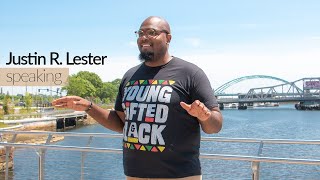
Justin R. Lester shares his two suicide attempts and connects mental-health crises in Black and Brown communities to structural racism and the toll on civil-rights leaders. He argues for honest answers to "How are you?" and offers three challenges: name your principles, be faithful to your future, and raise the bar.
Questions this video answers
Necessary Endings
2014
32 years old
Chapters
Doctor Jerome, I'm so honored to be a part of this just great cohort of people as we engage in the legacy of Dr. King and honestly speak about a part of his life that was. That I think is overlooked prayerfully today as we jump into this, I can grab a hold of that. You guys saw that my book was mentioned. It's a book called Necessary Endings and I have a copy here as well. I'm going to speak about it a little bit later, but in 2014 was the second time I actually personally had attempted suicide. And I'm grateful to still be alive today. But the person I am today is because of really what I detail in here about four mindset shifts that I had to have change in my life and four things that called for funerals and Necessary endings, things that needed to end so that I'm able to begin again and to live the life that I know that we were created to live, to be the person that God is desiring us to be. And so I'm grateful to be here. And let's jump into this today. To all of you who are attendees, those of you on Facebook as well, please engage. I think it's always so much fun to talk back and engage holistically. And as my bio mentioned, I'm a black preacher and so it's kind of weird to be in a space where I'm not able to see people as I speak, but I'm enjoying comments and engaging holistically together to establish where I'm coming from for this. I'm a 32 year old male, I'm a husband and I'm a dad. And for me, in that order. And it's taken me some years and to finally get to a place where I could own that reality and be comfortable in the skin that I'm in and to own my blackness, to own my thinking, my feeling and my doing, it's taken years to really, truly get there. And one of the turning points for me to tell you was, well, you know, when I stopped lying to people. Let me qualify that statement. I hate the question how are you? Right. I think it's one of the most annoying questions there is because no one really wants to hear how you're really doing. I mean, think about it, right? When someone asks you the question, how are you? We have these planned responses I've seen, research and work out there about how to actually answer that question. I'm fine. I'm well, I'm good. What type of vernacular using what part of America you're in what part of the world you're in, how you're supposed to respond to the question, how are you? Because people don't really want to hear the honest answer. And I remember a day I was overwhelmed with work. I was overwhelmed with stress. I was overwhelmed with life and just everything. And someone had the audacity ask me, justin, how are you? And so I said, fine, if you ask me, I'm gonna tell you. And I responded with honesty. I'm happy. I'm overwhelmed. I'm tired. I'm ready to give up. I want to get to the end of the day. And you know what? Frankly put, I want something from 2015 in Paso Robles. I need a good glass of wine. I just remember being honest. And I never will forget that judgment. I never will forget that facial response. I never will forget that body language. And I never will forget the response the person said to me. They looked back and said, justin, you're supposed to tell me that you're fine. I didn't really want to know how you were really doing. How are you? And I think that basic question, you can have a response as a dissertation or have a basic response. How are you? That simple question can change the trajectory of your entire day. How are you? That simple question can change the dynamics of your relationships and friendships. How are you? I think it's a powerful question that really gets a real response, because the world we live in, in a world full of triggers and a world. A world full of. A world full of cancel culture, a world full of toxicity. A world can't handle honesty. And I'm not just talking honest negativity, but honest happiness. Think about the ways we talk about happy people, optimistic people, and that when you sit there and you respond with happiness, hold up, Something is supposed to be making you sad. The world can't handle honest pain. Get through it. Get over it. Weeping may endure for a night, but you better find the joy in the morning. But right now, I'm sitting in the weeping that endures for a night the world can't handle. Honest frustration, honest joy, honest optimism. And then in the context of our conversation today, people who are honestly seeking for the change of people they may never meet. And so let me create space today in our conversation as we. As we look at the life of Dr. King. I wonder what would have happened if somebody came to him, sat down over a cup of coffee and said, Dr. King, how are you? I wonder what it would have been like to have people around him, didn't enable him to do the other Things that we get frustrated when we hear about. But to really enable him to answer that question honestly, that could lead to a healthy balance of mental stability, a healthy balance of supporting others and supporting yourself, a healthy balance of engaging in hobbies that don't lead to addiction. So my question to pose today, and as I'm sitting here as a black male, as I'm looking at the work, work that Riverside is doing, is straight up, how are you? No, really, how are your dreams doing? How are your passions? If you allow me to come, I love coffee. I have a cup of coffee. It's my second one since we've been sitting here today. How, if I'm sitting across the table to you today, how's your soul? How's your family? How's your sleep? How are your relationships? If we're going to consider lived experiences of dreams, I want us to consider simply how. How are you that your dreams are so powerful? They paint the tapestry of the world with bold colors and power that's necessary to change the world. How are you? Your passions are the necessary cogs in the wheel that spins towards the future. How are you? Your goals are the pages in the book that the future can't wait to purchase and read. Because you aren't living somebody else's dreams, you're living your dreams, standing on the shoulders of the past, anticipating the future with the ability to maximize the present. You are the water in the desert that everybody is praying for. You are the possibility. How are you? And I wonder how different our lives would be if we meant the question, listen to the answer, and were comfortable with the tension of the ugliness, the pain, the frustration, the love and the joy that comes with it. King, how are you? Martin Luther King is a meaningful man in the 50s and 60s and I think was also a victim of circumstance and a beneficiary of circumstances. Allow me to qualify that. King was thrust into the limelight 1950s, because, well, here's this brother who just so happened to just graduate from Boston university with his PhD. He came, moved down to Montgomery, Alabama, 170 miles from his parents in Atlanta, Georgia, pastoring at Ebenezer Baptist Church. He's thrust into this leadership role as a 20 some odd preacher who's eloquent, who can speak with boldness and power at Dexter Avenue Baptist Church, and who just so happened to have a friend of his named Rosa Parks who was the president of the local NAACP and had deacons at his church who were friends with Rosa that wanted him to be a part of the naacp. But King said, listen, I have so much I want to do at Dexter Avenue. I have so much I'm trying to research and write because I just finished my PhD. I'm married to this wonderful woman named Coretta, and I have a child. I'm not really wanting to get into a leadership position. But the leaders at his church kept pushing Martin to do so. So two weeks after Rosa didn't move her seat, he gets into this leadership position. And there happens to be a meeting at Holt Street Baptist Church that evening at 4pm King is thrust in front of 4,000 people. 3,000 outside of Holstreet, 1,000 inside of Holt Street. King didn't ask to give remarks. He didn't ask to be the leader of this movement. He didn't ask to do anything. But it happened a circumstance. And this powerful black preacher happened to get up and just share some thoughts in his heart. And King began to talk about how justice can roll down like a mighty stream in the 1950s. Next thing you know, there's a Montgomery bus boycott and at the front of it is this young black preacher who didn't ask to be there. He just happened to be there. But because no one asked him how he was doing, they didn't wonder why King kept saying no when people kept trying to position him. Because we have to remember, this is the same man who attempted suicide twice in his teenage years after the death of his grandmother, but was told to pray just a little bit harder. This is the same man who had known sexual indiscretions and conscious decisions throughout his life to fill these voids of anger, animosity towards a movement that he was afraid at the end of his life was a failure because of the tension he had with Black Panther Party and other people around the country and how people turned his back on him because he kept going on a journey of his life. All he did was have a dream. This is the same man who, one year before his death, was so obsessed with his death that his therapist told him he needed to be treated for mental instability and well being and manic depression, only to be told by his confidants and his circle that for the good of the movement, get free through it, but don't take a break from it. This is the same man who we quote the same three speeches from his time in Montgomery, the dream he had in 63 and the mountaintop he envisioned in 68. But imagine a life where for 15 to 20 years, out of 365 days a year, you speak over 300 times with countless press conferences, pastoring the church, all because one day in Montgomery, you got up and opened your mouth to advocate for a member of your church. And one day in Washington, everybody remembers you had a dream. But nobody wants to hear about the nightmares you have because of the bombs on your doorstep, the worry about your children going to church or the police officers that come to the front of your house and tell you that they agree with those who put the bombs at your door. This same man where alcoholism and addiction and sexual addiction and loneliness caused him to tell all of his friends he would die before 40, and we buried him at 39. I just wonder myself if someone had sat down with Dr. King across the table and simply said, Dr. King, how? How are you? Not what we can get from you? Because we've got your dreams, but we don't want to hear about your nightmares. We've got your future. We've got your goals. We don't want to hear about the things that are ugly for you. Dr. King, how are you? That's the power of Howard Thurman and Benjamin Mays in his life. They sat him down at Morehouse and sat him down at BU and said, king, before you go forward, are you not what you can do for me, not what's available in your speeches, not what your next big decision is going to be, but how are you? I wonder what would happen for us. If we're going to consider lived experiences, we must consider the fullness of lived experiences. It's in the beauty of ugliness. We can see full and true beauty. It's in the practices of our lives that we see the beauty of the gains. It's in the losses. We can see gains. It's in failure. We can see success. How are you? I love that King had a dream. I love that King desired to create a table that included all people. I love to believe that. But I also refuse to believe that he wanted us to be confined to his dream in 63 as we sit in 2021. I love that King saw the mountaintop, but I refuse to believe he wanted us to die on that mountaintop. I love that King wanted justice to roll down like a mighty stream. I also believe the King wanted us to do much more than watch to watch justice roll down, but to be the active pursuers of justice, to ensure that the stream that starts in one city has the same fresh water in another city. How are you? And as we consider 2020, I think we saw so many different pandemics and problems that came to Light whether that was, you know, COVID 19, Covid 2020, Covid 1619 and so many other numbers we can put behind Covid pandemics have been revealed. And one of the many pandemics we saw was one related to mental well being and mental instability in particular in black and brown communities. And this shouldn't be a surprise, honestly, because the same issue arise back in the 1980s at the beginning of the HIV and AIDS epidemic. We saw how that presented a plethora of issues for mental health and well being in black and brown communities. The same thing continued in the 1990s. The same thing continued with the crime bills in 1990s where we saw our black fathers and black sons pushed into prison systems industrial complex where they made rooms based upon how many black boys were in fourth grade. Meaning that your goal was not to get to the goal of the community was not to push you into college, it was to push you into the jail cell. Because we saw you more valuable to make a jail cell for you in fourth grade than to create a scholarship for you. That created mental instability and mental sickness in black communities. The same thing happened with the 911 that revealed a lack of access that only contributed and can continue to build in the recession in 2008. My challenge to us, don't let's not act surprised that we saw this pandemic of mental sickness in our communities, mental illness in our communities. Because I don't want us to wait for the next pandemic to be surprised that the same problem that's happening in our black and brown communities when it comes to mental well being has been effervescent since slavery. Black women and black men have been told to be strong in places where others are given the freedom to be weak. That's the Mandingo effect we saw on plantations. The same effect that causes us to glamorize the sweat and the anger of black bodies in sports. The same effect that causes us to continue to watch the video of George Floyd's death, to share images of Chadwick Boseman and Kobe Bryant and the video of the shooting of Ahmaud Arbery and to show the videos of Michael Brown bleeding out in the street or Eric Gardner gasping for his last breath. Because for some reason we still get excited about black trauma. If you don't believe me, let me contextualize with Dr. King. One of the reasons one of the main pictures we continue to show Dr. King is the watching seven black men point towards where he was shot from or his son crying next to his mother. At his funeral while his casket is wide open. It's no Wonder that in 2020, a couple of months ago, the American Psychological association released an article that said black Americans are suffering from mental sickness and mental illness because their churches are closed. And if only there was race based social cultural intervention. That's our solution. So here's what we do. In a community that has been pushed down and suppressed by a lack of access in a pandemic. Let's open up a super spreading place that's justice rolling down like a mighty stream. So what I'm not here to complain because the reason I'm a part of, I'm glad to be a part of a conversation today is because I have hope. Organizations like Riverside, you guys give me hope, leadership and the service and the people that are putting together this work together, that gives me hope. All of you who attended and participated today, that gives me hope. And like Paul says in Romans 5 and 5, hope makes me not ashamed. I'm not afraid to have some hope because I'm joy filled in my hope. Because something about this moment in my heart feels different. That we're seeking to create new experiences, to name lived experiences and look at the totality of who people are, what people are thinking and what people can become. I think we are here because. Because we want a new normal. We want a new framework. We want a new pedagogy that will create dreams, unearth passions, reveal leadership and have a revolution that is intersectional. To me, that sounds like something King dreamed about. To me, that sounds like something worth dying for. To me that sounds like a legacy that I want my child to go to college and talk about what their parents worked for. That sounds like the work that will actually change a community and not just line pocketbooks. To me that sounds like where black men can honestly answer the question as to how they are without the fear that it will affect their jobs, their relationships, their masculinity of their engagements, how others see them and won't position them in prison over the fear of being like their father and not like their father or cause them to own their masculinity without toxicity. That to me sounds like fearless, purposeful living. That's the world I want to live in. It reminds me of this notion that I put in my research called the Theology of the Nod. Because in black communities there's something powerful, y'. All, I don't have to know you, I don't have to know your name, but when I see you, I can nod at you. And when I nod at you, my head goes up and down. A smile comes on my face because it tells a brother. It tells a sister. I see you. I don't know you. I don't know your dreams, but I acknowledge your dreams and I affirm your dreams. I don't know you. I don't know your story. I don't know your last name. But I affirm that you have been are bold and beautiful. I don't know you. I don't know your last name. I don't know how much money you make. But right now, in a world where we seem like we're unseen, where our bodies are just proliferated for dollars, where it seems like it doesn't matter, you know what? I acknowledge you have a dream. So I'm going to nod at you because my humanity is going to acknowledge your divinity. And the divinity that's inside of you acknowledges my humanity. And I know this, that you are somebody. You are valuable. And my challenge to those of us leaving from this space. Let us be people whose humanity affirms somebody else's humanity without even having to know them. We should should not need more deaths in our community for us to want to give life to the people around you. If you see a player in the street, nod at them and affirm that their life matters without them needing to be a hashtag, that their life matters without their face being airbrushed on a T shirt. That their life matters without them being told that they have to be gunned down to be seen. That my humanity acknowledges your humanity and affirms a divinity that is intersecting our paths today. So what are my challenges? I'll give you three quick things. If we're going to live these experiences, live these dreams, and what I believe that King stood for, that we can live out into the world. Number one, I want you to name and own your principles. What do you really stand for? I think 2020 pushed us in a place where we had to be at home with our doors shut, windows closed, televisions on, and I don't know about you, but if I have to hear one more thing about a tiger King, if I have to read one more thing about Bridgerton, shout out Shonda. Right? Sitting inside of our homes. But it forced us to take a look in the mirror and really acknowledge. When I leave from my home, what am I going to make sure I stand for? Principles communicate more about you than your words do sometimes, because principals answer the question before the question's even asked. What do you stand for? What matters to you? Who and what Are you living for number two? I want you to be faithful to your future. I have this picture in my head of the best version of myself. I want you to every person to think about this. The best version of yourself. I mean, what are they wearing? I mean, come on, let's just be honest. Like, the best version of you. Like, what did. What if they were to pull up to your house right now? What car are they driving? What type of cologne or perfume do they have? How is their hair positioned? How do they enter into a room? How are their shoulders positioned? What are they writing in their journal? What are their prayer points? How do they speak? Who's in their black book? I want you to think about the best version of yourself and what would it be like to stop competing with others and start competing with the best version of yourself. To be faithful to outdo. If everything were to go the way that you know it can go, you were competing to outdo the best version of you. Be faithful to that vision for your life. Be faithful to that dream. Don't live your life into the dreams others have for you, but live your life into the dream that you know you can fulfill. That's the power of vision. Love your future so much that you're not willing to compromise it. Love your future so much that you are willing to fight tooth and nail so that years from now, even after you are buried in a grave, somebody will gather hundreds of people together to talk about the vision you had for a community that you fought for. Be faithful to your future. Lastly, I will give you today is raise the bar and keep the bar. It's one thing to raise standards. It's another thing to keep standards. So I want you to raise the bar and then keep it. Raise the bar in your life. Raise the bar for how you'll be treated, Raise the bar for how you treat yourself, and then keep that bar. You know, I think this is a season where we've done so much about surviving through slavery, through Jim Crow, the new Jim Crow, who talk so much about surviving through civil rights and surviving through hip hop and surviving through AIDS and surviving through Covid. I think it's a time to thrive, and that's a decision personally, and I'm finished. I made in 2014. I showed you guys. I was near the end of graduating from Vanderbilt University, my second master's. I was in a terrible, terrible season. I felt like I couldn't make it. I felt like I couldn't move forward. I actually carried a knife around in my backpack because I just Knew at any given moment there was no point of me living. It seemed like things were falling apart all around me. I was depressed, I was anxious. And yet here I was, preaching to people, teaching people, and I'm losing my life, losing my mind inside of my car, not able to sleep. And so one day, I remember the day I sat there, I was in my apartment, and I attempted suicide for the second time. Because the first time I decided I was going to take a bunch of pills and drink a bunch of things. And my roommate caught me, and I had to go to the hospital, get my stomach pumped. This time around, I had no roommate. I said, no one's going to find me. No one's going to engage with me. And I just simply wanted to die. I remember sitting there in my apartment making that decision. I cut myself wrist. I was a cutter back in those times. And I remember my girlfriend, she's now my wife at the time, she was trying to get in contact with me. She knew I was in this very dark place, and so she happened to call the police that came. The ambulance came to grab me. I remember sitting there, waking up in that hospital bed, saying, okay, God, I'm alive. I'm doing something. What is it that you need me to do that next Sunday? I went to church. Didn't tell a lot of people. I went to church. And my pastor, who's since gone on to heaven, he asked me to pray. An altar call. And at the time, I'm not your normal black preacher. I don't do a lot of hollering and screaming. I'm not a television preacher. I'm myself. I'm authentic. I'm to myself. I remember getting up in the pulpit to pray. I'm sitting there. I have wraps on my arms from the places where I cut myself. I'm sitting here knowing how dark my life was just a week and a half earlier. And my pastor suggested, I need you to pray. Got up and there's a picture. My pastor put his hand on my back, and chairman of deacons put his hand on my back. And I remember praying. And y', all, I pray like I never prayed before because I've been told, like, I'm not a black preacher. I'm not good enough for black churches, all of this type of stuff. And I remember praying until I thought that God came down, told me to stop praying. I mean, y'. All. I mean, when I tell y', all, I pray, your boy prayed. And I remember it was over. And I remember that Wednesday, my pastor and I, we Had our weekly meeting, and I was talking to him, and he wanted me to go on a visit to the hospital with some members of our church. Went on a visit and went into this room with this. Just one of our deacons who had fallen really sickly ill. We had prayed for him, actually, that Sunday, and he felt really, really ill. And we went to go visit deacon and got to the room, just a wonderful guy. He called me into his corner. He said, young man, come here. He didn't know my story. He didn't know what I was dealing with. And I came close to this. Deacon, sat down, respected him, and he said, young man, Justin. He said, you know, you're not normal. You're not like most people I've met. And I laughed. I said, thank you. God bless you. He said, no, no, no, no. Justin, you have a voice. You have a voice. And I. And I don't want you ever to lose your voice. I don't want you ever to give up on your voice. This man dying on his bed, not knowing my own story, not knowing what I had been through before, this man turned around and said, sir, Justin, use your voice because your voice has power behind it. Your voice has something in it. I don't want you ever to give up on your voice. He ended up dying a week later. But his legacy lives on in my life because, you guys, I made a choice then to live. I made a choice then to use that voice. And the reason we're here today is because I'm not the only one who used my voice. We're honoring a man who years ago used his voice. And so I'm challenging every person across the screen from me today. Use your voice. Use that power of authenticity, and you paint your world and life around you and circle around you with bold colors. Live the life you were created to live. Be so powerful that you fight daily to bulldoze, to purpose. Use your voice. Because there's somebody like me out there who wanted to give up that needs to be reminded that their voice has power, their voice has authority. And who they are matters to the world. Live and be the person you've created to be, because somebody out there needs to see it. God bless and keep you. Thank you so much for listening today and allow me to engage with you. God bless you. Welcome.
More from Justin





AI gives you hours back every week. Most people's first move is to fill those hours with more work.



Most people stall out on AI at the exact same step. They don't know where to start.

Thank you for the follow-ups, the messages, the emails, all of it since the New York Times piece. Gr

The New York Times spent a weekend with me. Digital twins, AI, the local church, all of it.
