The Black Church and AI: If We Don't Train it, Who Will?
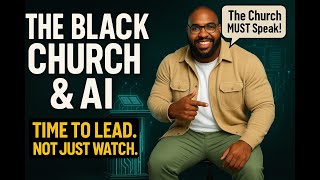
Justin R. Lester, a tech pastor, argues the Black church must train people in AI or risk biased systems that already misidentify Black women and shape loans, policing, and hiring. He outlines concrete steps: budget for digital innovation, teach coding, build church tech labs, and treat it as a spiritual calling rooted in Scripture.
Chapters
Justin Lester here. I call myself that tech pastor, infusing faith and technology in ways that we can make it applicable, make it intentional, and make it in ways that it applies to our communities. I'm a black pastor. I pastor some of God's favorite people. And one of the things I'm recognizing is trying to demystify and take away the sting of what artificial intelligence is and really actually give clarity to it, but also simultaneously prophetically engaging technology and artificial intelligence with black spaces. And so today I wanted to take some time and speak explicitly about the black church and artificial intelligence. If we don't train it, who will? Let's take some time to talk today. I'm that tech faster. Let's have some fun talking AI. Before we jump into our video today, I have a. I have wrote a book on artificial intelligence called the Church End of AI, where details ethics policy, laws, AI in the Bible, futurist thinking, reskill, cross, skill, upskill. All of that work detailing intentional how to use artificial intelligence inside of church spaces, ways that artificial intelligence applies to you, and way and intentional ways to apply to your church. So if you're on Amazon, you can search church of AI, you can go to my website, jrlesser.com AIbook and get a copy of your book today. So today I'm calling for the black church to step into a new kind of ministry. And I really want you to think about this today. If. If the black church doesn't train AI, then who will? Technology is neutral. And if we aren't a part of the conversation, what I'm realizing is that somebody else is setting the rules. Today I want to talk about the urgency of tech leadership, my personal journey with tech leadership, why it's important for us to invest in digital futures and then have a digital altar call, if you will, and really actually call us on the table to the carpet and give us practical ways as black leaders to engage artificial intelligence. Importantly, in our context, let's first talk about the urgency of tech leadership. If we get real for a second, AI is currently influencing everything from loan approvals to police surveillance. Studies have shown that facial recognition tools misidentify black women 35% of the time. And while they work fine for white men, it's not just a glitch. AI is a reflection of biases that are built right into the code. So what if I told you the next civil rights battle isn't happening on the street, but it's in code? We have. Black people have spent generations leading movements for justice. We taught America how To pray, how to protest, how to persevere. But when it comes to AI, too many of our churches are silent. And that silence, that's permission. It's complicity. Algorithms already designed. Who gets approved for a loan, who gets hired, even who gets watched by police. And too often the results are extremely biased because no one that looked like us is helping shape the system. And I think it has to change. It's time to move from consumers of technology to architects of justice, to bring the Brack prophetic tradition into tech spaces where our people's lives are being coded without consent, without care, but most of all without Christ. So I'm not telling you to go hire a software engineer next week for your church, but I am saying we can't afford to wait. I think we have to teach this and preach this and build towards it because if the black church does not show up in the AI space, the people who never valued us will continue to design systems that don't see us. And I promise you, they're not going to wait for us to catch up. So I'm asking, are we going to lead or are we going to be left out? We've always been on the front lines of justice, from hush harbors to our ancestors worship in secret to the airwaves of black radio pioneers to the black church has always been the heart to me of innovation and resistance. But today I think we face a different type of frontier where our voices are being coded into digital systems that shape our lives. So when I say if a black church doesn't train AI, who will? I mean it as a call to us on our. Call us on our carpet out of our prophetic truth in this technological age. So I'll give you my personal journey. So why does this matter to me and where do I fit in this? So those of you who've been following me for a while know that this is not the first time I've been talking about this. I've been talking about integrating technology in a minute industry since the early 2000s. And Facebook and Black Planet in MySpace. Right. I wasn't always the techie I am today, like deeply entrenched. But I always had a call for merging forms of communication, new age media with people. And one of the ways I did it was gamification. And as we saw the world move lightspeed with technology, most of our churches were stuck on the sideline. So my doctoral research, and when I tell people this, they get crazy. My doctoral research was on gamification and the black church. When people hear that they neither laugh or they lean in. Because gamification is not about making the church a joke. It's about making the church interactive. Gamification is what makes video games powerful. From feedback to creativity, to progression and to community. So when we think about it, didn't Jesus use that too? He gave people real time feedback. Your faith has made you well. He told stories that unlocked people truths, like he sent them on missions. Go and send no more. He formed teams, disciples, not solo acts. So I asked myself, what if the church stopped fighting for attention and started designing with intention? And that's what led me to technology, namely artificial intelligence. Because at the end of the day, the goal of our church spaces is not entertainment, it's engagement. Deep, intentional, spiritual, joyful engagement. That's some things I've applied in my own context. I think ways that we can engage further where people will lean in and participate because the church doesn't need more gimmicks, we need creativity. Gamification is just one way we reflect it and we are part of telling the story. So let's play church. Let's engage with how we can spark real engagement. And that's using real time sermon polls. That's interactive Bible challenges. That's even using your app not just as a place for the announcements, but to encourage discipleship. This is not a season of cool gadgets. It's about reclaiming technology for the kingdom and making sure our community isn't left behind. If artificial intelligence is just simply decentralized human intelligence, taking the human brain and placing it into something else. We need to make sure that brain is centered on Jesus. Because our tech experiments are not perfect. But every trial always teaches us something. And every step we take is a testament to our ability to innovate as God's people. So let's talk about our resources. How do we invest in a digital future? Right, because it's gonna now. Because we look at the church budget and if you're a pastor, you listen to me saying pastor Justin cool. But how much does this cost? Well, the same way that we're budget for building maintenance and choir robes and the same old ministries that don't work any longer, we're sending a message of what's important. Your money tells you what's important. Is digital innovation important to you? Is it mission critical? Because if we invest in all these other tools, I think we also need to invest in digital tools. Whether that's coding classes for youth, creating digital hush harbors for safe online worship, investing in tech workshops at your church. Are you Budgeting the future. You know, one of the things we've done in my own context is that we have a space where we're actually budgeting to innovation labs, where we have a lab. We're bringing in people from tech spaces to teach us coding, to teach us building, teach us Legos, teach us robotics. The result, More engagement, more creativity. Bringing the community in, where it's not just bringing them in to Sunday morning, it's bringing them in. Throughout the course of the week, we've also seen people light up when we end up talking about things. That's not just Sunday Morning. I've challenged my staff that innovation is not an option. Innovation is a requirement to build our own stuff, design our own stuff, to build our own ways and to also engage with their personal lives to then bring those to the church. That's Cross Skilling. So here's my altar call. Here's my digital altar call, if you will. I think we're at a crossroads. History shows us that when we innovate, we change the world. So this isn't about technology as much as it's about leading with technology. The black church has always been a beacon of hope and a force for change. Now we need to bring that same bold spirit to AI and digital innovation. In Acts, chapter 17, Paul walks through Athens and sees the idols. But he doesn't run from them. He studied them. He engages the culture. And then Paul said, let me tell you about the unknown God. Today. Our idols are not statues, they're algorithms. Artificial intelligence is shaping who gets hired, who gets healthcare, who gets seen and who gets ignored. And just like Athens, people are bowing to these systems without question. They say it's neutral, objective, just data. But let me tell you something. There's no such thing as neutral technology. Every algorithm has a value system baked into it. And if we're not at the table when it's built, we're the ones being left out, are worse. We're the ones being targeted. So here's a Paul like move, if you will. We walk into the tech space, we observe what's going on, and then we lift our voices and say, this is not the final way. God has always a better way. The black church is the voice in the digital Mars hill, calling out injustice, naming what's broken and casting a vision rooted in truth and liberation. So, preachers, it's time to talk about AI from your pulpit thinkers, it's time to engage tech like it's theology and builders, it's time to code with a conviction. Let's not Run from Athens. Let's preach in Athens. So I'm calling all of you to rise up. Don't wait for somebody else to do it. Don't wait for somebody else to code your future. Step forward and help shape it with truth and love and the wisdom that we have. And I'll leave you with this. If the black church doesn't train artificial intelligence, who will? So let's take our time and energy with our resources, our minds into a future that holds up all of our people. This is a digital alter call. Let's innovate together. Let's build together, and let's make sure our voices are heard in every line of code to the future. I'm that tech pastor like and subscribe for my journey. As we continue to build this out, I would love to hear your thoughts in the comments of where the black church fits, things your church has already done. I'm not critiquing every church. I'm just calling us where we are. This is us sitting here at a. At a precipice. Are we gonna be. Are we gonna be in a new form of slavery? Are we gonna be enslaved by the chains of algorithms we can't see? Or will we be the ones who create our own digital wakandas and do something amazing like and subscribe? I'm the tech pastor. I'll see you soon.
More from Justin





AI gives you hours back every week. Most people's first move is to fill those hours with more work.



Most people stall out on AI at the exact same step. They don't know where to start.

Thank you for the follow-ups, the messages, the emails, all of it since the New York Times piece. Gr

The New York Times spent a weekend with me. Digital twins, AI, the local church, all of it.
