What is Artificial Intelligence?
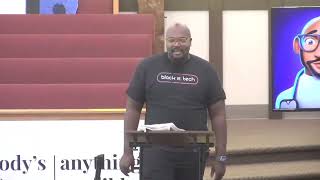
Justin R. Lester explains AI through a theological lens, arguing it reflects human creativity and won't eliminate jobs, but people using AI will outpace those who don't. He demonstrates practical tools like Bard, Night Cafe, and Durable.co, then shows church applications including a prayer chatbot and planned AR experiences.
Chapters
So let's play church for like, five minutes. Week one of let's playing church. So I want to talk about AI really quickly. Artificial intelligence is on the sheets that you have there. So here's one way you can play. It's a way of involving tasks like learning, problem solving, and decision making. It mimics human intelligence, but it's not human intelligence. What do I want you to know about AI in the church? Number one. Artificial intelligence, for me, reminds us of the human capacity to create and to innovate. AI is a product of human ingenuity and creativity. It's a testament to our ability to think. Remember, we wrote the code. So because we wrote the code, we can't give Satan all this credit for technology. Like, I'm so tired of, like, we demonize because here's this. That which we don't understand, we demonize. Let that sink in. So when we don't desire to understand something, we say, Satan did it. Why do we give Satan that much credit? I see everybody talking about Beyonce. Have you seen the concert for Beyonce? My wife went, and I'm sitting here like, oh, my God, the screens that are bigger than a whole thing. Why do we give Satan that much credit? Like, remember, God made the brother, he fell. And then God said, fine, I'm going to watch it make hell and put you in hell. Like, the very place Satan lives. God made in the first place. Like, Satan don't have that much authority. He's only. As a matter of fact, he can only do what God tells him. Job chapter one tells us, he goes to God in the morning and he goes to God at night. He can only do. And then God says, have you considered Satan's? Like, oh, I haven't, but thanks for giving me something to do. Because I can't do anything unless God tells me to do it. Satan is not as powerful as we think Satan is. And everybody you don't like is not a demon, okay? So it shows us the ability to create and innovate, and it's not satanic. And here's the principle I told you earlier. AI will not replace jobs. But people who use AI replace people who don't use AI. So here's the second thing. AI teaches us that God is the ultimate creator of intelligence. In Genesis chapter one, we learn that God created mankind in his own image, meaning we were all equipped with the ability to think, to reason, and create. We're also equipped with the ability to love, have compassion, and to do justice. AI is powerful, but it's not a replacement for human intelligence, you can get more done in a day and in a week so that you can spend more time with God. That's the way I look at AI. God is the ultimate creator, not this. The implications for AI like it raises the questions about understanding of humanity that are we simply machines? Program? No, we have something more. Yes. What AI cannot do is what humans do. That is have compassion, that is love. And to do justice in our community. I can't replicate that. So I wanted to show you really quickly, I gave you some recommendations inside of the sheet here. And I want to show you how they work. So you know I'm not making it up. So I gave you a couple of recommendations. I realized forgot how small this was. So you hear some things about ChatGPT. Let me just say this. ChatGPT very quickly is getting dumber. The reason it's getting dumber because everybody's using it. So I don't want you to use ChatGPT. The way it works is predict as piston typing. It's a predictive model. What it does is it weights certain types of words and it predicts what you're going to say, like if you send a text message. Like most of you within five minutes of waking up today, about 90% of you engage with artificial intelligence from the moment you woke up within five minutes, whether that was the lights in your house, the music that plays, the stuff on your phone, the recommendations, that's all artificial intelligence. All predict predictive models that predict what you want. Like when you mention certain things around people, you're like, oof, someone's listening to me because I saw an advertisement about something when I got in my car. It's predictive because what it's done is the things called cookies. We're gonna talk about cookies third week. So it's predictive where there's certain things on your computer based upon your activity, based upon what you like. That is predicting what you probably want based upon your location, based upon what you've liked, based upon what you followed. So no one's listening to you. They're just. You're not Martin King cheating on your wife, right? You are. It's suggestive models. I want to give some recommendations for how to use it and show you how to use it. So first of all, for writing, if you are using artificial intelligence, I say get off Chat GPT and try Bard. B A, R, D, A I. I like Bard because it gives you more information. Chat GPT was only updated. Doesn't that guy look nice? So this was made with artificial intelligence, actually. And I'll explain that in a second. So ChatGPT was only as recent as September 2021, whereas Bard is as recent as yesterday. What I like about Bard too, is Bard actually gets into your email if you let it. I let it in my email. And so whenever it responds to me, it responds to me like I wrote it. So I like Bard compared to that. But I give you some other options as well. There's pop, there's llama, there's chatgpt. But if you're going to get into artificial intelligence, if you have a Gmail account, go to Bard AI and check out Bard. Let me show you how it works. So this is me. I was talking to Michelle in the office and I said, michelle, give me a prompt for artificial intelligence. And so let's see, did it play? It's not playing. Oh, shoot, it's not playing. I have to do my computer next service. But all you do this is the interface. Oh, there it is. So I put down here a prompt. So Michelle said, oh, let's learn how to worship. And I said, great. So I said, give me at least 10 examples in Scripture of reflective and intentional worship. Give me 10 examples of scripture, reflective and intentional worship, and then you'll see here within 5 seconds how it builds. And so it'll. I was misspelling stuff, but as you did this, I press enter, and then let me show you how quickly it generates 10 examples of scripture. So if you want to grow in your walk in Christ, this is a great place to start. And it'll come right up on the screen in a second. So this is how long Bard usually takes. And there you go. There's 10 ways in scripture of reflective, intentional worship of the Lord Jesus. It's really cool. The next thing I did was like, date ideas for those of you who want to go on dates in Vallejo. And so what you want to do with your prompts is make it as intentional as possible. So I wrote here, give me at least 10 funny date ideas in Vallejo. And you'll see here too, how quickly this thing works. I like it because it's all down to your prompts, how quickly and how intentional you use the prompts, how particular your prompts are. And so in this case, trying to help all of you looking for a place to go date. It gives you 10 ideas for dating here in Vallejo and places like that. So I like this stuff. Number two for images. I like this app called Night Cafe. Night Cafe. You get 10 free credits per day. What I like about artificial intelligence. So this image right here was made on an app called Ideogram. Night Cafe is free online. A lot of those apps you download, like Remedy and all of that, that stuff you got to pay for, this is free. You get 10 credits a day. And so it's utilizing, I think, ChatGPT free as prompts models to make the images. But I'll show you. So when you make images online. So this one, for example, I said, give me a futuristic view of Vallejo, California, downtown waterfront in 2040. I hope it plays. There it is. So 2040. So what it does takes about 10 seconds and then it's going to give me this really futuristic view. So I was like, I didn't like that. So I said, give me a Vallejo, California, 2040. So I was like, I didn't like that future. So it gave me Vallejo in 2040 with the bridges and everything. It uses everything online to combine this picture. Then I told this to add in a church. And I'm gonna show you the imperfections of it. So instead of adding a church into the waterfront, it just literally put a massive church out there. And so it's not a perfect model, but if you're gonna make it, you can use it in your own work there. This last one I wanna show you is durable. Now this one is super cool because all of you entrepreneurs out there who need to make websites and don't know how to build websites, don't know how to code, I'm gonna build a website in 30 seconds and I'm gonna show you how cool this is. So I made up a website. I think it was a coffee shop. Like I made a coffee shop here. And so it's called Justin's Coffeeshop Durable Co Justin's Coffee Shop. I put in here the industry's coffee in Vallejo. And over the course of the next 30 seconds, and this is not sped up, this is not cut, this is live. And literally at the time, I think Michelle was at a meeting with me and I zoned out. Sorry, Michelle and I zoned out and built a website while she was talking. And here's the website. So it's going to create the banner, it's going to create reviews, going to create pictures, going to pull everything online. And this is completely free to you until you buy the domain name on Durable cl. So all of you who don't know how to build websites or want to start a business, this is a way that you can do it without having to build a whole thing. And as you can see, we just finished a website in 30 seconds and it's going to come up on the screen. There you go. Yeah, there's a website. And so your website's done has the bottom, the basic. So I code for fun. But this right here took away a lot of that. So you can go on and edit it. So I'm going to show you this when you get to the top of the screen, how you regenerate something so you can change pictures if you want. So I didn't like save with a perfect blend. So I just click regenerate in a second and it actually gives me another piece. I didn't like how that looked. I won't wait too long for it. But so I'll do at the next service, I'm going to do some live stuff and take suggestions from you and show you how this works. So here we click regenerate. So regenerate normally, whatever AI you're using is going to give you a chance to like just literally redo it. And I like to waken your senses. And I was like, come to Justin's Coffee Shop, where we awaken your senses in Vallejo. Come to Solano County's favorite coffee shop. Right. I mean, it's really cool tech. I love it. What it shows us in this playing church the first week and what I wanted to show everyone here is that it's a powerful tool that I want to challenge you to use. I give you prompts to use online. I really want to challenge you to try it out. There's an app on your phone you can download if you look up GENIE on your phone. G E N I E. It's absolutely free from OpenAI. Play around with it. If you want to study scripture, there's an app called Bible Chat. Bible Chat is an app and what Bible Chat does for you is you get a chance. Actually, it's AI built into scripture. So if you're reading a scripture, have a question about it, ask that scripture a question. It's not a perfect science, but it's a helpful thing and I think it'd be great. Use it to prepare, proofread your papers. And so I give you some information on artificial intelligence, how it works. I give you also I showed you my recommendations, but on the packet that I sent in the back, I give you five different websites for images and five different websites for language models, a large language model. The goal here, all of this type of stuff. The reason I wanted to talk about how to play church, why identity is so important. Is this does not replace God, but it can help us understand God. They can help us close the gap on it. And so, for example, for our church I'm currently building out, personally, I'm building it a chatbot, a prayer chatbot. So if you come to the church website, you can actually put in the chatbot. And what the chatbot I'm having do right now is go through all of my emails to get my language so that you can get me actually coming to you and responding to you and calling you through artificial intelligence and praying for you, no matter what time of day it is. We are building our augmented reality, which I'll teach about in the third week, where literally there'll be QR codes you see, like in the city. And if you take a picture of it, we're literally gonna pop up on your phone and talk to you and have live conversation with you. This stuff is so amazing. I think we could be used to build the church, but also build your personal life. So I challenge you this week. Try Bard out at work challenge you this week. If you're making images for a business or something, try out that cafe. And if you're building a website, literally, you ain't got to pay people thousands of dollars to do it for you. Go to Durable Co, buy the domain name and it will accelerate the work that you're doing. So that's the powerful parts of it. When we understand who I am, hear this, I am then not threatened by technology because I'm so firm in who I am. It's only going to make me better. It's not going to take anything away from me. I want to pray for you.
More from Justin





AI gives you hours back every week. Most people's first move is to fill those hours with more work.



Most people stall out on AI at the exact same step. They don't know where to start.

Thank you for the follow-ups, the messages, the emails, all of it since the New York Times piece. Gr

The New York Times spent a weekend with me. Digital twins, AI, the local church, all of it.
