EP8: Investing in Mobile Home Parks w/ Jill Jensen
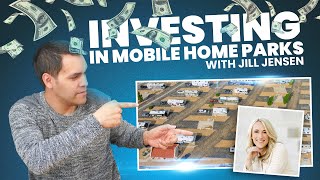
This is a YouTube video titled "EP8: Investing in Mobile Home Parks w/ Jill Jensen" containing an English conversational interview recorded in December 2024. The discussion features Pace Moreby interviewing Jill Jensen about her expertise and strategies in investing in mobile home parks, raising capital, fund structures, and her business growth plans. The conversation covers investment details, market insights, and personal journey in real estate investing.
Foreign. Welcome to the show. We have a special guest today, Jill Jensen. She's going to share what she's doing. And my understanding is you're the queen of mobile parks. And I'm really excited to hear about that. I actually learned some things from you before we even jumped on the call and it was looking at your calendar. I looked at even the invitation of the name. You know, let's talk about mobile parks. Right. And then you had the questions on your to book a call with you. And I was like, this is very strategic. And it's not just, hey, book a call with me. It's very pointed, like you can tell that you're on a path to something and you want to be directing the conversation and also I'm sure building your database of like, you know, leads and stuff like that. But it made me change some things in my calendar because mine was just very plain. Jane. And I was like, that is. That is good thinking. So thank you for that.
You're welcome.
Value. Even though I haven't even spoken with you much yet, but I'm only halfway there.
That's only half of it. So my. It is very strategic. When you got on, you know exactly what I do.
Yeah.
You're like, oh, this girl does mobile home parks. And now you know exactly the requirements of what I'm looking for. It says, how much do you have invest. Has drop downs. How soon are you ready to invest now? 1 to 3 months. 3 months plus. Are you accredited investor? So what area of real estate? How did you find me? So I'm more prepared. When we get on the call, we can skip past some of the questions I would have previously asked someone because of how they answered the question. So I know how to better approach. Okay, what is it that you're looking for? And I am going to take it another step further and you're going to actually go to a link and it's going to be a video of me telling you how to book a call and then some testimonials and then my calendar.
Okay, so you're gonna do the call. You're gonna do the call, the video before you get to the calendar link. Interesting.
So you're gonna go to a platform that's like Jill's landing page with like a 20 second intro of me and then a couple of my investors like testimonials and then book a call with me. If you like what you hear, book a call.
I like that. I really do like that. Because I know Pace recommended to film some intro videos and I'VE seen a lot of people do that, and unfortunately, I haven't. I really need to get on with it on that. But there's no way to force them to watch it. Right? I mean, it's hit or miss. You can ask them, hey, did you watch it? And then, you know, sometimes they do, sometimes they don't. I. I always watch it because they took the time to film that. So I want to be respectful of that. And plus, it helps me formulate questions before I even got in a call with them. So it's. For me, it's very valuable. But I know other people that are just blow right past it, and they'll just not watch the video. Right. So it's. That's. I like that. That's. I'm going to steal that, too.
You got to go to the video before you even get to the link.
Yeah. That's nice.
As we grow, because my main focus is raising capital for a fund for large mobile home parks.
Yeah.
And as my inbound leads are coming in, they're going to have to actually get on a call with someone else. Then they're going to book a call. My assistant will be booking a call on where to put the potential investor, or if they really do qualify, or if we put them in a funnel of where it's like, okay, how are we connecting you to Jill? And where do we fit you on her calendar? So systems. Yeah, systems.
I like it. No, that's awesome. I really like that. So, yeah, tell me why it's a good idea to invest in your fund and mobile home parks and what you're doing.
That's a great question. And it really comes down to someone's investment goals, because everybody can invest in different ways. And so if you have a large sum of money. You gave a great example before we started the podcast about, I don't want to be a landlord. And I was like, most people don't, and they don't realize that until they've become one. And then they're like, there's got to be a better way to make money than trying to get $500 off of cash flow. And then all of a sudden, the toilet breaks and you got to go fix it.
I. I had a toilet break in the Property. It was $420 this week. As the first thing in my head, I was like, well, there goes that cash flow for the month.
That's exactly. Can I just get a mic drop? Exactly what I'm talking about. So with mobile home parks, our strategy is we are very specific on what we're buying. And we have our niche. So our niche is mobile home parks, but then we have a niche inside of that, of our buy box, our location and the type of deals that we, we purchase. So this current one that I'm finishing raising capital for this week is 102 units. 60% of it's occupied and 40% of it is unoccupied. And I like to give the analogy of we're kind of like the fix and flippers. We come in, we update the amenities, we're going to bring in 40 homes and then we're going to sell all of the houses. All the tenants will own their own homes, they're going to fix their own toilets and they're going to pay for their own house. What we own is the land. And so every house is sitting on, we'll just call it a unit. There's 102 units. And so we just rent out the pad that that house is sitting on. They're basically leasing the parking stall and there's 102 of them. The rent, we got it off market seller finance at 6% interest rate on interest payments only for five years. So what that means for an investor is they bring in some money. And the money that I'm raising is going to be purchasing those 40 homes and updating the amenities. And after we do updating the amenities, what happens is it increases the land value and it makes it easier to raise rents. And when someone comes in to buy the park or buy a home, we want the park looking very presentable. So there's a lot of reasons why we really vamp up the amenities and make it look really nice. So what's the average rent, say it.
Again, what's the average rent there on the. For like the lot? Since they technically they're not paying a mortgage. Right. Because they own it, but they're paying rent for the land.
That's a great question. And currently in place, the 85 year old man is charging $390 and the market rate is 550.
Is that a month?
Yeah.
Wow. That's still expensive to. Even if they own like that whole, their mobile home, they're still paying that.
Well, if you want to go to a. Well, you could buy a house for $400,000.
Yeah.
Or you can buy a modular home for 40 grand. Or you could live in a two bedroom, one bathroom apartment for $2,200. Or you can pay $390 to have your house sitting here.
That's great money. I, I was that's kind of shocking to hear. I know nothing about this space, so I'm really interested to hear that. I, I didn't think there was that much money in it. That's awesome. Yeah.
So our investors, how they make money. There's a limited partner and a general partner. And the general partners were the ones doing the heavy lifting, finding the deals, bringing in the homes, updating the amenities. And a limited partner is someone who's just an investor, so they bring money to the table. Our minimum is $100,000 and you need to be an accredited investor. I'm going to break down the numbers of the deal that I'm closing on next week. If someone invests $100,000 over a, over a five year span, it's called a money multiplier. It's like, okay, how much money am I going to make? And what we calculated is 2.39, which means you will double the amount that you put into your investment. So $100,000, you'll make $239,000 more than double what you invest. This is over a five year span. And when we purchased the park for $2 million, it was off market and it's only 60% occupied and the rent rate's really low. So it's like, how can you sell that park for $7 million? And I'll explain some of the reasons why. Well, first, when we updated the amenities, that increases the amount of equity because it increases what's called the land value. We're bringing in 40 homes and we're going to sell all of those homes. So making some money off of selling the homes.
Yeah.
And number three, the rent is at $390. And I'm going to give a really good analogy. If you bought a house for $300,000 and the comps were $500,000, wouldn't you consider that a good deal?
Yeah.
You put it on the market, you can make $200,000. So we're going to look at mobile home parks, their rent. So their rent right now is $390 and the comps, the rent is $550. That's a really good gap. That means if I can raise the rents to market value, I can sell it for a higher price. Just like your house at $300,000. If you're able to sell it for $500,000, there's a large gap. So with single family homes, you're looking at the price of the house. And for a mobile home park, we're going to look at the gap in the rent. Because if you purchase the park and the rent is already at market value, you don't have a huge spread being able to sell it for more because an investor can't come in and raise rents.
Yeah.
And right now only 60% is even paying $390 because there's 40 vacant stalls.
Yeah.
So by us bringing in 40 homes, selling them all, raising the rent, that's 102 units. And we're charging $550 a month per unit. We're not toilets. We're not filling it with tenants. We're just making sure the grass is cut and the potholes are filled. And so it's currently cash flowing $182,000 a year after expenses. And by year five, if we have it occupied at 90% and the rent rate is at market value, it will cash flow $320,000 a year.
Wow, that's awesome. So maybe real quick, tell me a little bit about your journey. So, like it. I think it's easy for someone to look at someone like yourself and just be like, wow, like, she's really successful. Like, this is. She's here and I'm here. Like, that's just intimidating. Right. Tell me a little bit about when you were here and how you got to where you're at now.
Someone asked me, this being like, how are you progressing on getting these investors in these big real estate deals? And I was like, as soon as I stopped trying to impress people and just did what I needed to do and that was raise capital, I was progressing. So stop worrying about what other people think and just do what it is that you need to do. So it's like, okay, I really want to buy a property. Well, then you've got to call people. You got to call sellers all the time. Well, I'm kind of embarrassed or other people will judge me or I'm kind of scared. Like, as soon as you can push that out of the way and just put the reps in, it's a compound effect. And over time, you'll. You'll get better at it. And the trick, I tell people my favorite book is who, not how by Dan Sullivan. And it talks about. Have you read it?
No, I have not. It sounds like I need to.
Yes. Even if you just read the COVID you just have to figure out who's really good at it and not trying to figure out how to do everything. And so I had a problem. It was a good problem. I financially stable and I had some money and I was like, my money needs to Be making me money, but I don't know how. I know rich people are in real estate, so I'm going to go figure it out. So I started off having no background in real estate, but what I did was I'm going to find the best person that's lending their money and go partner with them. I don't want to learn from a poor person that needs my money. I'm going to go find someone that's already using their own money. They have a long proof of concept. They can give me all of their failures over the years. And so it's coming once you figure out what you want to do. I tell people, just go find the person that's very like the best at it and then be a go giver to them. Just try to hold onto their coattail. Be like, hey, I want to learn from you. And that is where I got started in feeling confident in lending. And then from there it was the same thing. Okay. If I'm going to invest with someone, I want them to have one niche. I feel more confident working with someone if the only thing they do is. Is self storage. Okay, I'll consider investing with you. You're not scatterbrained. You're looking at one thing interesting. The first mobile home parks I bought was with a gentleman in West Virginia. It's the only thing he does mobile home parks in West Virginia. Okay, awesome. The fund that I work with, the only thing they do is mobile home parks in certain areas. So finding it out what it is that you want to do and then just holding onto the coattail of the person that's already light years ahead of you.
So how long ago was this when you. When you first started that?
14 months.
14 months ago?
Yeah, not that long ago. I purchased my first mobile home park in June of 23, and then I took this position at Sonos Capital, their fund, at the beginning of this year. And so I've been with the fund. I started raising capital on this last deal a month ago, five weeks ago, and just finished raising capital this last week. And it was a 2 million raise for this last park.
So is that like, are you working for like a hedge fund or. Tell me, tell me about the background of that fund. How you got.
Yeah, it's a 506C and they just strictly do mobile home parks and they've already. They were already really established. And so because they were established, I felt more confident coming into there. I don't want to go figure it out once again. Yeah, so just go find the fund. That's. They already have all the systems in place. They have a track record, and they've all been in real estate for quite a while. And so it was just kind of one of those things that I got connected. I'm going to give a piece of advice, two questions. If people are watching and you only take away one thing, it's this. Every person you talk to, Pace Moreby taught me this. Ask what do you have to offer and what do you need in your business? And that's how I got to the position I'm at right now. Because every person, I'm like, well, if you have something that can help my business, let's see how we could collaborate or vice versa. If neither of us have anything that can help each other, because we're both connecting all of the time, I can usually connect you to someone that can help you in your business.
Absolutely. No, Yeah, I heard him say that. Well, I mean, shoot, he says that every 30 minutes. Right. He just beats that into your head, and it's so true. And when you start to think about things that way, it really changes your perspective on things. And, you know, to create value and give and not have any expectation of anything in return and, you know, the way our community works, it just, you know, it just works itself out that way.
Yeah, it's awesome.
No, that's. That's fantastic. So after this deal, are you. Are you. Is there a specific. What other regions, I guess, are you targeting in the country?
We are in the Midwest, red states. So the next deal, the last deal was in Arizona, and this next one is also in Arizona. This next one is a much larger deal. It's just under 500 units.
Oh, so you already have the next one, like, figured out or you're planning for it?
Yep, I have the next one that's. That's in the pipe. We always have something in the pipeline. So as soon as I'm done raising capital for this one, once again, I stay in my lane of just raising the capital. And I have other people that are finding the deals, underwriting them, negotiating them, and so that's how we can. I'd rather have a small slice of a big pie and have a big team of people all doing their job.
Yeah. If you take the other mindset where you have, you know, hey, I want to do this all by myself, and it's, you know, hey, you can have 100% of nothing, and, you know, you're going to be stuck in where you're at. Or you could partner with good people and really just catapult to the next level. And you know, like you, obviously in 14 months, that's impressive.
If you want to go fast, go alone. But if you want to go far, go with other people.
That's awesome. So 500. Yeah. I'm out of Indianapolis, Indiana, so I'm right there smack in the Midwest. Where are you out of?
I'm in Utah. Utah.
Okay. Nice.
Just real close to Arizona. So I go down there quite often.
Nice. And you're just in sub two. Are you in anything else?
Yep, I'm in sub two. That's my main focus.
Nice. Nice. Wow. Let me see. So what. I don't know if you have any questions for me or what can I. If we circle it back around right. What can I do for you?
I'm looking for capital, always looking for capital. And something I learned was every person's an investor, whether they have the money or they know someone that has money. So even though you might not have money at the moment, you're going to be connecting with 37 people this week. And by simply asking them, okay, what do you do and what do you need? And someone says, oh, I have money. Then I could say, hey, let's partner together and leverage this person's potential investment money. And so referring people that you talk to that have money might meet my criteria. That's always helpful.
So I assume you target like IRAs, people with IRAs, right? Investing with that?
Yep. Self directed IRA is huge. Do that all the time. There's so much money in people's retirement accounts that are not being leveraged. So retirement accounts, people have whole life policies, their cash value accounts, stocks, CDs, cash. There's a lot of different areas that people are just not using their money. So my main focus is educating people that were in a position like me, they have money and they just want their money making them money, but they don't know how or where. So I've taken the time to like figure it out for them. So now I just go communicate to them, being like, hey, here's your money, here's my deal and how. And then I show them how, how to move forward. And with this fund, yes, I'm really good at raising capital. That's awesome. To enable to grow my business though, I'm starting to grow outwards. So I'm also looking for other people that want to raise capital and I want to teach and train them. So I'm like, okay, how can I duplicate myself? I just need to teach and train other people to raise capital. And join, join the fund. And something I learned were there's invest, there's people that invest and there's people that don't invest. And the people that invest are usually from someone's niche or let's say like an avatar. And so I went to this convention and there was a dentist. He used to be a dentist, now he's a full time investor, but he only targets dentists. And that's like his avatar. There's another woman that I'm going to be working with and her main focus is self directed Ira. She has someone she works with. So all those clients, they already have or she knows that's her avatar, that's who she's going to market to to raise capital from. I personally, my previous business was I owned a pest control company. And so there's a lot of money in door to door sales. These guys go out and sell for a summer, they make a bunch of money. And now I can be like, hey look, your team could lend on this deal. And so what I'm doing is I'm just finding different avatars to go raise capital with me.
So it sounds like you're looking for people to join your team, right?
Yeah, I'm looking for other people to hire to raise capital on my team.
And is that, is that a full time venture? Is that for people that want to do stuff part time or what does that look like?
It's more of a full time thing. There is someone that I'm taking on part time, but it would be someone who wants to focus on it full time.
So how many other funds are there in the country that are doing the same thing?
That's a good question. It's changing all the time. I went to a convention this last week and they help people start funds or there's another avenue called a fund to fund where I have a fund. And let's just say you go raise a bunch of capital and then you're like, okay, where do I put all this money where you can just be a partner with us? But you just raised a bunch of capital from someone else. So you have a, you're just like, you don't have the deal, you just have the capital. And you created a partnership with some people, you raised the capital and you told these people, hey look, I'm gonna go find us a deal. And then you come to me and you and your fund to fund, lend into someone else's deal.
So how does that work? Like mechanically? I assume there's legal paperwork to create the fund or the Fund to fund. And then is there like some sort of custodial account that everyone, hey. Pulls their money together, then they take that money and invest it in whatever other fund?
Yep. It completely depends on how you structure it. And if you're a fund or a fund to fund. So a fund, we can go do a lot of different deals. And in a fund to fund, it's like you guys are together and you're all investing into that one certain deal at a time.
Gotcha, gotcha. So can you take, if you look at the fund to fund concept, can you take, you're saying, you know, if you raise 500k, it has to go to one deal. And if you wanted to do another fund to fund, it's gotta be like this whole separate secondary fund to fund. Right? There's only one fund at a time, essentially. Yeah, but that's the same thing as a normal fund, isn't it? I mean they're not just, they're. They're always creating different funds.
So my fund, you can invest into my fund and I'm always going to be having different deals. So like today I had someone invest and. But I'm done raising capital for this current deal. Well, tomorrow I'm going to start raising capital for my next deal and, and that money's going to go into the same fund.
Same fund. Okay.
Syndication is when you have one, you're raising money for one specific deal. So if it's like, oh, I have this mobile home park, I got to go raise capital. But they don't have a fund, they're just raising capital for that one deal. That's what we call a syndication.
Gotcha. Very cool. So what would you say makes your fund stand out from other funds that are doing the same exact thing? Right. How are you guys separating yourself from that?
How we're separating ourself is just the type of niche that we're narrowing ourselves into. A lot of these funds are very successful. Having a fund costs a lot of money. So you have to have your head on straight. Is that like you really have a fund? So structure.
What are some of the cost. Is that more legal or.
Yes.
Okay.
Having a lot of legal documents worked up, so you're paying a lot of attorney fees and, and so when you have a situation like that, you're dealing with high caliber people being like, okay, I have to learn how to structure this. I'm putting a lot of money in, into this deal just to start the fund in and of itself. And so you can be a part of a fund Like Pace, I have money in his fund and his is for apartment complexes. So it's not necessarily one is better than another. It's what type of portfolio, what else do you want in your portfolio or what do you like to invest on? And ours is people don't want to have to do any type of overhead labor, they don't want to be a landlord. They just want their money making them money. And there's insanely high tax advantages for investors, not just the people acquiring the park. So everyone gets tax write offs, everyone's getting 50% cash flow, 50% when we sell it. And there's low maintenance, low turnover, high demand for affordable housing. So it's a very secure investment, so to speak.
So how does that work on the depreciation side for what you guys are doing? Because you can't depreciate land and you're selling the home, so technically you don't own the homes. So where the depreciation tax, you can.
Still depreciate on the entire park, like the property itself. And a mobile or a single family home depreciates over 27 years. And a mobile home park is 15. So the depreciation is a lot sooner, more upfront. We're also purchasing 40 homes in the first year. And so because you're buying so much real estate, you can write off a bunch of that real estate in that first year.
Is there like depreciation recapture when you're selling those homes? Like you can't just claim all that depreciation, sell it and then you know it's gone. Right. How does that.
We only hold the park for five years.
Okay.
And so like our process is we're going to acquire the park, we get large tax advantages the first year, and then it's of course a smaller amount from year two to year five. At year three, we refinance and then we keep raising rents for two years and then we sell the park at year five. So it just, it changes over time. A larger amount in the beginning and then evens out and then, yeah, we just get what we can over that five year span.
Gotcha. Do you guys do anything like non pro rata depreciation? Like let's say for example, your fund takes 30% of the deal. Do you incentivize investors by saying, hey, our 30% depreciation wise goes back to you or how does that work?
It depends on how much someone's putting in, how much they're investing. And, and we split it, we just split it between our investors evenly, depending up how much they're investing. The more you invest, the more depreciation value you're going to get. So like the one park I have in, I have two of them in West Virginia and I'm a 10 equity partner, so only I'm only going to get 10% of it compared to some of the other investors.
Interesting. Yeah, I just, I didn't know you could depreciate mobile home parks when you're selling it to other people. So I've never, never heard of that. It's very interesting.
Cool. Yeah, that's what I do.
That's awesome. And so as you look forward to the next two years, where do you want to be maybe at the end of this year and the year after.
That by the end of next year? Within one year, I want to have 1600 units by January. And so like this next park is going to be 500 units just in one park. So even if I only acquire four parks, that's great. 1600 units. And I also want to have a team of people that are raising capital over this next year. So if I could have, if I could have, if I can raise. If you want really want me to get into numbers, if you really want me to tell you my goals, I want to personally be raising $2 million a month and I want to have two other people and they're each raising a million dollars a month. Well, there would be four of them. I want to duplicate myself twice. I just want to raise $6 million a month. I know it's a big number, but I'm like, how do I figure that out? I figure out how many people I need and how much they need to be raising every month. And I just, I just work backwards. I'm like, okay, here's my number. Now just work backwards. And as long as you're working on the next step, you'll get to your goal. And so if I can break it down, if I'm like, okay, if I have a, if I bring on an investor and they raise a million dollars, okay, and how many investors do they need? Okay, they could get 2 investors at 500k. Maybe they only need 4 investors at 250k. Like, depends on how you break it down. Okay, now how do we find those types of investors that have that kind of money? Okay, what is your niche? You're going to be in self directed, Ira. Okay, perfect. How do we find those people? Okay, we're going to navigate your LinkedIn account to match those types. That type of audience. We're going to have someone else help run it. Okay, now we're going to schedule you for podcasts for accredited investors, and they have to have over 2,000 listeners, and maybe it's people that have these retirement or investment podcasts. So it's literally just about how you. What your goal is and breaking it down to the numbers and then how you find the people that have that amount of money. So 1600 units and building a team.
I love it. Love it. Yeah, it's. It's. Yeah. I'm sure, you know, you probably have some really wealthy clients that are, you know, repeat investors. Right. But I'm sure you have plenty that are like, hey, I got a hundred thousand dollars to invest. And, you know, you invest in your fund and then their. A hundred thousand dollars is gone. Right. So now you have to go find new capital and new investors, and then eventually they'll get it back, you know, in five years, and then hopefully they become a repeat client for you. But that's. I mean, it's constant. You know, you have to be constantly.
It's every day. Being consistent is really what it is. And showing up every day. I talk to new investors. It's Saturday. I still have four phone calls today. Still talking to new investors. I'm like, you know, people are off of work. Why not Saturday? Sure.
Yeah.
You booked a call on my. On my calendar for Saturday, so. Have to be willing to do things other people aren't willing to do.
Yeah. Well, if I run into any. Any investors that want to park some money in mobile home parks, I obviously, I know who to call now.
Yep. Or they just want their money making them money. People don't realize that. How lucrative mobile home parks are, so.
Oh, my cat, he just only jumps on the table every time I'm on a call. It's like he just knows.
What's his name?
His name's Simba. He's. He's got to be the star of the show every time. And he'll just plop right there. He does it every time.
That's hilarious.
He'll do it for hours, too. I've had some, like, really long phone calls. Most of my phone calls, I promise my camera doesn't shut off every five minutes, but. But he'll just sit there for hours. It's. It's crazy. But no, I really appreciate the time today. Learned a lot from you and definitely give myself and other people something to aspire to and admire your vision. I really like how you really have a very clear roadmap, and I think that's really critical to success. And reverse engineering. What does that look like? You know, talking about, like, the perfect day. What does your perfect day look like? Right. What is your perfect client look like? And how do you reverse engineer your way into finding that client, like you said, and, you know, for other people? How do you build the path to whatever your end goal is, what's going to make you happy? Right. And kind of work your way through that process? Here's the step you need to take to get there. And you've already done that, and you're on your path to doing it. And I have no doubts you'll be getting 6 million in capital pretty quickly.
Yep. Me too. So confidence is key, right?
Yeah.
As long as I get help and referrals from you, too, you know?
Yep.
Money alone.
Yeah, exactly. But no, I appreciate the time. I don't know how, because I know it looked like the. At least on my end. The video feed is a little laggy, so hopefully it doesn't look too bad whenever it gets posted again. I've never used this before, but I know Pace uses it because he invited me to talk one time and he used it and I was like, well, if it's good enough for Pace, it must be good enough for me. Right? Right. So we'll have to see what the end product looks like, but we'll clean it up and, you know, cut out some stuff. Cut out the 17 times that I left and picked my camera.
You can just throw me a few clips. It's great.
Yeah. But no, it was. It was great. Great meeting you. Glad we had a chance to connect.
Great. Thank you.
Awesome. Have a good rest of your day. Enjoy the rest of your calls.
See ya.
All right, take care. Bye.










