Choosing to be Seen with Danette Kubanda EYV87
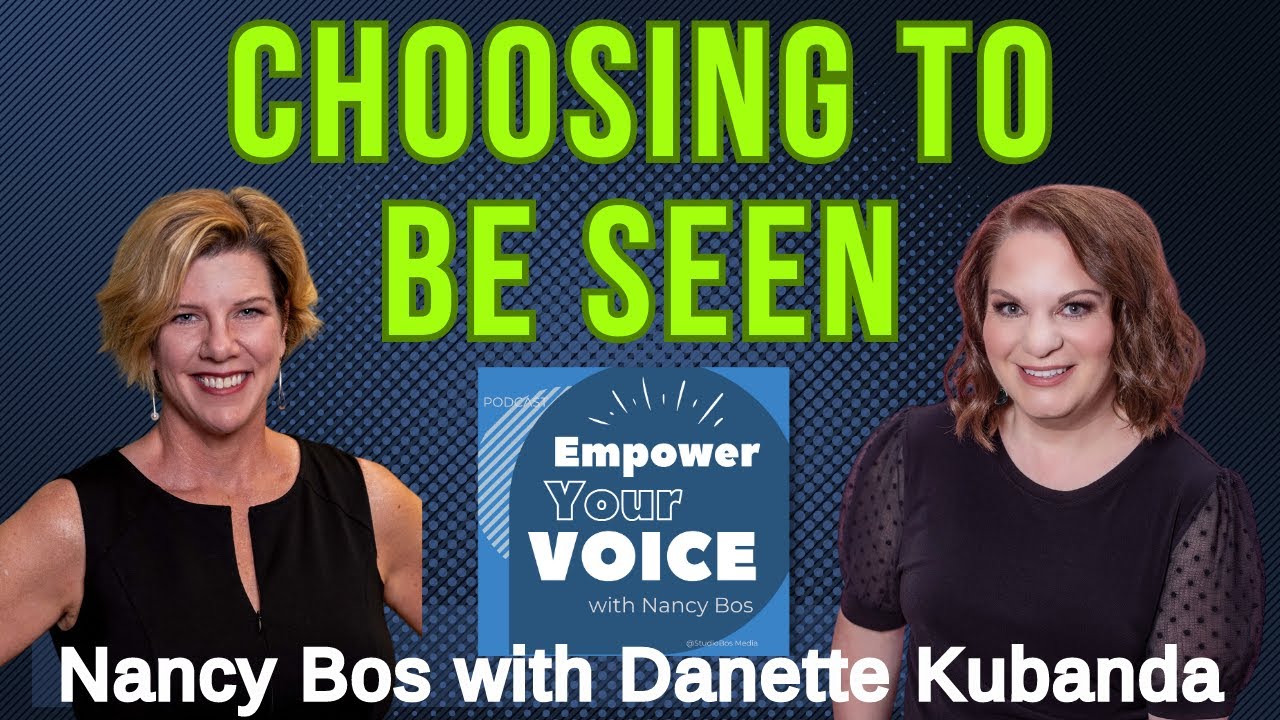
Emmy-winning media coach Danette Kubanda teaches people how to pitch themselves and speak on camera. She works with clients on soundbites, mock interviews, and movement, and describes the throat as the gatekeeper between head and heart. One client, a dancer and empowerment coach, integrated dance into her media presence to move past overthinking.
Chapters
Hello, I'm Nancy Bos, and this is Empower Your Voice. Thank you for being here today. This is a very special episode. I actually extended the season in order to include this awesome interview with an amazing woman. Her name is Danette Kubanda. Danette is an Emmy Award-winning television producer writer, speaker. And the reason why we're having her here today is because she's also an amazing media coach and publicity consultant. So let me give you a little bit about her background. Her career spans over 20 years working for some of the most recognized and respected names in the industry, like CNN, The Oprah Winfrey Show, HGTV, Fine Living Network, and then Christina's Court, which earned her the highest distinction of her television career. And she has won 2 Daytime Emmy Awards. But after years of shifting through pitches from public relations representatives, authors, and experts who are all looking to get a segment on one of her shows, she now offers her hard-won expertise to clients of her own. So Danette knows what producers are looking for in a guest, and she helps regular people with a passion and an expertise to become the media darlings that they're searching for. So you can imagine she is constantly running up against people not believing in themselves or doing something that holds back their voice so they're not sharing it with the world because Really, she can be a courage coach. Absolutely. And this really cool little interview is an opportunity for you to find the courage to move forward with what you're passionate about, sharing your expertise with the world. I hope you enjoy it. And at the end of the interview, I'm gonna tell you a little bit more about the Empowered Voices Tour and what's coming up for this movement. This movement. For now, here is Danette Kubanda. Hello, Danette! It is so good to have you on Empower Your Voice. Thank you for joining us.
I'm so happy to be here, Nancy. Thanks for inviting me.
Yeah, absolutely. You and I have a special relationship in that for the last year you've been helping empower my voice. You know, it's one thing for me to stand on a stage and talk to audiences— love doing it— completely a different thing to think that I need to tell the world that through media that they need to listen to my messages. And, and, and so thank you for that. It's been awesome.
We need you out there, Nancy.
You have no idea how much that means when you say that. That is so awesome. Um, just 2 weeks ago we had a guest on the show, um, Paul Fortune, who is a hype man. He, he coaches athletes and he coaches individuals in business, but his primary job is to let them know how awesome they are. And I think there is a real role for that. So thank you for making me feel awesome.
You are awesome. I'm just reminding you.
Awesome. Okay, that word's tired now. I'll stop using that. So, but Danette, I've never really talked to you about your journey, if you have struggled with having an unempowered voice or nervousness or fear about being in front of the camera or stage or speaking up. So I'd love to hear about that first before we get into what you experience with your clients.
Sure. I kind of always knew from a young age I wanted to work in TV. So I went after every opportunity I could. And when I got to college, I chose my college based on them being a top 10 journalism school and they had their own student-run television station. But actually getting in front of that camera, I will admit I giggled through all of my newscasts because I just felt weird being there. I didn't, you know, and that's where you need that training and that expertise. But I think the thing that stood out to me most was even despite those early giggling fits, I kind of rose up through the ranks. TV2 was the name of our station and I was news director my senior year. And our advisor asked me to speak to some, honestly, I don't even remember who I was speaking to, but it was in front of a big auditorium and I got so nervous. I knew what I wanted to say. I knew that what I was saying mattered, But when I got in front of that crowd, I kind of froze up. And I remember looking over at my advisor who I respected like crazy, and he didn't want to make eye contact with me. And I thought, I'm embarrassing Dr. O. You know, it wasn't that I'm embarrassing myself, but when I felt it, I was embarrassing him. And that was when I knew I needed to get better, especially if this is what I wanted to do. And it's interesting because I felt I needed to get better for him. I needed to get better for me.
Yeah.
So I really kind of worked through that. And I think that's something that I want to help other people through is, yes, you want to be better for the people that you're working for, for the people that you serve, but ultimately the most important person you're serving is yourself and you need to get better for you.
Yeah, that is next level. I can say for myself, when I was, um, 35 and I was working really hard on getting over my performance anxiety as a professional singer, I created, um, 3 recitals for a foundation for a rare illness. And so I created those recitals for that foundation so that I could do it for them, right? And that would give me the extra power. I wasn't doing it for me, I was doing it for them. And then this book over my shoulder, Singing Through Change, what compelled me to start working with you and with other people was that this book This book needs to be heard about. This information needs to be out there. Again, it's not about me, it's about this book. Um, and I, I still, you know, I'm going to push back on you a little bit because now, even though the message is not about the book anymore— that, well, it is still, I'm still doing a lot of cool Singing Through Change stuff— but the, the Empowered Voices message is coming through me. It's a bunch of gifts that I've been given and rare knowledge that really inspires me to get over myself and get out of the way so this message can come through me. So how do you feel about that? Does that sound right?
Or— I see, I see. If that makes sense for you to get out there. But from my perspective, it's still about you getting out there because this message could be so powerful, but it's so powerful because you're the person to get it there. You know, other people can have this information, but it's not going to come across the way it comes through when you share that message because you're so relatable and you want to empower women. And it's the why behind what you do. I know that you wanna do this because you can help other women live their lives no matter what age they are and share the messages they wanna share no matter what age they are and sing out loud and proud no matter what age they are. So again, even if the message is what's empowering you, if that's what you need to do to get out there and share it, that's great. But also hold on to the fact that you are the person to do it. No one else can do it the way you do it. And that's what makes you and your message so special.
Wow. Okay. I knew that you were going to crack open a golden egg and golden light would come firing out. I just had no idea what it was going to be. So that's a message that I want everyone to hear, that they are unique, uniquely suited, and passion, right? We all know that we hear the passionate message much better than the one that's unimpassioned, right? So if there's something that you're crazy about, that you're passionate about, that's your direction, right?
Absolutely. And it's that little— it's kind of like an itch. Like, I need to share this. I don't know why, or I don't know why I was chosen to share this, but I need to be the one out there. And sometimes you just kind of have to work through the uncomfortableness of being the person who's out there and get in front of people so that you can help more people.
Awesome. So I know you run into this every day with your clients. Can you give me some stories from other people who've overcome their, their block around sharing themselves and being visible and being seen and heard?
Yeah, absolutely. And I think, I think it's something that a lot of us experience, especially as women. We are so conditioned to put other people ahead of ourselves, to not be the focus of attention, to kind of be in the background. I know I felt that in my life. I'm sure so many other people have. But when you have a message like this to share, when you know that your expertise can help somebody live a better life in some way, then it is— I'll quote our friend Jen with, it's your responsibility to get that message out there. So it feels uncomfortable, and a lot of people kind of struggle with, well, I don't want to be braggy. I don't wanna be boastful. I don't wanna just talk about the things I've done. But it really does kind of just take a, a mind shift away from— it's not about being bragful or boastful or talking about yourself or showing off. It's more about letting people know you're qualified. It's just telling us that you've built up the experience, you've built up the expertise, and you know how to help us solve whatever problem your audience is facing at that moment. And really just that little tweak in the way you think about it can make such a big difference because now you're not talking about, I'm so great. You're talking about, I've got the expertise to help you become great. So it's just a matter of thinking about it a little bit differently.
Wow, that's fantastic. Do you have any stories of specific client experiences with this?
I've got so many people. I feel like— I do feel like a broken record sometimes because I kind of feel like I make that same little spiel quite often. But I had one specific client. She was excellent. She had so much knowledge. She's an empowerment coach, more so about, like, in the health and wellness sphere. But again, she wanted to talk about all these other things rather than herself and her expertise. But she was also a dancer.
Okay.
And we, we kind of worked through how to share her message through movement, and that got her out of her head and into her body. And then, and now I feel like I see her all over the place because she is just willing to share herself now because it's not, it's making her more comfortable that it's all of her. And she's not thinking just about in her head, but about how dance can make you healthy and how you know, eating right can make you healthy. And then she was able to put it all together and feel more comfortable in her body.
Wow. Okay, I love that you just said that because that, that perfectly fits into the podcast episode that I put out last week. And, and that is that, that, um, the throat sits in between the head and the body. The throat, where we're blocked, which is not just about the voice, it's also about confidence, self-expression. It involves the hands because we talk with our hands. It involves the feet because a lot of people move around when they talk. But at any rate, that, that idea that the throat is the, the brakes or the gate keeper on what happens between our head and our heart. And you just said that she was so much in her head and she had to get into her body and integrate all of that.
Wow, that's so powerful. And I love the gatekeeper idea too, because it's so true. That's, that's amazing.
That's a great example. So, so what would you say that you see the most that you wish your clients would just figure out? What, what would you like them to know?
I wish they could see what I see, you know. I wish they could see what the audience sees, because we focus so much on this one little thing that's holding us back that it's hard for us to see the big picture and see all we have to offer. Um, and, and a lot of times that's what it is. It's just one tiny little thing that just keeps them from putting themselves out there. When they do do an interview or a TV interview, they're focusing on this one. My hair was out of place.
I was going to say, like, my background doesn't look good.
Yeah. Or they said, um, too much, or they had a weird— they moved their hand funny. The things that no one else is going to notice. Everybody says, um, granted, we don't want you to say it in between every single word, but a normal amount of ums is normal. That's just how we speak. No one's going to notice that. And yes, if your hair's got a big thing in it, maybe somebody might notice that. But generally, as long as it's, you know, combed before you go on, no one's going to be looking to see if you have a hair out of place. No one's going to be looking, you know, watching that, you know, that particular hand movement. Chances are your hand movement's not even like— it's not even in the screen here, you know? Yeah. Even though you're concentrating on that, the audience at home may not see it. So, yes, we want to pay attention to things that could be distracting so we can improve them, but don't focus on them to a point where you're paralyzed and don't move forward. If you feel like it's holding you back, maybe get some coaching from somebody that you trust to work through that particular thing, but don't let it hold you back from sharing your message with the world. There are so many people out there who need your help, who are looking for your expertise, and they won't get that help if they don't know you exist. So, you know, it really is so important to get your message out.
Awesome. How about, um, fear of the unknown? You know, I don't— I've never done this before, that, that kind of fear. How do you help people through that? Like, I, I literally pitched Gayle King and Oprah Winfrey last week, and a year ago that would have been like, I have no idea how to do that. So that fear of the unknown probably slowed me down.
And, and that's, again, totally normal, totally expected. Um, I always say try and start out a little bit smaller, you know. If Oprah is your ultimate goal, I know what that's like. I wanted to work for Oprah, so I get that feeling. But if that feels too big to you, take a smaller step. Maybe pitch a local TV station and get yourself out there. Pitch yourself to podcasts because again, maybe you're not in studio on camera, but you're still on camera. You're still sharing your message and just kind of build your way out. The more you do it, the more comfortable you'll be with it. So when the time comes to pitch those big names like you just did, you'll be ready because you know that your message is ready and you know that you've got all the background steps laid out and you're ready to go.
Yeah, that's actually what I did was I pitched the local public radio station and got interviewed on, on KUNM Women Voices. And, and I thought, you know what, this was a good interview, and if they care, then this is going to matter everywhere. And so that really empowered me to to step it up and try to go national instead.
Yeah, and you're ready for it. You are absolutely ready for it. I can't wait to hear what comes of it.
Thank you, thank you.
So what—
tell, tell us a little bit about your job. If, if there's, if there's public speakers or people that they're, they're passionate about, you know, message that they have to deliver, which I hope everybody in the audience is on that path Is it a thing to work with someone like you? How does that work? What do they look for to find a consultant like you?
Yeah, absolutely. I'm a big fan of finding people who know how to do what you want to do and learning from them. So, you know, there, there are lots of different coaches that are out there. What I do is I take everything I learned as a television producer and what I was looking for in my guests that I was booking. And help those people who want to be those guests write the right pitches, how to be a great guest on television, how to speak in soundbites, how to come up with your key messages and your talking points so that you're ready and comfortable in front of the camera. And there are other consultants out there, and I work as part of a couple of different mastermind groups that you get some business coaching and you get some PR coaching as well. So there's a couple of different ways to go about it. And then I also do a TV course where I, you know, I take you through how to create your key messages and talking points and your soundbites, how to pitch, how to come up with visual ideas for television because, you know, you want to go beyond just being a talking head. What kind of demonstrations can you do on air? And then doing some mock interviews so that you feel comfortable and you have those video examples that you can share with producers so that they can envision you on their shows as well. So it's really fun.
Oh, I love that. I love that because you don't want your first time doing the material to be on Good Morning America. You want to have a little bit in your background and underneath you first. And that goes for everybody at any stage. If you're trying to squirrel up the courage to speak at your local library, you don't want that to be your first speech. You want to do some practice rounds. I know the first time that I gave a big talk in front of a big audience, I held 3 practice rounds at my house and, you know, about 5, 6 people at each one. And each one I got a little smoother so that by the time I hit the stage, I'm like, I got this.
That's awesome. That's a great piece of advice.
Well, that's what you're doing too, is, is you're providing these practice real-life scenarios that take the risk away when the person really gets in the moment. So I love that.
Yeah. And it's, it's a really good tool too to promote yourself when you're pitching. You know, I always, you know, when you send out a pitch, here's a link to a recent interview I did. I don't care if it's a podcast interview or radio interview or, uh, an actual television interview. I just want to know as a producer that you can think on your feet and answer a question, that you're not going to give me one-word answers. So having that little snippet of an interview to share is really valuable.
Okay, cool. Plus that, that little snippet of an interview that you can share and the fact that you're going to be calmer in the actual event so that you're more likely to make smart responses instead of, ah, what did I say?
We all have those moments.
Yeah. Cool. Well, is there any other advice that you'd like to give people who are trying to figure out how to share their message and find the courage, squirrel up the courage, like I said earlier? Yeah. What do you got for us?
I would say, you know, really think about the people you're helping. Think about your target audience and what they're going through and how much longer their suffering may go on if they don't hear from you. You know, what can you do to jump in and help them a little bit sooner than it would take them to figure it out on their own? And that's something that helps me is just thinking about, okay, well, if I get out on this podcast, if I get out there in front of people on social media, maybe somebody will hear that and know that they can reach out to their local radio station or they can reach out to their local TV station and do an interview. So whatever you can do to help someone, that usually pushes you a little bit forward.
Okay. And so I thought I was going to wrap it up, but now I want to bounce back and, and go back to that, that conditioning that we've gotten from our culture or from our families that tell us to sit down and shut up, or be a good girl or a boy, and don't think you're so special. There are so many different phrases that are meant to keep us from as children. Yeah, from stepping out and, and being loud and obnoxious and trying to take over a room. So part of this is reconditioning ourselves maybe to respect ourselves as adults who have something to say, reframing that idea. What are you thinking?
Yeah, I, I like the way you said that, reconditioning ourselves, you know, because it's true. And, and I don't And I'll be honest, I have a little boy who's like that. Like, he wants to be the center of attention, and I'm just like, let somebody else talk. Yeah, but I try to be conscious of it because I don't want to break his spirit. I love that he's not afraid to share what's on his mind or share his opinion or come up with an idea, and I want to encourage that. I also want him to let other people share. So it's, you know, it's a tricky line, but that's kind of what we need to do to ourselves too, is recognize that those messages that we really took to heart when we were children Maybe they weren't so much that we don't ever want to hear from you. Maybe we just don't want you to share it right in the middle of class. Maybe we want you to share it, just not when somebody else is talking. So maybe when you hear those familiar phrases pop up from your inner critic in the back of your mind, just stop them and say, wait, is this what you really mean? Or did you maybe mean I could speak in this situation. I like the idea of reconditioning. That's, that's a really good one.
Or another reconditioning thought might be, um, that, that may have been appropriate for who I was then, but it's not appropriate for who I am now.
That's powerful.
Early in my career, I, I definitely, um, had been tagged with know-it-all. And early in my career, I was a know-it-all who didn't know it all, right? And I've become much more modest. I no longer think I'm a know-it-all, but Now I know a lot more. And so if, if I'm, if I'm afraid to speak up because I don't want to be a know-it-all because I was called that when I was, you know, 16 or whatever, um, then, uh, I need to reframe that. And like you said, um, now I have stuff, and everyone, you have stuff now that you can share that maybe wasn't appropriate to share before.
Maybe now you're the, you're the, the know-it-all for this for this specific, for this, this situation. So maybe it's not that know-it-all is a bad thing. Yeah, it's because it's excellent that you are, you know so much about your topic, you know, no matter what your area of expertise is, you've earned that expertise, you've earned that experience, you worked hard for it. So it's, it's a compliment that you know it all now. Yeah, so maybe it's like, well, you know, I am a know-it-all No, for, for this particular situation, I am a know-it-all and I'm gonna share it.
Yeah, because I was given those gifts and now it's time to move forward. And bouncing back to the kids, I was so impressed. My 24-year-old daughter, a couple of weeks ago, I— an older man, 60-year-old man, confronted her with— not confronted, but offered her some fatherly advice that she neither wanted nor agreed with. And so she didn't just go, oh yeah, uh-huh, you know, which is probably what I would have done. She said, no, actually, that's not the way that I look at it. Here's how I see it. I'm like, 24-year-old girl, 60-year-old man, I'm so proud of you right now.
Yes, go! Oh my goodness, that says so much. It says so much about her, but it shows so much about how you empowered her and gave her the confidence in herself and her own opinions.
Yeah, she tells me that sometimes when some stuff like that's come up, she'd say, well, I just think, what would Mom do? And I'm like, well, you got it wrong because I probably wouldn't have, but thank you. Cool.
Oh, and I'm gonna think that too. What would Nancy do?
Oh, but I'm like Wonder Woman pose. What would Nancy do? Cool. Well, thank you so much, Danette. This has been an awesome conversation. I can't wait for my audience to hear it.
It.
Yay!
Oh, I've loved it so much, and I can't wait till we talk again. Thank you, Nancy.
That packed a whole lot in there. This might be one to go back and listen to more than once because so much information, good advice, and wisdom in that short conversation. I'm excited now to share with you how to find Dannette. She's at Dannette kubanda.net. You can take a course, you can hire her as your PR and media advisor, and you can see what an encouraging and amazing person she is for that job. Perfectly perfect for helping you get your message out there. So now I'm giving you my little secret: you too can hire Danette. And it's worth it. It's totally worth it. Part of my journey is the exciting upcoming Empowered Voices Tour. Now, I know podcasts are evergreen, so you might be watching this after August of 2023, but if you are indeed tuning in before June, July, and August of 2023, then I want to let you know what I'm up to. After that, I don't know what's going to happen. I'm really excited for the next 3 months. I'm going to be going on a tour that includes Salt Lake City, Seattle, Vancouver, San Diego, Las Vegas, South Africa, and other unknown destinations because I'm still booking it at the time of this recording. I'm going to be speaking at seminars, workshops, meetup groups, but mostly What I'm excited about with the Empowered Voices Tour is to hear the stories from the people who have empowered voices. What is it that caused them to move forward with their passion? What is it that helped them unblock whatever was stopping them from using their voice to express what it is that they were put here to do? I cannot wait to learn more about this and also learning from more experts along the road about how they help people empower their lives and empower their voices. So to that end, I have got a new website. It's called empowered-voices.com, empowered-voices.com. And that's where I'm going to be posting everything about the tour. You'll find on YouTube and Instagram and probably Facebook as well, the Nancy Bos, that I will be putting up lives, conversations, a lot more activity starting mid-June, definitely through the beginning of August, and then we'll see what takes off after that. But I can promise that it will be at least a 2-month tour of empowered voices. If you have a message that you would like to share with me, please email me at info@studio boss.com. Studio Boss is my publishing company. That's the email address will go to me, info@studio boss.com. One more episode of Empower Your Voice left in the season. It'll be a solo episode from me next week, and then I'll be taking a break from Empower Your Voice in order to really focus on the tour and getting everything geared up and ready to go for that. Thank you for being here for this season of the podcast. I hope you've gotten a lot out of it. I certainly appreciate you as part of the Empowered Voices community. Thank you. Bye for now.










