The Power of Encouragement and Accountability with Paul Forchione EYV85
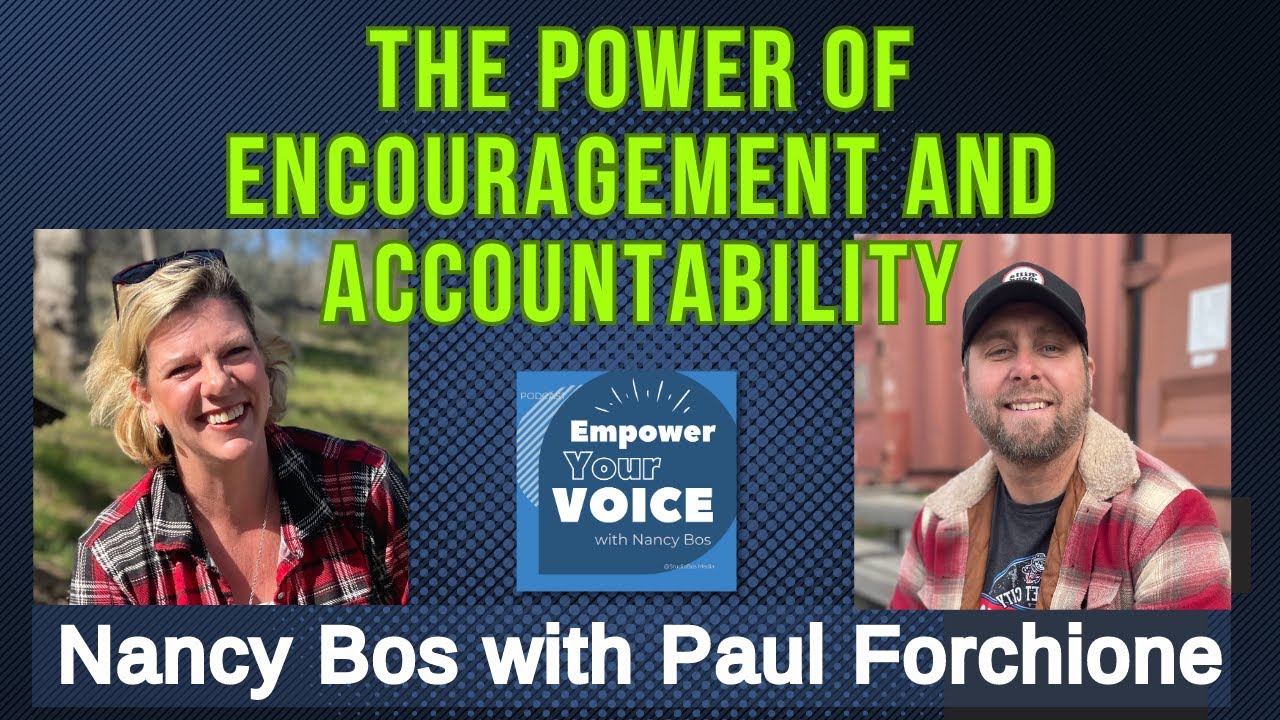
In this Empower Your Voice episode, host Nancy Bos interviews mindset and voice coach Paul Fortune, who was born with severe cerebral palsy. Paul recounts his early life, describing how his mother’s relentless advocacy and intensive physical therapy enabled him to walk by age two, and how early experiences of commitment (finishing a soccer season despite pain) taught him the value of honoring obligations. He shares his underdog journey through high school sports, a pivotal surgery, and overcoming bullying to make his varsity baseball team, then proving a doubting principal wrong by earning a college degree and becoming a top mortgage loan officer. After the 2008 financial crash and multiple job losses, Paul discovered life coaching through a motivational speaker, earned a certification, and transitioned to full‑time coaching. He explains his coaching philosophy: the importance of a “hype‑person,” accountability, empathy, and active listening to help clients uncover their own answers. Paul outlines his 3‑month coaching program (goal‑setting, accountability calls, weekly check‑ins) and emphasizes that fear, imposter syndrome, and lack of confidence are the main barriers to empowerment. The conversation closes with reflections on enjoying the journey, the power of voice, and gratitude between host and guest.
Chapters
This is Nancy Bos, and I am the host of the Empower Your Voice podcast. I'm glad you're here with me today because today's conversation with Paul Fortune is gonna getcha. It's gonna get you. You are going to be inspired by Paul's message. I'm just sure of it. Before I jump into introducing Paul, however, let me just say that my upcoming Empower Your Voice tour of the West Coast of the US is coming along nicely. If you live in anywhere between Seattle and San Diego, I will be in your area, and I'm looking forward to seeing a lot of you when I'm out there. You can find details on NancyBos.me or on my social media, or just reach out to me. My email address is info@studioboss.com. Now, today's conversation is just excellent. There isn't really anything I could add to it, so let's get started. Paul Fortune was born with cerebral palsy, and it was so severe that doctors told his mom that he would never be able to walk. Thank goodness for a wonderful mom and a great mindset that this wasn't actually his story. He was able to overcome it and is now able to live a very active and inspiring life. It wasn't easy, however, to get to this point, and we have lessons to learn from Paul about how he was inspired by others and has turned that into inspiration for you and the people he coaches. Paul is a mindset coach like none other. He shares his story with his clients. He's modest in this interview, but believe me, when you're in Paul's presence, you can feel the power and the energy and the joy that he gives to his clients. He helps them rewrite their own stories to go after their true dreams and desires. And if you're one of the lucky ones, Paul will help you with that too. Here's Paul Fortune. Hey Paul, welcome to Empower Your Voice. Thanks for being here.
Thanks Nancy. I, I really appreciate it.
Absolutely. Now you live in California, right?
I do. Southern California, Long Beach area.
You've got an amazing backstory that got you to who you are today. They've already heard in the bio a little bit about who you are. How did you end up there? What's your story, Paul?
Well, as, as your bio alluded to, um, I, I suffer from cerebral palsy. And if your viewers don't know what cerebral palsy is, it's lack of oxygen to the brain at labor. And as a result of this lack of oxygen to the brain at labor, it can leave one side of the body paralyzed, and it can affect your speech. And these things are permanent, they don't go away. So when I was born, I wasn't moving the right side of my body very much, and obviously my mom was very concerned about that, so she took me to the doctors to get some testing done to see what was going on with me. And that's when I was diagnosed with cerebral palsy. And this first doctor thought the cerebral palsy was so severe that he thought I would never ever be able to walk. And when I got to a certain age, it would be a good idea to get me in a wheelchair because that was going to be my life going forward. Well, I have an amazing mom, and I've had a lot of conversations with my mom about that. And when she heard that news initially, obviously she was devastated. Cried herself to sleep, wondering what the life was going to be for her baby boy. How was he going to live with not being able to walk and all the challenges that come with that? And then she woke up the next, next morning and got me ready to start the day. And she said I gave her a look. At this time, I'm an infant, so I can't speak. So, but she said that I gave her a look, if to say, Mom, don't let this be my story. I want to walk.
That's what your mom— that's what your mom took away that day.
That's what my mom took away that day, that I gave her some sort of look that, that, that said to her that I wanted to walk. And the, the mama bear inside of her started raging. So she got a second opinion, a third opinion, a fourth opinion, a fifth opinion, finally found a physician willing to help. And with this physician's help. And me doing physical therapy 5 to 6 times a week and my mom's unrelentless attitude to make sure I was walking. I was walking between age 2 and 3. And I've asked my mom about this, you know, a lot. I mean, I asked, how many, how many doctors were you going to see before you stopped? And she said, I wasn't. I wasn't going to stop. So that kind of gives me chills that that was her answer. I was not stopping until I got the answer that I wanted to hear. And that was you were going to walk. But I was 2 or 3 at the time, so I don't really remember that much at that time. But I do remember being 5 and being put into soccer. And at this time, I probably could run, I don't know, about 25 to 50 yards before my leg would give out.
That's amazing, Paul, saying what you've come from with that. And I'm also imagining infant you, toddler you, needed to have the discipline. Most toddlers don't need to have a lot of discipline in their lives, right? They just kind of do what they do and try not to get in trouble. And you had to show up and get to work at that early age. Wow, what an impact that must have had.
It must have. I think it did shape me. Now, again, I don't really remember that, but I, I know that my mom was a big pusher on that. I mean, I— whatever my mom said, we did. So yeah, that's right.
Yeah.
So, so yeah, so I was doing all that. So, um, but The work wasn't done physically and still isn't done today, but I had a lot of limitations, especially at 5. Like I said, I could only run about 25 to 50 yards before my leg would give out. So playing soccer was pretty difficult. I'd pretty much be standing there on the soccer field while kids were playing soccer around me. And I'll never forget this. One day after practice, I was just fed up. I didn't want to play soccer anymore. I wasn't having fun. These kids were making fun of me.
Right.
I was going to tell my mom that I didn't want to play soccer anymore.
Hmm.
And I remember what my mom said to me that day because it's stuck with me in my personal life and in my business life to this very day. She said, Paul, if you do not want to play soccer anymore, that is fine, but you need to honor your commitments. So you need to finish out that soccer season. And if you do not want to play soccer after that soccer season, You don't have to play soccer. And I'm 42 now, and I haven't played soccer since that season back when I was 5 years old. But I honored my commitment. I finished out that soccer season, and that's the most important part of it. Now, I got a big break roughly after that soccer season. I got surgery on my right foot to tighten up the tendon to give me a little bit more spring in my step. And this surgery was a game changer for me. I didn't know how big of a game changer it was. Until I had to— I switched schools around this time. I think I'm in first or kindergarten. I was first grade, and I remember my first day at PE, and we did our stretches, and the teacher says, okay guys, run a lap. And I'm thinking to myself, here we go again. Yeah, yeah, I'm gonna run 25 to 50 yards, I'm gonna have to stop, everybody will notice, and everybody will notice. But because of the surgery, it was different. I was able to go past that point where I normally have to stop. But I remember saying to myself, come on, Paul, you got this, buddy. Keep going, keep going, keep going. And I finished the lap with the other kids on the outside. I kept it cool, but in the inside, I was like, yes, yes, yes, yes, yes. The first time in my young life where I just fit in. I didn't stand out. And yes, because of the surgery, things got easier for me. But I wouldn't consider them easy. My parents got divorced roughly when I was about 12 years old. So I had to switch schools during that time. And just being a new kid, switching schools during that time is tough. You know, kids are going through hormonal changes, they're becoming teenagers, and most of them going to school with each other for years and years, and they've already formed their cliques, so they don't have time for anybody new.
Right.
Yeah. So me, who walks with a little bit of a limp and holds his right arm differently, it was even tougher for me. I, I really couldn't break into the school. I was spit on, tackled, bullied, you name it, they did to me. It was a really tough time in my life. And while this was going on, I was raised Catholic, so my mom wanted me to go to Catholic high school. So I had to take an assessment test to see where they were going to place me when I got to high school. I must have bombed that test because when I met with the principal and my mom, the principal tells the both of us that she's going to put me at the lowest level possible and she doesn't expect much from me. I do not seem like I'm going to be college material.
Knowing you now, that just makes me want to cry. That's just— okay. Anyhow, you've gotten my heart so many times with this story. Keep going. I know it's not over.
Uh, yeah, so, um, now I think I'm stupid, right? Because, uh, I have a person—
that's what they told you. They told you you're stupid.
Exactly, exactly. She told me basically I'm stupid. So I'm back, going back to a school at the time where I'm not being accepted. I'm getting bullied. I'm crying myself to sleep most nights, saying to myself, why me? Why do I have to go through this? Why can't I just be like every other kid? Why do I have to have this, this burden on me. And I don't know what came over me, Nancy, but, uh, the start of 8th grade, I was just sick and tired of feeling angry and sad all the time. Those were the emotions that were coming up most of the time. But I knew deep down those aren't the emotions I wanted to show on a daily basis. That's not the type of person I really am deep down. So I thought, what could I do to change that? And at the time, I loved baseball. So I said, what if I try to make my varsity baseball team in high school? And I focus in on that goal, and that will help me ignore the noise. So I start playing fall ball, winter ball, spring ball. And if I wasn't doing that, I'm throwing a tennis ball against the wall.
Wow.
And while I'm going through this journey, a coach comes up to me and he says, Paul, well, you play a lot of baseball. Do you have any goals with this? And the first few times he asked me that question, I just kind of blew it off saying, "Ah, I just like playing baseball." I didn't want to tell him that I wanted to make my varsity baseball team because I didn't want him to laugh at me.
Right, that's risk.
Yeah. Somebody with cerebral palsy making the team? You know, I didn't think it was possible. It was more to ignore the noise. But he kept asking me that question.
Wow.
Caught me at a weak moment. And I blurted out, I want to make my varsity baseball team.
Hope stated out loud. Wow.
Stated out loud. And I was bracing myself for him to laugh at me, but he didn't. Paused for a second and he said, that's doable. And I'm like, what? That's doable? Making the varsity baseball team? Me? He goes, 100%, it's possible, but you have to have other people keep you accountable for this goal. I'm like, What do you mean by that? Other people keep me accountable for this goal.' He goes, 'After practice tomorrow, you're going to go from the team and you're gonna tell the team that's your goal.' And I'm like, no, no, no, no, no, no, no, no!
No, I told you that's enough. Let's just do that.
Exactly, exactly. Because I'm thinking to myself, these kids are going to make fun of me. They just started accepting me on this team, and I tell them something like that, they're going to start to laugh at me and make fun of me again. But he said, Paul, the only way this is going to be a reality is if you have other people keep you accountable, because in this journey you're going to have some rough times and you're going to need your teammates to pick you up and push you forward when you have these rough times and when you're not feeling it. And I said, okay, I reluctantly agreed to him. So after practice the next day, I'm shaking, and I tell the team, My goal. And they, they didn't laugh at me either. They clapped. And again, I know this now, but I didn't know this when I was going through this. I started changing the energy that I was sending out towards people. I started to gain more confidence myself. I started carrying myself with my head up, my shoulders back. And as a result of this new energy I was sending out to these kids, these kids started to send me a different energy back. In other words, instead of bullying and teasing me, they started rooting for me.
Yeah.
And that alone right there is the win.
Yeah. Yeah.
But the cherry on top of the thing was I was able to make my varsity baseball team as a junior and a senior. In my senior year, I pitched a 3-hit shutout. They poured the Gatorade on me, and I never felt so alive. I felt so good about myself. So I graduate high school. And I really start to reflect on that goal that, uh, that I set for myself back in middle school about making that varsity baseball team. As I mentioned before, I, I thought it was, it was an impossible goal. I just did that to kind of have to ignore the noise and focus in on something, but I was able to, to complete the goal. So I started to think about what that principal said to me years earlier about not being college material. See, all through high school I pretty much mailed it in. I just did enough to get by, by, because I thought, well, I'm not college material, so just do enough to stay eligible to play baseball and move on with yourself, right? Yeah, because I was gonna have to find my another way. But I thought, well, if I could make this goal a reality of being a varsity baseball player, why can't I set another goal for myself to, to say that I am college material? So I enrolled into a junior college because that was the only place that would accept me at the time. I got myself a math tutor, got myself an English tutor. I went to the math lab. I did everything necessary to increase my grade point average. And I took my barely a 2.0, if not lower, all the way to 3.5, where I was able to transfer to a 4-year university and graduate and become college material. And I still wanted to go back to that principal and say, see, see, you were wrong. I was college material. Yeah, but you know what? In the back of my mind, and I thought about this, is I should thank her because all through college I heard her voice saying to me, I'm not college material. And my next thought was, I'm going to show you that I am. Yeah. So she gave me the motivation to really hit the books at a level that I don't know if I would if I didn't have that motivation. So I should thank her for that motivation. Okay, so now I'm 22, 23 years old. I have no life experience whatsoever. I have no idea what the heck I want to do with my life.
What was your degree in when you got done with all that?
Radio, television, film.
Oh yeah, that's kind of like my music administration degree.
I just wanted to do something I thought that'd be interesting, you know, and I thought, you know, why not try it? Yep. So I, you know, I didn't know really if I wanted to do that or not wanted to do that. So I was kind of lost when I graduated college. And I had a family friend who was in the mortgage industry. He was a CEO of a small bank. And he said, hey, Paul, we're hiring mortgage loan officers. Would you like to give it a shot?
Wow. There's a break. Who you know is a big deal.
Absolutely. 100%. It is. Yep. And I said, well, I got nothing going on, so let's give it a go. Yeah, I was kind of— I was pretty excited about this because it was my first time. I've had jobs, I've worked various places, but it was my first time really dressing up for work, so I felt like an adult. So I was really excited for my first day of, of working in this, in this new environment. But when I got there, when I got into this job No one wanted to talk to me. I'm getting shunned. I'm sitting alone at lunch, and I haven't felt this way since middle school. And I'm like, what in the heck is going on here?
Yeah.
And I quickly realized what the issue was. Everybody knew that I knew the CEO of the company, so it wasn't because of my talents, it's because of who I knew. So what they were going to do is they were going to chew me up and spit me out because I didn't belong there. I didn't, I didn't pay my, pay my dues.
Yeah, yeah, you came in the easy way.
Exactly. So I was determined to prove everybody wrong. I had a great work ethic.
And you, right now in life, you are very, very likable. At some point here, like in high school, did you decide, I'm going to be likable? Is that part of your—
that, that, that too. Yeah, that was part of it. That was definitely part of it, uh, you know, trying to connect with people. And yeah, and I'm a pretty good listener, so that, that, that, that helped as well. Um, but you know, what I just tried to do was just kind of put my head down and do my job and, and stay out of everybody's way was, was, was my, was my goal. And, and, um, with that, um, I was observing what the top loan officers did in the company because they didn't want to talk to me. But I knew if, if I was going to get far in this company, I really needed to observe what they were doing on a daily basis because I needed to implement that to have, to have my own success.
Smart, very smart.
And while I'm going through this, um, I felt like I was ready to go and I had my rate sheets ready and was gonna go out and, and sell, sell, get some loans. And my, uh, family friend CEO stops and he goes, what are you doing? Hmm. And I'm like, I'm ready to go. I'm gonna go out in the field and I'm gonna sell. And he had a concerned look on his face. He's like, no, no, no, no, no, you're not ready yet. Let's get you some more training and we'll send you out in a month or two. I'm like, no, no, no, no, I got this, I got this, let me go, right? He's like, all right, go. And he was 100% right. I needed way more training. I was falling on my face left and right. But slowly but surely, I started to find out what value I could add. And I started bringing in loans and more loans and more loans and more loans. And 2 years later, I became a top producer in this company. And the people who didn't want to talk to me when I first got there are now coming to me with questions. And I thought this was going to be my life's work. I loved what I did. I really did. Because I would travel around for work and I remember many times thinking this Monday morning, I'm in my car driving around and I'm thinking, how lucky am I? Wow. I ride around in my car and some other people have to be in their office and sit in front of a desk and I get to go all over. I got to travel around the cities and experience things. I was like, this is the best job ever. Then 2008, 2009 hit and the economy tanked it, right?
Mortgage upended.
Yep, yep, yep. And that whole company that I was working for went belly up. Yeah. So I had to find another job in the mortgage industry and that company went belly up. This happened 4 or 5 times to me.
Wow.
And a lot of these companies that I was working for weren't like how I was in the beginning company where I really was enjoying what I was doing. I really did not like what I was doing, and the environment was different. It was a lot more negative in some of these companies. So instead of living for Mondays, I was dreading Mondays. I was— I had what's called the smunday blues, where Sunday afternoon I stopped enjoying the day with my friends and family, and I started stressing over what I had to do Monday morning. So I was really starting to lose the luster of being in the industry.
Did you call that smunday blues? Is that what you said?
Monday blues. Yes, the combination of Sunday and Monday together. Love it.
Thank you.
So, um, I, one of the last places I was at, and I was, I was a pretty good, uh, producer. Um, so I, I, you know, and, and, oh yeah, but, and I had probably a little bit of an, at the time I had a little bit of an arrogance to me that I, that I've since changed, especially getting into coaching. So they brought in this motivational speaker to us one, one day to say, you know, to help with the sales numbers, to bring up the sales numbers, to help the sales team. And I said to my boss at the time, I'm like, I don't need this. I'm self-motivated. I don't need some guy telling me, you know, be motivated. I know when I need to be motivated, this and that and the other. He's like, no, it's me. I'm sorry, you got to go. But in the back of my mind, something told me to keep an open mind. I don't know why, but something told me keep an open mind. So I did, and I listened to this person speak, and he blew me away. The guy was tremendous. Wow, wow. To the point where I had to go talk to him after to tell him how great of a job he did. And he, and he, uh, I picked his brain a little bit, and he said he started as a, as a life coach. And I'm like, life coach? What in the heck is a life coach? He explained it to me, and like You know, maybe, maybe this is something that I want to get into. Hmm. So I started getting a coaching certificate and I started telling, you know, my coworkers, you know, what I was thinking about doing. And most of them were humoring me, saying, okay, okay, Coach, go out and save the world. But before you save the world, can you bring in a couple loans? So nobody was taking me seriously. And, uh, but then I, I started posting things on my social media and I got my website up. And, uh, the legal team that I was at, at the time comes to me and says, so what is this? And I was very transparent. I said, I'm going to do mortgage, that's my full-time job. And then I, I want to do a side hustle with, with this coaching. And they said, well, that look, that sounds like a conflict of interest, uh, we'll get back to you. I'm like, ooh, that doesn't sound good. Ooh. Came back the next day with a 5-page report of what I could and couldn't say. I looked at this report and I'm going, there's no way I'm going to make any traction in the coaching world if I follow this to the T. Wow. So I thought to myself, I'm going to have to make some changes. So for a year I didn't do any coaching. It was all just mortgage stuff and I paid down all my debts. I did everything necessary.
Set yourself up.
Yes, exactly, set myself up. And a year later, I quit. And people are looking at me like I am nuts. What in the heck are you doing, Paul? You're a mortgage loan officer. You just made President's Club. We're just about to go on a cruise. Get your butt on the cruise, have a good time, and continue your, your life's work. And I'm like, maybe so, but I gotta give this a go. There's something inside of me that says I, I have to at least try this to see where this takes me. And so they're like, okay, whatever, but you're going to be back. You're going to be back in the mortgage industry. I can just feel it. And for a while, um, I thought they were going to be right. I wasn't getting any traction in the coaching world. I wasn't getting any speaking gigs. It, it was, it was just, it was just really, really bad. I mean, I was Ubering and Lyfting to make ends meet. I'm delivering food to people I went to high school with, and they're saying, oh, times must be tough for you, huh, Paul? And I didn't have time to explain what I was doing. I just had to kind of shake my head, yeah, get in the car, because I had to make my next delivery because I had to make a certain amount of money. So I, I'm— there was days where I'm sitting on my steering wheel literally crying, going, what in the heck are you doing, Paul? You had this career, you had all this money, and now you're doing this. I mean, what do you— why are you— why are you doing this to yourself? Then I thought to myself, how do I expect people to be vulnerable with me if I'm not vulnerable with them? I wouldn't show anybody my vulnerable side, anything, right?
You were the leader. You were the tough guy. Yes, I can picture it. I can picture it.
So the story I told you about having cerebral palsy, wanted to bury that story because all through growing up, all I wanted to do was fit in. I just want to stand out. I didn't want— I didn't want to, uh, have that, have that feeling.
Yeah, yeah.
If I brought it up, I would be near and dear in tears. So, but I thought the only way that I'm gonna make any traction in the coaching world is if I, uh, if, if if I tell my story. So I started going on podcasts, I started telling my friends, I started telling my family, started going to Chamber of Commerce meetings. I started telling my story on why I wanted to be a coach. And, um, I started telling my story so much that, that, that I got the emotion out of it because I tell it so often. And I remember my first client ever, I'll never forget, he goes, I don't have cerebral palsy, but I have X, Y, and Z. And I feel like you would, you understand me. I would be honored to hire you as a coach. So I've been emailing coaching clients, speaking gigs, and it brings me to present day talking with you.
That is so fantastic. And when we were at that motorcycle resort in California, there was, um, hatchet throwing, and you were coaching everyone. It was just, you're clearly a natural coach. You didn't even think twice about it. Okay, everybody, come on, we can do it. Yeah, yeah, fantastic.
Wow.
I, I'm curious, Paul, about how you managed to feel confidence in your voice. Why didn't you just go back and hide behind the desk? What was it that, that made you need to do this, to empower yourself for this?
The coaching stuff?
Yeah, the coaching stuff.
I knew But part of the reason why I kept going is I put myself back in the situation of being back in mortgage and how unhappy I was. Yeah. And I remember if I just thought if I put myself back in that scenario, making money, but not being happy with myself, I knew in the back of my head I would be like, man, did you really give it a go? Did you really give it all you got? Yeah, give up too soon. And I think that was— that's the thing that was going through my head.
I get that. No, no, going back, I, um, I was a one-to-one singing voice teacher coach for 25 years, and I enjoyed the people that I worked with. I enjoyed my job, and of course it brought joy to everyone. But after 25 years, I couldn't stand it anymore. I said, I cannot go in that studio one more time. And so it was, in my case, I quit the job of being a voice coach before I replaced it with something else. So I totally get it. No going back. There's got to be something different, even though it looked like a cherry job. Um, yeah, I hear you there. But you also knew, which I didn't know at the time— I do now, but I know now my role is to empower people's voices, and that I've been given every tool that I need in order to do that. How did you know what your role was? I mean, you said you heard a great speaker, but it must have been more than that.
Yeah, um, all through my life, um, I've enjoyed the underdog story. I love reading books about the underdog story. I love watching movies about the underdog story. I, matter of fact, when, when I'm feeling blue, I go through YouTube and I, and I look up different various inspirational stories to kind of pump me up. So it's always been in my blood, uh, to do that. And I remember, you know, going on, you know, having Uber— not, not me driving Uber, but taking an Uber and talking to somebody who had a goal where it was like they wanted to be an actor or something that was very, very hard to obtain. And I remember every time they would say that, I would get pumped up that they're going for it and they're telling people that that's their goal. Because so many people, when you say something like that, you say you wanna be an astronaut and you say you wanna be an actor, you say you wanna be president of the United States, say all these high, high, high-level goals, most people are going to say, oh man, come on, be practical, be this and that. And when they would tell me that, I'd get fired up. I'd be like, let's do this. What, what, what, where's your— where are you going from this? What, what's your next step? Let's go. So, so it's always been ingrained in me to, to, you know, help out the underdog because I felt like I was an underdog. Somebody asked me the other day, they asked me, why you love the story Rocky so much? And, and my answer to them is I feel like I am Rocky.
Yes, I am Rocky, your morning mantra. So when you talk about that, I can see in your eyes and I can feel in your voice, I can hear the— yeah, you, you are the fire, you're the flame that can keep a person burning. Sometimes you're the borrowed confidence. You're the, like, okay, if you don't have confidence in yourself I do, and I know you can nail this, right? That is a key part of my journey to becoming, to overcoming my severe stage fright as a professional singer. The last piece was having somebody who was saying, you may not believe in you, but I know what I'm talking about and you belong here and you're good enough. So just get out there and do it. And how valuable that you are making yourself that to anybody who needs it. That's so cool.
Yeah, it's funny that you say that because people call me the hype man.
The hype man.
The hype man. Yeah, because it was funny, uh, just recently I was working with— because I've been working with a lot of high school athletes lately— and, uh, I was working with a particular, uh, client, and he had a— he had a— he had a hard day on the golf course. Um, so, uh, after the round, um, you know, I needed to you know, talk to him about that, listen to him, have empathy. Um, but you know, I was pumping him up a little bit, and there was a teammate of his that, that was, that was close by, you know, was listening to what I was saying. And this, the other kid— I think my kid is a junior, and the kid that, that was listening was a freshman— and he walks up to both of us and looks at me and goes, man, I need a hype man for myself.
And now I'm drawing the line between the hype— we're going to say hype person— the hype person that your mom was, the hype, the hype person that the coach was who got you into baseball. I'm sure that you had hype people and physical therapists all through your journey. You've seen amazing examples of this and how it could transform your own life. I'm, I don't know if I'm connecting these dots correctly, but this is what I'm hearing in your story. And so you know what a difference it can make, and you give that gift to other people.
No question. I'm very, very fortunate first to have a mom that I do, because without my mom, I wouldn't be walking today. And that coach in Little League that pushed me to the CEO that gave me a shot.
Yes.
All through my life, I have had people to help me to get where I would— where I where I am today. Um, so I definitely did not do this alone. I had a lot of help during the way, and I'm very fortunate that I did.
So let me ask you a coaching question. Um, so many people, they seem to have everything that they need. They've got all the training for whatever it is they want to accomplish. They're good to go, but they still don't believe in themselves so much so that the presence of a hype man is really, really valuable. Why, why do people feel unempowered to do what they're called to do? Do you have any thoughts about that?
I think it's the fear of the unknown, the fear of failure, the imposter syndrome. I mean, we can go on and on about the fear. Fear.
Yeah. Fear.
And one of the things that I have a conversation with people about that, because that comes up quite a bit in my coaching practice. Probably pretty much every single client has had some sort of fear about taking action. And my analogy is, is, um, jump in the pool. You'll learn how to swim. Aha. Just jump. Just go. You'll figure it out. You're not— you're, you're going to be fine. Just jump in the pool. You'll swim.
Oh my goodness. I can just viscerally, I can feel that fear. And I'm not— I've been swimming since I was 3, so this is not something I should be able to feel. Yeah, but I can, I can feel that discomfort. I can feel— I do intend to jump out of an airplane sometime soon, and I can feel that if I don't, if I'm not tandem, if isn't— there isn't somebody there who's like literally carrying me out of the plane, um, that'll make all the difference in the world. Hmm. So sometimes you're there literally carrying the person just that one last step.
Yeah, I think that there's a couple components into my coaching and most coaching, I think any coaching like this is one is the accountability piece. You know, we come up with a plan and keep people accountable for it. But more so than that is 2 parts. One is having empathy for, for the client, having empathy about understanding the challenge that's in front of them and having empathy for it. Because it's, it's not— it's easy for me to tell somebody, just do this, right? You know, they're doing it, not me.
You can literally just say what you always say, the same thing every time. Yeah, that, that's easy.
Yeah. So I need to have empathy for what they're doing and that it is tough for them.
Yeah, you have to have that emotional, that heart connection that they can feel.
Yeah, exactly. And the most, the most important thing of all, the most important thing to my coaching is listening, actively listening to what they are saying. I think it's huge because so often in conversations people are not really listening. They're just being polite enough to stop talking So when they start, when they stop talking, they're going to say the point that they were thinking about, not really listening to what the person's saying. And we're very receptive to that. We understand that's going on. But I mean, that's society. So we have to get up and get over it. But sometimes we just want somebody just to listen to what we are actually saying and not rush them to say something else. And so I want to give people a space where they can share. We're not being judged, and they can be patient with their ideas and their thoughts, and we won't move forward to it until they articulate it the way they want to articulate it.
Oh yeah, it isn't, it isn't listening so that you can spin it. It's listening because they need to vent, off-gas, formulate, plan, whatever. There's processing that needs to happen.
Yes. Uh, and, uh, prime example, I remember talking to a client one time where they were having a rough go of it. Like you said, they were venting, you know, getting everything out. I, I, and I felt the energy. I felt like that that's what they needed. So I let them go, let them go, go, go, go, go. And I was taking mental notes of, of what they were saying. When they were finished, I went back through their story and I was pointing out all the positive they were missing. Like, what about that? What about this? What about that? They were so tunnel vision on all the negative, they weren't seeing any of the positive. So when I was able to point out a lot of the positive, it kind of helped them. And I'm not saying they were jumping and doing jumping jacks after the end of the call, but you could tell in their voice they were much different from the beginning of the call to the end of the call, all because I was able to show a different perspective on their story. Yeah, to me is a win.
Yeah, I'm— the picture I'm getting in my head is someone has bored a tunnel. There's like a culvert that they are used to going back and north like a freaking gopher through this tunnel, and you managed to make some cracks and break up the stability of that pointless rhetoric that they were feeding themselves.
Yeah, yeah. And then there's other times where, uh, I probably say 3 words, right? And then at the end of the call they say, this is the greatest call we've had. I'm like, really? Because I just said 3 words. But they felt my energy. They felt that I was actively listening to them, and that's what they needed. They needed to talk. They needed a voice, and I, I was there to listen to what they had to say. And that's what it's all about. That's what coaching's about. It's not giving advice. It's really not. I really— I rarely ever, ever give advice. It's more probing, pulling the answers out of them, because they already know what to do. I just have to ask the right questions so they can realize it themselves, what they need to do, the next steps.
Ironically, because I'm the Empower Your Voice person, I just heard you say the word voice and I made the connection that when this message comes out of the body through the voice, that that really does make a difference. It could also be written perhaps, but through the voice it's shared with you and your ears and that vocal energy is released. Hmm, interesting. You really made me think about new stuff here.
All right, cool.
Yeah.
Wow.
Paul, is there, is there anything else around this theme of empower your voice that's coming up for you that you would like the audience to hear?
Yeah, I, I think that when you're empowering your voice, whatever that means for you, right, to enjoy the journey of it. I think it's extremely important to enjoy the now, the present day of your empowering your voice, your journey. Because the past is gone and the future is not guaranteed. Because if you bulldoze it and you hit your— you find your voice and you get to the top of the mountain, you're going to be like, okay, what, what's next, right?
Why am I here?
Yeah, yeah. What, what did I do here? I really didn't enjoy it. And I think it's important to enjoy the journey more than anything else, more than the result itself. I use this analogy all the time. When you, when you watch a child build Legos, right, the most, the, the best time they're having when is when they're actually in the moment building the Legos, right? They may have fun telling their siblings of what they built. Yeah, but when they're really enjoying themselves is when they're in the moment creating. And that's what we need to do. We need to enjoy building our Legos, finding our voice.
You know, as a performer, I can relate to that. My favorite part of being in a musical is the rehearsal process. The performance in front of the audience, great, it's fine, but getting it together, that, that's the fun part. I get it.
Absolutely. Absolutely.
Wow. Thank you, Paul. So tell, tell us, um, what kind of clients do you like to work with? Are you available? Do you do Zoom work? How's your coaching work?
So, so my curriculum is this. Um, yeah, I do, uh, Zoom because I, I have clients outside the state of California, so I work with all over the state. And I do have with my high school athletes, most of them are, are local to me, but they don't necessarily have to be, but it works better for the, those type of clients. But basically my, my agenda is this. Oh, it's a 3-month program. And the first order of business is I have the client write out, you know, their goals or what they want to accomplish. And I tell that person, there's not a— there's not, uh, something too big and there's not nothing too small. It's just got to feel good for them. And I don't want that rushed. So I give a week or two, and if they need more time, I give that, right? Once, once they, they send me over that list, then we set up accountability calls. Well, first off, we set a call, an action plan, and we come up with a plan together on how we're going to accomplish every single one of those goals. And then from there, we have accountability calls twice a month to, to go over things. Maybe we have to pivot, maybe we have to change things. And I'm, I'm constantly in contact with them on a weekly basis, whether it be on email or whether it be on text. So I know what, what's, what's going on. So I'm completely informed of, of the journey, where we're at. So So I'm there for pivots.
No hiding from Paul. Your mindset is exposed.
Exactly. And that's the crux of my coaching practice. I kind of gear it differently towards the high school athletes. I do it a little bit differently, but generally it's somewhat the same.
Yeah, fantastic. Thank you so much. It's been a great pleasure. I've enjoyed this journey today.
Yeah, one more thing, Nancy. When we had a one-on-one, And, uh, you told me, hey, you know, uh, send me some stuff about your YouTube, your, your singing. I'm like, okay, yeah, I'm gonna check it out. And I started listening to you at the choir, your, your solo, and I was absolutely blown away on how talented your singing ability is. I'm like, geez, that is— I mean, that is next level stuff. So Um, I, I just wanted to say to you publicly because I, I, I'm, I'm, I was blown away on your, your great gift.
Wow, thank you, Paul. Thank you.
No problem.
Fantastic conversation with Paul. I'm so glad that you stayed to the end and got those key nuggets about the hype man and what makes a hype man and why it is so valuable to all of us to have a cheerleader leader, someone on our side that we know and trust, has our back and our front and walks beside us. I hope you enjoyed this conversation with Paul. I hope you'll check out the other Empower Your Voice podcast episodes. And as always, you can reach out to me at info@studioboss.com. Perhaps I'll see you on the Empower Your Voice tour. Until next time, this is Nancy Bos.










