Tips for When to Speak Up EYV86
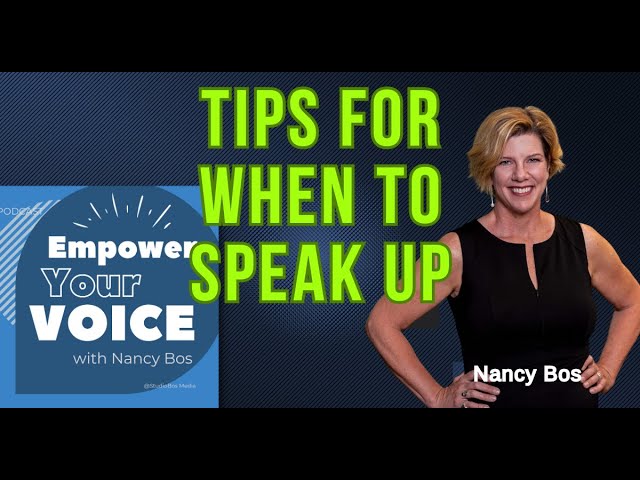
Nancy Bos explains why people hold back from speaking up and how to find their voice. She shares her own 28-year marriage that ended after she finally spoke her truth, and breaks down four risky contexts: intimate relationships, family, work, and public speaking. She offers tools like aligning your head, heart, and gut, practicing in low-stakes situations, and deliberate breathing to unblock the voice.
Chapters
Hello, hello, this is Nancy Bos and welcome to Empower Your Voice. Today I want to talk to you about those times when we are afraid to speak up, when we hold back because of fear. Now this could be as big as speaking to your boss or speaking to a family member or a friend about something that's important, but you're afraid to speak up. Or it could be something as simple as a neighbor who built a fence that you don't like. Well, that could actually be complicated. It could be as simple as a waiter. And let me give you an example of speaking up and how it might look when you do it. This is a situation where I went out to dinner with a friend who ordered prime rib medium-well. The steak came out to him medium-rare. It was very pink. So he said, "No, I don't think so," and sent it back with the waiter to get it to medium-well. 5 minutes later, the steak came back well done. I've worked in kitchens, and I know it's really hard to get the steak a second time to the right temperature and the right doneness. But nonetheless, this was presented to him with like caramelized top and no pink left, and it just was not what he wanted. So he sent it back and said no thank you. He wouldn't be eating dinner there, and he just had the guacamole that we were eating. This is an example of speaking up. Would I have done that? Or would I have put up with the medium-rare steak? Well, I don't eat steak, so this is hypothetical, but maybe, maybe I wouldn't have spoken up. Maybe I would have just let it go for fear of making someone feel bad. Not telling your authentic truth because it might make someone feel bad, you know what that does? It makes you feel bad. So just at that foundational level, if you look at this as, if I speak up, I might make that person feel bad, but it will be the right thing to do, or but it will help them learn, or but this is not what I paid for, so I'm going to speak up, versus not speaking up because you're afraid you're going to make them feel bad, which makes you feel bad, and those little things add up over time, you start to get used to feeling bad, right? You start to get used to holding back, and you get smaller and smaller and smaller because you don't value yourself as much as you value other people. So this falls into the realm of self-care when it's at this level. Let's talk about not speaking up when it comes to your partner. This is something that I personally experienced for 28 years, being the good wife, letting things roll off, keeping the peace. In many ways, it was the right thing to do. I didn't always keep the peace. We had plenty of intense discussions. But when it came to the important stuff, I didn't want to take the risk of losing my partner if I expressed my truth. In the end, though, once my kids were grown and the risk was greatly reduced, I did speak my truth, and it It ended up in divorce because we weren't an amazing couple anymore. So yes, speaking up to your partner, that is a big decision. But again, what is it costing you by not telling your truth, by not sharing your authentic voice with this person? You have to weigh that cost-benefit analysis, hopefully with the help of a therapist and some good friends, because perspective really helps. There might be things that you don't know that's causing the situation, or things that could easily be cured through better communication. So definitely, I understand speaking up with family and with a partner can be a very risky thing. Now let's talk about speaking up with your boss or coworkers. This, I would say, is very important that you use your authentic voice and you speak your truth because You only have one life. These people are not your life partners. This is not your be-all end-all. You have the right to decide your reality, your truth, your story, and how you fit into the world. And if somebody else from outside is controlling you, then that can be such a negative impact that you will indeed regret it on your deathbed. That's very important. So that frame of mind for speaking up to your community or your employer or someone else who has an impact on your life that you could live without, that's definitely a place where you don't want to sacrifice yourself. Now, of course, you need to choose your words wisely. You might want to read a book about conflict first and how to have conversations around conflict. But once you feel armed with the knowledge that you need to be graceful and respectful in speaking up, you should indeed do that. Otherwise, this might be a price that's too big to pay for the rest of your life. And then the final topic of speaking up and speaking out that I want to cover today is speaking up and speaking out from the stage or in front of a group of any sort, whether this is your networking group where you have to speak once a week, or if this is actually a $50,000 paid gig. Speaking up and speaking out is motivated by your drive and your passion. The risks get higher the more people are in the room or the more power that those people have over you. So if you're speaking up to a room full of CEOs and you're a middle manager, there is risk in that, absolutely. But again, is speaking up and speaking out going to have lifetime long-ranging benefits for you or for other people? Then yes, you should do that. You have to keep in mind the higher purpose, why it is that you need to say what you have to say, what difference, what change can it make, and lead with that. Lead with your why. Why this is important to me is because it can impact so many people in such a positive way. So I hope— this is, by the way, the script, why this is important to me— so I hope that I have your ear and your understanding that the things I'm about to say might be disruptive or might be concerning, but it is only with the best interest of the company or the best interests of you in the audience that I feel it's important to share these things. So with your permission, "Let me dive into the topic." That's a potential way to start that sensitive conversation in front of a group of people. Now, assuming you've got some clarity on when and why you might want to speak up and speak out when you haven't before, let me give you some tips and tools, discuss those a little bit, about unblocking the potential of your voice. You see, I discussed it in this format before, that we have our visceral, our gut reaction to things. We have our heart. This is all in the body. We have the anxiety that may show up in our limbs or in our breathing or in our gut with gut distress. All of that is below, physically, literally below the voice. And then we have our head, our brain, telling us what to do, telling us what to notice, maybe showing us distractions. The monkey brain might be in— the monkey mind might be in full flare when you've got all this excitement and the hormones of adrenaline excitement going through you. And that sits above the voice. So guess what? That voice is the gatekeeper. It's the funnel, the tunnel. It's It's the stop, it's the brakes. It says, your head and your gut and your heart are not sending me the same messages here, so I'm going to close down. Chakras— this is the 5th chakra. It's understood by energy healers around the world that this is an extraordinarily important point of the body for sharing our confidence, our identity, our purpose. It stretches out into our limbs because we talk with our limbs. And so this fifth chakra includes our hands and our feet. Have you ever known people who can't stand still when they're talking? Why are these things related? They are through the energetic chakra system. It's all part of the voice. So if you're feeling a conflict between your head and your core, that will show up in your voice. Now, actors and professional singers literally train in order to overcome this. We do mindset work in order to overcome the block that might come at the throat, but that doesn't always work. Even professional singers, professional speakers, and actors get performance anxiety and nerves, and it shows up in the throat. So this is something we all share in common. And the higher the risks, the more likely it is that that throat is going to shut down on us. So what I want to talk about now is some ideas for how to unblock the potential of our voices. If our heart is feeling freaked out about what we're about to say, because this is scary, but our brain knows it's the right thing, we're still going to feel that block in the throat. Your thoughts and your opinions and your emotions truly do matter. If you feel that conflict, you might want to spend some time looking into it, like, why do I feel conflicted here? Is there anything I can do to reduce the conflict so that my heart and my head and my gut are all in alignment on this? That will go a tremendous distance in helping you unblock your voice. Practicing speaking up can be a way to override those traumas that you might not even be aware of, where you were taught that your voice is not of value. So practicing speaking up with the prime rib would be a valuable thing for me to do because of stories from my past where I was not encouraged to speak up, but instead to suck it up. Isn't that interesting? That's right there at the voice. Suck it up, get what you get, and all those other negative statements that we hear throughout our entire lives that stop us from using our voices. So practicing speaking up— start small by speaking up in low-stakes situations like asking what you— for what you want at a restaurant, or sharing an idea in a small group setting. And as you become more comfortable You can challenge yourself to speak up in more challenging situations. This is a journey. This doesn't happen just overnight, although some good mindset work and a therapist might help— might help it happen faster. Breathing. Of course, you've heard this before, but one of the things that happens with our body when we're in anxiety is that our sympathetic nervous system is highly activated. Flight, fight, flight, fright, freeze, all those words, that all happens when the sympathetic nervous system is in high alert. Breathing deliberately and slowly will be uncomfortable at first, but that is a way to reduce the activation of the sympathetic nervous system and increase the relaxed nervous system, the parasympathetic nervous system. So what I'm saying is that doing conscious Meditative breathing in the moment of stress is a tool that you are applying to line up your heart and your gut so that they are more relaxed and you can move forward better. It will help reduce your heart rate. It will help reduce the amount of air that you're breathing quickly back and forth. It'll help relax the muscles of your core so that you're not tense and stiff. And all of that sends a signal to your brain that we're okay now, we're calm now, we got this. Deliberate, deep, or meditative breathing can help calm those nerves and ground you before you speak. And then one last tip or tool that I want to give to you is to embrace your unique voice. No one else has the lived experience that you have. No one else knows the story from your angle, and no one else is in charge of your life. You are the one making the decisions that you will live with for the rest of your life. Do you want those decisions to be regret or empowerment? This is your unique voice. Now, truly, you may have a unique physical voice. You may not sound like other people, Who cares? As long as you own that with confidence, move forward with that. That is not important. The world is filled with unique voices who have become famous speakers. I'm sure you can think of some right off the top of your head, people that's like, "Wow, that's an odd voice, but great things to say." That can be you if you embrace your voice, your unique place in this world, your power, That's all, that's the core of it right there. That is the core of having an empowered voice, is embracing that you have the strength and the right to express your truth, and nobody else does, and nobody else can stomp on it. They probably tried when you were a kid, they might still be trying, but no, it's your truth, it's your authentic voice. You can speak up And as long as the risks are appropriate, you should speak up. That's all for today. I'm so excited that you're part of the Empowered Voices community, the Empower Your Voice podcast. Please share this podcast with other people. Everyone needs voice empowerment from time to time, and I'm so happy to be part of your journey with you. Thank you and have a great one.










