Changing Demographics in Venture Capital with Naseem Sayani
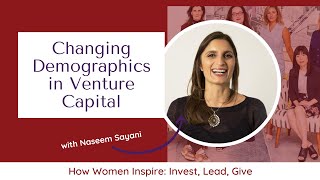
Naseem Sayani, co-founder of Emmeline Ventures, explains how a gender-focused fund redirects capital toward women's health, financial services, and sustainability. The VC world is dominated by cis-white-male investors, which narrows what gets funded. Women manage money more stably and gender-diverse leadership improves company performance.
Chapters
Welcome to How Women Inspire. My guest today is going to inspire you. She is the co-founder, managing director at Emmeline Ventures. This is a venture fund that invests in female founders in like healthcare, financial services, and climate, all those things you care about, and really, you know, looking at where technology can enhance women's lives and their well-being. So it's all about us, ladies. Uh, with 20 companies in the portfolio, her most recent investments include Alloy, Clutch Wallet, Do Foods, Luna Joy, She Matters, and The Beans. I know some of these companies, I don't know them all. I can't wait to lean in. Her expertise in investing and business building is really spans 20 years, and she's held executive leadership positions you know, in management consulting, agency services, venture incubators, a corporate venture capital firm. And she's been actively engaged as a venture investor, as an angel investor herself. And in 2022, she and a group of partners, brilliant friends and partners, launched Emmeline Ventures. The clear objective is to provide new capital opportunities for female founders and promote gender diversity among VC checkwriters. Nassim, we are completely aligned. It is so great to have you here today. Thank you for joining me.
Oh, absolutely. I'm such a fan of everything you're doing as well, so it's great to get some more time together and, and share some stories cuz that's what we're all about.
Exactly. That makes it more fun. All right, let's start with something that's completely seems off target. Um, but on those days when you have a win or even those days when you need a lift, do you have like a go-to song?
I do. So About Damn Time, Lizzo, is, I mean, hands down favorite. My 4-year-old knows all the words. He walks around singing it with me. It's just got power, energy, empowerment. And it can be a hard phone call or a great phone call, and you listen to it and you're like, no, I'm good.
This is going to be fun. Wonderful. I think for so many of us, you're doing big stuff. You're breaking ceilings. You're taking risks. You're doing critical things that are going to set the future of our country, you gotta have little tricks up your sleeve to how to sort of stay grounded and how to really get that mojo consistent. So we'll all be turning on that Lizzo song. So you have just an amazing background. How did you decide to launch Emmeline? And I would love to hear a little bit also about your partners, like how did you build enough of a strong relationship, you know, you wanna go in business together?
Yeah, it's a great question. So the first one, you know, I grew up, as you mentioned, management consulting, all in digital strategy and innovation. Started in that world circa 2007 when we first had iPhones in our hands. And it's crazy to think about a world pre-iPhone, but it certainly did exist. And so I ended up just doing a lot of digital strategy work as of 2007. That turned into then launching an agency inside of the consulting firm that I then ran for 3 years because our clients, one, didn't understand digital strategy, two, didn't know how to build product or turn on experiences or what UX and UI were. So natural extension of that work. And then that turned into the venture incubator. So we went from thinking about ideas on paper to turning them on in prototype form to then building them into full-on businesses and raising the funding for those businesses. That's where the whole toolkit has come from.
Yeah.
But as you can imagine, in those worlds, in consulting, in agency, and in venture incubators, the rooms don't look like this, right? It's a lot less diverse gender-wise. It's a lot less diverse race and ethnicity-wise. And a lot of what we were building reflected that. So it just, we were building a lot of B2B SaaS, which which is valuable and important, but it was making the same people rich. It was resolving the same problems over and over again. And so I, I kind of came to a moment where I said, I have all these skills, I do all this great work, I work all the time, and I need to direct it towards a better outcome. So it was very much a woke up one morning and said, I have to do this differently. And I started doing some angel investing, like literally seeking out the female founders who were doing things that mattered to me and to people like me. And then by way of that angel investing, I met my two co-founders. So all three of us joined one of the same angel networks at the same time. We were part of like the fall cohort that joined that group, and they hosted one of those like larger meet everyone weekends, like a bootcamp weekend. And you know, you were sometimes when you're in rooms, you're listening to questions people ask, you're following their thought process. You're like, ooh, she's smart. Ooh, that's a great question. Ooh, wow. I like how she thinks. We were doing that to each other all weekend without knowing it. And by the end of the weekend, you have to team up on diligence. And we all teamed up like instantly and the rest is history. So it's been very serendipitous that we found each other in the moment that we did. And so we immediately started investing together. We spent a whole weekend grounding our own thesis, what we wanted to go after, why we wanted to go after it. We have big Post-it notes that we put on walls that we still have somewhere in the house. That was the germination of what is now Emily Ventures. And it's been incredible.
I can't imagine being there. That sounds like— I mean, that's that moment where you're like, that vibration of when you feel so deeply. It's absolutely such a gift. And for a lot of women, you just described something. I don't know how old you guys were, but like in your early to mid-40s, it's called middle. And that sense of like, hey, I cannot put up with that stuff anymore. It is an imperative to have an impact in the world and to do it with other women. It can be really quite visceral.
And it absolutely was. Yeah.
And I think so often, like, like you said, you just kind of go, wait, this is not right work and this is not where I should be putting my beautiful life force. And you're so spectacular. Like, I'm so glad you're in this. You just mentioned your thesis. Okay. So in your thesis, a lot has a lot to do with women and things that impact women. Is that in response to the changes you want to see in the venture capital world? Or how does that— how did that come about? And was— did you have to convince any of your other partners or were you guys like 100%? We're all same stage. Beliefs?
Yeah, it's a good question. We were pretty much in the same place, and so we knew we wanted to invest in things that affected women because we each come from different diverse backgrounds. So I'm South Asian, my partner Lakisha is African, and then third partner Azeen is Iranian. So we've all grown up in different versions of some kind of immigrant and/or underserved and/or minority or underestimated kind of experience. And we've all been through different fertility experiences, we've all been through different career experiences, different money management experiences, and It was all of those things that we said, there's gotta be a way for us to invest such that we can help the women after us do this better, do this more easily, have more options. So that commonality of thinking that was in place, and we didn't know that until we were in a room crystallizing it and we were like, yes, that's it.
That's what we want.
What we had to get aligned on was the sectors that we were gonna prioritize because we wanted to get into, because It's women building for women, right? And that those two things have to be true. So we needed to identify the spaces where we could make that real. And so women's health is a semi-obvious one, right? Like we're solving and building solutions for what we're experiencing as women that the existing healthcare system doesn't have enough data on, nor enough insight, nor enough teaching. So yes, we can influence that. Financial services became the second one because we, in our conversations and the research we were doing in the room, that relationship between health and wealth is so critical and so foundational for women that we couldn't do just one or the other. We have to do both. She's gotta be able to manage her health and she has to be able to build her wealth and do those things in tandem. And then the third, we talked a lot about sustainability, about climate, about cleaner air and all those things. And what we translated that into was cleaning up the world around her. So what she eats, what she reads, what she wears, all of that influences her health, which is then connected to her wealth. So So we were able to intersect these things that we could have influence on that ultimately drove home helping her live better. And we could leave out energy and we could leave out oil and gas or like other things that one are not great anyway. And two, we can't have influence in the way that we want to on those sectors. Right.
To me, like solving the problems that are impacting the group of people that you just talked about that we all care about is what's missing in the market. What is your belief about what's missing in the venture space in the venture capital?
That's like a whole long extended conversation.
Yeah, it's not a 2-day, it's not a weekend, we need a month.
It's another weekend. So there's a couple of things. One, and this is, I like to talk about as like the capital flywheel, right? And so, and you know this, if you look back at what the profile of VC has been, it's been cis white male graduates from Stanford and Harvard. That is a profile. It is 80% of the checkwriters, 95% of the checkwriters, you could almost say. In venture to date, the companies they funded have been big companies we use every day, right? It's the Googles and it's Facebook and it's all these things. But it, we have to, and we've done a lot of work, I would say there's a lot of energy with new founders who are diverse, who are building companies, who are doing things to close gaps around behaviors and preferences and, and design differences that apply to different segments of people. But we're not seeing more money go to those audiences as fast as we would like. Because the check writing is still a profile. And that's why we have to influence who's writing the checks so that we can influence where the checks go. And I think that's the biggest part of this equation is how do we get more women and people of color in a place of wealth and an ability to understand and engage with the asset class so that they can write checks into it. And if we can do that and you change the other half of the flywheel, we're going to see the 2% get bigger.
The companies are there. The venture capitalists like you are in place ready to take capital and make it, make it work for all of us.
Yeah.
And then there's honestly, like, what you just described about those companies— my daughter works at Uber, my son works at Electronic Arts. You know, you look at the history of those companies and some of the cultural problems they've had.
Yeah. Oh, exactly.
Maybe he had some diversity around the table early on when that very young man started this company. They don't know any better. You can blame Travis Kalanick, but it's like, where did he know, or, and how much training did he have on leadership and culture before he built that? Absolutely. Technology solution. The adults in the room should have been coaching and cultivating him all along so that it wasn't such a massive crisis for the company and for him personally. Yeah.
Well, and it's a, it's an inevitable outcome, right? Because if you grow up in a world that doesn't have to interact with or resolve differences of profile or background or experience, and now you're put in a world that needs to, and you don't have the toolkit because those people couldn't have conditioned him. They haven't done it either.
Yeah.
So we're, everything is, is converging now. We have to learn. New ways of working and engaging that a lot of quote-unquote older founders didn't grow up in those rooms, right? And so it's becoming a whole new skill set.
Well, and not only are women— goes up and down, but approximately 50% of the workforce and the majority of the people who are getting advanced degrees. And we have a generation of women like me and you that have worked in companies for 20, 30 years, leadership positions. We have power, we have influence, we have wealth. It's time to activate us. So that we can create a new flywheel where it's jobs that, you know, your beautiful 4-year-old works in. Like, my kids are 30 and 27, like, but your 4-year-old, we want him to work in a company that is like better, just better, right? I'm not asking for permission anymore. I'm not asking for a seat at the table. My friends, this is the first generation of us. We have a huge opportunity. We have power and influence and wealth. And we can start building the tables where we get the prime seats. Today we want to invite you to join us as investors in venture. I know no one's asked you to do it before. It might be something that seems scary or foreign, but I promise you it's not that different than investing in a mutual fund where your retirement funds are. I want you to lean in and just a little bit more. How about making a commitment that in the next 12 months, you can give yourself 12 months to figure it out and to take a step. I wanna invite you to be part of the new table of power and influence and wealth. You're invited. I want to sit at the table with you cuz we're gonna make big change. We're gonna make the world we've been dreaming of. All right, let's talk about women's health, because to me that can often be the most glaring gap where it's like, wait, there's nothing for menopause on the market. How is this possible? That's when actually what's so stupid about it is not only does it affect half the population, but that's when you have the most disposable income. My kids were— I wasn't paying college bills anymore when I turned 50. And, you know, I started going through menopause. I was like, I would have paid anything if there was anything to buy. Just give me some relief, right?
Right.
When you think about women's health, what do you see as the future? Like, what looks different when you change the market?
So one is— one, the big one is stigma. Stigma and semantics. Because the reason we're solving for these things now is because generationally we're asking more questions. We're demanding more of our healthcare system, right? My mom won't say the word menopause out loud. It scares the shit out of her. She won't do it. And she trusted her doctors in ways that I don't trust mine. Right. And so that's a big thing.
Your doctors have had an hour of training on menopause if they're an OB-GYN, right?
And a lot of current medical providers aren't trained on women's health or menopause when they go to medical school. It's like one chapter in a 4-year curriculum. And so we're asking more questions now. We're saying the words out loud. We're talking about it at work. And that's going to be the big thing that changes. We just have to take the stigma out of it and be open and willing to talk about these things. Like we go to, the office as long as we're menstruating every month, at least a few days with the worst cramps in the world. And we just power through it and don't say a word. And now it's becoming something we can— some companies, well, you can take 2 days off and you're like, you know what, I can't come in, but I don't have to power through it. And that kind of expectation change is going to be what drives a lot of what— if we look around in 5 years, hope 5 years, I would love, it'll probably be 8 or 10 years, but 5 years you look around and the words are not stigmatized. We can talk about it openly. Our partners understand what these things are. They talk about it openly. And I think that's going to be— that's what I would love to see, is that it's not perceived as niche because it is 50% of the population that drives 50% of economy. And we have things we deal with that are different than what men deal with. Like, let's talk about them and make sure we're all aware of it.
I love it. So you have a fund that somebody might be interested in applying to. So if you're a woman founder, What is like the must-know thing that they need to know before they seek funding, especially with you, but with any?
Yeah. The thing that's mattering, I think, and it's always mattered, it matters even more now, is really crisp and clear differentiation because some of these spaces are getting, this is gonna sound insane, are getting crowded, right? Like women's health is getting crowded and there's a lot of companies doing great innovation, but it has to be very clear why what you are doing is different than others are doing. Not that you can't all coexist, but at some point consolidation is going to start to happen. And so you want to be the consolidator, not the consolidatee. And so I wanna hear really great perspective on why you're different. And I wanna hear vision and influence. If your business and brand exists in 5 years, 8 years, what role does it play? Where does it sit? Who is it influencing? What difference has it made? If you can tell us a story about that, We're all in, right? We get excited, we can lean in. We'll, I of course wanna see the details and the financials and we wanna make sure it's all robust. But it's, it's that vision that I think a lot of founders, female founders often struggle with because we're so ready for prevention questions. We don't walk in with vision. And I tell everyone, I want you to walk in with vision. We will get to the other stuff, but I need to know what you're building and why it matters. Start there and then we'll get to the rest.
I love it. So what you're talking about is why you're unique in the market. Are you looking for someone that's a full-on blue ocean strategy or just a, a deviation away from, you know, like a better way of doing something that might already exist? Some people say the second to market is the biggest one to invest in because the first one to market takes all the bruises.
So we like to call it core rewiring. We want to invest, we love big ideas, moonshots, things that can change things top to bottom because we don't want to invest in what's solving for current pain. We want to invest in things that can change how it works from the ground up. And we call it core rewiring. And that's what everything in our portfolio has to check that box in some way for us to write the check. Because this is about systematic change, not letting the existing norms persist and building around them like this. We're going to change the world and that's what we're after.
I love it. So you talked a couple of minutes ago, we talked about women's wealth, right? Yeah. Why is access and autonomy so important? Important for women's economic empowerment. I mean, so everybody I know, myself included earlier in my career, is like, oh, I just go through the— my corporate— my company's retirement thing, and I just do the maximum, and I'll deal with paying attention later on.
Right. It is so critically important because we've been conditioned in the world to believe that we're not good with money, to believe that we are spendthrifts, to believe that we make bad decisions. And that, that is literally in the media and in the content that gets fed to us about money. And so we have to consciously break that mindset because when we do, women are better money managers. They have stronger portfolios. They actually don't emotionally react to the market like our peers do. We're actually much more—
like the men do. Like the men do.
We're much more stable through rocky waters.
It's—
the data is out there to prove it, right? Fortune 500 CEOs that are women have actually delivered— their stock prices are higher, their returns are higher. So we don't get told those stories enough. And so we inherently don't believe we can do it. But if we did do it, like the order of magnitude change on the kind of wealth we could harness, the kinds of things we could do with that capital could be dramatic. We just, one, weren't conditioned a certain way. And two, because of care economy problems and other things that are woven around this, we end up stepping out of the workforce more often than our partners. And so when you look at career trajectory and you look at salary increases, it's, you know, women make what, 80% cents on average for every dollar a man makes. Not because we're not as good, but because we are stepping out when we have kids. We're stepping out when the family moves. We're still— there's just those things affect me.
Yeah. My 23-year-old started at a corporation and the CEO brought in the Attorney General and then they leveled the pay. Within one year, she got a 40% increase in salary because the boys were being paid so much more than her. So we believe it's not whether you have kids or not.
No, absolutely.
Problem that is so— absolutely. And, you know, at Salesforce, who stuck their neck out to be the one really driving quality, takes 2 months. Even when the company's CEO talks about it all the time, 2 months. Yeah.
Yeah. Well, and it's, it's a really interesting— the pay equality and the pay transparency is a really interesting thing because when I started in my consulting career, every single consultant was paid the exact same rate across the country. Male or female, it was published. We knew what the bands were. So I always knew what everybody was making around me and I took it for granted. Then I jumped outta consulting, I went into agency for a while and I didn't have the transparency and I didn't know. And so, but because I came from a world where I just assumed I would have transparency, I just asked more questions. I was like, so are other managing directors making that? What is the average? What's the band? And HR was like, golly, nobody asked us these questions. I was like, you don't understand where I came from. Like I know what every, I could calculate my bonus to the penny and knew exactly what I was going to get. And that kind of transparency should just be on board.
Absolutely.
Absolutely.
Thank you for saying that. Okay, so you're talking about all these beautiful future visions and aspirations for the world, and you have this beautiful 4-year-old baby. Do you think he has any clue what you do?
I think he does, because he will walk in on Zoom calls and he'll listen, and then he'll say things like, Mama, you're working? Yes. Mama, are you buying things? I'm like, yes, yes, I am, actually. And so he's understanding kind of at least in the simple functional of what I'm doing. And then as he hears more and gets a little older, he'll get to hear more stories. The really interesting thing part about it is because I end up talking about women's health and other things like in the house at dinner, he's going to know all this language like as a 5 or 6-year-old that other kids like him don't know. And so there's going to— it's going to be really funny to see what he ends up saying at school. And I'm going to be like, well, it's the great— I'm in venture and women's health. And yes, we talk about vulvas. Like, yes, my 4-year-old says the word at school. I don't know what to tell you.
Sorry, kindergarten teacher.
So I'm very sure that's gonna happen.
Yeah, I have a 27-year-old boy and a, and a 30-year-old daughter, and boy, the gift of watching how they've evolved because they had a working mother, because of the kind of work that I do, has just been absolutely extraordinary. And yet, so my son considers himself like on his best Bumble BFF profile, it says is feminist, Black Lives Matter ally who loves to play basketball. Um, and so, um, uh, but he also said to me not too long ago, he's like, Mom, sometimes it's so weird, like, I'm realizing you're a real person. And it's like, you know, maybe there's something beautiful about that too, which is like, oh, despite everything, all the— I mean, I worked like you, I worked my entire life, I was a primary breadwinner. And I know, and I wanna, you know, I, I try to keep shedding any sense of guilt but he still thinks of me as mom more than anything.
Yeah, yeah.
I'm the safe one to call. I'm the only person he gives a hard time to in life. He's sweet to everybody except for me.
Same. My 4-year-old is the same.
It's the same. And the other place—
yeah, right. Yeah. And like, and then the other thing he's getting, um, is between my, my husband and I, my partner, you know, there's the work in the house is the work in the house. It's not my work and his work. It's just work.
He's not helping you do the dishes.
He's not helping me. He's not babysitting the child, right? This is not how it It's just somebody cooks and somebody does the laundry and somebody sweeps and somebody takes out the trash and somebody, you know. And so my son is seeing a different baseline when it comes to gender norms in our house that we're very deliberate about, very deliberate about. And so it's— and also like, Mama's at work or Dada's at work. So he hears these— he's hearing both of us do the same kinds of things. And so it's completely different than the baseline I grew up with, for sure.
I can't wait to see what happens for him in 25 years. I'm like, it's gonna be such a beautiful thing to see where it's so different than even my own children's experience. Like, that's a huge difference. Mm-hmm. That's a, that's a big difference. This time went way too fast.
Uh, are we there? We're there.
I think we're almost there. I am so impressed by you. You're such a powerful leader. You're so values-based. It's really wonderful to be in your orbit. Can you please give us one more piece of advice or wisdom or message that you wanna share out in the world?
Oh goodness. That's a great question. What I live by and what I tell founders I talked to, the bottom line is to be audaciously bold. That's what we should be doing every single day, right? What we want is not minimal. It's not small. It's not niche. It's not a rounding error. It is big and it's bold and it's important. And so everything we do should be wrapped in audaciously bold mentality and we'll get there. And that's how I try to do everything. It's— I'm here for a purpose and I'm running after that purpose.
I love it. Thank you so much for being with us today.
Yeah, absolutely.
And I hope everybody listening here really, really got infused with this sense of like, hey, life's short, got to make an impact, got to do things aligned with my value, and no time but the present to be big and bold. Thank you so much for everything you're doing.
Absolutely. Thank you so much for having me. This was great to chat more and tell more stories. It's always fun.
[MUSIC] [MUSIC]
More from Naseem
“People kept handing me airplane parts. But I was building a rocket ship.” #femalefounders
“What you don’t ask for, you don’t get.” #femalefounders #magicalthinking #venturecapital

“Everything you’ve heard about fundraising is true.” #startupfunding #femalefounders #podcast
How's That for Masculine Energy with Jenni Ogden #femalefounders #venturecapital #podcast
Bias Isn't Personal #femalefounders #podcast #venturecapital #startupfunding #thecapitalflex
How many times can you hear “no” before you start questioning your worth? #femalefounders #podcast
Trust the Expert, Not the Pattern with Dr. Maria Ulokoof VULVAi #femalefounders #podcast
Misaligned Capital Is Still a No with Lisa Hillyard #femalefounders #podcast #founderenergy