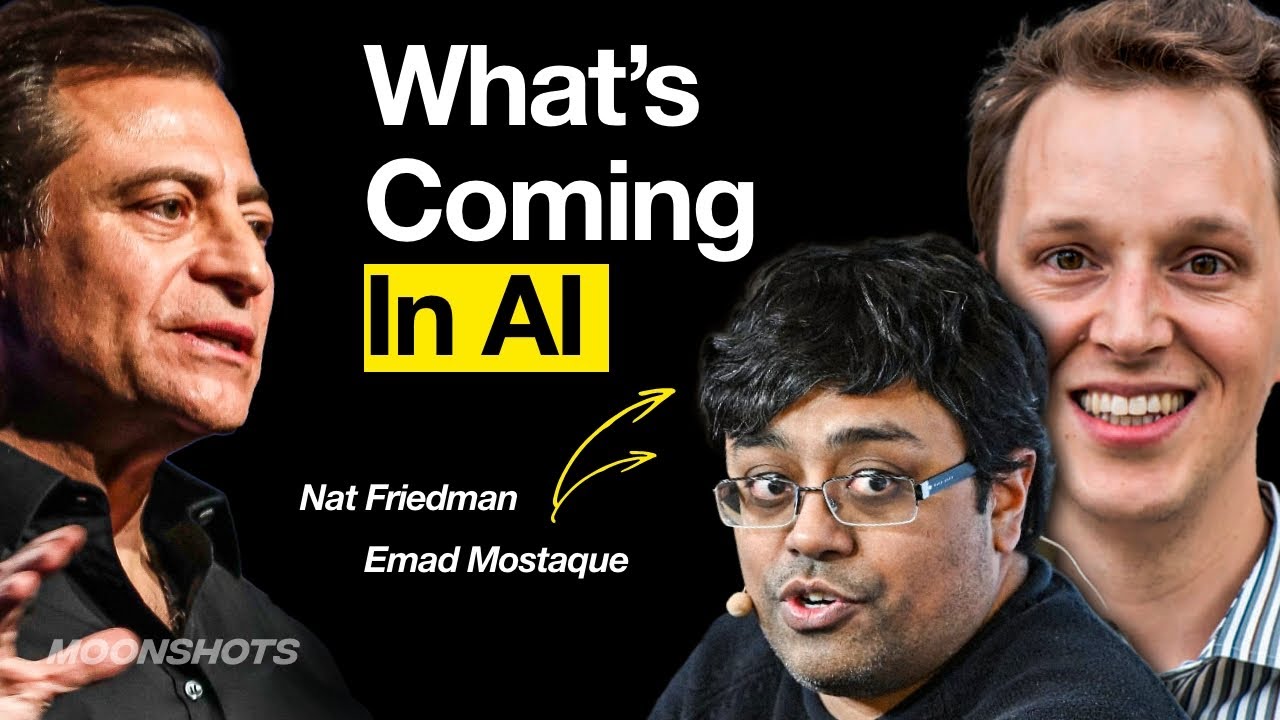
Nat Friedman and Daniel Gross in conversation with John and Patrick Collison

In this live panel recorded on May 19, 2026, Nat Friedman, Daniel Gross, and the Collison brothers discuss the unfolding AI singularity, its economic implications, and the practical realities of building and deploying AI agents. They describe the current "slow" phase of the singularity, driven by human bottlenecks in model training, and the push toward self‑improving systems that remove humans from the loop. Daniel explores whether AI will be inflationary or disinflationary, using China’s WTO entry as a historical analogue. The conversation moves to concrete metrics: compute CapEx now approaches 1% of global GDP, and Stripe’s contribution is about 1.6% of global GDP. Nat shares vivid personal anecdotes about using AI agents (Claw/Hermes) for everyday tasks—hydration reminders, medication purchases, hardware reverse‑engineering—illustrating a "golden age of tinkering" where any device can become an AI‑controlled peripheral. They debate safety versus capability in consumer agents, the need for continuous security testing, and the asymmetry favoring defense. Organizational themes surface: rapid user‑centric iteration loops, breaking down internal tooling friction, cultural shifts that empower engineers, and the importance of dignity and low‑friction processes. The panel also touches on aesthetics of AI data centers, the role of beauty in technology, and broader philosophical questions about what metrics we should maximize as AI reshapes society. Finally, they offer predictions for the next year (more domain‑specific agents, rising hardware costs) and advice to Stripe to become the platform of choice for AI agents, building new stacks for identity, pricing, and dispute resolution.
Chapters
So we opened yesterday by proclaiming it, acknowledging it to be day 119 of the singularity. So I guess day 120 today. Singularity started on January 1st. Thoughts?
Yeah, I mean, it really does feel that way. I think the thing to remember, we see AI improving constantly, and it's just able to do more and more, and there are these sort of I think we've learned a couple of things. First, AI works. Second, when a new model comes out, we're quickly dazzled by it, and then we become inured to its new capabilities very, very quickly. We're like, it feels like nothing's happened for a couple months. AI is dead. Then there's another step change, and it improves again. I think the thing to remember is that this is the slow part. This is the slow part of the singularity right now because the improvement of the models—
Felt very slow to everyone. Yeah.
The improvement of the models still runs through a lot of human effort. You know, at all the labs where models are being developed, humans have to make decisions, they have to discuss things with each other, they have to run experiments, they, you know, they make mistakes along the way, they have meetings, they have to sleep in between, although less and less these days, and all those things slow it down. And the prime project at every AI lab right now is to remove humans from the loop of all the continuous work that has to be done to make the models improve and to get to self-improvement where you have AI systems that can start by doing what the people are doing now, the researchers are doing now, and therefore eliminate all those sleep gaps and also scale it out to data center scale. It feels somewhat sometimes fast, sometimes slow right now, but it's probably as slow as it will ever be when we start to automate more and more of that process. This is the story of the economy too. This is not new to AI. It's always this question of how do we take a thing that has to be done to provide a product or service and automate it, make it more reliable, more efficient? We're always doing this, and it's happening in the way we produce AI too. I feel like we are It just feels to me like we are in the singularity, and we're in the beginning slow part before it elbows up with self-improvement.
It's hard to add on top of that, but one of the things I'm responsible for today is Meta's compute strategy, where Nat and I both work. One of the things we're trying to figure out is obviously the local consequences in terms of how to think about compute and all the things that may matter to you know, a hyperscaler that also is building some of these models. But the impacts, I think, of the singularity on the economy, I think, are also not really well understood, nor should they be. This, as far as we know—
Hasn't happened before?
Hasn't— well, we'll find out. Maybe Atlantis will— at some point, we'll discover— you know, we'll find the missing GPU cluster in Atlantis, and maybe there is a cyclicality to all of this. But I think there's a lot of, you know, very basic things that I'm trying to figure out. Like, for example, Is AI something that we would expect to be inflationary or disinflationary? Is the singularity an inflationary effect on money supply or disinflationary? And you wander around San Francisco, and people have usually takes that involve very large numbers, billions of dollars, trillions of dollars. So that would imply a kind of inflationary view. Numbers get very big. I think that is— I'm not an economist, but that would be what the economists would say. But then if you kind of think back to, I think the best reference point I have for the singularity is the last time we connected a lower-cost superintelligence to the global economy. And I would say that that's roughly when China started modernizing and then joined the World Trade Organization. And you can kind of think of China as a kind of a superintelligence. It is able to produce goods and services at a lower structural cost than what the West was able to produce. And the effects of that are actually somewhat disinflationary. Like, if you were trying to put on an event like this right now, and we sit here—
And then you say the last time this happened was when China joined the WTO, and not when Ireland joined the EU.
Well, Ireland GDP is a very interesting story of somewhat of a different trade going on there, and that can be discussed at a later time, maybe with your tax team. The— obviously, the GDP of China, you know, goes a lot— goes up a lot, but the actual effects on consumers are that you're able to purchase much more with much less. Like, if we were trying to provide this experience today, where someone sitting in the other corner of the world can watch this entire show live streaming on their phone for $10 a month data plan and a $200 device, if you were trying to provide that pre-China, I would think that that would be tens, if not hundreds of millions of dollars. And so your purchasing power of a certain quality of life has collapsed dramatically. And so I don't really know. I mean, that would be a story of disinflation. So I guess I say with a lot of humility, we don't really know what a singularity is. There's a lot of reference points we can try to look at.
And we don't even know what the sign bit is going to be on any of this stuff.
That's right. We don't even know the direction.
Isn't, you know, when you talk about inflation versus disinflation, there's so much averaging going on there. Everyone's familiar with the famous chart showing when you break out the goods, education and healthcare have seen this rampant cost inflation, and then durable goods and your flat-screen TV and everything, you know, we talked about in the talk earlier today, tend to go down over time. Shouldn't we— and again, a lot of that was this, you know, the China effect, where—
It's like the Marc Andreessen line, you know, if you damage your wall, in San Francisco, it is cheaper to buy a flat-screen TV to cover over it than it is to repair the wall.
Yes, it was literally true. And so shouldn't we expect more of that effect with AI, where you just get massive deflation in the things that AI can help you with, and then there'll be a Baumol effect where certain other things, you know, you shouldn't necessarily bet on, you know, 4-year university tuition getting that much cheaper?
Maybe. I mean, part of Baumol's cost disease, I think, was this idea that wages in very productive sectors of the economy rise, and that forces wages in other parts of the economy, even though they may not actually need to, rise as well. But I think it'd be interesting to see, depending on where the costs of software production go over time, how those wages interact with other parts of the economy. And I think there's— we stand, you know, before an immense amount of uncertainty in terms of what happens next, and I think anyone who has total conviction about this ought to get themselves checked. I'll get to you in one second, Patrick.
So many questions.
But the thing I would say is maybe a good thing to come out of this is we may reindustrialize certain parts of the economy that have had a lot of cost disease, because a lot of those people end up working on things in areas where there's a lot of low-hanging fruit, and they just haven't been touched because all the talent has been allocated to software.
This is like things like US domestic manufacturing.
Yeah.
What's the latest number for the total— I mean, we described how Stripe businesses in aggregate are now responsible for about 1.6% of global GDP, and there's some caveats around final goods and whatever, but just like directly 1.6% of GDP. What's the latest figure for aggregate compute CapEx as a fraction of global GDP?
Global GDP would be just under 1%. So— There's a lot happening. There's a lot happening.
We're talking about the numbers here. How weird is the singularity going to be?
I think pretty weird. Yeah. I think it's going to be pretty weird. I think we'll be in a state of perpetual future shock for probably a number of years. Maybe for some reason things go a little bit slower than people expect, but I think even the most pessimistic people working in the field think that it's like, I don't know, 15 years, 20 years. I don't think anyone thinks it's 200 years. That means in the productivity— I think we're all going to— We're all going to be there for it, you know, God willing, and we'll experience it, and we'll go through many layers of surprise and shock and change on the way there. And I think it will be quite weird, and there will be periods of chaos embedded in it. So, you know, we see that these models are pretty good at finding bugs in software, including bugs that have been in that software that's, like, been— Like, my background's in open source, and, you know, we had this notion that to be really secure, a codebase has to be open source because then many people would look at it and they'd find the vulnerabilities. The more heavily used it is, open source, it's like many eyes make all bugs shallow. Yet even in OpenBSD and the Linux kernel, there are decades-old bugs that were only recently found by applying some tokens to models. Now, whether those reports are overblown or underblown, it's just simply true that these models can run all night and The thing that you used to do occasionally, you know, pen test or hire a red team to, you know, test your software, you now must do continuously. I think it's like one of the conclusions of agents is that, like, these occasional things become continuous. You can increase the frequency at which you're doing all these things that you used to hire a team to do, like, somewhat sporadically. And so I think because some firms that have software deployed will be able to afford, you know, they'll have the software development lifecycle in place, and they'll be able to afford the tokens to, like, pen test their own software, to AI red team it, they'll be able to harden it. And I think fundamentally that there will be an asymmetry in favor of defense, because you'll be able to say, okay, I'm not going to, like, deploy software until I make sure it doesn't have bugs. But in the meantime, lots of people will have bugs sitting on the internet and will get exploited. So that's, like, part of the chaos that I think we should—
Stuff's going to get hacked all the time.
Stuff's going to get hacked constantly. Yeah. And then the other thing is just our relationship to these ecosystems changes completely. I don't know. For me, one of the really fun things with coding agents the last few months in my meta is keeping us really busy, so I've not had very much spare time. But I like to buy things on eBay. It's a good website, and they have everything.
That's all you're going to say about it.
You can buy anything on eBay. It's incredible. I'm like a huge proponent of eBay. I bought my rug, I have a rug. But anyway, the concrete—
concretize this for us. What's the last thing you bought on eBay?
The last thing I bought on eBay, I was watching as I was falling asleep at night a video of Bryan Johnson, and he had this face scanner that showed like all his subsurface skin damage on his face, and it looked grotesque. And I thought it was cool, I wanted to try it. So I went on eBay and I found this Vizia face scanner, And they shipped it to my house. And it's supposed to— and I plugged it into— you need to use Windows. So I plugged it into a Windows computer. And then the software refused to run because the eBay seller neglected to include the decryption dongle that comes with this. And I spent like a few thousand dollars on this thing. So I was like pretty annoyed. But then I just plugged it into my laptop and I had Claude Code reverse engineer the device and it like read all all the academic papers about the type of, you know, different polarization settings, and I think my software is better than the one that that hardware dongle would have unlocked, and I spent like $100 in tokens to get it, and it works exactly how I want it to. And so there's this feeling now, it's like a golden age for tinkering, and there's this feeling like you're Iron Man now because you can just like get anything and tell the Jarvis to like connect it and make it work, and it's awesome. So this is like, in whatever spare moments I have, I like do this Iron Man thing where like— another cool thing is I have all these Raspberry Pis. You should definitely stockpile all computers right now, but Raspberry Pis are good. And like every screen in my life has a Raspberry Pi plugged into it via HDMI, and they're all like displaying stuff that's totally custom to me. And so basically, the conclusion is that every piece of hardware will be a trivial to integrate I/O device for your AI. Like, they won't have lives of their own. This idea that the hardware has a life of its own, I don't think this will survive. And so they're all peripherals for whatever your AI ends up being. So yeah, I think this is like the delightful side is we're going to watch ecosystems reshape. Like, I could have contacted Vizya sales But it was Saturday, and Claude Code recreated their software from the academic research and reverse engineering in less time than it would have taken them to even get and return my email. So I don't know what that does, but it's going to be weird.
And it all starts at eBay.
Usually starts at eBay, yeah. I have gotten screwed a couple of times, but then you can leave a review. So it's pretty good.
There is something— Have you asked me about OpenClaw yet?
We're going to. There is something in the water right now. Like you said, it's the golden age of tinkering. I feel like that is the— many people I talk to say it's the most fun they've had with software that they can remember in their career. That's certainly my experience of it. And it's interesting.
You never get stuck.
You never get stuck anymore when you're developing software. And it's also kind of retro in a way. And yeah, I want to get to OpenClaw where home networks are relevant again. Just like, when's the last time you thought about the LAN in your house?
Totally.
But now it's really relevant. And the Unix philosophy is back. Maybe you can talk a little bit about your Claw.
Yeah, I mean—
Can you tell the story about the water?
Yeah. OK. Yeah, so I mean, I like to play with all these things. And in January, when Open Claw started to sort of appear in the Jungian subconscious, tried it out, and I, you know, started hooking it up to everything. It was super neat. I mean, part of it's that Opus is a really good model, and you get to experience Opus in a new way, you know, in this sort of general personal context. But I also integrated it with a lot of things. I have cameras in my house, and so I let my Claude— I connected my Claude to all the cameras so I could see them. And then I think a lot of people, when they get these personal agents, they start to think like, okay, how can I use this to make my life better? And a lot of people turn to health. Like, okay, I want to— everyone wants to exercise more, be healthier, sleep better. Maybe it's just me. But so my Claw pretty quickly determined that I was dehydrated, because I gave it all my blood tests, my DNA, and all that stuff. And the DNA didn't say that, but maybe the blood test did.
Epigenetically, you're— Yeah.
Also discovered, created an Illumina competitor.
And so it was like, you really need to drink water. I was like, all right, you should like do whatever it takes to like make sure I drink water.
And then— You literally built the paperclip maximizer.
Yeah, I was like, just break laws, whatever it takes. And then at one point it was like, I can see you on the camera. I want you to walk to the kitchen right now and drink a bottle of water, and I'm going to watch to make sure you do it. And I was like, whoa. So I did. I walked into the kitchen and I drank a bottle of water, and then it sent me a snapshot, a frame of me drinking a bottle of water, and it said, good job. And I was like, I felt like I did do a good job. So that was nice. So there's that one. That was a crazy story. That was like January 29th, and I was like, oh shit, this shit is for real. for real, like, this is really serious. And then the other one was a couple days later, I was driving home from work, and I was talking to my claw on WhatsApp with voice messages, and I was in my Tesla, and I had full self-driving on, so it's driving me home. And then it says, I'm on the sleep topic, and it's like, you really should try magnesium bisglycinate, and I'm like, I don't have that, and then my car turned. And it was like, you should pick it up on the way home. There's a Whole Foods on the way. I've redirected your navigation system to the Whole Foods. And I was like, whoa. So I went in, and I did buy the magnesium bisglycinate. And so those were like a couple of crazy stories, and I was like, wow, this is like—
Singularity theory.
I don't know if this is the experience everyone wants, but it definitely feels pretty crazy. Maybe you don't want that, but—
Well, so we're getting to something here which I find very interesting, which is, again, if you use— I think it is— no matter how AI-pilled you are and no matter how much time you spend talking to an LLM chatbot, it is quite different when you start using something in this modality like Claw or Hermes or something like that, which has both the persistence and the tool use and just like the ability to write arbitrary code. And I feel like there's a tension where clearly this feels like the future product direction for consumer AI, and many people are kind of sprinting in this direction. Obviously, OpenAI acquired Pieter Steinberger, the Claw father, who created it. But there's a tension between making a consumer product that won't get your hand burned on the stove and just like, it can run arbitrary code and integrate with your Tesla and do whatever it needs. How do you think for the mass consumer audience, this tension gets resolved?
Yeah, I think there's 2 basic approaches that you can take. One is you take something that's perfectly safe, and then you slowly add more capabilities to it.
That's going to be so lame and boring and gimped.
And keep it safe. And then the other is you take something that can do anything, and you slowly add more safety to it, and you try to climb the nines on not crashing your car or whatever. And I think the market has pretty much spoken because I think most people when they run Claude Code or Codex, they run it with --yolo or --dangerously-skip-permissions. I don't know what the numbers are actually. That would be good to know. But everyone I know does that. And so I think people are really counting on the model's agentic alignment right now. And the truth is it's not safe right now. I do not recommend that you I mean, it keeps you hydrated. Yeah. No, but I mean, I sound like I'm really cavalier with it. Maybe I'm a little bit cavalier with it. But like, one thing I don't do is give it access to inboxes that the internet can put information in, because these things are trivially prompt injectable still, even the most advanced frontier models. And so if it can just read all your emails that are coming in, if like you have that set up, I can easily take over control of your Hermes or your Pi or your Claude or whatever it is. by sending a well-crafted message to it, and it'll send me your personal information or redirect your car or whatever the thing is. I think they're quite unsafe, actually. I think consumers will— I think that there's a race to ship something, and there's a race to ship something that's just as powerful but sufficiently safe and reliable that people really like it.
This is going to be a rate-limiting factor. Consumers will make their own decisions, I think, on what they want to do and how edgy they want to be. Another way in which you might define Q1 as the beginning of the singularity is AI adoption started getting rate-limited on safety in the enterprise. When you speak to actual people that run large businesses, there is a lot of fear suddenly.
I was going to ask you about this, actually. We're talking about agents and AI in the personal context, the very personal context, and one's own hydration. But Then there's also all these technologies applied to the enterprise. And so when you think about NFDG, the investing firm, or now Meta, just tangibly, concretely, what are the coolest AI tools you had or have for folks here? Just what are— like, inspire us.
Other than eBay, what are some good products?
Well, it's interesting. We used to run a venture firm, and we did a bunch of things at the firm in order to try and make our lives a little bit more streamlined. I think nothing that would surprise this audience. I mean, Stripe customers are obviously self-selected into an elite level of AI adopters, but you'd be amazed how much venture capital, despite being in the epicenter of Silicon Valley and funding some of the greatest companies like Stripe and other people in the audience, I'd imagine you'd be very amazed at how laggard that industry is. difficult, I think, to be state of the art in adopting some of these tools. But I'll give you an example of something that we, and I think many businesses, are thinking through literally today at Meta, and I think many other companies are. For the first time, individual ICs in everyone's business have the ability to rack up a lot of charges using a bunch of different APIs to, you know, create a bunch of—
Couple of agents in fast mode.
Couple of agents in fast mode, couple of cron jobs, and suddenly, you know, you start off by celebrating it, and then you're wondering, What are we actually doing here?
Where did the $10,000 go?
Yeah. $10,000 would— yeah, that'd be great if that was $10,000. So the interesting thing— the problem we're working on that I think everyone will have to start working on is, what is the right way to think about attributing budget to individual people? How much tokens should they be allowed to spend? Are the outputs and the artifacts that are being produced economically valuable themselves? And I think when you start— you know, really thinking about this, you realize, well, a lot of what is being produced is either being produced by a very large model that could be done by a smaller model or isn't really economically as necessary as you may have thought. And so a product I think, you know, we're— we're— and I think everyone else will build is just using, of course, language models to understand the economic value of the generated tokens. And I think—
It's a new kind of budgeting that every organization That's right. Interesting.
I think the closest analogy I have is we are all portfolio managers in a hedge fund, and every IC you have is running a strategy, and you have to decide how much budget you're going to allocate to their strategy off some sense that they're going to do better with it than without it. There's risk management. There's a whole similar dynamic that I think is much closer to portfolio management than your traditional headcount budgeting. thing that I think is also going to be the story of how not just intercompany finance happens, but venture finance in general, I think, is now a game of basically how far can an individual get with a certain token budget.
Sort of related to that, I won't ask this question on Meta, and you can decline, you can both decline to answer this question at all, but if we normalize Google headcount today to be 100, What is Google headcount in 3 years?
Obviously, the question that you're asking is not about Google in particular, I assume, because I don't have any particular understanding of Google. But I think you could kind of ask the question for a Mag 7 company of that scale in general, and excluding maybe anything specific to Meta. I would have very large error bars on that. And of course, the mood, you know, that you might have if you walk around Silicon Valley and talk to the right people that are reading the right online internet forums is like, you know, that number should be far fewer people. I am not totally certain for 2 reasons. One is, it's not immediately obvious to me that the tech companies that we know of today are producing the right products at the perfect rate. Like, I don't know that there is some physics limit that was hit. In fact, I strongly suspect the entire raison d'être—
Because tech makes more stuff.
For startups is that these companies are very inefficient. And so I think if they correctly organize themselves, you could end up in a situation where you have the same or more people just doing many more things. And there probably is an organizational transition strategy, because I think the way you want to run these teams is a little bit different from the way they're currently run. So that would be point A. And point B, maybe Nat has something to add too, is— Okay, so I saw your video that you started the conference with, which was great, and it starts with the dot-com sort of boom. And a lot of people weren't sure what the internet is going to be used for. And I think the other take you could have when the internet is sort of getting started is you could stare at it. By the way, I guess we're on a very special— we're in a very special place today, because this very stage launched many of the iconic products that you demoed, that you had that video of, including the iPhone, I think, was done here on this stage. And you could have looked at all of these things, and you could have said, you know, I think realtors are just going to be out of a job. Because what are realtors doing as a service? Why are we paying them a 6% vig on a transaction in a house? Well, it's their networking.
6%?
The fact that you don't know the number is really interesting.
I never got the 6% bill.
Yeah, we should unpack that later. So the— and you might say it's going to be totally gone because the internet will— and it turns out that they're here, and that industry has in fact grown, even though I'm not sure it is rational in a purely utilitarian, sort of libertarian paradise sense to have that industry. And I think as we sort of look forward and project, you know, which industries grow and shrink, there's a lot of stuff that's out there like realtors, and I'm using that only as an example, which is there, is valuable to have. It's kind of complicated why it's still there. I don't think it's that they regulated themselves in. I mean, we could transact in a house without talking to them, so it's not law. But there's a lot of stuff around the edge, and my parallel for that would be in a company like Google, there's a lot of people doing realtor-like stuff. Sales, marketing, talking to folks, you know, considered purchases that need handholding.
Well, can I ask about that?
Because I have a diffusion question. So I think it's very sensible to split up what companies do into a few categories. I think engineering is actually on trend to see productivity improvements because engineers love tools. They have for decades. And so they're there looking at what the models can do and let's rebuild our workflows and things like this. And so I think that makes sense within engineering. I think go-to-market, like sales and marketing and things like that, also works pretty well because one, fundamentally, I think the sales roles are about, like you're saying with the realtors, it's about the humanity. You saw a little bit of this with COVID people talking about the death of business travel. It turns out if your competitor is going to visit the customer, you will be going to visit the customer as well, and it's thus one-upmanship. Go-to-market, it feels like it will do great, and sales roles will do great in the age of AI. The question I have is how the diffusion works within what we call G&A within companies, legal, finance, compliance, all these kinds of roles. In particular, there's how you get all the automation there where we run a reforecast process within Stripe and we're not feeding it all into a coding agent, but maybe we should. But then also the ergonomics are wrong where your finance data is in a spreadsheet and the models make up numbers and maybe you prompt them to not make up numbers and they're a little bit better.
That's it.
And you're not going to be able to verify those outputs. It's not going to be like an RL problem where you're going to run the budget a million times and get the correct—
So how do we get a much more AI-native GNA function at Stripe? Make no mistakes.
It's a— I'm not sure your SOX auditor is going to sign up for that, but maybe they will. It's a good question. And I think you get bottlenecked on verification very quickly. And then verification in situations where, as people are finding out when they have to verify, parts of code that you can't easily unit test, it takes a lot of time if you don't have the context.
But people say that, but it's interesting. And, you know, people talk a lot about this phenomenon of the models do best on things where there's a good RL environment. And so we have good RL environments for coding, and therefore they're really good at coding. I don't see why you can't have a good RL environment for finance. Like, it's a very closed-loop task.
I think you can.
Yeah, I mean—
Have they just forgotten to? Like, should I—
Yeah, no, it's just hard to make. And so you have to— work really hard on it and have good people do it. I mean, the model is just—
Could Meta AI be the first quant? Could you guys—
That's what we're here to announce, actually.
Yeah.
Complete strategy. Yeah. A huge shift. Yeah. I better text somebody.
Anyway, you can see what John really wants from the singularity.
Yeah, exactly.
I just want an AI that can do numbers. I think—
I mean, the truth is, and this is actually in some ways bullish, some ways bearish, but Yeah, I mean, the models are what they eat. And if you can feed them very good data, you get very good capabilities. And so then it's the question of, like, how hard is it to construct that dataset? And can the models help you construct a dataset that leads to a better model? Or do you need to do a lot of human work and that sort of thing? And we're still sort of filling in the map. You know, there's still fog of war all over the map where, like, it hasn't been covered by datasets very well yet. And some of them are easier to create. And I do think it's true to some extent that math or or software are pretty easy, but they're also like the things that the people creating the AI know how to do already. And so, yeah, I think all those things are doable and they will all happen. And each of them will get easier as you sort of surround that part of the map with other capabilities that are built into the model. It's like usually data.
It's usually data.
Nat, in my introduction, I mentioned GitHub Copilot, which launched in 2020, right?
It was actually 20— so yeah, it was 20— yeah, I think it was 2020.
It was, yeah.
Not sure, actually.
Your tenure at GitHub was widely renowned for its success, and—
Well, I apparently needed to work on the scalability some more. I think I might have missed a step there.
Well, when you were there, things worked really great. And I guess it was 2018 to 2020 or thereabouts, and it was a—
Yeah, to '21, yeah.
Okay, yeah. Just how did you do it? Like, how does one— I mean, I don't want to call it a turnaround situation because GitHub was already doing well, but, you know, there were lots of changes to make and things that, in fact, you did change. What are the tricks in a couple of minutes?
Yeah, I don't know. I mean, I don't know that there's any tricks. I mean, I think it's like show up. That's step one. Like, really try to be a user and talk to the users and really understand what their life is like. And, you know, when I was at Microsoft, we bought GitHub, and then we had to go through, like, regular, you know, antitrust compliance in the EU and in Washington, D.C. And so there was a period after we'd signed a deal to buy it, but before I could start running it, where I couldn't do anything with the company, but I could go and talk to all the customers. And so I spent, like, a couple months just talking to all the customers and users and my friends who were GitHub users to see what their life was like using GitHub. And so I kind of went in thinking I had some pretty strong views of what was missing. I mean, it was really clear that GitHub had not— it had treated itself as a hub, you know, where you store your source code and have pull requests and issues. And, like, there was lots of parts of the software development lifecycle that GitHub hadn't worked on, like CI/CD, which had not actually been a part of standard software SDLC when GitHub was created. and a few other things. And so I was definitely, like, the clear message I got from the users was, like, we want more stuff directly integrated in GitHub. And so I thought, okay, we should just go in and do a bunch of stuff. And then I got to GitHub, and I found that the company had some kind of stage fright, because, like, it was such a beloved product, it was so well-designed, and it was, many of the people who had originally created GitHub were gone. And so the inheritors of it were worried about desecrating the legacy and were a little bit nervous to ship anything. It had to be kind of perfect when it shipped. And so it was like, okay, break the stage fright. We're going to just throw a lot of pots and hopefully we get good at this eventually. And then the other thing I did was I—
So talk to users, ship stuff.
Ship stuff, yeah. I mean, the main thing is always about learning. And so how quickly can you figure out if your idea is any good and how to change it to be And so, yeah, it's the cycle time. Like, if you can insert a temperature probe into a product team or an engineering team and only get one number out and, like, determine whether it's healthy or not, I think the number you want is how long it takes to go from an idea to something that's shipped to users to, like, observing the feedback from how they do or don't use it to, like, having an improved idea. And the faster that is, the faster you can learn. Now, of course, it helps—
What's a good target for the duration of that loop?
Well, I mean, like, early stage, for an early stage product where you're really not sure, you know, like, it's really nice if you can do that in one day, which is true sometimes. You know, you, I mean, Stripe was famously amazing at this. You and John would sit down with people who were installing Stripe in their business and, like, immediately learn what the problems were and fix them.
Now, that's sort of—
But Stripe was tiny at that point. Can you do something like that for an organ— I mean, GitHub was already at enormous sprawling scale. Can you get that loop down to mere days?
I think so.
Yeah.
I mean, there's things that should be slow moving, maybe like your database, although maybe that should have been faster moving. And then there's things that need to be fast moving, which is like you're trying to figure out what— you're always solving for the intersection of 2 sets, which is what is something we can build that doesn't exist that will work? And What is something that people really want to use every day that they don't know that they want to use? You have all these unknowns going into it. You have your own hypotheses, your intuitions based on your own usage. You start with those, and then you iterate and loop and figure it out. Tightening that loop is, I think, very, very important. Yes, you can do it in big companies. We're definitely doing it right now at Meta. We ship—
Is it a culture change?
It's a huge culture change.
Okay. There's something interesting here where I feel like everyone in this audience has probably heard those notions before of you want to be incredibly close to users. Again, we start our leadership meeting every Monday morning at Stripe with bringing a user on, and it's super useful because it gets you out of these galaxy brain product ideas. Maybe Stripe dashboard should be a BI hub, and instead people give you this incredibly concrete feedback of, I need you to fix the bug, or this number is wrong, you know? And so it's very centering. And then the fast clock speed and the iteration speed, and particularly like the demos, not memos, kind of actually getting down to the code. And yet, I think we'd find a lot of variability in these practices. And so it's a little bit like you should eat more protein, or you should go to bed at a consistent time.
It has to come from the top. This is my experience. So, I mean, there can be rare exceptions. But the inertial forces are so strong in any organization.
Organizations want to be mediocre on these axes.
That's the entropic force. Organizations entropically decay to the point where they're situated at the atomic level to prevent progress. And it's not anyone's fault. It's just an emergent phenomenon of local incentives. And, you know, often it's correct, because you have something that's working, and it's working for a lot of people, and it's scale, and you don't want to break it. But yeah, it has to, it really, if you are a leader in an organization and you want this to happen, it has to come from you. You have to drive the energy and you have to find what's the binding constraint or the limiting factor or the slow part of this process and make sure that the right things are happening to speed it up.
How do you think about, I mean, one thing that you've done in the teams that you've run is sort of you have your direct staff and then you always have this broader crew of Avenger executives.
I don't pay any attention to the org chart. So my org chart is like, there's that meme of the conspiracy guy with the pushpins and the string, you know?
Pepe Silvia, yeah, yeah.
At the corkboard. I don't know what it's from.
Yeah.
But that's what my org chart looks like whenever I run a team. It makes no sense. So I always just try to work with the people who are doing the work, and it's extremely confusing and probably toxic in some ways. But like, that's the only way. And then that, and in particular, talking to the doers at the coalface. Yeah, yeah, coalface is a good word. Yeah, exactly. Yeah, you wanna get in there and understand what's actually happening. And I don't do this perfectly, but this is what I try to do. And then the other thing is tools. And so, yeah, at Meta, one of the things that we've done in the first few months is change what tools people are using, because tools drive culture a lot. And so if the tool makes an easy thing hard, the organization completely reorients itself around that thing being hard. Like, we had a tool that we used for collecting labels for training AI models. That tool was extremely cumbersome and had lots of approvals and stuff like that. And as a result of that, it was very expensive to fire up a new labeling task. And as a result of that, people designed their labeling tasks differently. Like, they would bundle all kinds of tasks into a single task, and they would run it less often, and they would learn from it. But if your tool makes it really cheap and easy, and any IC can do it, and it's permissionless, then you're firing off all these things. So I think one of the binding constraints is often like, oh, this tool makes this thing really hard, and it's just like the activation energy to overcome that's too high.
And the fact that you were, I think, very impatient with what you felt like would be a—
Yeah, I think it's like you have to be impatient. Yeah, things can always go a little bit faster. Allow, if you're in an organization—
Fuck the usership, be impatient, ignore the org chart. I'm trying to extract the Nat framework here.
Yeah, I think that's right, but there's just like one more thing, which is something about dignity, which is like employees in companies allow the company to impugn, to impede, or to impinge, impinge, I knew I was gonna get it, on their dignity. And like, they just allow the company to treat them in all these undignified ways, where you're like a sacred human being, and you should be able to just do things, And so you have to restore a sense of self-worth and dignity to the strongest engineers that they should be able to do— they shouldn't have to schedule 10 meetings and write 10 documents to make a change that happens to cut across 3 layers of the stack in order to get something done. They have to feel like superheroes a little bit. I do think that feeling is something you're going for too.
You're talking about the indignity of being Hemmed in by process.
Yeah, in a veal pen. This is your box. Yeah, and this happens often when teams get too big, because coordinating across a lot of people is an n-squared problem. And so in order to make the coordination possible so you're not stepping on each other's toes a lot, you know, your project gets bigger, you add a lot of people because you're like, we need more people, and then you chop up the actual work into pieces so that each piece can be run by a smaller team that can actually coordinate with each other. And then suddenly your team architecture and your software architecture sprawl. And now you can't de-sprawl your software because it would mean de-sprawling your team, which is impossible because you can't do that. And so, this is the other problem is, yeah, you need— often the things that are really impactful involve a change to 5 different components, and you need to make sure that an engineer can actually just go change all those components. Or maybe they shouldn't be 5, maybe it should be 2 or something like this.
Can I try something on for size? I feel like in Silicon Valley, there is maybe, as companies get bigger, there is a desire to make things scalable, whereas actually maybe part of what you're talking about here is just leaning into the lack of scalability a bit. Like, Daniel, you spent a lot of time at Apple, which is just kind of a deeply unscalable company in how it runs. You know, how do you decide what goes into an iPhone release? Craig gathers everyone in an auditorium, and Craig reviews every single thing line by line. And there's something about not trying to make things too scalable, which is—
Yeah.
The cost of that is, I think, less relevant now. So the cost of that used to be that teams would duplicate efforts. And so there would be 5 logging frameworks, one that the Maps team would have, one that the Watch team would have, because you just wouldn't know. Because there's like 13, 14 people at Apple that have the full picture. And so, I mean, and that used to be a huge issue because you might say, well, we're spending all this. Now that the cost of software production is like collapsing, I do think companies should look on the inside more like Silicon Valley in that you have a bunch of different pods or companies. The inter-team contact probably needs to be less frequent, and they should be able to get done much more on their own because they can produce much more in less time.
Okay, we're going to have to really speed up because we only have 15 minutes left, so we have a lot to get through here. So I'm going to give you 3 topics. You can just choose one to talk about.
Wow.
Okay. So idolatry, data center aesthetics, or open source models?
Well, it— so, yeah, this wasn't in the briefing doc. I think an interesting question— so Works in Progress, I believe, is a publication produced by Stripe. And I think one of the things that it's been very focused on is the meaning of beauty. And, you know, should we take the view that that should only apply to sort of human-scale buildings, cities, places that, you know, we think we'll visit, or to the industrial buildings that we're building? And, you know, we are spending right now as a country— earlier I gave you the global number, but as a country, we're, I think, going to be north of 2% of US GDP on AI CapEx. And a lot of that CapEx is, building things in the physical world. And we don't really think of beauty when we think of these buildings. We think a lot about form and function. And these buildings, these data centers, predominantly they take in a bunch of energy, and then hopefully they produce tokens that are of economic value and use to people. But is that the correct way of building them? Not if strictly optimizing on what is the best ROIC for the dollar, but what is best for the human soul and for the civilization, or should we be doing better? Now, there are structures around the world, like in the Nordic countries, it's quite interesting, they have a lot— like, they'll have a power plant that has a ski slope built into it. Now, I don't know that that's particularly beautiful, but it's fun, you know, and I don't know that we've saturated the amount of fun.
I feel like we'd be breaking a law here if Patrick didn't just quickly interject with the Victorian pumping stations.
Yeah. Just Google Victorian pumping station.
Yeah, that'll help each other.
You guys need like the Joe Rogan guy that can put it up on LinkedIn.
Yeah, exactly.
Well, okay, I guess my question is, are you thinking about this question and aesthetics and beauty and data centers and so forth because of the brewing political opposition, and maybe if these things are more attractive, then people will be more accepting of the idea of having one in their locale, or is there something even deeper here?
Everyone working on AI, including Meta, will have to earn the right to build these data centers on the economic merits that'll be helpful for the people in the towns that they're being built. So I don't think beauty will fix that problem. I think it is a deeper question of beyond the numbers and the numerics, like, are we improving how people feel about the world? And we spend so much money constructing these things, the incremental spend on making it pretty. I think there's— obviously, you know, if you speak to an architect, they will come up with a design that actually is 100 times more expensive. So there's, you know, in theory, you could make it dramatically more expensive, but I think without a lot of more incremental spend, you can make it pleasing to the eye. And I think that's just the right thing to do regardless of all the politics, which I think will have to be solved too.
Can this mindset be applied to the model itself? And if so, what does that mean?
Well, that would be a question I would ask you because Stripe was obviously very famous for caring about beauty and design before it made sense to. I mean, developers developer— open and closed source developer projects, you know, they just kind of work. Now Stripe famously cared so much about beauty that I remember using it in 2009 or '10 and you only supported one browser because you did not want to go through the strings and arrows of effort in order to make it compatible and beautiful for other browsers. So there's a caring about beauty in a category that no one has cared about before that I think applies to Stripe and developer products and data centers. You're asking the question about language models, and I don't know that we know the answer to that. And my question would be what advice you would have for us and other labs that are thinking about this today, because everyone is very focused in our industry about things that you can measure. So we have evals. You know, are you familiar with the evals? So these are numbers, and you optimize the numbers. But part of what's going on with beauty is it's very hard to quantify a soul. And it's very hard to quantify the feeling that you feel when you see something beautiful. And I think that actually is also— there's a whole different story there of leaving the world of data-driven design. And it's not clear to me that we've fully saturated, you know, what that philosophy means. So we, and I'm speaking now on behalf of my industry, if I may, would love to learn from Stripe on how we could be making the models more beautiful. Yeah, that's to them, not to me. So I turn it back to you, Patrick.
It's beyond my pay grade. Well, I mean, I think there's— it is interesting to me. It does feel like there's a brewing vibe shift in the technology sector and has been over the last couple of years. I mean, I don't know if you guys agree. Maybe this is from our little kind of parochial perch or something, but where, to your point, for so long we've been focused on and oriented towards empirics and metrics and quantification and maximization and so forth. And at some point, there does a— I mean, in science, every experiment is inexorably, inevitably theory-laden in that every time you measure something, you implicitly have a theory about what you should be measuring. And I feel like in the same way, we're maybe coming to realize, well, you know, what are our metrics? What are we maximizing? Why are we maximizing these things? Why not some set of other things? And as our collective potency grows with AI and with everything else and with this kind of thundering cavalcade of new inventions, yeah, there is this question of, you know, for what? How does it elevate and glorify mankind? And how do we be good citizens? good stewards? And I think this is increasingly, again, a sector-wide question.
Yeah, I think it's pretty interesting, actually, that as society has secularized, discussions of these sort of higher aspirations or registers of the human spirit have declined. Like, you know, beauty shifted from a kind of public good that you know, the citizens of ancient Athens would tax the provinces to build the Parthenon. And it was like the purpose of a state was potentially to make that public space in some ways. So like beauty started to shift to consumer goods. And so maybe you didn't get it at this sort of public commons level, but you got it, you know, in hopefully like a well-designed object that you could buy. And so there's a way in which it sort of— it maybe is still there, but it maybe also really fell off. Like, things are very functional now. I mean, we spent most of this conversation talking about how to automate things and make them faster. But AI is kind of, like, causing us all to have these discussions about what kind of life we want to live and, like, who we want to be and what we want society to be and, like, what our values actually are. And that's pretty wild. Like, I don't remember— I mean, I guess there were some of this in the rise of the internet. There was sort of the Arab Spring moment, and it was about, you know, free speech and democracy.
Even before the John Perry Barlow, like in the '90s.
Yeah, the EFF kind of energy. But some of that was kind of reheated radicalism, or it was like the same ideas, that were already in the air, but like, okay, this new technology will clearly be a vector for the things that we already are saying we want. But there's a way in which AI is, and maybe it's just like the times also, it's causing us to like want to ask the questions more deeply and have the debates. I think that's really good.
You've invested in how many startups?
100 plus.
Is now a good time to start a startup?
I think so. You know, obviously, the question behind the question is, does it make sense to start companies, and is there one unique company in the future, and all sorts of sort of dark dystopian thoughts. My view is, I think, at least for the time horizon you can sort of productively forecast on, it is probably a very good thing to give people who self-select into not joining big companies because they feel like they don't fit in, capital in order to do something interesting. Now, it is true that the best companies to start in 2015 are not the best companies to start in 2026, and that's probably not going to be the case in 2036. And so maybe things today look a little bit more applied, look a little bit more industrial, look a little bit more like a different kind of turbine or energy. I'm sure some categories of software will endure as well, but my guess is that's kind of an evergreen asset. I do think the sort of— obviously, the market is telling us that the dynamics of SaaS are going to have to change just because those businesses were predicated on a certain high production cost, which has gone down. But my guess is there's— we, as a large company trying to do things in the world, are faced with 1,000 different problems out of which we are going to solve maybe 3 internally, and the rest we are going to procure. And it's possible that we are procuring from much smaller companies in the future. But my guess is that remains a kind of an evergreen category to invest in, even if the things that those people go and do change over time. There were startups, by the way, before the semiconductor. Like, it looked a little bit different. And we're probably— it's probably better to project us going back in time, I think, than to project forward the past few years.
Last question.
We will be gathered back here again next year for Stripe Sessions. What are your guys' predictions for AI concretely? Like, you know, recently it's been the story of RL and longer context windows and coding agents really starting to work. Just what's going to be different this time next year when we gather here?
I think the thing that we talked about, how coding is a well-covered domain, but the other domains are not as well covered. I think we'll have more examples of domains that are well covered by agentic capabilities, and that'll be because people did the work of building the RL tasks and environments and collecting the data. Then I think the other thing is computers will probably cost more. If you want a computer next year, you should probably buy it now. That would be my advice.
Which is very literally the case. Again, smartphone shipments are going down because we've priced the memory out of smartphones. It's all going towards data centers.
Next year's computer today.
And as many Mac Minis as you think you'll need.
Whatever it is.
Yeah.
RAM, disk, anything.
Daniel?
Well, a very good strategy in terms of how to answer that question, I have learned, is since he was one of the earliest users of Stripe and Figma and GPT, is to look at whatever Nat's doing now and just project forward. So eBay is one potential answer to that question.
It's a great website. There's a lot of stuff on eBay.
Anything you want, it's there.
It's amazing. But more practically, I mean, I think this, you know, much has been lamented about AI sort of producing miracle drugs, and we'll have to wait and see how that stuff happens. But there is certainly a lot of local at-home diagnostics one can do because of LLMs, which is, I think, part because the images can analyze poor telemetry much better. You know, just a bunch of iPhone images probably get you much better information about whatever random, you know, thing you may have than previously, but also because You can buy all of this low-end diagnostic equipment, to Nat's point, and have it just working. And I think this— if we do our job correctly as an industry, this has to be a much larger category than anything we have produced to date, because the productive mastery of physics and biology to elevate humans is a much bigger and much more interesting story than the production of software. And we're in our very early innings now. And I have proof of that, because Nat's on eBay buying some sort of camera to look at his, you know, some dermatology camera or whatever. So if I have to guess, you know, if we meet a year from today, those anecdotes have spread, not around the world, and I don't know if they'll make it all the way to the East Coast, but at least amongst the tight, high-quality alumnus of the Stripe Sessions attendees.
So John asked his last question. My last question is, as we proceed into the singularity, What's your each— what is your one sentence of advice for Stripe?
You really— I mean, agents are— I mean, it's pretty obvious. You're doing the things already, but you really want to be the platform of choice for agents that are transacting on the internet. So it's a combination of, like, building platforms that agents— that are well suited for agents as they start to exercise purchasing power.
But okay, agents are not just some hype meme, they're here to stay.
Yeah, I think they're going to spend money. Yeah, they're going to spend money.
They're going to spend—
and there's a whole new stack that has to be built around identities and disputes and pricing and all of these. That stack will have to be built anew for agents. And so I would build that, and then I would make sure that you become somehow the shelling point or the ecosystem for that. Because you really need the SEO. You need the SEO in the model where the model, for some reason, says use Stripe's platform.
If you go back to that analogy, flawed as it may be, of China, I think one interesting thing that happened to the Chinese economy is obviously they skipped a lot of the legacy technology stack that the West had. Instead of email, they went directly to messaging. Ant was obviously first to do QR code payment, tap to pay, all that sort of stuff. And so if you now think forward to agents, they're obviously going to leapfrog whatever we have today and do the directly native thing. And so you may want to think— you may want to ask the question, if kind of a new continent was to be discovered, which are going to be these agents, what exactly would that be and how could you build products?
Are you suggesting the agents might like stablecoins?
I don't know that the Treasury will be giving them Social Security numbers, so my guess is they're going to like stablecoins.
With that, folks, we are going to have to leave it there, not just for this interview, but for sessions. As you've gotten a sense, it's just the most interesting time by far that I think any of us have experienced in technology. Things are going so dizzyingly quickly. And so that's why we thought it was valuable to gather everyone here on day 120, days 119 and 120 of the singularity. We'll be back next year in early May, and we just can't wait to see what happens between now and then. I'm very curious, and what you guys all get up to. So see you back then there. Thank you.
More from Nat


What Nat Friedman Expects From GPT-5, Microsoft's AI Strategy, And How He Invests In AI Startups


Nat Friedman (Former GitHub CEO): Building AI-Native Products & What’s Next For AI | TransformX 2022