Nat Friedman (Former GitHub CEO): Building AI-Native Products & What’s Next For AI | TransformX 2022

Nat Friedman, former GitHub CEO, discusses building GitHub Copilot after GPT-3 emerged in 2020. He describes it as a slot-machine-like autocomplete that works despite being frequently wrong, and argues that unique workflows matter more than models alone as startups compete with incumbents.
Chapters
We're joined next by Nat Friedman, former CEO of GitHub, and Alexander Wang, CEO and founder of Scale AI. Nat has founded 2 startups, led GitHub as CEO from 2018 to 2022, and now invests in infrastructure, AI, and developer companies. Please join me in welcoming to the stage Nat Friedman and Alexander Wang.
Good to see you, Nat.
Good to see you, Alex. Thanks for having me.
So Nat was the CEO of GitHub. Most recently, well, I guess now runs AI Grant, which funds innovative AI products to improve all of our lives. Nat has made a request that we get straight into the spice and sizzle.
Yes, please.
So to start out with, why don't you tell us about the story of GitHub Copilot, which for the developers in the audience is a pretty darn magical thing.
Yeah, great. Well, thanks for having me. It's fun to be here. So I was CEO of GitHub, which I'd gotten into that position actually by selling a company to Microsoft, and then in my position at Microsoft, then leading the acquisition of GitHub, and then installing myself as CEO.
And, um, it sounds hostile when you describe it that way, but it was, it was benign in intention.
Um, but, uh, GPT-3 came out in kind of May or June of 2020. And like a lot of people, I saw it and I thought it was crazy. I couldn't believe it. And I'd been playing with it and I thought, I don't know what, but we, GitHub, should do something with this and code. And so we got in touch with the OpenAI folks and Satya had already in his wisdom set up a partnership with OpenAI and invested. And OpenAI was subsequently training on Microsoft servers. And so there was like a, There was a preexisting relationship in which we could work together. And we started exploring what that product might be. And it was a really interesting situation because we were kind of figuring it out in this foggy environment where we had this underlying capability that was wild, that demoed really well. But the question is, how do you take that and make it into a useful product? And we actually, we didn't know what it was. We had a few ideas. Actually, the first thing that we thought might be the product Because it's this natural language model, it talked, it understood things. Was maybe a chatbot, a Q&A, sort of Stack Overflow competitor. So instead of Googling for your question, you could ask this really smart AI a question and it would answer it.
I was just pitching a startup that does that, but—
Yeah. And, you know, so that was the first idea. And then we thought maybe code synthesis. Can it build code to spec if you file an issue? Can it just generate the pull request or could it review my code? Could it be a code review bot? And so we started just tinkering with all of these ideas. And the other thing that was happening was the model was improving. OpenAI was kind of building new and improved versions of it every week, or every several weeks. And so we had sort of new versions to play with. And what we found out that was kind of interesting was the model was very good. The phrase I used was that it alternated between spooky and kooky. So sometimes it was so good that you were like, whoa, how on earth is it reading my mind? This is crazy. And sometimes it would just output nonsense, and it was actually harmful. It was wrong. And so it turns out in the context of an agent that you're in dialogue with, where I'm asking you a question, if you give me the wrong answer 70% of the time, that's not an experience I'm coming back for a lot. And so the question that we ended up having to answer in figuring out where the product was here as we sort of explored product space was how do you take a model which is frequently wrong and still make it useful? And not just useful, but kind of fun to use. And so now I think you look at Copilot and you think it's this trivially obvious product. It's kind of an autocomplete for code. But finding, like, both in the macro sense that that was the right product and then sort of in the micro sense, how do you, you know, how fast does it need to be? How do you know when you're going to complete a line versus a block? What are the heuristics determine that? Should it show you multiple examples or possible outputs and you choose between them, or should it just show you one? All these sort of questions were ideas that we didn't know the answer to initially. And so finally we ended up with something which I think it's not just useful, but it's sort of fun. And it has the— I've described it as being like a slot machine where it has this kind of low ongoing cost to use it. It's kind of constantly serving you up suggestions for code that you might use. You learn yourself when to pay attention to the suggestions and when not to. So you get a sense, you in a way learn to goad it the way you learn to Google. You know, Googling is a kind of skill. You learn sort of how to, you know, prompt the search engine and you get that skill with Copilot too, and you learn when to ignore it. And then occasionally you have this jackpot where it saves you 15 minutes or something like that and you're totally delighted. And it's this kind of randomized psychological reward that arrives periodically, and you get addicted. So it's actually fun. And so that was why it works as a product, and millions of people love it and use it.
Yeah, I was talking to a developer the other day, and he was coding on an airplane. And he asked, he was like, why do I feel so unproductive on an airplane? And he realized it's because he didn't have Copilot.
Yeah.
Which is a great name, by the way. Copilot's a—
Yeah, one of the engineers on the team came up with that, and I think it was perfect, 'cause it sort of frames, you're the pilot, you know, I'm your copilot, you're responsible, but I'm here to help. And I think that's— the other thing that's interesting is in the sort of user interface paradigms dialogue was this very central idea to many AI people, which is this concept that there's an agent, you interrogate it, you pose questions to it, it answers. But the sort of challenge with that is that while I'm working, I have to reformulate whatever I'm trying to figure out into a question. It requires some cognitive work. And the copilot idea is instead of being on opposite sides of the table talking to each other, I'm going to be on the same side of the table as you looking at the screen like you're looking at it and just trying to speed you up and help out as you go. And I think that general rubric is extremely broadly applicable and we'll see Copilot for X, whether it's lawyers or accountants or anyone who deals in language of any kind. I'm surprised we haven't seen more. Actually, when I left GitHub at the end of last year, I thought there'd be— I mean, like, we had basically taken this thing that was wrong 70% of the time, was working in a domain where it's very objective whether it's right or not, like the code compiles or it doesn't. And we'd found out a way to make a useful product out of it. It had taken 5 or 6 months of tinkering to get there. But I thought, okay, well, the world is going to do this now and there will be, you know, because GPT-3 is out there, there will be all these other types of products as people kind of tinker around. And there's really not very many yet. So I think we have this amazing, exciting revolution this summer with image models, but text is somehow neglected. I think it'll change next year, but I'm surprised there isn't more productization yet.
Yeah, well, this— I'll go straight to another topic that I know you're passionate about, which is, you know, you built Copilot in sort of the— in this environment of a very big company within the Microsoft environment. And there obviously was this deep collaboration with OpenAI.
Yeah.
And I think now you're investing in startups. But I think one of the big questions about these artificial intelligence products, even the new ones today or even the ones that have been successful, is do You know, is there actually a window and, and a durable advantage for startups to build products on top of these large models? Or are we going to get to a point where the big companies, whether it be Microsoft or Google or an Adobe or whatnot, are going to integrate AI functionality deeply into their existing very established tools? And there's going to be sort of no window for startup innovation?
Yeah, I think this general question of what's the market structure of value creation and capture in this AI landscape is kind of the big question, like who is gonna benefit? I think people will benefit broadly, but in terms of companies, who benefits? And it's not clear. The narratives keep being wrong. So the narrative has been that AI is the centralizing force. Whoever has the most data, the most dollars for hardware, you know, is going to— and the most distribution is going to be able to build products that the startups simply can't. And so it just enhances the moat of the incumbents. And I think that's probably partly true, but what we've seen so far is that the know-how diffuses quickly. And so this idea that maybe there's one or two organizations that have the technical expertise, they keep some secrets, those secrets enable them as this priesthood to control this new, you know, they're trying to summon a god using a language named after a snake. It's like very mystical. But instead, all the ML folks are all friends and they live in group houses and they tell everybody what's going on. And so like the secrets Secrets are not kept. The half-life of a secret in this field is like 3 to 6 months. And they're also, the secrets are very obvious. Like each paper, the papers are long and impenetrable, but after you spend hours reading them, it's like 10 lines of code or something like that. Like they're relatively, once you know a secret, it's hard not to talk about it because it's so simple. So the secrets don't seem to be a thing. I do think incumbents will have a lot of benefits and there will be a category of bolt-on features where you take your distribution and you add a copilot to it or whatever, and it works great. And maybe a startup that was focused could have done something much better, but it was the Pareto optimal product and you already stuffed it into your channel. And so that will happen. I think we'll also see startups, and I think the opportunity for startups to build new products is where the product doesn't fit neatly into an existing category because maybe it has a totally new workflow or user interface. Or, and like that, I think is something where an incumbent might try to bolt it onto an existing product and it just like doesn't go potentially. The other one is the reputational underwriting that's necessary to do some of this quote unquote generative AI stuff where like, what if it says something offensive? You know, when we were shipping Copilot, there were a lot of people that were very worried about that. And Yeah, maybe stop there, but we shipped it anyway. And it probably does say offensive things, but if you're a big company with a big brand, with a big business, and this tiny thing that might make $100 million a year, it's not gonna move the needle on your business. Why would you go through all this reputational risk for it? I think some conservative incumbents won't take that bet. The flip side, though, is that's really interesting here is that in these previous technology revolutions, the new platform was a joke. So you kind of laughed at the web. You said the web can't do all these things. You know, people are not going to move away from desktop applications. Or the smartphone, you know, we've seen it before. And no one's laughing right now. And I think that's kind of interesting. Like, it's— it might be bad news for startups. And I think the reason is that all the big companies have had 10 years of ML, and they've seen benefits from ML, and they have talent in their team that wants to work on this exciting new stuff. So I think it'll be some split between incumbents and startups, and I'd pick the startups.
Yeah, you know, I think it's a really good analogy. I think everybody's paying very deep attention to AI right now, and it's sort of become this sort of like clear thing that everyone needs to focus on. And I think there's sort of these questions, you know, if you can, what are the moats for a startup? You know, similarly, I think one interesting thing I'd love to get your thoughts on is there's been this topic of like, you know, is the model the moat or is the sort of like application or the workflow the moat?
Yeah.
And this has been a really interesting one because I think OpenAI, a lot of their business model is predicated on this thought that like, hey, we're gonna build to your point, this very advanced algorithm and model, and everyone else is going to build on top of it, right? And then Stable Diffusion came in, um, and, uh, and sort of, and, and blew that wide open. Uh, and we'll have Amod here later today to sort of talk through that. But, um, but I'm curious your thoughts. I think it's sort of a, uh, a, a, a very big sort of question mark of whether or not the models have, yeah, have enduring value.
Yeah, I mean, the people who are in the model is the moat camp are retreating to smaller and smaller future scenarios where models cost like $1 billion, basically. And because right now, as you know, GPT-3 cost whatever, $10 to $20 million to train. We can do it now for a fraction of that. Moore's Law may help guarantee that that price continues to decline. Techniques are improving. We're occasionally finding, you know, low-hanging fruit on the order of 3x training efficiency gains. And so you've got to have some argument that you need to spend a lot of money. So technical secrets aren't it. Maybe technical secrets can unlock the dollar thing to some extent. Data engines could be. So if you have the distribution, and so you have millions of users, and you've got telemetry about how they're using your product, and that allows you to kind of have some takeoff where your product's just better because you retrain your models constantly. Maybe that could be it. I think it's a classic battle, though, where it's about the startups getting distribution before the incumbents get product. And I think because of all this, you know, all the sort of swirl around it, I think incumbents are unusually disabled right now. Like, we had a really interesting period in the prior millennium where Clay Christensen introduced sort of this disruption, this idea of disruptive technology, and it was because he'd seen this pattern where incumbents were consistently disrupted by new companies, and then the incumbents kind of learned about that, and they said, we shouldn't do that anymore, and they stopped being disrupted, and they bought competitors early enough, or they were just willing to cannibalize their own businesses, And now I think they've become paralyzed again by internal cultural forces and maybe by government to some extent. Like, many of these companies simply aren't allowed to acquire companies anymore. And so it's possible that there's a unique moment where you can really attack them because they're run by more conservative people who are paid a huge amount of money and kind of don't actually want to win in these new categories. They want to do something else.
Yeah, you know, I think if, if we want to be on the side of broad innovation, I think you always want to be on the side of the startups. But I think there's, there's a lot of— I mean, the sort of, frankly, Copilot is maybe one of the biggest points in the sort of big company column because Copilot took off long before any startup was able to build similar technology and will probably, you know, have a lead in distribution for a very, very long time.
Yeah, I think that's true, but there may be leapfrog innovation. So I think we'll see next year new generations of models come out. And we have these— as the models get bigger and better and they get soaked with more high-quality data and compute, these emergent capabilities pop out where it couldn't do this thing at all and now it can do it. And it's like 6-digit multiplication or something like that.
May not be the best example.
Maybe not the best example, but it's sort of interesting. When you have emergent capabilities, you have emergent products. You know, like this product was not feasible before. Now it's feasible. And so I think, you know, there will be— there will be changes next year. My guess is GPT-3 is like pretty good, but not great, basically. You know, you've got a few good companies and products like Copilot and some of the copywriting and other things that have been built on it. But the next step change is where you see the real commercialization wave.
Yeah. You know, one topic that we've also talked about before and is highly related to the AI grant being started in the first place was that there's sort of this— AI was born out of research.
Yeah.
Right? It was born as a research field. And for a long time, there were remarkably few people in the AI community who cared at all about building products or cared at all about building businesses and cared about sort of getting this technology in the hands of people and had good intuitions around it. And I think, you know, we worked together on the AI grant years and years ago, and this is sort of one of the initial theories is that, like, how do we turn AI to, like, real things that actually have an impact? And now you've obviously continued with that in a big way. But I'm curious to hear your thoughts, like, how do you think about, you know, research versus products and how that's going to evolve?
Yeah, I mean, it's really interesting. Like, okay, so what I think has happened is that researchers have done an amazing job. And they've basically created this brand new set of capabilities, raw capabilities that are out there to be used to build new things. And bridging the gap between, okay, here's a new thing we can build and here's a thing people actually really want to use, requires a kind of product nose and creativity and a level of tinkering and just messing around to see what works that is an important input for progress. You know, the Wright brothers ran a bicycle shop, right? They weren't doing, like, fundamental physical research into lift. They were tinkerers. And so what's happened is more and more people have flowed into AI is that they've tended to chase the existing status leaderboards. Like, oh, the cool thing is to publish a paper on arXiv that gets lots of tweets or citations. And so my encouragement is to say you don't Actually need to do that. There's a capability overhang now which entrepreneurs and product people can fill in with products. And in a way, you don't actually even need to know how the training works. Like, there's a, there's a level of phenomenology that these models have where I think the people who tinker with them the most in a way understand them better than the people who built them because they know what they're good at and how to interact with them and that sort of thing. And so, yeah, I think it's time for product people to catch up. Like entrepreneurs, you know, have been sleeping on it for too long. Now they're all doing text-to-image, which is cool. I just would like more people to do language stuff because I think language is sort of an AGI-complete problem. If you solve language, you can probably solve reasoning. There's a huge amount of value to be unlocked there.
Yeah, totally. I mean, one of the, one of the things I'm kind of curious to get your thoughts on is like, these, uh, it, it's, it's very weird, but we've just released— just reached this point where these models are platforms. And they actually are like, you know, before they were always so brittle.
Yeah.
That you actually really had to understand the technology to really use them in the first place. It really wasn't the case that you could just take it out of the box and then play with it. And now you can take it out of the box.
Yes.
Um, and, and play with it. And I'm curious, you know, uh, you probably interact with a lot of tinkerers, like What do you think makes— what are the qualities that make the best tinkerers?
That's a good question. Well, okay, so what you have to do when you build a new product is you have to kind of find the intersection between what's a new thing we can build that's never been built before, and what's the thing that people are gonna wanna use almost every day that they're gonna love. And then if you're trying to build a startup, you have to say, okay, what's the thing I can get distribution for too? So you're sort of trying to intersect those sets. So I think it requires a kind of, Truth-seeking curiosity and an understanding of what intuition, some intuition for what people actually want. So you need to, like, understand the people a little bit and be interested in tinkering with new things. There's a lot of people who can do this. So, yeah, I think we're going to see a huge amount of it.
Yeah. You know, going hopping from the spicy topics, I think one of the, one of the really big questions right now, it's highly relevant to Copilot, also the image generation models. is this question of intellectual property, right? And I think that one of the very tricky things about these models is that, you know, let's talk about the image generation use case. If you look at most of the prompts that create really cool images for image generation, they have some artist's name in it.
Right.
Oftentimes multiple artists' names.
Yeah.
And you're just explicitly asking the algorithm to rip off their style. It's really weird, and the artist isn't getting compensated for that. And you could, you know, just as an example of something that could happen, someone could make some AI art using some artist's name, sell that piece of AI art for $1 million, and the original artist could still be putting stuff up on DeviantArt for pennies.
Right.
You know, and so it's this really weird moment where the sort of— there's like a new form of plagiarism, you know, AI plagiarism, if you will. The same is true in code. You know, there's the same paradigm in code. I'm sure there's lots of examples where Copilot has allowed individuals to basically rip off code from some open source repository that they don't have the license for. And so how do you think this— what do you think we need to do? I mean, this is a really big problem.
Yeah. Well, I mean, first, I think people have intellectual property, you know, to the extent that there's intellectual property protections. I think it's important to sympathize with that artist who, you know, sees someone literally invoking their name to produce something. as if they had produced it, or if you're a programmer and you're using, you know, a code generator and, you know, it like seems to produce code that you wrote, like that's like a visceral moment of feeling cheated somehow. But I think there's also kind of like the basic question of what's happening here. And I don't know, I think one thing I remember well, and you just had Eric up here, but is when search engines got big. There were actually a huge raft of IP lawsuits against the big search engines from people who felt that the act of creating a search engine, indexing my content, storing it on your server, you know, allowing people to search it, snippeting it, even caching the whole page and just having a cached link there, that felt like theft to some people. And there, you know, Google ended up funding what I'm sure was a very expensive set of lawsuits in defense, arguing that what they were doing was fair use, and won. And I think they won on the letter of the law, but I think they also won because people recognized that this was the future, and it was valuable, and that in fact Google, by indexing these things, was helping a lot of people, including, by the way, probably those content authors themselves, you know, who may have had some kind of reaction to it. And so I do think kind of ultimately society decides these things based on whether it likes them or not. And if these AI things, you know, allow me to express myself visually, which I've never been able to do, or make me a lot more productive as a programmer, and, you know, I think that will inform the sort of, you know, overall democratic governance policy decisions that people make. The other thing I would say, though, is that the people who are reacting to this haven't necessarily thought through all of the implications of the positions they're taking. So if the position you take is, I put some code out there publicly and you statistically trained on it and your model became better as a result and you shouldn't be allowed to do that, well, the inputs for these models are public data and GPUs. If you can't train on public data because people are saying that that's— that should not be allowed, then who will be able to train these models? Well, large companies will just spend $1 billion and get private data. And so only large companies will be able to train models like this. It's not really a great future you're arguing for. It's kind of a pro-big company future. It's like an anti-little guy kind of future. And so I think a lot of the reaction, at least on the coding side, has a lot to do with just big companies are rich and we don't like entities that are rich. As this diffuses and more people benefit from it, I think people will start to take new positions. On the just pure legal question, I think fair use is the backbone of this whole topic. And in the US, machine learning, statistical learning across datasets is very useful.
Yeah, but to press on that, for example, like if that— let, you know, obviously genie's out of the bottle, but let's say DALL-E 2 was the only way that people ever created, you know, AI-generated imagery, then, uh, you know, OpenAI on their own could basically in some form solve this problem. They could sort of ensure that royalties were given to the artist. They could, you know, enable artists to opt out of their name being used in prompts, all this stuff. And so in some sense, you know, maybe from the little guy from a company perspective, not the little guy from an artist perspective, they actually— we could have had a better outcome. Now I think it's impossible, but I think that these are tough questions.
Yeah, I think it's, you know, it's going to be a public debate, and I think it's going to come down to the overall benefits to society and the sense of fairness that emerges after this stuff's been available for a couple of years.
Yeah.
You know, one thing I think about there is like, 1998, the US passed the Digital Millennium Copyright Act, and it was, in retrospect, this unbelievably foresighted, enlightened moment of governance in the country where the internet was starting to take off, and there was this idea that there would be platforms that would have user-generated content on them, and there should be some kind of legal framework, and Congress and some, you know, forward-thinking people in Congress debated, you know, as elected representatives and passed the DMCA. And basically, to the extent that we have UGC platforms today, it really rests on the provisions of the DMCA to a large extent. Ideally, something like that would start to happen now where, you know, enlightened people in Congress would have a debate and there'd be a law. I think the alternative is that judges, it just gets kicked to judges under existing legal frameworks and—
Judges or regulators.
Yeah. Yeah. And I think that'll be more unpredictable.
Yeah. And I mean, you can see the precedents in other new technologies. Look at crypto, right? Legislation has lagged and therefore regulators are just sort of, are just acting without the, without grounding of legislation necessarily.
Yeah. When Copilot came out, you know, we basically, we launched it in like May of last year and we stupidly, whatever, we didn't have enough GPUs, so we only had like 10,000 users. That was not a good move on my part. And the people who were using it loved it, but the people who were not using it were like, this looks like it writes bugs. Sometimes the code's insecure, like, you know, whatever. It doesn't look good. So all the sort of FUD was coming from the people who didn't use it. But we knew, like, if you just used it, more often than not you came away saying, this is amazing, it's indispensable. And, like, actually those things are not as big issues as they might appear at first. And so I, I was like, we just have to get more people to use this. And so I went to the Azure team and I said, I need more GPUs. And they said, well, we have this one block of GPUs, but it's a lot and you have to, it's all or nothing and you have to decide today. And it was like 4,000 A100s or something. It's like tens of millions of dollars a year. And I was like, okay, like we'll take them. And then we just opened the floodgates and it sort of worked. And then the people who'd used it said, I actually use it every day. And they started to sort of be reply guys to the people who were complaining. So I think, you know, the interesting thing is Google was really broadly used. And I'm not sure how broadly used this stuff will be.
Yeah.
But I think, like, the faster there are great products and the more people those benefit, and the more people just have a tactile sense for the value and the contours of this, the better the debate will be and probably the better outcome we have. Yeah.
As my final question, to make fun of the venture capital community a little bit, and I'll actually exclude you because we literally were working on AI Grant back in, I think, 2018 was the—
2017.
2017. 2017 was the first year. And so you've obviously been passionate about this for a while, but we're obviously now every venture capitalist has aped into AI as their top investment theme. And I'm just curious your thoughts on this. I mean, the last time this happened was Web3 and And I won't say how that's necessarily worked out, but I—
Yeah, I said the other day, I tweeted, Stable Diffusion is Ellis Island for refugees from crypto seeking a better life. And I kind of believe that. I mean, yeah, it's fun to make software that does stuff. And I don't have anything against crypto. It seems to make some people happy. I'm glad, but thank God we have, it's sort of like, okay, we had the web, we had the internet and the web, and then we had mobile, and we had kind of cloud in there somewhere. And then there's been this question for a decade, which is like, what's the next new platform wave? And there were these sort of false, is it VR, is it AR? And we had this massive sort of sideshow of crypto going on. It was very noisy. And kind of, Stole a lot of IQ points from the rest of tech for a long time, and they owe us. They gotta give— we want that back. So I'm glad we have a new thing, and it's an exciting thing, and I think it's gonna show up in people's lives in a big way.
Do you think we're getting overhyped?
Definitely, yeah. I think we're definitely— we're sort of— it depends on your timescale. It's hard for the thing that no one is making fun of not to be overhyped. Like, I would feel much more comfortable if people were making fun of AI more. And, like, deriding it and saying it's a joke and underestimating it. And you just don't see that enough. So I think we're definitely overhyping it in the short run. But in the long run, like, I think we're gonna solve reasoning. We're gonna have computers that think. And you're gonna be able to type, you know, David Dohan gave me this one, but it's like, a well-known formula for a room temperature superconductor is, submit, and, like, get—
That's right.
get the answer at some point. And so I think it's gonna be absolutely huge, but I'm not sure quite what the timescale is of that. And in the short term, people are gonna lose a lot of money. Like, look, there's a lot of people who lost a lot of money on the internet. They were right about the internet, but they just invested in the wrong companies along the way. And that's probably gonna happen here too.
Yeah, it's the classic channel tunnel problem where there were tons of investors who invested in the channel tunnel. They lost a lot of money, but the Channel Tunnel is great.
But bubbles are good because bubbles, they create this big bubble, and it's this distributed search function where all of society in the free market is searching for good things, and they're trying— they're finding a lot of bad things along the way, but they're gonna find good things too. Then the bubble collapses, but it leaves behind this sedimentary layer of progress that the next generation builds on. I think about this a lot, like the dot-com bubble created Webvan, which was like the, you know, sort of an Instacart before its time, and it failed because the internet wasn't big enough. But then the executives who ran Webvan, some of them went off and started this robotic warehouse company that became Kiva Systems that Amazon bought, and then Amazon built tens or hundreds of thousands of these robots. And so in a way, the sedimentary layer left behind from Webvan powers Amazon's warehouse, and then some of those executives ended up running Amazon Fresh, and subsequently bought Whole Foods. So Webvan lost as an equity vehicle, but for society, it produced all this progress in the form of this sort of— and that's gonna happen here too. A lot of things that don't work will be tried. People who are sophisticated investors will lose money doing that, but we'll all learn something and move forward.
Yeah. Well, great conversation. You heard it here first, bubbles are good. And thank you so much, Nat.
Thanks, Alex. Good to see you. Good to see you.
More from Nat


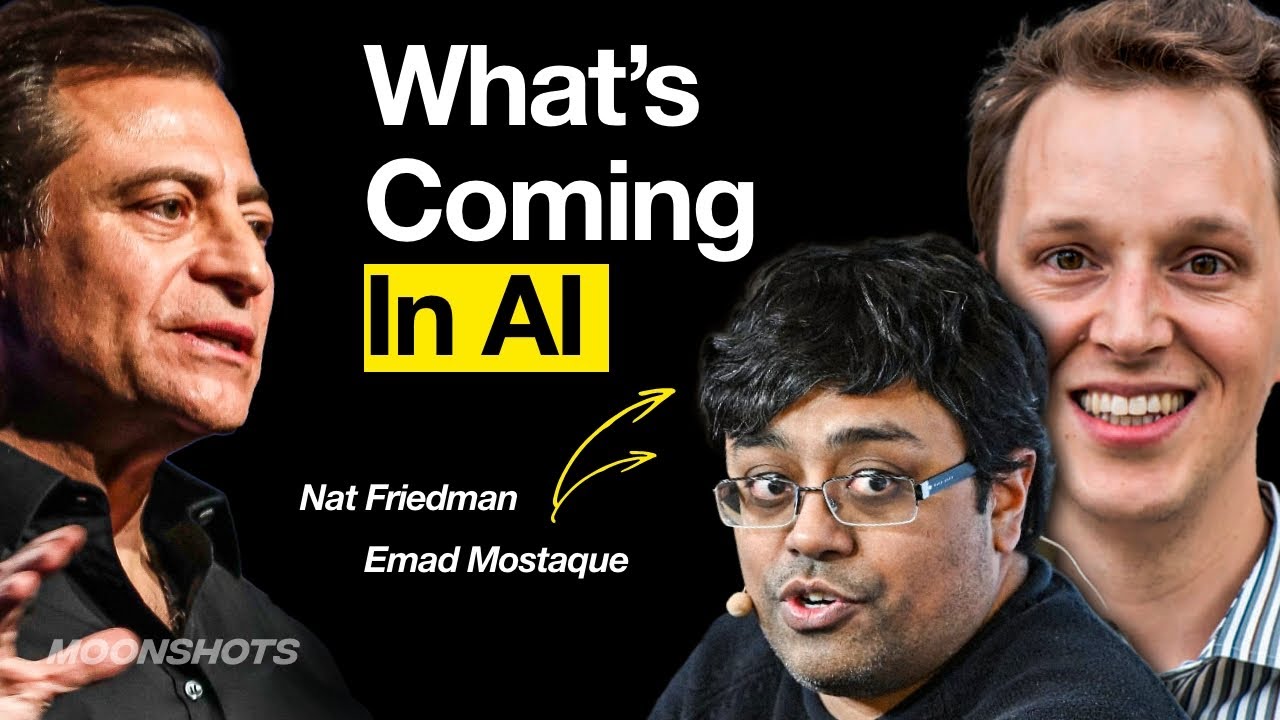

What Nat Friedman Expects From GPT-5, Microsoft's AI Strategy, And How He Invests In AI Startups
