101. Ryan Dusick: Author of Harder to Breath
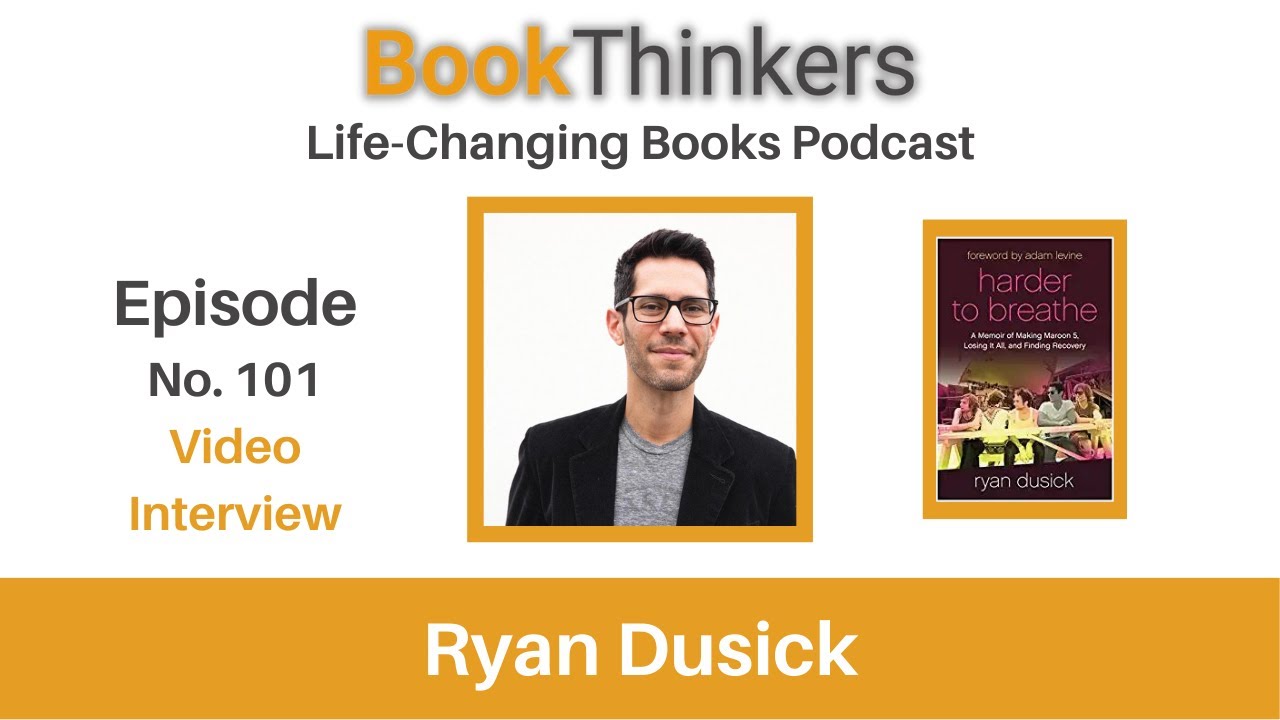
This content was created by Nick Hutchison. This content was uploaded by Nick Hutchison. This is a YouTube podcast interview (episode titled "101. Ryan Dusick: Author of Harder to Breath", created 2023-01-27) from the Book Thinkers Life-Changing Books Podcast. Host Nick Hutchison interviews Ryan Dusick (founding drummer of Maroon 5, now a therapist, advocate, and author) about his memoir Harder to Breathe. The excerpt covers Dusick’s dismissal at the Houdini Mansion, his childhood and musical influences in Los Angeles, the formation of Kara’s Flowers/Maroon 5, early anecdotes (7-Eleven, youth baseball), creative dynamics within the band, and the book’s themes of resilience, recovery, and identity.
Chapters
Ryan, welcome to the Book Thinkers Life-Changing Books Podcast. How are you doing today?
I'm doing great. Thank you for having me on.
As the Book Thinkers family is about to find out, I'm very excited for this conversation today for a few reasons. But before I jump into those, I'd love to have you introduce yourself to my audience.
Yeah. Well, I'm Ryan Dusick. I was the founding drummer of the band Maroon 5. I was in that band for over a decade. And my journey, you know, that was a whole lifetime unto itself. But my journey didn't stop there. I dealt with a lot of, a lot of pain when I left the band and alcoholism for a decade, as well as other mental health challenges, which ultimately led to my new path in life, which is as a mental health professional. I'm a therapist and an advocate. And an author. And I've written this book, Harder to Breathe, which kind of tracks my whole journey. There it is. My whole journey from, you know, before I was in the band through all the years in the band to what I've been doing since and how I've gotten to this place of advocating for hope in recovery.
Well, I'm excited because when I was younger, the album Songs About Jane, which leads off with Harder to Breathe, the name of your book and also the lead track on that album, was my favorite album and, and still is my favorite album of all time. And I can remember going to Maroon 5 concerts and singing these songs with my family and my dad. And so when I saw that you put this book out, I said, wow, I would love to collaborate with Ryan, help him promote the book a little bit, ask a couple of questions. And so that's what we're here to do today. So we're going to talk a little bit about the book, which deals with both music and recovery. So I think what we'll do is start off with the same trajectory that the book does, talking about the founding of Maroon 5 and what you were like as a child, and then kind of go into some of the more mental health-related, recovery-related subjects in the second half of the podcast. Sound like a plan?
Sounds great, man. Thanks.
Okay, so you kick off the book in a very dramatic way. It's 2006, you're at the Houdini Mansion, which is not as spectacular as you thought it was going to be. It's a little bit of a— it's a little bit trashed. And it's been a few years since Songs About Jane blew up and you sold 10 million copies or so at the time. You're there with the band to record some demos for your next album, and something happens. I'd love to have you kind of pick up the baton as I hand it to you here and tell the second half of that story.
Yeah, I started the book with that scene at the Houdini Mansion because it was a pivotal moment in my life. It's the moment when I officially was asked not to continue in the band. And I treated it in writing the book, I treated it kind of like it was a, you know, the crime scene in a mystery novel, like take you right to the murder scene, you know, and like, how did it get to that? And where does it go from there? Kind of leaving you on a cliffhanger was the idea. And so I figured that was a good way to start because it takes you right to everything that my life had been up until that point. And where it has gone since, and where my life had been before that. We start at chapter 1 after that, after the prologue, my childhood growing up in LA, and, you know, a product of a very eclectic background, a mixed family of different cultural backgrounds, musical backgrounds, and then that leading to the formation of this band in high school. which was, you know, just these misfits at the school that we were kind of the only 4 musicians, really, not really, but some of the only musicians there and came together, these brothers that formed a bond in 1994 and worked for a decade to finally reach the mountaintop with the album Songs About Jane as Maroon 5. So that's the kind of the first part of the book leading up to the band. And then the middle part of the book is you know, that whole journey going on the road and promoting Songs About Jane and what a toll that took on me and my constitution. Just all of the issues that I hadn't really dealt with or wasn't even aware of in myself because I didn't have the language to discuss mental health, let alone do anything about it in those days. So, you know, all of that is the precursor to where I get to in that moment at the start of the book. Where I have this breakdown and I have to leave the band and where will it go from there?
Well, as a reader of many books, as you could probably see behind me, I read a lot of introductions and I thought yours was amazing. I was given a tip one time in regards to writing, which said oftentimes you want to, you want to create and build up for a scene. But really what the reader wants is you kind of open your eyes, you have the blood flowing from your nose, the bully's on top of you with a fist, and that's where you start. You have to start there, and it creates that sort of anticipation. It speeds up the book a little bit. And so I'm happy you did it that way. Um, obviously it was a very tough time for you, and it led to some things that we'll talk about in a couple of minutes. But can you paint that picture for us a little bit? I'm sure some of the readers are going to want to understand what that's like with other members of the band sitting around that table and you're being asked to leave.
Yeah, it was a really devastating, painful moment in my life. that, uh, I couldn't have anticipated a few years earlier. Um, we were brothers, you know, we started the band together in high school. I was the oldest member. I was kind of the, the responsible one. I was the one who was making sure everyone, uh, showered and, you know, didn't throw TVs out of the window at our hotel rooms. I, you know, so it was like I was— in the early years of the band, I was, I was the guy. I was booking the shows. I was driving us around in my Jeep. Uh, with all of our gear and, you know, making sure that we took down, uh, the mailing list and sent out— this is real mailing list in those days, pre-email, right? So, you know, there's all this history, all this time in the band, and, and really a connection that was beyond just, um, friends and beyond just music. It was a spiritual connection. And yet it had gotten to this place for me that I couldn't perform anymore. I physically couldn't perform. There was a lot more going on than just the physical ailments, the joint issues, and the, and the nerve damage. But at the end of the day, the band had gotten to this place finally where we were on top of a mountain, ready to conquer the world, and their drummer couldn't play anymore. So I'm sitting with these guys who are my best friends, but feeling alienated from them because they've been going further and further into the limelight, and I've been retreating more and more and isolating. And I have to, you know, stare them in the face and look at them and accept this reality that I'd been in denial about for a year, probably knowing somewhere in my unconscious that it was coming because this was not sustainable. It was not manageable. But that was the moment in which I couldn't be in denial anymore, and I had to really just kind of sit with the reality that this is not going to be my life anymore. And losing not just this career that we had built, you know, that was so epically successful at that moment, but also just really losing my identity, losing my sense of purpose and meaning, everything that I'd focused on in my life up until that point since I was 16 until 28. And then on top of that, losing really my entire social circle. You know, these were my guys and the guy and the group of friends around the band was like my whole entire social sphere. So, uh, it really felt like everything that, that mattered to me, everything that was important in my life, was just crashing down around me in that moment. Um, and it was awkward for everyone. I mean, the guys in the band, they didn't want this to be the reality any more than I did. Um, but they had a career, a business to run, and, you know, an album to make, and They had to make the decision that it was time to move on as painful as it was.
I'm happy that you just mentioned that it was a business because we interview a lot of business authors on this podcast that have similar stories. Certain members of a founding team aren't a good fit for the business anymore. And if you look at the business and what it needs and you're looking to serve the business, sometimes you have to break apart founding groups and Maroon 5 and the band in that group that you were a part of, it was a business. And that's a mature way to look at it. And I think what's important to highlight here from this segment of the story and how you kick off the book is this is a story of resilience and recovery. And people can read this and draw inspiration from it and apply it to whatever battles they're facing. We all have some version of what happened at the Houdini Mansion in our own lives. So it's It's, uh, yeah, I'm happy that you wrote it that way. It's inspirational. Now let's, uh, let's go into your childhood a little bit. That's how, that's how you transition into the book at the next part. You highlighted earlier that you had some musical influences in your family, so can you highlight a couple of those people for us?
Yeah, I was really lucky growing up, uh, with the family that I did. On top of the fact that just there was a lot of love and support in my family, and my parents are really great. My dad came from a musical family. His dad played the piano and wrote some songs, and his sister became a Broadway singer star and went on to be a TV star, film star, and recording star, all that stuff. So in my childhood, there was my aunt and my dad on that side of the family were both very big personalities and very musical and just loved singing, loved music. And then on my mom's side, my mom was from Mexico, and her family was very musical as well. Perhaps not in the same showy kind of way that my Broadway family was. But my uncles— actually, my grandfather, whom I never met, played the mandolin and the fiddle. And my mom and her siblings grew up with that in their household. And then my Uncle Gil played the guitar. My Uncle Rick played the jazz drums. And Rick was still playing with jazz and blues groups well into my life, and those were some of my first memories of seeing live music, was going and seeing my Uncle Rick, you know, playing with his aging jazzers. So that was fun for me and my brother as kids before we even knew that we were musical in any way. We took piano lessons, but that didn't really stick. But I also, you know, my— I had cousins, I had my brother who were into rock and roll. It was the era of MTV in the 1980s, and so a lot of different influences. influences, you know, and culturally and musically. And, um, and then my brother picked up the electric guitar when he was 14, and that was kind of the inspiration for me to find my instrument, which eventually became the drums pretty soon thereafter.
Yeah, Christmas 1989, right?
Wow, you took some notes.
I did, I did take some notes. So what I, what I find interesting about memoirs like this as compared to a lot of the books that I review, which which are traditional business nonfiction types like leadership and stuff like that, is that a book like this reads like a movie. I mean, I can see it happening, especially in the way that you've written it. And so something that stuck out to me, and I just figured you could tell 2 quick stories, were the only in LA memories from this point in your childhood because those are pretty spectacular stories. Not a lot of people have those.
Yeah, you know, it's funny growing up in LA, you have those moments, especially where I grew up, because I was kind of like right on the border between Hollywood. And when I say Hollywood, in those days, it was pretty grungy. I don't mean like, you know, the Hollywood you imagine in movies, you know, just like the decaying part of LA. And then Beverly Hills was on the other side of the border where we lived with the most affluent kids that were going to private school and children of celebrities. And so I had a little bit of a juxtaposition between those 2 things, going to a public elementary school where we were middle-class kids, relatively humble, and then playing soccer and baseball with these children of affluence. 2 of them were on one team, Neil Diamond's son and James Caan's son. 2 very big celebrities. Neil Diamond, of course, massive singer star, and Jimmy Caan being from The Godfather, Sonny Corleone. So very cool guys to meet. I never got to talk to Neil a whole lot because he was so famous that he would come to the games and he would just have his hat down low, scruffy. He'd pop his collar and just kind of sit up in the corner of the stands because he didn't want to get recognized because he'd get mobbed. You know, that's how famous he was. And so no one really heard anything from Neil Diamond for 2 years that his son was on my team until the championship game when I was 12. It was a very tense game, very close game. I was pitching and we were like within a run, maybe up by a run in the last couple innings. And it was very quiet and very tense. And all of a sudden he comes down to the front of the stands. He pulls like his hoodie off and his sunglasses and he starts like, He's like a cheerleader now. He's like, "Let's go Orioles! Let's go Orioles!" And everyone was just like, "What is going on right now?" Was that Neil, man? And he was like a little kid, just so excited, you know, for his son's team to be in the championship. And that was that was just a surreal one of those only in LA moments, you know. And the other one with with Jimmy Khan, he was another he was a very exuberant personality. He was he wanted to be involved all the time. He was trying to play catch with the kids and be an assistant coach and. My dad was the coach, and, but he had just gotten into a motorcycle accident, and he had a pin in his shoulder, and, and it was always in a sling. But that didn't stop him because he wanted to participate so badly that he would come and he'd take his sling off and he'd play catch with the kids, and then he'd be like, oh man. And so it was kind of funny. He actually taught me how to throw a curveball. I had never thrown a curveball before, and the way that he taught me was actually very effective for me. But so that whole year goes by. And towards the end of that season, Jimmy Caan rolls up onto La Cienega Park right by my house on like a Harley-Davidson or some big motorcycle. He's got a Playboy Playmate on the back with him, his current girlfriend. And she walks up and she's showing off her new necklace. It's the pin from his shoulder on a gold chain or a silver chain or whatever it was. So I thought that was, you know, a Pretty baller move.
I think any 12-year-old boy would. Yeah. When I was reading that, I was just imagining you kind of sitting there like, what in the world is happening? Especially juxtaposing like the area that you grew up in versus the kids and the families that you were playing sports with. I mean, it's just, it's a cool part of your history and reading about how important baseball was for you and how great you were at baseball was really interesting as well. And then, but kind of back to the Christmas '89, you're gifted a drum set because your brother's playing in a band, and you look at the drummer and you say, I could do that. And so you then go on, on the next page, to say that drums represented freedom for you. So how fast did that happen? I mean, were you in there on day one playing every single day? What was that like?
Oh, yeah. I mean, the way my dad tells the story, I said to him, in begging for this drum set, I said, you know, the way that the guitar was in my older brother Josh, the way that it was in him waiting to come out, the drums are in me just waiting to come out. And he was like, how can I say no to that? You know? So I get this drum set, I'm 12 years old. And from that day forth, it was like I'd come home from school, I could not wait to get home from school to go into our garage and just start beating the hell out of those drums. And I didn't know what I was doing, but it was it was— I didn't have a release like that before, you know, it was very cathartic.
Hmm.
When you're entering adolescence, there's a lot of angst that you haven't even begun to understand, let alone process. And granted, I mean, baseball was definitely my outlet up until that point, pitching, you know, was definitely my thing. But this was creative and expressive and Uh, and physical. And it was just kind of— I was emulating my heroes, the people I'd watched on MTV, um, and thought they were cool. But it was also just me alone with the drums, just doing whatever I wanted to do, whatever came out. So that was freedom to me. That was just expression and the ability to get out whatever I was feeling inside.
What did your parents think of, uh, the drums inside the house all the time?
Well, lucky enough, we had a garage, a converted garage that was separate from the house. We had neighbors that complained a lot. Actually, only one neighbor that complained a lot, to be honest. Everyone else was pretty cool. There was one guy that was kind of a, kind of a dick.
But I'm sure nowadays he says, hey, that annoying group of kids that played in the garage all the time ended up being Maroon 5, or at least the founding drummer.
Yeah.
And then you go on to talk about the 7-Eleven story. So, I thought this was pretty funny. It's probably one of those moments that people ask you about a lot on podcasts, but it's so entertaining and probably iconic now that I'd like to have you share that story.
Actually, nobody has asked me about that story.
Oh, wow.
Well, Adam Levine and I were acquaintances as kids. I mean, family friends through another family friend. We knew each other at these events, birthday parties. We had taken a little trip with a couple families down to La Jolla one weekend. And to me, he was just— he's— Adam's a year and a half younger than me. He was 2 grades younger than me. And when you're 12 years old, you know, a 10-year-old is like a child to you and you think—
Yes.
So he seemed like just, just, you know, an annoying little brother to me at the time. He was very rambunctious too. He was kind of a, you know, a hyperactive kid and So, but we started this band when we've just started playing instruments. I had just started playing the drums. He had just started playing guitar, and we had a mutual friend, Adam Salzman. He was the connection, their family, the Salzmans, who was actually a pretty good guitarist by that point, and he was singing a bit, and he kind of put the whole thing together. We had like 3 or 4 rehearsals in my parents', in my family garage, and You know, we were terrible. It didn't really go anywhere. We didn't book a show or anything like that, but it was fun. Uh, but one of those first rehearsals, and with, uh, Adam Salzman, Adam Levine, and this other kid Jesse Nacida, um, we took a break one day and we all walked to the 7-Eleven down on the corner of Olympic Boulevard and La Cienega. And, uh, and Adam did that thing when we came in, we wanted Big Gulps, of course, right? Uh, we grabbed the big You know, 32-ounce or whatever it is. And Adam goes immediately to start, you know, putting a little bit of each soda in his Big Gulp, a little Sprite, little Dr Pepper, little Diet Pepsi. It was like, and I was looking at, I was just watching him and I was like, oh yeah, I used to do that. And he, he turns to me and he says, he says, my friend showed me this. This is, this is the way you have to drink soda. This is so cool. And apparently I said, yeah, I used to do that. When I was young and immature. And Adam was like very deflated and he poured out his big gulp. He tells the story to this day. He's like, Adam made me feel— I mean, Ryan made me feel like this small. And I don't remember it like that. You know, I don't doubt that it's true if he remembers it that way. You know, because like I said, I was 12 years old, just entering adolescence. and wanting to probably assert some dominance over these younger kids or pretend like I was the grown-up one and I was very mature. But it's kind of funny to think about, you know, 10-year-old Adam Levine.
Yeah, no, I mean, it is funny to think about, you know, getting embarrassed and pouring out the soda and then, you know, now what exists out in the world is just so very different. And then, you know, in the book, you kind of skip ahead a little bit and you talk about Adam and his squad sort of begging you to join their band once you were all in high school, and you end up forming what becomes Kara's Flowers. Is that right?
Yeah, Kara's Flowers.
Kara's Flowers. Okay, Kara's Flowers.
Very common mispronunciation, and part of the reason why we ended up changing the name, because it was actually named after someone, a friend of ours named Kara. Um, but no one would understand us when we would say the name Kara's Flowers on stage. We would say, we're Kara's Flowers. And afterwards they'd be like, did you say Carson Flowers or Carson Flowers? And then when people see it written down, they always say Kara's Flowers.
So yeah. And that's what happened to me. I know you have an audiobook coming, so if I had listened to it, I'm sure I would've had the pronunciation right.
Yeah. Yeah. Well, I had been playing in the school band, uh, at Brentwood High School. And like I said, with my older brother who had his own band and he was playing in the school pep band. really accomplished guitar player, and the guys that he was playing with, uh, were, you know, guys who'd been playing for a few years and really quite skilled musicians. And so I was, you know, playing above my pay grade coming up, and it made me a lot better playing with these older guys. Uh, but all of a sudden, you know, as most of those guys had gone off to college, including Josh, um, I was in 11th grade, um, and had like no musicians my age to play with and wanting to start a new band of my own. And then I realized Adam Levine, who I'd known when we were kids but I hadn't seen in a couple years, was a freshman now at Brentwood. And I heard him sing one day and I was like, okay, I didn't realize he could sing like that when I knew him as a kid. And, and immediately I thought, that's the hardest thing to find in any band is a good singer, right? There are a lot of guitarists and a lot of drummers and bass players and whatever, But finding a good singer is really hard to do, and that's the difference between you know every other band and a good band. So I wanted to start a band without him. I was like kind of being persistent with him, like let's just me and you find a guitarist and a bass player, you know, just a really sick trio, me and two other guys, and you can sing. And he was kind of like, I don't know. I have this band with my buddy Jesse, my best friend Jesse, and Mickey, my other best friend, and. Um, I can't start a band without them. And they had only been playing for like a few months, you know, and they were not very accomplished yet. So I was hesitant to start a band with these guys, not knowing exactly how, uh, what kind of musicians they were. But Jesse was, was very persistent. In, in PE class, he would follow me around like a little puppy dog. And he was— Jesse was just a very, uh, enthusiastic kid, very just like wide-eyed and bushy-tailed and just like We're so good, man. Like, Adam is a really good guitar player and I'm getting really good, and Mickey's a good bass player, and you need to be in our band because you're the best drummer in school. And it's just like— I was like, all right, all right, okay. It's like, maybe let's, let's jam a little bit, let's see how it goes. And I was resistant, I was reluctant because, uh, I wanted to play with some top-notch players. But then that all changed one day. We were in the, the orchestra room in school one day and we were rehearsing for a pep rally that we were going to play at. And we were playing Rage Against the Machine's Killing in the Name, which is very inappropriate for a high school pep rally. And, and it just kind of hit me like a ton of bricks in the middle of one rehearsal playing with these, these 3 guys, just realizing we were so locked in in terms of what we were trying to do with the music, the intensity of what we were doing, the passion. the influences that we had, um, there was a chemistry that far exceeded any level of musicianship that might be lacking at that point. And I realized that's what matters most, is that we connect and that we're on the same page and that we— the, the whole is greater than the sum of its parts, right? Uh, that's what you're looking for in a band as much as you are, you know, a shredder guitar player or, you know, some other great musicians. So it just kind of hit me right in that moment, like, this is it, that we're on to something here. No reason to question it or to pick it apart or to try to think we can do better or something, because we have something really cool here. And from that day forward, it was just kind of like the 4 of us were just a unit that spent all of our time together, and we were just really passionate about each other and what we were doing and growing by leaps and bounds. On a daily and weekly basis, musically and just as young men growing up.
As I mentioned, I read a lot of entrepreneurship memoirs and I think this sort of reminds me like of the founding of Apple, you know, Steve Jobs and Wozniak in the garage working things out for the first time. And your brand, the brand of Maroon 5 is as big as anything on the planet. And so these stories are just fun to talk about. They're fun to think about and not a lot of people know these stories. And so Um, for Cara's Flowers, I thought how you named the— or how the group was named Cara's Flowers was an interesting story. If you could just highlight that real quick, it's just one of those funny little things.
Cara was a girl at Brentwood who was in their class, Adam and Jesse and Mickey's class. Um, I was a shy guy, like I, I hadn't really dated or anything at 16, um, which is weird, you know, being in a band at most high schools, that probably makes you Very cool. At my high school, that was a, you know, college prep wealthy school where people are mostly concerned about their cars and what, you know, Ivy League school they were gonna go to and stuff like that. Being an artist of any kind was not really where it was at, but I was also just very shy. But I had a crush on this girl, Kara. I thought she was really cute. She was a friend of Adam's, and I think they'd gone to elementary school together, so they knew each other. Um, and the night that we formed the band, just Adam and Jesse and me, um, it's a long story. There's a whole chapter on it, so I won't tell the whole thing. But, um, but we, at the end of this night, we had decided to form this band and we were back in my, at my parents' house going to sleep. It was around midnight and we were all really excited and just wanting to like get going with this new band. And Adam's like, this night can't be over. We need to cap this night with something epic. And he was a little more adventurous than I. I was, like I said, the responsible one. I usually followed the rules and did what I was expected to do. But he was like, we got to sneak out of the house and we got to go to Kara's house and wish her a happy birthday. It was her birthday the next morning. And I'm like, oh no. But then I'm just like, you know, there's so much excitement, there's so much enthusiasm, and I can't say no to this guy. He's too— charismatic to say no to Adam Levine. So, uh, we, we snuck out. We pulled my, uh, Jeep Wagoneer out onto the street, put it in neutral, and rolled it down onto the street and started it up, got in, headed out into the Hollywood Hills to find— because Adam said he knew where Cara lived. He didn't know where Cara lived. So we got lost driving around in the hills above the Whiskey a Go Go and, uh, ended up having to sneak back into my parents' house to get the school roster to find her address. Tried to find that again, couldn't find it, came back, had to sneak back in again to get a Thomas Guide, which in those— this is before we had, you know, phones that had maps on them. So you had to like manually look up, you know, on a certain page in the Thomas Guide for the streets. We've ended up rolling up to her house at like 3 or 4 in the morning, finally, after this epic journey where, as much as anything, we bonded. You know, the original three guys just really went on a quest together, and and needless to say, she was she was pretty stunned when we knocked on her window at four in the morning with flowers in her hands, and she was just like confused and like blushing. And you know, it was I thought it was going to be kind of dorky. It was actually kind of cool. She seemed impressed, and and it worked out pretty well for us. So that was the beginning. That was the start of Kara's Flowers. That's how we got the name of the band, and we had that name for. 7, 8 years.
Yeah. And then what you just kind of highlighted was one of the things I wanted to bring up, and you bring up in the book quite a bit, which is the dichotomy between you and Adam, the differences between the two of you. And one of the things that you just said kind of 2 questions ago was you realized that when you were playing together, the sum of the parts was greater, or whatever that saying is, like, it just felt right. And one of the things that you believed was that Even if everybody wasn't up to the same skill level, like you could get there, you could learn. And I read that Adam thought, no, you're either born with this or you're not born with this. So it seems like there was a little bit of butting heads that started to develop between the two of you guys.
Yeah, Adam and I, you know, we're, we're brothers in every sense of the word. You know, we're bonded in some like very familial ways and we're very similar in certain ways. And then we're almost like opposites. in other ways, in terms of the way we see certain things or just our natural temperaments. I've always been, or always was growing up, a shy kid, a very controlled kid, you know, just sort of perfectionistic, like held myself to a really high standard, was really hard on myself, would get down on myself if I didn't do things up to that standard. I could be obsessive, you know, in my thinking about things. compulsive in my behaviors. And just by all accounts, a kind of anal, kind of just a compulsively anal kid, very neat, very orderly. And I was the organized one in the group. I was the one who kind of put everything together. And then Adam is like on another extreme on the other end of it. He was an ADD kid, which at the time I found very frustrating. I obviously understand that a lot better now as a mental health professional. But, you know, he was, he was scatterbrained and it was hard to maintain his focus. He was very excitable and very distracted a lot. Like, we'd be talking about something passionately and then something else would catch his attention and he'd be gone and be like, where'd you go? And it was so— it could be frustrating for me. And he just kind of had this very impulsive mindset about life, about just like pursuing something if it's, if it's exciting and you're passionate about it. And if there's a spark and a magic. And so in— as far as how that related to the music, like, if, if something came to us or he wrote a song and he brought it in and it gelled immediately, like, we would write— knock out a song in like half an hour and it would be magical.
Wow.
We'd have these moments where it was like everything just flowed and there was this natural energy, and that was wonderful and magical. I'd never experienced anything like that in my life before, uh, But then if it was work, if it was struggle, or if it was like we had to pick it apart, or, um, they required, you know, refining or growing, or sometimes it was just hard for Adam to maintain that focus. He just kind of, you know, whatever, I don't want to— let's not force it. Like, let's move on to something else. And a lot of times that meant just like going to lunch, you know, and for 2 hours and then blowing off rehearsal. So those things could be frustrating to me who like wanted to be like, okay, it's not perfect yet. Let's make it perfect. And he was more like, it's like, it's not perfect, whatever, we'll do something else later, you know. So that kind of stuff could be aggravating. But in a lot of ways, I think we were kind of foils for each other. We balanced each other in terms of our energy. I think he probably needed me a little bit to rein him in because he had all this natural— he was like a savant, a creative savant, just like melodies would come out of him and just ideas and things that were unrefined, you know, definitely a— a diamond in the rough in those days. And he probably needed to learn a little bit from my sort of organizational skills and just working through a problem and finding a solution. Whereas I needed a little bit of his— what he offered, which was this spontaneity and enthusiasm and just like going with the flow and having an idea and just being impulsive about it. I needed to loosen up and do a little bit more of that. So I think that we were a good balance for each other in that way.
Yeah, it sounds like you were—
frustrating as it could be at times.
Well, it sounds like, yeah, you guys were necessary for each other and for the success of the business and the band. I mean, you can't just have one person off and, you know, switching gears every 2 seconds and the other person not taking any risks. You kind of have to come together in the middle, and that's probably one of the reasons that you were so successful.
I do think that that was a factor in terms of the the chemistry, not just musically, but, you know, just as personalities forming a business, you know. Uh, you do need, uh, someone who thinks outside of the box, you know. You need somebody who pushes the envelope and, and will follow an idea wherever it may lead, um, without restraint or constraint. Uh, and then you do need somebody who's organizational, somebody who thinks critically and who can, um, you know, rein in what needs to be reined in and, and cut through the nonsense and find what makes sense and what's logical. So I do think that without even planning that out, we had that in the initial chemistry of the band between us. Jesse added— both Jesse and Mickey added interesting dynamics as well, because Jesse is— because Adam could be impulsive, I could be too controlled. Jesse was driven and focused, but in a much more grandiose way than either of us. Like his vision, he was always thinking like 3 steps ahead. and wanting to do something he thought big. You know, he wanted to do— he was already thinking about having string sections in our songs when we were still just figuring out how to play the drums and guitar. And, you know, he wanted to incorporate classical music and jazz music and, and was just very, like, driven for, like, changing the world with our music. And with, you know, the Beatles were our heroes at a certain point. And And Jesse liked the idea of like starting a revolution with what you do as a band. So he, you know, he was an interesting dynamic as well. He needed to be reined in a bit at times too, because he could be out sort of like in this dreamerland of very idealistic. And we needed that. We needed that. That drove us forward. And then Mickey was kind of this, a very cool hipster type. whose taste was very refined and very, you know, indie and was always a little bit rejecting of the idea of really mainstream stuff. So he had this effect on us of whatever we were doing, we wanted to make sure that it was cool with Mickey because if it was cool with Mickey, that meant it was cool, right?
Yeah.
We all balanced each other in a certain way. It's like Adam and Jesse needed a little bit of reining in, but they also needed a little bit of, space to run. And Mickey and I kind of balanced them out in some of those ways.
In a few minutes, when we transition to the second half of our conversation, before we— I want to touch on a few other things first. I think we'll go back to this point and how writing a memoir can help you like see value in different people throughout your life in different ways and stuff. But we'll kind of skip ahead. I know you said in 1998, the band was in kind of a rough spot. You guys had started, I mean, you were taking it seriously for a few years now, but you were in this weird transition point. And there's something that Adam says in the foreword to your book that I wanted to read. He said, we were 5 white kids in an LA rock band playing soulful R&B pop music. And so there's a point that you highlight in 1998 where you started to go from more like traditional rock, your original influences, to sexy music. So how did that happen? I mean, that's a big transition. Normally you're grouped into specific segments of music.
Yeah, you don't see that happen all that often in that way. Uh, when you, when you actually, when you read the book and you look at how it evolved, it does make sense that it happened the way that it did because we grew up with eclectic taste. You know, we ended up in the '90s being this very '90s alternative rock band, but we had other influences before that, and some of those were like Michael Jackson and Prince You know, growing up in the '80s, those were, you know, ubiquitous artists. Those— I mean, you turned on MTV and they were on constantly. So— and I was a huge fan of Thriller. All of us were. I mean, that was like the definition of pop music as a child. But it was in the late '90s when we were going through an identity crisis and we were all trying to find our own direction. I mean, we were young men, just— we had made this record in '97 that had failed. We were— I was 20 years old, 21 years old, or yeah, turned 21 in '98. And just figuring out who I was, let alone what the band was. And we were all listening to a lot of different kinds of music. Every month we had a different sound. We would write new songs and some of them would be kind of folky and then some of them would be like classic rock and then some of them would be all of a sudden there was this like little bit of an R&B soul tinge to some of the songs. And it was because Adam and I had both been listening to a lot of Stevie Wonder. That was kind of the turning point.
Mm-hmm.
And it was weird. I think— I don't know if I turned him on to Stevie Wonder or if we both started listening to Stevie Wonder at the same time. But strangely enough, whereas everything we had been doing up until a certain point was this alternative rock, we both were listening to this classic soul. And, um, and then that translated to listening to a lot of contemporary R&B and hip-hop and being really influenced by that. And at first it was kind of like, okay, I like this music, but there's no way to incorporate this with what we're doing. We can add a little bit of bluesiness, and with Jesse's influence, a little bit of jazziness. So that was kind of how some of the Stevie Wonder stuff kind of started to make its way in too, because Jesse was writing more on the keyboard, more piano. And it was more, uh, jazzy and classical in some of the arrangement. Um, but then there was one day in rehearsal when we were all talking about like our favorite hip-hop and R&B tracks, um, tracks by Timbaland and the Neptunes, you know, Jay-Z and Busta Rhymes and Missy Elliott and stuff like that. And I think Jesse had the idea. He was like, why don't you just play a beat like that, you know, just do a real drumbeat, like, but influenced by hip-hop. And so I started playing this beat, the first thing that came to me that was influenced by a Timbaland beat. Jesse started playing something on the piano, uh, first thing he played was the riff to Not Coming Home. Adam starts writing a melody, and within 20 minutes we have the song Not Coming Home written. It was one of those magical moments where it just— and it was, it was audacious for us at that point because it was like We were bringing in influences that we had had for a long time, like Michael Jackson, uh, and then we were bringing in these very current influences at the time, uh, in the late '90s, early 2000s. And, and we were just like looking at each other like, this is different. This is different than anything we've ever done and different than anything we've ever heard, because you hadn't heard white guys in a band like us, a rock band, going this close to hip-hop, R&B, without crossing over completely to using programmed drums and stuff like that, you know, and looping it and all that. So it was this intersection of 2 worlds that we knew was unique. And rather than be fearful of it, we were like, let's just lean into this. This is finally a sound that is unique to us and incorporates and embraces all of our influences. And so that was kind of like the turning point for us. It was like, oh, okay, I think we've got it now. I think we're on to something. And that was really the genesis of what became Maroon 5.
I mean, as a fan of that album and it playing such a big role in my childhood and singing those songs with my dad and stuff like that, I mean, despite the subject matter, which we'll talk about in a minute, but like, it's so cool to hear this. I mean, it really is. And, and I'm happy that you took the time to write this book simply because it gives different meaning and perspective to the music as I'll continue to listen to it for a long time. And I think that's one of the cooler parts about you writing it. And so I have kind of a left-field question. What advice would you have for people who don't want to deviate from what they're necessarily doing but feel drawn to inspirations in other places? I mean, clearly you guys leaned into it. And it blew up for you. But I'm sure it was not— I'm sure it was a little scary and a little strange to deviate from what you had been doing for so long.
Well, I do think that trying to stick to something that is comfortable is a recipe for mediocrity. And I say that, I say that kindly, because as a mental health professional now, I understand that We grow in discomfort, right? If we always avoid the things that make us uncomfortable, we stay exactly where we are. We stay stagnant, right? It's in the discomfort that we learn and that we find new ways of being and discover ourselves, discover new versions of ourselves. Well, as it applies to creativity and artistry, music or otherwise, I do think you need to always be moving forward, whatever that means for you. You can stay within the genre of, you know, you play rock music and you're always playing rock music, but you look at any of your favorite rock bands of all time, you know, the ones who really stood the test of time, each album is a little different. They go a little further. There's a progression. There's an evolution, right? If you're trying to recreate something you've already done, you're stagnant. But especially if what you've already done has not been the thing for you yet, you're still finding your sound, you're still growing. So you have to be open to the idea that it might be something that's new and a little bit uncomfortable where the real magic is going to happen, I think. So also, I think that for us, we were really lucky that we had this failure with our first album, with our first incarnation as Cars Flowers. And we had this testing ground for a few years there where we could try out different things and push the envelope a little bit without it being under too much scrutiny. Um, we were playing every week at this place in Westwood, the Westwood Brewing Company, that I'd booked a residency at. And we were playing for like 2 hours every Thursday night, and we didn't have enough songs to play for 2 hours, so we had to really stretch out We were doing a lot of COVID songs. We were jamming a lot. We were just pushing ourselves to do new and different things. And in that environment, it made a lot of sense to be trying to play more danceable beats in a college bar, you know, and to be trying to entertain the sorority girls, you know. That was fun. And it was, it was purposeful in that we were trying something new. We were trying to entertain and do something that was new and exciting. For us and for our audience. So we had the benefit of that to kind of try out things and test things. I think that as an artist, you know, you've got shows and you're, and you're making demos or whatever. If you're not comfortable going on stage and doing something totally new and foreign to you, um, there's, there are other avenues to do that, right? You can do it without necessarily, um, you know, I mean, there's no reason why you can't at one rehearsal just break out and do something totally opposite from what you've always done, or write a new song and just like, I'm gonna try to write an opera today, you know, and just something that's totally outta left field for you. That's where you grow. It might not be the thing, you know, it might be an experiment that leads to, to nothing, but even if so, even if it falls flat, you're gonna learn something from that process much more than trying to write the same song you've written 20 times before.
Yeah. And it sounds like for anybody listening today, mixing things up in whatever profession you work in, or whatever hobbies you play around in. There are benefits to doing that because you do grow in your discomfort. So that's a cool way of putting it. I'm happy that I asked the question, and I kind of want to skip ahead a little bit. I mean, you go in to talk about Songs About Jane a little bit more, what it was like touring. I mean, just like most Maroon 5 fans that came to know about Maroon 5 because of Songs About Jane, I didn't know. that you guys toured for 2 years and did 500 shows promoting the album before it sort of took off. So that was fun to listen to or fun to read and learn a little bit more about driving around in the small passenger van instead of the glamorous RVs and stuff. You're doing an audiobook, right? So when will that be out?
Yeah, I've done the majority of it. We're going to do the last sort of touch-ups, I think, next week. So hopefully by Christmas, that'll be out. I don't know exactly the date, but it's coming soon.
Any, uh, any music in there that you layer over your reading?
No, that hasn't been part of the process. I mean, that's a cool idea. I don't know if we can get clearance for that.
Yeah, I don't know either. I was just curious. I was like, it'd be cool if like something kind of like came in and out as you were talking about a certain song or something like that. But yeah, that's cool. So, all right, we'll transition to sort of what happens after that moment that we kicked off the podcast with. So nerve damage, you're having problems, you— your performance is suffering, you're asked to leave the band. What happens next? I mean, what's life like the day after you're no longer part of what you've put your entire identity into?
Well, in some ways, um, there was a moment of relief because I had been for like a year and a half Trying to come back from this injury, and during that time really devolving. You know, my entire spirit, my my entire constitution had just been getting knocked down and down and down. My my self esteem, my self confidence, my sense of purpose was really just degrading over that time, trying trying to make my my way back. behind the drums in Maroon 5. So the day after the decision is, is final, I'm leaving the band, um, there's kind of a moment of, okay, I don't have to try anymore. I don't have to continue to try to break myself to overcome this. Uh, but then that segued very quickly to, okay, then what the hell am I? Who the hell am I? What is my identity? What is my purpose? I had this opportunity. I built this thing for over a decade, and now it's gone. My entire career, my entire focus in life, my entire social sphere, um, my entire identity. What do I do with that? And just feeling more depressed than I never felt in my life. And for the first time ever, drinking alcohol became a coping mechanism more than a way to facilitate fun. It became self-medication, you know. My attitude, because it was so painful, the reality of dealing with what I had just lost was so overwhelming. It was difficult to sit with it, to even accept that as reality. I look back on it now as a grieving process, stages of grief. You know, at first you're in denial. This horrible thing that happened, or this thing that I lost, it didn't really happen, or I'm going to pretend like it didn't really happen. I'm just going to act like it didn't happen. I'm happy. I'm going to go out and party, you know. Uh, and so that's kind of the form it took. It was this sort of The other, the other mind trick I realized I played on myself at that time also was, um, because something that mattered to me so much was lost, I had to pretend that I didn't care about anything. This very nihilistic approach. Well, nothing matters, you know, who gives a, who gives a shit? Like, I can just go get wasted and party and, you know, just go find some chicks and pretend like I'm a rock star and You know, who cares? Nothing really matters anyway, so I might as well just, uh, live as if nothing matters. Just live for the moment. And that seemed like, uh, seemed like truth to me at the time. But understanding the psychology of it better now, having done a lot of work on myself since, I realized that that was avoidance, that was escape. Um, and so I really was not in touch with what the real feelings were. They would come, you know, I'd drink a little bit and have a smile on my face and pretend like I was like, oh yeah, I'm having good times. And then I drink a little more and then it would go down into a dark place. And I'd find myself, you know, at 2 in the morning sitting in my office watching old videos of the band and crying, you know, just really, really depressed underneath all of that. And Those first couple years after I left the band were really dark. I mean, I, I, it was, it was a haze. Um, my anxiety ramped up. I was, I was constantly medicating something. Um, but then there was a turning point, maybe a year or two into that new reality, where another form of, of escape or, or rationalization and denial took hold, which was Okay, that's in the past. I'm moving on with my life. All I need to do is just kind of moderate a little better, drink like a gentleman, and get over it. Just get over it and get on with my life. And I refer in the book to that phase as the illusion of control, which is a common phrase you hear in recovery a lot because it's this, uh, it's a stage of denial. Um, and if you're comparing it to the stages of grief, it's like bargaining, right? Well, this is a certain reality. I can accept that, but I'm not going to accept this other part. I'm going to keep that under my control in some way. I'm going to negotiate with it. And so in terms of alcohol, that means, well, I'll only drink on the weekends, or I'll only drink, you know, after 5 o'clock, or I'll only drink beer or wine, or, you know, as long as I can sober up for family events, as long as I show up and I'm smiling and I'm looking relatively healthy and I look like I'm happy and everyone thinks I'm fine, then everything is fine, right? If I can manage that little dance between what's really going on behind closed doors and what's happening when I'm out in public. And what you realize in time when you live that way is that the only person you're really fooling is yourself, right? I look back on it now and it's just— that's That's what denial is all about. It's like, I'm not ready to accept how much I've been beaten down by this thing. So I'm just trying to create any illusion that I have control over these things, that I can control the feelings, that I can drink just enough or a certain amount to not be a wreck, but to get the painful feelings out of my mind. Just, there's a sweet spot that I can find. And It's insidious because you, you, it's, you, it works a little bit for a while. You feel like, oh, I'm having more good times than bad times. Yes, the negativity creeps in and I have these dark nights. And there's sometimes when I drink a little too much and I end up really hungover and sick or whatever. But I have all these good times too, where I'm able to just like pretend like everything's fine. And so those moments maintain the illusion, maintain the denial and the rationalization. But in time, the bad gets worse and the good gets worse too, until you're— the bad times are outweighing the good times. And that continues to progress. That's why we call it a progressive illness, because always when you're in that cycle, you think you're improving and you're actually degrading until it gets to a point of total unmanageability. And that's what happened for me over the course of like, uh, really a decade from when I left the band to when I got sober, um, to getting to a place of humility, which was what was necessary to achieve acceptance, ultimately acceptance, which is the end stage of both grief. You know, you go through the stages of grief and you eventually find acceptance of what has, what has passed, right? Um, and the beginning stages of recovery from alcoholism. Acceptance of my my illness, acceptance that all of these ways in which I've tried to control it has been an illusion. It's been a lot of rationalization. So being humbled, finding humility, finding acceptance, and moving forward with with just the ability to accept help and stop thinking that I've got it all figured out or that I can control it in some way. That's the beginning of recovery.
I mean, it's such an important subject for you to talk about. I'm, I'm sure that most people that go through something like what you went through don't write about it because I'm assuming it was painful. And, uh, I mean, is that your, is that your purpose for this book? It's, it's to tell a story that I'm sure a lot of people want to read about, but it's also to give confidence or to give guidance or to give advice or to give inspiration to people who are facing something like alcoholism. and giving them the, the toolkit, sort of the path forward.
Well, the purpose for writing this book, Harder to Breathe, was twofold. And you kind of touched on the other purpose as well, which was for me, that it was therapeutic. I had gone through a lot of therapy, I had done the 12 steps, I'd been volunteering at a recovery center and being of service, I was doing a lot of things that helped me find closure on that chapter in my life and reach a place of acceptance. But the idea to write this book seemed like a whole other level of therapy for me in terms of narrative therapy, rewriting the story of my life in a way that was going to be more useful for me moving forward. And the secondary purpose which was other people can read this and they can learn from my journey. And I will be of service in that way, hopefully offering hope and recovery, not just from alcoholism, but, you know, I tell the whole story. The reason why I start from my childhood is because I dealt with anxiety before I even had a word for that, before I even knew what anxiety was. Looking back, I understand it so much better now. And if I had, you know, some of— If somebody had been able to express their story to me in the way that I attempt to in this book, I might have learned some of those things or had better understanding, uh, to apply to my life moving forward that would have helped me in that journey to reach where I got to sooner. So, you know, that became the primary purpose of this book. I've been telling my story in meetings at the recovery center. I've been writing papers about it in grad school as I study clinical psychology. And I have this opportunity now to offer that story to a larger audience and for it to be something that can be empowering for me, but also empowering for the reader. If it's going to be— if it's a process that for me is fulfilling writing the book, if it takes me on that journey and takes me to places that I hadn't fully gone yet, I hadn't processed completely yet, and it's cathartic and it's an emotional roller coaster going back to some of these difficult places and then ultimately getting to this place of hope, then there's a good chance that people reading that story will have a similar, uh, you know, experience in, in, in re— in hearing about my, my journey. And if they can relate to it, not necessarily the exact particulars of it in terms of being in a band and the music and everything I went through, but just the feelings, you know, the ways in which I was really hard on myself, the perfectionistic qualities, um, the anxiety, the grief, the depression, the alcoholism, any of these factors of me, if you can relate to it, then you can see the ways in which I dealt with it at the time and the ways that I'm dealing with it now in a better way, uh, in a healthier way. And so hopefully that will offer some, some guidance and direction, but more than anything, hope.
Yeah, I mean, there are a lot of professions that statistically you either make it or you don't, right? Musicians, athletes, comedians. actors, actresses, performers of all types. You either make it or you don't. It's either your full-time profession and you're earning a nice livelihood from it, or it's a side hustle that will eventually die. And I'm sure a lot of people tuck a big portion of their identity into something, and it's very difficult when you lose it. And so your story can apply to anybody in any of those situations that has a loss of identity, that copes with it in an unhealthy way. And that you're, you're sharing the tools that you leveraged to get out of that situation. And one of my, one of the, one of my favorite books, it's called Built to Serve. And the author says your purpose comes from your pain. And so your purpose now, you are a marriage and family therapist, and you're a life coach, and you're helping people through these things. And so your purpose did come from your pain, you're helping other people bridge that gap. So tell us a little bit more about what you do today.
Well, like I said, I went back to school after about 3 years of sobriety to get a master's degree in clinical psychology. The reason why that happened was because I was volunteering at a recovery center. And the primary purpose for that was just to be of service, and, and to help me in my own recovery, to continue to remind me of what I was doing as a sober person. And it was very fulfilling, you know, showing up to this recovery center and just talking to people and listening to their story and realizing that I had something to give of myself in a helpful way. That offered new purpose for me, a new meaning in my life. So I started getting some good feedback, people saying, hey, you should consider doing this as a career. And then I thought to myself, why wouldn't I do that? You know, this feels as good as anything I've done in a long time. So I applied to school. I went back and I wanted to just become like a drug counselor or something like that. But then I found this new passion for psychology that was really exciting and realizing that I'd always thought of the world in those ways. When I watch movies, when I read books, I'm always thinking about the character development and what drives this character. Why are they the way they are? And I want to see the arc. of how they change over the course of a story. And so studying people and their, and their psychology in that way was interesting and exciting to me. Um, so I just kind of followed that along the path, and the next logical step was to become, uh, a therapist. The license is the marriage and family therapist. I'm now an associate marriage and family therapist working with clients, and, uh, I'm working at a clinic called the Missing Peace Center for Anxiety. in Agoura Hills, California. That's an inspiring place to work. A lot of great colleagues, interesting clients. I have some of my own clients. And now I have this book out, Harder to Breathe, which is for me the logical next step from there of being an advocate, also telling my story in a way that can be helpful. And it's because I've gained the education in psychology that I have, I have a different perspective on my journey than I might have had otherwise. But I was mindful not to tell the story, you know, in a heavy-handed or overly clinical sort of way. I wanted it to just be a narrative, you know, that people could relate to as like as if it were a novel. So, but the purpose is to be an example, you know, in the same way that you tell your story in an AA meeting or something and people learn from it, from when a speaker tells their story. As a therapist, I think I probably am somebody who talks about myself more than other therapists, perhaps, because I feel like my life experience is as much, if not more, a part of my education as a therapist than what I learned in grad school.
Hmm.
I think that going back to school at this age and taking everything that I learned in my own journey is what I have to offer as a therapist more than anything. You know, it's, it's having that real-world experience with some of these things and knowing that when my clients come into my office and they talk about their struggles, I can relate to it because I've been there. And if they understand that about me, then they're going to trust me more, you know. So the book plays into that and what I'm doing, and I'm just kind of following every opportunity as it comes to be helpful to the people that I'm talking to.
And how old are you now?
45.
45. So do you think you'll stay in this industry? Are you a therapist for the next 15 years? Is that what you plan on doing?
Yeah, I think so. I mean, you never— I've learned to never say never. And I've also learned that life has seasons. You know, I couldn't have predicted that I'd be doing what I'm doing now 10 years ago. And here I am, and it's inspiring, and it's exactly what I want to be doing right now. Is it exactly what I'm going to be doing when I'm 65? I don't know. It could be. I could have moved on to other things. I know I want to keep writing. I would love to write more books. I know that I want to keep speaking when I have opportunities to speak to people. And being a therapist is a great home base to do those things, you know. What that will look like exactly, I don't know. I might have an office in one part of town and I'm spend 90% of my time doing that, working there, or it could be a quarter of my time and I'm doing a lot of other things. So, but that's the wonderful thing about finding purpose. And as we discussed earlier, you know, the idea of like getting out of your comfort zone and doing something new. I'm at a point in my life now where something like that presents itself and I run towards it. You know, it's a challenge. It's not like, oh, I don't know if I want to step into that uncomfortable place. It makes me anxious. Now I see it as, well, there's an opportunity for growth. There's a challenge. There's something to overcome. There's something that, that might be rewarding in ways I can't even fathom right now. So who knows?
Yeah, well, you said alcoholism is progressive, meaning it will get worse as the momentum moves in that direction. And I think embracing discomfort is also progressive in that As the momentum moves in that direction, you'll just continue to embrace new things. And that's what happened with me. I mean, years ago, I found myself in a place where I was dealing with a lot of ego on one side of the spectrum at the expense of other people, and also a lot of anxiety at the other side of the spectrum. And so, that was a confusing place to operate from. I read a couple of good books that helped me change my entire perspective, and I started to focus more on impact. And like I said, your purpose comes from your pain. So does yours. And that's kind of where you are now. You're in a place where it's fulfilling to be of service to other people. And so, yeah, I think you should speak. I think you should share this story. I mean, you can, like you said, you can build a lot of trust with people because, I mean, when you talk about fame and fortune, you were literally at the top of the mountain and lost it all. And that's a big drop. So you gained a lot of perspective as the result of that, and then it took you 10 years to get to the next phase. So hats off to you. I'm so happy that you wrote this book. And before we wrap up, 2 more things. One, what's a final message that you'd like to share with somebody? I mean, we talked a lot about what was in the book, but what's another message to anybody listening today that might be on the fence? Hey, should I read this? Should I not read this? What other types of value does the book provide?
Well, I think the book is a balance. It's an entertaining story. I mean, you're gonna enjoy it regardless of whether you're into Maroon 5 or you're into addiction recovery. You know, some of the messages and topics that are in the book, I wrote it in a way that it's a story that will keep you entertained. It'll keep you engaged. There's a, there's a beginning, middle, and an end. and with plot points and all of that. So it's intended first and foremost to be something that people enjoy reading. But also, it's something that I think you're gonna relate to it, hopefully, regardless of, like I said, it's anything particular that is similar to your life. Whether you're a music person or starting a business or in school or having gone through loss, there's so many different angles from which you can relate to what's in this book. And ultimately, it's hopefully going to leave you with a feeling of inspiration for whatever it is that you do, and for your own life and your own happiness. And so my hope is that people that read this book will be entertained and inspired. And why wouldn't you want to read a book like that?
Hey, I'm with you. It gets my stamp of approval. My last question, I I called my dad this morning and I said, hey, Dad, you want to sit in on this? Because he was a huge fan of Maroon 5 back in the day. Songs About Jane, absolutely the best album from Maroon 5. And he said, ask him what it was like meeting Bono.
So that was my final question for you is, what was it like meeting Bono?
He's the biggest U2 fan on the planet.
Meeting Bono was awesome. It was, we were actually playing on the Top of the Pops at the BBC in London. And we pull in— when you're recording, when you're filming Top of the Pops, it's a long day on set, which is weird because you're, you're not lip syncing, but there's a track that you're playing to. So it doesn't even have to be that good a performance. You go up there and you just mime. But they have all day, like long hours of blocking and camera and sound and Everything because it's— they do it live in front of an audience at the end of the day. But, uh, but anyway, so you're on set for London. We pull in early in the morning and we walk into our dressing room and there's 2 doors right next to each other. It says Maroon 5 and U2.
So cool.
This was like, you know, 2003 or '04. Um, so we were just kind of like reaching the mountaintop. I think it was probably This Love was the big hit at the time. And Bono and Edge were in there promoting— I think they were playing on the roof that night, U2. And it was either— it was one of their last really big albums. You know, they had huge hits in the '80s and then had a big comeback. And then they had a couple albums in the early 2000s that were like really big hits. It was one of those records. And we were coming back from one of these uh, blocking camera things. And they're walking out of their room, Bono and Edge, as we're walking in. My girlfriend Shawn was with us, thankfully. And, um, so it was the 5 of us and her walking back from the stage. And Bono just kind of scans the 6 of us and hones right in on my girlfriend Shawn, and he goes, I liked your guitar. Telecaster, right? And she was like very self-conscious. He was obviously Teasing and joking, but it was I was like that's that's charisma right there. He knew like he could flirt with my girlfriend right in front of me, and like we couldn't say anything about it. And it was like we were all charmed. You know, he was very very charismatic, and and they took the time. They they stopped, and they stood with us in the hallway for like twenty minutes, and they gave us advice. Uh, they knew we were just at that moment when we were blowing up and that we were very, uh, new and green to the whole fame thing. And they'd been around the block for 20 years at that point, you know. Um, and it was kind of ironic, the advice that they gave us, because they said, um, say yes to everything on your first album. Because if you say yes to everything and you do all that hard work for the first few years, then every— all the promoters, all of the clubs, all of the radio stations and the distributors, they'll all love you. And they'll be dedicated to promoting you for the rest of your career.
Interesting.
Right. But if you say no, then they're never gonna ask again, right? So you have to say yes to everything. The ironic part of it was that we had gotten that speech from our record label and all of our management and everything like 2 years earlier. And that's part of the reason why we were so burnt out at that point, because we had been saying yes to everything for month after month and without any time off. So we were kind of like, you know, kind of like frowning and nodding our heads along to the sage advice, but realizing, well, it's good advice, but it's also a little toxic in terms of lifestyle.
Yeah. Well, I'm happy I asked the question. Now, for members of my audience that want to learn a little bit more about you, about this book, where should they go? What should they do?
Yeah. ryandusick.com. My website is up now and has everything that I'm doing on there from speaking events Virtual events, my book and everything about it, as well as as a therapist and life coach. And then if you want to see videos and photos and other fun stuff, my IG account Ryan Michael Dusick, Ryan underscore Michael underscore Dusick. You can see some fun stuff there.
More from Nick

Napoleon Hill’s “Think and Grow Rich” is a timeless classic #selfhelp #personaldevelopment

4 Books to Help You Get Better at Decision Making #selfhelpbooks #bookrecs #nonfictionbooks


Have you read this book yet? 📖: The 5AM Club by Robin Sharma #selfhelpbooks #robinsharma

Dan Sullivan on Listening to Your Customers Instead of Watching Your Competitors

5 Books That Will Boost Your Financial Intelligence #financialfreedom #nonfictionbooks

The People That Preach the Loudest About Virtue are Usually the Most Power Hungry



Books are the greatest mentors you can find #selfhelpbooks #businessbooks #successmindset

Let’s fight this toxic instant gratification culture together 📖 #selfhelpbooks #jimkwik