94. Cooper Saunders: Author of Marketing Secrets of the Ultra Wealthy
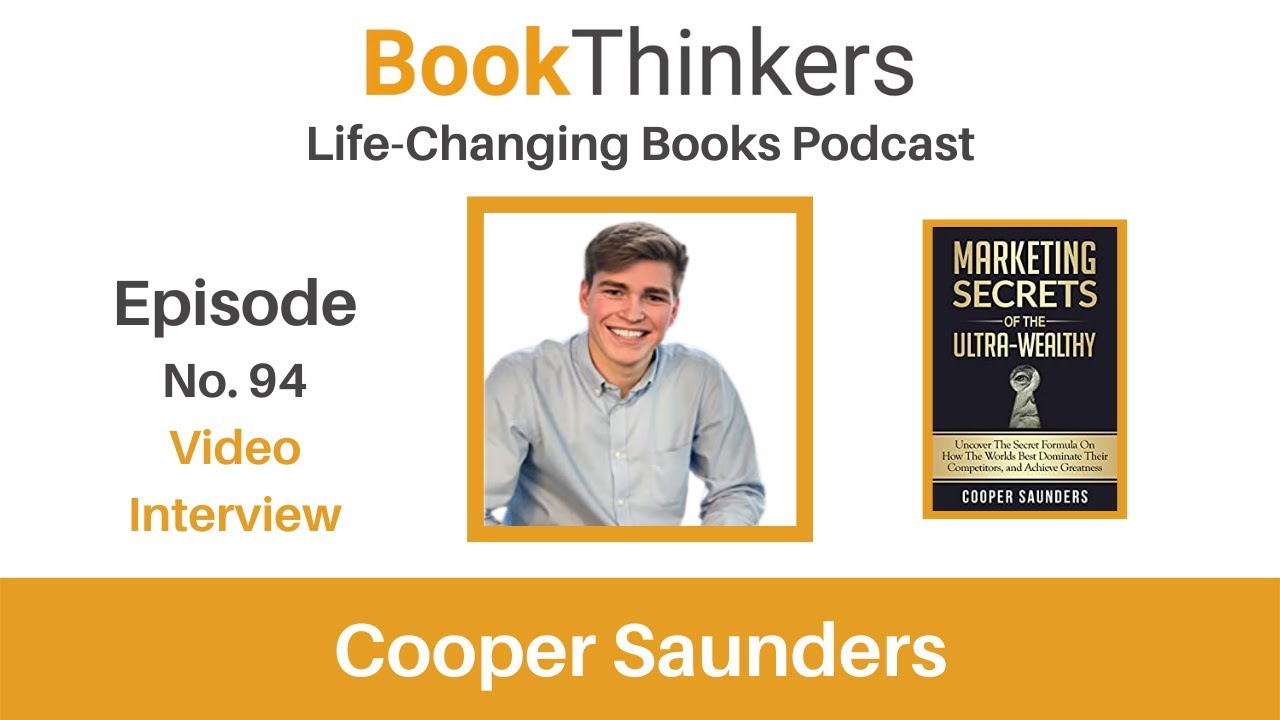
In this episode of the Book Thinkers Life‑Changing Books podcast, host Nick Hutchison interviews Cooper Saunders, a 25‑year‑old founder of Wise Guys Digital Marketing and author of Marketing Secrets of the Ultra Wealthy and Quit Competing, Start Dominating. Cooper recounts how he launched his agency while in college after helping his grandparents’ bike shop, secured his first client through cold‑calling a CMO, and grew to serve 500‑600 local service businesses nationwide plus a mastermind community. He explains the company’s results‑based, performance‑pay model, the “Proven Process” and the “One‑Star Improvement Plan” that focus on data‑driven tactics such as Google Business Profiles, reputation management, GPS tracking for technicians, and ethical‑bribe ads. Cooper discusses why he began personal branding and writing books—to amplify impact, share systems, and address the anxiety of being a young public figure. The conversation also covers his mindset shift from a fixed to a growth mindset, influences from authors like Grant Cardone, Malcolm Gladwell, and Carol Dweck, his views on faith, abundance, and the importance of thick skin, persistence, and learning sales. He shares personal advice for his younger self, the value of mentorship (including an “invisible counsel” concept), hiring philosophy favoring gritty, humble workers, and his perspective on blue‑collar trades. Throughout, Cooper emphasizes focusing on emotions over logic in marketing, targeting local service owners, and being transparent about challenges such as anxiety and failure.
Chapters
Mr. Cooper Saunders, welcome to the Book Thinkers Life-Changing Books Podcast. How are you doing today?
Good. After spending a whole day with you guys, I'm even better. Are you exhausted? Yes, but I think it's good to be exhausted and talking about your business and truly growing it does take a bit of effort, but it's been fun.
Yeah, no, hey, listen, we've all really gotten to know you today and I'm happy that we did. You've got a lot to teach us. So for those in For those in the audience that are not familiar with you or your 2 books or your business, I'd love to have you introduce yourself to everybody.
Well, yeah, I'm Cooper Saunders and I own Wise Guys Digital Marketing here in Kansas City. We work with businesses and business owners just looking to grow their company. And really the biggest thing with Wise Guys is we're very big on results-based marketing and really have grown in our marketplace for that. So I've also written 2 books on the different marketing techniques that we utilize And they've really proven to be very helpful for a lot of people.
Now what sticks out to me— now what sticks out to me before we jump into the books is the fact that you're a young guy. How old are you?
25.
Okay, so you're 25 and you started this Wise Guys Digital Marketing business.
Yeah.
And it's a big business now.
Yeah.
How many clients do you guys work with?
So across the country we've got around 500 to 600, but then we have a master Mastermind group, that's a paid group through email marketing that ranges around 500 to 600 people too.
So a lot of my audience, my audience is like 18 to 34, so mostly young professionals looking to start their own business. They're reading these books so they can learn more about business and entrepreneurship. So let's dive a little bit into the early days of this business and tell us like how did you start it? Where did it start?
Yeah, so it was my freshman year in college and my grandparents called me up. They had a bike shop out in Florida And they said, hey Cooper, I'm trying to grow this company. I've got no idea where to start. I've hired this digital marketing company and we're not really sure what they're doing. It feels like they're just throwing the money around, no real plan. So I said, okay, well, I'll come out in the summer and see if I can help. And you know, I had an iPhone as my first phone. Social media, digital marketing was just like another leg to me, right? So I went out there, implemented a plan, flew back. They went from one location to 3, sold off. And I went to my dad and I said, hey, I'd love to start a company around this. What do you think? And he said, well, you can, but first you have to promise if you don't hit a revenue goal, you'll have to go back to school. I said, all right, that sounds good. You know, I said, well, what do you have to do to get clients? You know, I've never done that. Now, he's a financial advisor. He kind of grew up in the Wolf of Wall Street type of scene where, you know, you cold call. Either you pound the phones until you get a deal. So I was like, okay, you know, everyone will want to hear from me, right? I'm the greatest, whatever. So I called one of the biggest companies in Kansas City, got a meeting with their CMO, and I think that I didn't know that people didn't like cold calling, right? So I just went in there with a lot of enthusiasm and was like, hey, how can I help? And so I got a meeting with their CMO, and they were our first deal, and then they referred us to other big companies, and we just grew from there.
And how old were you when this was happening?
19. Going on 20.
Something you told me earlier that I really identify with is the fact that it helps to be a little naive when you're jumping into business and entrepreneurship. And I can relate to that because when I was first starting Book Thinkers, I thought I was going to grow a multi-million dollar business in 6 months.
Yeah.
And that's just not realistic, but you sort of need that misunderstanding and how easy business can be in order to get off the ground.
Yeah. And I always say, once you find a process that works, stick with it until You find something else, right? So we have a process, it's called the Proven Process. And if someone's like, hey, we should try this, we'll try it, but we won't break from our process until we figured out, okay, this system does work better than this system, we'll replace it. You know, it's kind of like an engine, right? Every single part of this car, right, and the engine has a specific need that needs to get completed. And so with a company, you need to have that. It's almost like an assembly line. And so Once you kind of get that, you know, a Toyota is built in an hour, right? But a Rolls-Royce takes 6 months. If you're going to build something great, it does take patience, but once you have that system in place, it's relieving.
That's awesome. I have a few questions that maybe are going to back this up a little bit, but oftentimes, you know, like we look at a person like you, you're 25, super young, super successful, and we look at ourselves and we think, you know, I'm 28 and I'm like, man, I don't know if I'm going to be as successful as this guy. Is there something about you that's super special or can anybody become successful, do you think?
I think first off what you said, success comes in different variants. I think you might be more successful for your hair. Your hair's better than mine. I think you're successful. You know, and I think also that compare, like comparing yourself. You know, I can look at Nick and be like, dude, he's got 100,000 followers. Like, could I ever? You know, and so comparing yourself I think is a big, you know, that's the ultimate.
They say comparison is the thief of joy.
Exactly. And so I think that first off, if you're focusing, there's a picture of myself I don't know if it was Michael Phelps, but there's 2 swimmers, and the guy in the lead was looking straight forward, and the guy in second place was looking at him. And so winners focus on themselves, and losers focus on the winner. And so if you focus on your end goal and just ignore everything else, you'll be good to go.
Yeah, that's, that's some solid advice. I mean, it's, it's true. I think oftentimes, especially in the world of social media, we get caught up in what everyone else is doing. And the reality is, it's— you're in a competition with yourself.
Yep.
You got to focus on yourself and It's taken a long time for me to learn that, and I think I'm still, I'm still learning that.
Yeah, I am too.
But it's a daily battle.
Yeah, I think that, like, you know, everyone again has different forms of success, but, you know, it's easy just to show off your highlights. And I think that with social media, you always have to realize that, you know, yeah, they're putting out a front, but at the end of the day, is that really how they are? And so You always have to remember that as well.
Well, talk to us a little bit about why you decided to invest in your personal branding today, because for years you've been growing this successful business, but from an outside perspective, you can't really tell what's happening.
Yeah, so with Wise Guys, we've been very successful for growing companies, and for myself, I always have this thought process of, okay, if I focus any of these resources on me, I'm being selfish. I'm trying to show that Wise Guys is me, rather than showing, hey, Wise Guys is this whole team, my employees. So I think that I had a company-wide meeting and I said, hey guys, I'm thinking about hiring Nick. I've got 2 books, people read them, but I feel like we could reach a whole different sphere. Do you guys believe that if I grow my personal brand, that's taking away from your guys' work? And so I think maybe it was a subconscious thing that if I built my own brand, it was kind of like claiming all their work under just me, and it is a team effort. That, and also I'm a pretty private guy, you know. Um, you know, I found a system that worked, you know, and that was the biggest thing.
Yeah, no, I love that. So let's talk a little bit about these 2 books. So today we focused primarily on Marketing Secrets of the Ultra Wealthy, but you also have this second book, Quit Competing, Start Dominating. So tell us, when did you decide to write your first book?
So when COVID hit, When COVID hit, I noticed that I wasn't driving around anymore to clients. Like, my biggest thing is I love people and I'll meet with people and discuss their goals and challenges. And when it went all to Zoom, I realized, okay, I could get all this done in 2 hours, 3 hours. Like, I'm going Zoom to Zoom. I'm like, hey, I've got all this free time, you know, might as well try it. And what I did was I just took out a Google Doc, put in the processes that worked with marketing, I put little bullet points of subtopics and just typed it all out. And was it as easy as I thought? No. I mean, it does take a lot of time, but I think a lot of people have this thought of authors up on a pedestal where they're like, you know, on a golden pedestal that, you know, only they can do it for some odd reason, right? That's not true. I mean, anyone can do it. Does it take work? Yes. But you don't have to be some special breed to get it done.
Yeah.
Who are some of the authors that inspired you in your entrepreneurship journey?
You've got the typical guys like Grant Cardone. I just like how he approaches like, you know, the education of this is how I did it and this is why it's important. But also, you've got Malcolm Gladwell, you've got all these people that, you know, they're— I see it as more like a selfless act of, you know, they took all this time to create this for you because they want you to succeed. And I don't know if everyone has that philosophy, but all the authors that I read, I have such great respect for now, seeing how long it took.
Yeah, and I know today we talked about some other authors like Jim Collins, Good to Great. We talked a little bit about Kiyosaki with Rich Dad Poor Dad, Napoleon Hill with Think and Grow Rich. We talked about Robert Greene, MJ DeMarco, so many of these names, and they all seem like they've had an influence in you in some way, shape, or form.
Yeah, I don't think that— excuse me for interrupting, but you know, I think that that's the goal of every author, is to say, a guy like me that had trouble in school, but didn't like school, and then they're saying, hey, there's a different option. And being able to say, even if they influenced one person, I think that'd be enough for them. So I think that when you're thinking about writing a book, you have to have the vision of not, oh, I'm going to sell a bunch of copies and become very successful, because after the 20th page, you're going to be like, I'm tired of this, right? I don't know if I'm supposed to mention I'm writing a book.
Oh, I don't think you can.
Okay, so with you writing a book, you understand that your why needs to be very big, and like, I just want to help companies grow. That's simple as that. And if I help one person, that's enough for me. So I think I would always transcend my belief in my mind into what they're thinking.
Yeah, yeah, impact is something that I know Nick cares a lot about, and I think I do too. There's also something that I caught in there that I want to— maybe we can expand upon a little bit, which is mindset. Today in our conversations, we talked a lot about that. So what is, what is a good mindset to you? And like, what are your thoughts around mindset?
So there's a book called Mindset by Carol Dweck. Oh man, I love it. And so I was always kind of the belief that you, your mind is, is a fixed mind. I mean, either you're smart or you're not, you can't learn. So once I, once my mindset went from the growth From the fix, I think everything changed. I can learn everything, anything, right? I can learn everything, I can learn anything, and that's, I think, the time I changed. And then also reading things like The Science of Getting Rich, that type of stuff really made a positive impact on everything.
Well, you said earlier that you hated school but you love education. That's a term that we were throwing around a little bit, and And what that means to me in my life is that I was a poor student just like you. I hated being told what to read and also what to think about what I was reading. And then you break into this world of self-education and you get to choose what to read. So you can say, I want to learn about fixed versus growth mindsets, let me open up Mindset. Or I want to learn about outliers, let me open up a Malcolm Gladwell book. And that's a whole different type of education.
Yeah.
Yeah.
And it's— and again, not everyone wants to own a successful business. Some people just want to live off the land and whatever. But I think when you are aligned with, okay— and I think also whenever I dropped out of school, it was almost like it's game time. Like, my parents were like, you've got this amount of time. And so whenever that shift— it was almost like the burning the ships once you get to the beach. Like, win the war, you're done, right? And so Robert Greene, that's where I first heard that from. So I think that is the most important thing with business as well.
You shared that your dad said, okay, here's a revenue goal. If you don't hit it, you have to go back to school. Can you share with us what that was? Oh, I thought—
I think it was something very attainable, um, something like $15,000 a year or something like something where he's like, you know, I think he just threw that out there not thinking that I— I don't know. I definitely believe he thought I could do it. But he didn't want to make it so outlandish where I was like, I'm not going to be able to do that. Yeah.
But 0 to 1 is the hardest point to move, right? So, the minute that you earn $1, you know you can earn a million.
Exactly.
Yeah.
And I think that with school, I've always been really good at communication and understand— like, I think whenever I see someone and I say something and their face kind of I can tell, okay, they didn't like that, right? And so my communication has always been my strong suit. And if you talk in school a bunch, what do you get?
Yeah.
In trouble. And so I think that I've been always very good at reading people and being like, hey, you know, this is kind of what you want. Like, what does this person want? And so when I'm meeting with business owners, that's also a very big key is that I don't do most of the talking. You ask questions and get to know them, and then you kind of go from there.
Let's just see what we're at. That's 15 minutes.
I feel like I'm just like your last question. I'm just like out in the deep end. No, you're good. Same topic.
It's great.
Okay, okay.
You're doing awesome.
Yeah, it's good that we can cut this because that last one I was on, they're like, cut out. Like, what if I say some fucked up shit?
Now we can cut it.
I never know.
Shout out Luke in the future who's going to be editing this.
I'm still getting used to that one.
I love that tweet where it's like when you're listening to your talk and then it's like, yeah, yeah, it's like really high, you know. That's exactly how it is.
All right, I'm going to kick us back in for a few more minutes before we pause and restart again. So talking a little bit about Marketing Secrets of the Ultra Wealthy, who is the target reader for this book? I mean, you wrote it for a purpose. You said if you could impact one person or one business owner, then hurrah. But Who is the target reader for the book?
Yeah, so in the introduction, the first chapter, I talk about, you know, almost every business owner that I meet with is visiting the casino, throwing their money in the slot machine. Hey, I don't know what works, what doesn't. It really doesn't have to be that way. So really, a business owner that's marketing their company, and really we pivoted and focused a lot on the local services, right? Like the home services. Now we still help the national companies, but We feel that there's a massive problem and unmet need for the local companies like plumbers, electricians, because they don't have enough capital to hire the mass marketing firms that do, you know, work with these big companies, but they still need help. And so that's the target market that Wise Guys really focuses on. In this book, both of them can really help them exponentially.
So if I'm a plumber, yeah, and I'm a local business owner, family-owned, third generation. I know my marketing is not up to snuff, so I pick up this book. What are some of the things that I can expect to learn?
Yeah, so if you're a local business, the first thing you need to do is identify where you want to dominate, right? So what city are you in and what service? You know, we'll meet with companies, we're like, hey, we do plumbing, HVAC, all these different things. But really, your Google Business Profile or Google My Business, first step, and your website And then reputation management. But getting— what you would get out of this book is understanding you don't have to wish and hope and just throw money around. There is a way to put in X amount of dollars and get Y amount of return. We've done it. We've got hundreds of case studies of, hey, this is what we did and this is what they got out of it. And so that's the biggest thing is them knowing that it isn't just such luck of the draw. There is a way to go about it to grow.
I love that. You also, in your book, you expand upon some of that stuff. You said you have this— oh, I forget what you call it, but the 1-star improvement plan. That's what it is. Yeah. So could you tell us a little bit about that? I love that we talked about that today.
Yeah.
So I always say a problem is a terrible thing to waste. And whenever you're in business, every business solves a problem. And so I'll meet with companies, they're like, hey, you know, our growth has stagnated, how can you help us? And so I created the One Star Improvement Plan. I'm sure there's different variations of it, right? What I'll do is I'll go in, especially for an HVAC company, for example, I implemented this. And what I did was I looked across about 200 HVAC companies across the nation and found 3 or 4 trends that the consumers were not happy with. It's rude technicians, Either they were rude or their arrival time was so different, right? And so what we did was, and then like, you know, the unwrapped vehicles, they didn't know what company was pulling up. And so what we did was, is we, for this company, we enabled GPS tracking on the vans. So in real time, the customer could go in and see, okay, here's my technician and a real-world estimate. And that right there, and then of course like, hey, just fire your rude technicians. Like, what's going on here, right? I was like— we marketed that and we became— I think their revenue grew and has grown 200% a year. They're the number one HVAC company in their city. So I think that if you can find one thing, like with Wise Guys, we don't have year-long contracts, right? That was one thing that our target market did not like. And then we're also performance-based pay. So rather than, you know, you just paying us a fee no matter what, you know, We get— either it goes up or goes down based on the results we brought to them.
And so if I'm an HVAC company and I hate reading books— I'm an HVAC company owner and I hate reading books, is that what Wise Guys will do for me? You'll implement the things that you talk about in this book for other businesses?
Yes, so that's— if you don't like reading and you don't like implementing, my company can do it for you. And I think that's the problem we solve, right? Like, are you worried about giving your secrets away? I'm like, you know, reading it, learning it, and implementation is 2 different things. And so, just showing that you're the expert is really the reason for these books.
Alright, one of my favorite subjects to talk about is who's a good fit for being an entrepreneur. You're an entrepreneur, we're all entrepreneurs in this room. But I'm curious, for somebody who's listening today and they go, wow, these guys are all talking about their businesses and how they help other people. I'm an employee, I'm disgruntled, I'm not happy with what I'm doing. Would I be a good fit for an entrepreneur? Like, who do you think is a good fit for entrepreneurship?
So you've got to have thick skin, you've got to be persistent, and you must get— failure must be a thing that you're normal, like you can just deal with. I think again with school you're taught that if you fail, you fail, and that's it. But failure is gonna be your best friend because if you fail, you It doesn't mean the whole strategy was bad. You got tidbits that you can pull and then implement, pull, implement. Failure is part of it. So just thick skin, being persistent, and being okay to fail is— then you'll be good to go. Also, learning sales is big.
Yeah, I know you talked a little bit about being naive with cold calling, kind of coming from a family where you just had to be a little bit bullish with that. And cold calling is one of those skills that I'm so happy I learned as well. So you said Grant is one of your big influences for selling.
Who else?
You've got, I mean, oh man, what's the guy? He's like the most— Zig Ziglar. Zig Ziglar is a big one. You've got Chet Holmes. You know, there's just so many books that, you know, again, sell or be sold. But really, when you're looking at sales, it does come down to 3 or 4 things that you just need to realize. And that's just, hey, You're helping another human, you know, what can you do for them? And asking questions. Because when I called that massive company, I got the CMO, I'm like, hey, what could— like, what are you having trouble with and how could I help you? And she's like, well, we've got this subdivision that is just not taking off as we thought it would and we need a better social media presence. I'm like, oh, funny, you know, that's what I do. You know, she could have said anything and that's what we do. But, um, Again, that's just more being naive. Now, if they just would have said something we don't do, I'd be like, oh, you know, maybe then we're not the best fit. But at that time, just finding a problem and then being able to implement a solution, that's sales.
Yeah, we kind of joke about that internally at Book Thinkers sometimes because there have definitely been situations where somebody says, well, I need help with this, and I say, funny enough, yeah, we can help.
Weird. Yeah.
And Grant always says overpromise. But also over-delivered. So it's always nice to be stretched a little thin with your implementation team rather than having them sit around twiddling their thumbs, right? You always want to be overselling.
Yeah, and it's kind of like jump off a cliff and build the plane on the way down, you know? That's kind of been my philosophy of if a client needs something and if they've got a question you don't have the answer to, either find a solution, say, hey, I don't know that right now, but I'll get back to you. And then also find a solution for them and get it done and get it implemented.
Now, as a more mature company, you mentioned like a lot about targeting in your book. Is that something— are you still like in the mode of we'll fix whatever problem that you have, or are you trying to now like just do a better job at like picking out your Yeah, these days we're not as, you know, like, you know, these days we're not as people-pleasing, right?
It's like, hey, this is our target market, this is what we do best, and we're sticking with it. But in the beginning, you have to be a little bit more gritty and be like, hey, you know, I will take some jobs that I probably won't down the road. And so as more of a mature company, we've realized that, hey, we like working with these people, This is the results we can bring them, and it's a system, right? But definitely in the beginning, it was very wild.
This podcast allows readers to discover new books and new mentors that they can learn from, and part of my goal moving forward for the podcast is to have it be a little bit more conversational and dig a little bit more into maybe some of the things that an author might be battling or dealing with so that we can sort of remove the superhero cape and show everybody that listens And Cooper's a super successful young business owner, but maybe he's dealing with things that could be relatable to the average listener today. And one of those things is anxiety.
Yeah.
We talked a little bit about anxiety earlier, so could you share some of your experiences with anxiety and maybe some of the things that you do to manage them?
Yeah, and so I think with myself, you know, walking into a big business meeting, I'll find myself having anxiety. But it's the times where you don't know where the anxiety is coming from is what's nerve-wracking, right? And as owning a business, you could say, yeah, you know, you're stressed out, but it's not necessarily stress. And stress is normal, but with anxiety, I think there's a stigma of you always have to be perfect. And as a male especially, like, hey, what do you have to be anxious about? You know, you run a company, everything's going your way, you have no reason. I think that's one thing where We were at lunch earlier and I'm like, hey, not feeling great, can I run to the bathroom? And being open and talking with people because a lot of people struggle with it. And when you open up and say, hey, I'm not feeling too well, do you mind if I use the restroom? You'd be surprised on how people do deal with it. And anxiety has been a thing that I've had to deal with all my life, and it seems like more and more people are. And I just hate the thought that You don't have to suffer in silence. You know, I remember I had a business owner, an older gentleman, that you would think everything was going great, and he's like, hey, Coop, not feeling well, do you mind if you go get me water? And I'm like, of course. You know, and this guy, we were in the middle of a negotiation, super intense, and that vulnerable side really made me go, wow, you know, not only do I suffer with it, but people, industry-leading people People have trouble, and it just makes it— and I'm super passionate about just being open with it, and people like to see a vulnerable side to people.
I think that's one of the most important reasons to have a personal brand outside of your business.
Yeah.
It might not be appropriate to share that on your Wise Guys page.
Of course, yeah.
But I think when somebody can see a young, successful business owner talking openly about anxiety, that's the perfect reason to have a personal brand.
Yeah, yeah. And again, we chatted about it whenever we were filming earlier, and it's just one of those things that people do deal with, and it's— there's no reason to hide it.
Yeah, there's so much shame around it. I know we discussed this earlier, but there's just so much shame around it, and you feel, you feel so alone in it so often. Like, you're like, there's no one else that struggles with this. It's like, because especially in today's day and age, the world that we live in, we see this very polished version. Of people through social media. And like you said earlier, it's like that highlight reel of success, and then it makes you feel even more isolated because you're like, wow, all these people are doing this, this, and this, and I can't even, you know, get on my personal stories and share anything.
Yeah.
So what do you— do you have any advice for anyone that is dealing with anxiety? Is that— I know we kind of talked a little bit about management techniques, but maybe you can just share some advice for when you go into those board meetings and you're like feeling A little anxious, what do you do?
And I think, yeah, and so I think whenever people have anxiety, they think that, okay, I can't be successful, all I have to do is, you know what I mean? I think that you've got something where you always need to feel good, you always need to be rockstar. And I've got days where I wake up and I'm like, this is gonna be terrible. But being open with people and saying, hey, you know, today, like I said to Nick, I said, today I'm not I'm not feeling great. Like, we got a lot of filming to do. I'm just being open with you, so if I am acting weird, this is why. And so just being radically transparent with people really helps. And that's what I do. I walk into a meeting, hey, I know this is what we're covering. I'm not feeling too well. I shot with Nick all day yesterday. If you don't like that, we probably shouldn't do business because I'm a people person. I love people. If you don't, you know. And so I think that's the thing that people If you're dealing with anxiety, people care about you. People care about you a lot, and I care about you. Everyone does, and you don't have to suffer in silence.
Yeah, I think that's so true, and I'm just very appreciative and grateful that you are open about those things.
Yeah, it's something that a lot of people are afraid to chat about, and I mean, I've got nothing to be ashamed of. A lot of people deal with it. Am I successful? Yes. Do every now and then I feel under the weather? Yes. But also don't be afraid to talk to your doctor about it. Don't be afraid to tell your parents about it. No one's gonna think of you as a lesser human. No one is. And if they do, probably not your person, right?
Another subject in this sort of same vein of being transparent and open with everybody. Earlier I asked you, hey, what's one piece of advice you would give to your 18-year-old self? And you came back and you You said, you know, don't be so sure of yourself.
Yeah.
Don't be so, for lack of a better word, you didn't say it this way, but I will, cocky and arrogant about life, right? Thinking that you have everything right.
Yeah.
And being— because I remember we were on the soccer field and, you know, I was playing in college and of course I knew everything, right? I'm the best player, come on. And my coach said, you got to be coachable. Like, you're going to go nowhere if you're not going to take advice, you're not going to do this or that. Look, I told you to do this, you're not doing it. you got to be coachable. And so even in business, I was doing something within one of our systems and an employee said, hey, what do you think about this? And I was like, yeah, we'll try it out. And it ended up being one of the best things we could do with the system, right? So being able to learn, and if you're the smartest person in the room, you probably got to get a new group of people, right? Mm-hmm. And so that's the biggest thing that, you know, always be open to learn. You know, someone knows, you know, it might be a hobo on the side of the street, He knows something that can make— that you don't know, right? Everyone is better than you in some aspect. If you act like you're high and mighty, you're gonna have a bad time.
Yeah, that's great. You mentioned your coach, and there was a quote earlier that I'm trying to recall that you were talking about.
Oh, criticism. Yeah.
About criticism. I would love for you to expound on that. Maybe you can say that quote too.
Yeah, so really it's, don't take criticism from someone you wouldn't take advice from. So if you're starting a business and someone's criticizing you, the best way to turn them off and really like, oh, you know, really put them back is, is I don't take advice, I don't take criticism from people I wouldn't take advice from.
Mm-hmm.
And it's like, oh, it kind of puts their brakes on because it's true. I mean, am I gonna take business advice from somebody that's never done it before? Am I gonna take criticism from somebody that's never tried to build a personal brand? Probably not. But if Nick came to me and said, hey, you should probably do this instead, okay, I respect his opinion because he's done it before, right? And so That's my thing is that if they haven't done it before, they don't know what they're talking about. If you wouldn't welcome pointers from them, then don't worry about criticism.
Yeah, you talked a little bit earlier about mentorship.
Yeah.
You know, that's the subject we're talking about now, and you said one of your biggest mentors is the future version of you.
Yeah, yeah.
That's a cool concept. We haven't talked about that on the podcast before.
Yeah, yeah. You know, in Think and Grow Rich, there's a part where he had an invisible counsel, right? And, you know, I would have— close your eyes at night, give your mind a task. And I always said, what would, like, my 4-year-old self say to me, right? What does my life look like and how did he achieve this? And if some days I'm laying in bed, I'm like, well, I don't want to do it, you know, of course you're not going to do it every single day. But I think whenever— I think I have a child with him, I think about what I'm going to be in the future. If I let him down, it's going to be a bad time. Even like laying on your deathbed, right? I talk about this in my book. I said, what would have to happen for you when you're laying on your deathbed for you to be completely satisfied? Even if that's a thing. I don't know if it is, right? But thinking about your last day on earth, how would you spend it? What would that look like? It's one thing that I typically think about.
Well, yeah, it helps create a gap between where you are now and where you could be. Yeah, and that's what's helpful for me too. I mean, that's what books originally did for me.
Yeah.
The minute I started reading Rich Dad Poor Dad by Robert Kiyosaki, I realized that there's a big difference between who I could be if I was implementing all of this versus where I was. And some people choose to turn and run away from that full speed, and they get back under the covers and they hide. And then some people decide, hey, wow, that's pretty humbling, but I can go out there and learn, you know, from people like you. And so that's why I'm blessed to be doing this podcast and reading books like this, meeting people like you. I mean, it's just such an amazing experience.
And it's just not only, you know, also my ancestors, right? That's the big thing that a lot of people talk about is, is your guardian angels. Everyone's rooting for you. All you have to do is just take action and believing that, hey, everything's good, having faith, you'll be good to go. And I think that I like people to look back and say, hey, this is what Cooper did when he was on this earth, and you didn't waste it. I think that if you go for it and you don't, you don't hit your goal, that's fine, but as long as you went for it. It's always been very big for me. You know, nothing is worse than looking your parents in the eyes and seeing disappointment, and I think that just kind of resonated with me as what would my future self be looking at myself right now.
I wanna go a little deeper on the faith subject because you brought it up earlier sort of in passing. You're like, listen, I can talk about marketing tips all day long, but there are some subjects that I don't really talk about, things like faith. So do you picture your ancestors rooting for you? Like, what's that conversation look like? How does that feel?
And so within business, I think that, you know, you've got this fine line between business stuff and then like spiritual stuff, right? Where at the end of the day, we're all made up of the same thing, right? Energy, matter. And mindset, kind of like the law of attraction, does kind of go through. And we were talking about this earlier of, you know, not only if you're going to be an entrepreneur, it's great to have persistence, but you also must believe that what's going to happen is possible. And so when I'm looking at it, I I truly never believed that I would be able to fail because I've got all these people, whether they're alive or they passed away, rooting for me and setting up things. And then different things would happen and exactly how I planned it, and I'm like, this is insane. And then you just keep going for it. And I think that the universe sides with people that know where they're going because not only— whatever religion you believe in, your God wants you to be rich. I think that's the biggest thing, that people think that their God wants them to be poor and suffer. Well, your God, especially Christianity with me, he wants you to be abundant so you can give back to the church and give to other people, right? Because I do donate to charities and good stuff because, you know, if you're not abundant, you're just kind of like a leech. That's not what God wants you to be, right? So once I made that shift of, okay, God doesn't want me to suffer, he wants me to be abundant. Then that kind of started clicking for me.
Yeah, 1,000%. Have you read The Alchemist by Paulo Coelho?
Yeah, yeah. And I was reading The Titan, the story on John D. Rockefeller, and he was like, you know, I see it as a sin to not be wealthy because, you know, I'm giving back to the community, building— like, I'm making all these people jobs. If you're not wealthy and you're not making a difference in life, then that's the ultimate sin. So I think that when you have that mindset of, hey, God, the universe wants you to be wealthy. I think if you have money, you're looked at as greedy, blah, blah, blah. Once you make that mindset of, okay, God, the higher powers want me to be rich to give back and make other people's life great, it's huge.
Yeah, 1,000%. I had a mentor that used to tell me, Nick, the door is open, you just have to walk through it. The door is open, you just have to walk through it. And most people don't realize that, they just stand in front of the door looking at all of the possibility of life and then they just don't take any movement.
Yeah, that concept of the universe is conspiring for you, I love it and it's taken me such a long time to learn. And like that, you talk about that belief in yourself and the belief that the universe is conspiring for you. It's something that's taken me years to adopt, and even like to this day I struggle with it, but I can look back through my life and even like just see all the proofs in my life that that is true.
Yeah.
Like everything, everything that I've done, it's just like it has gotten me to this point, to sitting here and having this conversation. I love the stat, and I'm gonna get this off a little bit, but there's like a 1 in 40 trillion, or maybe it's 14 trillion—
Yeah.
Percent chance of you being here.
It's crazy.
It's so infinitely tiny. Like, there's just— so the fact that we're here and we're human life is such a powerful thing, and I think we often just don't realize that.
We take a lot of things for granted, you know, and the fact that we can— you flew here on a plane. We're speaking through the— you know what I mean? Like, even all this stuff 500 years ago would be insane.
Yeah.
And, uh, we do take a lot of things for granted. A lot of the times your subconscious mind is sabotaging you before you even get started. And I think that right there makes that mindset— because ever since you were a kid, most likely, you know, if you're born rich, you're going to stay rich because the thoughts and mentality your parents give you. But if you're poor, you're most likely going to stay poor because that, again, that mindset. And so making that shift, being like, okay, it's just as easy to be rich as to be poor, right? Honestly, either it's working hard because you're poor or working hard because you're rich, right? That subconscious mindset shift, I think, was the turning point for me. Being like, you know, either you can work hard being poor, or you can work just as hard being successful. Will there be struggles? Yes, on both sides.
I think one of the shifts in the BookFingers podcast moving forward as well, and Luke reminded me of this last week, is that it takes just as much effort to run a $50 million business as it does to run a $500,000 business, right?
Probably less effort.
Probably less effort. So I think when we start meeting with successful business owners like you, we can be a little bit more transparent about the business and ask Advice and communicate to our audience and allow them into our business so that they can grow with us. And so, yeah, that abundance mindset that you just talked about is so important.
Yeah, and when you're growing a company, managing employees is a lot easier than people make it seem. All you have to do is give them, okay, this is where I want— what I want you to do. Give them an expectation. If they don't hit that expectation, sit them down. Hey, what Why didn't you do X? And if you hire the right people, they'll do it and you don't have to micromanage them. And then again, you delegate and elevate. Okay, I don't do that anymore. I'm gonna do other things that I like, like this, right? If I was at where I was even 2 years ago, I'd say I don't have time to do this, right? But I could spend a whole day doing this because you give expectations, they don't hit it, they're out, right?
Yeah. I'm really curious, you've had like success from really early on, and I'm curious, what is— what's been like the hardest things for you? What's been like the biggest struggle in your business? Like, have you had any setbacks, or has it just been one win after another? I mean, you talked about failure before, so I assume that you've failed enough.
You know, I always say I've been very, very lucky, right? I could have had a terrible time getting my first client. If I that's the biggest thing. But it was like my first call, right? So I think the biggest setback I had was finally letting go of the reins, right? Like saying, okay, you can come on and take this over from me. I would have to— I wanted to do everything because I could do it all. But then I hired a graphic designer. She was a lot better than I was, right? And then I was like, oh, that's amazing. And then I hired a backend success manager for our clients. Oh, that's awesome. I And so that was the biggest thing where— that was the biggest struggle for me was letting go. And I think that's a lot of entrepreneurs' thing, where it's like, oh shit, you know, do I really want— what if I mess it up? You know, and you can be there and you can train them, but then slowly let go. And then you'll— you know, you don't want to own a job, you want to own a business.
And that's huge. On that point, Cooper, I was told one time by a boss of mine when I was running a house painting business that The man that can do the work of 5 people is not as great as the man that can get 5 people to do the work for him.
Yeah, yeah.
And I think there's a story, I don't know where I got this from, but 2 brothers were given a task to build a pyramid. Now the first brother went ahead and started carrying these massive boulders, massive boulders, and his brother wasn't doing anything. No progress, nothing, nothing. A year goes by. Brother's got his base done, other brother nothing. Well, his other brother was building a machine, right, to get all these stones up. Because if it was just him, he understood, okay, I'm gonna wear myself out. So there's about a year left, his older brother's like, you're an idiot, you're not gonna do anything. And then his brother came out with this big old system rig, all this stuff, and got this pyramid done, and his brother wasn't even halfway done. So I always look at that as Kind of sharpening your axe before cutting down a tree. And I've always been big on, okay, stepping back and looking at everything from a bird's-eye view. I think that's big. Like, it's sort of what I talk about in my book of grand strategy, having a vision, saying, okay, how did others grow their business? How can I do the same? Okay, we're going up as a bird's-eye view. This is where I'm having a kink, and this is how I can fix it. And working Working smarter, not harder, is one of my philosophies.
Yeah, I love that. I was thinking when you were talking about that, it was either Einstein or Edison that said— I don't know which one it was, but one of them said, like, if I had an hour to solve a problem, I would take 55 minutes to think about it and then 5 minutes to implement it. So that's just adding to what you said. That's a really great formula.
And I don't think— and I might be wrong— but a lot of people don't just sit and think. Like, when's the last time you were bored? Like, you back in the day, if you're sitting in a doctor's office, you're bored. You didn't have your phone. You know, now I can pull up YouTube, watch, you know. And so having times— and I find myself between 4 and 7 in the morning, just quiet. I just let me think because whenever that— when I get into my office, hey Coop, hey Coop, hey, hey, can you look at this?
Like, beep beep beep.
And having a time saying, okay, this is— I just gotta think. Turn off everything. And that has been probably the most impactful thing for me is having a time of just absolute quiet.
Now I asked you earlier, do you have a morning routine that you can share with anybody? And you said no, but now you're sharing with us that between 4 and 7 you get up and think.
Yeah.
So like, what does that look like for you?
Yeah, so again, it's not every day. I do have time. This is this thing where everyone's not perfect. I do have days where I sleep till 9. But if I'm having a problem, you know, right before I go to bed, I give myself a task, right? Hey, this is a problem. Can you fix it for me, subconscious mind? I wake up and I just get coffee and blow a piece of I get a piece of paper and I write out what my brain has got for me. And you'd be surprised, I mean, just these complex problems would just solve themselves, either a dream I had or just from— I'm just writing. And so coffee does— everyone's different, but I love coffee. And I found that like energy drinks don't do the same, but like a half cup of coffee is perfect for me.
And a bunch of water.
There's this idea from Steven Pressfield, he's an author we've had on the podcast, of a muse. That these, these beings, he calls them, I think, angels. Like they exist out in the universe and they want to help you solve the problems. And once you invite them into your life, they can come and work through you.
Yeah.
And so oftentimes he'll say that he writes for a few hours and then he'll wake up from it and be like, what the heck did I just work Yeah, and I'll go—
if you see my journal, I've got quotations and questions that I'm asking, and then I'll just write, and it's like someone else is answering for me. Where that's true, like, you just ask a question and just write it out, and sometimes there might be nothing, but sometimes it does work. And I think that being surrendering and being like, okay, like, someone knows this answer and it's gonna come through. It's just a matter of time and being open to it. You know, don't think that you know everything and you'll be good to go, right? Yeah, it's true.
Something I want to ask you about too that I know you're gonna have great advice on, I don't think we've talked about it at all today, but maybe I missed it because I stepped out a few times. But when it comes to hiring employees, I don't know how many employees you have at your company, but like, what is— what's criteria you look for? How do you go about that? Is— have you had bad hires in the past? Like, what's your experience there?
So what I look at is what jobs have they done in the past, right? Some of the best employees that I've had didn't go to, you know, Duke, didn't go to all these amazing— they had lawn care jobs, they worked at Taco Bell, they have a chip on their shoulder, and they've got something to prove. Those have been the best hires. Now, the times that I've had a Errors in hires. I never say it's the person's problem, it's my problem, right? Never, never them. But is saying, oh, you know, they've got all these accolades, you know, well, they didn't really have a job, you know, they went to Duke, UCLA, where are all these people, and they're going to be a great addition. And then as soon as things get hard or, you know, they got to put in an extra hour, it's just different from somebody that is gritty and can really know how Because if they can go out and lay mulch for 8 hours in the heat, then this will be a cakewalk. And you can teach anybody anything if they're open to it. But the people that are entitled, they think that, hey, I should— now I incentivize my employees, right? But being able to work for it is huge, in my opinion.
Yeah, there's an author that we work closely with. His name is Ken Rusk. He wrote a book called Blue Collar Cash, and he celebrates Blue-collar tradespeople.
We need more of them. I love them. Yeah, I mean, it's these days, this— my company, that is glorified, but I mean, the real— the people that make the world move are the blue-collar people, you know. So if you're thinking— and I always say to people, if you're not thinking about college, then you know you don't want to be a doctor or lawyer, right? Something you need a degree for— engineer, You need to go to trade school, learn how to be an electrician, start like— because man, these days that's where it's at.
Yeah, I think for every 10 electricians retiring, only 5 are getting into the field.
And my cousin is becoming— is a welder, and I think they're starting them off at like an insane hourly rate because they're like, there's nobody here to do it.
Every single thing in this room and out on the street It was all placed here by dozens of tradespeople doing different things.
They're so essential.
Yeah.
And that's one of the biggest things that with my clients, it's not, hey, we're not getting results, it's we're growing too quickly and we need to slow down our marketing budget because we can't find good workers. And so that's one thing I'd like to— maybe if you know How do you find good trades employees? Is it possible for my clients? Because, you know, I say, hey, sponsor a trade school, right? Like sponsor, pay for somebody to go, and then when they graduate, they gotta work for you for 5 years. That's the idea I came up with, but I didn't know if there's anything else.
Dude, we'll definitely connect you with Ken. He'd love to talk to you about that, and I think the two of you could—
Yeah, for sure.
That'd be great.
He's got a couple hundred people in his organization. So, I'm sure that there are some good ideas. Yeah.
Now, does he have a like a blue-collar business?
Yeah. So, a little bit about Ken. He started his business when he was 15, I think. Digging ditches.
Of course.
And doing waterproofing and stuff like that on foundations. And now his business which he's grown that same business, it has a couple hundred employees. But he also is now on the education side of things. So, he wrote this book, Blue Collar Cash. He's got a chorus and everything else.
Heck yeah, need it, need it, absolutely need it.
Yeah, well, um, I don't know where we're on time, so I'm just looking at that up there.
Yeah, another 10 minutes. I mean, we can keep vibing on these kinds of questions. It's creating content for you.
Yeah, I'm good to go.
Yeah. Yeah, I mean, there are a million things to talk about in here, but kind of tying things back to the book a little bit, Marketing Secrets of the Ultra Wealthy. Go ahead.
No, no, no, you rock.
No, you go, you go. You're tying it back to the book. That's good. We need that.
Tying things a little bit back to your book, Marketing Secrets of the Ultra Wealthy, one of the things that I really loved was when you said, listen, marketing messaging needs To bypass—
Neocortex. We're going to restart that again.
Sorry, Luke in the future who's editing this.
Luke.
Coop, one of my favorite parts of your book, Marketing Secrets of the Ultra-Wealthy, to kind of tie things back to the book a little bit as we get ready to wrap up, I really loved how you said marketing messaging needs to bypass the neocortex and go right to the limbic system, which is the decision-making portion of our brain.
Yeah, yeah. And you know, there's a book called Cashvertising, and it's a very popular book in the marketing world. But you know, kind of with our target market, the blue-collar, the home services, and even the bigger companies we work with, forget that. And just reiterating, hey, this is important. You mean you must focus on The emotions. People buy with emotions and justify with logic. So the fundamentals, the Life Force 8, right, is what he calls it. What does your company do? And then you need to market that, and then that's gonna give yourself a massive competitive advantage over your competitors.
Yeah, so you say people aren't buying Mercedes because it gets them from A to B. They're buying Mercedes because it's kind of like, hey everybody, look at me, I'm pretty cool.
They want to feel superior, you know.
Yeah.
I know it's beat to death, but the Rolex, they don't buy a watch, right? They buy a status symbol. So if you're looking at electrician, plumber, I mean, it's important that what decisions and what do I think about when I'm thinking about hiring a plumber, right? Not only do I want to live a great life, I want to feel security. Like, if you're going to come to my house, I must know that you're a reputable company, right?
Right.
And so how do you paint yourself as that company that I can trust to come into my house? What are you going to do? Now people think, oh, I'm just a plumber, what can I really go with on that? And it's painting yourself as, hey, we're a reputable company, you can trust us, this is why. And then, okay, we've got the best price and we've been in business for this long is kind of justifying with logic. But I'll just see ads where it's like XYZ Plumbing, here's our services, Been in business since 1950, call us. And it's like, well, is that going to catch my attention? Probably not. But I created an ad for an HVAC company. It was an ethical bribe, which we talked about. He's like, I want to grow my email marketing list and hopefully turn those into clients for sure. And so what we did was we created an ad, like a pay-per-click, so even though— call them, but a Facebook ad too, where it's like 5 ways to lower your electric bill. summer, right? And so when people are searching either for HVAC services, they want to go with someone that's going to provide value. And so that's kind of the way I look at it, is showing yourself as the expert and speaking to the lemon part of the brand.
I think it kind of comes down to you have to have clarity, right? And I think we have— there's so much noise out there that you have to have Clarity on, you know, your clients and who you're going after. But it's not like you just said, it's an emotional thing. You have to have clarity on what their emotions are and what they're feeling, because that's what's important at the end of the day. People, like you just said, don't buy on logic, they buy on emotion. And I think so many people just completely miss that.
Yeah, like reviews are huge, like the psychology of why people choose companies. I mean, These days they choose, you know, if someone gives a personal recommendation, they're going to trust reviews over that person. And I'll meet with HVAC plumbers, all these companies are like, yeah, we don't really focus on reviews, we're more word of mouth. It's like, well, you know, people like me are starting to buy homes and word of mouth only goes so far.
All right, man, amazing podcast today. Thank you so much. For those in the audience that want to learn a little bit more about you, And your books and your business, where should they go? What should they do?
So you can follow me on Instagram. I've got CooperSonders_15. And then also you can visit my website, which is wiseguysdm.com. If you fill out the form, I'll be in touch with you.
Amazing. Thank you so much.
Well, thank you guys so much.
Thank you.
More from Nick

Napoleon Hill’s “Think and Grow Rich” is a timeless classic #selfhelp #personaldevelopment

4 Books to Help You Get Better at Decision Making #selfhelpbooks #bookrecs #nonfictionbooks


Have you read this book yet? 📖: The 5AM Club by Robin Sharma #selfhelpbooks #robinsharma

Dan Sullivan on Listening to Your Customers Instead of Watching Your Competitors

5 Books That Will Boost Your Financial Intelligence #financialfreedom #nonfictionbooks

The People That Preach the Loudest About Virtue are Usually the Most Power Hungry



Books are the greatest mentors you can find #selfhelpbooks #businessbooks #successmindset

Let’s fight this toxic instant gratification culture together 📖 #selfhelpbooks #jimkwik