99. Chris Panagiotu: Author of CAPitalize Your Finances
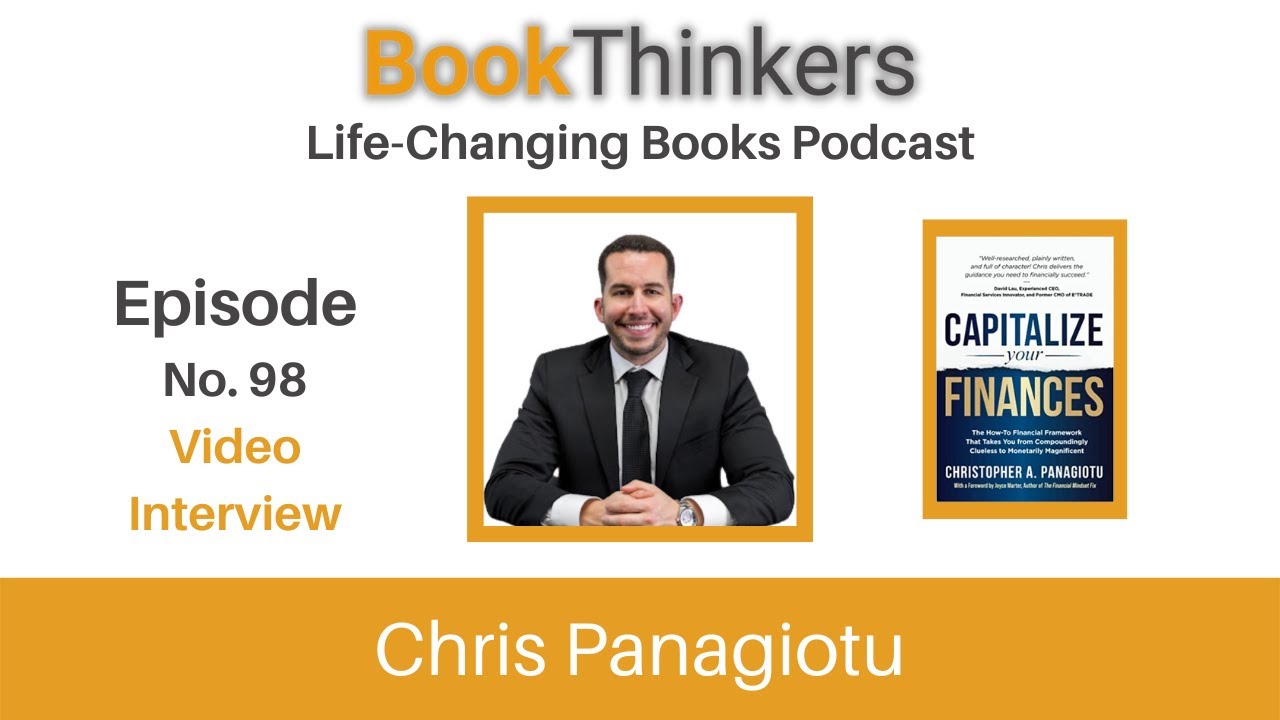
In this episode of the Book Thinkers Life‑Changing Books Podcast, host Nick Hutchison and co‑host Luke interview financial planner, author, and podcaster Chris Panagiotu (aka "The Cap'n Capitalized"). Chris introduces himself, sharing his Tacoma roots, education at the University of Oregon, early career at major wealth‑management firms, and the launch of his own practice and the "Capitalize Your Finances" podcast and book in 2022. He describes his drug‑free bodybuilding morning routine, the concept of being a "steward" rather than an addict to fitness or finance, and how purpose drives his work. The conversation dives into the book’s core premise – a simple yet comprehensive financial‑literacy framework that blends purpose (the "art") with rigorous financial science (the "science") to help readers move from "compoundingly clueless" to "monetarily magnificent." Chris recounts a pivotal 2014 seminar that sparked his shift from corporate disillusionment to entrepreneurship, illustrating the power of mentorship and recognizing one’s unique value. He critiques the financial‑industry’s opacity, the lack of financial education in schools, and the prevalence of lazy, Google‑style answers, arguing that true financial empowerment requires a disciplined, purpose‑centered mindset. The hosts discuss the importance of positivity, stoic expectations, organic growth versus noisy fame, and practical ways listeners can access Chris’s book, podcast, and services. The episode ends with Chris offering actionable advice on setting low expectations in relationships, embracing stewardship, and encouraging listeners to buy and review his book.
Chapters
Chris, welcome to the Book Thinkers Life-Changing Books Podcast. How are you doing today, man?
I am fired up as always. There is no place I would rather be than on Book Thinkers with 2 of my besties for the resties. And yeah, I'm excited to talk about capitalizing on your finances.
Yeah, man. Well, as you know, our audience is here for really 2 reasons. Number one, to learn a little bit more about some good books, and we're definitely going to talk about that today. But before we do, they're also here to learn a little bit more about some cool authors, and I think you are a cool author. So why don't you kick things off by introducing yourself to everybody?
Wow, the stage is mine. So my name is Christopher A. Paniotu, formerly known as The Cap'n Capitalized, located out of Tacoma, Washington. For those that do not know, it's about 45 minutes south of Seattle. A little bit about me. Tacoma boy, born and raised. Went to the prestigious University of Oregon, was in and out in 3 years, and jumped into the world of financial planning and wealth management. Started my practice out of my apartment about 8 years ago after working for 2 of the largest firms in the world and a family firm. Formed Capitalize Your Finances, my business, earlier in 2022, which was inspired by a lot of my followers that are capitalizers on my podcast, Capitalize Your Finances. And then everyone said, Chris, you've got to write this book. I'm like, god dang it. Okay, fine. I will do it. So then in August of 2022, we released Capitalize Your Finances, the how-to financial framework that takes you from companionably clueless to monetarily magnificent. And so that's really me. And then outside of that, I'm a family man, married to an amazing wife, Stephanie, my infinitely better half. We are welcoming into the world a baby girl January 27th, 2023-ish, because she may come a little earlier or she may be fashionably late. Super into health and fitness outside of what I do. I do drug-free bodybuilding, used to do some powerlifting, and now I'm just trying to be holistically healthy because with a little girl running around, you need to wrangle that rascal. So, that is my bullet point nutshell of who the Cap'n Capitalize is.
Well, before— sorry, sorry, but before we get going, we just need to just spend like 1 second on your last name. We have gone back and forth about how to pronounce it correctly, and then however you just said it is not even close to what I say.
Yes. So, very simple. You got to break it down into 4 chunks, which is not an attractive descriptor, but it's the best one I've got. So, Pawnayotu. So, pawn like chess, uh, like I'm super confused at your last name, yo, like what's happening, tu, like dos. Pawnayotu. Once you get it, you'll never forget it.
Pawnayotu.
There it is.
There we go.
There it is. Not as hard as Gifford, but yeah, yeah, it's close.
Now, I've got a couple of questions about you and your routines. You mentioned you're really into health, drug-free bodybuilding. You've got all of these amazing things going on. What's your morning routine like? I mean, you have so much energy, it jumps off the screen. I'm sure it jumps into the mic as well. Tell us, what's your morning routine like? What do you do to get the juices flowing in the morning?
Yeah, that's a loaded question. It always depends on the day. Up until earlier this year, it was 6 days a week, relentlessly getting up at 5 AM, saying my morning prayers. I'm a man of faith. And then having my shake. And we were blessed to put our own commercial gym in our garage. And so by, let's say, 5:30 or 6, I am out there clanging and banging. As of late, so I was, I was diagnosed with Crohn's when I was 4, and so that's where the, the— and it sounds really cliché, but the holistic health side has really come into play. So now I'm at this point where I'm not necessarily looking to compete anytime soon. And so Monday, Wednesday, Friday, I still get up at 5. I get, I get in my clang and bang, little push-pull legs. Tuesday Thursday, Saturday, I'm either doing yoga, high-intensity interval training, which if you do it right, it is embarrassing to do it in public because you are about to die. But it's really just focused on getting myself geared. So by the time most people are just getting into the office, whatever that means, I've already gotten way farther ahead. And, and that will allow me to capitalize on the rest of my day. And I also, I get a lot of demons out, you know. I mean, if you're lifting really heavy, I don't care who you are, you've got to go to some dark, dark places. And so it's almost symbolic. Once I shut the door to my gym, it's almost like I just leave the demons inside. And so when I go through the day, I don't really have anything to complain about. It's fantastic, right?
Yeah.
And I—
do you work out by yourself?
I do. I, I've had a couple people try. They, they go, well, I'd love to come work out with you. I'm like, dude, bring it. Meet me at my house, 5:30. Let's go. Let's get it. And then a week goes by, and most people fall off after legs because then they just— it's like watching a baby giraffe learn to walk, but it just keeps going. And, uh, and I'm like, you know, it's my way to It's almost monkish. You know, I used to love going to the gyms and clanging and banging with some of my buddies in college. But then as time goes on, people start to fall off. They don't like to continue compounding that success. And for me, I'm, I'm, I don't want to say I'm addicted to it, but I'm a steward of it. And so for me, if people are like, well, you know, I'm tired. Well, congratulations. We're all, we're all tired. Right? Like we're all exhausted. I don't know anyone that genuinely wakes up unless they're on crack cocaine, and they just they're wired for hours and hours and hours. Some days it sucks, but you get up, you get sweating, you get going, and then you leave, and you're all good. And you don't want to babysit, you know. So that was kind of a tangent. But to answer your question, yes, I am a solo lifter, and if those want to. come and lift at the Ponte Otte Powerhouse, they're more than welcome. But just know that you, you're entering an absolute hellhole when you get into the gym.
Well, I've got one more question before I kick it over to Luke, and he could tell you about when he put me through a high-intensity interval training session recently. But when you say that you're not addicted to it, but you're a steward of it, what does that mean? Can you, can you tell everybody a little bit more about what you mean by that?
So there's a couple of things, and this actually ties into everything that a capitalizer is. So when I was growing up, I was very much into the idea of, I understood that I was not quite, and I speak about this in my book, X enough. Okay. I was fast, but I wasn't the fastest. I was smart. I wasn't the smartest. I was like, I had, I was just close Just, just on the verge of being the whatever. But I knew I had that burning desire to go and get after it, and I was obsessed with it. Well, now you fast forward into where I am today. So financially, when I started my business, probably no different than you, a lot of people are really anxious. And I don't care what your dreams and desires are, if you don't have money, you're not going to make it. Well, now I truly believe God's blessed me with this this opportunity to go, okay, I'm gonna be okay. And I talk about this on my show a ton. In fact, when you came on my show, we talked about this. And now I'm at this point where you go, okay, you know, you're gonna be all right. So now you have a choice. You either start compounding for the greater good, or you start to dance with the devil and it starts to compound for, for the negative. And so there's a, there's a fine line between being brutally addicted to something And then also realizing you are continuously compounding your success, and you're being a steward of what you've been blessed with. And that is very difficult to walk. And so that's what I mean by that. I am. I was talking to one of my best friends a couple days ago, and I think I'm very rigid in a lot of things fitness-wise. But I also realize that rigidity is not exactly the the worst thing in the world because you have to be constantly committed to it. And, and that's the whole thing as far as being a stewardship of your success, whether it's your health, whether it's your financial fortress, whether it's your relationships like we all have. Um, being a steward of it, it's, it's— you're being a true gatekeeper to something that's bigger than you.
Reminds me of, uh, what Sharon Lecter said to me one time. She said, By the way, she's the original sort of author of Rich Dad Poor Dad before Kiyosaki sort of, well, I guess they built it together. We'll talk about him in a few minutes.
Yes.
But she said, listen, I don't have to work, but there's more work to be done. And she's on this earth, she's got the resources, she has the know-how, she wants to go out and use it to be a good beacon of God's light. So yeah, I'll kick it over to Luke.
Well, I've got a lot of questions, but first I'll, I'll, I'll share a little story about our high intensity training. I love, I love HIIT workouts. It's like my favorite form of workout, mainly because it's quick. Like I can do a 15-minute workout. I feel exhausted.
Mm-hmm.
And just like spent and I feel like I've burned a lot of calories.
I love it.
I love it. I'm not a huge weightlifter. I'm trying to get more into that now. But we were recently with a client out in Kansas, I believe. And, uh, I asked Nick if he wanted to work out with me. Actually, it may have been him. You may have gotten me down there first, and then, and then I was like, well, I'm down here, let's do a, let's do a HIIT workout. And, uh, we started it and got going, and it just killed us both. Um, I think, I think Nick was sore for a few days afterwards.
Yes.
Um, so I love those. I love those workouts. But yeah, they are They are killer. They are killer.
They are killer and it's efficient too. You know, the most valuable currency out there is time. Again, another grotesquely cliché statement, but it's true, right? As time goes on, your time becomes more and more and more valuable. That's why you look at the most successful people and they're very short with their responses and most people are like, ah, like it's kind of dickish, but it's like that's their— they're capitalizing on their time, pun intended.
Yep.
Right? So I get it, man. Yeah, well, you got to get out here to, uh, Tac Town and get a Clang and Bang session, man.
Yes, sir. Yes, sir. I've got to. Um, so going back a little bit to, you know, all you were talking about, all this stuff, and even throughout your book, you're a very positive guy. I mean, like, you're— which is great. You just exude positivity. And, uh, something that I've always struggled with is negative mindset. I've gotten a lot better. I've come a long way. But I'm wondering, is that something— do you feel like that's something that's really natural to you? You know, you said you struggled a little bit with, you know, getting out of bed, feeling tired and going anyway. But like, what is your mindset around keeping going? What is your mindset around being positive? Like, how do you, how do you do that? And how would you tell others who may have more of a negative event to get there?
My fitness coach, Katie White, when I was 21, I met her and my goal at 21 was to become a pro drug-free bodybuilder before I was 30. And I'm, I'm a very obsessive person with anything that I commit my mind to. That's just how I've always been. So I asked Katie in, and I remember I was a couple weeks out from my first bodybuilding show, which I looked absolutely horrible. Anyone that thinks they do look great on on stage the first time is kidding themselves. And so I'm in my Speedo and I've literally got my pen and paper in class. Great visual for those out there that are listening. And I'm asking her, what is the best thing that you can tell me to shoot me to success in drug-free bodybuilding? And she stopped me right in my tracks and said, I'm just going to tell you the best thing I wish I learned when I was your age. Life is a choice. And just walked away. Now, I was kind of pissed, right? Because I'm like, God dang it, that doesn't give me anything, right? Like, I'm wanting the sauce. I'm wanting the secret sauce. But over time, every year, every month, every day that goes by, that has become one of, if not the most valuable Almost a mission statement in my life. And so, I wake up and I can choose to be miserable. I can choose to look at my injuries that I have, or if maybe my Crohn's is flaring up. I've been, you know, 10 years in remission, thank God. But like, let's say my stomach is just not agreeing. We've all had those days. Well, I could choose to go, oh my gosh, you know, I just, I can't really go. Or I could just say, well, no one really cares, so just get it done. And, and yeah, there's a difference. Like, there are people out there, and I understand if, if you're going through something really brutal, like if you just had surgery or if you're going through a major treatment, of course you get that. But even then, you have a choice how to deal with it. So life is a choice. And then one of my mentors that I love dearly, I remember he told me, your greatest gift is your greatest curse. And that hit me hard. So I had to quickly understand more about myself. And then once you figure out more and more about yourself as life goes on, you combine that with choosing. It's just an on switch. You just turn on. Just, I'm going to be positive about it. And also naturally, that is just kind of who I am, right? Like, life is too short to just be boring and sad and miserable. And, you know, it goes by quick. So why waste it being miserable and sad? Cut the fat, man.
Yeah, man, I love that. Life is a choice. And that's something that I've been— yeah, that's, that's a great way to sum up what I've been working on for the last, you know, 20 years, 28 years, however long I've been alive. Yeah. Life is a choice, getting up and being positive. And it really helps to surround yourself. I mean, I forget if we've talked about it now or we talked about it earlier, but surrounding yourself with the right people, which has just really upgraded my mindset. And Nick, did you have something you wanted to say?
Well, I was just going to say I heard a great quote recently, which was that we all have the choice to view every situation in life through the lens that will benefit us the most. And that's typically a positive, uplifting way. You can also choose to view every situation in life through the lens that will hurt you the most. And unfortunately, that's what most people do. But when you think about it like that, it doesn't make much sense. But Luke, what I was going to do is ask Chris to kind of dive into the meat of the book a little bit and tell us about October 17th, 2014, and outline that scenario for everybody in the audience today, because I think this story is representative of the book in a great way. It's why you kick off the book telling this story. And it kind of gives the audience today a little bit of an intro to the book.
Yeah.
So I guess even before talking about October 17th, 2014, stating what I did at the beginning of this episode, I, I've always not quite been X, right? Up until that point, you know, I have, I've had a, I've had a great life. I'm not going to sit here and be like, oh my gosh, woe is me, started from the bottom. Like, I'm not Drake. But what I will say is struggle's relative. And I don't care what anyone says. You, you know, the first moment in your life when you have someone that is basically looking from the outside in and they're all in on you. And, and that sounds brutal, right? Because of course, like, your parents should be proud of you and all that. And yeah, that's true. And then your friends, and then maybe like your teachers, or like people that are kind of forced to be in your life. But when God brings someone in voluntarily in your eyes, and this person goes, all right, there's something here, that's where you start to wake up and realize, oh, Like there is some power to what I'm doing. I'm not just this loud kid from Tacoma. And so October 14th, 2014, I was, I was at a seminar to someone that I look up to massively. He's the closest thing I have to a dad. And I remember writing down notes and jotting down notes. And this person sitting next to me, because I was just getting ready to leave my previous job, and I was fed up with my industry. I was fed up. I'm not really a corporate guy, if you can kind of put two and two together. So this lady was asking me, like, are you picking up what this guy's putting down? I'm like, yeah, I mean, this is freaking bitchin'. Like, this is easy. Like, I'm getting it. Like, he's telling me What I feel like I needed to know all along. And you know, later on this lady actually became one of my clients. But I realized, okay, this guy knows something that deep down in my gut I have known is out there, but I didn't know how to verbalize it. So me being me, I went up to him and basically told him my spiel. I hate my job. I really did hate my life at that point, and I wanted to give him a chance. And you know, you fast forward. Obviously, he's been instrumental in success, in my success, as well as everyone else that has come into my life. But I guess my my big thing with October 14th, 2014—that was the first time in my life that someone. Saw me that really had no prior knowledge of who I was, and in 30 seconds they could find out very quickly, okay, this guy's got something really special. And so for, for people out there that are at that point in their life where they're starting to turn that corner and they know they're going to be successful, and you can look back and you can find someone— it doesn't matter age, Older, younger, don't matter. And you go, okay, there's something here. Let them know that. Let them know because shoot, I mean, you could create the next Capitalizer. I don't know. It could happen. So that was the importance of October 14th, 2014 for me.
And that's just spiraled and compounded into everything that I am Now you hear those stories sometimes of somebody saying, hey, I was at a stopwalk and somebody rolled down their window and waved at me and gave me a smile. And I was going to commit suicide that day or something, you know, and this is the first person that smiled at me in weeks or whatever the case is. Like, you hear about those stories sometimes. And yeah, I think, I think a lot of us take it for granted when we have it good. I know I do sometimes. And while you were just telling that story again, it caused me to think back to the person who really gave me the inspiration to start Book Thinkers, and his name was Kyle, and he was a mentor at my first job. And yeah, you know, the first person to kind of look at you outside of your family and say, hey, you have something special here. Like, you can help people, you can make a big splash. I mean, Hmm. Luke, who is that person for you?
Man, I was just thinking that through. You know, I'm thinking about mentors and people in my life. The most recent is totally you, Nick. Like, I know I've said this to you before, but the reality is that, you know, we talked a little bit about this morning in our daily huddle that I was scrolling through Instagram. I was desperate. I'm like, I don't know what to do. I don't know how to grow my business. I don't know where to go. And I forget exactly what transpired, but somehow I came across Nick's account and he may have had 500 followers, he may have had 1,000, but it was young and he was sharing about books and I'm like, oh, okay, well maybe I'll try to read a book and see what happens. And the first book I remember very well reading was, it's a really simple one, but it was, for me, it was very life-changing, which was Start With Why. And I think I saw it on Nick's profile, but I could be wrong about that. But like Nick is the one who got me into reading and reading really just, it's completely changed my life. It's like 180, 360, whatever, 180 difference. Like I am a completely different person than I was 5 years ago. And yeah, so you're that person, Nick, scrolling through Instagram. It's crazy that doing something that's so mindless and not like in a lot of ways not even helpful, but there was a glimmer of hope on that. on that platform that just really helped me. So yeah, you're definitely that person, Nick.
Well, thanks, man. It reminds me of, it reminds me of the first sort of call to action in your book, Chris, which is all around purpose, right? So Simon Sinek's Start With Why is all about defining your intention for existing. And that's sort of what you help the reader with in the beginning of the book, right, Chris?
Yes. And This is where kind of segueing into the, the, the meat and potatoes of the book. This industry can get on my nerves. Okay, I love what I do, but they make it so complex. It doesn't need to be. And I can't remember which one it was out of the two of you. I think it was Nick. When I was talking to you and I said my big goal in life when it comes to people's money is to kick a field goal right up the middle. So on one side of the flagpole, you got the art, and on the other side, you got the science. And it's been interesting because before I wrote the book, I was trying to find kind of like the go-to guide as far as like simple financial literacy principles. But also not to the point where it's like so simple where it's like a Bob book, right? Where there's like 3 pages and a picture. Like, we got to have some more meat. So you see a lot of these people in our industry, like the academics. I've had a ton of them on my show and they're super science-based, but they have no soul. I love these guys, but they have no soul, right? And then you've got like the art side where people just dive in to follow your purpose and your dreams. And then 45 minutes goes by, you haven't learned anything, you've got nothing. So I said, all right, there's got to be a blend here because everyone does have a purpose. That sounds so gross coming out of my mouth, but it's true. Everyone does have a purpose. And so when I wrote the book and you're capitalizing on what is your purpose, you're really setting the stage of, okay, now I know what I have been put on this earth to do. And then you go through all of the academic side or scientific side of things, but you're always going to fall back on the stewardship of your purpose. Okay. And for those of you that are listening, like, what is he talking about? Just go buy the book. It's really easy, but it's neither here nor there. So you start with the purpose and then as time goes on, you start to build these black and white checks and balances of things that you need to do. And then over time, once you've capitalized today, then you start to capitalize tomorrow. Then you capitalize retirement. Then you capitalize your legacy. Notice, and I know you guys have noticed it because you've read my book in depth. Once you start capitalizing your legacy, it all funnels back to what that purpose is. I mean, it's it's kind of like modern-day Lion King. It is the circle of life. It's beautiful. But then it's the balancing act of okay. I keep building my knowledge, building my knowledge, building my knowledge. I become obsessed with it. That is what a capitalizer is all about. But then I'm all— I'm doing all of this for the greater good of my purpose. And that's something that I think is a nice blend. Hopefully when people read the book, they feel really good. Like Luke said, right? I'm a positive guy. I try to be. But then they also walk away and they go, oh my God, like, there's some good stuff in here. Like, I knew some of it. Yeah, there's some backing with some academic brilliance, but there's some good stuff. And then you just walk out of there and you're done reading the book and you're like, I just want to punch a metaphoric hole in the wall because I'm so fired up to capitalize on my finances. That's the whole thing about the purpose. It's not just like, oh, here are your goals, your dreams. No, you grab that sucker by the throat and you yank it into the most successful way imaginable.
Yeah, I'm all about clarity and clarity of purpose. It's something, it's funny, my personal life, I'm struggling with like figuring out, oh, what's my purpose? But I wholeheartedly agree that we need a clear, you need a clear vision for your future and where you're going. And the more successful people we interview, the more people we talk to, the more I realize that is so true and it's so important. Do you mind sharing your purpose in life? Do you mind sharing that?
Yeah. So there's mine and then there's also Stephanie and my family's. Okay. And mine, and I actually got inspired by one of my really good friends, Josh Dunn, founder of Premier Media Group, a really amazing brand locally in the Tacoma, Seattle, Bellevue area. I remember I was at a, it wasn't really a networking. Yeah, we'll call it a networking event 4 or 5 years ago and he was speaking about it and One of the things that he thought about was being very active, like setting an hour aside and going home and actively thinking about what your purpose is. Now, you guys both know this, and listeners probably have figured out I'm pretty black and white. So there's not a lot of gray with me. So I'm like, okay, well, he's done really well. He's a good buddy. I'm gonna go home. I'm literally gonna set my timer for an hour. I'm gonna stare at a wall, and I'm gonna figure out what the hell my purpose is. And I remember a half hour in going, admittedly, this is kind of stupid, right? Like, I'm literally alone in my apartment, very sad. But then I kept digging deeper and deeper and deeper. And I don't care who you are, you've got an amazing set of principles within you. You just need to really think about it. And so for me, I realized, oh my gosh, my purpose is to not only be a steward of my character, but to continue to inspire those that also aspire to be great. Because that's what it's all about, right? Like, why am I talking to the two of you and all of your listeners? I want these people to do well. That's, that's what I was put on this earth to do. I know I'm kind of a character. I know I'm a lot. But I'm going to use that to benefit the greater good of people. When it comes to my wife, we try very, very hard, and our purpose is to not only to continue to be a steward of our success, but then that flows into our community. Because if— let's think about it, right? I'm just going to use Nick. I'm not going to throw you under the bus because that's just rude, especially on your own show. But like, if Nick and Rachel continuously focus on making sure that that their nucleus is capitalized to the fullest, that is going to start to compound and spread into Luke, into the rest of the employees, into the rest of the community. You can't help it. It's like a corporation. The best corporations out there, if you invest in it, which there may be another book on the horizon, plug, but I digress. If you look at the best businesses out there, They are always focusing on making sure that they're doing the best interest for their shareholders. Now, a lot of people critique that because they're like, oh my gosh, they're just hoarding all this money. I don't know about that, because then what happens is if they're doing so well and they have nowhere else to go with the cash, then they start distributing it to shareholders in the form of a dividend because they literally have nowhere else to put it. And then what happens is that comes to you And then you see where I'm going with this. It starts to trickle down into everything else, right? Maybe I own a really good company and it starts to pay dividends and then I don't know where to go with it. And but I'm like, oh my gosh, what's my purpose? Oh, I need to be charitably focused because that's who I am. And it all spirals. So it's a beautiful thing. I'm a little biased, but I think it's a beautiful thing.
Yeah. Impact. Impact is important on people and changing others' lives. That's what I mean. I really believe that's what I'm here for, and that's what Book Thinkers is here for ultimately as well.
Yeah.
Yeah, for sure. So your book is all about finances. I mean, not all about finances, but it builds on finances, capitalizing on your finances. I've loved getting to learn. I didn't grow up learning finances at all. I knew nothing about finances. It took me— I learned the hard way of debt. I've learned the hard way of credit card debt that I didn't pay off because I didn't have enough money. I learned the very, very hard way. And then I found books and I started reading books. So alternate education to finances. My question, I guess, is around that. Like, why do you think that America, our parents, the schools, why do you think we've done collectively just such a bad job at teaching finances?
Man, I love this subject.
I'm just going to sit back and watch.
Yeah, you got me fired up on that one. So there's a lot there, right? So if you look at Wall Street, why do they want to make it difficult? Well, it's pretty obvious, right? Like, if you don't really understand what the heck is going on, and then you're in this just massive circle, you're going to just kind of go off of what their word is, and then they're selling on emotion. That's what I did when I was at the big firms, UBS, Morgan Stanley, right? Backing in the wagon. And then you don't really know how you feel about certain things. So then you have a portfolio that matches how you feel. It's a bunch of garbage. It's first-class junk. So that's strike one. Strike two, I don't really understand why schools don't teach this stuff. Because what loss are they going to have if you think about it? Okay, there's really nothing. I've tried to think about that, and I guess my answer is for the school side, I have no clue. As far as like element in elementary school, let's face it, right? Like you're playing with Legos, you're having a good time, you're just, you're being a child. Middle school, I remember in 7th grade I actually took an intro to a stock class with Mr. K, and that was really fun. That's what actually spurred a lot of my investment philosophy in being a capitalized planner philosophy. But that was 10 weeks. You're not going to become a master at finances in 10 weeks. You're not going to be a master at anything in 10 weeks. So, you know, and then through high school, there was nothing. There was an econ class, but then I wanted to take it and it got canceled. And then in college, it was really fascinating because a lot of these teachers, they graduated and they went straight into teaching. Now, there's nothing wrong with that for the teachers out there listening in. Okay, I am all about furthering education, but there's got to be something to say, hey, I've got practical experience here. And so let me just teach you the real-world stuff. And, and I think it's a combo of a lot of people too want to hide behind what has been consistently given. And as you could probably imagine, I don't like that. So for me, it frustrated me because a lot of people— and here's another one. Here's another one that's huge. Now, you guys know this about me already. For listeners of Book Thinkers, I hate Googler questions. So what I mean by that is people will go like, is a stock good? Is a bond bad? Is debt good? What's the best savings strategy? And I'm like, no, that is— no, that is so not right, because you haven't even built up the framework about it. And, and a lot of people want the easy answer. That's another huge thing, right? Most people are lazy. Okay, it is what it is. And that could mean about specifics or just in general, like for me. I'm really lazy with admin. That's why I have my amazing teammate Betty, because she's really good at admin and I hate it, so I outsource it. Or I'm really lazy with trying to fix things in the house. My wife is actually much more of a handy person than I am. You know, she can fix a toilet. I struggle flushing it, let alone fixing it. And so a lot of these people don't want to put in the hard work. About financial literacy, they just want to go to Google and they want to Google in. Is this good? Is this bad? And that's magically it. So it comes down to a combo of Wall Street doesn't want to teach it, or they don't want you to know it. Teachers don't want to teach it because maybe a lot of teachers don't want to reveal that they're maybe not the most financially literate people. So how can you teach something that you suck at? And then. you have the icing on the cake and everyone wants the easy way out. The most successful people bust their ass in everything, even the stuff they suck at. And so I think it kind of comes down to the market. Like capitalism's pretty black and white. They're going to provide you what the people want. And if the people don't want to work hard at it, well, they're not going to get it. And so going back to my book, I try to make it very black and white and easy. And over time, you're going to have to put your big boy pants on and really buckle up because we're going for one hell of a ride. But at the end of it, my hope is people can look at this and they might not even need someone like me. You see what I mean?
So is the target reader for your book somebody who's upset with their current circumstances? They're not feeling fulfilled and they don't understand the basics of financial literacy. And so your book kind of gets them to a place where They can be more fulfilled, understand why they're here, what their purpose might be, and then have the financial frameworks to go execute against it.
Yeah. I mean, like, take Luke. Luke, I'm gonna throw you under the bus now. So Luke's trying to figure out his purpose, and I could actually probably figure out your purpose in 5 minutes, but I know we're running out of time. I want to—
Well, I don't know. That might be valuable.
Right? Well, so let's think. Okay, so let me rip through it, right? We'll freestyle it. So Luke, you've told me a little bit about yourself. You got 3 little ones. Okay, you've got an amazing wife. Okay, so I don't know, but I'm gonna strongly assume that you love them dearly. Maybe not as much on certain occasions as opposed to others, but all in all, you love them dearly. And I know you were telling me too, you had an amazing career, but then you, you found Nick and Once Nick came into your life, you're like, oh my God, hold on. Now I've got that person that believes in me. I've got an amazing family that I'm the one revving the engine for, because if my engine stops, their engine stops, and I won't let that happen. And I've never asked you about this, but I think you're a pretty nice guy. So I would say it's pretty safe to say that you love the community that you're in. Now you may move, I don't know, right? Maybe you want to be closer to Nick, but like all in all, you've got an incredible family, you got an incredible boss— totally biased— uh, you've got an amazing community that is surrounding you. Yeah, you've had your trials and tribulations, so your purpose is probably a combination of making sure that you're obviously there for your family, you're making sure that the boss that you look up to, know, and love dearly Is consistently proud of you. You want to make sure that your community is fulfilled because they did give you a chance in your previous job in career, and they still believe in you because let's face it, if they didn't, they would just let you crash and burn. And you clearly haven't crashed and burned because you're here and you're crushing it. So those three things I can't dig deeper because I'm not you. But once you start figuring all that out. Your purpose is right in front of your face. You just need to open your eyes about it. And then what happens is over time you go, okay, every single step of capitalizing whatever it is, your finances, your health, your life, it all comes back to that. And then you just keep accumulating knowledge and accumulating knowledge, but you never lose sight of what you're really trying to do.
Hmm.
That's it. That's literally it. I will send you a bill after the show. Okay? I'll give you the discount. That's your purpose, man. That is literally it. But Nick, to answer your question on, you know, the book, because I was getting to this point and I am at this point where I know I can't help everyone and your greatest gift is your greatest curse. So I love helping everyone, but I can't. So that's why I started my podcast because then I realized I had something. And then as time went on, I started to realize, because the market tells you when everyone's telling you, man, you should probably write a book. Well, god dang it, you should probably go and write a book. And so then I've gotten to this point where I go, oh my gosh, there are a lot of people out there that are absolutely swindled out of their minds by people in our industry that should not be there. But then you've also got a lot of people that want to do it themselves, or they want to know the framework. that is going to be utilized for them before they even enter the door of the business partner that they're going to hire. So it's kind of a combo. There are people out there like our fans are just rock-ribbed, diehard people that want to get after it in every aspect of their life, including their finances. You've got business owners that are saying, hey, I'm starting to turn that corner. Nick, we talked about the J-curve on my show. And they want to start capitalizing on their people, their communities, their families, and really turning that corner. Because I don't want you to just have success. You know that that today is actually a pretty low bar compared to what a lot of people are trying to achieve. When you capitalize your finances, it is above and beyond. Like you are your own ecosystem. That's pretty freaking bitchin'. And so you see a lot of these owners that have true empowerment, and they understand that. They understand what they need for a team. And then you've just got everyday people that they're never gonna meet me like we're getting emails now from people. They're like, hey, Cap, and they tell me their freaking life story. They tell me what they've got going on financially. And a couple years ago, that would have been a phenomenal client for me to have. And if I got all that email, like all that info in the email, And they just said thank you, I'd kind of be bummed. I'm like, ah, like I kind of need to build my business here, people. Like, are you sure you don't want to come over? But nowadays you've got these people emailing me from all across the country and they're like, hey, I just listened to your show and because of Capitalize Your Debt, I saved $385,000 over 30 years by doing it prudently. Thank you. No intention of ever meeting me. That is like the most rewarding thing in the world. Again, it goes back to You're a steward of your success.
I love how you mentioned when you're capitalizing your finances, then you're also sort of creating and living within your own ecosystem. And the sweater that I'm wearing today says CYOE, which stands for Create Your Own Economy, similar concept. And, you know, we're— you don't have to be materialistic to love money. We're all forced to play the game, and so you might as well be good at it. You have to exchange money for Everything in Maslow's hierarchy of needs, especially the bottom tiers. And so, that's why I think it's important to read a book like this. And man, I just wanted to say, because I can't believe we're already probably 40 minutes into this conversation, that I could sit back and just watch you and listen to you talk all day long. You have such amazing energy and you're so articulate. You've got every metaphor you could just pull from. And so, I want to be more like you. I love the energy. And I can't believe you're not all over social media. I just had to finish off by saying that because I'd love to watch your face speak to me in like 60-second clips every day on socials.
You know, I really wish I could have recorded and saved that segment because if I'm ever in the doghouse with my wife, I would just go and I'd go, remember? Okay. Or anyone. But, you know, all seriousness, man, I do appreciate that. You guys know my whole spiel. I mean, one bummer with our industry, and there's, there's, there's no such thing as a perfect industry. Okay? And, and I love what I do. You know, I've been throwing the industry under the bus. It's been great to me. It's given me my life. It's given me my financial freedom. It's given me my ability to start a show and all that. But there's a lot of things I want to change, which is why I'm super passionate about it. And, and one of the bummers is with compliance, obviously, right? And so for me, You know, I've got my podcast on Spotify. People hit me up on LinkedIn all the time, and I've got my business. I got my podcast website, and I got my book on Amazon. And I think there's something to be said about growing. Nick, you told me this. We were texting back and forth, and and I forget the exact term, but basically growing nimbly and and growing. Was it in silence? I don't think that was it, but it was something like you say it. You're You're saying I'm the articulate one? I can't even get the sentence out of my mouth.
No, I think you summed it up. I think what I said is if, yeah, I think if you can move in silence, if you could just build this entire empire from behind the scenes, that's a beautiful way to do it because you avoid a lot of noise that way.
Yeah, well, it's kind of nice, right? Because I don't know, you know, you see a lot of these people on social media too that just blow up overnight. And it's a combo of they're really loud, but then they're loud on every platform. So then it's just like this, this metaphoric echo through the world, and then they just die off immediately because everyone's over it. And I get I'm kind of a character. And so like, you know, if people are like, where is this? Where did this guy come from? You know, I actually learned that with the— so one of our really good friends runs the number one car podcast, classic car podcast in the world, Cars Yeah. And Mark Greene, love him to death. And he was telling me too, if you can grow as nimbly and organically as possible, there's the stickiness effect, which again is not the most attractive descriptor, but you guys know what I mean. Like if people in your business, in your brand grow organically and you have quality stickiness and loyal people over time, The chance of you losing that is significantly less versus if you're successful in an instant, it could be gone just as fast.
I've got one question that I like to ask, or I've been asking a lot of my friends or successful people lately, which is you cease to exist suddenly, all your knowledge, all the books, everything that you know and are is just gone, but you're allowed to leave one final, one sentence, one piece of advice. What would you leave? Everything's gone. You just have one, one thing you can leave.
I don't know if this is the right sentence, but it hit me really hard when I was interviewing Fahim Anwar, who's an amazing comedian. Shout out to Fahim. At the very end, when I was asking him what he did—excuse me—what advice he could give people or what advice he wished he knew when he first started, there was a lot that he said. But the one thing that hit me was nobody ever wants to see you happen, and the rest of it just is—it's just kind of like murmur murmur murmur. In the background, like I don't even remember the rest of it. I will when I re-listen the episode, which is dropping December fifth. But I was speechless. I had—I was like, "Oh my gosh, this is great!" And you know, I don't know if that's the best answer because if everything just ended and you're gone, but at the same token, if you are very prudent. And you are very intentional with everything that you're doing in your life, going back to being a steward of your character and a steward of your success, you'll never really go away. And so if you're always trying to remind yourself that no one really wants to see you happen, by the time you get to that point, you're, you're never going to be gone because no one will ever be able to take away that constant compounding that has really just catapulted you to being someone that everyone can look back to even when you're gone.
Well, relating that to the prior point on social media, when people ask me, who do you aspire to be like in the future? I always say, well, I always say the first name that comes to mind is Tim Ferriss. Tim Ferriss is somebody that you wouldn't recognize unless he's truly changed your life. He's famous, but only to the right people. And I like that idea of moving in silence, building in silence. But if somebody stops you at the grocery store, it's not because they want to take a picture because you're famous. It's they want to take a picture because you changed their life.
Mm-hmm.
And I think that's the coolest thing.
Yeah, yeah. But that's so hard to do in practice because I get it. Like, you know, I'm not gonna go into some examples I'm thinking in my head. But there are a lot of celebrities out there that you could look at and go, okay, I think originally their intentions were pure. But somewhere along the line—
Oh, yeah.
You're dancing in gray. And money gets involved. Money always gets involved. Okay, and it goes back to a choice. Did they choose to keep doing what they were originally out to do, or are they able to be phenomenal marketers and kind of dance in this world of gray because they've locked on all these people that look at them almost as a god, and they can basically milk them dry? And that's really tough on the celebrity side if someone is trying to come up to you. Because let's face it, fame is kind of cool in theory. And then I've talked to a lot of people where we've interviewed them on the show and they get to that fame and then they start to lose it. And then they are desperate because they want to keep going, but they don't really want all of that fame because they never got into it for the fame in the first place. So you look at all these people, and it's, it's super sad because you start spiraling into this crazy roller coaster you can never get off. And they're just never happy. You know what I mean? It's really sad.
Yeah, absolutely. It is. Well, I loved your answer to my question. I thought it was beautiful, succinct, and just such a great answer. And I think to add to that too, I was thinking, you know, nobody— what'd you say? Nobody cares that you happen. Nobody wants to see you happen. Nobody ever wants to see you happen, right? And I think there's another point there, which is nobody really cares.
Either. Nope.
You know, and I have found that time and time again, being— I call myself a recovering people pleaser. Still, still, still struggle with it a bit. But overall, like, what I've, what I've noticed over the years is that, you know what, people don't think about me nearly as much as I think about me. And that's a, that's a super freeing thing. And the other thing to add to that too is that in 100 years, it's really gonna be way less than that. 6 months from now, if I passed away, no one's really gonna remember me. And for me, I just, I love it. Really, it just, it frees me. It frees my mind a lot. So I loved your answer, and I think you're, you're exactly right on that, right, right on the nail. Well, Nick had to, um, to hop off on a phone call, but I guess we could, we could keep talking. We can wrap this up. Um, yeah, man, I know, I, I literally, I'm scrolling through. I had a bunch of questions written down, and I loved your book. It was, it was a great read. It was really easy. One thing for sure, I've read a lot of financial books over the years. Most of them I don't like because finances, money, numbers, I'm not a numbers guy. Usually, I glaze over. But the way you tied in purpose and how you built, you just built up this beautiful framework throughout the book, and I just really appreciate it. It was a fun read. You had your humor in it, which is great, and you could see all your positivity coming through. And I really appreciate you taking the time to do that. And, you know, I think Nick said it earlier, but how do I become cool like you? I'd love to know.
Well, I will tell you, man, all seriousness. I was talking to another one of my buddies who was a guest on the show, like in the after hours. And I was saying the same thing. I'm gonna leave his name nameless just because he wants me to. And I remember he was telling me, because I want to be like him. And if you knew this guy, which you will, you want to be like him too, in theory. And he looked at me just deadpan and goes, everyone wants the title without the responsibility.
Hmm.
And I tell people that, and I'm honored about it, right? I'm super grateful that you said, like, you've made my day, my month, my year. Maybe not my year because the, you know, the baby news that made my year. Okay. But you're on the podium. But my whole thing is when you think about that, and I know obviously you have great intentions and of course, right, I will give you all of me like I am today, like I will forever. But one thing I'll tell you And if you're more of an emotional brain guy, which is what it is, it's not good, bad, or indifferent. One thing that's been really helpful is being objective about the person you're talking to. So what I mean by that is earlier this year I read Warren Buffett's biography, one of his many. Rob, I think it's Roger Lowenstein.
Okay.
Really good book. It's a thick monster too. And I've looked up to him for years. And yeah, his investment acumen is brilliant and his philosophy on business and the way that he is prudent about giving, I can start to, I can objectively agree with. But I can tell you there have been a lot of things personally after I read that book, I was really sad. And I remember, after a couple of chapters, I actually set it down and I said a prayer for him. And, you know, he's getting towards the end of his life. I mean, if he's a Microsoft Word document, he's 98% loaded. Okay, he's almost complete. And so for him, I was able to objectively look at all the brilliant things that he's done. But then also look at the things that I never want to have in my life. Like, you know, and I don't want to give any of the book away, and I'm not here to knock one of my idols, but we live in a broken world, man. So what I would say going forward is I want to— I want the best of you in me, and that will make you feel a whole heck of a lot better because you don't want I am not perfect, man. I'm not. I'm exhausting. I understand that. I totally get that. You know, I always joke, and Betty, my teammate, she always jokes that, yep, I've been working with Chris for almost 6 years. It's been the longest 40 years of my life. And, you know, it is what it is. And part of me feels really good about the fact that I have this energy and I'm putting it out there. But then other times I feel really bad about it. Because I know I can be exhausting. I talked to my counselor about that. I'm like, I struggle because it's a lot being me. And that's how it is with everyone. Absolutely. I didn't mean to go on that tangent, but I felt like I was called to say it.
It was beautiful. And, you know, it reminds me of a quote I heard from Bob Proctor. He said, don't be mesmerized, don't be mesmerized, don't be mesmerized with people, don't be mesmerized with things. And That's something I think about pretty often. And I know Nick and I, we've talked about this several times because he's like, I don't know if I ever want to meet Tim Ferriss, you know, because he is on this huge pedestal for him and he knows that he's just a person, right? And when you meet your idols, there's a great quote about meeting your idols and I can't recall it at this moment.
Okay.
But basically, it's like, when you meet your idols, they're not as good as you think they are. They're just human. They're just people and they're flawed, right? And I totally agree with you. It is so true. It is so true. And we're all unique in our own ways and we all have our own strengths and our own weaknesses. And each person is individual and beautiful in their own right. And I love that answer. And I'm glad you went off on that, that, that little tangent.
Well, and one thing I will add to that is, so this is This is gonna be some controversial advice, okay? But—
Hear it.
And I'm happily married, the love of my life. But back in the day when I was single, right, we were all going on dates, whatever the case is. And for me, I always went into the date with the bar set really low, like on the floor, right? So on a scale of 0 to 100, I always put the bar like at a 0. Because literally anything that she said or did, it exceeded my expectations. It was fantastic. I remember I told my chiropractor that and he's like, what in the world? And I go, yeah, because then you— it's a numbers game, right? If you're at 0 and she scored a 20 out of 100, she exceeded your expectations by 200%. You should be elated. You should be ecstatic. Right? And my wife is an absolute million on a scale of 1 to 100, or excuse me, 0 to 100. She's an infinity.
Absolutely.
But you get my point. And so like, if, and I would challenge Nick, you want to meet Tim Ferriss, you want to meet him and you want to see everything about him. But I'm not saying, you know, Tim, if you're listening, don't take offense to this, set the bar on the floor. You know, maybe he's having a bad day when you meet him. Maybe he's going through something you don't know. And then you're like, man, that really sucked. But then you realize, oh, wow, maybe he had something really grotesque happen, like he had a death in the family. Or maybe he had to let go his longtime— or his longtime employee left and took a ton of business away from him. Or, you know, maybe his kid, you know, got beat up in school or something. I mean, to laugh, but like, I'm just— I'm freestyling here.
Yeah.
And, you know, anyone out there that's looking to, to really meet these people and, and truly network and get them on shows and, you know, get on their shows or whatever, just accept the people for what they are. You know, just don't tell them that, you know, you exceeded my expectations, but I set the bar pretty low coming into meeting you.
Yeah, you know, I think that's another thing that we can do in life just generally, you know, if you, if you get up and you expect the worst, if you expect— there's something in stoicism about that. But expecting— if you get up expecting the worst, like, it can only go up from there, right? And I just, I love that. So, I guess we can start wrapping this up a bit. But if you're wanting people to find out more about you, learn about your book, where should they go? What should they do?
So, if you're trying to find the book, of course, go on Amazon. Type in Capitalize Your Finances: The How-To Financial Framework That Takes You from Compoundingly Clueless to Monetarily Magnificent. Snag this copy. It's $19.99. Even though we are in a recession, most people have got $20 set aside. If you're really cheap, you can even buy the Kindle version. In some cases, get it for free. Okay, now if you're really cheap and you just want to hear everything that I have for free, then head on to Spotify. Look up Capitalize Your Finances. You will find me. We have new episodes every other week. And if you're really wanting the cap and capitalize in your life to truly capitalize on your finances, you can head over to capitalizeyourfinances.com. You can hit us up. Betty will answer the phone. She is my gatekeeper. And if you are truly as cool as the other capitalizers out there, I'll help you out. But start with heading on over to amazon.com. Snagging the book, give it a 5-star, please. Okay, help me out here. I gotta afford my daughter somehow, and I would greatly appreciate it.
I love that. Well, thank you so much for being on our show today, Chris. You have been an absolute joy to listen to. And like we've said a few times already, we could go on probably for, you know, a couple more, 3 more hours pretty easily with you, which is, which is great. I can't wait to continue to get to know you better. Throughout the years. I know that we're going to be, we're going to be good friends going forward. So appreciate your time. And I know Nick would say the same thing if he was, if he was still here. So I appreciate you. Thank you.
Absolutely, man.
More from Nick

Napoleon Hill’s “Think and Grow Rich” is a timeless classic #selfhelp #personaldevelopment

4 Books to Help You Get Better at Decision Making #selfhelpbooks #bookrecs #nonfictionbooks


Have you read this book yet? 📖: The 5AM Club by Robin Sharma #selfhelpbooks #robinsharma

Dan Sullivan on Listening to Your Customers Instead of Watching Your Competitors

5 Books That Will Boost Your Financial Intelligence #financialfreedom #nonfictionbooks

The People That Preach the Loudest About Virtue are Usually the Most Power Hungry



Books are the greatest mentors you can find #selfhelpbooks #businessbooks #successmindset

Let’s fight this toxic instant gratification culture together 📖 #selfhelpbooks #jimkwik