Condition Your Mind for a GREAT Life with Jorge Perez
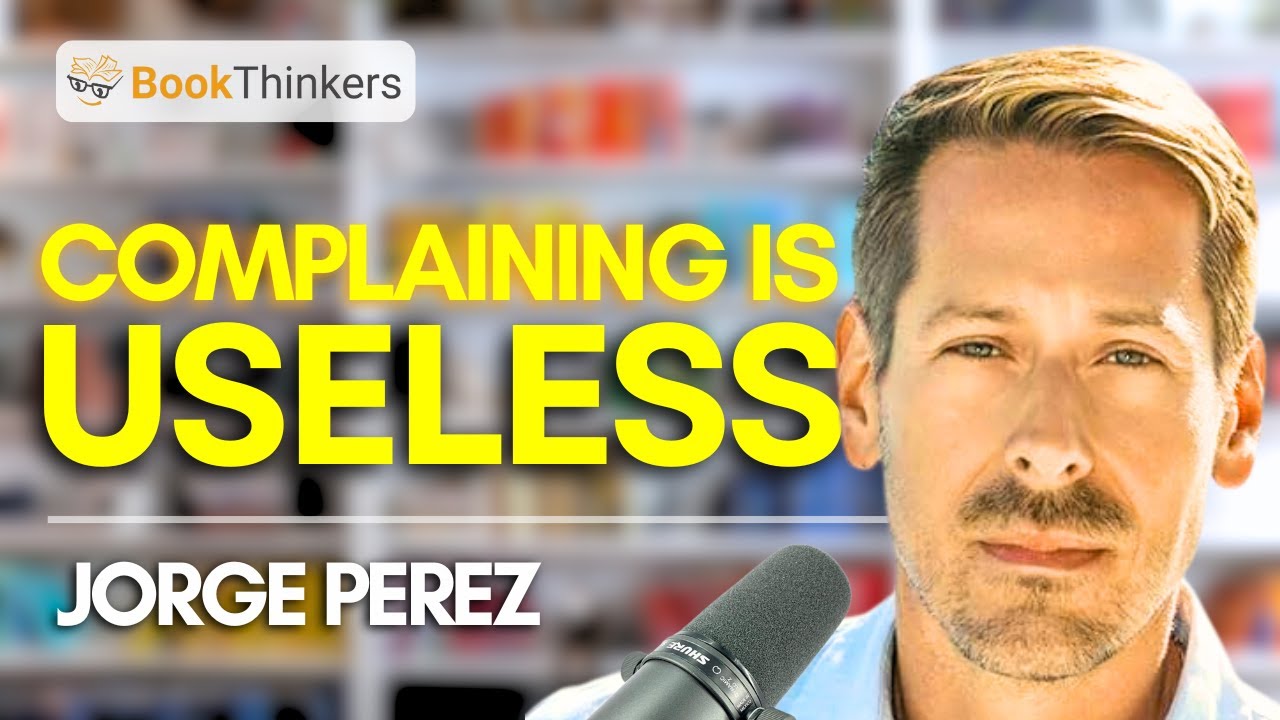
Jorge Perez argues that silence, a non-reactive state of awareness, lets you skip complaining and move straight to solutions. He traces the idea to mentors like Byron Katie and Dr. Joe Dispenza, and claims chronic stress harms your brain's wiring. His book Shut the Fuck Up offers tools to rewire your stress response through gratitude and daily meditation.
Chapters
When we resist anything, when we resist reality, we lose. So I think not resisting reality actually is the easiest and fastest way to change is when you have to just surrender to what is and then you have a solid platform to grow the next thing. As far as what, you know, the silence of it all is just that when life comes up and there's that survival knee-jerk reaction to say like, this sucks, what a bad day. Like, to have that self-awareness and that willpower not to say it, it's so powerful, Nick, because when we go into that silence and we, we take a breath, it's almost like you're in a diet or you're fasting and there's pizza all around you and you go, you know what, I'm not gonna do it. I'm not gonna do it. So you're not repressing yourself from pizza. You're just making the choice that's intimate with your goals. And that's what silence is. Silence is making the choice that's intimate with our goals.
Jorge Perez, welcome to the Book Thinkers Life-Changing Books Podcast. I'm excited to interview you today, and my first question is a scenario that you painted on page 88 from the book. You're in the airport, you're on the phone with your sister, and you end up walking out of the airport and you have to go through the checkpoint all again. But instead of getting frustrated, something different happens. Can you explain what happens?
Yeah. Thank you so much, Nick, by the way. I love seeing you. I love what you do. Excited to be here. So, you know, I remember that moment specifically, and this is where I also talk about being our brother and sister's keeper, right? And literally my sister, because I'm talking to my sister. So in that moment, you know, I recognized that I stepped out of the security checkpoint. Now I have to go back. And obviously, you're on the phone with someone. And the first thing that you would do is like, oh, man, I got off this thing. And then they're like, what happened? And then so immediately, there's this new thing that awakens in me where it goes, there's no need to talk about this. Let's just handle the issue. So rather than be like, hey, I just stepped out, which is going to You know, now summon them into my issue, right? Because she's gonna either have her thoughts about you never pay attention and focus on that. I don't want whatever the even if it could be super small, but why have an audience when you don't need to have an audience? So I just said, "Hey, let me call you back. I need to just focus." Hey, great. And then without going into all the story of what it means to get back, you just without you know without complaining, you just go straight into action. And that's what I did. I went back, I did the line, and I smiled. And I— and, and, and to me, uh, being efficient with action taking without complaining just makes everything so seamless and effective.
Yeah, there's a bunch that I'd like to unpack there for the audience, but first I'd like to share a similar experience that happened to me recently. So as you know, my wife and I were just on a trip internationally And we were in Lisbon, downtown Lisbon, and we're about a week into our trip and she's 7 months pregnant. She's feeling kind of sick and run down from the time zone changes, and she's getting like some nasal congestion and a little bit of a headache. And so we walked to a pharmacy and we walked in and we said, hey, my wife is pregnant. She's feeling a little run down. Do you have any cold medicine that's okay for a pregnant person? And the pharmacist said, no, we don't have anything for a pregnant person. Like, you should go to the hospital. And we walked out and she gets all nervous, like, oh my goodness, there's something wrong. You know, she starts freaking out. And I was like, okay, there's no emotion that's going to help this situation. So logically, what should we do next? And we walked down the street to the next pharmacy and that person was able to help us. And so again, it was one of those situations where I could have been like, woe is me. I could have shared in the emotion. We could have been all stressed out. But instead, Especially with this information being reinforced in my head right here, we just defaulted to action. So, here's my question for you, my next question. How did you develop the awareness that there's a difference between reaction and proactively choosing to take action? I'm sitting here today with Ken Rusk, who has done hundreds of millions of dollars in business. He's also sold tens of thousands of books and changed countless lives. We're sitting here today because he is sponsoring today's episode. So Ken, tell everybody about your course.
Well, thank you. I built a course called The Path to a Successful Life. It's designed around trying to get somebody unstuck. You know, sometimes you're feeling like you're kind of stuck in where you are, you're not really sure what you want your life to look like or how to go about getting it. Well, for the cost of about dinner and a movie and maybe the time you'd spend on a weekend, you can know exactly what you want your future to look like and how to go about getting it.
You know the power of vision. That's why you watch podcasts like this. So click the link below, get signed up, and let me know what your experience is. experiences like?
Yeah, you know, I think it goes back to, uh, really incredible things that I learned from one of my mentors, Byron Katie. You know, we, we collapse complaining with caring. We collapse complaining with, with, um, with really empathizing and, and commiserating. And, and what it— what actually complaining, what it does, it's, it slows down the process of the effect effectiveness. You know, let's say you, you're walking down the street and God forbid you're, you're with someone that you love, whether it's your kid or whoever, in a car, you nick someone, hit someone, or whatever, right? Like, yes, there's going to be a moment of shock. But the more that we're so used to those stressful levels, then there's going to be a period where you're going to just go probably ballistic, right, and go after the guy and all that. But I think as we work with, with my method, And really lower down those survivals. I'm telling you, Nick, all that is left with is just action to take care of the problem. So instead of maybe like spending 10 minutes yelling at the cab driver for having hit whoever you're with, you go straight into like, all right, we got to go to the hospital. You know what I'm saying? And that doesn't condone that somebody did anything, by the way, but it just makes you a much more solution-driven person. And that's that in my experience. I experienced it the other day, man. I was driving down the street and I was talking to somebody on speaker. And till this day, I don't know what— basically, I was going straight and there was a truck making a left and it hit my side view mirror and it made a really loud noise. And the truck kept going. And dude, I didn't even flinch. Like, I just It happened, and the woman was talking on the phone, and I just drove one more block, and I'm like, "Hey, let's talk about this tomorrow and recap the event." And she's like, "Yeah, no problem." Hung up, got out of the car, went back, got the rearview, got the mirror, put it back in the car, and it was done. And and you know what? The the real beautiful takeaway from from this, Nick, was how I didn't violate myself through dragging myself through those cortisol levels and and really become a oh my God! Someone just hit me.
What?
Someone just hit you. Oh. go take it, you know what I mean? And now I'm not like creating a havoc situation, not just on me or the other person. Again, there's no right or wrong. I'm not saying you need to be a robot. I'm not saying you need to be hard. I'm not saying anything. All I'm saying is there is a way that we could swim right into a solution instead of, of taking so much time in, in, um, not accepting the situation, if you will.
Yeah, I, I love that, that perspective and that advice. And It reminds me of a concept in Stoicism called Stoic joy. You know, sometimes we see cheer as like smiling, and we forget that that's temporary, and what's stable is underneath. It's the ability to remain in control and process logically and take action. And that's exactly what you recommend through your method. So, where did all of this start for you? Kind of bring us back in time. How did you get into this world of personal development, and how did you discover this idea of silence?
Yeah, yeah. You know, I think it started when I was 20 years old and my mom took me and my sister to India and we were there for a month to see Sai Baba, which was this Indian guru. And I, I really learned— I think that was more of an energetic heal because I got really sick. And over there in India, they were like, well, apparently you filter karma through sickness. And I was about to die, so I must have been ready to go to hell. So that was like my big cleansing. And I don't know, I I grew up in the United States by myself since I was 12, and I really had to kind of fend for myself. And I think that created a level of independence that, you know, it's interesting, right? You think being a heli— you're about to be a new parent. You think being a helicopter parent sometimes can deprive the kids from their own internal tools to develop, you know? And I know, I think in parenting, you know, a parent wants to give their kids everything that they didn't have. But also, as I wrote in the book, you know, that story of Howard Schultz, Howard Schultz, the founder of Starbucks, that he says he doesn't give his kids any money because he doesn't want to deprive them of the same chance that he had, which is to build it for themselves. So I think that the fact that I had to fend for myself got me really into personal development studies. You know, when I found out about Tony Robbins was actually when I was in India on that trip that I couldn't leave the ashram. So I started reading Tony Robbins and I remember being like, I didn't even know this stuff existed and I was fascinated by it and And then, you know, then life happened. I moved to LA, got into the entertainment industry, which you need a lot of personal development for that. And I, and, you know, and I, and I talk also about it. So funny, I'm that guy that talks like I talk about it in my book, but I do talk about it in my book, which is, you know, LA has been such a great place for personal development because you're constantly not getting what you want. So you have to really process it in a way of really being in a calm space. So I think life has been my greatest teacher. Like I also said, I think Dr. Joe Dispenza's work was really what, you know, was what tied everything together, if you will, was the last kind of light that connected all the dots, you know. And I think for me, the whole concept of silence was that the genesis of this book was that Dr. Joe would like sit there talking about, you know, quantum physics and how when you as the observer, Nick the action figure, when you observe something and you call it out like life is hard, then you actually summon proof so that you could be right. So then I would start noticing how people, whether they were staff or volunteers or participants, would still be complaining. And I'm like, oh my God. Then I said it as a joke, I swear. I said, if I ever write a spiritual book, it's going to be called Shut the Fuck Up. And, and that was the, that was the genesis of the book.
Yeah, I love that. I think, uh, number one, I'm a fan of Dr. Joe Dispenza's work as well, and there's so many amazing people in this space. Uh, I'm curious, when you went to India for one month, number one, interesting growing up in a household where a parent would bring you to India for a month, but did you learn anything from the spiritual teacher who you were observing for one month while you're in the ashram?
Yeah, so, you know, his teachings are, are very non-denominational. So, and it was, uh, a lot of it was— a lot of it is based on, you know, having empathy, uh, having, um, really getting to the other person's point of view, um, and, and really, you know, uh, really assume somebody else's life and before you judge them. So it was very based on that. But I gotta say The fact that I found out about Tony Robbins during that trip, I think, is what started my journey. You know, I also became a— Byron Katie became a huge mentor of mine, and she really breaks down that there's no dualism, you know, and how when we resist anything, when we resist reality, we lose. So I think not resisting reality actually is the easiest and fastest way to change, is when you have to just surrender to what is. And then you have a solid platform to grow the next thing. As far as what, you know, the silence of it all is just that when life comes up and there's that survival knee-jerk reaction to say like, this sucks, what a bad day, like to have that self-awareness and that willpower not to say it, it's so powerful, Nick, because when we go into that silence and we, we take a breath, it's almost like you're in a diet or you're fasting and there's pizza all around you and you go, you know what, I'm not gonna do it. I'm not gonna do it. So you're not repressing yourself from pizza. You're just making the choice that's intimate with your goals. And that's what silence is. Silence is making the choice that's intimate with our goals.
Hmm.
Can you give us, uh, an example? You gave us the car example from a couple of weeks ago, but can you give us another example of how maybe this happens in it in your daily life? So you're resisting food. That's a good example. Where else does it present itself?
You know, it presents itself every single moment of my life, man. It presents itself when I go outside and people are like, oh my God, it's so hot, right? And I just smile and I go, yeah. But, but I know that I'm not jumping in the bashing of the weather or the bashing of the climate or the bashing of the political situation, you know? And you could still take action. Listen, I'm a Venezuelan citizen, and I don't know if you're familiar. There's a lot of upheaval right now in Venezuela. And listen, I went to a protest on Saturday, and I went because I still—I believe that the person that won the election should be let be the new governing party, right? But the government right now doesn't agree with that. So what do I do? I—I go and protest, and I do my peaceful stance. And that's it. I don't go around telling everybody that what's happening is messed up and how can this be. And, you know, there's a difference between taking action for what you stand for and, and then also creating havoc around it. So if, if what I have to say is not going to add to your benefit and it's going to cause you to, to raise your stressful hormones, I don't say it.
Yeah, that's wonderful advice. So my next question is, What's the most surprising way that silence can transform your life?
You know, Nick, the most surprising way that silence can transform your life is when, when you stop saying that life is hard, you are inevitably going to start experiencing life easy. And that's just it. The power of words, we— it's— you have energy and matter, you know, we are 99.999% energy and 0.00001% matter. Just trust that energetically you're doing your part. And guess what? Matter is going to catch up. We just have to give it a second because matter is slower. You can immediately have the thought life is great, but just give yourself a minute for life to start customizing and turning itself that way. And I think that in my experience, I just— if I'm not describing this life as good, I'm shutting the hell— I'm shutting up. I'm just not describing it as bad. There's no need. You know, there's no need. to form camaraderie for me over how bad the world is because I don't wanna be right about how bad the world is. And I don't wanna be right. When I meet somebody now that I don't like, I actually love it 'cause I tell myself, oh man, I'm gonna be so wrong about you. I'm gonna be so wrong. And I find— and I commit myself to finding that thing about you that I do like. And if I can't find it, then I go to step B, which step B is— What's step B? I can start not contemplating on why you got that way and, and how you were raised a certain way or how genetically wired you came and how you don't have the same toolbox that I have. I'm working with a great, like, brand new Home Depot screwdriver. You're— maybe you're working with like a rusted Phillips head. And how can I judge you, you know? So I think that, that contemplating on that and, and giving things a beat, uh, it just starts to transform everything.
Yeah, the world needs more of this, my friend. So we got to make sure you don't shut up entirely, that you keep talking about these subjects. So we're dancing around a subject that sometimes gets called the law of attraction a little bit, right?
Yeah.
And, you know, there was that book a few years ago, The Secret. I'm a fan of it. I think that sometimes people who are critical of that book and of the law of attraction, you know, they say, oh, you can't just sit there and pray for money and money will fall from the sky. You need to take action. We all know that you need to take action. But like you say, energy does manifest itself. And so what are your thoughts on the law of attraction?
I think I am— I'm very aligned with the law of attraction. And I think that what happens is when, when we don't pay attention to the things that we don't want— and by the way, handle it right, like handle, you know, your partner left socks on the floor and you don't like the socks on the floor, you pick up the socks on the floor. That's it. What doesn't work is you telling everybody how you have a messy partner. You're telling her how she's always a mess. That's different. Does do you feel me? Like there's a difference between action and sorting out, and then you going around telling everybody that. So the more that you don't talk about the things that you don't want, you you start sucking the oxygen out of it. You know, and one of my chapters is the law of retraction. You know, and I made that up. I I was like, okay. So if attraction is based on what you focus on, like in quantum, like the energy, what you— where attention goes, energy grows. So if you're not focusing on something, then all of a sudden you're going to suck the oxygen out of it and it's going to go away. I believe that action is awesome. I take action now more than ever. You know, I don't sit all day and meditate for book sales to happen. Dude, I'm hitting 40 people a day. I'm hitting my social medias. I'm hitting my network. But the difference, Nick, is that I am so enjoying the process. I've told everybody right now, we're about to hit 1,000 books today. And, you know, for a little group that— for a book that's, you know, grassroots, I'm so proud of it, Nick. And I don't— as much as I want to be a New York Times bestseller, I don't want to rob myself from the process and from the winning of selling 1,000 books. And I don't want to be sitting in this accomplishment like, But how about that New York Times bestselling list? You know what I mean? Like, why would we rob ourselves from this moment? This moment is— I mean, listen, you and I right now, I mean, listen, I don't have your medical records, but it looks to me like you can breathe without pain. Do you know how many millions of people would love to be in our shoes, regardless of how many zeros are in your bank account or mine or not? And that's something like, I work with people that have ALS and MS and Parkinson's, and some of them so wealthy. And Nick, and what they would give to be able to do this, to not have a 5-second delay on just raising their hands. So no matter who you are, no matter what you're going through, millions of people would love to be in your shoes. And that's, that's the end of the story.
Yeah, truer words have never been spoken. I, I think that's a beautiful message. And You know, there are a couple of things that it reminds me of. Number one, there's a quote from Napoleon Hill that says, action is the real measure of intelligence. And so, you're right, it's not just sitting back and meditating all day long. It's going out and loving the process, truly loving what you do, being totally aligned. And I heard Jordan Peterson say recently that the fullest expression of human purpose is being aligned with your own potential, taking action in a way that serves other people and also serves yourself. And that's what creates joy and happiness in a stable way, not in a fleeting way, but in a stable way, being aligned with something that's good for you, like book sales, and good for other people, like book sales. Because when people read and implement this book and its method, then they improve their own lives, which is so beautiful. So my next question for you is, Mm-hmm. How do we break free from our own limiting beliefs? Because there are a lot of people listening to this today and they go, okay, yeah, yeah, I get it. I can live up to my potential and I can enjoy the process, but my life circumstance is different. What do you say to that person?
You know, I, Nick, I believe that obviously we're, we're all wired how we are, you know, and the wiring of, of our computer system, our brain has to do with, you know, our genetics, our upbringing, our, uh, uh, environmental, how we were raised. So what I would suggest is obviously reading great books like mine or like yours or Tony Robbins or Dr. Joe Dispenza. It's great to have that awareness and be like, oh my God, this is what I do. And at the same time, I do believe, and I write up and I wrote this in my book, that we also have to do the hardwiring part, which is—
Mm-hmm.
Please adopt yourself a 5-minute meditation practice. 5 minutes. Like, go on YouTube, find a free guided meditation. Meditating, you got to think of it as you go into the hardware of the brain. So you start really bringing yourself down to those brain states like delta and theta, where you're not in beta all the time, which beta is like, boom, you're doing stuff, you're on high alert. The more that we start conditioning our brain to go on those lower states with intention, right? Whether it's a minute meditation and you wake up in the morning and, and I'm a real stickler about this, have a gratitude practice, man. You have to start conditioning the brain to how good your life is, even if it's 3 to 5 things. You know what? I can breathe without any pain right now. I'm laying down in a comfortable bed. I have food in my refrigerator. You're done. You do this every morning, right when your brain is in theta, when you're in between those 2 states, and right before you go to bed at night, in addition to the awareness of, of the stuff that we talk about in the book and what we're talking about, dude, you're off to the races. You are off to the races, my friend.
Yeah, gratitude is my middle name, man. I'm so happy that you brought up these subjects. And this morning, actually, I was up. I did my workouts. I walked the dog. I did my meditation. And when my wife was getting up, because again, she's seven months pregnant, all the credit in the world to her. She's doing an amazing job with everything, and I'm so proud of her. And she was feeling a little tired this morning, and so she was in the mirror brushing her teeth. And to make the gratitude practice easier for her, I said, "Hey, are you grateful for our dog Pickles?" And she smiled while she's brushing her teeth. Yeah, yeah. And I said. Are you grateful for the fun time at the pool that we had yesterday? And she was nodding her head, yeah. And I was like, are you grateful for your dad for buying us a stroller for the baby yesterday? And she nodded her head, yeah. And I was like, there we go. That's gratitude. She didn't even have to say anything. She just had to nod her head and smile a little bit.
That is such a beautiful thing that you, as her husband and the father of the baby that she's so generously caring for, the both of you, You could make her— man, I'm getting emotional. That's—
Me too.
That's really sweet. That's so sweet.
Yeah, gratitude. Gratitude can change your life in so many ways. And one of my favorite quotes from an Indian monk named Gaur Gopal Das, he says, it's not happy people that are grateful, but it's grateful people that are happy. Gratitude is the action and happiness is the lag. It's the result of the action. So, let's take a quick pause. What are 3 things that you're grateful for today?
Dude, I'm grateful for being talking with you, man, an inspiring man who's about to be an amazing father. I'm grateful. I'm looking at my dog right now who I can't turn the camera on, but it's the cutest thing in the world. And I'm grateful for this moment that I can be healthy and thriving and alive. So those are 3 things that are very present to me right now.
What about you? I'm grateful for you. A little reciprocity here. And I'm grateful for your book. I believe that the right book at the right time can permanently change somebody's life. And so if you're listening to this or watching this podcast right now as a, as a consumer of the information, consider buying this book for yourself and also consider buying this book for somebody in your network. Who could use a little bit more silence and awareness and needs to get a little bit more in touch. Because what's cool about gifting a book is that the person reading it doesn't attribute the value to the author. Thank you for writing the book. But what they do is they attribute the, the value of the book to the person that gifted it to them. And so, you know, we're only a couple of months away from the holidays. Consider buying a copy. of this book for somebody in your network that could use it. So that's the first thing I'm grateful for is you and you for writing the book. The second thing I am grateful for is my wife, and I cannot wait for this baby to be born in a couple of months. And the third thing I'm grateful for is Zoom. You know, every once in a while we have some problems with this platform, but guess what? It's a wonderful piece of technology that allows 2 people on opposite ends of the country, 3,000 miles apart. to have a conversation in real time, which is just so cool. And there's going to be a virtual version of the two of us replaying this conversation thousands of times all over the planet for weeks or years to come, which is also just— I mean, it's mind-boggling. So those are the 3 things I'm grateful for today.
Those, those were really good. I'm not gonna lie.
I appreciate you, man. So my next question for you is this. The statistics around stress and anxiety are continuing to trend upward. Everybody is dealing with it in some capacity. So how can we leverage silence to overcome stress and anxiety?
Well, you know, I think it's important to, you know, look at the stats. And I talk about this too. Like, people are living 70— studies are showing that people are living 70% of their lives in fight or flight stress. And that's not sustainable for the human body. It's like you're driving from LA to Vegas on gear number 2. You're going to burn the car down. So now that we have that information, right, the, you know, and as you know, Nick, the, the reason why I wrote this book is both, both my parents passed away from cancer pretty close to each other, you know. And I, I, I went on a deep dive on epigenetics and, and how the study of how we metabolize stress and what stress does and the kind of genetically predispositioned that stress detonates, you know. And, and our genetics— what I learned is that our genetics are like Christmas lights. They're like firecrackers. If we don't light them, we don't have anything to worry about. And, and stress is what lights up our genetic predisposition, you know. And, and again, you can look this up with science research today, whether it's neurological diseases like ALS or MS or Parkinson's. Like, a lot of these people that I've worked with and interviewed They remember something emotionally that happened stressful that detonated it. And it doesn't need to be from one day to another. It's a knocking on the door that gets louder and louder. You know, we're at a very incredible time where, like, it's almost like science and spirituality are finally meeting face to face, you know? And we hear of, you know, the saying, like, the universe first knocks. And if you don't pay attention, it knocks harder. And finally, it's a really loud thump. And I think, like, consider this book as a gentle nudge, because if this book got to you, whether you bought it or a friend gave it to you or you saw the picture, that this is your calling to start taking love, to start taking care of yourself and loving yourself and not allowing for you to get so stressed out and to really use these tools and this way of understanding to how you can lower your sympathetic system and you can let your parasympathetic system, which is the one that runs your peace, to be more prominent in your life. So, so yeah, so I think that we owe it to ourselves. This information is out here for us to live calmer lives and to really take care of our emotional states.
Yeah, one of my friends, John, he always says, go calm yourself. And, uh, yeah, we need to live calmer lives. I'm, I'm somebody who has now read hundreds and hundreds of books in the personal development space, and I've read books dedicated to subjects like early childhood development and how things like autism or other learning disorders end up presenting themselves, and stress and anxiety play a big role in that, or trauma. I've read a lot of books on degenerative brain diseases, like you've mentioned, a handful of them, books dedicated to unpacking how these things end up impacting our lives. And you're totally right. It's stress and anxiety creating chronic inflammation that doesn't allow the recycling of dead cells. And as they build up, they become toxic and mutate. And then boom, here we are, you know, in this state. 70% of the time we're in this state of chronic inflammation that doesn't allow us to function properly. And no wonder we break. as a result of those things. You mentioned meditation earlier. I always just love to hear, like, what's your meditation practice look like today? What do you do on a daily or weekly basis right now? Nothing?
No, no, no. Yeah, it's, it's very what you and I are both aligned with. So every, every morning I do a 15-minute gratitude meditation, and it's a guided meditation by Dr. Joe Dispenza, and it's just It's got really kind of futuristic synthesizing noises, and it's him just basically wiring you on gratitude. So after I do my gratitude practice, I go into a gratitude meditation, and it just coats my day. It just makes me look at everything from the glass is always full. And I've talked about this before. I Lately, I, I'm not getting so much pleasure, Nick, from getting what I want, but from seeing who I am when I don't get what I want. When I'm about to go to sleep and I, and I realized that there was a lunch canceled or a meeting postponed or a business didn't happen, and then, and I didn't react, you know, and then 10 minutes later, because that dinner was canceled, another friend called me To see if I could help him out with an issue that he has, and because that dinner was canceled, now I'm available. So to me now, every no feels like a yes to something else. And to me, that has to do with living in a state of emotional autonomy. Because you know what, Nick? I'm just not really into being a yo-yo anymore. Like you get your way, you get a good news happy, bad news sad, good news happy. But no, it's like enough with this roller coaster. Like We gotta— our piece needs to be at a solid 90%, and maybe it can fluctuate 10 up or down, but you don't mess with that 90%. And I think this is completely doable. It's something that it's reachable. We just gotta do a little bit of the work and do rewiring. And, you know, and not to look at the survival mechanism that we have inside us like it's a bad thing. Like, we gotta remember, man, we're the descendants from survivors that You know, look at us. No one came to America, our ancestors, because it was a little chilly in Europe. Like, shit went down. And so we're the descendants of people that, you know, got on boats and felt bad about it. Like, probably, you know, had to leave stuff behind, were persecuted, were— you know what I mean? So now here we are, like gladiators and fighting, you know, Amazon Prime being an hour late. Like, things are a lot more peaceful. But the the gladiator machine is still like at war, you know? So, so how are we going to learn the lesson of acceptance, Nick? Do you want to learn it when someone cuts you off on the road and you don't violate yourself with stress and you, and you feel empathy for that person? Or do you want to learn it when you get a call from a doctor saying that there's something that you need to come to the office for? Because we are going to learn acceptance, Nick. It's just how do you want to learn it?
This is like the 5th mic drop, drop moment of the podcast so far. That was awesome. Yeah.
Oof.
So many things to unpack there too. My immediate reaction is I love how you talk about the 90% and that you can fluctuate up or down 10 points. Some of my friends in relationships, and even me in relationships in the past, you know, I used to swing from one end of the emotional spectrum to the other. The highs were really high, but the lows were really low, and that's never a fun place to live. When you can enter into a relationship with everybody around you and with yourself that's stable and high, and it doesn't have those really low emotional swings, it's such a better place to be. You're in alignment with where you're supposed to be. So that was kind of my first— I love that little thing that you, you kind of painted out there for us. And the other comment, yeah, you know, we're I heard somebody say recently that somewhere in our lineage, somebody was fighting for survival. They're fighting for survival physically. You know, if you go back far enough, tribes at war with each other, you know, sleeping in the dirt, looking up at the stars. It's like, yeah, we had people that survived that. And now, like you said, when your Amazon Prime delivery doesn't show up fast enough, you're getting all mad, or when somebody cuts you off. And I have very distinct memories of myself years and years and years ago when a supercar would fly by me on the highway. I would think, what does that person have that I don't have? And I'd get all down and I'd start comparing myself in a negative way. And after practicing gratitude on a daily basis for the last decade, when a supercar flies by me on the highway, I look at my steering wheel and I go, I'm so grateful that I don't have a car. I mean that I have a car because so many other people can't afford one, and I'm I'm blessed. I'm in such a wonderful position, and it's funny because comparison can be the thief of joy when you compare to people that have more, but it can also create joy when you compare to what you used to not have and you now currently have. So anyway, just a couple of random word vomit things I'm throwing back at your way because I love everything that you're picking up here. I mean, it's just. It's really amazing content.
Thank you, man. Thank you. No, I think it's exciting to look at the world and see the things that you want to achieve. Listen, accepting reality and being in surrender of your life, it doesn't mean that you don't want those fast cars and that you won't get them. And it doesn't mean that I don't want to be a New York Times seller, bestseller in the future, or you, or whatever our goals are. Right. But I'm certainly not going to rob myself from the getting there because the getting there is what we want. The getting there. Listen, we go on vacation, right? But have you noticed how before you go on vacation, you— we're so wired to be like, oh, I can't wait to go on vacation again. And then once you're on vacation, you're like, I can't wait to get back, getting back into eating healthy, going my workouts, going— so we're so already— so we're so future-driven to like, no, no, but what I want is over there, over there. So we, we're starting in almost less than zero. We have to rewire this thing from the inside out because we're already so like, what's next, what's next, what's that? Again, nothing wrong with what's next. But Daddy, don't rob yourself from the only thing that's real, which is this moment. Because you know what? Tomorrow a truck can come and hit you, and that, that was next, you know? So it's like, it's okay to be ambitious and have your goals and dreams, but make no mistake that that's not real. And, and you might not even get there. And, and, you know, whether you were aware of it or not, it never got better than this podcast in your whole life with me right now, because this is what's it.
It is. Yeah. The present moment is literally all you have. And Gary Vee talks about it as the clouds and the dirt. It's, it's tough, but we have to balance the everyday hustle, the grind, the love for the monotonous, right? Just be in it in the present moment as much as you can. And we also have to balance that kind of greater perspective, the clouds, where you have to look at things from a macro level and realize that you could die tomorrow. And realize that hundreds of years from now, none of this will have been significant at all. Nobody will remember your name, whatever. But that doesn't mean that it's not worth fighting for at the ground level. So it's like you got to balance all of these things at the same time. How did— actually, I have one other comment that popped in my head, so I'll say it. Sometimes I'll meet authors who write these beautiful messages, but they don't convey them in a way that their younger self Would have been interested in, right? Like, would you have picked up this book when you were less evolved emotionally and you were less intellectual? But what's fun about your book is that you're sort of selling people what they want to be sold up front with the book cover, but then you're actually giving them what they need once they pick up the book and they open it. And that's what I love about it. I think I've said it to you, but it's sort of like The Four Hour Workweek by Tim Ferriss. He's not actually helping you work four hours a week. That's not the point of the book, but it does get you. when you're stressed out about time to pick up the book. And so I think that that's kind of what your messaging does here too.
Yeah, no, I, you know, I read when you wrote that and I loved it and I'm so honored to be compared to Tim. And you're right, the book is a big Trojan horse for so much. I mean, the book is— the title is provocative. You know, I was really specific on how I picked So I wanted it to look like you're erasing something and going beneath. So this is the board. This is underneath it all, right? And then also, I wanted it to be yellow because I wanted it to read like an idiot's guide or a Cliff Notes. I want people to subconsciously know that this is a compilation of something really maybe more complex made easy. And, and, and this book, as provocative of a title and cover it is, it will It is the most loving book that will hold you with so much love and grace. Everyone gets a pass in this book. Everyone. And I know, and I'm not gonna get into examples of those anyones would be, because that would like throw things sideways. But if, if we're all part of this consciousness, we're all, we all have a real estate spot in this life for some reason, you know, my My uncle, the world would say that he was a deadbeat father, you know, and he died young. But because of who he was, my 2 cousins became overachievers and are the most incredible parents. One could say, you know, they became exactly what he wasn't. So they were so aware of it because he was that way. So maybe, I don't know, maybe on a spiritual realm, Nick, regardless of what your belief system is, Maybe we signed contracts and we took bullets for different people so then others can be better. And I love thinking of him in that way because he created 2 incredible human beings. So I— the book is a Trojan horse. It, as provocative as it looks, on the inside is the— it has so much love and so much space to hold for everyone.
Yeah. Well, beautifully well said. I've got 3 more questions for you and we'll wrap this thing up. And I know we went over a little bit, but you're putting out some amazing value here.
I'll do it all day.
All right. Question number 1, for somebody who's made it this far into the podcast, they're loving your message, but they're not quite sure if they should buy a copy of the book. What do you say to that person who's kind of on the fence?
I say you need to do what's right for you. Seriously, that's the first thing that I would say. But I would say that this book is so— it's written in such a simple way, but it's so powerful that I think that you, you owe it to yourself to, to get it and check it out because you will reference this book for the rest of your life. Everything, you know, Nick, yesterday I was talking to someone that read it that is so passionate about it. And she was laughing and she's like, you know, you don't need to write another book ever, right? And I was like, you know what? I kind of agree with you. She's like, it's all there. And I'm like, you know what? When people tell me what's the next book about, I'm like, there is no next book, bro. Everything is there. And she was like, if they say that to you, they haven't read the book. So do yourself a favor, get this book. You're going to be so glad and so happy that you did. And share it. Boom. I love it.
Okay, second to last question. Where should people go to buy a copy of the book and to learn more about you?
Yeah, yeah. So, um, Amazon. The book is on Amazon. We all have Amazon apps on our phone. It's going to take you less than 30 seconds to get the book. Um, the website is stfumethod.com. Uh, you can find out more about the story of why I wrote the book, how I was inspired by my parents' passing. And there's links to my socials. I'm Instagram. I'm super active at @jorgeperezjr. I'm a JR to honor my father. And and yeah, I I think this this book is it is so forever. It is for everyone because I take you from from training wheels. You know, I take you from training wheels issues with your coworkers or your mother-in-law all the way. to the quantum and the Big Bang and how the Big Bang was the biggest chaos ever made. And out of that, the biggest order ever made was created, which is the universe. So that's where you can find it.
All right, good. We'll put all of those in the show notes below. And our very last question. So let's imagine that there's another Big Bang in your life and everything disappears. The book is gone. All the podcast interviews are gone, the talks, it all disappears. But you can leave the world With one message in Tim Ferriss style, let's say it fits on a billboard for everybody to see as they drive through LA. Like, what does that billboard say? What's the one message you want to leave everybody?
You're doing it right. All right. You're doing it right.
Message. Yeah, you are. You know, that's the message that if I could go back and Tell my younger self, say 10 years ago, one thing I would say: You're doing it right. Keep doing it. Yeah, good.
That's the one conversation today. Awesome, brother. Thank you, man. I can't wait to meet you in person. So we're gonna, we're gonna, we're gonna, we're gonna do it. And and thank you for everything. So I'm so appreciative and so humbled by.
More from Nick

Napoleon Hill’s “Think and Grow Rich” is a timeless classic #selfhelp #personaldevelopment

4 Books to Help You Get Better at Decision Making #selfhelpbooks #bookrecs #nonfictionbooks


Have you read this book yet? 📖: The 5AM Club by Robin Sharma #selfhelpbooks #robinsharma

Dan Sullivan on Listening to Your Customers Instead of Watching Your Competitors

5 Books That Will Boost Your Financial Intelligence #financialfreedom #nonfictionbooks

The People That Preach the Loudest About Virtue are Usually the Most Power Hungry



Books are the greatest mentors you can find #selfhelpbooks #businessbooks #successmindset

Let’s fight this toxic instant gratification culture together 📖 #selfhelpbooks #jimkwik