Confidence Beats Competence in Business — With D.M. Christensen
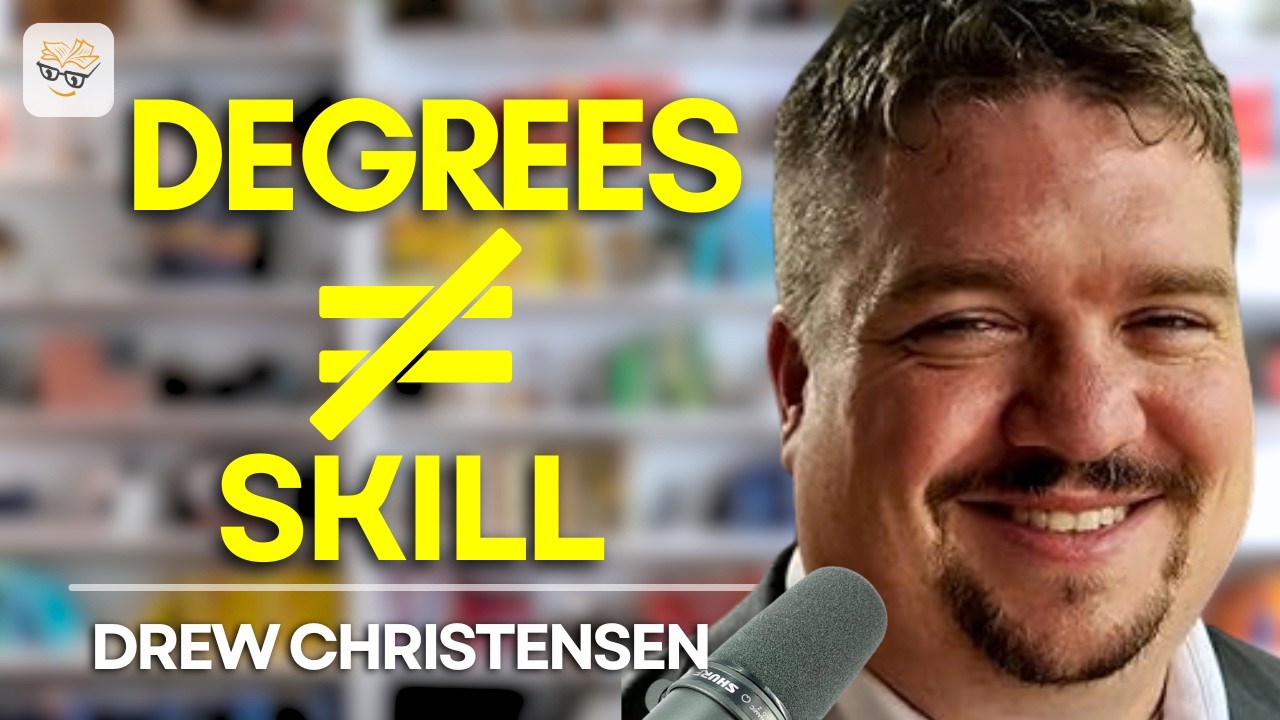
In this episode of the Book Thinkers Life‑Changing Books Podcast, host Nick Hutchison interviews Drew (D.M.) Christensen about his new book, which argues that confidence often outweighs competence in business and politics. The conversation covers several interrelated themes. Christensen critiques the value of MBA programs, arguing that most are overpriced and often pursued to check a credential box rather than acquire useful knowledge, and he suggests alternative, cheaper ways to gain business skills. He then expands the critique to the broader higher‑education system, describing student loans as a form of legal indentured servitude, exposing how universities inflate tuition and rely on federal aid, and noting that many degrees do not improve workforce efficiency. The interview delves into the competence‑vs‑confidence problem in leadership, using a tool‑belt metaphor to explain why rigid frameworks can be limiting and emphasizing the need for situational awareness and self‑reflection (the “mirror”). Christensen offers practical career advice: use government labor‑market data to choose degrees that align with desired lifestyles, focus on experience over credentials, and adopt a reverse‑engineering approach to career planning. He identifies his book’s target audience as mid‑career professionals, senior leaders, and executives seeking introspection. Finally, he proposes systemic reforms, including removing federal involvement in student loans, which he believes would force tuition down and shift hiring focus toward experience rather than credentials. The interview ends with a concise takeaway: constantly challenge your own and others’ thinking to grow beyond formal education.
Chapters
You know, the reason why I don't like proposing frameworks of how to do things is because there are times when things that are said to be good leaders don't do this sometimes are the appropriate action based on the context and the situation of what's going on. So I like to, using the tube analogy as an example, I don't like to Uh, say only use the tools in your, in your belt. Everything's available and open that paradigm up to say, this is, this is, uh, what you're looking for.
Drew, welcome to the Book Thinkers Life-Changing Books Podcast. I'd like to jump right in and kick off with a question. Are MBAs actually worth it? The floor is yours.
You know, that's a great question. So there's a story I like to tell whenever I think about an MBA, and it was a question that was asked while I was getting my MBA. 3 questions. First question was, if you see someone has an MBA on their resume, what do you think about them? In this, in the book, this story tells, people are answering. Smart, hardworking, know how to run a business, understand a lot of nuances, really, you know, all these really positive things. Second question was, what do you see when in the specific university that I was going into, and it being a Christian university, they added ethics and extra hardworking because it's a prestigious university, etc. And the third question was, why are you getting an MBA? So that's when you started getting answers of, I have a degree in history and I realized I can't make money, so I'm trying to change the perception and get something that makes money because I like money. So for me, the questions were very simple. The first question being, I immediately look for their undergraduate degree because I assume they're hiding a weak one. I definitely can be more politically correct associated with that, but certainly has resonated with my experience. Second, if I see that specific one, I assume it was, they were local, it was a 2-year program, and it was the cheapest program in the area. So again, a little bit of cynic, cynical there. And then for me, why did I get an MBA? The thing I realized very clearly is, for me at least, it was checking the box. So while I do understand there's certainly value in getting an MBA, At the end of the day, there's a lot more higher education options that can give you that same knowledge without spending $180,000, $140,000 on an MBA. And more importantly, I think the real challenge that you have to think about is, is the MBA what you're looking for, or is the knowledge what you're looking for? And to me, I think we've taken universities, MBAs, and, and higher education programs and taking them from something that was giving us knowledge, and we've made it into a premium product that's supposed to say that we know what we're doing, and in reality it doesn't. So generally speaking, short answer, no, MBAs are not worth it. Long answer, it certainly can be depending on, on what you're looking to get out of it.
Now, Drew, I don't have an MBA, but you make me go back in my head to my college years. And I do have a degree in business, an undergraduate degree. And when I graduated college and I went to work full-time and I was introduced to the world of nonfiction business books and I started to read them and I started to apply what I was learning, it felt like, why didn't we learn any of this in college?
Right?
I got a degree in marketing and I started reading marketing books and I feel like There was just so much more packed into those 200 to 300 pages than there were in my 4 years of spending in higher education. And it was kind of a slap in the face to me, like, why did I even spend that money? And it felt like for me, high school was just college prep. Like everybody that I went to high school with naturally went on to college. And it just feels like the system kind of forced me into higher education. Can you talk to me a little bit about that?
You know, it's funny, since the United States government is the only backer of higher education student loans, one of the things I like to remember, think about, and the way I think about student loans is it's the last form of indentured servitude still legal in the United States.
Hmm.
Which is pretty horrible to think about, but you can go bankrupt and you still have student loans. So when I look at that and I look at some of the universities that I've spoken to and gotten information about and find out what they use their tuition for. I'll use an example. A university, they had a tuition roughly $40,000 a year and their annual operating cost was about $18,000 a year. So what happened to that other $22,000? They were using it to artificially inflate student aid and they were using it for their endowment. So all of a sudden when you look at situations like that, and I have several that I can think about that are great examples that did that same thing or do do that same thing, really. And there's even peer-reviewed journals that showcase that federal aid and federal spending in higher education is directly correlated to tuition increases. When I look at like what higher education has become, it really has become something that you get drone footages of pretty, pretty campuses and all these things. And I'll never forget that like a business degree used to be 3 years and that was a long program. I mean, there are some business degrees that were undergraduate degrees That were two years, and now they're four. Some of them are five. Why are they doing that? Because they have a financial interest in doing so. And one of the things that I'm always I always keep in the back of my mind is it's not a conspiracy if it's capitalism. And at the end of the day, these universities have a legal obligation to their bottom line. Even nonprofits, they believe that that's their interest is to build and become bigger. And when they have financial incentives that do so, you all of a sudden you're not. You're not prepping for the real world. You're not, you're not giving education that actually provides value to the industry. All the industry is doing is getting people straight out of college and having to retrain them, and they're not prepped for it. They don't want to do that, and you end up having a less efficient workforce, and you have that same less efficient workforce coming in with huge amounts of student debt. That's just not worth it. The number of jobs I look at that really didn't need more than high school degree is extremely high. And yet the bar and the barrier for entry is an undergraduate degree these days.
So. Yeah, and it just feels like so many of my friends and family are working in industries that are completely unrelated to their degree in the first place.
Yeah. So just go to a McDonald's or any drive-through. There's psychology majors, there's people that got halfway through a program and then stopped, and now they're saddled with $30,000 of student debt. in an hourly job. I mean, there has been a perpetuation of higher education is the goal. And reality is it should be knowledge is the goal and progressing is the goal, not spending huge amounts of money to get a box or a piece of paper that, as my cover clearly shows, is about worth the same amount as a roll of toilet paper at the end of the day, especially when you get more experience. When you get 20, 30 years of experience on your belt, 15 years of experience, People don't look at your resume for your undergraduate degree or what education, they look at everything else. So, you know, what's, what's the actual value anymore?
Yeah. Drew, at what point in your understanding and kind of unearthing of, of some of the stats that you just mentioned, for instance, did you decide, hey, I'd like to write a book about this? Like, I feel so passionate about ripping the veil off that I think I actually need to document all of my perspectives in the form of a book.
Um, so I, I've always had a desire to kind of look at, um, and, and frame it. Um, so I, I had written a book previously which I use heavily to mentor folks. Um, and, uh, I was, I was looking at something that would be more value, um, and, and kind of, I'll say, trying to peel the onion and show just how rotten it is. Um, I think the, the problem is when, when people read this book, they hear it as an echo of what they already believe. The challenge is if the echo isn't loud enough, never, it never is going to drive change. So to me, when I look at what I'm hoping to do is I'm hoping to really see dialogue coming from folks and either universities or I'll say politicians looking at whether or not we really should be financially supporting You know, all these student loans for degrees that don't add value to the nation, to the workforce, and ultimately saddle us in more debt and don't drive what we really are looking for.
Yeah, I'm trying to think back to how I applied for my student loans because I came out of college with quite a bit of debt and Did I just fill out an online form and was I automatically given that money? Because if you think about, if you think about if I wanted to go apply for a personal or business loan today, I'd have to sit down and make a case and show a business plan and talk about a return on investment and how I was going to repay that money. And then you, you imagine, like I imagine an English major or a philosophy major or a history major going and making the same case. And being denied that loan, but that's obviously not happening. The government's giving those loans out to anybody who wants them. It just seems so backwards.
It's absolutely true. And that's the piece that when you let free market decide what a loan is really able to support, you'll see the market supports loans that pay it back. And I'll say something which I believe is true, but I will acknowledge I'm still researching into this. My understanding is that universities, if they accept federal aid and these federal grants and everything else, they're actually not allowed to give advice to students on which degrees they're pursuing. So if you get a degree in— I don't know, I'm just going to choose a random one— psychology, and let's say the average psychology degree is making $30,000 a year, they're not allowed to give you advice to say, hey, look at how much you're spending. You're spending $180,000 on an undergrad or a master's, and that's not going to get you anything And then you're still going to need a master's. So you're going to be $240,000 into this education journey and your opportunity for a career is, you know, $30,000 to $40,000 a year. As far as I'm aware, I believe they are not allowed to actually give that advice. And it's really unfortunate because that's the advice that a lot of these folks need to have, is to recognize that if you're going to put yourself in debt, you need to make sure that you are going into a career that is going to be able to support it.
Yeah, I feel so passionate about this subject too, probably because I regret having spent the money that I did on a degree that I also think of as not worthless because the time that I spent on my college campus for 4 years was more of a social benefit to me than an educational one. And I think that I did a lot of maturing, although it's this really safe environment that's artificial and it's not representative of real life. I mean, I did work all 4 years while I was in college, whereas a lot of my peers didn't. And so I just think about not only are you getting, you know, as an undergraduate or as somebody pursuing a further degree, like not only are you distancing yourself from reality a little bit and operating within this really safe space, but I think that creates even more resistance for getting into the workforce. And so in the example that you do, you have a psychology degree, Maybe it's a graduate degree. It's just the lure of staying in the college environment or in the higher education environment just becomes stronger and stronger and stronger. And that's why you see a lot of those people either abandon their degree and choose a different industry or just stay in higher education. They end up becoming a professor or something like that because it's just, yeah, it's like, what else are you going to do?
Well, I mean, even degrees that are highly sought after, I knew some people graduating my undergrad in engineering, because the job market was a little bit tougher for a couple of years when I graduated. People were assuming that they could just walk out and get a job. And because they weren't just walking out and getting a job easily, they were just rolling into getting a master's degree. And now look at— looking at it from the perspective of an employer that hires these college hires, like the difference between a master's and an undergrad, I have to retrain them either way. So the number of times I find these things actually added the value that they purport to do is extremely low, and it's very disappointing. And it's something that when you look at the systems as you get into real world, you start transitioning into seeing how those systems have perpetuated into day-to-day business life. And that's the other piece of the book that I really focus on as well is You know, there's this foundational aspect of education and what it's done to create these environments. And then there's the, what does that mean in real world? And real world, it's difficult when you sit there and you're in a room and you're listening to the loudest person in the room providing a path And it's the wrong path. And, you know, as I've seen those systems in place, I've played with a tremendous number of different ways to— from leadership books that give you framework to tell you how to do something or how to respond to certain situations. And the piece that I've realized is knowing the framework is not the hard part. It's being willing to sit there, listen to incompetence, and still clap. And that's difficult, um, because here you are, you've got this foundational educational system that's feeding into these, these, uh, these organizations, and these organizations have perpetuated aspects of that, and they continue to perpetuate it, um, where you're, you're confusing competence with confidence and Those kind of distinctions are pretty significant when you're dealing with what is the end result you're trying to achieve. And yeah, it's scary how the system is— I think in many ways, I think people consistently see and acknowledge it's broken. And it's disheartening to see how many people have just accepted the fact that the system is broken.
Yeah. Well, that reminds me a lot of politics as well. It rewards confidence, not competence.
Yes.
And obviously that plays out the same way in business today. So for somebody in the audience, of course they can buy and read the book, but for the purpose of this conversation right now, let's say they feel like they are the competent one sitting in the back of the room watching the confident one use buzzwords and make these big inflammatory decisions that actually hurt the business but sound good. How do you start to fight that fight?
So one of the things I really thought was important and over the last 5 years, I've redone this version over and over is there are so many different frameworks out there on addressing situations like that. And at the end of the day, each situation has nuances, and it can be a mix of different techniques and frameworks to solve a situation like that. What I didn't want to do with this was provide any of those frameworks. I wanted to give context of how to think through things and, and give context of, of what you might see in order for you to challenge the assumptions and think through different ways to approach things. But because of the number of times I've attempted to implement one framework myself and found that there was a nuance that I was unaware of, and now I had to implement a nuanced framework or a second framework or adjust the approach, there isn't one answer. You go to a lot of books out there in leadership and they're going to give you a framework, they're going to give you answers. And I encourage you to read them because some of those frameworks are extremely beneficial. I think the big thing to think about is it's not about having answers to everything. It's about identifying the problem and figuring out the right way to, to nuance through the situation. This is, this is not something that I encourage folks early in their career to read this because it's, it's helpful to challenge yourself and to really make sure you're constantly checking yourself as you're going through it. But it really hits home a lot for senior folks when they say, oh, I did that. And I think the big thing I was looking for was to put a mirror in front of yourself. And when you put a mirror in front of yourself, you start realizing that some of the things that I've written about, even good leaders do. And they don't even recognize it at times. So rather than trying to come up with a framework, it's just about trying to make sure that you turn the mirror on yourself. Consider what's going on around you and what you are doing and what, what changes that may inspire you to make as, as you're going forward.
Yeah, it kind of reminds me of the metaphor of a tool belt. And so a framework is a tool. Now, if you only have a hammer in your tool belt, everything looks like a nail. But if you have a hammer and you have a saw, And you have a wrench, then you have more tools. And therefore, when you see a nail, yeah, you might pull out the hammer, but it's that extra awareness and the knowledge of what other options you have available to deal with the situation in front of you that allows you to make a better decision. And so your book increases the awareness and it just says, hey, it's probably beneficial to learn multiple frameworks. Therefore, you can handle the nuance. We were talking about this before we jumped on that. You said you were kind of scrolling through LinkedIn this morning and you saw some leadership content and you thought, yeah, that's right. Sometimes, not all the time. And that's why you need longer form conversations and books in order to like properly educate people.
Yeah. And I think that's right. And I'll pull that analogy a little bit further and say this isn't just about taking someone and making sure that they're bringing the toolbook A tool belt with them. It's making sure that they understand that they're building a house.
Mm-hmm.
And that way they can consider what tools they need in order to be effective. I think oftentimes we forget that while the tree in front of us is on fire, the rest of the forest is still there. And if we forget to take care of the rest of the forest, while we're putting out that one tree, the next tree next to it lights on fire and the next one, the next one, and you're not addressing the overall picture. So sometimes it's very important to use a framework and really zoom in on that framework and exercise it really well. But it's always important to step back out to, you know, that 50,000, 100,000-foot level and consider what else is going on. You know, even down to, am I hiring the right undergraduate degrees out of college to, to actually address my needs or not? Can be a simple thing that people think, oh, I have mechanical work and I need mechanical engineers. And if you challenge that assumption, you might realize that I don't need mechanical engineers, I need mechanics. And all of a sudden you get a different paradigm that you're trying to, or that you're able to work in to move forward.
Drew, oftentimes you hear things like, if you're getting a degree in computer programming or computer science, by the time you graduate, the information that you've learned is 4 years old. And so how, how can somebody who's young and pursuing a college degree make the right decisions? Like, how can we go upstream a little bit and make sure that not from a hiring perspective, but from an actual college degree perspective, that you're making the right decisions?
So there's websites out there that, um, uh, the actual US government provides that gives you frame understanding of what, what the job market is anticipated to look like in 10 years as far as the number of, you know, let's say, number of nurses that are going to be needed in specific industries in 10 years, and is it more or less than what we currently have? Is it a stable part of the economy? I like to use that for, for an assessment of what you're looking at for, for an undergraduate degree. I know a lot of people like to encourage young folks to do what they're passionate. I'd flip that framework and say, Do something that gets you the life you want, and step back and try to make yourself passionate about it. It's when we look at what makes the American dream reality. It's it's not doing what you want; it's doing something that's hard. And I think we forget that that means. Doing stuff you may not like or may not be the best at over and over and over again because it gets you something that you enjoy. There's lots of people that want to be artists and painters and all sorts of stuff. So if you get a degree in, I don't know, accounting or something so you can pay your bills through the day, then your nighttime is doing that artwork. You are effectively living the dream. It may not— and I think when we look at higher education, As a whole, people are told to follow their passions, and that's, that's really not what we should be telling them to do. We should be telling them to, to do something that, that you can, you can find joy in, and after that, follow your passions, but, but really focus on, on something that, that is going to lead to the end state that you want. If you want to be staying in your hometown for the rest of your life, Absolutely. What enables you to do that? If you want to be in a career that forces you or allows you to travel all the time and every week you're traveling somewhere, what gives you that opportunity? And, and that may be something where we have to flip the paradigm of how we think about what we go after for education.
Yeah, that, that is the exact opposite of what's being taught to young people today. But I agree with you. We, we had a guest on this show a couple years ago, Brian Scudamore, the founder of 1-800-GOT-JUNK. And I remember one of the big takeaways from his book was that consistency creates passion, not the other way around. So, people look for passion first and then they think, oh, because I'm passionate, I'll be consistent. No, you have to fall in love with the mundane and the monotonous, and eventually, Once you are more familiar with it, you'll become passionate about it. And if it's something that from a financial perspective gives you the, the ability to do what you were previously passionate about as a side hustle or just as like something that you do on nights and weekends, like, great. So yeah, you're, you're suggesting begin with the end in mind and then, you know, engineer backwards something that will fulfill that today. And I think that's beautiful advice.
That's what you just said is, is I think, I think you just said without me saying it, the first piece of advice I give to any, any person working on a project, a program, anything is outline what the end needs to look like, and then map through where it goes and how you're going to get there.
And so what you're kind of saying is that if anybody was about to do that before they got an MBA, then they probably would realize the MBA isn't part of the path to get where they want to be anyway.
Yes.
Hmm.
But, but again, you know, there's, there's a lot of other degrees out there that could get them that same path. And that's the piece that I always like to remind folks is you don't always have to get that one degree. The best mentors I have have degrees in community college, from community colleges. I'll use an example. I, I'm an engineer. I did not have any passion to be an engineer in college. I was basically told you have to be an engineer for the first 2 years or else. Yay, thank you, parents. And after that 2 years, I realized that like sometimes exactly what you said, the foundational skills I was learning was gonna get me to a path that I wanted to be in. And there's parts of the job that I wasn't necessarily gonna enjoy, but there's parts of it that I could find joy and become passionate about and become better at. And then over time develop into things that I wanted to do.
So who is the target reader for this book?
So I think a lot of executives and senior leaders in any industry, and I've been surprised to find out a lot of the feedback I've had from industries outside of my expertise have had very strong positive feedback of this being a mirror that they're looking at themselves and their organization, and they're looking at what they can change to prevent some of the things that it addresses. So I look at this as, you know, if you're in the middle of your career looking to develop into a leader, if you're a senior leader that are trying to improve to become that executive, or if you're an executive and you're looking to do that periodic refresh and, and, uh, look at being introspective and, uh, put that mirror in front of yourself and say, huh, am I doing these things? And, you know, the reason why I don't like, um, proposing frameworks of how to do things is because there are times when things that are said to be good leaders don't do this sometimes are the appropriate action. Based on the context and the situation of what's going on. So I like to, using the tool analogy as an example, I don't like to say only use the tools in your belt. Everything's available and open that paradigm up to say, this is what you're looking for. So to me, I think folks that are willing to open the mirror and look at themselves and are looking to find a way to professionally be retrospective and introspective would find this valuable for how they're doing work.
Well, we have a lot of those in the audience, so I'm sure a lot of people are going to resonate with that. If, Drew, if you look out to the future, And this book reaches a lot of those target customers that you just talked about, and they're a little bit more conscious of the difference between competence and confidence. And they start looking at the forest and not the tree, or the house and not the nail, like we were talking about before. This dialogue starts to really take place. People begin with the end in mind. They start choosing degrees that are worth The money that they're choosing to invest, they're more aware. Like, what does the world look like if your philosophies are more widely adopted, let's say 25 years from now?
Well, I'm gonna say the radical thing out loud. The government is not involved in student loans at all. I think that's a tremendous situation of Ponzi scheming that has artificially inflated the higher education system tremendously beyond where it should be. That probably would spur a tremendous amount of foundational reform in the entire system. The other piece that would really be valuable is if this started Sparking the conversation among leaders that systems processes involve people, and to really try to acknowledge the fact that so I'll use use I'll quote a famous general here and say like war is a human endeavor, no different than business is a human endeavor. At the same time, while humans are part of that endeavor. making sure that you are very calculating in the system that enables that human endeavor is important.
Mm-hmm.
And creating systems that allow for inefficiencies of human thought and human behavior would be a valuable end state. But I certainly know, to me, this paradigm shift would start is if The federal government literally removed themselves from all student loans. And I think the piece that would be most surprising to a lot of folks is how many universities would just drop their tuition to what it should cost. And if that were to occur, if a lot of these universities that are $40,000 a year all of a sudden are $15,000 a year, Doesn't that potentially create a situation where they're not coming into the workplace with as much student debt? They're coming in with a properly afforded education. Uh, you go back into the '80s and the '70s and the '60s and the '50s, people were getting educations from, from their summer jobs.
Yeah.
And now you could have an extremely high-paying summer job and you're not even going to pay for a semester. So, so I look at like what my mother did to pay through her undergrad, what my father did to pay for his undergrad. And I look at that as the model that very likely we'd reset to something similar to that. And I think that would be extremely valuable. The second piece that would be critical to that is you'd start getting the conversation where the credential is not the important thing. It's the work experience. Your interviews would would get into a very different mindset where a resume may not look perfect, but you're going to really be open-minded and you're going to try to hire for the person, not just for their credentials. And I think that would be a foundational mind shift in improving overall business effectiveness.
I love everything that you just said. And you said, you said the thing, which was get the government out of student loans.
I'm sure certainly, it's certainly something where I don't have to be on the red or the blue or the green or the— I don't know what other colors there are— side of the government. I can sit here and say, at the end of the day, I look at the amount of student loans out there and the students that are getting those loans. And I just look at inflating and perpetuating a problem for those students for decades. And I would rather have it where the universities are not profiteering off of you. That's the bottom line. They're profiteering off of the government aid.
Yeah. And I've heard those stories from my parents. Well, my parents don't have college degrees, but from my in-laws about those days where a summer job would pay for your undergraduate degree. And listen, I I worked my butt off when I was in college. I ran my own house painting business for 2 summers in a row, hired all my own friends, went home on the weekends. I knocked doors, I sold house painting jobs. Like I made, I made a lot of money as a college kid over the summers. And I think the total amount of money that I walked away with was maybe only about 25% of my total tuition plus room and board. Yep. And that's sad. That's sad. I made a ton of money compared to all of my friends and, you know, family. And I only made about 25% of what I was paying for college. That's, that's, that's not good.
No, it— and the number of times I've heard stories exactly like that is, is embarrassingly large. And we talked about what can we do to help people that are going into the work place now. Now the AI is going to be a very different environment for a lot of different things. And the thing I look at is where have we created an inflation state or a bubble? And at the end of the day, right now, federal aid is creating a tremendous bubble on education system. It's propping up universities that shouldn't be propped up.
Right.
And, and at the end of the day, it's— we can't, we can't continually subsidize an institution that is historically, currently, and consistently failing to provide what they're supposed to provide, which is competent people in the workforce.
Well, Drew, if somebody wants to go out and grab a copy of your book, of course we'll have a link to it in the show notes, but where can they go? What can they do? How can they find out more about you and get a copy of the book?
Of course, online. I mean, Amazon, Barnes& Noble, pretty much any major bookstore and retailer will have this available online. We'll also have Audible and ebooks for anyone who, like me, reads none but listens to 2 books a week. So yeah, it'll be— any major retailer will have copies of this. As is here, this is one of our proof copies. This happens to be one from Amazon, but we have them being produced by every major retailer.
Okay, great. And then final question for you today before we let you go. If your entire book was deleted, but you could leave the world with just one simple message from it, and I have a feeling I know what it's going to be, but what would that message be? Just one simple message from the book.
The COVID looks really nice, and it's a diploma printed on a piece of toilet paper. No, I think a single message would be constantly challenge the way you think, the way others think, and Use that to grow beyond what formal education can give you.
People would have to put down their cell phones and stop scrolling all day on Instagram and TikTok in order for them to do that.
No, that's never gonna happen. Nope. Nope. All right.
Well, thank you for the conversation today. I think this is right in line with what the audience All right, thank you.
More from Nick

Napoleon Hill’s “Think and Grow Rich” is a timeless classic #selfhelp #personaldevelopment

4 Books to Help You Get Better at Decision Making #selfhelpbooks #bookrecs #nonfictionbooks


Have you read this book yet? 📖: The 5AM Club by Robin Sharma #selfhelpbooks #robinsharma

Dan Sullivan on Listening to Your Customers Instead of Watching Your Competitors

5 Books That Will Boost Your Financial Intelligence #financialfreedom #nonfictionbooks

The People That Preach the Loudest About Virtue are Usually the Most Power Hungry



Books are the greatest mentors you can find #selfhelpbooks #businessbooks #successmindset

Let’s fight this toxic instant gratification culture together 📖 #selfhelpbooks #jimkwik