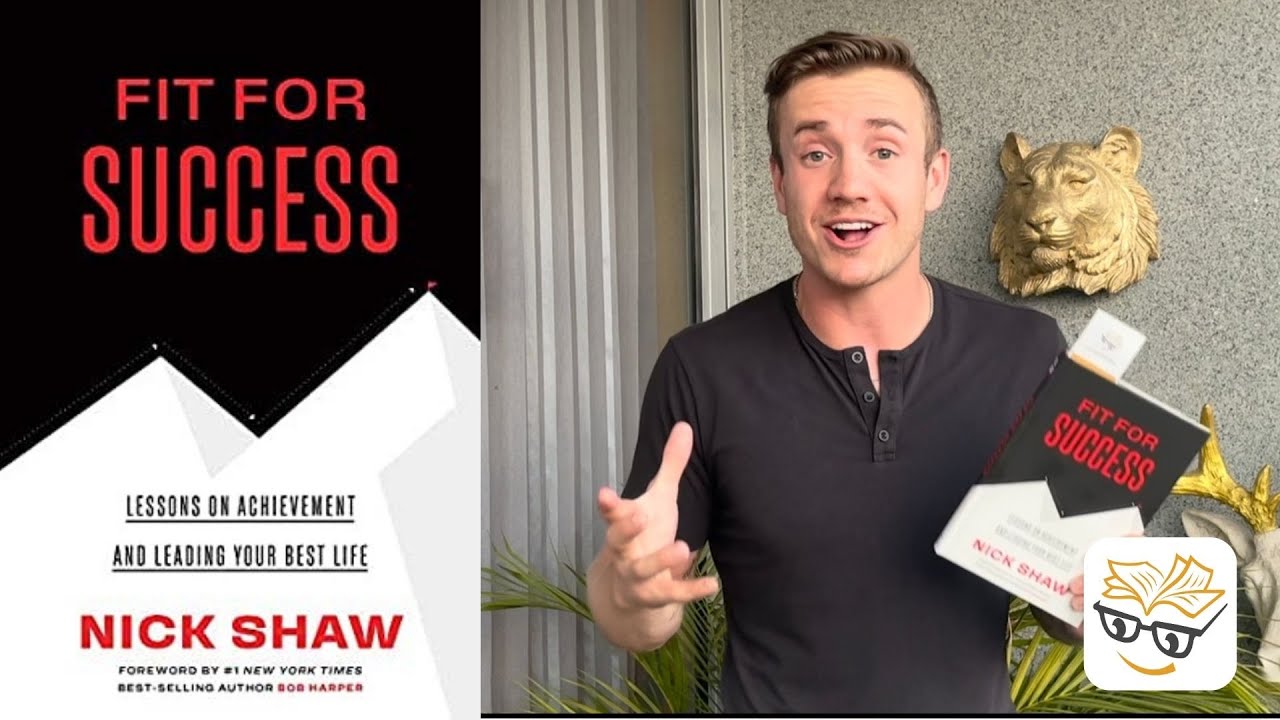
Nick Hutchison reviews Nick Shaw's Fit for Success, a book on achievement and leadership. Shaw teaches internal locus of control through soldier and diet examples, weaves in Marcus Aurelius and Stoic philosophy, and includes a chapter on journaling failures to find hidden opportunities. The book has practical "putting it into practice" sections throughout.
Chapters
Hello, Book Thinkers family. Today's book tip is going to come from this book right here, Fit for Success by author Nick Shaw, and the subtitle reads, Lessons on Achievement and Leading Your Best Life. I really, really enjoyed reading this book. I've been reading it each and every morning out here on my balcony in Medellín, Colombia, and there are so many fantastic things about this book. One thing that I loved was that the author Nick and I, both of us are named Nick, we have so much in common, including the first book that we read, which was Rich Dad Poor Dad, And he references so many other good books and authors in here that I've also read and loved. And so I just know that we both value personal development in a very similar way. Today's lesson from the book, or the things that I'm going to introduce you to, are pretty scattered. There's a couple different subjects that we're going to cover, but the first one is going to come right out of this book, right out of a quote that I'd like to read to everybody. And it's on the internal locus of control. This is a new concept for me. It's actually not something that I've read about before. So I'll give you 2 examples. This is going to be a quote from the book. Nick says that, quote, internal locus of control is the degree to which people believe that they, rather than external forces, have control over the outcomes of the events that make up their lives. So here's an example. Soldiers on the offensive who are assaulting an enemy position will have more control over the outcomes due to a number of factors, including the size of their platoon and the route that they take to attack their enemies. Those soldiers have an internal locus of control Whereas those who are under siege of steady artillery do not. The soldiers who are taking cover in the trenches are simply hoping that they'll be lucky and that the shrapnel from the blast won't injure or kill them. So how can this be applied to your life, right? We're not all soldiers in a battlefield. You can think about a diet and travel. This is something that used to happen to me all the time. You have a nice diet in place, you're doing really well, but all of a sudden you have a business meeting and you need to start traveling. So you get on a plane, it's delayed, your coworkers want to go out for a late night, meal or a drink totally disrupts what you have going on. But if you planned in advance, then you still have the internal locus of control. You are still on the offensive. And so when I used to travel, I was maintaining this activity spreadsheet. And whenever I would travel or have fun in Colombia like this, my activity completion percentage, so my goals, my results, they'd be way down. And it was so obvious to me, like a sore thumb. Every single time I traveled, I went way down. So I began to prepare in advance. I wanted to be on the offensive. And so that's a concept that Nick introduces in this book. I haven't— now I have a better way to articulate it, which I'm super happy about. Nick also talks about one of my favorite subjects in the world, Stoic philosophy, in this book. And so I really appreciate when an author like this takes the time to point out the importance of Stoic philosophy. It's a very actionable philosophy. It's not meant to just sit around and debate on the front steps. It's meant to apply to your real life. And so Nick, he goes into Stoic philosophy. a little bit, talks about the importance of Marcus Aurelius, some of the Meditations quotes that he has. Really enjoyed that piece. The last thing that I want to mention about this book is that Nick dedicates an entire chapter to failure. Isn't that a little bit ironic? Fit for Success, and there's an entire chapter on failure. Well, at Book Thinkers, you know we love people that talk about failure. It's very important to realize that within each obstacle there is an opportunity. A little bit of Stoic philosophy there too. And at the end of each chapter, Nick also has something that he calls putting it into practice. And in the failure chapter specifically, he says, write down 3 failures. Write them, journal them, reflect on them, and you'll realize that they actually led to opportunities, or you'll realize that, hey, it wasn't that bad to have faced a failure, and it could have led to a better opportunity in life. Kind of like Matthew McConaughey's new book, Greenlights, you know. But anyway, Fit for Success, Nick Shaw. If you didn't get a chance to win one of the books that we gave away, I would I highly recommend that you purchase a copy. This is a good book. He's a good guy, and there's a lot of fantastic wisdom in here. And so that is today's review. Go read something.