How to Build a Life of Meaning with These 9 Steps with Rick Walker
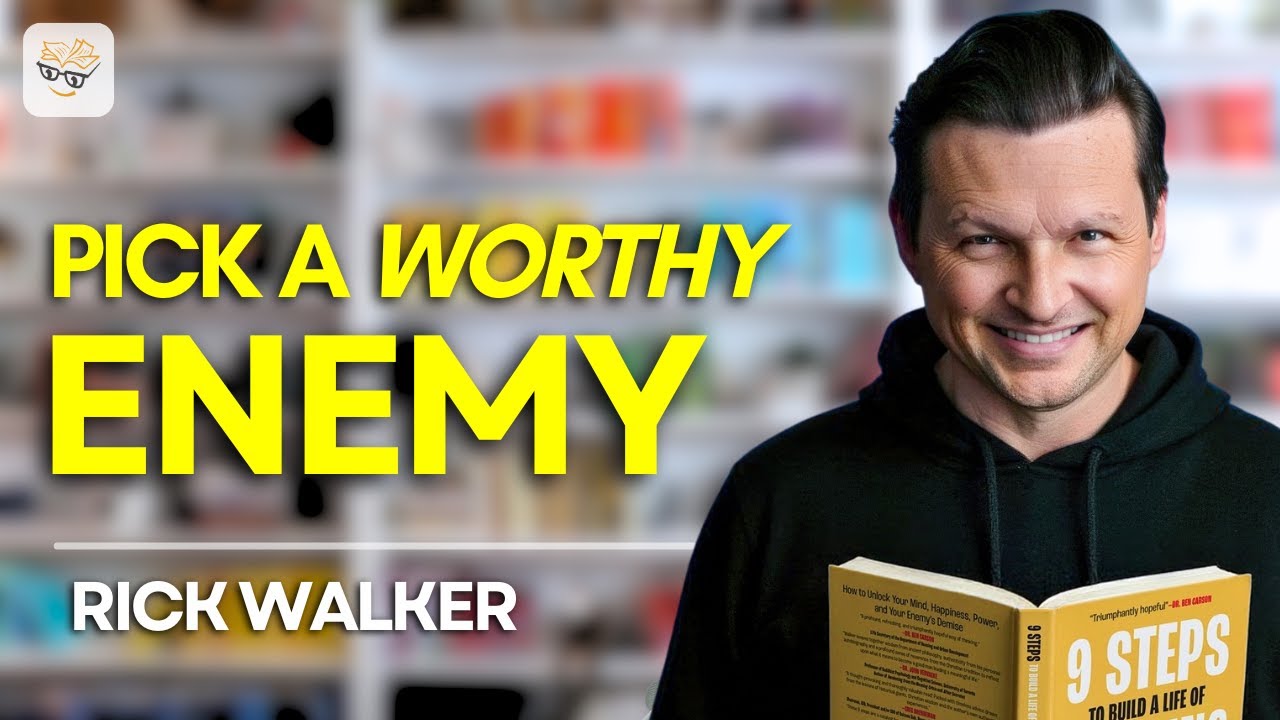
In this episode of the Book Thinkers Life‑Changing Books podcast, host Nick Hutchison interviews author Rick Walker about his book 9 Steps to Build a Life of Meaning. Walker argues that men aged 25‑45 are in a "meaning crisis" caused by unfulfilled potential and a loss of willingness to fight. He repeatedly stresses that value is earned through sacrifice, that discomfort is an asset, and that a "worthy enemy"—a concrete, personal evil—provides the focus needed to break out of comfort. The conversation covers the importance of paying the price for love and truth, the practice of visualising a future self, the power of habit loops and a rigorous morning routine, the superiority of ancient source texts over modern summaries, the controversial idea that violent action can be a moral good when it protects loved ones, and the broader cultural need for a collective enemy to energise a nation. Walker also shares personal anecdotes about growing up in poverty, his rapid‑wake‑up routine, his newsletter, and his favorite classic book (Dante’s Inferno). The interview ends with rapid‑fire questions about hope, mentorship, and the core message of his work: a single drop of hope threatens all threats.
Chapters
I say that, that life is nothing more than a string of failures with occasional moment of perfection. And if we can get that into our thick skull, um, that it's okay to fail as long as you reiterate and you, you come back with more and you learn, um, that's how you get better. That's, that's why fighting is good, because you know whether you lost or you won in a, in a proper fight. Like, that's, that's, that's a blessing. That's a blessing. The The most cursed man is the man that never knows whether he's winning or losing, right? That's the man that never has any goals, never has even a negative vision of what he doesn't want or a positive vision of what he does want. That's a cursed place to be. And that's the man who's standing still.
Rick Walker, welcome to the Book Thinkers Life-Changing Books podcast. podcast. We're going to dive right in. There's a line in the introduction of your book that caused me to sit back and reflect a little while, and it was right up front. It said, men rarely value what they don't earn. Talk to us a little bit about that concept. Men rarely value what they don't earn.
It's difficult to ascertain the value of something without paying the price for it. Right? Price and value are inextricably linked. And if we don't know what we're willing to give up for something, we never know how much we'll treasure it. And if we don't know how much we'll treasure it and how much we'll sacrifice for it, then we will never really let it affect us. That's why love is so powerful. That's why right love is so powerful. That's why a million likes will never equal a single great truth. Why love. That's why a million facts will never equal a great single truth. We have to get under our, our skin the idea that we've got to be able to feel the warmth and the costliness of the really great moments of life, the really great efforts and loves and truths of life. And that's what that line's about.
Yeah, even when I was a Cub Scout way back in the day, Rick, I remember they taught us, okay, if you earn the little knife that they give you by carving a bar of soap into the shape of a bear or whatever, and you learn how to use it, you're far more less— or you're far less likely to injure yourself with that knife than if I'm just going to give you one, right? And so that was a lesson that I learned super early in my life. Now, is that unique to men, or is that something that applies to both men and women?
You know, I've only been one of the two. And so I suspect it only maybe only applies to men, and women are probably a little, little wiser than we are in that. But yeah, the, you know, we want to understand, you know, our relationship with other people, our relationship with reality. And if we don't get that relationship right, everything else goes, goes askew, especially with your relationship with reality.
Yeah, I think so too. Yet it feels like the times we're living in, the country that both of us are living in, there are a lot of people, there are a lot of men that are dependent on others for basic food, water, shelter, and they seem to be crying victim, uh, when they're not happy with their, like, life's reality. Like you said, reality. And so, that lesson that you need to sacrifice in order to create value seems to be lost amongst a lot of people. Why is that?
Yeah, there's a great line in the world's greatest book that says, as a man thinketh in his heart, so he is. And if you think of yourself as a victim, you'll never be a victor. If you think of yourself as a victim or want to claim victimhood, you will be victimized. You're attracting that which you proclaim. You're calling forth your future out of what you want to currently use as an excuse. And excuses are rarely justifiable reasons. And so we're looking for someone else to blame. We all do this. We all do this. And so we've got to figure out how to move ahead out of that. I think having a proper vision of what your future should be And by asking that best possible future self what you should be doing in the moment, that is a way that we can move ahead and move out and look for the wisdom of that person in the future, hopefully that most valuable person in the future who loves us, our future selves, and ask them what we should be doing.
Yeah. When you wrote about that, it brought up an interesting thought, which is so many of us, and you're right, myself included, yourself included, there are times in our lives where we're actually abusing our future selves. We're making our lives more difficult in the future. We're sacrificing— well, actually, we're not sacrificing. We're indulging in short-term pleasures, only setting ourselves up for a more difficult future. And that's the battle of what it means to be a human. I think for a lot of us, there are so many different reasons to pull out your phone and scroll on social media or watch the news and feel the divisive nature of it because you get a rise. But It doesn't provide any long-term value. So, I think it's tough. It's tough to sacrifice in the short term so that you could think about yourself in the future and say, I got you, man. Yeah.
Well, and I think that's the ultimate gamble. The only way to have a future is to sacrifice the present. And I mentioned in the book, and I'm positive I heard this from somewhere else, I just can't find the source. Because it's too good. I'm pretty sure I didn't, I didn't invent it. That the— how you define wisdom is that the wisest mind looks into the most distant future for the most valued reward that he can purchase with the currency of the present. I'll repeat that because I'm sure someone's going to want to write that down. The wisest possible mind looks to the most distant future for the most valued reward that he can purchase with the currency of the present. Lewis says that we've already lost yesterday and all we have is the hope of tomorrow. So all we really have is today. And if we can't act in today, we'll never really get that forever. We'll never ever, ever get that future. And so, you know, being willing to give up today, but also to invest it. Think about every day that you have is just an investment. And investments by definition are merely sacrifices. The wealthy man who wants to keep his money, the only way that he keeps it is by giving it to an entrepreneur who's going to invest it and put it to use in a new business venture or existing business venture, if the investor tries to keep the money, he loses it to inflation. So, the only way you keep your life is to give it away.
Now, Rick, I'm somebody who, and I know you're a voracious reader, learner, the older the book, the better for you, which I want to get into in a few minutes. But I'm so thankful. I'm somebody who loves reading. I'm also somebody who loves difficult exercise. And I love tough conversations and I love a lot of what the average person tends to avoid. And it's what you're talking about, the short-term discomfort for the long-term gain. So for somebody who's not like me, or maybe not like you, they don't love learning, they don't love the physical, brutal exercise or the tough conversations with loved ones. How do you start to think about embracing that short-term discomfort in the present moment?
Yeah, you have to understand that discomfort is the asset. Like, that, that is, that is the pursuit in the end, the discomfort with a proper aim. It's the quality of your object that determines the quality of your life. And so the quality of the pursuit of your life. And so what we find is that the more that we push the boundaries, we— and we knew this growing up, we knew that we had to enter a subject that we didn't know very well. We have to enter the boundaries of our knowledge of that if we're ever going to learn something new, right? You never learn something that you already know. In fact, it's predicated on knowing and learning something that you have to admit that you don't know it. You can't ever learn something you won't admit that you don't know. And so you've got to push the edges there. And what I say in the book is that life is lived on the edge of safety. Like, that's where real life is. And whenever you're not living— I'm sorry, whenever you're living in the, in the comfort of safety, not on the edges of safety, you are wasting your life. And of course, a wasted life is nothing more than just a death. And so we've got to figure out a way to push. This comes down to learning, also comes down to pursuit, also comes down to advancement and becoming that best possible future self. Again, all you have is today to commit. If you don't make today better for tomorrow, You know, why— what are we doing? What are we doing?
One of the ways that you can get your butt moving a little bit is by choosing a worthy enemy, which is a subject that you talk about early in the book. And I want to tell you about how I interpreted that, that section of the book, and the enemy that I've decided to fight against. But tell us, why is it important to have an enemy? I think that's Unconventional wisdom.
Yeah, yeah, yeah. Well, so the book is written for men that are 25 to 45 that are in this meaning crisis, as someone like Dr. John Vervaeke would, would call it. And these men, for the most part, not all of them, but for the most part, they have an unmet potential within them. They realize, they feel that potential, potential that their, their parents told them when they had, when they were younger, their grandparents spoken to them, their teachers spoken to them. And they're now adults and they're wondering, where was all the success I was promised? Or at least I was told I had the potential to come to fruition. And so these men have never really had the opportunity to, to, to have that, that potential unlocked. Let me, let me give you a story. I'm going to answer it with a story. The— when I was growing up, we grew up fairly poor in the poverty of a 2-bedroom home. I remember dumpster diving for canned goods in the back of grocery stores. You know, they, they would have to throw the cans out when they were dented. And so we would go back maybe once a month and just find dented cans out of the trash can, out of the dumpsters back there. But I, but I've, I've been inside of a dumpster to do that when we were struggling growing up. And I realized when I left home for college that I didn't want that. I didn't have a positive view. vision of what I wanted, but I had a negative vision of what I didn't want. And so some— that negative vision was enough for me to work against that, to try to escape that poverty. By the time I was 26, I had 400 employees in my first business. I did more after that. But, um, I didn't have a positive vision of what I wanted. I never met anyone that was wealthy. I never met anyone that had the type of marriage and type of life that I wanted. But I knew what I didn't want. And I think that the men that are sort of in this age group that I wrote the book for are are men that don't have a positive vision of what they do want, but they certainly have a negative vision of what they don't want. And so what I'm calling out when I say choose one worthy enemy is find that one manifest evil that, that, that breaks your heart, that one manifest evil that you see around you. It may be the sex trafficking website that, that doesn't respect minors. It may be human trafficking that's around you. It may be the fentanyl that's in your local school system, maybe the alcohol that's castigated you know, 3 generations of your family to, uh, to poverty, there's some manifest evil in your very presence that you were called to invade. Like, the purpose of light is to invade the darkness. The purpose of the good man is to go and confront the evil around him. And so that calling to go find one worthy enemy is something that's in your DNA, like, like in your spiritual DNA, where you're meant to do that if you're a man that ever hopes to become, uh, what someone would call a good man.
I'll tell you, the one that makes my skin crawl and that really resonates with me is regret. And it stems from when I was in my early 20s. I read a book called The Top 5 Regrets of the Dying by Bronnie Ware.
Wow.
And she's an end-of-life palliative care nurse. She would spend the last couple of days, weeks, maybe a month with somebody as they transitioned out of this life and onto the next. And she would talk with these people bedside, and she realized through repeated exposure that people all had the same regrets at the end of their life. And the number one regret was that people decided to live lives based on other people's expectations of them instead of the thing that truly brought them more energy, right? And you do that in your career, you do that with your spouse, you do that Uh, in so many aspects of life and makes me— it just rocked my world, man. It made me so sad. And then I started to see it. I was filtering for it. I started to see it in family members and in interactions. And it just— I can't stand people who choose to live under their potential, swiping away on social media, eating processed junk food. Going without, you know, any type of meaning in their life. And you solve the problem with the book. But I just want to say thank you for helping me to articulate that my enemy is regret, and I can't stand it. Like, like I said, it makes my skin crawl. It really does.
Yeah, well, that's— and that's the— that's interesting thing too, because regret is so disproportionate. When you— when you avoid an ounce of pain, you drink a gallon of regret in the end. And that drinking of the regret is always more, more than whatever you would have— what you're avoiding. I think it's Peterson that says that the thing that you most need to do is the one thing that you don't want to do. And so I think it's that one thing is most time it's that it's those difficult decisions. But you're right, like people, you know, you're— we're in a very Girardian type of society where there's a lot of A lot of mimicking. There's a lot of copying, a lot of reflection of one another. And so, and even like in this book release process, I'm looking at what other people have. I'm thinking, well, I would like to be able to do that. I'd like to be able to do that. And, you know, 2 months ago I decided like, I'm only going to do podcasts. I'm only going to do these advertising campaigns and I'm going to use my newsletter and a launch team. I'm just going to do these 4 things. And now I'm looking and I'm, I'm mixed up because I'm, I'm looking at how everyone else is operating, uh, and I've got to figure out a way to get back to basics. But, um, we are, we're such an authenticity, uh, starved society because we just reflect that which we give our attention to. And I think that was obviously one of the great, uh, uh, philosophers was Herodotus that said that you become that which you give your attention to. Um, we do that. It's real. It's real. And unfortunately, in the end, you become that which you least want to become when you give your attention to the wrong thing.
Yeah, there's an author I read recently. His name's, um, Mike Baker. And in his book, he says your attention is a form of love. And that helped me start to think about, okay, if I give my attention to something negative or divisive or toxic like social media, And not every aspect of social media is negative. I mean, this podcast is going to go out on social media, so it's not all bad. But that's a form of love. And if you— let's just say the attention in your kitchen cabinet is going to the Doritos. Like, that's a form of love. That's a very dangerous form of love. I mean, I would say it's evil. And man, I just, you know, I have this tattoo on my neck that says Memento Mori, which is remember your own mortality. Remember you're going to die. And And that's— it helps to align my current decision-making with that future self because I don't want to end up being one of the people in the top 5 regrets of the dying, just sitting there not capable of going back and making different choices. Like, I'm, I'm in the moment to make those choices, and it reminds me to be a bolder version of myself. And books like yours help me to do that in a really big way.
Yeah.
Yeah.
And I think that that's a really important thing with your attention. Whenever you give your attention, you sacrifice everything else, right? Like, I feel like there's guys laying down bolts like 20 feet to my right through this window. I can see them, I know they're there, but if I'm focusing on them, I'm not, I'm not focusing on, on our conversation. I'm not focusing on connecting here. And that's one of those things that's true of everything. Um, if I give my attention to other women, I can never truly love my wife. Um, if I never, if I never give my attention to the, to the truest forms of art, I'll be just be looking at, at crap online when I'm swiping. Um, you've got to give up the crap in order to, to encompass the, the true. You've got to give up the lesser likes for the higher loves. But it's all— and that's what I suspect is true. I don't know if you ever did this. Like, you know, everyone says, you know, sit down and create your strategy or create your to-do list. I did the to-do list for about a decade and I realized there's more power in the do-not-do list. Like, so I started creating do-not-do lists. Like, it's more important what you sacrifice than what you are trying to keep because you try to keep— you try to keep 3 or 4 or 5 different things. No, I'm just going to sacrifice everything but this one thing. Um, that's— that seems to be a better and truer way of life.
Yeah, I think so too. I, I think in a lot of ways, happiness or productivity, they are subtractive in nature, not additive. You know, that you subtract all of the noise. There's a button I keep on my desk that says no, and it just reminds me if something is not aligned with My current mission, my current focus, the answer is no, and I'll hit the button and it's a good visual reminder for me.
Yeah, you know, it's funny. So, um, about every 2 or 3 years I'll get off this, this tangent where I'll, I'll get into my podcast or I'll get into something else that has a little bit of fame as sort of a side benefit that if you're successful at it. Um, and for 2025, I wrote at the very top of my annual planning sheet Um, you will never be famous. You will never be famous.
Mm-hmm.
Um, because at some point I just had to really pull the plug on that. I didn't wanna be famous, but I thought that there would be a hope, or like there'd be some chance that if I was really good at A, B, or C, that I would, I would become famous. Um, but I realized like, I don't want fame because if you have fame, you don't have privacy. Um, and so I'm willing to sacrifice the fame for the privacy. And honestly, if I'm going to be honest, like, I'm not good enough to be famous. Like, I'm not likable enough to be famous. You know, my own family, they don't— you know, they get annoyed with Dad sometimes when I, when I talk too much at the dinner table. And so, so much more for the, for the general public. But it's those things where you agree to give up that I suspect give value to everything else. And like, for me, it was, it was that this, this past year, just, just writing at the very, very top, you will never be famous. Like, don't, don't even try.
Yeah, I think that's a, that's a great lesson right there. Uh, I'll share one just for the audience to have another example. Something that I gave up— this is really recent, over the last couple of months— I gave up the idea of trying to go viral on social media because a mentor of mine, he said that virality and impact exist on opposite ends of the spectrum. So by definition, a viral piece of content has mass appeal. It applies to everyone. It's really funny or it's really sad or whatever the case is. And oftentimes the more people you reach, the more general you have to be with your message. But impact, like actually changing a life, getting the right book in front of the right hand so that it can change the right life, that's a very specific, very niche activity. There's a lot of depth, not a lot of width. And so I just stopped caring about the vanity metrics. Like you said, you know, it's not about how many books you sell, but it's about how many lives you change with the books that you sell. You'd rather sell a smaller amount and have a higher impact than, you know, so many authors play these games where they buy their books and keep them in a warehouse and ship them out artificially. It's like you're playing the wrong game. That's an ego game. That's right. That's right.
Full disclosure, I bought 10 books to send to my parents so they can get a little bit.
That's fine. You didn't buy 10,000 books. 10 books is a great number. Okay. So we talked about choosing a worthy enemy. What is your enemy? Is it evil?
My enemy happens to be the same enemy that's the enemy of this 25 to 45-year-old group, and it's, it's the, it's the lack of hitting the potential that they were promised. Um, they realize, I expect that the majority of them realize that they were promised a certain amount of potential, they were promised a certain amount of success, and they're wondering where that, where that success is. Like, you know, when I used to go, I used to, a couple years ago, I brought in 25 MBAs, like right after that, right out of graduate school. They all started the same month. And everyone were like ready to run the company. And, and I'm looking at it, I'm like, well, like, what have you done? Well, I got my MBA, like I'm ready to go. And I said, well, you know, let's, let's, let's slow it down for a second. Let's slow down for a second. But we think that the, that the potential is all there is, all there is. And we forget that there has to be something concrete there in order to, to, to be an anchored, anchored enough person to be able to actually substantiate something in the world that's real. So there's this, there's this expectation, and there's this underdelivery of, of the potential. The, the potential is unmapped, and so it's sort of lingering there, and a lot of men have given up on that. And so my goal is exactly the same thing, only that the way that I want to go about it is I want to rip away the comfort enslaving your potential. I want to rip away the comfort. That, that's my thesis, is it's the comfort that enslaves the potential, uh, primarily. There's other things, there's other things about, you know, you have, you have mental, uh, confinement, you have, you know, situational confinement, you have geographic confinement. There's other, other confinements that are there, uh, but I'm most interested in the men that wanted to unleash their potential and are willing to take the steps necessary to be able to do it. And from, from my perspective, it usually comes down to comfort. It's pain avoidance, it's awkwardness avoidance, It's that thing that they least want to do that they both need to do next.
Well, you give a great example of one of them, which is waking up earlier. You have a whole routine in the book about what it looks like to wake up as Rick Walker. And you had a buddy that was waking up earlier than you that originally motivated it. Is that right? So, talk to us about your morning routine. Like, why should everybody listening to this podcast get their butts up a little bit earlier than they do today?
Yeah, yeah, yeah. Great question. I'm gonna, I'm gonna attach this here. I've got, I've got, I'm surrounded by windows and the light kind of comes in and out of the clouds. So it's raining right now, but then the clouds disappear, so I get, I get more light. So I'm just gonna make a little darker here. But the idea, the idea here is that we think that we're, we're kicking butt and taking names when we get up at 5 o'clock or 6 o'clock in the morning. And I, and I did for many, many years. And I began to speak to friends of mine. I had a very accomplished friend, better looking than I, better dressed. I had way more money than I had, had a company in, I don't know, 6 states, 6 countries, same age. And I talked to him. I said, what time do you get up? He said, 4. I get up at 4 and I go and I start with swimming and Peloton. And then I'm getting on video calls with other countries at the same time right after that. And I'm working my way through it. I'm thinking to myself, well, This guy's starting from a better place. He's got the money, he's got the looks, he's got the dress. He comes from a bit— from a more stable, better, better family lineage, better connections. And I'm assuming there are people like that that I'm competing against in my own industry. And so that's a problem. That's a problem when I think I'm already doing well. And so I, I came to terms with like, hey, Rick, you're not the smartest, you're not the best looking, you're not the sharpest, you don't have the best Rolodex. And so you gotta have something that's, that's able— you want to compete with. And so what I started doing was I realized I could outwork those sorts of people, like the people like my friend that were in my, my business. And so I just started rationing down 15 minutes a week. 5, 5 o'clock became 5, 4:45 became 4:30 became 4:15, and finally I got down to about 3:15. It was a little bit too early, so settled on 3:30. 3:30 is a nice, a nice wake-up time. But, but you have to use— James Clear calls this the, I think, the habit, habit loop, maybe. I call it the 4, the 4-point action loop. And essentially it's a string of triggers that reward you for conducting the actions that you want to effectuate. And so what I've started doing is I started putting my phone in the other room. I never have a charger in my own room, but the phone in the other room, it's 2 rooms away. So when my alarm goes off, I have to actually stand up and go walk over to the phone and get it. It also prevents scrolling at night, which is a huge advantage. You're uncomfortable, you're bored the first 2 or 3 nights, but once you get used to sleeping through the night, it's amazing. And so when I walk into that closet to get my phone, when the alarm goes off, the auto light turns on. And so all of a sudden I'm turning my alarm off and I'm standing up wide awake at 3:30 in the morning. Lights are on. And I'm thinking, well, let's just put some clothes on. What would that hurt? And so 60 seconds later, I'm wearing clothes. I think, well, I can use a latte. And so that begins a series of steps where I end up at the office holding my latte on my favorite couch, reading some of my favorite books very early in the morning. I'm usually there by 4:15 by the time I drive there, and I can get some deep concentration, deep reading, deep work in before I even touch any screens for the day. And that has been a spectacular pivot to how I had been living my mornings. And so what I've done is I've taken the, the least productive time, this sort of snooze cycle where you're snoozing, turn it off, turn it back on, this cycle or scrolling. I've taken that, I replaced it with the most important thing that I can be doing when my family's asleep, which is being alone in silence, reading great books and thinking about my future and trying to plan out the future of others where I can, I can have an impact.
Talking about great books, you say that we should stop thinking about years or decades and start thinking about centuries or millennia. The older the book, the better. The greatest men have stood the test of time, right? So what's your philosophy there? And I guess like the back-end question that I really want to hit you with is then how do you go about recommending this book? So hit us with both. Talk about it.
Yeah, yeah. So the older the sage, the quicker the solution. That, that is the mistake that, that we make as, as like modern learned men, is we're looking for solutions in the, in these more recent books. But the more recent books have not said the test of time. Additionally, if you look for the source materials of these books, um, often the source materials will be, you know, you trace it back maybe one, one generation from the writers, what they what they've read or what they've learned in college. You're looking at the textbooks, and the people that wrote those textbooks have sourced textbooks in, in maybe, um, you know, Austrian economics or something else like that. And then, so then you move a step back, then you look at, you look at like von Mises, for instance, uh, the father of Austrian economics and human action. You're reading what he's, what he's talking about, and he's talking about Jewish principles. Um, he's talking about, you know, things that are 2,000, 3,000 years old. And so then he's going back. And so the, the easiest thing to do, and the best thing to do, I think, is just to go back to the source text, right? You read Shakespeare, and what you're really reading is you're, you're really reading like the old— the, the New Testament and the Old Testament is what you're reading. Um, and so if you go back to the source materials, you read the Plato, you read, um, you read, you know, the, the Tao Te Ching, you read the Bhagavad Gita, you're reading the, the actual source material. that all these other books are encompassed. And so why would you depend on a piece of drywall in a bathroom when you could depend on the foundation? Like, it doesn't make any sense. Um, and additionally, what you also have is you have modern men throughout the ages that are putting their opinions— they're, they're writing these things with their lenses attached to it, and these lenses come and go. And so you're missing very, very important things along the way. Um, and, uh, there's actually, there's actually a great, uh, little introduction to the— it's a, it's a book by Athanasius, um, where, where Lewis wrote— C.S. Lewis wrote the introduction to it. He talks about this, this very, very thing, um, about how to pick what books you should be reading. Um, and he talks about this and he says that, um, that whenever you read about isms, whenever you read about educated people that are right, making isms and making theories and, and trying to systematize this stuff, That's when you know that you're reading something that just— you shouldn't be reading. It's a slant. It's a distorted view. And it takes centuries for these things to be fleshed out. Great ideas take centuries and centuries and centuries because they need iteration. It's, you know, reading a new book is like reading something— is like, you know, trusting a car that hasn't been tested at all, or a doctor that's only seen one patient before. That's the way it is. And so So like a book, a book like mine, for instance, that's a great, great question. You're the first person to ask that obvious question. And I don't, I don't, I don't appreciate it because that's a very difficult thing to answer. But I think that a book, a book like my book that's rooted in these fundamental lessons, what I've tried to do is I try to summarize. It took me 25 years of work to come up with the concepts that I've, I've developed, you know, whether it was creating that first company of 400 employees, scaling international organization into 53 countries. or a number of the things I've been blessed to be a part of. But I also read 1,000 books along the way. I also sat down with 100 of the most competent men alive, and I distilled all that into a set of 9 operating principles, these 9 steps, and fit them in this, in this book. And so my goal was to write the densest book possible, not to go deep on one subject, but to go dense on the, the handful of things that really, really matter, um, to a man that wants to build relevance and meaning. And so, uh, that's the purpose. And I— and if, if I, if I had found a better book in the past, I would have just recommended that. It would have been great to find one. Um, but I think that someone like me who's coming from the world of practicality, the, the world of doing, not the world of pontificating, um, I hadn't seen one of those books yet. All I've seen is books by men that are learned, by academics that are, that are pontificators.
I think that was a great way to answer the question. And, uh, I think there is, there is value in the synthesis of information, right? You read 1,000 books, you found a through line. You're not looking for fame, you're looking for resonance, you're looking for impact. You want to serve that younger version of yourself. that hadn't read the 1,000 books yet and was kind of wondering where to go and what to do next and how to find meaning. And then you provided the solution. And listen, I think, you know, in the United States today, there is a massive need for this kind of content. And it's helping me to think about, you know, I genuinely believe in a lot of what you've written about, but I don't typically communicate that way. And I've been doing a lot of reflecting as to why, because I'm in the demographic that you're trying to serve and I have the same beliefs that you do and I'm sitting within it and I'm like, why am I not the voice, right?
Yeah.
And so anyway, you know, you've helped me, you've helped me, I think, in a really major way step up to the plate And, uh, I'll take a few more at-bats in a little bit more of a direct way. Here's a great example. I've been talking to everybody about this. I love in the book when you talk about the moment of perfection and you use the rancher's daughter example to highlight what a moment of perfection actually looks like. That's controversial. And I want you to tell the story and I want you to talk about why you think it's perfect action. But I'm, at least in the way that you wrote about it in the book, I fully stand behind your interpretation of those events and your reflections on them. And I'm like, why am I not talking about subjects like this? So go ahead, tell us about it. Yeah.
And that's, that's one of the more controversial parts of the book. There's a story in the news a few years ago about a rancher who had caught his ranch hand molesting his 5-year-old daughter in the back of the barn. And the rancher came up, came up to him and pulled the ranch hand off. And, and instead of having to run away and call the police, he decided to take matters into his own hands. And he just, he just pummeled the guy to death. He just pummeled the guy to death. And so his daughter was there in that motorcade and saw this. Now, the nice person, the, the good The, the prototypical good person would tell him no, like there's no use in the, in the little girl losing his father, going to jail for, for doing this. Like he should have been patient. He should call the police. He should have, you know, got used the justice system to find justice. But one of the rare gifts that we can give the people that we love in our lives is to let, to allow them to see justice with their own eyes. We rarely get to see the justice with our own eyes that the victims of 9/11 Never got justice with her own eyes. We didn't either. We didn't either. The perpetrators of the Nazi horrors—they did not receive justice in the eyes of the victims. There's a blessing that happens when justice is viewed by that from the eyes of the victims. But there's even more than that in that situation. So this rancher goes to court. and has to prove out like why he did this. And the court found him innocent. They found him innocent, um, not because he didn't do it, because he clearly did it, but because it was the right thing to do. Um, you know, the threat was already gone. He already pulled the guy off his daughter. Um, but it was the right thing to do. Um, and so you find this sort of thing at play, and you find it even in scripture. You find it in scripture in the Pauline doctrine where it says, hate what is evil, semicolon, cling to what is good. I'm not an educated man. I was educated in the public school system, but whenever I saw one of those little semicolons, I was told to kind of treat that as an equal sign. The 2 statements are equal on both sides. And I'm reading that, I'm looking, I'm thinking, well, the only way to get a bit of good is to hate the evil. Like, you have to do violence against the evil in order to receive a bit of the good in your life. And it's coming from the most peaceful, the most peaceful place possible. And I look at that and I realize that, holy crap, the guy did such a service to his daughter. Because in the future, if, if in that, in that circumstance, if his daughter never saw the man who most supposedly rightly loved her defend her, what would she expect from her husband? And if she would only see a half man in that, in that case, if he had tempered his temper, if he had mediated his hatred. But in that moment, he saw— she got to see a whole man in perfection, a whole man perfectly in love, willing to do whatever was necessary so that he could show her what justice really looked like with her own eyes. And that allows her not to be forced to grope and marry a half-man because she only saw a half-man growing up, not to have half-kids that were half-sons and to damn that entire family line, uh, to half-manhood. Um, and so I think that's, in a way, in a sense, what we're called to do as men is to allow the victims to see justice with their own eyes, to prove out that the only way to live a life of love is to live a life of proper hate. Proper hate is the fulfillment of proper love in the end, if you follow up to his philosophical conclusion. And there's something right and proper in the hatred. Chesterton puts it this way, that 2 people will look at a man rushing into war to go kill someone, and one man will look at that and say, this is a man that's filled with hate, that's going to go— just wants to go kill someone. He's bloodthirsty. And but another person will see that and said, no, he's not running into war because he hates that which is before him. He's running into war Because he loves those who are behind him. And it's 2 different perspectives of the same action. Um, and that's what we gotta get right. We have to get our perspective right. Um, if we get our perspective right, we get our whys aligned, our whats are gonna start to take place and take fulfillment in our lives and, and be able to, to form us into a better society and better men at the end.
Hmm. That's a mic drop moment right there. And I, I understand why it's controversial. But I think it reminds me of Peterson saying, I'd rather be a warrior in a garden than a gardener in a war. Like, you should be capable of violence against evil, and most men are not. And maybe it's because, like you alluded to earlier, they've never embraced discomfort, and therefore they're so far under their potential that they've submitted. And an act like that would be too big of a step. Or maybe they haven't properly identified the evil that they're fighting against. You know, why do you think— I guess I'll ask you, you're, you know, you're much more studied on this than I am. Like, why do you think most men in that position would probably rip the ranch hand off and call the police?
Because the most men would want to be said to be a nice man rather than to be a good man. Hmm. They care more about what other people would say about them in the end. Um, I also suspect that we've lost a lot of the passion, we lost a lot of the heart of what it means to be a man. And so what's taken the place is sort of this indifference, this, this allowance of allowing someone else to do do the difficult thing, to entrust the legal system to handle something when you could take it, take it upon yourself, right? It's possible that the ranch hand would have killed the rancher too, right? You're still at a risk, a risk of your own life in doing that. But I think that we oftentimes put our fate into the hands of others when our fate was meant to be within our own grasp. Um, and that idea that you've gotta be a dangerous man and only dangerous man can be a good man in the end is not to say that being dangerous and being reckless is good, is a good thing in and of itself. It's that only a man that can offer a threat can offer a love because you have to have a power. You have to have a, uh, you have to have a stomach. You have to have, um, the seriousness about you in order to issue a threat that can be backed up. That's why American dominance has been so pervasive over the last 250 years, um, is because we figured out how to issue proper threats. And a man who cannot threaten can never really love. It's the passions. Uh, you must live lavishly on the opposites of evil and good. Um, never send one bullet when you can send 100. Never send one rose when you can send 100. That's where life is lived, on these edges of evil and love. And this is, this is the thing that men are missing. They're missing those edges, right? Life is lived at the edge of safety. Um, a life never really lived is just a death. Um, we've got to figure out a way to break out of our shell. And I suspect the best way to break our shell, break out of our shell, is understand if the easy thing were the right thing, you would have already done it. Hmm.
I, I'll wrap up with a more of a meta question for you, and then we'll do a couple of rapid-fire questions and, and we'll end the show today. This has been awesome. I've, I've really enjoyed talking to you so far.
Yeah.
So the country that we live in and that we love was founded by people who hated the oppression that they were previously experiencing. And so they're fighting against an evil, right? And it was that energy for the first 100 years or whatever that allowed the United States of America to grow and flourish and take a stand and change and introduce this new system of government. And, and all of a sudden, you just go from nothing to a world-dominating power. And then over the last few decades or whatever the time has been like, that energy has definitely— it did disappear. Maybe it's coming back now, but it disappeared for a while. And it does feel like, you know, we as as individuals living within a society are a byproduct a lot of time that the you know the whole society like the energy that the whole society has. And so it doesn't surprise me that a lot of that energy has disappeared because like the average American is complacent now. They're not fighting any type of evil. I mean, maybe for a minute after 9/11, but then. Everybody goes back to normal life. You know, I don't feel any threat or danger walking down the street. I don't feel oppressed as I am, given maybe there are a couple of privileges, but nothing that I'm going to apologize for because I didn't have control over them. And it's like, I don't know, it just feels like maybe that energy is starting to come back a little bit. How do you feel about that?
Yeah, a man needs something to fight for. Um, and whenever you find yourself in that lackadaisical, right, right, a country is just a, uh, a long-term shadow of what a man should be. Um, and so as the country is waning from that perspective, they, they've lost that ability to fight. That's why it's really important, um, that a, a country our size go to war and actually not only just practice, but actually be in real war at some point. Like, Mm-hmm. Once you get to the point where you've had generations that have never experienced war, you've got a problem. You've got a problem. All they've done is practice. So too, once you, you as a man feel like you're getting stagnant, you got to find something to fight for. And this is why picking a worthy enemy is something worthy to fight for. This is why, you know, defending your loved ones under your protection is something worthy to fight for. It's that act of fighting that brings out the passion. It's that, it's that pulsing nature of the fight that revivifies your heart, not only physically, but also emotionally and spiritually. It's, it's that, it's that, it's that shock that stimulates your heart back into, back into functioning. And so we've got to embrace that. We have to embrace the unknown of what could happen, right? You could go fight the ranch hand and know that there's a 50/50 chance you're gonna die, or you'll get beat up. But taking that risk, that, that's what life— that's what life is. I say that, that life is nothing more than a string of failures with occasional moment of perfection. And if we can get that into our thick skull, that it's okay to fail as long as you reiterate and you, you come back with more and you learn. That's the how you get better. That's, that's why fighting is good, because you know whether you lost or you won in a, in a proper fight. Like, that's, that's, that's a blessing. That's a blessing. The, the most cursed man is the man that never knows whether, whether he's winning or losing, right? That's, that's the man that never has any goals, never has even, even a negative vision of what he doesn't want, or a positive vision of what he does want. He— that's a cursed place to be, and that's the man who's standing still.
And so I guess a clarifying question, just would love your perspective on this. Like, the United States of America seems very much like, because it's so divided internally, that there is no— and every 4 years maybe the, the main enemy of the country switches a little bit, um, because it's driven politically. But like, I guess if there's this internal conflict, you don't know what you stand for as a country. It's hard to have like one specific enemy that you're fighting against. And maybe that's the— maybe that's what's missing a little bit.
Yeah, yeah. I suspect that if you, if you look at it from a larger scale, what you'll find is that You know, a country is merely a group of broken individuals. In fact, men only come broken. And so we find ourselves in a situation like this where we're not aligned. We have to expect that that's what it is. And I think it's that vision casting that the leader does. It has to be done by the president. It can't be done by the various members of Congress. It's got to be by the president. And it has to be a strong enough threatening force. Right. We got to get back to saying Anyone that can't issue a threat, it can never really lead. You know, it's not by title. It's not because he is president. It's because he has, you know, he is a person that, that's able to win that, whether it be Biden or Obama or Bush or Trump or whoever it might be. It's— there's an individual there, and whether that individual is respected or disrespected will tell you what kind of threat that they can issue. And the threat that they can issue is the determination of whether or not they can cast a vision. It's not that this has to be believable, it's that the vision has to be enough to energize and create, stir a little bit of passion, and the people will follow that in the end. But, but yeah, that's a, that's, that's probably a 2-hour conversation right there.
All right. Where can people go to grab a copy of your book and learn more about you?
Yeah. Yeah. So it's on Amazon. If you go to my website, rickwalker.com, That's my favorite place for people to go. I have a newsletter that I send out about every 2 weeks. It's a 3-2-1 format. So I'm gonna give you 3 bangers. So these sort of quotes that I've been dropping along the way, I give you 3 of those that you can steal. They're free. You can steal them all you want to. I'm gonna give you 2 videos, which is sort of one instructional video and then one conversational video, and then one that's sort of a reflective thought or an essay that I write. In this style. And the newsletter is really a companion with the, with the 9 Steps to Build a Life of Meaning book. And, and they go, they go together. But if you go to my website, you'll find the links to the various Amazon and all the countries, the Barnes& Noble, the bulk purchases, the Walmart, and then all the audiobooks. I've got an audiobook as well. Right now, the Kindle version is number 1 in business leadership, business motivation, I think business management. It's number 1 in the UK for business leadership. It is the number one free Kindle book in all of business right now. And and so I'm really excited about. I don't consider it to be a business book. I consider it just be sort of a book about life, but it sort of got pigeonholed there. So you know, let's let's roll with it.
Yeah, this whole last fifteen minutes about a country choosing an enemy, a business can choose an enemy too. And so I think it is a great business leadership book, and I think that. Hey, I'll stop rambling. Couple of rapid-fire questions and I'll let you go. Number one is, if the book was deleted but you could leave the world with just one message from it, what would that message be?
This was, this was taken out of the original title. The original title of the book was called Hope Threatens. Hope Threatens. And my argument in that is that if a drop of hope exists anywhere, it threatens all threats everywhere. If a drop of hope exists anywhere, it threatens all threats everywhere. That hope is such a fungible resource. It's utilitarian. You can use it for anything that it can overcome. In fact, I don't even have to possess the hope to threaten your hopelessness. Like, like, like you could— your hope can threaten my hopelessness. It's, it's, it's that fungible. Um, and so as long as one drop of hope exists somewhere in the world, it threatens everyone's threats. Great.
Uh, my next question, I'll give a little caveat. I'm going to ask What is your greatest book recommendation or resource of all time, knowing that the older the book, the better? And I agree that the source material, the Old Testament, the New Testament— in fact, I'm going through a Bible in a Year program right now, I'm loving it. But other than the Bible, what is your greatest book recommendation?
I think Dante's Inferno. Right. I guess I could say the whole, the whole comedy, the Divine Comedy, but I think the Inferno, like, that's the, that's the centerpiece. And I, I wish, I wish I still had them here. So I did a podcast yesterday with a guy who's a big Dante guy, and I, I, I bought, I recently bought 3 collector's editions of Inferno, and I had my current edition that I have all marked up, and I had them stacked up in here. I have a, I have an overhead cam, and I showed him the difference between the current version The 1901 version, the 1890 version, and then I have a version from 1850 that's just gigantic and has these beautiful hand drawings in there. It's just lovely. And you show— you see how that as the technology heightens and efficiency heightens in printing, the beauty declines. And so yeah, that would be great to have here. But yeah, Dante's Inferno, that's sort of, you know, that would be my number one pickup.
Awesome. And then who's been your number one mentor? Who's had the most impact on your life? Somebody that you know. Yeah. Yeah.
There's a gentleman in Oklahoma City, my old trumpet instructor, Steve Goforth. He's deceased now, but Steve Goforth really poured into me when I was in college and just a lovely, lovely man. I don't know if his— he's got 2 sons, Cade and Parker Goforth, if anyone knows them, but they're in Oklahoma City area. I think I haven't talked to those guys in 25 years. His wife, Sharon. But that man just meant the world to me. He called me to a new level. And, you know, I kind of miss not being able to share this with him.
Yeah. Well, Rick, it's been a wonderful conversation. I know we went a little over, but thank you for spending time with us today. And for everybody, 9 Steps to Build a Life of Meaning, Rick Walker. Go grab a copy. Link in the show notes.
More from Nick

Napoleon Hill’s “Think and Grow Rich” is a timeless classic #selfhelp #personaldevelopment

4 Books to Help You Get Better at Decision Making #selfhelpbooks #bookrecs #nonfictionbooks


Have you read this book yet? 📖: The 5AM Club by Robin Sharma #selfhelpbooks #robinsharma

Dan Sullivan on Listening to Your Customers Instead of Watching Your Competitors

5 Books That Will Boost Your Financial Intelligence #financialfreedom #nonfictionbooks

The People That Preach the Loudest About Virtue are Usually the Most Power Hungry



Books are the greatest mentors you can find #selfhelpbooks #businessbooks #successmindset

Let’s fight this toxic instant gratification culture together 📖 #selfhelpbooks #jimkwik