Life-Changing Books Episode 31. Jay Papasan: Author of The ONE Thing
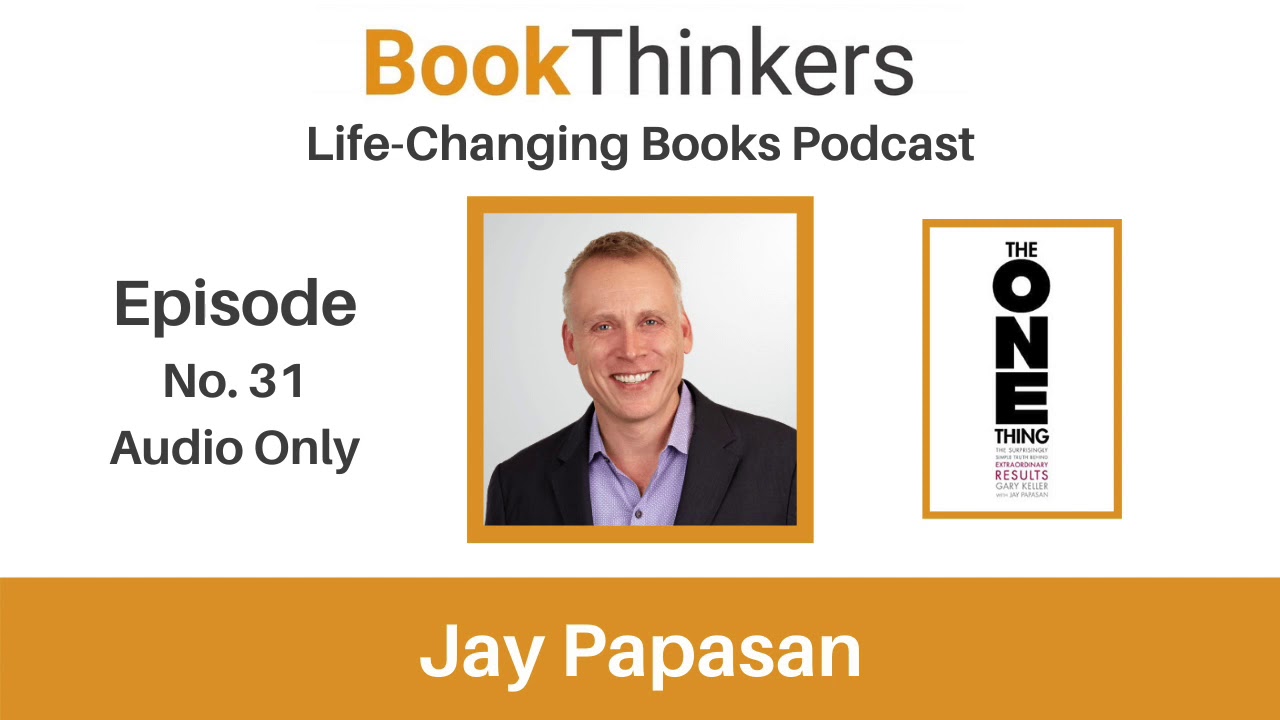
In this episode of the Book Thinkers Life‑Changing Books podcast, host Nick Hutchison interviews Jay Papasan, bestselling author and Keller Williams executive, about his co‑authored bestseller The ONE Thing. The conversation opens with Papasan’s personal background and the book’s massive reach (2.4 million copies, 50 languages). They explore the core metaphor of a small domino triggering a cascade of larger dominoes, illustrating how a single high‑impact action can generate exponential momentum. The hosts discuss the book’s three “lies” that mislead people: treating all tasks as equally important, believing multitasking is efficient, and assuming discipline alone drives results. They explain how the Pareto principle is amplified into a single “one thing” and introduce the focusing question – “What’s the one thing I can do such that by doing it, everything else is easier or unnecessary?” – describing its origin in coaching sessions. Papasan shares an introvert‑friendly networking system built around weekly coffee meetings that grew into a powerful referral network, and he emphasizes the importance of systems, habit stacking, and activity tracking to remove willpower fatigue. The dialogue moves to purpose, values, and decision‑making frameworks (the 90 % principle, “hell‑yes/hell‑no” rule) that help align actions with personal mission. Finally, they reflect on early career lessons: the limits of hustle, the value of investing in others, and the need for balance. The episode ends with Papasan directing listeners to his website (the1thing.com) and social channels for further resources.
Chapters
Hello, Book Thinkers family, and welcome to episode number 31 of our brand new podcast, Book Thinkers Life-Changing Books. During each episode, I interview one of the world's top authors, and as a listener, you can expect to discover new books, new mentors, and new resources that you can use to achieve more and live better. In this episode, I have the pleasure to interview the author Jay Papasan. Jay is a bestselling author and executive at Keller Williams Realty, which By the way, it's the largest real estate franchise in the world. He's also a co-owner of Keller Inc., Keller Capital, and Papazian Properties Group. Now, one of the books he worked on with Gary Keller, The ONE Thing, has sold more than 2.4 million copies, and it's appeared on more than 500 national bestseller lists, including number 1 on the Wall Street Journal's hardcover business list. Our conversation today is all about The ONE Thing. The message in The ONE Thing has resonated with people all over the world. I think the book has been translated into like 50 languages. And I know it definitely resonates with me. And prior to posting this episode, Ryan and I were lucky enough to go and have a coffee with Jay, actually a couple of coffees. Jay loves his caffeine. What a valuable experience it was. Big shout out to Summer Moon Coffee in Austin. Such a great meetup spot. And without further ado, please enjoy this amazing conversation with Jay Papasan. Jay, thank you so much for joining the Book Thinkers Life-Changing Books Podcast today. How are you?
I'm doing fabulous.
Thank you so much for having me here.
I'm very excited for our conversation today. For those in the audience that don't know who you are, can you introduce yourself to everybody?
Sure. My name is Jay Papasan. I am— I've been in Austin now for 20 years, and that's kind of my journey picked up after I met my wife in New York City. I worked in publishing and I was always going to work in books, moved to Austin and found myself a job as a newsletter writer in a very small real estate company. called Keller Williams. And that led to getting out of the editor side and into the writing side. Founder of that company, Gary Keller, has now built the largest real estate company in the world. I get to run his education and be his writing partner. And we've written a whole bunch of books together. And we're passionate about learning and we're passionate about teaching. And one of the ways we do that is books.
I love that. Well, the subject for today's conversation is The One Thing. And if I'm not mistaken, it was a number one Wall Street Journal bestseller, and it's also sold over a million copies. Is that correct?
I'm gonna—
you've got some old marketing copy, but it's like, this is like you've invited me. I don't just say this very often. We've actually, as of last month, we're at 2.4 million copies sold in 50 languages. So, it's pretty much every author's dream.
Yeah, no, it really is. And I was telling you before we jumped on here, I read the book for the first time in 2017, and then I've read it multiple times since then, and it's also been a subject of a book club that I participate in. So, I'm very well-versed in what we're going to talk about today. But I think for everybody listening, especially the young professionals out there, and that's our primary demographic, this is an amazing book and it unlocks a lot of potential in just about anybody in any area of life. And so, that's why I'm so excited for our conversation today.
That was, um, it's great. Gary is a very practical guy. That's one of the ways we meet. Like, I love to read books, but we both want to learn from these amazing people. Like, they can be dead or alive. I've got bookshelves of my favorite mentors. You use that language, right? But it's for doing. Like, I want a pragmatic, practical application. And so the great thing about the approach in The ONE Thing is that you can apply it to your family life, you can apply it to your personal life, your physical health. It's got some broad application. It's a simple plan that applies across a lot of areas of your life.
Well, for everybody listening, everybody knows I'm a big physical book lover, so I have bookshelves as well. This is kind of my remote setup that you're looking at behind me, but this is a beautiful book. It's laid out really well. The graphics are fantastic. There's a little bit of pop and color in there. And you actually kick off the book with a Russian proverb that I'm going to read here. It says, if you chase 2 rabbits, you will not catch either one. So why did you choose to kick off the book with that proverb?
We always look for a good epigraph, right? A quote or something that kind of, if you can, does it sum up the big idea? And our researcher, Vicki, who's worked with us for 12 years now, she found that quote and we had to source it because depending on where you find it, it's a Russian proverb or it's an Iranian proverb or whatever. And we've— we're pretty clear now that it was a Russian proverb. It sums it up, right? Right. A lot of us, especially in this day and age, we're a little bit overwhelmed and the world offers us a lot and it also throws a lot of stuff at us. And so the kind of daily triage that we face, that's that conundrum. You know, we're chasing 2 rabbits a lot when we shouldn't be.
Yeah, no, it's a great way to kick off the book. And I think it sets the stage for what we learn as readers going through this process. Now, before— the book is broken into 3 parts, but before those parts actually start, there's this amazing metaphor with the domino effect.
Right.
And I use this metaphor because it's very simple to explain. I use it when I'm communicating this idea to friends and family. And I love the idea that a 2-inch domino can start this amazing chain knocking over dominoes the size of the Eiffel Tower and things like that. So where did that metaphor come from and what does it mean to you?
Okay, so the number one misconception, one of our philosophically— yeah, I talked to you about the love of the classroom, teaching, learning. One of the things that Gary and I do as part of our writing process is when we have a thesis and we have an outline, instead of writing it all down, like that's a massive investment, one of the things we'll do is we'll go teach. We'll go, you know, we have this amazing system, 175,000 realtors around the world. We can go into one of our offices or regions and say, we're gonna teach an all-day class on this book. And of course, people, oh, Gary's got a new book. And then you hear what works and what doesn't work. And so here's the number one misconception when people hear The One Thing. They don't hear one thing in the sense of maybe the first thing, they hear only thing.
Mm-hmm.
And so the metaphor that naturally showed up is everybody listening has probably lined up dominoes as a kid, right? You line them up, and if you get them perfectly aligned, what happens, Nick, when you knock over the first one?
Well, the second one is probably going to get hit and it's probably going to fall over.
And it'll hit the third one and the fourth one. It just creates this fun chain effect, right? So we started playing with that as a metaphor for priority. The Latin origin of that, the root is around first, right? So the one thing is really your first domino. And if we can align our world and our priorities right, you can get these domino runs in your life. And so that becomes the metaphor. And again, I told you about our researcher, Vicki, and she's great. You know, we start hunting around and she just goes out into the libraries and finds this great stuff. So here we are in the mid-2000s, and she found an article in the American Journal of Physics by a guy named Loren Whitehead from 1984. And he had discovered that a 2-inch domino will knock over a 3-inch domino will knock over a 4.5-inch domino. And he had built them out of wood, but basically every domino has the ability to knock over one that's 50% larger. And he described it, you know, this row of just 10 dominoes that he built. What began with a little tick ended with a slam because by the 10th domino, it's like 6'7, right? It's a— it's as tall as a doorway, practically. And I immediately, because I'm a goober, I went straight. I'm also not good at math, so I can't keep doing that math. I went straight to a spreadsheet and I graphed it out and I just said, what does that look like? And so by the 23rd domino, if I got these right, by the 18th it would knock over a domino at that pace that would be as tall as the Leaning Tower. By the 23rd, as tall as the Eiffel Tower. And you and I are both in Austin. There's not a single building downtown that's as tall as the Eiffel Tower. People don't realize it's about 100 feet short of the Empire State Building because it's in Paris and there's no context, right?
Mm-hmm.
And by the— I believe it's the 57th, if you kept that going, it would reach all the way from the Earth to the Moon. And it looks like a hockey stick on its side. And again and again, like, this is like the series of little Like Russian nesting dolls, like ahas that we had. One, oh, so if you do the right thing, a lot of stuff can happen. But it also can increase in scale. You get momentum, you get better, you get more mastery. And I'm sure you've seen this with your podcast, right? You just keep plugging along and then you start to see there's more people downloading, there's more people listening, and the jumps can get bigger over time. And that's what really extraordinary success looks like. there's this elbow of the curve and it starts to kind of blow your socks off. So that's, that's the metaphor. I probably went a little deeper, but I nerd out on that stuff.
Well, hey, I nerd out on it too. One of my favorite books of all time, it was, and it's one of my favorite because of how early on I read it, was The Compound Effect by Darren Hardy. And in that book, yeah, the entire book is about this concept of creating momentum and momentum is going to create exponential leaps. It's not linear, it's exponential. It is that hockey stick that you're talking about. And so I get very excited about that and And I'm a practitioner of delayed gratification because I know the math and I know that it works. So just like you, I love to nerd out on these subjects.
Love it. I remember reading that book too.
I had to— I embargoed it. There were a few books that I embargoed because we read really broadly, but as a writer, a professional writer, you don't want to get tainted by ideas. But it's incredibly compatible. I recommend it all the time because it's just hitting that note really hard. If you just read a few pages of a book every day, right? That adds up to a lot over time.
Yeah, yeah, it absolutely does. And so then you move into part 1 of the book, which is about these lies that mislead us, these common misconceptions that exist out there in the world today in every area of our lives. So what are some of the common misconceptions that you highlight in the book?
Okay, well, the first one, we tried to organize the book, right, a little bit along the principle that most people don't read very far into business books, right?
Yes.
They read the introduction, they get the big idea, and that's kind of— they're done. And our publisher was great at kind of making sure that the book aligned. So if you only got one of these lies or misconceptions around productivity, it's everything matters equally is a lie, is what we stated. And the idea here is I don't think that people argue that all the time. We might say that all people are created equal, And that the playing field should be level for everyone, all of those things.
But we treat the world that way when we just work from a to-do list. What happens is we have all of this stuff that we know we have to do, and I'm guilty of this on my bad days. I'll look at my long list. And instead of doing the one thing that actually matters, like that really, really will have an impact, I'll try to do the things that I can cross off the fastest. Because I just want the list to be shorter. And the moment you do that, you're treating it like they all matter equally.
Mm-hmm.
And so you've read a lot of self-help books, you've read a lot of these books, so you know the 80/20 rule. Kind of the counter to this is by working from a priority that's based around impact, right? The whole idea of Pareto's principle is this idea that a handful of things will actually give you the majority of your results, and we just wanted to put that on steroids. So that's kind of where you get this idea of that first domino. The first domino is if you say, what's the 20% that will give me 80% of my results? And you just keep asking it, you'll finally get not to 20%, you'll just get to one activity. And that's where we want you to start.
Yeah, I love the idea of prioritizing from the top down in order of impact because Yeah, that's— it's a great metaphor to look at yourself from a third-party perspective, whacking away at that domino. And once that domino goes down, everything else in life is easier.
Yes.
And a lot of people don't spend enough time understanding what does have the biggest impact. And I mentioned to you before, we had Greg McKeown, the author of Essentialism, on, and he talks about this idea that most people major in minor things. All day long we give credit to these things and we think they matter equally, but in reality we need to major in major things. We need to only put our time into the high-impact activity. And so, you know, with your business and the people that you're educating on a daily or weekly basis, you know, a lot of them are in a sales role. And so I think in sales, I worked as a sales professional for 6 years, we try to focus on everything. It's all busy work, it's a whirlwind, but if we stop and we slow down and we say, Well, what 20% of prospects are most likely to create 80% of the business? Now I know what domino to go after.
We've got lots of— we— Gary will tell you again and again, and our other books reflect this, that anybody that's in the service business, frankly almost any business, their number one thing is lead generation, right? It doesn't matter how good you are at servicing clients. You're the best doctor in the world, if you've got no patients, the world won't know. And that's just a harsh reality for a lot of people. And a lot of authors, you know, I make a commitment. One of the reasons, like my assistant, you and I didn't talk before this. I didn't screen anything. I have a commitment every week. I try to do one thing to help promote my books because I know if I'm not methodical, they— all the work we did, 5 years of research and writing on the one thing, 5 years invested in that thing. And we got to nurture it. And a lot of people, I just want to be an artist, I just want to be creative. You're putting your success in other people's hands. So yeah, the one thing, it shows up in a lot of places.
Well, you just, you just talked about systems. And so before we go to another lie or 2, common misconceptions out there, I'd love to talk about another system that you told me about before we jumped on. Introvert's Guide to Networking is kind of the title here. So what's that all about? I'd love to have you talk about that.
So one of the great things about having a self-made billionaire, right, Gary Keller, as your mentor, is that you think bigger and your world gets bigger. And I've had coaches, and I'm sure you have too, and when this book was first coming out, we started to get the sense that it was gonna be big. It's like, okay, the reviews are coming in, this is gonna blow up a little bit. My wife ran a big real estate team. I have a publishing company. You know, we had this idea for a training company. I had my job and I ran departments. So we had a lot of opportunities in our world. And I asked my Coach, what's the one thing I can do to contribute to all these businesses that I'm either a part of or I'm leading or I own? And what we came to is network. Like the one thing that really, and you know this, If you're contributing to a book, it can open doors for you. It's a platform. And so we thought, well, why don't we do that? The problem is I'm an introvert. So I remember we're trying to come up with a plan for how will I network and raise our lid in terms of, you know, Jim Rohn, you're the average of the 5 people you spend the most time with. How can we up our network? Like, we started coming down with like conventions and like I could go to— I wasn't going to do it if I went to a convention. I would sit on the back row and I would get out of there as fast. I mean, that's just who I am. You know, at a party, I go stand by the food and I talk to one person for the whole party.
I don't work the room, not naturally at least.
So I had been interviewed by another podcaster and she did a little unofficial podcast called Coffee with a Stranger.
Oh, wow.
And she had met me for coffee and then said, do you mind if I record our conversation? I just keep a blog and I upload the audio. And I do this every week as a way to meet people. And I just said, what if I did that? What if I committed to meeting 50 really cool people a year? And I'll just have coffee with them because that actually sounds attractive to me. And so we identified that as an activity, one thing I could do. It's a very small domino. My wife's in real estate sales. She's like, oh, you committed to meeting one person a week? Like, how low can you set the bar?
Right.
But the only definition was they had to be talent. And so what's cool about that is I got my assistant. I said, let's start going through my LinkedIn. Let's find out who lives in Austin and who's a manager or whatever. And I just start reaching out. Hey, it looks like you're really good at what you do. Would you mind if I took you to coffee? I would like to hear more about your career. I have no agenda. I'm not selling anything. And we started lining up coffees with strangers. And what happened is the first year, Nick, I did 50 of these. And some of them, I was trying to do it every Wednesday morning. Sometimes you'd have to double up or whatever. But as soon as I got to 50, I quit. I said, victory, I did it, thank goodness. And the goal was I added 50 new people to my database. Not all of them were amazing. A couple of people were salespeople who showed up to sell me junk, but I still had coffee with them. But then they started referring me to people. And the next year I did 79, and the next year did 129. So the dominoes started getting bigger. And then I was like, I can't even do much more of this. And then my coach asked me, so you've built this database. I started hiring people and giving referrals. Like, it started having all of those impacts that we'd hoped it would. And he goes, well, how are you staying in touch with them, Jay? And I was like, well, you know, I'm an introvert. It's like a lot of them are in sales. They call me or email me. He goes, that doesn't count. And so he challenged me to, if I've added them to my database, so I started a newsletter, right? And it's just for those people. That's where it started. I just, you know, it's like about 450 people now. And once a month I send them a note. This is what I'm up to. Reply back with what you're up to. So we just built a system. And I can tell you, I've probably hired a few dozen leaders from that group or the people they referred me to. We've launched a whole business. Just from those coffees. So again, that little tiny goal, let's just meet one interesting stranger a week. That's a small domino. If you build it into a system, it can become much bigger if you stick to it. And I've been doing this now for 6 years.
That is an amazing way to take advantage of that small little domino. It makes me think of a dozen different ways that I could kind of follow up and ask, ask other questions here. You know, the whole introverted piece, we had Vanessa Van Edwards on the show and she wrote a book.
I'm such a huge fan of hers too. I love her book Captivate. I was like, I saw her on your list. I was like, oh my gosh, I'm a super fan of hers.
She's so cool. She kicks off her TED Talk, I think, by saying that she's a recovering awkward person or something like that. And it's so funny, but she has so many good practical tips for networking as an introverted person. But I love that you put a system in place. We also had another author, Michael E. Gerber, who wrote The E-Myth Revisited, which is all about systems, systems, systems. Like, systems can help everything. And so I love what you did there. I mean, that's truly amazing.
E-Myth was one of the first books that Gary made me read. So, um, the real estate company he built is a franchise company, and that's, that's actually the metaphor I believe that they use in The E-Myth.
It is, right?
You go into McDonald's because They've built a system that gets average people to give above average results. And that's what franchises do, right? We know how to make our hamburgers. We know how to make the fries. We know how to make the special sauce. It's all about systems. And I'll bring us back to the book. My aha is like, in a business, you build a system that you or other people follow. We also build habits, right? And that's one of the lies, right? We talk about like, discipline, right, is a lie. Most people think that they can just kind of will themselves do what they need to do, and they just misunderstand what discipline is. And our aha was, if you knew what your number one thing was— and in a lot of professions, it doesn't change from day to day, right?
Mm-hmm.
With health, there's a handful of habits. Did you get enough sleep? Are you getting proper dental care? Are you getting nutrition? Are you exercising? It's not like a list of 50 things. If you built a people system, a habit for getting those things done, you take a lot of the thought out of it, you take a lot of the effort, and they become very predictable. And so that was one of our— that was one of our discoveries, that if you knew what your one thing was and the research was out there, that it's tweaking over time. Now I've gotten to interview BJ Fogg and all these other people too, but essentially around 66 repetitions If you do them repeatedly, that's about 10 weeks. It's not exactly that. And you look at the research, some people it's shorter, some people it's 250 days depending on the task and the person. So, but the rule of thumb, it's a lot longer than most people give it. If you make the investment in the habit, then the habit will serve you. And that's like one of the ultimate hacks in business and life.
Yeah, people, you know, everybody in the audience listens to me talk about this activity tracker that I've built with some of my friends that actually originally came from The Compound Effect.
Okay.
And it's essentially a shared online Google spreadsheet. We each have our own tab and we set up an activity tracker where we set the different things that we want to instill as a routine in our lives. Let's just say the morning routine has 10 steps and we measure it Monday through Sunday. Then we have conversations once a week where we meet up and we discuss, okay, I didn't hit my meditation 3 out of 7 days during my morning routine. Why was that? What systems can we change? What could we improve? That kind of thing. And, and so I'm a big fan of, You know, take the discipline out. Willpower fatigue is real. Don't let it overwhelm you. Put the system in place, stack it with high-impact habits right in the morning, and then the rest of your day will be easier. So you're speaking my language.
The key to that, right? And I bet— have you interviewed Hal Elrod, like the Miracle Morning yet?
Yeah, we have.
Yeah. I mean, it's the same thing. Like you've got a habit stack early in the day that manages a lot of the big areas of your life. And you've done this, you interview and you listen to interviews with the most successful people in the world. A lot of them are getting it done early in the day when they have that willpower naturally. They can say yes to what they need to say yes to, and there's fewer distractions. And my only, you know, aha around that in my experience is you can sometimes group things together and say, I'm going to do this grouping. But if you just took the time to do them one at a time, they might stick and stick for longer. Because you're just probably super ambitious, and a lot of entrepreneurs are also a little impatient. I'm not saying that about you, but I work with 175,000 of them, and they want stuff done and they want it done fast. So they look at that domino, and then they look up 18 dominoes down, they see that leaning tower, and they're like, it's already leaning, I can knock that sucker over. And they start rushing ahead, and that doesn't usually end well. But one at a time, you can become an amazing human being in a relatively short period of time.
I love that. That is amazing. That is amazing. I love the metaphor. If you look at it, it is already leaning. I am going to start using that one.
You want to put on your football helmet and just like, I am just going to build up a head of steam. It ain't going to work.
Yeah, yeah, that is great. Well, let's talk about one more lie or misconception before we move on to some truths. And this one I think will resonate with a lot of people, multitasking. So what is the lie about multitasking and why in the world do we have a culture that promotes multitasking?
You know, the truth is starting to come out a little bit, right? It's peeking out. When we were writing this book, and that was one of our hypotheses, right? Gary's like, oh, multitasking is wrong. And I've read some books he read like back in the '70s that were preaching against it, right? So some high performers were already saying this is probably not a good idea, but they had no science to back it. Right.
It was all pop psychology, but he bought into it and lived it.
So we went out to go prove it. And I was Googling how to be a better multitasker. And it was so fun, like over the months and years that we were working on the book, how it went from like 350,000 results to like 8 million.
Oh, wow.
And it was like this cult of people writing about it in Fast Company. You could literally go on monster.com back then. That was like the big site before Indeed. And one of the boxes you could check was, I'm a multitasker, to make you more attractive to employers. So the idea shows up and it's a part of the time we live in. We hit on it earlier. The world's throwing a lot of stuff at us and we have a lot of things we want to do. Right. We have ambitions and the digital lifestyle, like we're even seeing it with COVID what we can do in a day. with a laptop and a cell phone is kind of amazing, right, what you can accomplish. So we end up with this long list. So if you don't know how to turn that to-do list into a success list, that's using the Pareto principle like we talked about. The natural thing is, well, I'm just going to do things, 2 things at once.
I've got 2 screens.
I can have the stock ticker up over there and I've got Twitter and I've got messaging and I'll have my writing column in the middle, right. And I've got 4 or 5 things happening. And the research is really clear. You're actually switch-tasking. You're going back and forth. You're not really aware of it. And you're doing it so frequently that your brain— there's this weird trick. We are programmed to notice stuff happening in the background. Squirrel!
You know, you're there.
Like, that is how we survived all of those eons ago when dinosaurs and saber-toothed tigers were hunting us. We saw them in the background. So we're programmed. What we don't realize is that our brain has to switch from the rules of the thing we're doing to the rules of the thing that we want to do. And so you've probably been there. If you've ever been really focused, maybe you're playing a video game, maybe you're reading a book, maybe you're watching TV, you're actually in the zone. Someone walks in, maybe it's your girlfriend, maybe it's your spouse. They start talking to you. You know, the words out of— coming out of their mouth are aimed at your ears alone. But you're not processing any of it. And you'll shake your head and you'll say, I'm sorry, what were you saying? That's that transition time. And researchers estimate when people are bouncing back and forth that 28% of their day is lost to that reorientation. We're not even aware of it, but we're just transitioning and we're losing time. And we list, I think, 6 or 7 things in the book. I've added to that list as more research has come out. It lowers your IQ, right? There's a great study of people taking an IQ test, and then there's another group that takes it while having to juggle phone calls and emails, and then there's another group that takes it while they're stoned. And unsurprisingly, the focused people score 11 IQ points higher than the other 2 groups. But what— why I know about it is the people who were stoned were 6 IQ points higher than the people multitasking.
Wow. Hello, Book Thinkers family. A quick word from today's podcast sponsor. Today's episode is sponsored by Audible. Audible is the leading provider of spoken word entertainment and audiobooks ranging from bestsellers to celebrity memoirs, business, and my favorite, personal development. And as part of Audible's partnership with us, we're actually offering listeners a free 30-day trial. This trial includes 1 credit good for any Premium Selection titles you'd like on the whole platform. So that's pretty much any book, including the one we're talking about today. That book is yours to keep even after the trial is over. Now, this trial also includes access to Audible's Plus catalog of podcasts, audiobooks, guided wellness programs, and Audible Originals. You can listen all you want, no credits needed. Now, everyone on the Book Thinkers Instagram knows that I love physical paper books. There's nothing better than having a book in your hand Scribbling notes everywhere in the margins. I kind of tear those things up, but I've been completing an additional 20 to 30 books every single year using Audible by listening when I'm in the car, doing chores around the house, or while I'm on my morning walks or runs. You could take advantage of this free trial by clicking the link in today's show notes or going to www.bookthinkers.com/audibletrial. You will not regret it. Now, back to today's episode.
So it steals your time, it steals your intelligence, and you make more mistakes. Like, there's a reason they don't even allow the surgeon to grab his own scalpel, right? There's a reason they're not supposed to be multitasking when they're flying a plane, right? When lives are at stake, we know it's a problem. We don't let people do it. The challenge is when you're writing your— the great American novel, you're building your podcast, you're doing whatever it is you do for your life. You don't think that your life, your career is at stake. So we do it.
Mm-hmm.
And we cheat ourselves and we cheat our relationships. You know, that phone at the table. Anyway, I could preach about this. It is a problem. And now I've probably beaten up everybody who is out there like jogging while listening to this podcast going, oh shit, I'm multitasking right now.
Mm-hmm.
Go find your number one. If it's for your, your relationships, like it's date night or it's dinner with that special person, maybe with your kid, it's when you're reading a book to them at night. What's the linchpin, that first domino that, you know, if you get that right, everything's going to be better. If it's as a salesperson, I'm making my sales calls. I'm a writer, I'm writing. Whatever that is, your number one, don't multitask then. And then let yourself off the hook the rest of the time.
Hmm.
What I found is if people take one little island, that 30 minutes when they know they're doing their most important work, and they just turn off their phone or they shut down the other screens, they can get addicted to how much they can actually get done. And it starts to bleed over into other areas. So anyway, sermon over. I can go on and on.
That's some great actionable advice, though. You know, identify the lead domino and then only eliminate the multitasking to start during that domino while you're hacking away at it. There's also this little, this little brief funny thing that you exercise, you could do with people. I read about it somewhere. I don't think it was in here, but it said Okay, say the numbers 1 through 10 as fast as you can. Okay, 1, 2, 3, 4, 5, 6, 7, 8, 9, 10. Say the letters A through J as fast as you can. Okay, A, B, C, D, E, F, G, H, you know, blah, blah, blah. Okay, now go A, 1, B, 2, C, 3, and see how fast. And then your time goes way down.
Everybody thinks they can do it. We do that in a lot of our workshops. And we've had people like link together, you know, paper clips And also staple. Like, you can mix it up any way you want. But we— there's another lesson from this, right? Batching, right? You probably have read enough stuff to know there's a lot of things that if we just batch them instead of multitasking, now we're just using that same principle of focus, but we're putting another label on it. Email. I'm going to dedicate a little time in the morning and a little time around the middle of the day and a little time at the end of the day. And I'm just going to set a timer and for 30 minutes I'm going to see how many emails I can knock out. And then when we're doing similar tasks, we can do them faster, right? And now we also get to have focus in between those things. So I actually do that. I try to batch email in the morning. I try to batch email at lunchtime. And like we're coming to the end of our workday, I'll try to batch some email before I leave the office. My goal is I don't want— as those little vibrations happen, And the number on the email app goes up an hour from now, I want to know that I handled the important stuff. It's unlikely— like, the dopamine little burst I get for looking at it doesn't work as well when I'm batching.
Mm-hmm.
Yeah, and I'm sure the anxiety that you feel about, or the ability to get sucked into the whirlwind, is much higher. The likelihood is higher if you do value everything equally too. You know, true.
Absolutely. All right.
Let's transition because of time. And we could nerd out on this, I'm sure, forever. Let's transition over to part 2, which is labeled The Truth. And so right at the top, there's the focusing question. And this is my favorite part of the entire book. What is the focusing question?
So it's funny, like, it's so important. Like, we put the question mark on the back of the book and it's this idea that the quality of our answers is really dependent on the quality of the questions we ask. And how do I know what my one thing is?
Right.
It actually— the story we didn't tell in the book is that the focusing question came out of coaching sessions that Gary was doing with our top business owners.
Hmm.
And so if you've ever had a coach, you have a call this week and next week you're going to do a follow-up. At the end of the call, they'll say, all right, Nick, what are the 3 things that you need to knock out this week? And you'll list those 3 things. Well, Gary would do that same thing. We'd get those commitments and then he would check on the commitments in the next call. And what he noticed is that people would do one or two things. They rarely did the most important thing. And it was out of frustration, right? He was like, okay, I don't care what else you're going to do. What's the one thing, the absolute commitment I can get from you this week that I know that you'll do for next week? And what he found out is that when you gave them a list of one, it's a binary thing. Either they did it or they didn't. There's no place to hide. So they all started doing it. And then what happened is he noticed that when they did their number one thing, they tended to do all the other crap anyway. And so he made his stand around that. And that's where this question— what's the one thing I can do such that by doing it, everything else is easier or unnecessary? It's a mouthful, right? But it's very specific. What's the one thing, not 2 or 3, So your brain's immediately going into this focus mode that I can do, not would, could, or should. It's something you can currently do so you can get right into action and results. Such that by doing it, all that is a cue to is there's more than one domino we're talking about. So there's some leverage associated with this, and the scale of that domino run is that everything else might be easier or unnecessary. And so you're asking yourself, for this thing I wanna do? Writing my book, making sales, building my podcast, knitting socks for my niece, I don't care. Whatever that is, what's the most levered opportunity I have in my life? And that question works, man. I remember we're writing the book and I'd heard him say it a million times. And he has like a little music easel, he's a musician. Gary is. And for the 20 years I've worked with him, in some part of his environment, he has this statement: until my one thing is done, everything else is a distraction. It's just this cue in his environment always, right? So he's lived this for so long, and I was actually afraid that people wouldn't know the answer, man. It's like, we're going to write this book and everybody's going to ask the question, they're going to go, I don't know. And so I, I can now I feel better about it after the fact, having taught this to probably tens of thousands of people, that most people do know their answers. In fact, when they ask it, they immediately feel guilty for not doing it. The problem is we're so friggin busy, we're not stopping to ask the question.
Mm-hmm.
And so the reason that question mark's on the back of the book, if you can get about 110 pages, like it's not even a long way into the book, if you can make it that far, The only thing that we want you to do when you put the book down is to ask that question. What's my one thing? What's my one thing? If people build that habit of identifying the priority for the day or the week or the month, it's really kind of life-changing.
Mm-hmm. Well, that was great. I'm going to listen to that back. And I also agree with everything you said. It's the most important thing. It is the one thing that you need to walk away from this book with is ask that question. And we, you know, we talked a little bit about the book Essentialism earlier today or earlier in this conversation, you know, majoring in minor things. It's actually a form of laziness just to jump into your workday without identifying what the priorities or the highest level of impact activities are like. That is a form of laziness if you choose not to spend the time to identify what the one thing is, right?
It's a form of procrastination. It's a form of selfishness. My friend Ben Kinney, He's one of my, um, the thought leaders in my industry. He always talks about it in terms of selfishness. If you're running a business and other people are depending on you for their livelihood as the founder and the visionary—
Yeah.
When you're screwing around, you're being selfish. You're potentially harming them. And if you're a solopreneur, you could be thinking about you're being selfish in the sense that you're denying your customers the best service or the best product. So you don't have to be perfectly focused all the time. That first domino is where you always come back. If you can just identify that one thing, it usually only takes an hour, maybe 2. Like, you just can't focus that hard for that long. If you just nail that thing— great successful people don't have perfectly successful days.
Mm-hmm.
They have a great day up until about noon, and then they're just knocking the other stuff out.
Or there's—
I mean, I watch Gary. He's screwing around sometimes, but he got the good stuff done early.
Yeah, well, for anybody that's listening that feels a little bit of anxiety coming on, I don't know if I can identify the one thing. It's not that difficult, and it does decrease your daily anxieties if you can figure it out, you know. So it's, it's, it's worth going through.
I love that you just said that because you've been living the book, and I thank you for that. What a gift back to me and Gary, um, and the team that put it together. But you look up, and I know that when I do that exercise And I apply that to my long list of stuff that I think I have to do. When I realize that only a handful of things actually matter and that I only really need to do one today, it gives you a lot of psychic relief. And it also, like, when I know what I'm saying yes to, it actually gets easier to say no to stuff.
Mm-hmm.
So it really is a gift you give yourself. Just 5 minutes. It's not like 5 hours. It's like 5 minutes. What do I need to focus on today? What's my one thing?
What you just said reminds me of early in my professional career. I had a boss who I told him I read the book The 4-Hour Workweek by Tim Ferriss, and he used to go around telling everybody like, my sales guy only works 4 hours a week, but it's not true. It's I spent the time to identify what activities were the 20% that led to the 80%, and therefore I had more of a relaxed lifestyle as a sales professional, as opposed to everybody else who was pulling their hair out. So it does, you know, just that's another example of it does decrease The anxiety that a lot of people do live with. You know, you're unorganized. It's a chaotic life. Identify the one thing that leads to extraordinary results. The math is there and it's sound. You know, I believe it.
Speaking of that great book, we've gotten to interview him a couple of times, and he actually has expressed public regret over the title because so many people misread it for exactly what you just described. But if I remember correctly, part of his program was identifying your top 3 priorities for every day. And doing them first. So like, there's another example of someone that we all know is like a paragon of success. It's a very similar roadmap. That's been my experience. You interview top people, there's a lot more in common than there is different.
No, it's a great point. All right, let's transition to the last part of the book, which is Extraordinary Results. So there are 5 different sections that you have in there. Is there anything that sticks out that you want to make sure we cover today?
Um, I think the section where we talked about— I guess there's 2 things. We talked about purpose. That can be a little heavy. And this is probably, you know, get them to go back and listen to Greg McKeown and Essentialism. That's a big part of his book. I think if you can identify why, why is it that you're on the journey that you're on, I mean, that could be a journey in itself. It's not like you get a road to Damascus moment and this light comes down from the heavens and Nick, you were here to build a podcast. No, we have to discover it. But it's really meaningful when you realize why you're doing things. And for me, like, I realized pretty early on that I loved books and teaching because the fuel for me was finding out that somebody was doing something with it.
Mm-hmm.
You know, I talk about priorities and then I get a note from a guy and this is a note I got and he'd heard me talking. He goes, I've started walking my daughter to school every day. And my whole day is different as a result. And I'm just like, yay, I helped some dad be a better dad and he was a better worker as a result. And that's like super fuel. So like, figure out your why, your purpose. And we, you know, did the old iceberg metaphor that's worn out, but under every productive person, that under the water is this sense of purpose. And when you know why you're doing it, it tells you what to say yes to and what to say no to. It gives you priority. And that leads to productivity. When you're doing your, your number ones, you're going to be a very productive person. So that's a big idea that a lot of people, I'd say they struggle with it. But again, it just comes back to time blocking, which we didn't really go over. And you know your one thing, you got to put it on your calendar.
Mm-hmm.
That's where the rubber hits the road so you can do it. And then you got to protect that time. So those are some of the big ideas.
No, I love it. Purpose is a big subject, I think, in my Instagram DMs and also on this podcast. And there have been a lot of different tools that I think have helped me to identify my purpose. Have you ever— question for you— have you ever read the book Built to Serve by Evan Carmichael?
No, I'm writing it down.
Write it down. It's a good one. He has this framework that's who, why, how. And so he helps you identify sort of your who. That's your one word. What is one word that represents your purpose? And so for me, it's progress. I love helping other people make progress, and I also feel fulfilled at the end of the day when I've made progress in my health, my wealth, my love, and my happiness, communication with people. And then he talks about, okay, so that's your who, and he talks about your why. And he likes to say your purpose comes from your pain.
Yeah.
Now my why is because late teens, early 20s, I was full of insecurity and also ego, and it was these two juxtaposing Characteristics that were not very good, and it left me unfulfilled. But then I read some personal development books that led me to a place of security and confidence and overall impact. And so that transition, that inflection point in my life is so special. That's my why. I want to help other people use personal development books as a mechanism for growth and happiness and fulfillment. And now when I can communicate that and I can—
So is your second word impact then?
Is it progress and impact?
So yeah, it's who, why, how. Why is more of a statement, so kind of that whole thing is my why. And then my how, right now it's through the book Instagram, it's through this podcast, it's through a few of the other things that Book Thinkers is doing. But when you can articulate that to yourself and say it to the world, you can also channel it into your calendar and time block for it, which is really cool too. So I think purpose matters a lot.
I love that.
I love that you just shared that. One of the products that we're putting out, if you know the Best Self Company, the journal company, the founder founders here in Austin. I've become friends with her. I read Essentialism and then I read Dare to Lead by Brené Brown. And then I met her and she created these decks, Catherine Laverley, and they have decks that they are cues, right, for you. And those 3 things, that's a whole, probably a whole other conversation. We started doing exercises for ourselves and with our teams trying to get people to identify their top 3 values and rank them 1 to 3.
Ah.
And that, we found, was a way for us to teach people, kind of like that framework that you learned from Built to Serve. You look up, it's a framework for people without having to go through some mission statement or anything to get something that can act as a compass. And for me, mine are family, impact, and abundance. And the way it works is like when you identify your 3, you look up and you're like, okay, I know what my number 1 is. Like, it kind of, any big commitment in my life kind of needs to be a 9 out of 10. on all 3. And that was in McEwen's book. He called it the 90% principle, right? You've got these attributes, and if they're not a 9 out of 10, it's a no. And you've also probably heard Derek Silva. Is that his name? Derek?
Sivers from—
Sivers, yeah. If it's not a hell yes, it's a hell no. It's that same principle. Like, the world's got lots of opportunities. Let's lean into the big ones. But it can give people a compass. And that we found in the last 2 years has really helped a lot of people just like you progress. They have something to latch on to. It's a little oblique, but it's a bucket that they can put things in and test.
And that's—
I love that you shared that. I'm on that same journey.
Yeah, I read another book and went through a workshop recently that helps you pick 5 words. He calls it your flock of 5. And so progress and impact are my top 2. for sure, which you had mentioned before. And then I think my third is family. So we share that.
There you go.
It's a great compass. Yeah, it's a great compass. So I know we've got to wrap up in a couple minutes here. I would love to ask, and this is kind of more of a general question, but because our audience includes a lot of young, energetic professionals, people who are probably working a little bit too much or too hard, big goals, big ambitions, what is one lesson that you wish you learned a little bit earlier in life that maybe everybody could resonate with?
I'm gonna give you 2 answers. I know this is a one-thing author, this is so contradictory, but they're kind of flip sides of the same coin. Because I immediately go, when you talk about today's entrepreneurs, there's kind of a cult of hustle. And there's this idea that if I can just work harder and longer, and when you're young, you've got the energy to do it. 'Cause I'm telling you, I'm 51 now, I cannot put in the hours for as long as I could when I was in my 20s or my 30s. That's a reality. So you have an advantage when you're young. And that is something that at the right times you should do. You should lean into it and put the hours in so you can learn and get better and excel. But that as a strategy is a strategy for a coffin.
Hmm.
It's a strategy for an unhealthy life in a lot of different ways. Because ultimately we all get 24 hours a day. And if it's— it's got to be about what you're putting into the hours, not how many hours you're putting in, which is back to that 4-hour workweek conundrum, right? It's not going to be 4 hours. And heck, I'd be so bored. I love what I do, right? I rarely work only 40 hours. That's ridiculous, especially for entrepreneurs. But I also am very capable of turning it off. And I'm going to go to the movies and it's like the theater. It's like New York Broadway. I'm going to turn my phone off. I'm not going to be looking at work and I'm going to be thinking about work because I know I did my stuff. So the flip side of that, that's this new thing. What you will discover that the number one way we break out of that is to succeed through others. And that's what I really wish I had known. I didn't. I think I always kind of was playing some of this game that Gary did. I was understanding that I wanted to have some sense of balance between work and my, you know, personal life because I'm a creative. I have to have space to be creative.
Mm-hmm.
So I was working some of that. But what I didn't realize is that if I can invest in someone else, a lot of times they can do what I do better than I do.
Mm-hmm.
And they therefore— now we're both doing things, we can do more together. And there's a million clichés we could go down. But if people will make the investment to succeed through other people, it's a whole other skill set. Individual contribution is what they've probably mastered. There's a whole art to leading and succeeding with people over time. And every great business that was built—
it's—
you're gonna— I know you could probably find an exception. The vast, vast majority, the 99.999, right? It was more than one person. So you're missing someone in your life right now. You just don't know it. Go find it.
Go partner.
Go work on it together.
Succeed through others.
I was too much of a loner, that introvert thing, for too long. When you build a team, it's amazing what you can do.
Brilliant advice. And I'm also a big advocate of that last one. I brought on a business partner to Book Thinkers about a year ago, Ryan. He's, he's in the room over here probably listening, and it's been been such a blessing to be able to run ideas off of him and collaborate and brainstorm. And 1+ 1= 3. There's this third mind that gets created. All right, Jay, amazing conversation today. I'm sure everybody is thrilled to learn a little bit more about you. So where should they go? What should they do?
Well, luckily my name is so Googleable. Like, there's only one Jay Papasan in the United States, so they can find me if they want to find me. I manage my own social accounts. I don't block a lot of time to do that, so they may have to wait a while, but I can answer specific questions. And obviously, the1thing.com, you know, the with the number 1 thing dot com, we've got all kinds of free resources. There's links to kind of everything that we do there, our values process, our goal setting process. We have all of these things, and they're almost everything has a free version.
So go dive in.
Um, try to live the book a little better, and hopefully we can help you.
That is a wrap. Thank you so much for taking the time to listen to this week's episode of Book Thinkers Life-Changing Books. To discover more books, more mentors, and more resources that you can use to achieve more and live better, make sure you check out our website at www.bookthinkers.com. There you'll find links to our mobile application, more podcast episodes, our shop so you can get some Book Thinkers swag, and our socials. With that, I'm signing off and I'll see you for next week's episode of Book Thinkers Life-Changing Books.
More from Nick

Napoleon Hill’s “Think and Grow Rich” is a timeless classic #selfhelp #personaldevelopment

4 Books to Help You Get Better at Decision Making #selfhelpbooks #bookrecs #nonfictionbooks


Have you read this book yet? 📖: The 5AM Club by Robin Sharma #selfhelpbooks #robinsharma

Dan Sullivan on Listening to Your Customers Instead of Watching Your Competitors

5 Books That Will Boost Your Financial Intelligence #financialfreedom #nonfictionbooks

The People That Preach the Loudest About Virtue are Usually the Most Power Hungry



Books are the greatest mentors you can find #selfhelpbooks #businessbooks #successmindset

Let’s fight this toxic instant gratification culture together 📖 #selfhelpbooks #jimkwik