Life-Changing Books Episode 8. Nir Eyal: Author of Indistractable
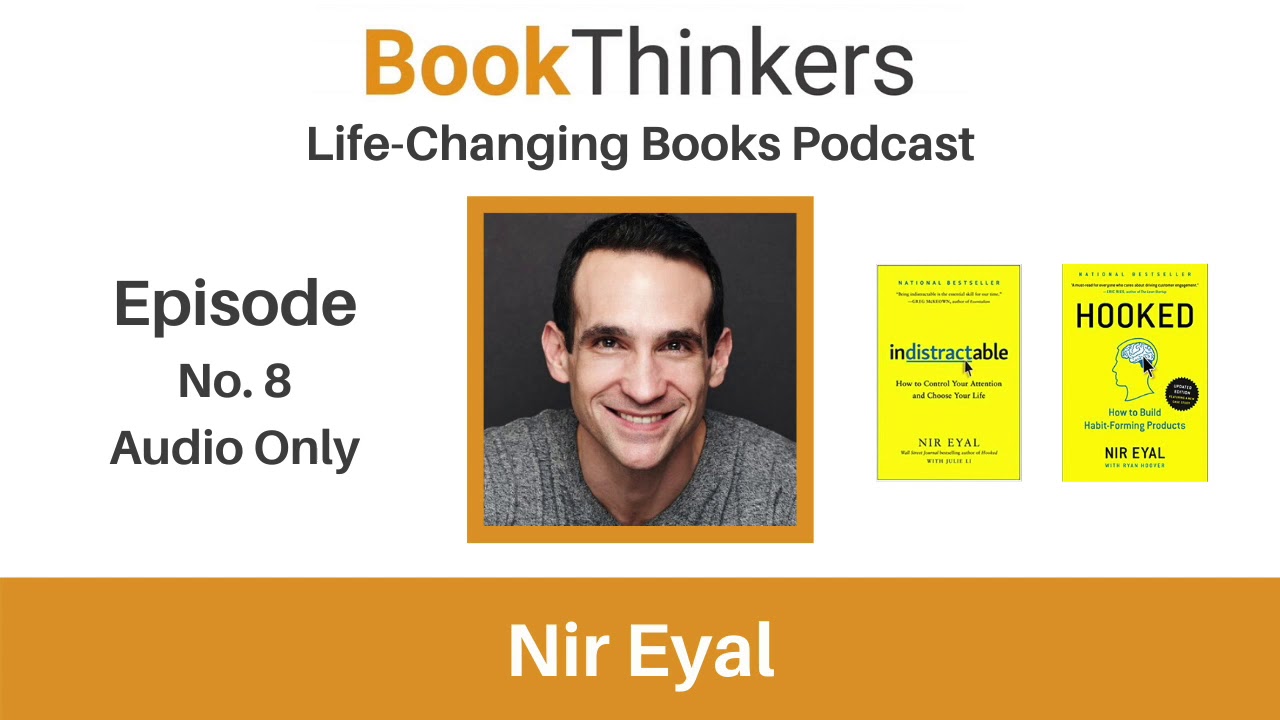
Nir Eyal, author of Hooked and Indistractable, explains why distraction stems from internal triggers like boredom and stress, not just external ones. He missed a promised moment with his daughter because of his phone. His framework for fighting distraction centers on four strategies: mastering internal triggers, planning your time intentionally, separating reactive from reflective work, and aligning your schedule with your values.
Chapters
Hello, Book Thinkers family, and welcome to episode number 8 of our brand new podcast, Book Thinkers Life-Changing Books. During each episode, I interview some of the world's top authors, and as a listener, you can expect to discover new books, new mentors, and new resources that you can now use to achieve more and live better. In this episode, I have the pleasure to interview author, entrepreneur, and investor Nir Eyal. Before writing his 2 books, Nir sold 2 businesses and then lectured at Stanford's Graduate School of Business. He writes, he consults, and he teaches about the intersection of psychology, technology, and business. Our conversation touches on his 2 books, Hooked and Indistractable, but we also talk about the future of technology as well as some of his favorite books. So without further ado, please enjoy my conversation with Nir Eyal. Nir, thank you so much for joining us today. I've read 2 of your books, and I know the Book Thinkers family is going to be very excited to listen to this.
Thank you so much. I know I've been following you for quite a while now on Instagram, and I appreciate you bringing attention to authors' work. Thank you.
Yeah, you're very welcome. And so let's dive right in. It's my understanding that you were a lecturer in marketing, and then you sold a couple businesses before you turned into an author. So what did that journey look like for you, and why did you decide to pick up a pen or get on a keyboard and start writing your first book?
Yeah, so I've always enjoyed— not always, but starting in high school, I would say I always enjoyed and appreciated good nonfiction. And I remember, so English is not my first language, as you can probably sometimes tell. But in high school, I had a great teacher who was so bad. It was the football coach who taught my English class, and he was He was so bad at teaching English that he basically gave up, and all we basically did was read periodicals. And so, like, my favorite— that was actually my favorite class, because he would, like, bring in the day's paper or Time magazine. This is well before the internet, and we would just read, like, opinion pieces and then talk about it. And I just, I just love that. I just thought, you know, wow, a well-written 1,000-word op-ed can really change minds. And I thought that was just so special. And so when I went to college, I was a journalism minor. And I thought I was going to go into some kind of, some form of journalism. But then one day I saw the— we had in the journalism department, they had this job board. And I was looking through all the the jobs that you could get straight out of college. And then they had the salaries posted next to them, you know, $16,000 a year, $21,000 a year. And I said, oh my God, no way. There's no way I can survive. So I decided to put that on hold for a while and didn't write again for years and years and years. And fast forward to 2017, I was at Stanford Business School and I helped co-found a company that was in the advertising and gaming space. And this was 2007, so this is, remember, this was before the Apple App Store existed. That was launched in 2008. Apps meant Facebook apps. That's what people meant when they said apps. It was Facebook apps. You know, remember like the days of throwing sheep at each other and all these stupid games that people used to play on Facebook? And so those were some of our clients, and I had this front-row seat to watch the rise of these— some, some of these very trivial, silly apps that were built, you know, in a weekend and somehow had millions of people using them overnight. That had never been done before. And I had many friends who were working at companies like Twitter and Facebook and Instagram and Slack and WhatsApp, and, and I got the opportunity to to watch these companies being built. What fascinated me about these companies was how effective they were at changing habits, at changing consumer behavior, at building the products that people use because they wanted to, not because they had to. That sounds silly today because products are so well-made online, but you got to remember back then, the big complaint The thing that everybody complained about was that, why are computers only for nerds and geeks? Why can't anybody make a personal computer that is actually usable to the rest of us? Fast forward a few years and the iPad comes out and the iPhone comes out. Now, all of a sudden, we got our wish. The downside, of course, is that we got our wish. As Sophocles said, nothing vast enters the life of mortals without a curse. And so the curse of these amazing technologies that are so usable, that are so user-friendly, that are so fast and so well designed, is that sometimes we go overboard. But at the time, the— for the first book, for Hooked, my goal was to figure out ways to codify what these companies were doing so that it wouldn't just be the gaming companies and the social media companies using these techniques. My dream was Well, why can't we use the same techniques and technologies and psychology to make all sorts of products habit-forming, right? What if we could make exercise habit-forming? What if we could, you know, facilitate saving money through an app? What if we could make the kind of software that people use in the workplace to make them more productive into a habit? What if we could, you know, use various healthcare products like, you know, patient adherence, people actually taking their medication or using a medical device. Huge problem. Millions of people die every year because they forget to take their medication or use a device because it's not a habit. And so that was kind of the idea was what if we could use those techniques for good? Uh, and so it took me a little while to write the book. Uh, it wasn't until, it wasn't published until 2014, but in between there, um, I started. So the, okay, so the, we started that company. That company was acquired in 2012. Uh, I had some time on my hands. The company was acquired and I was trying to figure out what to do next. So I started blogging because I wanted to know these techniques and yet didn't find, you know, the codification of them. And so I just started writing about it. I was looking for a book on how do you build habit-forming products, couldn't find it, so started to write about it. You know, blogged here and there and really enjoyed it, kept blogging, started getting some good feedback from readers and syndication from various publications like TechCrunch and You know, various, various online publications. And then I got a call one day from my former professor at Stanford that said, look, I really like your Hooked model. I've been reading your articles. They're really interesting. What do you think about teaching a class with me at Stanford? Okay, that sounds fantastic. And he was very generous. Baba Shiv, wonderful neuroscientist who gave me carte blanche to design this class with him. And I taught that for many years as a lecturer in marketing at Stanford. And then moved over to the D School, the design school at Stanford, taught there for several years, then published Hooked in 2014, and then started to think about the other side of the coin, right? So if Hooked is about how do we build good habits, Indistractable is about how do we break bad habits. And so that's what I've been doing since Hooked was published, was trying to dive into the other side of the equation. How do we understand the psychology of why we do things against our best interests? Why do we do things that, that that sometimes are bad habits and how do we break those bad habits?
Well, I love that introduction and it helps me to understand a little bit more about what led to the 2 books because as you just mentioned, they are 2 different sides of the same coin. And so it's very interesting that you chose to do that. And so as far as Indistractable, let's start off with something that I thought was fascinating. And I think that this will be a fun little story for you to explain to everybody. You said in the book that boredom drives distraction and that studies show that people would actually rather shock themselves and experience pain than sit in a room by themselves and do nothing.
Yes. Yes. This is a study done by Timothy Wilson who had this experiment where he put people in a room and basically told them to do nothing. And he strapped this, this device that would give them a mild but painful electrical shock. And they were told This will hurt, but if you want to press it, feel free. And it turns out that I think it was something like— I don't have the study in front of me, but I think it was something like 30% of men and something like 20%, if I'm not mistaken, of women would rather shock themselves knowing it would hurt than doing nothing. And I think this study is really illustrative of the root cause of distraction, because as much as we like to blame the devices, the pings, the dings, Facebook, Twitter, the iPhone, all these technologies. First of all, distraction is nothing new. Plato talked about it 2,500 years ago. He called it akrasia, the tendency to do things against our better interests. So it's not— was not invented with our devices. And, and more importantly, it points to the fact that most distraction does not start from outside of us. It's not just about the pings, dings, and rings. most distraction begins from within, that most distraction is a desire to escape discomfort. That's why one of the slogans of the book is time management is pain management. Because fundamentally, if we don't understand that— and this is what drives me crazy about all the books I read about time management and productivity— they all give you these cheap life hacks that none of them work. And let me tell you, I've read just about every book out there on this topic. None of that stuff works if you don't first and foremost understand what is the discomfort you are trying to escape, whether it's, you know, watching too much news, drinking too much booze, uh, scrolling through too much Facebook, watching too much football. Any of that stuff can be a distraction if you do not understand why you are using these things to escape your mind. if you don't know how to deal with those uncomfortable sensations, something will distract you no matter what you do. That is always the first place to start, mastering the internal triggers. Because look, procrastination, distraction, a lot of people think that it's a character flaw, it's a personality type, that there's something wrong with them. Rubbish. It's not true. That's a self-limiting belief. It's simply that people don't have the habits to deal with discomfort in a healthy manner, so they impulsively reach for something to take their mind off of that uncomfortable feeling, the stress, the anxiety, the uncertainty, the fatigue, whatever it might be. They reach for something to fix that as opposed to learning healthy ways to deal with that discomfort so that leads them towards helpful actions as opposed to harmful ones.
I love the idea of helpful actions. And another big line from the book says that the antidote to impulsiveness is forethought. And so can you talk a little bit about what the next step is once you're able to accurately identify what the real problem is? Yeah.
So I think that, that motto is probably the summary of the book, that the antidote to impulsiveness is forethought. Because as sinister as we think these distractions are and how people say, oh, the world is so distracting these days and how, you know, how can we focus when all these technologies are trying to hijack our brains? It's all— first of all, it's all rubbish. It's the— these, these kind of headlines are written ironically enough to get you to click on them because it's written by, by media companies who monetize your eyeballs, right? Whether it's the Wall Street Journal or, you know, the New York Times or, you know, lifehacker.com. All these companies make money by selling your attention to advertisers. So of course they want the most sensational thing they can find. The research does not show that this is true. Some people are actually addicted, just like some people get addicted to alcohol. That doesn't mean that everyone who has a beer with dinner is an alcoholic, clearly. And the same thing goes with, with these technologies. We're not all addicted. We are simply distracted. So the thing that, that we all have as a species, that is this, this, this miracle of evolution, is that the human race can do something, among many things, better than any other creature on the face of the earth, which is we can see into the future. better than any other animal. We can predict what is going to happen with greater fidelity, with greater accuracy than any other animal on the face of the earth. And so we need to use that superpower because here's the thing. There is no distraction that we cannot overcome with a bit of forethought. No algorithm, no sinister plan to get us distracted, to make us watch something or scroll something cannot be overcome if we simply Plan ahead, because if you wait till the moment, right, if the chocolate cake is on the fork, you're going to eat it. If the cigarette is lit, you're going to smoke it. If you sleep next to your cell phone every night, you're going to pick it up first thing in the morning because you've already lost, right? Self-control and willpower don't work. They fail. The idea— the antidote to impulsiveness is forethought. It's about planning ahead. It's about having a system in place so you don't have to spend any self-control and willpower. The decision almost becomes automatic for you.
Well, so how do you put that system in place? What are some of the pieces to the puzzle that can help you avoid some of those distractions?
Yeah. So the part that took me the longest in writing this book was to filter out the 4 fundamental strategies, right? There's so much great research out there that unfortunately barely sees the light of day, right? Trapped up in academia, almost nobody reads these studies, but there's a lot of great research out there. So what I wanted to do was to categorize all the research around attention, distraction, procrastination into these, these 4 fundamental strategies. So number one, we talked about a little bit, is mastering the internal triggers, that realizing that most distraction and procrastination begins from within. Step number one is having new habits so that when you feel bored, lonely, fatigued, stressed, anxious, You're not impulsively reaching for something to take your mind off of that sensation as a tool of escape, but rather you have a habit of dealing with that discomfort in a way that leads you towards healthy traction rather than distraction. So that's the first section of the book is about how do you master the internal triggers, and that has to be step 1. None of the other life hacks and techniques and tricks work if you don't do that first. Step number 2 is about— it was about making time for traction. Another one of the important slogans from the book is you cannot call something a distraction unless you know what it distracted you from. That so many people out there do nothing but complain about how distracted they are, and yet when you say to them, wait, what was on your schedule today? What did you get distracted from? Oh, nothing.
Right.
I didn't have any plans. Well, you can't moan about getting distracted if you didn't— if you can't tell me what you got distracted from. So that means we have to plan our day. And this, and this kind of kills me because of all the techniques in the book, this is the one people most don't want to follow. There's a lot of, you know, when I, when I preach this gospel around how this works— and by the way, I didn't make this up. This is called setting an implementation intention, and it has been proven that— well, proven, you can't ever prove something in science, but it has been shown in study after study to be a highly effective technique. And it's very simple. It's planning out what you're going to do and when you're going to do it. And yet, you know, I think maybe 1 in 1,000 people, when I tell them the secret is to plan your day, it's in one ear, out the other. And here's why. Because it's work.
Mm-hmm.
You got to think. People don't like to think. But maybe I can reach a few people who are listening to me right now and say, wow, you know what, this guy's done his research. Maybe I should give this a shot. I know it's a little bit of work. But if I want to live the kind of life that I know I deserve, if I want to be the kind of person I know I can be, if I want to actually control my attention and choose my life, please take my advice. Plan your day. It takes maybe 15 minutes a week, and you're going to plan out how you want to spend your day so that you can turn your values into time. What does that mean? Values— what is that? What's the definition of values? Values are defined as attributes of the person you want to become. That's my definition. Values are attributes of the person you want to become. So we ask ourselves once a week for 15 minutes, we just ask ourselves, how would the person I want to become spend their time? How would they spend their time? And then we ask ourselves in these 3 life domains of you, you're at the center of these 3 life domains. If you can't take care of yourself, you can't take care of others. How would the person you want to become spend time on themselves? Time for proper rest, proper nutrition, Exercise, meditation, prayer, video games. You can do any of that stuff. Whatever it is that the person you want to become would do, put it on your calendar. Okay? Don't just say it. Put it on your calendar. Hold the time for it. And the beautiful part is you can turn distractions into traction by simply planning for it. If you want to play video games, social media, YouTube, great. Do it. Enjoy. Because the time you plan to waste is not wasted time. So just by planning for it, it becomes traction rather than distraction. The second circle, the second domain is relationships. Planning time for the most important people in your life as opposed to giving them whatever scraps are left over. Our kids, our parents, our siblings, our friends, our community groups. Planning that time and holding that time and keeping it sacred for the important people in our life. And then finally, the work domain, right? So there are 2 types of work. We have what we call reactive work and reflective work. Reactive work— this is how most people spend their entire day, reacting to stuff— phone calls, emails, Slack notifications, messages. They're constantly reacting. But the people who get ahead, they do reflective work to some degree. It doesn't even matter how much you do. If you have just a little bit of time in your day, 15 minutes, 20 minutes, 30 minutes every day, To think, just time to think, the kind of work that requires undivided attention, time to strategize, to plan, to reflect. This is the problem. People find it so easy to do the reactive work that they spend almost no time thinking. They're mindless. And so they wake up 40 years later and say, wait a minute, my career didn't go as planned. My body doesn't look as I planned. My relationships aren't what I planned. I'm not living the life I planned. Well, too late, buddy, right? Your life's almost over. Don't be that kind of person. And the way you prevent that is by making time every day, even if it's a little bit of time, to reflect, to make sure you're living the kind of life and doing the kind of work that really matters. So make sure you reserve that time for reflection. So that's step 2 in a nutshell, is about making time for traction.
Everybody needs to go back and listen to that. That's— that is a book summary. And I do encourage everybody goes through the book because there's a lot more context and data that can help you understand why this might be an issue. And so let's bring it back. When was the very specific time? Because I know that you've written about it. When is the very specific time that you realized that you had a problem with this technology and that you needed to understand how to take control of your time better?
Yeah. So for me, the, the, the, the day of reckoning came when I was with my daughter, uh, one afternoon and we had this beautiful day planned of just daddy-daughter time, right? Just some quality time together. And we had this book of activities that daddies and daughters could do together. One of the activities was to make a paper airplane, and another was like a crossword puzzle, all these different activities. And one of the activities in the book was to ask each other this question: if you could have any superpower, what superpower would you want? And I remember the question verbatim, but I can't tell you what my daughter said. Because in that moment I got distracted. I started looking at my phone, and I don't even know what was on my phone now. I forgot. But I was sending a very clear message to my daughter that whatever was on my phone was more important than she was. And by the time I looked up from my phone, I realized that she had left the room and she decided to play with some toy outside. And I realized that I had blown it. I had messed up this perfect daddy-daughter moment and I'd let her down. And if I'm honest with you, it wasn't just with my daughter. It was when I was at work and I would say I was gonna do one thing and yet somehow didn't get it done because I was checking email or Slack channels or whatever else but doing the thing I know was important and I needed to do that day. With my body, with my physical health, right? I would say I would exercise, but I didn't. I would say I was definitely gonna eat right, but I wouldn't. And so the superpower I decided I would most want would be the power to simply do what I said I was going to do. Imagine what life could be like if you simply lived with personal integrity. We all know what to do, especially these days with the internet. If you don't know what to do, just Google it. I promise you, somebody has written an article online, probably for free, that you can access. Worst case, you can buy a book for a few bucks that's basically going to tell you how to do whatever you're looking to do. So we can't claim ignorance anymore. The problem is no longer that we don't know what to do. The problem is we don't know how to stop getting in our way. We don't know how to do the things that we say we are going to do. And unfortunately, I think the world is full of flaky people. And I was one of them. I mean, I was patient zero here. I used to be clinically obese. I've always struggled with self-control and willpower, not doing what I said I was going to do. And unfortunately, I think more and more, there are a lot of people out there that are flaky like I used to be. And they flake on their relationships, they flake on their friends, they flake on their jobs. Nobody wants to hire those people. Nobody wants to be in relationships with those people. Flaky people suck. And so what I'm trying to do is to help people do whatever it is they say they're going to do. I'm not here to tell you what your value should be. I wanna help you do whatever it is you say is important to you. That's my goal.
Oh, it's a very important story. And it humanizes you as the author, because you're not just saying, I'm an expert in this field. So I'm going to tell everybody how to live the perfect life, just like the one that I have. It's, well, I was in a place where I was obese, and I was having a problem with my family and work because I was too distracted. And I'm patient zero. And so I wrote the book. And I think that's a very important thing. To come across. So I love that.
That's always been my MO, by the way. I mean, when I write, with the same with Hook too, I only write— I don't, you know, some people write a book when they know the topic, and that's never been my style. I write because I want to know, right? That's why it takes me a long time to write these books, is because I don't, you know, I read everything on the topic. And look, most of the time that solves my problem. I'll read somebody else's book and I'll say, oh my gosh, that's great advice. I'm going to do that. But once in a while, right, like my pace so far has been every 5 years, I have a problem. I can't find a book that solves the problem. I try other techniques and it doesn't work. And that definitely happened with distraction. I read every book that said, oh, technology is melting your brain and, you know, stop, you know, get rid of your iPhone, stop using social media. But that didn't work because The problem wasn't the technology. I would find some other way to get distracted. I would organize my desk. I would take out the trash. I would, you know, find every excuse to not do what I said I was going to do, uh, because the problem of course wasn't the technology. So I was looking for a tech-positive way that actually gets to the psychology, the deeper reason why we get distracted. And so yeah, that, that is really what it took for me to change my own behavior and change my life. I mean, today, uh, I'm 42 years old. I've never been in better physical shape. I've never had a better relationship with my wife and my daughter. I've never been this productive in my life as I am today from a work perspective. And one of the big benefits of being indistractable that I really want others to experience is that ironically, even the leisure time for the person who is distractible isn't enjoyable, right? That only when you are indistractable Do you really enjoy leisure? Because what used to happen to me, I would come home from work and I would, I would, you know, I just want to watch some Netflix. I just want to like, you know, play with my daughter, just relax. And yet I would feel guilty about it because there's all this stuff I hadn't done. Whereas today, when I come home and do whatever it is I want to do, that is exactly what I planned. Right, that is, you know, the time you plan to waste is not wasted time. If I want to go on Facebook, it's in my calendar, right? If I want to putz around on YouTube or Reddit or whatever, that— there is a time for that. And so I can do it without guilt. And so I don't feel like I'm, I'm not filling up to my obligations because anything else other than that would be a distraction because it's exactly what I planned.
That's actually a problem that I've faced at certain points in the last few years, and it comes and goes sometimes. You need to refresh these skills. And so I'll find myself defaulting to work instead of leisure because I don't want to feel guilty. I know my task list and the things that I want to accomplish in order to be more fulfilled are a million miles long. And so that's something that I've faced. And let's— there are 2 more things that I want to talk about. One of them is the future. And so as companies continue to adopt your Hooked model and perfect it and There will be more technologies to help support that model, and there will be more technologies that grab our attention faster and quicker and keep us there longer. It's so important to understand the principles of this book. And so do you think it'll become more relevant as time progresses?
Yeah, for sure. I think the world will become a more potentially distracting place. And ironically enough, that, that is a good thing. Remember, we want these tools to be good, to be interesting, right? Should we tell Netflix, hey Netflix, can you stop making your shows so interesting? I want to watch them all the time. Hey, hey Apple, you know, you're— the iPhone is so user-friendly. Can you please make it not so quite easy to use because I use it too much? That's never going to happen. That's not a problem. That's progress. We want technologies to facilitate the behaviors that we ourselves want to do. And so I think everything in Hooked is still very relevant. And I think if anything, it's not used enough. It's not that it's used too much, it's not used enough. Think about interacting with government services, the enterprise software, the kind of crappy software you have to use at work, local businesses. I mean, the kind of products that we use online for these examples They don't suck us in the way that Facebook and Twitter do. No, they just suck. So I hope that we can use these techniques that I described in my first book to make these type of products better, the kind of products that we use because we want to, not because we have to. On the other side of this is that that also means that the world is becoming a more potentially distracting place, and, and we haven't even really begun. I mean, if you think about, you know, the potential of virtual reality, augmented reality, or just plain old reality, you know, I've seen a spike in book sales since COVID because the people are more anxious now, right? So what do people do when they're more anxious? They're more distractible. They're looking for escape from the uncertainty, the stress, the anxiety. They're looking for escape. So for a lot of people, it's doing things that they later regret— drinking too much, watching too much news, putzing around watching too much TV. You know, there's all kinds of distractions. And so they're looking for solutions. And then you couple that with the fact that now so many people are not working from an office, which means that the routines that we used to have in our life, the structure is gone. And we know that when we don't have structure, we don't perform at our best. We are much more likely to get distracted when we don't have structure in our day. And so that's kind of created this perfect storm of distraction. When I wrote the book, and it was published back in September, I thought the world was distracting. Now it's only gotten more distracting. So I think it's even more necessary. I mean, I'm so glad I, I learned these techniques because I think I've had a much easier time getting through this very rough distractible patch because I can use these techniques myself. But that being said, I want, I want to emphasize something real quick, that being indistractable doesn't mean you, you never get distracted. Okay? I made up the word so I can define it any way I want. Right? So, so being indistractable means you strive to do what you say you're going to do. Okay? Not perfect. I still get distracted from time to time. You know, when there's big changes in my life, you have to reassess. Okay, you know, how do I reallocate my time so that I do what I say I'm going to do? What do I want to do? That, that takes a little bit of work, especially when there's— when your life is in flux. The difference though between someone who is distractible and someone who is indistractable is that the indistractable person learns from when they got distracted and does something about it. So Paulo Coelho has a wonderful quote. He said, that a mistake repeated more than once is a decision. I think that's such a profound quote because, you know, many of us choose to be distractible. Because if you keep getting distracted by the same things again and again, you know, if you keep getting distracted by Facebook and Instagram, how many times do you get distracted before you do something about it? You're making a choice to be distracted, right? Okay, the news got you again?
Right?
Like, true, we can do something about this. And that's the difference, because what an Indistractable person understands why they got distracted, and they put systems and structure in place to make sure it doesn't keep happening again and again.
Mm-hmm. I really like that. And what you highlighted is that it's not a problem, it's progress. And there's actually a quote right out of the beginning of your book Indistractable that I want to read to everybody because it was pretty eye-opening for me. It said, When you invent the ship, you also invent the shipwreck. When you invent the plane, you also invent the plane crash. And when you invent electricity, you invent electrocution. Every technology carries its own negativity, which is invented at the same time as technical progress. And that's Paul Virilio. Is that how it's pronounced?
Yeah. I wish I could take credit for it. I didn't say that. That was Paul Virilio, right? Yeah.
And that's such an amazing way to look at it because we're going to continue to make progress at an extreme rate. extremely rapid pace that most people aren't ready for, and you need to be able to take control of your time. And so let's wrap up our conversation with a little conversation about books. And so I love to ask our guests, what are some of the books that have helped impact your life the most in a positive way, if any pop to mind?
Oh my gosh, there are so many. This is always a tough question because I have so many author friends, so sometimes I get trouble.
We won't tell.
Yeah, hopefully none of them are listening. But there's, there's so many. I'll give you, I'll give you a few that come to mind. So I think a fiction recommendation is Moby Dick. I think it's particularly— now, okay, I have to caveat that because the original Moby Dick is is really long and very hard to get through. But if you can find yourself the stage adaptation for it, it's phenomenal. And I think it's really— it has— I think it has the essence of the full version, particularly when it comes to this timeless struggle with distraction. I mean, the story of Captain Ahab is really about how his internal struggles create distraction. It's the same story. It's a very American story. It's the quintessential American story of, of, you know, being driven in some way, in some ways in a good way, right? I would argue that the same thing that drives Captain Ahab, this madness, is also what makes us go to the moon and create light, you know, world-changing innovation. And it's that same passion and drive. But understanding that the real source, I think, is, is, is a fascinating look into, into this very same problem that I talk about in Indistractable. So that's, that's a great fiction book. What else is really good that I'd recommend? If you've read Mindset by Carol Dweck, I'm sure many of your, your listeners have. That's a, that's a terrific book. I loved Sapiens. That comes to mind. That's a fairly recent book that I really enjoyed by Yuval Harari. What else is really good? The War of Art. I'm sure many of your listeners have read that. That's fantastic. Thinking, Fast and Slow. Nudge: Predictably Irrational. Yeah.
A lot of good ones on the list. Yeah. Whenever I ask this question, everybody gives a fiction book. Not everybody, but a lot of people have been giving a fiction book. And so I love that because fiction is one of the only places where the impossible can become possible and it stretches your— it intentionally, if you're doing it intentionally, stretches your ability to be creative and helps to flex those neural pathways. And so I love that.
Good point.
I've actually never read Moby Dick because it was such an intimidating book. And so now look for the stage version.
Look for the stage version, or if you, if you can see it performed after we're done with this, this COVID crisis, then if you can see it performed, that's even better. But if you can't, then you can order the stage adaptation. Well, let me add a couple other books, by the way. Factfulness was fantastic. I think everybody should read that. And, and a book that really inspired me as a writer, and I know it's inspired many others, Hackers and Painters by Paul Graham.
was—
it's a collection of his essays, so it's, you know, it's not your typical nonfiction book where it has an arc through the entire book, but it's just a collection of essays. And I really admire his style. You know, Paul Graham does such a fantastic job of writing these essays that after you read, you're kind of— you can't help but see the world a little bit differently. And so I remember being super inspired by how he did that to me and how I would love to do that for others.
Well, I just got a couple new recommendations myself, so we appreciate that. And before you go, where can people find more information about you? I know you have a great website. Can you talk a little bit about what that is?
Sure. So my website is at nirandfar.com, but Nir is spelled like my first name. So it's nirandfar.com, nirandfar.com. And yeah, I publish something new every 2 weeks and I send out a weekly list of articles that I've read that I think are interesting that other people should read too. So there's like a weekly digest as well. You can subscribe to one or the other or both. It's totally free. And there's also an 80-page workbook. We actually— I wanted to create a workbook for Indistractable, but it was 80 pages. And so we had to leave it out because it got too long. But the good news is you can get it for free. You don't have to go on Amazon. You can go to nearandfar.com and there's an Indistractable workbook that anyone can go get and it will help you on your journey to becoming Indistractable.
Well, thank you very much for your time today. I know that everybody will appreciate it.
My pleasure. Thank you so much for having me.
Bye. If you've made it this far, thank you so much for listening to my conversation with Nir. I really do believe that we're the average of the 5 people that we spend the most time with. So if there's somebody in your network that you could help elevate by sharing this episode, please do. It only takes 60 seconds or less, and it could change their life maybe your life as well. And so before I go, I want to remind everyone that BookThinkers is both an online community and educational technology company that enables readers to achieve more and live better. For more information on our mobile application, our shop, our social pages, or our mission, please check out www.bookthinkers.com. And as always, remember that real learning requires education like reading Indistractable, And reading Hooked, checking out Nir's blog, but also behavior change. And with that, I'm signing off. I hope you found real episode in this episode of Book Thinkers Life-Changing Books.
More from Nick

Napoleon Hill’s “Think and Grow Rich” is a timeless classic #selfhelp #personaldevelopment

4 Books to Help You Get Better at Decision Making #selfhelpbooks #bookrecs #nonfictionbooks


Have you read this book yet? 📖: The 5AM Club by Robin Sharma #selfhelpbooks #robinsharma

Dan Sullivan on Listening to Your Customers Instead of Watching Your Competitors

5 Books That Will Boost Your Financial Intelligence #financialfreedom #nonfictionbooks

The People That Preach the Loudest About Virtue are Usually the Most Power Hungry



Books are the greatest mentors you can find #selfhelpbooks #businessbooks #successmindset

Let’s fight this toxic instant gratification culture together 📖 #selfhelpbooks #jimkwik