Life-Changing Books Podcast Episode 28. Peter Mallouk: Author of The Path
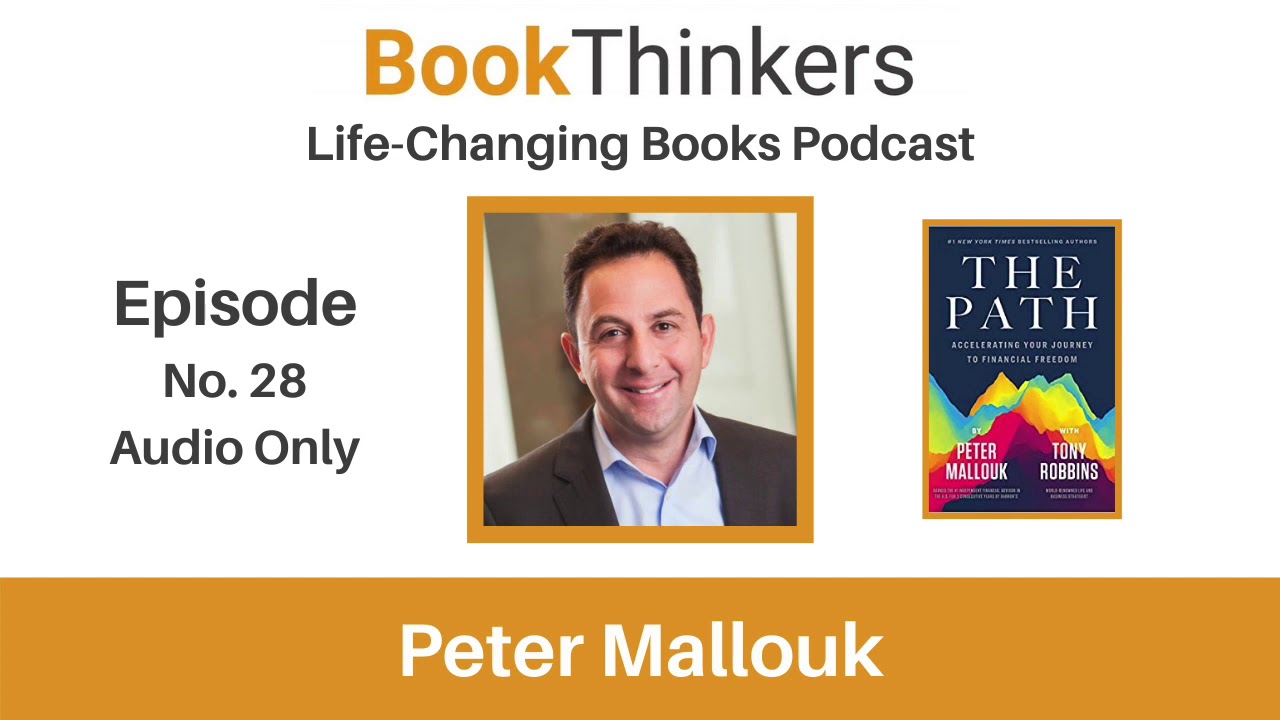
In this episode of the Book Thinkers Life‑Changing Books podcast, host Nick Hutchison interviews Peter Mallouk, president of the independent fiduciary firm Creative Planning and co‑author of the new book The Path: Accelerating Your Journey to Financial Freedom (narrated with Tony Robbins). Mallouk explains how the book differs from typical finance titles by emphasizing personal financial planning before any investment decisions. He highlights the alarming lack of emergency savings among Americans, attributing it to a culture of status‑driven spending, instant‑gratification, and overconfidence. Mallouk offers an optimistic macro view, citing technological progress and the global decline of poverty as drivers of long‑term market growth. He outlines the “4 C’s” for choosing a financial advisor—competence, conflict‑free, custody, and customization—and contrasts independent fiduciary advisors with broker‑type advisors. For younger listeners, he stresses the power of time, employer 401(k) matches, Roth IRAs, and disciplined, diversified investing. Mallouk warns against market‑timing, advocating staying invested for the long run, and strongly recommends low‑cost index funds over active managers. The conversation ends with resources for learning more about Mallouk, Creative Planning, and The Path.
Chapters
Hello, Book Thinkers family, and welcome to episode number 28 of our brand new podcast, Book Thinkers Life-Changing Books. During each episode, I interview one of the world's top authors, and then as a listener, you can expect to discover new books, new mentors, and new resources that you can use to achieve more and to live better. In this episode, I have the pleasure to interview the author Peter Mallouk. Peter is the president of Creative Planning, which is a company that provides comprehensive wealth management services. What does that mean? These offerings include investment management, financial planning, retirement plan consulting, and much more. And Creative Planning manages an astounding $50 billion in assets as of July 2020 for clients all around the US and abroad. Our conversation today is all about Peter's brand-new book, The PATH, and the subtitle to this book is Accelerating Your Journey to Financial Freedom. This book is a great combination of 2 things, really, one being self-mastery, which is actually written in primary Narrated by Tony Robbins. And financial— so our conversation today touches on all of the topics mentioned above, and it left me feeling very optimistic about our collective financial future. So without further ado, please enjoy this amazing conversation with author Peter Mallouk. Peter, thank you so much for joining the Book Thinkers Life-Changing Books Podcast today. How are you?
I'm Good to be with you, Nicholas. I'm doing great.
I'm very excited for our conversation today. For those in the audience, Peter co-wrote Unshakeable with Tony Robbins, and that's a book I read years and years ago. And so I'm very excited for this book, The Path. It just came out. And for those in the audience that don't know who you are, can you give an introduction and maybe a little bit of a background?
Yeah, I'm the president of Creative Planning. Creative Planning is an independent wealth management firm, which basically means We're a firm that's a fiduciary to clients. We have to act in their best interests. We don't own our own products. We don't sell investments on commission. And so we're aligned with our clients when we're helping them choose their investments. And we do everything from a financial planning-led approach. In other words, we build a plan that figures out what the clients are trying to do, and then we point all the investments in that direction rather than choose investments based on age or risk or because it happens to be a product our firm owns.
And so, this book, what separates it from all of the other financial advice type books out there? I mean, it's brand new, it's hot off the press. What do you think is the main differentiator here?
So, there are thousands and thousands of these books. I've written a couple of them myself. But the main difference is even the other ones that I've written or co-written in the past have been very just investment-focused, like here's how the market works and here's how to invest. Successfully through these markets. This book is much more about before you invest a dollar, what should you be thinking about? And so you never start a race without knowing where the finish line is. And so if you— we, we kind of all generally know if we want to accomplish something, we need to know what the goal is, you know, to get a certain degree in school. We, we then go backwards and go, what courses do we need to take? You just go randomly take, uh, courses. Of course, there's tips to get through school. But you need a goal to figure out, well, what courses am I going to take? When am I going to take them to get there? Well, you need a financial plan to really make investments make sense. You need to know, I want to retire at this date or be financially independent at this date with this amount of money. I'm going to need more early on for maybe cover my own healthcare costs. I'm going to need less late in life because I'm not traveling. Maybe I'm not going to owe as much in taxes because you're going to move to a state that doesn't have a tax, really figuring out, okay, what am I trying to do? I want to pay for my kids to go to college. I want my family to be okay if I'm gone. I want to make sure that I'm not broke if I become disabled and can't work. What are all the goals? Get them down on paper, and then from there, go, okay, now what do I need to do to make those goals, those dreams a reality? What investments make the most sense to make that happen? And The PATH, the book The PATH is all about Determining where you are, what you're trying to do, and how to put those pieces in place to get there, as well as how not to lose it along the way, you know, just because of risk or a risk of loss.
Found it fascinating. There are some statistics right at the front of the book that were pretty alarming to me. 60% of Americans don't even have $1,000 saved for retirement, and then also less than 40% of people say that they could handle a $500 emergency. And so, it really is a crisis to start planning and paying attention to our financial futures. Why do you think that we ignore that right now in the US? And why do you think we're all in such a bad spot?
Well, I think we're in an interesting— we live in a culture that feeds competitiveness and we think that we win this competition by exhibiting signs of wealth. And it's fascinating psychology. We could all kid ourselves about a lot of things. Like, so you might think that you're really funny, I might think I'm really funny, and there's no like scorecard out there. Do you know what I mean?
Yeah.
And so, we can all fool ourselves and we can fool ourselves about all sorts of things. But the reality is that a lot of people look at wealth as a way to keep score. And in general, people meet 5 other people, they try to categorize them into those ways. And so, a lot of us are programmed to compete that way? How can we appear to have more than we have? So, we take our money and we spend them on cars and we spend them on— we might stretch on a home that we didn't need and some wealthier people might buy a second home. And it doesn't matter how much wealth there is. I've observed this competition is ongoing. I think the other part of it is we're a now, now, now culture and we're not used to delaying gratification to accomplish something in the future. And then third, I think a lot of people are confident that they can pull their way out of things all the time. And so, I think until you really face a crisis, you really can't appreciate it. It's kind of like your health, you take it for granted until there's an issue. I think it's the same thing with money. You just assume money's going to keep coming and if something goes sideways with your business or your real estate or whatever, or your job, and all of a sudden you don't have it, you realize it's not like you gradually can go down, you can really be wiped out pretty quickly.
Yeah, no, absolutely. And so overall, this book is about 2 things. It's about self-mastery, and I know Tony has written a couple chapters specifically dedicated to the emotional side, which we touched on briefly. But then there's the mastery of investing. And so a stance that you take that I find really interesting is that we're actually in a very good spot in time to invest. Economic winters are always followed by an economic spring. And so we're What does the climate look like to you right now? Should we be investing? Should we be optimistic? Like as a normal person out here trying to invest their money?
I mean, I can't imagine, I don't see how anyone cannot be very optimistic over the long run. So I think there's always these periods in history where things move very slowly. This is not one of those. I think if you, people go back 100 and 1,000 years from now and look at history books, they'll still be talking about the invention of fire and the wheel, and they're going to talk about things like the Industrial Revolution and the printing press, and then they're going to talk about the period we're living in right now. All this technological innovation, all the way from like not having a computer or a phone to artificial intelligence surpassing what humans are capable of in one generation. Do you know what I mean? So it's absolutely stunning what's happening right now. And through all of history, when you have innovation and technology, these big leaps in advancement, what is tied to that is economic growth. The other thing that's even better today than ever is for almost all of history, 90% of people have lived in poverty on Earth. And today it's a minority of people living in poverty, and we're on a path that within 50 years, probably nobody will be living in poverty on Earth. So this huge group of people that could barely get day to day, week to week, are going to not just not be suffering in poverty, which is wonderful, but they are going to be consumers, which also drives economic expansion. These 2 extremely powerful forces, that does not mean there is a lot of things that can scare markets along the way, or they could screw things up in specific countries, whether it is a 9/11 or a war or coronavirus, all sorts of things. An investor should be diversified and and have their short-term needs covered. But big picture, it doesn't get better than where we are today.
And it seems like from reading the book that you're also a fan of Factfulness by Hans Rosling. I really enjoyed that book because when I walked away from it, I felt so positive about the progress we've made over the last 100 or 1,000 years. I mean, we've really taken huge steps as some of the numbers that you just highlighted.
Yeah. Yeah, you're right. I cite him a lot in one chapter specifically as just showing that the negative narrative that we have just pounded into our head all day long on TV and radio and social media is not consistent with the reality of what's really happening.
There was another point in the book that I thought was really interesting. You said that the higher your net worth, the more likely you are to use a financial advisor, which is a little bit counterintuitive. You would think common sense-wise that it's critical early in life to get some help and some strategy, especially if you're not very well-versed in money and you don't have a high net worth. But it kind of seems like it's the opposite. So, what are the 4 C's to selecting a financial advisor and why do you think we should all have one?
Well, I think it is interesting is that people are surprised. They think when people get to a certain net worth, they have the sophistication to do it themselves. It's really the opposite. They have the sophistication to know the value of getting good advice. But one of the things is they don't just go get an advisor. They are really cautious about who that advisor is and some of the criteria that they're looking for, I highlight in the book. One is competence, right? So they're not necessarily going with like their neighbor or their friend from high school. They're really thinking, does this person have credentials, they have education, do they work with a lot of people like me already? They're looking for that experience. We intuitively know this with other things. If you were going to go get a house built, you'd find an architect that's done a lot of homes like the one you want. If you were going to go get knee surgery, you want a doctor that's doing knee surgery all the time, not 100 other things and only does it a couple of times. But with financial advice, we tend to go just based on a relationship. And I think the very high net worth people tend to really seek out very competent advisors. They're also very wary of conflicts. So, they're saying they want to make sure that they're paying the advisor, they're not paying the advisor to then sell them their own products. So, a lot of, say, investment banks or big brokerage houses, you pay the advisor maybe 1% to manage the money, but then all of a sudden, you wind up with their own funds in your portfolio. So it's kind of like walking into a Ford dealership and paying a fee to ask what kind of car to buy. You're going to get a Ford, right? There are several Fords, but you're going to get Fords. And so they're really sensitive to conflict. And I think if you can get somebody who's competent and doesn't have that conflict, that's a huge head start. And then we all heard the horror stories about people who lost money because advisors stole the money. And those almost always are accompanied With custody. So, if you look at Bernie Madoff, people wrote a check to Madoff Investments, he put it in his bank account, then he took it out and spent it and bought a yacht or whatever. You want to work with an advisor that holds your money somewhere else. Like if you're working with Creative Planning, my firm, none of the money is at Creative Planning. It's sitting at custodians like Fidelity and Charles Schwab. And that's the type of relationship you want to have with your advisor. And then lastly, you want an advisor who can customize. You don't want somebody who's just going to take all your investments convert them to cash and invest them in a model. If you're going to do that, you may as well just buy a mutual fund. You really would be better off having an advisor that's going to figure out, okay, you own a lot of real estate, maybe we should not have real estate in your portfolio, and really try to work with you to tailor things to meet your needs.
And then there's the big difference between an independent advisor and a broker. And so you use the example in the book that most financial advisors, they don't actually go to school and specialize in wealth management. They go to school and specialize in maybe another business discipline, or they're really just a glorified salesperson. And funny enough, I interviewed for a couple jobs like that right out of school, and I'm a salesperson. And so you can really end up in the wrong profession. And, and you use another metaphor. You say like, you know, maybe I'm going to mix this up a little bit, but if you need heart surgery, you don't go to another kind of doctor like a dentist or something like that, right? You go to a heart surgeon. And so What are the differences between an independent advisor and a broker? And then what are some of the things that might— some of the questions that maybe we should be asking?
Well, there's hundreds of thousands of advisors and there's a ton of advisors and the word financial advisor is very broad. Like most insurance agents would say they're a financial advisor and they are advising on a part of finance and most people would give tax advice would say they're a financial advisor. Most brokers who sell certain products say they're a financial advisor. A guy that just runs a single money management strategy and is trying to get people to invest in that strategy would say they're a financial advisor. And then I think what most Americans, if you say financial advisor, they think, oh, this person's a financial planner. They're going to look at my situation, my overall wealth situation, and tell me what investments make sense for me and so on. That's what most of us think a financial advisor is, but that's really a very small segment. That's a minority of the world that would call themselves financial advisors. And about 90% are in the brokerage world. The brokerage world gets paid a lot of different ways. They might invest in a fund where the mutual fund is paying them a fee back. They might get a commission. They might have a product that their parent company owns. Then there are independent advisors. Independent advisors are fiduciaries all the time on all investments, meaning whatever investment that we're recommending to a client, it's got to be in their best interest. That independent advisor ideally doesn't own their own products, right? So, you're getting truly independent advice just like you would hopefully receive from other fiduciary professions like doctors and accountants.
Book Thinkers family, a quick word about today's podcast sponsor. Today's episode is sponsored by Audible. Audible is the leading provider of spoken word entertainment and audiobooks. Ranging from bestsellers to celebrity memoirs, business and money, as well as my favorite, personal development. As part of Audible's partnership with Book Thinkers, we're actually offering listeners a free 30-day trial. This free trial includes 1 credit good for any premium selection titles you like and yours to keep even after the trial is over. It also includes access to Audible's Plus catalog of podcasts, audiobooks, guided wellness, and Audible Originals. Listen all you want, no credits needed. Now everyone on the Book Thinkers Instagram knows that I love physical paper books, but I have also been completing an additional 20 to 30 books a year using Audible. I simply listen when I'm in the car, doing chores around the house, or while I'm on my morning walks or runs. And so today's episode that you're listening to is all about The Path, Peter's brand new book, which is also available on Audible and narrated by both Peter and Tony. If this book sounds like a good fit for you and you're enjoying the topic, or you think that you could benefit from listening to it, you can access this free 30-day trial and listen to The Path for free by clicking the link in today's show notes or by going to www.bookthinkers.com/audibletrial. You will not regret it. Now back to today's episode. Changing subjects just a little bit. Most of our listeners and most of the people listening today, they're young professionals in their 20s or early 30s. So what are some steps that people in their 20s or early 30s can take? What are some of the first steps that we should be taking if we don't currently work with somebody or we're not very strategic with our money in the first place?
And that's what I love about being on your podcast today is I love being able to talk to that audience because they have these single biggest advantage that exists in all of wealth accumulation, and that is time. If someone can put away money today, someone who puts away $100 a month from age 20 to 30 will wind up with more money at age 65 than someone who from age 50 to 65 puts away 10 times as much every month. The advantage of time is on your side. If you— if let's say you earn To make the math easy, just 10% a year, your money doubles about every 7 years. That's pretty powerful. I mean, $1,000 becomes $2,000, $4,000, $8,000, $16,000, $32,000 before you need it in retirement. And so, anything that you can put away at a young age is a big deal. So, if you're in your 20s or 30s and you're fortunate to have a pretty good job and you've got enough money to live on, number one, take the match at work. So, a lot of employers When you put money in a 401, they'll match part of it. If you put in— sometimes they'll match the first 1% or 2% or even 3% of what you put in. That's 100% return on your money. If you put away 3% of your salary in the 401 and they'll give you 3%, that's literally 100% return on your money. You can't get that anywhere in the world. Always take advantage of that. If you still have money left, you should contribute more to your 401 or to a Roth IRA, or if you're really fortunate enough to to do both. And those are buckets where your money can grow tax-free all the way until retirement. And the combination of getting a match and getting started early and having all that time on your side, you'll accomplish every single goal you set out with very minimal pain, with very minimal deprivation versus most people who start in their 50s and they really, really have to feel some pain to cut back to accomplish what they want to accomplish.
Do you recommend somebody in my age bracket to Do you recommend, if we could only choose an IRA or a traditional type 401, which one do you recommend? Do you recommend pensions now or later?
Well, if there's a match in the 401, I always recommend the 401 at least up to the match because again, you're doubling your money. No, that's better than everything else. After that, most people are better off going to a Roth IRA where you use after-tax dollars and you put your money in an account that grows tax-free and then comes out tax-free. Uh, and, and then with— then I would go back to the 401 and then max out the 401 if I could. So here we're getting a tax deduction. We're not paying taxes on the money we put in the 401 today. It grows tax-free like the Roth, but unlike the Roth, when you take the money out, you will pay taxes. So it's pretty complex, but start with a match, then go to a Roth, then go max out the 401 if you can.
All right, love it, love it. So what about market timing and how markets work? I know that's something that you write about a little bit later in the book, and I think that that's something a lot of us are going to find interesting because unless we have a degree in this or unless we're reading a lot of books on markets, it's a very complex thing to understand.
Yeah, I think that the thing about market timing is most people don't realize they're doing it, and it's really time in the market and not timing the market that creates a success. I think intuitively we think, oh well, I just need to be in the market before it goes up and when things look shaky, I'll get out and I'll go back in when I think they're going to turn around and so obvious when that's going to happen. And really, it's not obvious and people who do this inevitably get burned and they wind up being far worse off than if they had never done anything at all. I think this year is a great example. I mean, we had the biggest drop in market history, the fastest drop in market history in March. The market dropped 34%, which happens to be an average bear market. A bear market's a drop of 20% or more. An average bear market's a 34% drop that happened in March. And most people said, oh, this is horrifying. I'm going to the sidelines. When things settle down, I'll go back in. Well, things turned and within just a few weeks, most of the losses were recovered. If you had been on the sidelines, you may never get that money back. You may have permanently lost that money. If you invest today, the odds your account will be up a year from now are 75%. It's pretty good, but it's not awesome. But if you stay in for 3 years, it's over 90%. And over 10 years, It's 98, 99%, depending on what research you wanna believe. The point is, if you go in, the longer you're in, the more likely you are to win. You are kind of the house in Vegas. In Vegas, if you're the house, there's gonna be some hands you're gonna lose, but the longer the players play, the house ultimately wins 'cause the odds are on their side. So you need to just stay in the game and it's gonna work out for you over the long run and try not to go in and out. A lot of people go, well, I don't market time, but if you've got a bonus and you're holding it until after the election, your market timing. It's little things like that. When you get money to invest, just invest it, especially if you're younger, just get the money, invest, get the money, invest. It will work out and you'll be better off than trying to time your entry points and exit points. If you were the worst investor in the world, you had 4 lump sums and you put one in before the tech bubble, one in the day before 9/11 happened, one the day before the '08-'09 crisis, and one the day before coronavirus crisis, you would have 500%, 1,000% more money than you had when you started because the market is up from all of those events. It just takes time. You just gotta keep investing and leave it alone. If you've got a good diversified portfolio with quality stocks, you're gonna be fine.
And I think there is actually a— in the first kind of introduction that I had to that concept about how long was in Unshakeable, and I think that the two of you wrote something along the lines of Basically, an index fund will beat a managed fund over a very long period of time in over 90% of scenarios because the market always wins, especially over a long period of time. So what are your thoughts on that? Do you recommend index funds versus a managed fund? What are kind of your high-level thoughts there?
I definitely recommend index funds, and I use index funds myself. Our 401 at Creative Planning is almost entirely index funds. And so for your listeners, you can own a basket of stocks like the S&P 500, which is just 500 of the biggest companies in America, or you could own an international index or an emerging markets index, or you can pay somebody to trade those stocks all day long. And the data suggests that people that are trading the stocks are going to underperform the people that just hold the basket of stocks over a long period of time. And so, why bother going and looking for those active managers who are definitely going to create more taxes And definitely going to cost more than taking a more passive approach. And so, I definitely strongly prefer that. I touch on that in The Path quite a bit as well.
Well, this was a very value-packed podcast. I know that we need to jump off. We're running up against our time here. But Peter, for those who want to learn a little bit more about the book, which just came out, or a little bit more about you, where should they go? What should they do?
So, if they want to learn more about me, they can follow me on social media. @PeterMalouk on Twitter. I'm also on LinkedIn and Facebook, and so is my firm, Creative Planning. If you want to learn more about Creative Planning, you can visit us at creativeplanning.com, and you can Google Peter Malouk The Path, and you'll get to The Path website. You can order it, or you can order it on Amazon or any major bookstore. Awesome.
Peter, thank you so much for your time today. I really appreciate it, and I'll let you know when the podcast comes out.
Hey, thanks for having me, Nicholas. Have a good one.
That is a wrap. Thank you so much for taking the time to listen to this week's episode of Book Thinkers Life-Changing Books. To discover more books, more mentors, and more resources that you can use to achieve more and live better, make sure you check out our website at www.bookthinkers.com. There you'll find links to our mobile application, more podcast episodes, our shop so you can get some Book Thinkers swag, and our socials. With that, I'm signing off and I'll see you for next week's episode of Book Thinkers Life-Changing Books.
More from Nick

Napoleon Hill’s “Think and Grow Rich” is a timeless classic #selfhelp #personaldevelopment

4 Books to Help You Get Better at Decision Making #selfhelpbooks #bookrecs #nonfictionbooks


Have you read this book yet? 📖: The 5AM Club by Robin Sharma #selfhelpbooks #robinsharma

Dan Sullivan on Listening to Your Customers Instead of Watching Your Competitors

5 Books That Will Boost Your Financial Intelligence #financialfreedom #nonfictionbooks

The People That Preach the Loudest About Virtue are Usually the Most Power Hungry



Books are the greatest mentors you can find #selfhelpbooks #businessbooks #successmindset

Let’s fight this toxic instant gratification culture together 📖 #selfhelpbooks #jimkwik