Life-Changing Books Podcast Episode 30. Rolf Potts: Author of Vagabonding
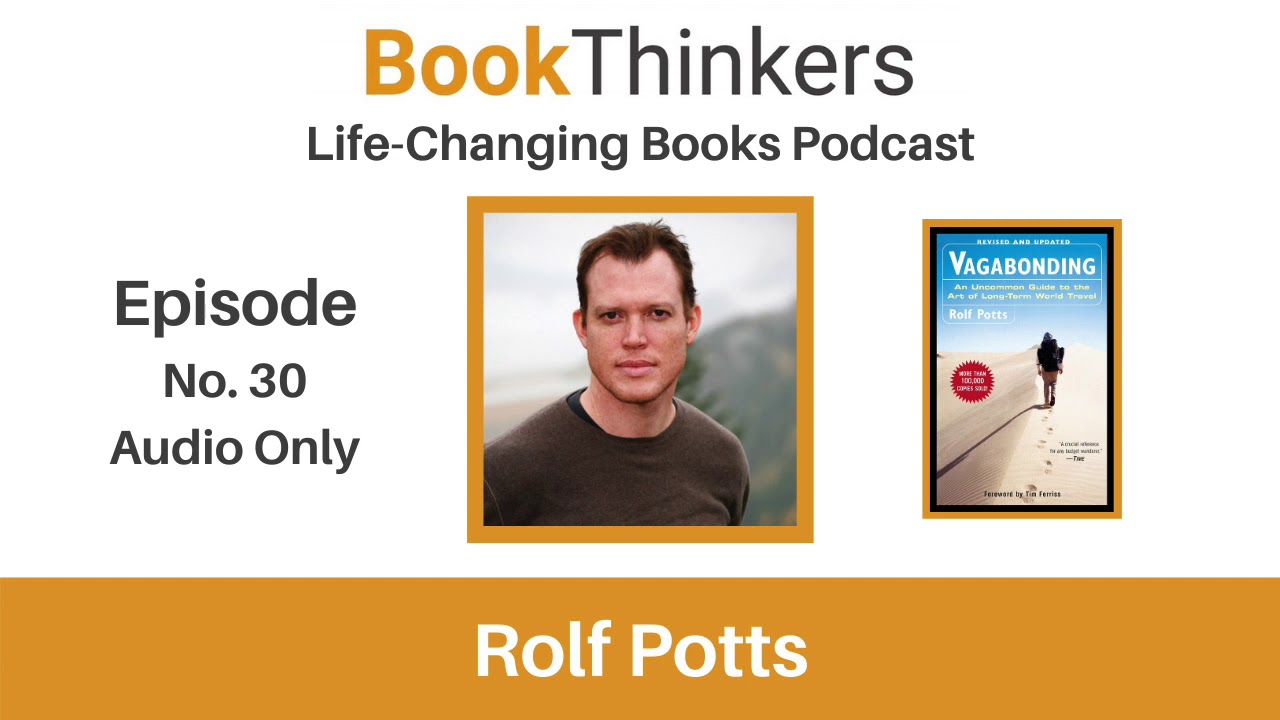
In this episode of the Book Thinkers Life‑Changing Books podcast, host Nick Hutchison interviews travel writer Rolf Potts, author of Vagabonding. The conversation weaves together Potts’s definition of vagabonding as taking time away from ordinary life to travel earnestly, his personal journey from a middle‑class Kansas upbringing to a life of long‑term travel, and the practical and philosophical lessons he draws from it. Potts recounts how a chance email from Tim Ferriss led to a lasting mentorship, and how travel can be a form of ‘time wealth’ that enhances employability, language skills, and personal growth. He offers concrete advice for beginners—overcoming the middle‑class habit of postponing travel, setting concrete future dates, embracing discomfort, and using travel to build transferable skills. The dialogue also explores common pushback from friends and family, the influence of social media on travel culture, the concept of anti‑tourism, the role of souvenirs (including tattoos), food as a window into culture, and the importance of authentic, slow experiences over checklist‑style tourism. Potts shares his favorite memories, future destination wishes, and points listeners to his website for more resources.
Chapters
Hello, Book Thinkers family. We have a very special episode today. Welcome to episode number 30 of our brand new podcast, Book Thinkers Life-Changing Books. During each episode, I interview one of the world's top authors, and as a listener, you can expect to discover new books, new mentors, and new resources that you can use to achieve more and to live better. In this episode, I have the pleasure to interview the author Rolf Potts. He's one of my favorite authors because he wrote one of my top 5 favorite books of all time, Vagabonding: An Uncommon Guide to the Art of Long-Term World Travel. Rolf has reported from more than 60 countries for the likes of National Geographic, The New Yorker, Sports Illustrated, The Travel Channel, and much more. And I'm very jealous of what I'm about to say. His adventures have taken him across 6 continents and include piloting a fishing boat 900 miles down the Mekong River, Hitchhiking across Eastern Europe, traversing Israel on foot, bicycling across Burma, driving a Land Rover across South America, and traveling around the world for 6 weeks with no luggage or bags of any kind. Without further ado, please enjoy this amazing conversation with somebody who I aspire to be like, Rolf Potts. Rolf, man, thank you so much for joining the podcast today. For those in the audience that don't know who you are, could you introduce yourself to everybody?
Yeah, I'm Rolf Potts. I'm a travel writer and journalist. I've written 4 books, most of them about travel, the most well-known of which is Vagabond: An Uncommon Guide to the Art of Long-Term World Travel, which is about taking time off from your normal life to travel the world in earnest, not just a vacation, but a way to embrace your only true form of wealth, which is time, and invest that time into travels that enrich your life.
So you kick off the book with a few different definitions of vagabonding, and I love all of them. But when you meet somebody on the street for the first time and you introduce yourself and they ask you about what you do and you tell them about vagabonding and they say, hey, what's that word mean? How do you define vagabonding to people like that?
Well, I gave it a great definition in the book that I might have to paraphrase now, but I think it's taking time off from your normal life and that doesn't have to be a prescribed amount. It can be 6 weeks, it can be a year, it can be 5 years. To travel the world in earnest, not just as a consumer who is experiencing the world as a vacationer. Nothing wrong with vacations, but as someone who is more like a pilgrim and is seeking to explore the world and learn about it and deepen their life. Now, that's not the book definition, but in some ways maybe I like that a little bit better. So it's, it's sort of traveling the world in the manner of a seeker as opposed to someone who's just sort of passively wanting to be entertained by the world.
Now, I loved your response. Uh, before we get into sort of my definitions of travel and all the ideas I have about it, I wanted to point out to the listeners that Tim Ferriss, who everybody here knows that he's one of my favorite authors, he actually wrote the foreword for your updated version of Vagabonding, and he also helped you produce the audio content. So how did that relationship start? How'd you get to be buddies with Tim, and where'd you guys meet?
Well, it's funny, he reached out as many readers who have responded to my book and sent me an email. This is before he wrote The 4-Hour Workweek. Um, and he said, look, I'm, I'm Tim Ferriss. I, I forget where he lived at the time, but he said, I lecture at Princeton sometime. I'd really love to get on the phone and talk about your ideas. I mean, nobody knew Tim Ferriss at the time. He had no book out. And I tried to be generous with everybody. I had no idea that he'd be, you know, the Oprah for dudes down the line. But, uh, I answered him and we got on the phone and he's obviously a really smart guy who's put a lot of thought into a lot of different things. And so I actually gave him some ideas, um, you know, as he was launching the book and some encouragement and stuff. And in a way that has flipped, this is good advice for anyone who is in sort of a mentor-mentee relationship that in a way my, the small bit of help that I gave Tim back in the day has paid off a hundredfold because he's really promoted my books. Um, yeah, so, so basically he asked me for some input. I gave him some, I referred him to my agent at the time who turned him down.
Very nice.
foolishly turned him down. And, um, and then he of course became this very influential person. Um, but he's a, he's a solid guy. He's a good guy too. We remain friends to this day. And so while The 4-Hour Workweek takes some ideas from vagabonding, you know, obviously he is, he's, um, delved into worlds since then that are way beyond vagabonding and he's his own brand. Um, and of course I do my own thing too. So yeah, it's interesting in a way. The time wealth, the idea of time wealth, which I just mentioned briefly, is a lot what goes into the 4-Hour Workweek idea. You know, just the idea that let's think about how, what's the best way to spend our time. You know, if we're going to be working or traveling, how can we invest our time in such a way that it pays off in a way that makes us a fuller person?
Well, before I read The 4-Hour Workweek and before I read Vagabonding, I sort of had that Charlie Sheen Wall Street idea of travel. I'd love to have you— and I know you give the example in the book— I'd love to have you describe that Wall Street scene to everybody so that they can understand sort of where my frame of reference was before I read these books.
Yeah, a lot of people have responded to that little anecdote, including Tim, because it's sort of It's a movie from Wall Street, which is about, you know, people working in the financial markets and trying to be big shots. And I watched that movie after I got back from a couple years of traveling around in Asia and really having the most mind-blowing experiences of my life, which cost very little money. And so the Charlie Sheen character is talking to his girlfriend about, you know, his ambitions in life. And he said, the way I think, you know, you can I just want to make a big bundle of money before I get too old and then I can ride my motorcycle across China. Well, I'd just been in China and many other places in Asia and it's like, yeah, you don't need to make $1 million on Wall Street to buy a motorcycle in China and ride it around. I mean, and I think I say in the book, you could work as a janitor cleaning toilets and earn enough money to buy a motorcycle and ride it around China. And so I think that there's this misplaced thinking that We treat success and money as an abstraction without thinking about how it actually serves our lives on the other side of that success. And so, that example, I think, really appeals to people who have very concrete financial goals for themselves. And I think that's great, but I think what's important, and I think that's something that Tim has grabbed onto and that I have certainly grabbed onto, is that, well, so you make a ton of money, what is it going to serve? Is it going to make you too busy to enjoy your own family? And Tim knows a lot of millionaires and billionaires who barely have time to see their kids, right? You know, whereas you go to a really poor country and the fathers are interacting with their kids all the time. You know, they're living a very organically happy life. Um, and so I think that that example basically served to readers to say, look, making a lot of money is great, but how does it serve your life? What is the concrete goal of this? Because you don't need to make $1 million to ride a motorcycle across China. You just need a few thousand dollars. And, um, And improvise from there. Yeah.
There's another metaphor that hammers home that same point in the book, which is there's this group of monks and they always delegate their travel to the future. And so growing up in sort of a traditional US household, that's always what I was doing was delegating, hey, I would, I want to make a lot of money, then I can ride my motorcycle across China. When did travel start for you? Because that's not something that you really touch on in the book. Did you grow up in a household where travel was open and friendly and everybody talked about it, or was it looked at sort of in the traditional sense in your household?
Well, to an extent. And, you know, it's funny, they say that part of being middle class is being a little bit fixated with the future. They say that poor people have to be fixated with the present moment. Rich people are sort of fixated with the past and all of the rich forebears that came before them, whereas middle class people, which is a ton of Americans, are sort of fixated with the future in a way that doesn't really serve the present. Sometimes we keep putting things off to future times. And so I grew up in, in Wichita, Kansas, which is a fairly provincial place. Um, a lot of great people, but not a lot of people traveled, including my parents. My parents didn't have passports until I had been traveling for several years. So even though my parents were school teachers, which is a great way to be raised because education is important, I think education is a great tool to have. The educational environment I was raised in did not include international travel for whatever reason. And so, um, basically part of my story is that when I was in college and I was coming to the end of college, and when I was a late teenager, I realized that the hardest working person in my life, the person I respected the most, was my grandfather, who was a farmer in Kansas. Really hard work. And he'd worked hard his whole life. He had an 8th grade education. He started farming. You know, when, when, when people in the late 20th century would be going to high school. And by the time he got in a position to retire, my grandmother had Alzheimer's disease. And even though he never really dreamed of traveling, he just couldn't enjoy his time in the same way that he could have earlier in life. So I thought, if I'm going to cash in my travel dreams, I have to do it now. So I worked as a landscaper for a while after college. I saved a bunch of money, which in retrospect wasn't that much money, but it didn't cost that much money to travel. And I got a van and a buddy and I traveled around America for 7 months. And it was so amazing. And that was a big shifter. I realized that you don't have to put things off, that you can mix your, your what seemed like distant dreams into the present in a way that doesn't ruin your life. That basically I realized that travel was cheaper than I thought it was. It was safer than I thought it was, and it was easier than I thought it was. And in a way, that first journey, which I took when I was 23, hasn't fully stopped because I've found ways of mixing travel into my normal life. And that's what I try to encourage people in Vagabonding. I try to encourage them to think, well, you don't have to put things off. I know society isn't telling you, you know, society is making you scared. You have to get— work hard through your 20s or else you'll never have a job again. Well, you know, it's good to be smart in your 20s, but actually— and I wrote this book before the digital nomad movement came about— but actually being overseas and in a dynamic way when you're young makes you more employable. And as you know, the 21st century has gone on, that's been a very true thing that people will literally take their job overseas They'll learn languages, they'll learn negotiation skills, they'll learn geography, and suddenly they are more employable than your average person in LA or Austin or Minneapolis or wherever they're living.
Yeah. My— so a little bit about my story. I came out of college, I had already been working in an internship for a software company in a sales position. And the idea of the job at the time was it was a full-time office job. I needed to be in the office. It was location dependent. And at that same time, I was reading books like The 4-Hour Workweek and books like Vagabonding. And I said, well, I can perform this from anywhere in the world. And I hadn't really done much travel at the time, but I had a couple of friends who had either dabbled in travel or were really encouraging that as part of their future lifestyle or kind of like short-term lifestyle. And so, yeah, I did just that. I negotiated with the company that I was working for to do some short stints internationally. And I did a little bit of solo travel and now I'm in love with it. I love working remotely. My job is full-time remote. And I really do feel that I'm more employable should I ever need to go get employment because of my travel. I feel like it's a topic of discussion and the skill set that you can learn while traveling and maintaining a workload is very important. So what kind of skills can vagabonding teach a young professional? And what are some things that maybe people aren't thinking about?
Well, I actually might flip that on you because I'm curious to know where you went and what you learned there. How did your travels— where did you go and why? What did you learn and how has it made you more employable? Because you're a perfect case study.
Sure. So the first solo travel trip that I did was a 5-week stint in Buenos Aires. And so I flew down there. I didn't know anybody in the country. I didn't speak Spanish— the country of Argentina. I didn't speak Spanish. I had never been to South America, and I just brought my laptop and a keyboard and a mouse, and I got an Airbnb, and I said, let's figure this out. And it was an extremely intimidating process, but some of my favorite moments looking back in hindsight are the simplest of things. And so I know you'll enjoy some of these. When I showed up at the airport, and I had done very little preparation, by the way, so I showed up at the airport and I took a taxi. And it was about an hour taxi ride, and I didn't have— I hadn't exchanged any currency, and my taxi driver at least said that he didn't speak any English. And so that was a whole debacle. And the whole time I was trying to ask him questions, and I didn't have any cell phone service. I couldn't translate anything, and it was just a mess. But, you know, it was so uncomfortable at the time, but I look back and I'm like, wow, that was pretty refreshing. That was kind of how I hit the country. And then getting into my Airbnb was an issue. There was a security guard at the front desk who didn't speak any English, and so I had a very difficult time getting up there and settled. And then going to the grocery store, what an intimidating process when you can't understand everything and you don't understand how the currency works. And so mustering up the courage to go to the grocery store and even buy water because you need to buy water, like that was, that was quite the experience. But yeah, I knew that I had internet access and I plugged in and I could work and then go out and explore in the evenings and on the weekends. And I started to make couple local friends, and then the experience started to progressively get better and more comfortable. But yeah, embracing the discomfort right up front was a thrilling experience for me. And yeah, I think the difference in time zones was interesting to adjust to. Having other people when I was prospecting from a sales perspective, when I would dial in, I didn't realize that they would get an international dial tone sometimes. especially if they tried to call me. And so, you know, having to explain that to people that I was working with when I was trying to do it undercover was definitely an audible that I had to pull. I mean, there are just so many countless things, but if I was to sit down in an interview and tell somebody how that experience, I think, lends itself to me as a candidate, I would talk about the flexibility. I would talk about intentionally embracing discomfort and why I'm better because of it. I would talk about a lot of the friends that I made and the fun experiences I forced myself into. And so those are just some of the high-level things. I don't want to ramble too much more.
Yeah, well, it's— I think we live in a time where it's easy to have everything planned in advance so that we're not vulnerable. Like even that taxi experience, it's classic. The gift of travel has always been that uncertainty. And humans are super adaptable. You know, we can go online and we can plan every microsecond of our trip. to a place like Argentina. But being stuck with no phone service makes you confront things and usually we come out pretty good on the other side. And yet that sort of adaptability, people complain about millennials or the younger generation insulating themselves with technology. Travel is a great way to pull that insulation away and to realize that, hey, I can do a lot. I can be adaptable in so many ways. And I'm glad that you mentioned fun because people sometimes, especially people who are worried about being employable later, are afraid to have fun. It's like, Dude, having a, you know, partying in Buenos Aires or Bangkok can teach you a lot, you know? And if you're a little bit smart, you're not gonna spend your whole time, you know, partying your brains out. But basically any interaction helps you be more savvy in so many ways when you're overseas. It's a fantastic education and I think it's underappreciated. I mean, people stress out about college. I think university is a good experience, but for the amount of money that you spend on college, you can spend way less on a trip around the world. And learn quite a bit more. Again, I'm, I'm a fan of university, but gosh, for the money, a 1-year trip around the world is as good as a 4-year investment in university and probably cheaper. So—
Well, I'm still taking care of my university debt, so I would, I would love to have traded those 4 years because whenever I look back at my college experience, the first thing that I mention is, you know, I grew a lot from a social perspective, but I can only imagine What opportunity cost sits on the table if I had done that internationally versus in the US?
Well, absolutely. And, and I think of a lot of my favorite university experiences, just meeting people my own age and having fun, having these intense conversations, dreaming about our future. Well, I've also had those in hostel lobbies on the other side of the world, and those people are not just from Oklahoma and Virginia, they're from Germany and Israel and Brazil and There's so many parallels of travel to the college experience, but it's just so much richer and so much more challenging and so much more vulnerable in that way that really makes you a more full person and really a more employable person. So I love it. Yeah.
And I've done remote work over the last— and I've only been traveling for a few years now, but I've done remote work. My girlfriend also works remotely. So earlier this year before COVID we did a few weeks in Peru, which was a lot of fun. Very underrated Lima. I loved this city. And then we've worked from Portugal, we've worked from Aruba. And with my friends, I've worked from Colombia and Panama and Costa Rica and just all of these other brilliant places. I'm going to Mexico in 2 weeks. I'm really excited for that. But yeah, you can work the entire time and still mix in fun and have it be a healthy blend and kind of work on the road. I really do enjoy it.
Do you speak— you must speak Spanish then after all these Latin American countries.
Solo hablo un poquito de español. I only speak a little bit of Spanish, but I'm learning. Estoy aprendiendo. What languages do you speak?
Well, I speak English like a good American. I can read and write Korean, the Hangul alphabet, because I lived there for a couple years. My Spanish is okay, but it's actually been several years since I've been in a foreign country. I mean, that's another great example of you can study Spanish in college, but like going to another country And like flirting with someone in Spanish and just realizing, well, unless I know this much language, I can't talk to this pretty girl that I want to talk to. When you're young, that's huge. I mean, if somebody had told me that in high school, that yeah, actually you can talk to interesting girls, I would have been better at Spanish when I was young. So there's just all of these examples. And I think one fun thing about travel, you mentioned Peru. I was taking an Uber in LA last fall and my Uber driver was from Peru and I'm like, oh yeah, I've been to Cusco. I've been to Southern Peru. He's like, oh, you gotta go to Northern Peru. And like suddenly I had this connection. And I think he was— it was cool for him to meet someone who was interested in his home. And then I'm like, northern Peru? And he's like, yeah, there's mountaineering, you can do all these long hikes. And suddenly it's like, whoa. So there's so many small and big levels at which the travel can enhance your life, because suddenly I was bonding with my Uber driver in a way that was cool for him and me. And I was getting these great ideas for further travels, which will make me a better Spanish speaker. And again, there's just It is once you start that seed of travel and it can enhance your life in so many ways, it surprises you how it can make not just your life better, but a day better, an Uber ride better. It was really cool.
I love connecting with Uber drivers, even, yeah, like you were mentioning here in the States and asking people where they're from, where did they grow up, and you'll learn a lot of interesting countries or maybe add something to the bucket list that you hadn't thought of before. So I really enjoyed that experience as well. And yeah, the Spanish is getting better and I'll continue to travel in Central and South America just because I've loved the experiences, but I need to broaden my horizons a little bit as well.
Yeah. And there's, yeah, just all parts of the world are so great. I'm under-traveled in Africa, but I was there 3 winters ago and oh my God, I mean, you say Africa, but it's this giant continent that, you know, that is 54 countries and I went to Mozambique and Namibia and South Africa. And again, you know, you go to South America, you improve your Spanish skills. One reason why my language skills aren't great is that I just keep wanting to go to new places. And just when I have like mediocre to bad Spanish, I'll be in Mozambique where Portuguese is sort of the lingua franca. And so, yeah, it's a menu of wonderful possibilities. I might add too that There's no real rules for vagabonding. I've met people who have really meaningful travel careers that are entirely set in South America, which is this giant continent, and their Spanish is better than mine will ever be. And they don't need to necessarily spend time in Mozambique because there's some great— like Uruguay has some great beaches that just like Mozambique has great beaches. There's no elephants in South America, but—
Yeah.
But yeah, there's so many combinations under which you can explore the world. So that's great that you're following your passions and exploring Latin America, which is a fantastic place to visit.
So for people who are interested in starting their travel journeys, they're interested in vagabonding, what are some tips that you have for entry-level people? You know, people who haven't traveled before?
Well, one might go back to something we were talking about earlier, that middle-class American compulsion to put things off because you think you're, you know, that's the responsible thing to do. So decide that you're gonna do it. That's, that's far and away the most important thing because then it becomes an active part of your life. Just say, well, I don't have enough money now. I'm being hypothetical here, but I don't have enough money now, but I bet in 2 years I can save enough to travel for 6 months. Um, and then all of a sudden you're in dialogue with this future self that's a world traveler and suddenly you're watching the news and let's say that you want to go to Peru and start by hiking the Inca Trail and going to Cusco and then maybe go overland to Bolivia and, and, um, like Titicaca or, and then Chile or whatever, then pretty soon every time you see the news, it's like, that's South America, that's where I'm gonna go. You know, that's, that is places I'm gonna dream about. You're reading about places you never thought about. You're creating your bucket list. I like the idea of bucket lists in part because usually once you start traveling, you destroy your bucket list because the world is so much more amazing than you could have dreamed when you're putting your bucket list together. And so that is the exciting thing, you know, to anybody who's listening who's not sure when they can travel. Yeah, just, just put a mark, a calendar 5 years from now or 6 months from now when you're going to go. And then suddenly in a certain way you're on the journey and you stop making those excuses because when you're just like, yeah, someday I'll do it. Well, someday is an abstraction. Make someday concrete. Make it 2 years from now. Decide to go to a place. Maybe you have a distant cousin in Norway. Maybe you, you know, you have somebody you went to school with lives in Singapore, you know, just Start making plans and suddenly that trip becomes a part of your life. And then all of a sudden you're waking up on the other side of the world and you're so grateful.
Gratefulness has been something that I've been practicing on a daily basis for a long time. And I do feel the most alive when I wake up in a foreign country and I think to myself, wow, this was never part of the plan, but I'm having such an amazing time. And so you just gave some advice for people who are interested in starting their vagabonding journeys. What advice do you have when people receive pushback from their friends, like immature, reckless, irresponsible, whatever the adjective might be? Because I know that I've received some feedback from people like that, especially when you're in your 20s.
Yeah, well, that's a real thing. It's, it's, it's your friends who have their own fears about how their life is coming together. It's people like your grandma or your parents or your uncle because they have fears about how this works. My best advice is just to nod and say, that's interesting, and ignore them. Because winning, winning the argument with your uncle or your friend about how you shouldn't travel, it doesn't matter because they're not stopping you from traveling. And oftentimes I think people, they judge you for your travel ambitions, not because your travel ambitions are irresponsible, because they're, they're afraid of their own ambitions. It's almost as if they want to do that, but they're afraid of it. And so if you do it, then that will give them less of an excuse not to do it. It's a weird psychological thing. And I don't mean to disparage people who don't wanna travel, 'cause it's fine if you don't wanna travel, but I think most people do. And yeah, and so those arguments are not important if you know that you yourself can do it. And I think I say in the book that sometimes those are the people, you don't wanna rub their nose in it, but you just say, look, I got you this enamel box from Thailand. And you know, And Wilma, you can keep your jewelry in there or whatever. You're sending them postcards, you're sending them emails, and you've expanded your world, but you've expanded their world too. That basically you've strategically ignored that advice not to travel because I guess it goes into— there's so many ways that we perform, that we compete with each other in life. And now that includes social media where we have sort of a more perfect version of our life on Instagram. And that applies to travel too. But in a way, that contest doesn't count because it's not real anyway, right? So the people who think, yeah, you're just gonna make— ruin your life, you're gonna be less employable, you're just gonna be one of those meatheads that's partying on a beach in Thailand, just say, I don't think so, but we'll see. When you come back, you can judge whether or not I've ruined my life. And then you've given yourself permission that you don't— basically those arguments are less important than your very real experience that might involve enjoy a party on a beach in Thailand. I've done that a few times myself, but also can encompass other amazing experiences in the country that make you a fuller and more employable person.
I like the idea of sort of strategically ignoring their advice. Um, I know that, and my mom will probably be listening to this at some point, so sorry, mom, but I remember my parents had a little bit of pushback when I said that I wanted to start traveling internationally. And that wasn't anything that we really did growing up. I think, you know, my parents purchased a beach house that was within driving distance so we could spend a lot more time traveling in kind of a newer area. And it was more convenient for them. But because of that, we didn't travel as a family internationally. And so when I started to travel, I did exactly what you just mentioned. I brought home a lot of gifts. I would try to take a lot of pictures and videos and include my family. And now we're scheduling trips as a family to travel together. So you can really help persuade the people around you and show them what, what a great time traveling might be. And so that's kind of the slower approach to it, but it definitely works.
Well, I had a similar experience with my own parents who were encouraging but nervous with my travels and were sort of waiting for me to start my normal life. And eventually they got their own passports. They came and visited me in Korea. We went to China and Mongolia, went to Paris and Prague, and now they live very close to me. When I see them during the pandemic, we end up talking about, yeah, remember we were walking through Prague and, you know, we ran into a Corvette rally in Prague. And then suddenly, not only did it, you know, make our worlds bigger, it gives us something to talk about. You know, it's the kind of memories that we still get excited about. And so it's a great way to bond. And I know people have different degrees of pushback from their families, but if you can just sort of gently say, No, Mom, I'm going. And when I get back, maybe you can go with me. Then it becomes a part of the familial conversation, and it can be a part of the conversation with your friend group too. That's that you can just gently convert them. You know, you gently make them into travelers. Those people who push back against you, and pretty soon you're excited because you're you're drinking beer that you drank for the first time in Egypt or the Czech Republic or wherever, and it's it's. Everybody's life gets broader and deeper and more fun.
Have you read— and I think this book, it did come out this year, so, so it's a brand new book— Die With Zero by Bill Perkins?
Or have you heard of it? No, tell me about it.
Bill, he was a guest on this podcast and he wrote a book called Die With Zero. And the whole premise of the book is have experiences today and create memory dividends, and those dividends will pay out for the rest of your life. And he has an experience where in his 20s, a roommate of his left work, traveled for 3 months or something like that, and then came back. And Bill, at the time observing this kind of in that hustle culture, watched his friend resume normal life. And he thought to himself, wow, you know, your life can be put on pause. You can go travel and then you can come back and resume things and life's not over when that happens. And so Now, he, a little bit older in life, has realized that creating memories today and then letting those memories become stories that you can relive and experience for the rest of your life before you're too old to travel and the plane rides and the disruptive sleep and the weird food is too much to handle, like, live it now, not when you're 65. And so, Die With Zero is kind of that concept. But I was wondering if you had read it because that concept of memory dividends is really interesting.
Well, it sounds— I mean, that's me with my grandfather, who I respected, just the idea that he'd worked harder than anyone. And, you know, your work is supposed to give you your free time at the end of life, and it didn't work for him. And so, yeah, embrace these things now. I think there's a couple things in American society in particular that travel is either seen as a status thing, it's something that you show off your wealth and it's ostentatious, or travel is an irresponsible hippie-dippy thing that you go and you make bad decisions. When it probably has never been either. You know, that there were some rich people in the 19th century who would showcase their life by traveling to Paris or something. But at the end of the day, travel is just— it's a form of life like any other kind of life, but it's a new set of challenges, a new set of problem-solving, it's a new set of opportunities, it's new foods, it's new languages, it's new places. And just like life at home, it's just life, But it's intensified and, and in a way time slows down. And so I'll have to check out that book. Yeah. Because in a way you get more memories per week when you travel because everything is so new and neurologically memories are constructed, um, more meaningfully when they are within a brand new context. And so what a great context in which to create those kinds of life memories that make you a more full self. than when you're being vulnerable and trying new things and being in unfamiliar places.
So, um, and when you're younger, yeah, just like, just like investing money when you're younger, if you invest in travel, then you can relive that experience. You can receive the dividend payment more often and throughout the rest of your life. And then they sort of compound and build on each other as well. He uses an example in the book where he says, oh, if you, if you go to Thailand and a funny thing happens, and then you tell that when you get home and somebody's milk comes out of their nose because they're laughing, like, that becomes part of the experience when you tell it next time. And so those experiences can sort of grow. So yeah, it's a fun framework. There's actually a quote directly from the book that I want to read to you. It might be a popular quote. We'll see. And I'd love to have you reflect on it. So here's the quote for everybody. The value of your travels does not hinge on how many stamps you have in your passport when you get home. And the slow, nuanced experience of a single country is always better than the hurried, superficial experience of 40 countries. That's something that I try to communicate to my friends a lot because they'll want to do a 1-week trip to Europe and hit 3 or 4 countries. And I'm like, hold on, we got to slow down. How do you think social media plays into that quote? And do you think that social media has hurt the travel culture or do you think it's improved the travel culture?
Well, it's done both. And I'll get back to that. But in the '50s or '60s, there was a movie called If It's Tuesday, This Must Be Belgium. Which is about the idea that you're traveling so fast that you're not even sure where you are. You know, the idea that Americans would go to Europe, they'd have 10 days there if they were lucky, and they go to 7 countries and they spend all their time on buses and like rushing through restaurants and stuff. So I absolutely do think that social media can create— it can cheapen travel in some ways because it makes us think it is this consumer experience where you cram in experiences and then you have these, in the case of Instagram in particular, these mountaintop experiences that you're showing off to friends. It becomes this conspicuous consumption where— and in some ways you're literally rushing from one Instagram-famous place to another so that you can show yourself being in an Instagram-famous place. When in reality, the best parts of travel are sometimes those long bus rides with nothing to photograph where you're talking to this cool other traveler from Germany or a local person from Peru or whatever. And I think the bucket list mentality can feed into this, the idea that, well, there's— I'm going to Europe and these are my top 10 countries. And so I have a month, I'm going to go to all 10 countries. Well, have you eaten dinner in Italy before? It's pretty awesome to spend 3 hours eating dinner and talking to people at the next table. And if you can't slow down and enjoy a place like Italy or France or England or wherever, Then you're actually not maximizing your experience by going to 10 countries. You're cheapening it. If you go to England and you only spend your time in London going to sightseeing sites and you're not out in the countryside going for a 5-day walk through the Lake District or the West Highland Way or whatever, maybe you should reconsider that. Because really, basically it takes this consumer mindset, this micromanaged mindset that we have from home, which serves a purpose at home, And then it takes us into a part of your life where it sort of doesn't belong, you know? It's like, this happens to my students. I teach a class in Paris every summer, a writing class, and they'll sit down for lunch their first day and they'll think, I want to see, I want to experience Paris, and I'm so mad that my waiter is taking so long to take my order and then bring the check and all this stuff. And I don't want to spend 2 hours eating lunch in Paris. I want to see these 10 things. And it's like, no, no. A 2-hour lunch is the experience of Paris. That is, it's more French to spend 2 hours enjoying your lunch and savoring the food and, and looking at people walking by on the street as you eat out in the, in the open air than racing around on a bus or a subway to all of these museums you thought you were supposed to see. So literally, I really stand by that, that book, that sure, you can say you've been to 40 countries, but to have deeply experienced a single one is so much more meaningful. Um, and it affects your life in ways that are more important than sort of the Instagram show-off version of how you think you're supposed to be traveling.
Mm-hmm. Yeah. And I think that there's also an— I don't know that this is new, but there's also an aspect to tourism or travel where you can be anti-Instagram. And in the book, you, you say, well, being anti-tourism is a cliché in and of itself. Like, don't avoid the top of Machu Picchu or taking a picture there just because everybody else does it, like, go have fun, but also don't ignore the rest of the country. And so what does that mean to you? How do you— how are you thinking about anti-tourism and sort of the cliché that sits around that now?
Yeah, well, this is all part of a meta conversation, you know, that there's— we all sort of know that what's on Instagram is sort of a fake version of the party we went to last Friday or a fake version of the Inca Trail in Peru. But that doesn't mean that it's all fake, you know, that it's a distillation of what could be a really cool experience. And I think sometimes, yeah, the meta-conversation is what cheapens our travel. You know, I think I may mention Paul Fussell's idea of the anti-tourist who sort of ostentatiously doesn't take photos because in a way that conversation is really an inter-tourist conversation. You know, that if you think that you're being more of a traveler than a tourist, the local people don't really see the difference. You're just some guy that doesn't live there. And so I think this is why I say in the book that your travels really have to be personal. They have to be about your own experience there. Because if you're always comparing, even if you're traveling well, but you're saying, oh, well, I'm sort of cooler than this Instagram bro who's just taking pictures and not experiencing things. It's like, well, let him be. Let him be the Instagram bro, you know?
Mm-hmm.
And maybe you can throw up some pictures on Instagram too. You know, it doesn't— it's not that big of a deal. What matters at the end of the day is how you're affected personally, how you're making yourself vulnerable, how you're challenging yourself, how you're learning new things, how you're going to neighborhoods that maybe you— that aren't on top 10 lists online or aren't in the guidebook. Um, and in pushing yourself, you're making your life richer. Uh, yeah. So I think at the time, and I wrote Vagabonding before there was social media, There was this argument within traveler culture of— it was sort of a hipster argument of people trying to be a cooler version of the traveler than the other person. And I guess I was gently trying to say, yeah, it doesn't matter. The hipster argument doesn't matter. Because if somebody is— if you think they're being a, you know, a cheap, boring tourist, fine. That's fine. You don't have to win that argument. Again, just like you don't have to win the argument with your grandma about traveling. Just go and let travel deepen your life. And whether or not it translates to social media is nobody's business. And it sounds like you've had some of those experiences yourself, you know, that at the end of the day, those personal experiences, that making it through that cab ride and before you've changed your money teaches you way more important lessons than anything that you would compare with somebody in the hostel lounge. So.
Yeah, absolutely. And so kind of in summary, like, look for an authentic experience, be present, There's, there's another line that I tell people all the time when they ask me about travel. I say sort of discover whole new continents within yourself. And that comes from your book. And I love that. I mean, it's a present experience and it needs to be authentic in relation to you, not in relation to Instagram or what other people are doing or anything like that.
Well, I think you— that was a paraphrase of a Henry David Thoreau quote, who also said, yeah, I've traveled a lot in Concord. Right? And so people say, oh, you know, I've been to Finland and I've been to China. And he's like, well, yeah, no, I've been to Concord. And so what I love about that is he really paid attention to where he was and he didn't go to a ton of countries, but he walked across Maine and he, he experienced all 24 hours of the day in Concord. And if you read Walden, you'll understand that this is a guy who was paying attention. And in a way, that's what counts, you know, regardless of these Instagram arguments or who's cooler than this guy in the hostel. Paying attention and really opening yourself up to what life can give you is what counts.
You have another line in the book that's sort of related to this. Hello, Book Thinkers family. A quick word from today's podcast sponsor. Today's episode is sponsored by Audible. Audible is the leading provider of spoken word entertainment and audiobooks. Ranging from bestsellers to celebrity memoirs, business, and my favorite, personal development. And as part of Audible's partnership with us, we're actually offering listeners a free 30-day trial. This trial includes one credit good for any Premium Selection titles you'd like on the whole platform. So that's pretty much any book, including the one we're talking about today. That book is yours to keep even after the trial is over. Now, this trial also includes access to Audible's Plus catalog of podcasts, audiobooks, guided wellness programs, and Audible Originals. You can listen all you want, no credits needed. Now everyone on the Book Thinkers Instagram knows that I love physical paper books. There's nothing better than having a book in your hand, scribbling notes everywhere in the margins. I kind of tear those things up, but I've been completing an additional 20 to 30 books every single year using Audible by listening when I'm in the car, doing chores around the house, Or while I'm on my morning walks or runs. You could take advantage of this free trial by clicking the link in today's show notes or going to www.bookthinkers.com/audibletrial. You will not regret it. Now back to today's episode. The reason that you're going to a country isn't always the thing that you think when you go back and you try to remember your experience, like the little the little small details, if you are paying attention, might be the highlight that you go and you talk about. Like, when I go to— when I think about Peru, I don't think about Machu Picchu as the first thing that I wanna talk about. I wanna talk about how I think Lima is one of the coolest and most underrated cities ever. And I had such a fun experience spending 10 nights there or something like that. And so, yeah, sometimes you do go for one specific reason and then you end up looking back. And as long as you're paying attention, when you look back, it might be a very different reason or a very different group of experiences that end Yeah, I love that.
When I was in Peru, I didn't go to Lima because it had a bad reputation. And maybe it's my loss, you know, that I didn't open— I didn't make myself vulnerable to this place and discover what there is to love about that. You know, as we said before we started, this interview is being conducted by my house in Kansas. Nobody comes to Kansas, right? But if you do come to Kansas or any place that isn't traditionally a place you should go, suddenly you find yourself really awakening to these little details that reveal themselves. And this, Ties into that bucket list approach to travel, that if bucket list— your bucket list should get you out the door, but odds are there's gonna be things that are way cooler than the stuff at the top of your bucket list. And if you don't leave yourself open to experiencing the bucket list adjacent things in this country, then you're going to— you're gonna be missing out because the odds are that, you know, Machu Picchu probably isn't the number one experience that you take home from that. I love Machu Picchu, it's a beautiful place. But there's so many other amazing things in a place like Peru or Kansas or wherever you go that you're gonna remember. And so if you're really— if you're judging each day by the basis of your bucket list instead of just being open to everything that's there— another thing I often say is that you're gonna be so much smarter on day 7 of your trip than you were when you were planning it in front of your computer in your home office, right? That basically whatever is on your bucket list, suddenly there's stuff like, holy crap, I didn't know this. I didn't realize that The beaches in northern Peru are kind of awesome. I didn't know there's a surf culture in Peru. And then suddenly, if you haven't limited yourself to your itinerary or to your bucket list, then suddenly your travels are growing in these mind-blowing directions that they give you these great memories that you were talking about earlier.
Mm-hmm. Well, I know that we've got to wrap up pretty soon, but I'd like— I'd love to ask a couple, not rapid-fire, but sort of short questions here. I'm very curious about you with food when you're traveling. Do you always try the local cuisine? Do you enjoy weird, unique experiences? Because I know that I do, and so I'm curious about you.
I do. I'm not a foodie, so I run into travelers sometimes who are startled that I don't know the name of this delicious dish, or I haven't been to this restaurant. But I think trying new things, especially street food, is so important. Um, and again, going back to some of my students, they show up in Paris and it's like, oh yeah, I'm not sure about this place. And there's a, there's a Burger King up the street and it's like, yeah, no, there's a Burger King up the street in your hometown. Just, just go to the place and try it. Just make yourself vulnerable. This is a great— in that metaphor of making yourself vulnerable, food is a great example of it. You don't have to eat silkworm larva or fried cockroaches to expand your horizons as a food person. A great thing about food is that local people are also eating at these restaurants. So walk down the street. You don't have to go on Yelp. Walk down the street. Where are the local people obviously eating and enjoying themselves? Stand in line. Try your bad Spanish or your bad Portuguese or whatever and order your food and expand your horizons. To this day, my favorite food is, or my comfort food is Korean food, and Korea is where I lived overseas for for 2 years before I ever really traveled much overseas. And I learned so much about Korea through its food. I learned so much of making myself vulnerable to the culture through its food. Before I understood— before I knew how to read Hangul on the signs, before I knew how to interact with Koreans in a more nuanced way, I was trying out their food. And it's really talking about memories. It's those memories of my vulnerability in Korea has given me a weirdly emotional relationship to Korean food. So I think that of the many windows through which you can experience a place, and I'm a runner, so like going for a 1-hour run in any city is gonna be an amazing place to experience it, but food, everybody has to eat, and food is such a great window into any place you are because every place in the world loves to eat, but they eat in a way that's slightly different.
Mm-hmm.
And so I love it. I go on forever and ever. I mean, it was years before I realized that in Spain, tapas are not just a snack. They're food that's eaten while you drink. And it's sort of— it's a way to regulate your drinking habits instead of just going out and getting hammered. You have this discipline where this food goes with this drink, and then we're going to enjoy the evening. And instead of having 2 hours of being blitzed, we're going to have 5 hours of going around and eating small dishes and drinking and having a nice evening. So What a great place to start seeing another culture through its food.
I love how you started off by saying, I'm not a foodie, but— and that's how my experience is too. Like, when I'm at home, I eat sort of very similar meals all the time. I like to prep. I'm not very into food while I'm at home, but when I go internationally, I'm willing to try almost anything. I'm willing to ask for recommendations and eat way outside of my comfort zone. And so, it's a good way to learn about the local culture and ask questions and interact with people and see what they like. What about— now, I know the number of countries on your passport isn't super important, but I'm sure people ask you all the time. How many countries have you been to?
Well, I usually say I can't remember and I haven't because I'm not a big country counter. And then sometimes what does count is a week in— what's a week in one country versus a month in another country? you know, being in an airport hardly counts at all unless you had something super interesting there. I've probably been to 70 or 80 countries. Um, but then, you know, I've been to Siberia, which feels like a different country than the other part of Russia. You know, um, I've been to parts of Canada that on the East Coast of Canada that don't feel at all like the West Coast of Canada. Um, so yeah, technically 70 or 80 countries. Um, but it feels like every country can consist of 80 countries, you know?
I'm going to start stealing a lot of the things that you're saying in this interview when people ask me questions, because like you mentioned Uruguay earlier, like I went for one day. Does that count? I'm not sure. Nothing really interesting happened during that day. I took a ferry ride from Buenos Aires. And does that count? You know, I guess typically I have been counting it, but I'm not really sure that it would count in what I would describe as counting. So yeah, it's an arbitrary number, but it's always something that I'm sure people It is, yeah.
And it's funny how this becomes a part of the conversation. It's like, oh, you went there for a visa run. Did you go there for a visa run? To Uruguay?
No, I didn't. I just went because it was a little excursion out of Buenos Aires and I wanted to see Montevideo. And yeah, that's all.
Right. Well, there's certain beaches that Argentines go to because the beaches in Uruguay are great. But there's actually some sort of hippie beaches a little further north that the Argentines don't go to because they're inconvenient. I spent Christmas at Punta del Diablos in Uruguay a few years ago, and it was one of the best Christmases ever. So it's a country-counting thing. I think sometimes that, you know, there's a certain part of traveler culture that would say, oh yeah, that doesn't count. And who knows how it counts? But in a way, maybe that gave you a taste for Uruguay that will lead you into another experience of that place. Because at the end of the day, just like it doesn't matter if your grandma doesn't want you to travel, it doesn't really matter how many countries you've been to. And so that's just an exercise. It's sort of a metaphor, but it doesn't really matter.
I know you've written another book called Souvenir. I haven't read it yet, but do you collect souvenirs while you travel?
I do. And it's funny that my— I write about this in the book, that my relationship to souvenirs has changed as I've traveled. When I first started traveling, I bought a lot of souvenirs, but I think that the souvenirs certified my travels. That somehow those certifies Those souvenirs made my travels feel real at a time when my travels felt so new. And then pretty soon I had been to 40, 50, 60 countries and the newness wasn't there and it felt less important to get those souvenirs. And sometimes the souvenirs weren't something I would buy in a shop, but maybe I took this riverboat down to Laos and so I'm gonna take the broken propeller from, from day 10 of that adventure and I'm gonna hang it on my wall because that means way more than anything I would have bought in a souvenir shop. And yeah, actually, gosh, I mean, there's, there's souvenirs all through my office and it's sort of another thing I talk about in the book. It's sort of like a part of my own autobiography that only I can understand. You know, I can look back and I can see that boat propeller. I can see the puppet's head that I bought in Myanmar. You know, I can see these, these other things that I got in different parts of the world. And it's a way of certifying my memories. I'm not for overdoing it with souvenirs, but I'm a pro souvenir guy because really it's this very personalized conversation that only you can understand and you think, man, that was a good day. And it sort of reminds you that you've had this, again, going back to the idea of creating good memories, it reminds you of, yeah, today might not be the greatest day in my home office, but that was a great day on the Leotian Mekong. Yeah, so that was a fun book to write. It's not as long as Vagabonding. It hasn't sold as well as Vagabonding, but it's more esoteric. It's about that— again, it's like Vagabonding, it's about the existential tenor of travel and how, you know, taking these objects away from travel can be a part of this dialogue that makes your life more meaningful in many ways.
Yeah, it's— I wanted to tell you this because I think it's I think it's interesting. I view souvenirs sort of the same way, and the way that I collect them— and I've been doing this maybe for the last year and a half or 2 years now— is I collect them in the form of tattoos. And so I love tattoos, and I love being tattooed in foreign countries. And yeah, just like you, you just said, you know, I could be sitting back in the office and look down at this tattoo on my leg and think, you know, today might not be the best day, but wow, that was a really fun experience getting that tattoo. You know, and then I could think about the other things that happened during that experience. So I'm a, I'm a big souvenir fan as well, and I'm an advocate for them.
Yeah, that makes sense. I don't think I've ever met someone who's done tattoos as souvenirs, but it makes so much sense, you know. Yeah, literally, you take your souvenirs with you. You don't have to be in your home office. You can be waiting for the bus and look down and think, yeah, you know, Uruguay is great, but God, you know, Namibia was wonderful. I'll have to go back there someday.
Yeah, I think of it in terms of positive neurolinguistic programming. I mean, my subconscious sees these things all the time and they are not in remembrance of people or things like that that maybe you'll find with typical tattoos. They're in remembrance of experiences. And so anyway, yeah, it's been a fun experience. Where is somewhere that you haven't been that's really high up on your list? Like, where's your next destination?
Well, for 20 years I've been saying Antarctica because I've always sort of loved the idea of Antarctica, but I wouldn't say it's my next destination. I have a very specific— gosh, I have so many specific itineraries, but I'd really love to see more of the South Pacific and Borneo, Vanuatu, the Solomon Islands. For very, for very specific and esoteric reasons, I want to go more to Central Asia. I want to see more of Africa. I realize I'm being a very— I'm giving you a very general answer here.
That's okay.
I want to do more walking. This is on my own podcast. I've talked about wanting to do more walking. So I mentioned that in England, I'd like to go walking in Cornwall. I'd like to go to the Julian Alps. I'd like to walk around the fjords of Norway. That's it. This is one thing too, is that once, once you've broken the seal a little bit, once you have a few experiences, you realize There's more experiences than anyone could ever have in their life. And it's so fun to think about. So some, eventually I'll narrow it down. So maybe Vanuatu in the South Pacific, maybe hiking the fjords of Norway. We'll see. But it's so exciting to know that those experiences are out there.
And then kind of last, last question here. When you meet somebody new and they learn about who you are and what you do, and they say, hey, what's your favorite travel experience? What's the best experience that you've had? When you think back, what is the first thing that pops into your mind?
Well, the one that popped into my mind just now is my very first vagabonding trip. And I've said before that you can only travel when you're 23 years old once, you know? And what I'm saying when I say that is that it was just so new that everything was just like, I would just use the word grateful. I was so, every day I was so grateful. It was like, this isn't that hard. This isn't that expensive. Why didn't I do this earlier? And so, Traveling, they call it van life now, #vanlife, but I just, a buddy and I fixed up a Volkswagen Vanagon and we slept in it. It was a total dirtbag trip. We didn't spend much money, but as far as the gratitude and excitement and memories that went into that, it's hard to compare to. And I think a lot of travelers might say that they've been to 80 countries, but the first one was the special one because of that emotional relationship, again, that vulnerability. of just the excitement and gratitude that go into your first big adventure. So I guess that'll be my answer. I could give you 20 answers, but, um, that first van trip, just, just sort of waking up and thinking I'm doing it. I didn't even leave. Well, I went to Canada on that trip, but I didn't leave the United States besides a few days in Canada. And even though it wasn't an exotic trip, I will forever be grateful for, for just deciding to do it and doing it at that young age.
Yeah. My, my first 20 experiences jumping on a plane were all domestic. for work, but a lot of them were solo trips domestically for a week or two. And I mean, I had some amazing experiences. So whenever I think about my travel experiences, they all started kind of in that form as well here in the US.
Yeah, it's a great place to start. And I would never knock US travel. It's a big country.
Yeah, it is. Yeah. And you mentioned, you know, sometimes being in one place and then being in another, you know, area of one country, it could feel like very different places.
The US has Yeah, and people make fun of Americans, and probably rightly so, for not traveling outside of America very much. But yeah, there's a ton east to west, north to south, and smack in the middle, Kansas, where I am now, a state that I love, there's just a lot to see. And it's funny how I run into Europeans sometimes who'll say, yeah, I just want to see the Art Deco in Miami and go to Vegas and LA and New York, and then I'm done. It's like, oh no. Yeah, I mean, I think that's a big thing. The US is an amazing place too. You need to slow down.
Yeah. Rolf, well, thank you so much for our conversation today. I've, I've been looking forward to this conversation for a while because this is one of my top 5 favorite books of all time. And, uh, I tell people that all the time. For people that want to learn a little bit more about you, where should they go? What should they do?
Probably rolfpotts.com. It's an old school author website. I'm on social media a little bit, but I'm sort of trying to wean myself off social media if I don't need to be on it. So yeah, that's roughpass.com. We'll have links to my books. It'll have links to my podcast, um, Deviate, and, um, to a lot of my articles and travel advice. That's a great place to get, to get started, to learn more about me.
Awesome. Well, thank you so much for coming on.
Yeah, thanks for inviting me.
That is a wrap. Thank you so much for taking the time to listen to this week's episode of Book Thinkers, A Life-Changing Book. To discover more books, more mentors, and more resources that you can use to achieve more and live better, make sure you check out our website at www.bookthinkers.com. There you'll find links to our mobile application, more podcast episodes, our shop so you can get some Book Thinkers swag, and our socials. With that, I'm signing off and I'll see you for next week's episode of Book Thinkers Life-Changing Books.
Bye.
More from Nick

Napoleon Hill’s “Think and Grow Rich” is a timeless classic #selfhelp #personaldevelopment

4 Books to Help You Get Better at Decision Making #selfhelpbooks #bookrecs #nonfictionbooks


Have you read this book yet? 📖: The 5AM Club by Robin Sharma #selfhelpbooks #robinsharma

Dan Sullivan on Listening to Your Customers Instead of Watching Your Competitors

5 Books That Will Boost Your Financial Intelligence #financialfreedom #nonfictionbooks

The People That Preach the Loudest About Virtue are Usually the Most Power Hungry



Books are the greatest mentors you can find #selfhelpbooks #businessbooks #successmindset

Let’s fight this toxic instant gratification culture together 📖 #selfhelpbooks #jimkwik