Life-Changing Books Podcast Episode 66. Dave Corbin: Author of Illuminate the Negative
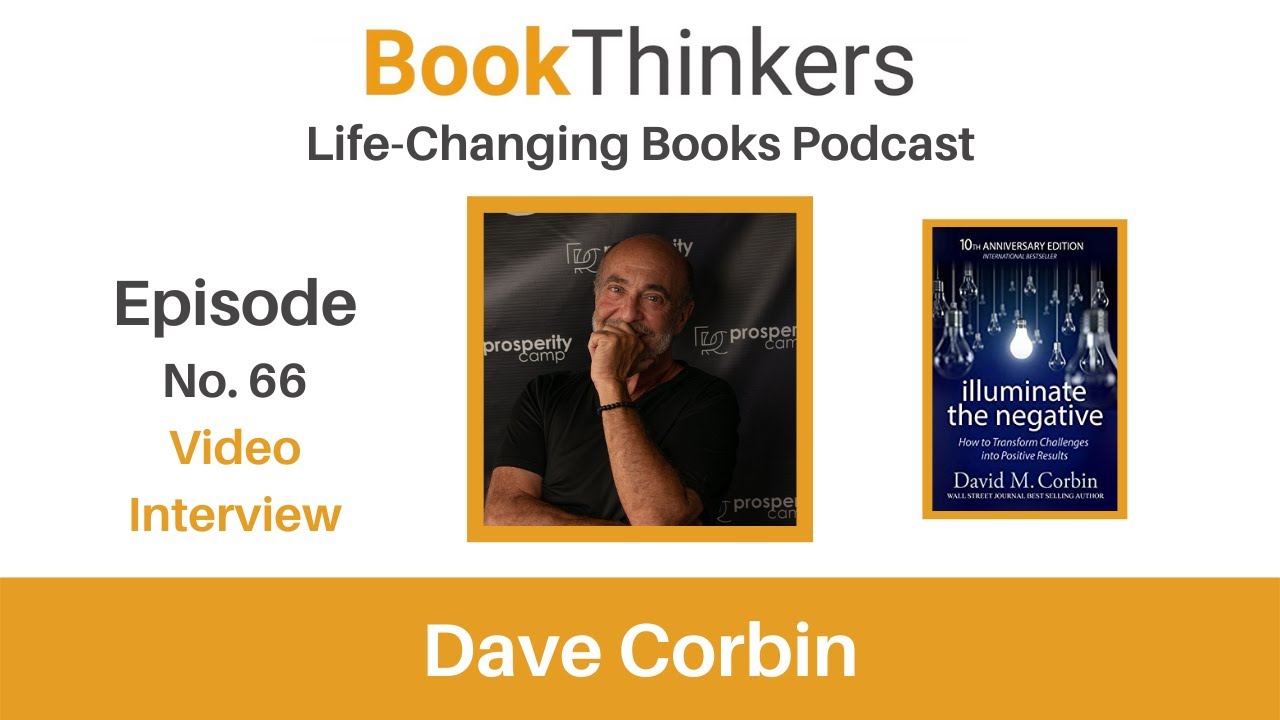
In this episode of the Life‑Changing Books Podcast, host Nick Hutchison interviews entrepreneur, consultant, and author David Corbin about his book Illuminate (10th‑anniversary edition). Corbin introduces himself through a series of colorful role‑playing anecdotes, then traces his early belief that business and money were “dirty” to a later appreciation of money’s constructive power. He explains the origin of the “Illuminate the Negative” concept, drawing on a 1980s dancing‑bear video and a James Baldwin quote, which led to his three‑step framework: Face‑It, Follow‑It, Fix‑It. The conversation critiques the over‑use of Positive Mental Attitude, illustrates the framework with metaphors such as mushrooms growing in the dark and a hub‑and‑spoke wheel for self‑assessment, and expands it to personal relationships. Corbin introduces the notion of “Brand Slaughter” versus brand integrity, describing an audit process (ABBI) and sharing examples of brand‑killing behaviors. He discusses his role as a “mentor to mentors,” his zero‑budget marketing philosophy, and his title of Chief Illumination Officer. The interview also covers his personal library, daily reading rituals, and how he leverages the law of attraction to close business gaps. Throughout, Corbin emphasizes authenticity, the joy of serving others, and practical steps listeners can take to illuminate negatives in their own lives and businesses.
Chapters
David, welcome to the Book Thinkers Life-Changing Books Podcast. How are you doing today?
I'm doing fantastic. Thank you.
I'm very excited for our conversation today. For those listening, I had the opportunity to watch David speak recently at Greg Reid's house at Prosperity Camp, and I love the energy that he brought and the wisdom that he was able to share with everybody. So I asked him to come on the podcast to talk about this book right here, Illuminate: The Negative, or Illuminate depending on what edition. And so, David, for those that aren't familiar with you, can you please introduce yourself to everybody?
Oh, I'm just the most amazing person in the world. I mean, I mean, I'm happy to introduce myself to you mortals because I get such a kick out of you. I'm, uh, I'm, I'm— I think the movie Forrest Gump was my life story. I think, uh, And I never got any commissions or royalties out of it. I'm probably not the brightest, brightest bulb on the shelf, but I'm certainly the luckiest and most, most fortunate. I've, I've been an entrepreneur. I've been a counselor, a psychotherapist, an inventor. Yes, I've written some books, but I'm not an author, and I'm not an entrepreneur, and I'm not an inventor. I am actually a spiritual being who plays those roles and enjoys the crap out of it, uh, each and every, uh, role. This week I, um, played the role of inventor. Uh, my latest invention won the International Healthcare Design for Innovation Award. Yo, mic drop. See you later. Nice to talk to you. Bye. Uh, no, and, and, um, uh, and, uh, I I actually took on a mentoring client. I haven't done mentoring in 18 months because mentoring for me is a covenant, it's not a contract. And so, I entered into a mentoring relationship with someone who spoke at the event that you and I were at last, and he's now a client of mine. And so, there's that role of mentor, there's the role of inventor, and then I have another book coming out. in 2 weeks. So there's the role of author. And I was FaceTiming with my granddaughter. There's the role of grandpa. And I woke up next to the magnificent woman in the world, my goddess, my beloved, my wife. And there's the role. So these different roles. So, yo, that's who I am.
That's who he is, everybody. And he's a rap star.
I'm a rap star. Oh yeah. Because I mentor a rap guy, who's also being mentored by Master P, they decided I needed to have a rap name. Well, everybody calls me Uncle Dave, so my rap name is Uncle D. Uncle D, and if you doubt me, you better out me.
I think this might be my favorite introduction so far, and we've done about 70 episodes. You, uh, you give off— and I, I thought this at Prosperity Camp as well— you give off, and don't take this the wrong way, like a Yoda vibe. Like you can sit up there kind of cross-legged like a spiritual teacher, and you can say things in a way that they're not normally communicated, sort of in the same way that Yoda does in the Star Wars movies and, and everything like that. And, uh, you're calming, like your voice is calming. There's a great presence about you, and you just feel— especially like me, I'm a younger entrepreneur, and I feel like a calming, mature wisdom. coming from you. So I love that introduction.
Thanks. That feels good. That's what Greg calls me.
Yoda. Maybe that's where I got it from. I picked it up subconsciously. Well, hey, listen, in the, in the preface of this book, you said something that was really interesting. This is the 10th anniversary edition, Illuminate the Negative. You said that you used to consider business a dirty word. And so I'd love to start our conversation there and have you talk about that for a minute or two.
Well, if you, if you think of how I grew up, um, like 52 years and 6 days ago, I was at a little party called Woodstock. So you think about how I grew up. The military-industrial complex was happening, and I believed had conspired and put us in a war that I didn't feel was a just war.
Right.
And so to me then, and to many of my friends, and we've all gotten over it over time, money was bad. It equaled war. It equaled military-industrial complex. It equaled napalm on innocent civilians and babies. So, so yeah, so I thought money was bad. People talked about filthy rich, and I was like, yeah, it is filthy. And I've come to terms with that, and it took a long time. I've always made— not made, but earned a lot of money. Just my soul moved me in that direction. I didn't do it sort of consciously. But now I see the value, the magnificent value of this green energy and what it does and how it does. Now, money for money's sake is silly, just silly. It's silly to hoard anything. Um, but wow, what, what I've been able to do with money, what many have been able to do with money, is a very groovy thing.
So tell me how you came about this concept of illuminating the negative. Uh, maybe it was the Bing Crosby lyrics, since you're a rap star and you're in the music game anyway. Maybe that's where it came from, but You turned it into a book. You use this parable to tell a story, to give a point, and you were playing a specific role. But where did the concept originate from? And how did it become yours?
Well, see, vibrationally, you already knew that. Because literally, I was watching a VHS tape movie with my baby girl. This was about 1980. 3 or 4, and there's the dancing bear singing, you got to accentuate the positive and eliminate the negative. And I was watching that, and then I realized, because I was a consultant then, as I am now, same company, 42 years, and I realized that my clients who were really kicking ass were those who accentuated the positive But they also had the nerve not to eliminate the negative, but to illuminate the negative and look at it and look into it. And I knew there was something there. I didn't really know what per se, but I knew there was something there and it percolated over time. And then check this out, man. Then I read this book. Let me see. I read a book. This guy was one of my mentors through books. I don't know if you could read this. But that's James Baldwin, African American poet, playwright, author. And in the last line of his movie, he said, we can't solve everything we face, but we can't solve anything unless we face it.
Wow.
Now, probably 20 years or 15 years before I wrote the book Illuminate and really got Illuminate, That was in my brain too. You see, I've got a scanner over there. You see that scanner?
I do.
The scanner is nowhere near as good as this scanner. So the movie was scanned in from The Dancing Bear. The, the movie was scanned in from, from James Baldwin, and his movie's called I'm Not Your Negro. But then years later, it made it, it marinated. And I realized you can't solve everything you face. You can't solve anything unless you face it. And then I took it forward and I said, face it, follow it, and fix it. And that's the model in which I've invented products, built businesses, always illuminating, face it, follow it, and fix it. What are you not facing? Follow it. Why aren't you facing it? Follow it to the present. What's keeping it alive? Follow it out into the future. What happens if you don't mitigate it? And that's what the Illuminate— that's, that's, that's the birth story of Illuminate.
Well, we'll go into those 3 steps in a little bit more detail in a minute. But at the end of the preface and beginning of the book, you talk about PMA, positive mental attitude, and about how sometimes You could take that too far. Sometimes you can suppress what you're really going for by just flashing that term, hey, be positive, don't talk about the negatives. So is that something that you saw through consultation? Is that something that you saw in big business or the government, or just a trend? Like, how did you start to weigh your message against that message?
Yeah, yeah, you're a smart guy because you see it. Yes. from all of the above. What I saw was people were pushing on the gas pedal, not realizing that their foot was on the brake, right? So they just push harder on the gas pedal. And so I knew that if you identify the patterns or you identify where your foot's on the brake, you're gonna go forward fast, man. I'm holding my cell phone now. If I had 2 hands, I would show you One hand pressing against the other. One hand is driving where you want to go. The other one is pushing back. And when most people will just keep pushing hard on the gas, that's okay. But what I find is if you could eliminate or remove the brake, you're going to go freaking flying.
Yeah.
And so, I looked in boardrooms that I was consulting in, et cetera, I knew I wasn't the only one spotting that elephant in the room, but nobody was addressing it. And until you do, it ain't going away. It's hungry, it's big, it can't even fit outside the door. You gotta identify it, man, and have the courage to say, um, I think there's a problem. I think I smell smoke. And most managers go, well, unless you have the solution, I don't want you to talk about that. And it's like, but I'm trying to—
You—
if you don't bring it up unless you have a solution. And it's like, well, great. I hope the freaking place burns down. I don't know where the fire is, but if that's the way you're going to treat me, boom, the roof is on fire. Let it burn, mofo. Let it burn. You know? And that sucks. And the only reason managers do that is because they don't have the resources of time or money or even know-how, nor do they have the courage, the authenticity, or the chutzpah to say, I hear you. I'll put it on the flip chart here. I'll put it on the greaseboard. And maybe together we can figure out how to do it. But they don't have that. Yeah, until da da da da illuminate where I show them they could be authentic and it's okay. It's okay to not have all the answers. That's a common thread with the most successful leaders and entrepreneurs in the world to say, "I'm not great at this. I'm a three. I need to be a six. I'm gonna close that gap." That's a champion.
Yeah, it is. I mean, to give everybody that's listening today a little bit of context, I worked for a company for a few years that at certain points in time, management suppressed intrapreneurship, entrepreneurship, right? Management suppressed the illumination of the negative. And that creates a culture where you limit growth, you limit the people that are working for your business. And you're right, like, you use that metaphor about mushrooms in the book, mushrooms grow in the dark. Cal, the mentor in the book, is talking about how these mushrooms, they grow, they thrive, they multiply, and they get out of control in the dark. And that's what happens with these problems as well.
Yeah. And then when you use— as soon as you put it in the light of day, you might remember the line he said, you know, daylight is the best disinfectant. And sometimes the negative issues that we as entrepreneurs might want to just suppress, In the, in the light, they evaporate like a vampire.
Yeah, I remember when we were in person at Prosperity Camp, you used the metaphor of, of a wheel, maybe a wheel with spokes or something like that. Um, I didn't take the best notes because I was pretty engaged, uh, with the lessons that you were teaching up on stage. But for people who are thinking, okay, I need to start illuminating the negative, where's the best place to start? If you're a business owner or if you're a family man, like, where should you start? What should you look at?
Well, yeah, those wheels are a great way to go. Not having done those wheels early on in my entrepreneurial world cost me a lot of zeros at the end of the sale price of one particular business. Yeah, so what I suggest is And go back to Woodstock again, is trip out with me here and make believe your business had a voice. And you could say, yo, business, what are the things I need to do to be effective? What are the core job functions in my business? And your business would say, if you're tripping out, your business would say, well, you need to do marketing, sales, social media, communication, finance, accounting, strategic planning. It would have all those things. It would say, you need to get to do, you know. And so I say, make a wheel with a hub and spokes and then the rubber on the outside, right? And make each one of the spokes emanating from the hub one of those Core job functions. Now you've got it written out. Then you get naked with yourself. You strip yourself of ego and all that. You're doing this alone, and you rate yourself on a scale of one to ten. One down by the hub means you suck, and then out at the end near the rubber is ten. That's mastery. Boom! So it's from cha-ching. down to suck, you know. And so you rate yourself, and, and as the song goes, where you're 7, 8, or 9, accentuate the positive. But where you're a 2, 3, or 4, don't listen to the song.
Yeah.
It says eliminate the negative, and I say no, illuminate the negative. Set a goal to go from 2 to 4 and then close the gap. And, and that's it, man. And so you illuminate the negative. So what happens to the people who are listening right here? If you're resonating with this, make a circle, make a hub, make spokes, close the door, close your eyes, talk to your business, and look at the components, and then courageously Honestly, authentically rate yourself and then commit to closing the gaps. Always celebrate and accentuate the positive. That's cool. And then look around for people, go hunting for people who can help you close the gaps because seek and ye shall find, baby. Once magic freaking happens, you can call it the law of attraction, whatever you want to call it. But surprise, surprise, in this area where you've acknowledged you want to close the gap, out of nowhere a buddy calls you from high school or college and, and, and she's like a CPA and you need to know this and you feel comfortable enough to say, help, could you, could you suggest a book? Could you spend it? You know.
I learned most efficiently in the form of metaphors. And so it's very easy for me to see how I could create the hub and spokes and rubber and fill those in. I haven't gone through this yet. But my business partner at BookThinkers and I, we're very open about shining light on, on areas of the business that I think need a little bit of improvement. And you're totally right, the law of attraction, whatever you want to call it, does seem to just fall right on your lap. And that example that you just gave has actually happened with us. We hired a friend who does our bookkeeping and accounting because we realized that we were our own CFOs and we weren't doing a very good job at it.
Yeah.
And we wanted to tighten up that area of the business. And then boom, conversation happens. Now we've had a great relationship with that person for a couple of years and really helped out our business. So I think it's very important to be doing that.
So pat yourself on the back for that, brother, because that's powerful. That's powerful. Um, had I known that— I mean, my partners and I, we invented the military suppliers guides. We got first-ever permission from the Pentagon to publish numbers. Bob, we built a company. It was enormous. It was great. But we didn't make the circles. We were really good at sales and marketing, but we We totally suck at accounting, finance, and strategic planning. I mean, we were suck 0.5. And had we just known that, we could have either learned it, hired it, or somehow developed. And we sold the business. Thank goodness. They came into the United States and they bought RCA Records, Arista Records, Doubleday Books, Bantam Books, Dell Books. They bought all those companies and they bought my company. Oh my God. Thank God. Of course, they made me stay on as president, and that was a suck and a half because I'm an entrepreneur. I'm not a big business guy. I like getting results, not having meetings. But so there's that. So you've got the Illuminate concept, and I'm hoping everybody who's listening, just for the cost of a pencil and a piece of paper, it is life-freaking-changing.
In this book, it's a parable. So it's a fictional story where you teach this lesson. Let's talk about the 3 steps steps to illuminate: face it, follow it, fix it with an example. So a lot of us are in relationships with other people that are maybe fizzling out. And oftentimes we do ignore certain parts of our relationships. And we let that negativity grow in the dark like a mushroom. So maybe we could say that you're in a romantic relationship, but you're traveling too much for work, and you're not spending enough time with your significant other. So how could we follow that 3-step framework And address the problem.
You're hitting home, baby, because I went through that. So number one, face it clearly. Write out what you're facing. I'm facing a situation where a relationship which was electric is now very—it's it's at a thud. It was a wah, and now it's a la. Okay, you face that. And you follow it. Well, where's that coming from? Well, we're really— we spend a lot of time together. We're not spending time together. Follow that. Well, why are we not spending time together? I'm building a business. I'm traveling, or I'm building a business. I'm busy. I'm on my computer all day. And at the end of the day, man, I'm a man. I ran out of words. She's a woman. She still has 20,000 left. And it ain't happening. She's like, why are you not There's a follow that you can follow that into the difference between the male energy and the female energy. There's no shortage of research on that. I recommend the work of Alison Armstrong, Alison with one L, The Queen's Code. So you follow it, follow that out into the future. Yo, well, okay, if this keeps going on, we better find ourselves a divorce attorney, or we better find a counselor or whatever. What's the fix? Well, look at the— I mean, it's, it's, um, it's so simple it's absurd. The thing is, is we don't stop to face it. The follow-up and the fix-it is, um, I'm not saying it's easy, but it ain't crazy. It's just stopping to say, what am I not facing here? And I have people set their, um, their cell phone alarms for 17 to 22 days and repeat every month. And when that alarm goes off, then what is it? Ah, boom, face it. What am I not facing? Uh, and it, it's kind of cool. So that's, that's how it applies to—
Yeah, no, I mean, it sounds so simple, but a lot of these personal development practices are, and you don't take the time to stop and refresh the fundamentals. And sometimes you make the problem, like a relationship problem, more complex than it needs to be, and you read into little intricacies that aren't there. You just need to stop and face the bigger problem. I, uh, I'll share real quick. I was reading a book earlier this year, and it's a philosopher, and he was saying, look, have the fight. He said, in an intimate relationship, one where you're facing the other person on a daily basis, over the course of 30 years you'll share 11,000 days with that person. And so if there's a small thing that bothers you, address it immediately, because otherwise it will grow. You'll sweep it under the rug, but it will grow and grow and grow 11,000 times. And eventually it'll leap out and kind of represent itself in a way that could end your relationship. And you don't want that to happen.
Well, I think it will end the relationship, or you'll stay in A painful, dysfunctional relationship built on avoidance, aversion, lies, duplicity. It's like, yeah. So yeah, good, good, good example, man.
Yeah, it's scary. It's scary how those things can kind of build up. And in a business, right, they say, uh, what, you have a 5% chance of succeeding over 5 years, and 95% of small businesses fail in the first 5 years. And I'm sure it's because people aren't illuminating the negative. But now you've got brand slaughter. That is a harsh word, huh? It kind of wakes you up and, you know, stiffens up your back a little bit. So tell us about brand slaughter.
Yeah, that's, that's, again, that's sort of illuminating the brand. And what you find is, there's some people that are walking around, literally killing the brand. And they don't know it and you don't know it. And unless you face, follow, and fix it, uh, in what we talk about in Brand Slaughter, which is an audit of brand integrity, an ABBI, unless you're illuminating the brand, illuminating the touchpoints, which is to say your receptionist or you as a marketer, you're touching different people. Could be a prospect, could be a customer, could be a vendor, could be a your partner. And then unless you're asking, well, what is my brand? What is my brand promise? How do I want to be described? What are my intended brand descriptors? And then you go like, well, am I doing that in this touchpoint? Am I building the brand, living it, which is brand integrity? Or am I killing it, which is brand slaughter in the first, second, or third degree? I've heard an owner go, yeah, I know that really sucked what she did. Um, and, but, you know, why are you talking to me about it? She's the one who did it. Because you own the company and you're going to get busted for brand slaughter in the second degree. And oh, by the way, you want to have a loving conversation with her and do, you know, a 1-minute praise, a 1-minute reprimand, and a 1-minute goal set, you know. And And also, that's what Illuminate is about. You're either building the brand or killing it. It's another story. And I was so excited that it made the Wall Street Journal bestseller list because it told me people give a hoot about this. People know the value of a brand. You know, the brand is brought to the bottom line. Never used to be brought to the bottom line as a value. It did in Europe before it did in the United States. We didn't recognize that. But now, because the brand is so valuable, it's a Fabergé egg, man. You know, it's a delicate multimillion-dollar Fabergé egg, and you're gonna hand that off to somebody and, and, and drop it. No, you gotta hand it off carefully. So that's why, um, uh, that's why that book is An Audit of Brand Integrity. It's a very simple process to do. Um, and then I created a corporate training program around that. Which I love doing.
Our audience is full of young professionals, primarily ages 18 to 35. And, and I think for young professionals this day and age, you're right, branding is more important than just about anything else, especially as you're starting off. I mean, personal branding, professional branding. So what are some of the most common mistakes that you see in small companies that maybe they, they aren't illuminating or even know that they need to illuminate?
Well, number one is they don't know really what the brand is. Yeah, well, I'm not saying you need to define a brand. A brand is not logos and, and what— yeah, I mean, that's a part of it and all. A brand is like you, you know, part of your brand is continuous and never-ending improvement through learning and reading. I think that's a fair— yeah, okay. So that's part of your brand. What would an example of brand slaughter be for you?
Yeah, any— I mean, I suppose any action that goes against progress and consistent continuous improvement. Right? Any demonstration against that would be brandslaughter.
So let me give you an example.
Hey, how you doing?
Well, what's going on? What are you up to these days? What are you reading? You're a book man. What are you reading? Well, um, I started a book, but, um, we actually found this Netflix show which is so freaking awesome. So we've been binge-watching that, um, and it's like 7 seasons. So, I, you know, I've been pretty much in that. Boom! You're a hypocrite, man. You're killing your brand by that, you know. So, my message to young entrepreneurs, and by the way, I believe that this country is sick. And I believe that the antidote to it is entrepreneurship. The entrepreneur has always built this country. So I'm serious when I talk to my fellow entrepreneurs, my fellow young entrepreneurs, because I'm only 69.
You're a young entrepreneur.
I've got another 60 years left if all things go well. I got another 60 years left. This is what I'm going to say to my entrepreneurs. Think about how you want to be described by others? Someone meets you and they yell across the fence, hey, I met this guy, you may know him, his name is Dave. Oh yeah, who is he? Oh, let me tell you, he's blank, blank, and blank. How do you want to be described? What, what is your brand promise through either whatever your deliverable is, whether it's a hard good or or an intangible service, whatever it is. And write these words down, write these words down. Progressive, caring, smart, fun, funny, complex, whatever. Write the words down over here, right? Then over here, write down the touchpoints. the, the individual you might be in touch with. Let's say customer, let's say prospect, and let's say vendor or whatever. Write those down. And you might even go deeper than that and write specific customers. And then go through an audit and go like, this value, let's say, or this brand promise of caring, and over here the prospect I was taught, did I show the caring or not? Well, actually, I was on the phone with them and I got another call from my partner and I decided, well, I'm going to take this call from my partner because I know he's on the road. That's brand slaughter. And you go down that list. There's a cool TV show they did on, on me and this concept called The List TV. And if you go to thelisttv.com, and you search Brand Slaughter, you'll see a little TV show they did on it. And it's really cool. It's done really professionally. And the guy's a comedian. So it's really pretty funny. So that's it. That's, that's part of the Illuminated Brand Training Program, which is the title of my latest book. So, you know, I only write about, talk about, and train on stuff I give a shit about. And the reason I do is because I've used it myself. I've used it with clients. I have abused it and didn't use it. I mean, this stuff works. And my fellow entrepreneurs, my brother and sister entrepreneurs, illuminate. Take inventory of your brand, manage your reputation, Do an audit of brand integrity, do the matrix, blah, blah, blah. And if you don't quite get it, read the darn books. And if you don't get it, next reach out to david@davidcorbin.com. I invite entrepreneurs liberally. I'm not going to answer you immediately because I get a lot, but I will get back with you because you as an entrepreneur are building the nation that my grandchildren are growing up in.
Wow, that's an incredibly powerful message. And I also agree, we're in a very sad spot. And we need to illuminate a lot, and entrepreneurship can help do that. And I also believe that my grandchildren will live in a country that's built and constructed by the entrepreneurs of tomorrow. So I think it's incredibly important. Mentor to mentors, that's a title that I've heard bestowed upon David Corbin. What does that mean? How do you mentor mentors?
The same way you mentor anyone else. It's just that because for years I got paid as a consultant, but I really earned my wings as an insultant so that I could be a resultant. And that's to say, I've always been about getting real. And what happens with famous people and high-profile people, no one is willing to get real with them. And I did, and I do. And as a result of that, they recommend and refer me. And so I've worked at some pretty awesome high levels. And I've mentored a lot of mentors. And so that's, that's, that's how that happens. See, the key is, and you might want to write this down because it's very complex, do good work and make sure people know that you're doing good work. And that's it. Mic drop. That's the best marketing. My marketing budget in the last 42 years of my business, Performance Technology Group, my consulting, speaking, mentoring business, has been zero. I've not spent marketing in my practice, and I've been as busy as I want to be because my marketers are my clients. People say, you know, one of Tony Robbins' platinum group, and they paid gobs of money to go in there, uh, heard about me, was introduced to me, and I took him on as a mentoring client. Well, guess who I kept getting calls from, you see? So, um, yeah, so that, that, that's, that's how that works. And I'm proud of it. And at first I was like, that's a little, uh, a little, uh, bold and audacious. And I was like, no, yo, Like you mentioned, I have wisdom. I used to go, well, yeah, I got wisdom. I got wisdom. Um, I got wisdom and I'm gonna share it liberally, um, for 2 reasons. One is I didn't have a lot of one-on-one mentors as I was growing up, neither my parents nor anyone in business until I got a little bit older. And then I realized, yo, we gotta close gaps, find people to do that. So that's number one. And number two is it feels so good. I called a buddy yesterday. I was coming back from a mentoring, uh, gig, uh, with a client, uh, who you met, but I won't mention names. And I called a buddy of mine, I go, who I gave birth to as a consultant about 25 years ago. And I said, it felt so good. I haven't done this in 18 months. I'm like, oh my God, I'm high as a kite. It feels so good to love, serve, and bless someone. That which is for you is very natural and simple because you've been through this before, to others who are like, oh my God. And to make those small changes that they'll make— I just offered up, they'll make small changes. They're gonna— this, this one dude's business is gonna go from $5 million now to $25 million in 18 to 24 months. And I bet my house on it. Because you don't see what you don't see. I mean, you can't read the label from inside the bottle, we say, right?
Yeah.
And so, that's the beauty of objectivity with a trusted, wise, loving advisor. And that's a mentor. It's not a coach. That's a mentor. And that's what I love doing.
It's a great distinction between coach and mentor. And impact is, is now one of my first and foremost core values. I need to feed that on a daily basis because just like you're saying, it makes me so happy and fulfilled when I'm able to positively impact other people.
And, uh, thank you for saying that. Thank you for saying what you just said. And I'm stepping on your tongue for a reason. And I'm going to give you props. And in giving you these props, I want everybody to listen and listen carefully. You do what you do. Most people say, why do you do what you do? Why? You know, I, I, I pay a mortgage, I got to feed family. But ultimately, it comes down to we do what we do for our own PSI, our own personal self-interest. And you impact because it lights you up. It just so happens to positively impact others. But let's get real. We do it because it feels good. I, I'm here talking with you. I'm not looking for new clients. I'm looking to love, bless, and serve You and others who are watching and following you. That's it. That's my— and you know why I do that? Because it freaking feels good. Boom.
Another mic drop. A lot of mic drops today.
Yeah, look at my mic over there. I'm gonna have to reach out for it and pick it up and boom on the— so, so thank you for acknowledging your, your personal drive.
Yeah. And I was actually, I, I kept it in the dark for a while. And now we're getting a little bit off topic of you. But I'll share a brief story. I, I swept impact under the rug for a long time, because I developed a reputation, late teens, early 20s, as somebody who had a big ego, and impact was not something that I was focused on. And so when I did find the fulfillment in impact, It felt, it felt like my own dirty little secret, kind of. It was like, okay, people don't view me this way. They're going to call BS. I'm just going to sweep it under the rug for a little while. And I was having a conversation on a podcast, funny enough, with an author who said, dude, you bleed impact. How is that not one of your core values? And I'm like, well, you know, here's the story behind that. And he said, if you don't start feeding that on a daily basis and basically illuminating it, but he didn't use that word. You're going to continue to act below your potential. And so I've been illuminating it now and it feels great. It really does.
Yeah. Good, good. That's, you know, people ask me examples of illuminate. There it is, man. I love people challenging me. Give me an example in corporate America, big America, blah, blah, blah, blah, blah. And it's all there, you know, it's I've been hired by corporations to be their chief illumination officer as a consultant. Chief illumination officer. One multi-billion dollar company, they, they thought they were in one business, they were actually in another, and they didn't know it. And yeah, yeah, so there we go. I won't tell you the company, but it rhymes with Schmammel's Pizza.
Well, uh, I'll drive around town at all the pizza shops and see if I can find one that matches up with it.
See if you can guess it.
Yeah. Well, one last thing before I let you go, David. I'd love to have you tell everybody a little bit about the library that you have created at your home, because we're all book lovers. Anybody that's listening this far in the conversation does it because we love books. And, uh, tell us about that library.
So in the house, I've got the Dawn to Dusk Lounge, uh, and it is a full wall of books. And in one of the shelves, it has bourbon and whiskey and scotch. And in the morning, I'm there reading at 4:30 AM, drinking scotch— no, I'm not. In the morning, I'm there reading. And in the evening, my wife and I will convene there at the end of the day amongst the books. And we might have a scotch or we might not, but we'll always do the top 3. What are the 3 things that lit you up during the day? And we go back and forth and it keeps us connected. That's a great gift I'm offering you. It keeps you connected on what's going on in the day. But in the back of my property, I'm in a cottage, which is a 2-bedroom cottage with a bathroom and decks. That's where my clients come in. They spend the night and then I mentor them. But then there's another building back there and it's a separate building and it's a library. library, and it is a full library, and it's got lots and lots of books. Uh, one big section, one big section of just books that my friends have written, my colleagues, my clients, and whatnot. Then I've got another section with old books. Um, uh, Carl Sandburg's book on Lincoln signed by Carl Sandburg, and, um, it's some very groovy, uh, things like that. Actually, that's on the inside of So I was never a reader growing up. I was never a reader, and I wish I had been. Well, now I am a voracious reader, and I'm loving it every morning. And yeah, that's it. I adore, adore books, and books come to me. They, they come to me. I was just at a conference and I met someone, and I met Carlos Santana's wife. So now this weekend, Anne and I are going to go to be a guest of Carlos and his wife Cindy to hear him perform and then hang out backstage and stuff like that. Right then and there, I meet in the hotel someone who told me about this guy who he was mentored by, who was FDR's speechwriter, who came up with the term New Deal, who came up with the term brain trust. So I found— the book was $900, and I waited a day, and I found a used one for $30, the only one. So books come to those who have active, embracing, hungry minds, and whose spiritual self knows that there are messages and lessons in from them, from the non-physical source energy. You get attracted to a book and boom, mic freaking drop.
I couldn't agree with you more. And I've had more books come to me at the right time out of thin air than I can— than I could ever explain in a 45-minute podcast. So, David, thank you so much for the conversation today. It was an absolute blast. I look forward to seeing you at the next Greg event, maybe in a couple of weeks here. And, uh, we'll touch base to the next event. Yes, yes, I'll be there. I'll be giving you this.
You'll be getting this, which is the COVID of my latest book, The Illuminated Brand. And, uh, it's because Brandslaughter and Illuminate got drunk one night and had a baby. I'm just saying. So come and, uh, I'll gift you this bastard— I mean, this new book.
I will have you sign it as if it was your only copy. And, uh, write a little note and I'll share it on Instagram and everything. So I'm, I'm really excited for that event. It'll be my first Secret Knock event and I can't wait for it.
You're gonna love it, baby. I was at every single one of them. The first one was just me and Greg speaking. Yep. And now we've got— I can't tell you who, but dude, yeah, just be, just be prepared. You're gonna, uh You're in for it. And before you go, I want you to think about what gaps you want to close while you're there. Never go to a conference without knowing that. And watch the magic happen, brother.
Will do. Thank you so much. And, and for people that want to find out more about you, they want to learn more about your books and your website and your consultation and the video and the TV and the movies and everything else that we didn't even touch on, Where should they go? What should they do?
Uh, well, if they have that www interweb thing with the googly thing, you know, that thing, that thing, they'll find me.
All right. Well, David, thank you so much. I hope you have an amazing day.
I'm gonna. Peace out, brother. Bye.
More from Nick

Napoleon Hill’s “Think and Grow Rich” is a timeless classic #selfhelp #personaldevelopment

4 Books to Help You Get Better at Decision Making #selfhelpbooks #bookrecs #nonfictionbooks


Have you read this book yet? 📖: The 5AM Club by Robin Sharma #selfhelpbooks #robinsharma

Dan Sullivan on Listening to Your Customers Instead of Watching Your Competitors

5 Books That Will Boost Your Financial Intelligence #financialfreedom #nonfictionbooks

The People That Preach the Loudest About Virtue are Usually the Most Power Hungry



Books are the greatest mentors you can find #selfhelpbooks #businessbooks #successmindset

Let’s fight this toxic instant gratification culture together 📖 #selfhelpbooks #jimkwik