Life-Changing Books Podcast Episode 70. Susanne Conrad: Author of Get There Now
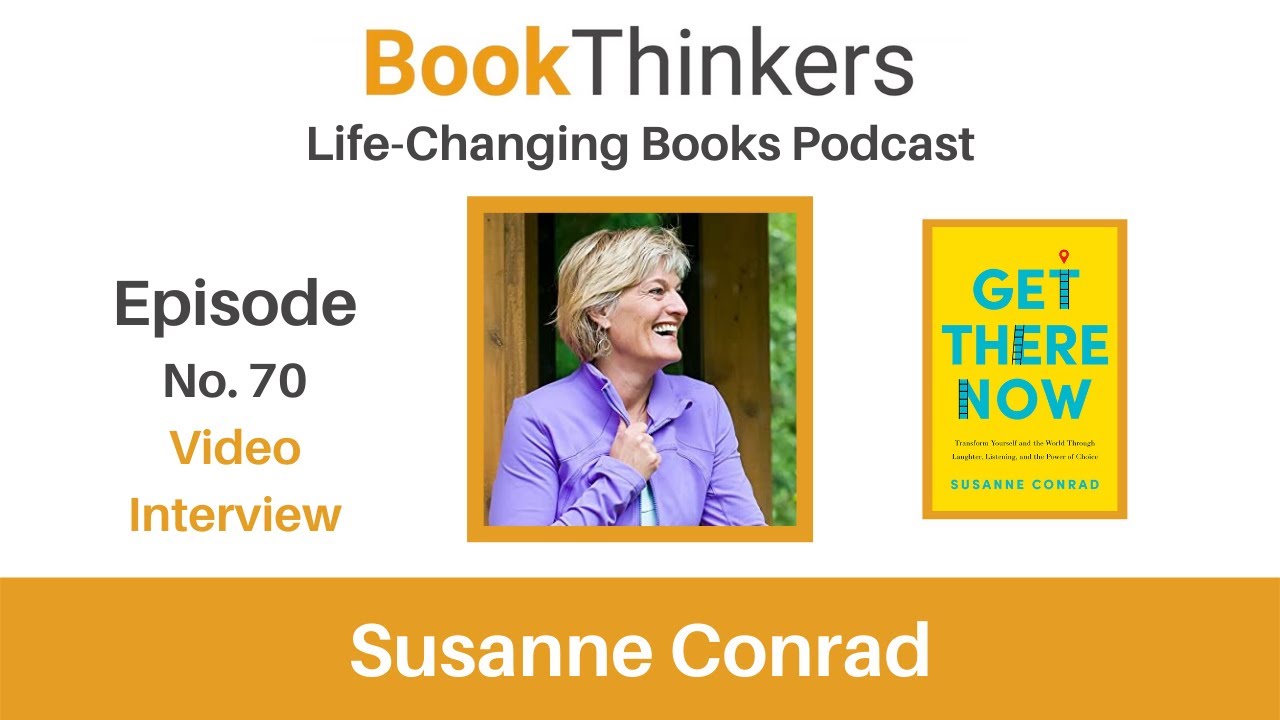
In this episode of the Life‑Changing Books Podcast, host Nick Hutchison and co‑host Luke interview Suzanne Conrad, founder of Lightyear Leadership and former Director of Possibility at Lululemon. Suzanne shares the personal journey that led her to write her memoir Get There Now—a book she describes as a vehicle for restoring personal choice by recounting messy life experiences and the lessons they yielded. She explains how she crafted the memoir without journals, relying on embodied recall, and outlines the seven “transmutations” (e.g., blame → courage) that structure the stories. The conversation delves into the core concepts of her Lightyear framework: the Circle (clarifying what you want), the Line of Choice (shifting from reaction to conscious choice), and the I‑Am/You‑Are geometry (maintaining healthy boundaries). Suzanne discusses unlearning limiting beliefs, daily morning/evening practices, and how to cultivate awareness amid modern distractions. She offers concrete advice for young professionals navigating the tension between traditional life scripts and emerging paths such as personal branding and social influence. The interview also touches on the impact of the pandemic on workplace culture, the future of Lightyear as a private, ad‑free learning community, and several vivid personal anecdotes (the ferry question about death, the garlic‑breath labor story, a song she sings to herself). The episode closes with practical calls to action: visit suzanneconrad.com, join Lightyear, and email her with feedback on the book.
Chapters
Suzanne, welcome to the Book Thinkers Life-Changing Books Podcast. How are you doing today?
Oh, awesome.
It's great to be speaking with you, Nick and Luke.
We are very excited for today's conversation. I'd love to have you introduce yourself to everybody in the audience that is not familiar with you or your business.
Okay. So my name is Suzanne Conrad. I'm the founder of Lightyear Leadership. How most people know about me is I Was formerly the Director of Possibility of Lululemon Athletica for a decade. I am a new author. So, being able to speak about my book and express myself at the age of 61 is kind of cool. So, I now say I'm an author.
Hats off to you. That is a really cool accomplishment. I'm in the process of writing my first book, and it is a very daunting project. It's far more difficult than I thought it was going to be. So, I have the ultimate and utmost respect for anybody that can complete and put out a book. And your book was fantastic. So, tell us a little bit about why you decided to write it.
Well, I had a goal. As people that know me know, I'm really big into vision and goals. And if you don't know me, that's the work that I've done in most of the companies that I've worked in. But I had a goal to write a book and have it published in 2012. And this videographer named Julian that had videoed me at a Lululemon conference. She's like, girl, you've got to write a book. Like, this is so great. I, I now know to not be so sarcastic with my dad and forgive him and see all these things. And I was like, okay, Julianne, I'm going to write this book. And I started to write a book and it wasn't my book. It just wasn't my book. And I stopped. And then I was working in Houston And I tapped into just talking to these young people that I was training that were going through our coaches training about stories in my life. And they're like, I've never heard any of these stories. Like, what is all this? And I was like, well, this is like part of my life. And so it was then that I saw people want stories that they can relate to. So that's when I decided to write this book. So instead of having one in 2012, I had it in 2021. So that's the story of that.
Better late than never, but it sounds like it came at the right time.
Well, you know, I mean, that's the thing, to have patience with oneself and to not give up on it, I think. So I'll say that to you, Nick, as you write your book, you know.
Yes. Yeah, my timeline has already passed, my initial timeline goal. So we're already working on Borrowed Time and like, it's, uh, it's quite the adventure. So, I want to read a quote that I saw right in the preface of the book that is one of my favorite quotes, and it's talking about your intention with this book. So, you say that the purpose of this book is to, quote, restore choice, the choice to discover, to love, to understand, to forgive, to liberate, to embrace our mess. And you highlight a lot of the different messy situations you've been in in life, but sort of the silver linings that you drew from them. and what we as readers can learn from those experiences. So is that now, after having put out the book, how you would still define the purpose of the book?
Yeah, I am committed that particularly your generation, I'd say, have their choice restored. So in my world, choice isn't just between this or that. It's really the whole range of all of the color hues of possibility. All too soon, you know, I'm looking at Luke. I know you have little children. Very early on, we start to tell people who they are and who they aren't from the very beginning. And oftentimes it's done with love. Yet what happens is then the person starts to believe, well, I am this, I am smart, or I am beautiful, or I am ugly, or I am fat, or I am good at math, or I am— and all of that starts to limit the range of possibility that a person has. And so I Believe that the Get There Now book is about helping people truly have choice in their life.
Have you ever read that poem? It's called Two Wolves.
Yes.
So I actually have a tattoo on my forearm. It's probably kind of hard to see here, but it's of the two wolves, and it reminds me that I always have a choice. I have a choice to feed sort of the darker side that leans into you know, maybe some insecurities or whatever the case is, or I can feed the positive side, the one that does have a choice, the one that, you know, is hopeful for the future and has faith that things are going to work out. And so that is what that quote sort of reminded me of, and so much so that I actually do have that tattoo, funny enough.
That is awesome. That is awesome. I mean, what a way to remember what your commitment is to yourself. That is awesome.
Yeah, and I know that Luke has a question about storytelling or a comment about storytelling.
Oh yeah, bring it.
I love, I love— you already talked about, um, telling people stories, and I tell you what, your book was so much fun to read. It really was. It just like took me on this fun journey, and I wasn't expecting that at all. Like, the book was not at all what my expectations were, and I opened it up and I was just— I enjoyed every single page. You are such a great storyteller, and I was just curious, did you do this all from memory, or did you keep a journal and diary over the years, or has this just been something that, hey, you sat down, you just kind of recalled these events, and that's how they happened?
Okay, well, 2 things to say. Thanks. Well, first, at some point you're gonna have to tell me what your expectation was. That'll be fun. But so the 2 things, one that was this, I did really go to Wellspring Spa, and I really did see the 7, let's say, transmutations that I wanted to tell stories about. So like from blame to courage or whatever it was. So I had this map in my mind, Luke, because I knew I'm not Michelle Obama. Nobody's going to read my memoir.
That's not—
It needs to, you know, needs to be stories that make a difference. not just like some part of my ego. And then the second part of it was actually really daunting. And I am glad you're asking, because what I did is I didn't have journals or any of those things. I did, but I didn't use them. I sat myself down and I went right to the moment. And I allowed myself to see and to feel and to taste And to sense, and then I did my best to write from that place. And even as I talk about this to you and close my eyes, there's a way where I would get so moved by my own life or my own pain or pleasure. Like, it was a job, all to say.
Yeah, I can imagine. I mean, reading it, you even took me just through some of the pain I felt. I was laughing. I, I'm not gonna lie, I cried a few times. And it was just— I really felt like I saw myself in a lot of your stories, which was really, really cool. So I just think you did such an incredible job at writing this story, and I can't wait to give out copies to other people. And I'm excited just to see where our relationship will go in the future, because I don't think this is the end of it for sure. So thank you for writing it. Yay!
How exciting to get to touch somebody who's a young father. What a special thing.
It's very special to me, so thank you.
Yeah, yeah. I'd say, you know, becoming a mother young really did shape a lot of the kinds of intelligent empathy that I developed over my life. So I'm really grateful to my children and grateful to the two of you.
Thank you.
Well, telling, sort of teaching nonfiction, traditional nonfiction advice through memoir-type storytelling, I think is becoming more and more of my favorite genre. I love traditional business memoirs, but I'm starting to love these crazy stories, reading about what people experienced and how they were able to take something and draw something from that and implement it into their lives. So like Luke said, I really found your storytelling to be immersive. And you just talked about how you could recall those things by closing your eyes and being present in that moment. In chapter 1, you actually talk about how the safest place we can be is within our bodies, present and responsive. We have so many external distractions in 2021, moving on into 2022, so many screens in front of us. So How do we cultivate more awareness? How do we take a step back? I know it's something that you love to teach.
I, I have a practice. I encourage all people to develop some type of a morning practice and an evening practice. But so in the morning, I do sit quietly and I write advice to myself. from, let's call it, my higher self. So I do that every day. And so that's pretty interesting. I feel that one of the things that's important for people to do, it's been important for me, is really get there now. The emotional release that I was working to cultivate for the reader is one where they could, release from the downward spiral of self-brutality? By telling all the stories of where I did that. So where that happens, though, is in our body and in our mind, our heart. And so we're really the only ones that can cure it. Nobody else can. So to take our life in our own hands and find— and to fall in love with whatever is completely deeply peculiar or idiosyncratic is I feel a big part of being a human being.
When in your journey do you think you first became aware of your prior lack of awareness, if that makes sense? Like, when did, when did you become awake? You know, because that, that happens to all of us, right? Like, we all sort of operate— let me rephrase.
Great, I love it.
We all sort of operate in a place of just like the day-to-day, right? Like the rhythm of life. The whirlwind is what a lot of people call it. And then we all get slapped in the face one day and we say like, hey, there's more to life. Like, I can actually think about my own thoughts and I can work on myself. So when did that happen for you? Because a lot of these moments have such of like— they have this like meta lesson or the advice to advice thing that you were talking about before. Like, when did that start happening for you?
Okay, when did I become aware that I wasn't aware? I mean, you know, Okay, I'm going to do my best to answer this in a really true, in-this-moment way. So I feel— of course it's still happening, right? But I remember one day on the ferry, driving, you know, we would drive the car onto the ferry. And as, as the reader finds out, you know, we live on this island, and my parents have us go to a Presbyterian school, a private Presbyterian school, because they didn't want us to go to the rural schools that were there. And of course, my mom was sort of raising us Catholic. So there was this very unclear spiritual, non-spiritual dimension. And of course, my dad was an entrepreneur and a scientist. And, and I remember being about 6 and asking him, you know, where do we go when we die? And he said, you know, you go in the ground and rot. And that was the end of the conversation. And I remember thinking, that's not all there is. So I was aware that I wasn't aware of something. So I have early memories of that. But mostly what I feel like the book is about in a way, so let's explore this together, is like— Being a child, I had the experience of being connected, and then there was this jading thing that happened, like how to be in the world, how to be a, a girl in the world, how to be a woman in the world, how to be smart, how to make it, how to toughen up. So I feel like my journey has been like, uh, Oh, I don't know. You know, softening it somehow. And having that be a valid way to contribute in the business world. So I'd say more in my mid-30s, Nick, I became aware that I wasn't aware. Like when I met my teacher Dorothy, when I began the process of no longer being my father's son, I feel like that's more the real— Waypoint would be right around there, early 30s.
Yeah, it's so— it's— I mean, you mentioned something that I've thought a lot about, which is that we have this childhood innocence about us that's so pure and honest and transparent. And then something happens where that gets taken away from us in our late teens, throughout our 20s, whatever the case may be for most people. And then it sort of returns. And so you talked about that moment with your teacher and kind of becoming aware again. Luke and I have had some conversations about this in the past.
I'd really like to know, I don't know if this is the best follow-up question for this spot, but I'll ask it anyway because I'm thinking it. You talk about your— in your book, you talk about unlearning a lot of those fears and things that we have from our childhood. And I think you state also that it could be more important than the things that we learn. What is, what is the process of learning, unlearning? And like, how, how do we begin that? How do we start that? And how can we integrate that just into our daily lives to be better, better people?
Okay.
Wow.
Super. Okay. Well, the first thing is to be aware that there might be something to unlearn. So that was my first awareness. I only— now you all are getting a great head start— I only had a value for what I had learned. I was the sum total of what my knowledge base was and my experience, and that was what I saw my identity as. I didn't have, you know, the— some people contest the source of this quote, so I don't know exactly what it is, but I've been told Albert Einstein said, you know, the intuitive mind is a sacred gift and the rational mind is the faithful servant. Unfortunately, we have created a society that only honors the rational servant and has forgotten this intuitive gift. And so for me, the unlearning is more about accessing my intuition. So some of the ways— so the first thing, as I said, is to be aware that we can. And then the second way is really to know that we have a choice. And that most of the time that choice is going to come from forgiving something or someone or someplace, and then finding love. So that triangle of love, forgiveness, and choice that we begin with in chapter 1. is a big part of the unlearning process. So let me give you an example. Let me give you a real example that's fresh. In Lightyear, we talk about having fresh bagels instead of stale things. So I just came back. Yeah, fresh bagels. Here's some fresh bagels for Luke.
Great.
So I just came back from a 10-day work trip in British Columbia. just last night. And there's a, there's a pattern that I've learned to protect myself where when I'm away from my husband for a long time, when I come back, I'm sort of snarky and mean. Like I want him to kind of fight to get me back or something. Like I wasn't born with that pattern. I wasn't born— I learned it somewhere. I learned it like a little baby bird watching, you know, whether it was my mother or other people, or movies. And so that's something that I'm choosing to unlearn, because it doesn't really serve me. You know, so I love that. Yeah.
Yeah, I love that. It kind of leads into another question I had, which was about choosing choice. You tell us a story about your ex-husband, Sunji, I believe, or is it Sanji? Sunji?
Yeah, Sunji.
Okay. All right. And not speaking up when you should have, and this was like a really pivotal moment in your life. When you speak of this, you talk about the line of choices. Could you explain what that means and how we maybe can't— how we don't lose the line of choice or how we get that back? How we find that?
Mm-hmm. So in that, in that scenario, um, I'm, I'm meeting this new person and I'm very interested in him and he's very interesting. And yet there's a, like, a moment, a flash where he touches me, where my body quickens and I know, uh-uh. And so back to what you asked me earlier about unlearning, at that point in my life, All I had learned was to override body sensations, muscle through it, overthink it, go to the next thing, disregard it. And so in, in the body of work that we call Lightyear Leadership that the coaches I develop train, there's really 3 primary geometries of which the line of choice is one. And so So, I practice it all day long. It's where I'm either in reaction or in choice. And when I'm in reaction, I could also be in worry, fear, doubt, unforgiveness. I can't, I won't.
Hmm.
And there's body sensations connected with that. In that moment, in that chapter, I wasn't aware that I had a choice. I wasn't aware of this idea. I didn't know how to choose choice. And you can see, you know, the train track took me to a, you know, it took me to a whole nother place.
As it often does. Yeah.
As it often does. And let me, I want to just put the record straight for all of life and for your all's generation. I find a lot of self-development, so-called leaders and people on Instagram saying things like, embrace your embrace your mess. At Lightyear, we say embrace your mess and deal with it. Embrace your mess and clean it up. Embrace your mess and learn. Stitch up the hole in your pocket. Make a difference. Communicate. You know? And so the reason I say that is there's a lackadaisicalness about going with the flow. I was mute. I muted myself in that moment with this learned behavior. And there's a lot of people that would say, oh, but Suzanne, look at how much you learned from that. You know what? I also know now how to go back to that moment, make another choice, see what I could have done to have had a different education to have not become impoverished, to earn my PhD in the spirit. And, you know, no one made me the Director of Possibility of Lululemon. I did. I spoke up and said, that's who I am. I was never an employee. I sold my intellectual property to the company. I co-created. So, it was in going back to that moment and reclaiming what I lost because of my errors I then received the benefit of cleaning up the mess. Does this all make sense?
Oh yeah.
This isn't really in the book. It's for you all to figure out.
No, thank you so much. I love it. It makes perfect sense for sure. Nick, I'll pass the mic back over to you.
Yeah, no, I'm always excited when we end up having conversations like this because, Suzanne, I could see how passionate you are about kind of setting that narrative straight. and saying that it was you, that the standard social narrative sometimes is clean the mess, but that there's more to it than that.
Yeah.
And you need to step in, sort of assert yourself, and fix the problem. So, that actually does lead into one of the questions that I had, which stems from chapter 8, where you talk about the parallel between the old get an education, get married, have children narrative, and the new narrative, which a lot of people aren't aware of, which is like be independent, grow a social following, write a book, And that side of the narrative. So what advice would you give to a young professional who's confused about their path? There's a lot of pressure to become a social media influencer nowadays. Okay.
Let me just take a moment and really listen in. So what I'm doing right now is something I'll call— what I'm doing now is something I call going to my office. So I'm just going to listen. a moment. Okay. So Nick and Luke, when you go on a trip, do you, do you generally take a suitcase?
Yes.
Yeah.
Yeah. So each of us comes here provisioned. And the provision is within us. So my advice to a young person is to begin with— I offer you the idea that you have what you need within you. Now, that doesn't mean you just sit and meditate on your navel on some rock somewhere and your life's going to work out. It means that you're going to get a combination of your rational mind, your We call this in Lightyear your strategic instinct. So, you are going to have your rational mind and you are going to have your intuitive mind, and they are going to be working together in this collaboration. And so, let's take the time to talk about the 3 geometries of Lightyear, because this will really help that young professional, and then we will go talk about social media. So, there is the circle, which is the power of knowing what you want. And the first thing that I do, whether it is working with a company or an individual, is Write everything that you want in your life on the inside of the circle and everything you don't want on the outside of the circle. The circle is the Earth's traditions, wisdom traditions, most sacred geometry. It's going to protect things. And then just like you said with your wolf, Nick, you keep your eye on that wolf. You keep your eye on the inside of the circle, right? And focus there. Then there's the line of choice. So noticing how often can I move from reaction to choice? What do I need to do that? And it's just like being an athlete. We're all here to be spiritual athletes. It's the speed it takes for me to notice I got reactivated, and then the speed to recovery is what's important, just like our heart rate recovering to our resting heart rate. And then the third geometry is really I am and you are. So this is now to the social media. So people that are listening to this podcast instead of watching the video, I have my hand on my chest for I am, and then I'm placing my hand facing outward, my palm facing outward to you are. So having this healthy boundary where I know who I am what I want, what my choices are. Because what I see right now is that young people are losing their authentic voice in the no-win race to be liked.
Yeah.
Literally.
It's very true.
Literally to be liked, you know. And I'm not quite sure what the future of Lightyear will be. I've written a vision for it. And it's part of why I've created a collaborative social learning platform that's private, that's ad-free. I believe that, you know, what we're not telling the truth about every day is that there is no free. Free is not free.
Never.
Every day we're trading our data and our eyeballs. It's just like those old sci-fi. And, and if people want to remain human, we're going to need to learn faster than that which is gathering our data. And I don't have any fear about— I don't actually call it artificial intelligence. I call it machine intelligence. I love all my machines. Okay, this is my iPhone. I love my iPhone. This is my computer. I love it. It does not define me. That's the thing. I am, and you are. I am Suzanne, and you are my Instagram account.
Right?
It's an important separation.
It's not, I am Suzanne and you're her Instagram account, you know, with my hand over my face. So that's what I would say, you know, and, and to make it a daily practice, you know, it's the best, it's the best game playing on earth is to discover who you are.
Yeah, one of the, one of the toughest things about being a content creator today, and I'm a content creator, Book Thinkers is a content machine, is having to rely on other social platforms, especially social platforms where value is not determined by you, but it's determined by the platform. Does it get enough engagement? If so, we'll push it to more people. If not, we're going to take it away. And so I'd like to have you tell everybody a little bit more about Lightyear. I don't think that we've properly defined Lightyear, and we've referenced it quite a few times. So tell us a little bit about your leadership program and everything else that you're working on?
Lightyear.co is a platform for people—
And we'll link that down below.
Yeah. Okay. Yeah, we'll link that down below. So it's similar. So LinkedIn, for instance, is a platform where you can say all the things you've been and meet people. And so Lightyear is a platform where you let people know who you're becoming. So you write your vision, you write your health and career and personal goals and other practices that you have. And then we have all kinds of workshops that are available all the time for members. It's only $15 a month. We also have lots of free events so people can experience. But what Lightyear is, is it's a place for people to do that kind of work together. Now, what I also would say it is, it's good practice for me. What is it? Oh my God. I, I've developed 5 complete years of curriculum that people who become Lightyear Coaches can study. Each of them deals with another level of responsibility, beginning with yourself, with society, then with corporate responsibility, then with the environment, because I have an environmental background, and then with our energy. So, Dr. Jill Bolte Taylor, the author of My Stroke of Insight, says that, you know, we are responsible for the energy that we bring into a space. And we now know that that space is also the digital space. So I could say more about that. But that's what, that's what I want to say about Lightyear. It's amazing. It's an amazing— not because I'm amazing, because it's I am Suzanne, you are Lightyear. It's the people there, how they support each other. You know, what they talk about is different than what they talk about on Instagram.
That's a very, it's a very interesting way to describe it. Like LinkedIn is who you were professionally, and Lightyear is who you are becoming. So are there any prerequisites for people before they get onto the platform? Do you have to have a vision drawn out and core values already constructed? Or can you kind of, you know, be brand new to this space and find value there?
Yeah, anybody can begin and just start where they are. And the way that it's structured now, and it might change and be dynamic, is that when you start your membership, you have the first 30 days are complimentary, and we offer you a course called Power My Future where you can author your vision and goals. And people can also begin by joining our virtual book club. So if they want to read the book, then we have little mini podcasts embedded in the course and questions. And it's a whole collaboration between the community. And then people could also just be members and come to Light Hours. So every Monday at 10 AM Pacific Standard Time, I or one of my Lightyear coaches leads an hour of developmental conversation. And those are always recorded and sent out to members. So Then there's just lots of things. It's super fun.
Well, like I said, I'll put a link down below for everybody to check out. And I know that Luke and I are going to get more involved as time progresses. But before we end the podcast, I want to go back to a quote in the beginning of the book, read that to you, get your reaction, and then pass the baton back over to Luke for a couple more questions. So I'm going to read this off my screen so I don't get it wrong. I'd like to get your reaction here. Every day, oh, every way, I feel I'm growing. Day by day, every day in every way, I feel I'm growing. Tell us about that because that put a smile on my face when I read it.
Oh, why didn't you listen to the audiobook? Okay, so I'm however old I am.
I'm excited. Now you have to tell us what's in the audiobook.
Riding my bike. I have this big-ass, you know, those things that newspaper boys carry and girls carry their papers in. I've got all my laundry, so I'm kind of riding my bike like this. And this is just a rhyme that I made up for myself. And it goes like this. It goes, every day, oh, every way, I feel I'm growing day by day. Every way and every day, I feel I'm growing. And I would sing this to myself.
Ooh.
Because like my life, if people saw my life, they'd go, oh my God, that girl's life is so hard. I had no money. You know, my husband was gone, and when he was around, he was abusive on every dimension. And something within me just knew to sing and lift me to the next thing. And that's the suitcase I packed. See, that's what y'all have.
We've never had anybody sing on the podcast before, so I love this moment. This will go down in history.
Also very, very beautiful. Um, I do have one more question. It was kind of— you may have just answered it, actually. I really just wanted to ask, like, why didn't you give up? Like, there were so many moments in your story that you talked about all these different struggles. Like, what kept you going? Was it just that song or a little bit more than that?
Well, I did give up, you know. I did give up for, like, however many minutes. See, we're all gonna give up for, you know, pick any given day. You know, but one of the things that I feel like I do now is I set a timer like, okay, Suzanne, indulge yourself for 10 minutes and then come back. But then I'd say, you know, by the time I meet Melba and she's in chapter 10, And I have somebody see me different than how I see myself. I, I began to realize I had a purpose that was worth discovering, that was bigger than my, you know, buy the Top Ramen, get the laundry done, figure out how to pay for tuition. Flip the credit cards life. Yeah.
It's incredible. Well, I know you're a little bit pressed for time, so I won't, I won't ask any more follow-up questions on that. But I'll pass it on to Nick. I know he wants to get, get things wrapped up.
Yeah, there's one more subject that, that I really wanted to talk about, which is, you know, if anybody saw my book review, I would encourage you to go to go check it out. I'll put a link down below as well. But I said that my biggest lesson was never eat garlic before you attend to a laboring woman, which highlights the humor in the stories. I think that they help balance out the depth in which you write. But at the tail end, maybe you should tell that story and then I'll kind of bring it home with the point that I want to make. So, can you tell everybody a little bit about that story?
Well, the story is, you know, I've made the choice, the decision to deliver my first son at home. You know, I've cleared the inherited legacy of, you know, my mom's fear, and she's like, oh my God, you're giving birth at home. So I'm, you know, just at the part where it's starting to get really super intense, and the woman who's attending me has eaten garlic, and just, it's really, if you've ever been around somebody who's laboring, they're super sensitive to smell. So that's the situation that I'm in. And Yeah, I could say one more thing about it. And then you can ask me whatever you want.
Yeah, go ahead.
So one of the metaphors for it really is there was a way where she wasn't responsible for her energy. She wasn't responsible for the breath. See, and that's the thing that we're always helping people do in Lightyear is right here in this moment, the energy that I'm expressing to you makes a difference in your day. It makes a difference in my day. And, you know, I forgive her. She didn't know about the garlic. But it's just a funny example of people are unaware of their impact on others. And, and that's part of why I wrote the story the way that I did in that chapter.
Yeah, that's really interesting. I think that I read it through a different lens, which does happen, obviously, when people write books. I— my biggest takeaway from that was sort of how you tie off the chapter and you say, you know what's worse, than garlic breath is not having breath at all. And so, as long as you still have breath, you still have choice. You still have the ability to make— the whole book is about restoring choice, but you still have the choice to do whatever you want in life and to leave whatever sort of choice-based legacy you want to. But that story, I think, will stick with me just as it's always— there's always sort of a silver lining in each one of these stories. But Going back to the point that you just made, I also think that's really interesting. A lot of us don't realize the impact that we're having on other people. Could you expand on that for a minute? I mean, are there awareness-type lessons that you teach other people to become more aware of how they're impacting others, or—
Yeah. When people go through our foundational course, which I highly encourage people to do, it's called Personal Legacy. I talk about it towards the end of the book. They do a series of what we call the Lightyear Interviews, where they interview 5 people that they love and trust, and they ask them 8 questions so that they can learn about the atmosphere that they provide. Because here's the truth about all of us, we don't know what we provide because we're not there to know what's missing because we're not there. So like, when your kids get older, look, you can interview them. And you can certainly interview your wife, because you don't know what it's like when you're not around, because you're not there to notice. You need to find that out from other people. So Lightyear helps us really understand that atmosphere that we provide, because we're all— we're always in it. And knowing what it is makes a big difference. Yeah.
I'm interested to go through that now. And I definitely will. And I'll report back to everybody. So I know that I said that that was the last question, but very, very last question. Things really got switched up because of the pandemic. I think work culture has changed a lot. And so we were talking before we started about your time at Lululemon and your work on culture and sort of how you see things moving forward. So let's have a little conversation about that. I know you've been thinking about it for the past 10 days.
Yeah, yeah, while I was up working. So I've had— I've earned, I'll say, the privilege to have lived pre-COVID a COVID-type life. What I mean by that is I've been able to work from home. I've been able to be nomadic and travel well before the pandemic. I built my own private platform that embeds Zoom recordings. So this world that you all are living in now isn't new to me. I've been living in it and it's been part of why, you know, Lightyear, when you think about light, it's both a particle and a wave. So I'm a physical being here in Ivins, Utah, and I'm also the light wave that's transmitting through a digital space. And I'm probably best in the world at teaching people about that. So I feel that now that people have been in those new choices of like, oh my gosh, I'm happy I get to wake up and be with my kids and eat lunch with them. And oh yeah, I do need to go to the library to have space from them. Now that they're learning about the expanded choice of remote working, I believe that the things that we did at Lululemon and other companies where I've worked, at Earl's Restaurants, the Dr. Peter Center, all these different places where we've initiated Lightyear Work, people aren't going to be satisfied with the shallow level. of personal development that they've been scrimped out. They're going to want something deeper. And from the very beginning, my work has been practical spirituality. I don't have the time to go like, you know, maybe I'll get to go do a sabbatical in Bhutan. But my life has been such, getting pregnant at 20, that I've needed to deliver. So I believe that as we move into whatever's next, that we really look at it not as the great resignation, that we look at it as the great regeneration of choice.
Hmm.
And that companies invest in those individuals So that, you know, people always talk about, oh, I want to unpack that trauma. Jesus Christ, unpack that suitcase you brought with you. Unpack your purpose. And when an individual does that the way that they did over years at Lululemon, the organization benefits instead of the other way around, where I still see companies saying, okay, this is my KPI and I need to reach this KPI. That's not the future. The future moves at light speed. And it moves with the individual person discovering— pardon me, let me see if I can say it straight. It moves at the speed of light. It moves at light speed. And it moves from a person discovering themselves. Yeah, that's what I see.
I'm happy that I asked that question. It gives me new perspective too. Well, I think that— I mean, we touched on a bunch of different subjects. But I think we gave a listener a good preview for the types of things that they can learn from you in this book and from Lightyear. So I'm happy that we were able to cover a bunch of different things. Do you have any last words before I wrap things up, Suzanne? Anything else that you want to mention that we didn't talk about today?
Well, I want to just really thank, thank the two of you for jumping into your work and recognizing that there is a business that you can operate that supports people that have worked hard to create life-changing books. And I want to thank the people listening to the podcast for listening all the way to the end. I want them to know that they matter. And if you do read the book, write to me. My email is susanne@lightyear.co. And let me know what you think. If you loved it, write a review. If you hated it, text me or email me first. And we can talk about it. Um, that's really what I'd want to know is to thank people. Uh, and, you know, please thank your teachers, the great teachers in life. And I'm grateful to have had one. And it's my honor to be able to be one. So thanks, guys.
And for people that want to learn a little bit more about you or the book, where should they go? Should they email you? Do you have a website that everybody can go to?
Yeah, we have suzanneconrad.com, and then lightyear.co is the actual platform where you can become a member and meet lots and lots of other people that do this work. And you can look through other people's vision and goals and get ideas about what, um, what you'd want. Because sometimes it's inspiring to see what other people's futures are, to see, oh, okay, no, I want to take my kids to 6 different continents over the next 10 years. And, and then you start to see, okay, where do I want to go and why? And what kind of eco-retreat do I want to contribute in? It's, it's super inspiring. We have everything from restorative and regenerative farmers to people in tech to people in education and healthcare. So that's where they'd go, suzanneconrad.com and lightyear.co.
And if you want to check out my profile or Luke's profile by the time this podcast is out, you can come hang out with us and see what our goals are as well. So Suzanne, thank you so much for, uh, for coming on today's show, and I can't wait to see what people think and if people email you. And, uh, yeah, it was a really fun conversation.
Thank you so much.
Have a really super week. Yeah, thank you, Luke. Every day, every way. All right, peace out, guys.
All right, bye.
Bye-bye.
More from Nick

Napoleon Hill’s “Think and Grow Rich” is a timeless classic #selfhelp #personaldevelopment

4 Books to Help You Get Better at Decision Making #selfhelpbooks #bookrecs #nonfictionbooks


Have you read this book yet? 📖: The 5AM Club by Robin Sharma #selfhelpbooks #robinsharma

Dan Sullivan on Listening to Your Customers Instead of Watching Your Competitors

5 Books That Will Boost Your Financial Intelligence #financialfreedom #nonfictionbooks

The People That Preach the Loudest About Virtue are Usually the Most Power Hungry



Books are the greatest mentors you can find #selfhelpbooks #businessbooks #successmindset

Let’s fight this toxic instant gratification culture together 📖 #selfhelpbooks #jimkwik