Life-Changing Books Podcast Episode 74. Philip Gabbard: Author of Thrivation
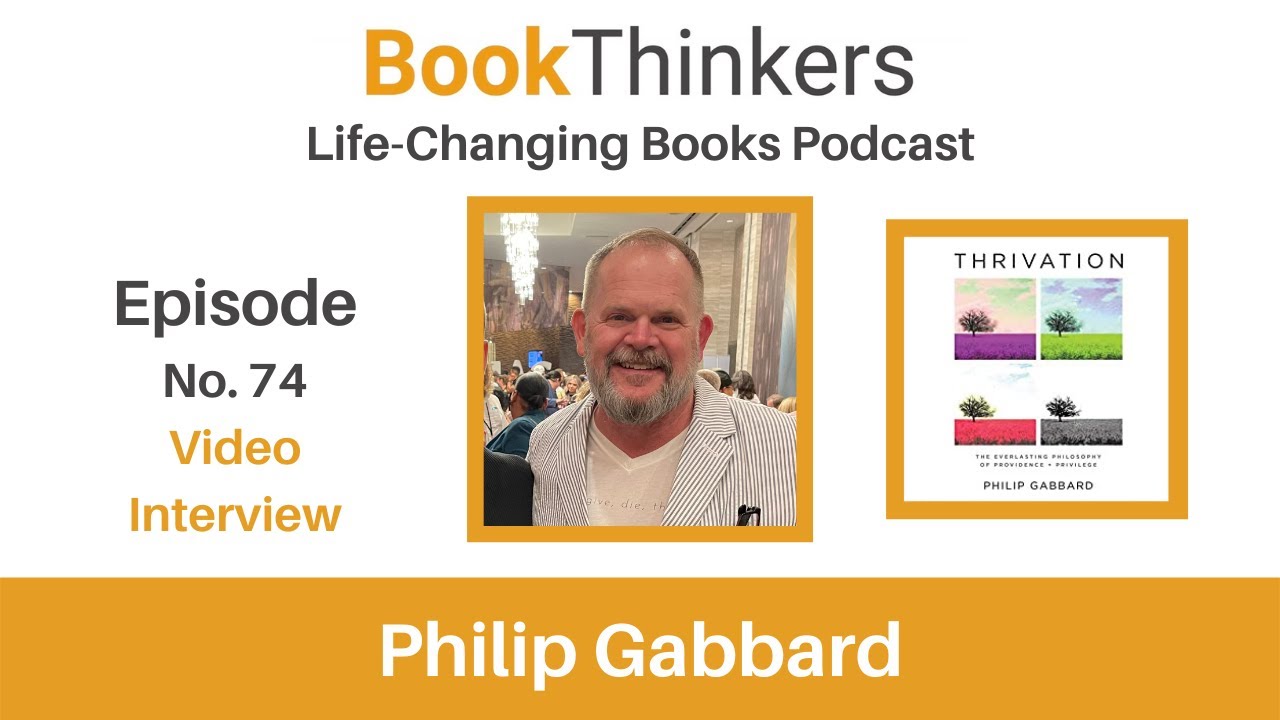
In this episode of the Life‑Changing Books Podcast, host Nick Hutchison interviews author and marketer Philip Gabbard. Gabbard introduces himself as an "everyman" who writes from a place of love and vulnerability. He discusses his three published works – This Day (a non‑conformist self‑help book presented as a square with a playlist instead of a table of contents), Thrivation (which uses parables such as the Hot‑Dog‑Man to explore what it means to thrive), and a forthcoming third book, Thyself. The conversation covers his writing process, the importance of authenticity versus conformity, his use of flow‑of‑consciousness style, and the challenges of marketing a book that defies genre conventions. Gabbard also shares a profound near‑death/zero‑point experience in which he was taken to a realm he describes as "heaven," meeting his deceased brother and receiving what he calls absolute truth about love, energy, and the nature of existence. He explains how this experience reshaped his perspective on death, spirituality, and the purpose of his upcoming book, which he frames as a guide to aligning with love and the self. Throughout, the interview weaves personal anecdotes, philosophical references (e.g., Nietzsche’s amor fati, Marcus Aurelius, biblical concepts), and practical advice for writers, emphasizing the value of staying in the creative fight and trusting the muse.
Chapters
Mr. Philip Gabbard, welcome to the Book Thinkers Life-Changing Books Podcast. How are we doing today?
I'm great, Nick. Thanks. Thanks for having me. I'm really honored to be here.
This conversation is long overdue. We met, uh, in the beginning of— no, sorry, the end of 2019 when I first reviewed your first book, This Day, and our relationship has continued. We've had the opportunity to hang out in person, but for For those that are not as familiar as I am with you, could you please introduce yourself to everybody?
I guess I'm— how can I say it? I'm nobody and I'm everybody. I'm just like you. I think we're all the same. I'm a— I think by profession, I'm a marketer. By passion, I'm a writer. By God, I'm You know, in my experiences that I've been given, I honestly think I'm chosen. I honestly believe I have a mission or a mandate, and my journey is just unfolding. So I'm a bunch of things, Nick. I am honored to have a chance to talk and to share and to enlighten and and to learn from, from others and through my experiences of writing. But outside of being a dad and a, you know, probably a pretty decent human, um, you know, I'm, I'm openly receiving new ideas and new ways to communicate and advance a conversation with something that I care about, which is love, um, humanity. And Um, yeah, well, one of my favorite— Individual, just like anyone, you know.
Yeah, well, one of my favorite things about you and, and me is that we are both students and teachers at the same time. You're a writer, but you're willing to learn from anybody. You're the everyman. So what does the everyman persona mean to you? Why, why are you unique? Because you're just like everybody else. I mean, it's It's a little bit of a funny question, but so many people are trying to be something else and you're just you. And you seem very comfortable in that.
I am. I've been comfortable being alone without being lonely. I think an everyman idea, which is not— this is not something— these are new revelations for me, Nick. But the everyman idea is, is to really become in touch with the fact that we all go through the same experiences. We all have endeavored and endured the same fears and anxieties and, you know, good things and bad things, and, and we can relate. It's— there seems to be a disconnect at times with, with some of us that we go down these paths that we have an inauthentic self. And in those situations, I think we disconnect from who we truly are. And, you know, this everyman idea was shared with me from my first editor, and I didn't really know what it meant either. But the more I leaned into it and the more I took it on and studied it, I went, you know, I'm proud to have that kind of character definement in my life. It's, it's, it's humbling and it's honoring.
Have you always felt that way?
I think with a realization, yeah. Um, you know, I was, um, I would probably define myself as more introverted, and if I were to say that to another person, they're like, are you kidding me? Yeah, you know, you're very extroverted. And at the same time, I've, I've always felt I've been thoughtful thinker, um, careful not by fear, but careful as because I care for some strange reason. If it's an empath, you know, element of my persona, um, I give a shit about People.
There's actually a quote from This Day that I think relates to this subject a lot. I'm going to read it. It'll take a minute, but it'll give everybody a preview to, to your styles of writing, and then we'll get back into the books later. But it says, okay, quote, why is it that as kids we live our youth unabridged and full of self-expression, then at some unknown yet definitive point we transfer our outward selves to an inward self Full of known limitations. Tell me, is it an act of a conversation that closes the door on possibility and ends our youth? And what's interesting about that is you've seemed, at least from an outside perspective, it seems like you've kept that self-expression, that youthfulness, the curiosity, the willingness to learn, whereas so many other people don't. They let it go away. That's That definitive point, even though it's kind of hard to describe, it happens. People sort of mature out of that youthfulness. So anyway, it seems like you still have that. Do you think you still have that?
I think I do. I think one of the things that I long for— there was an interesting book I read years and years ago about Teddy Roosevelt, who's one of my favorite people in history. And the book was titled Exuberance. And exuberance as an emotion or a feeling, it's kind of adjacent to joy in a real outward kind of way. Teddy Roosevelt was ridiculed for being the President of the United States, but he would have dignitaries visiting the White House. and he would be rolling on the ground playing with his grandchildren. And, but it was, it was a zest for life and a love of experience and adventure and so forth. And I, and I think I'm remiss in some of that. So aspirationally, I, I think I'm, you know, you know, as a young kid, we can run down the street naked, you know, um, and, uh, singing a song. But, you know, a couple years later, probably we shouldn't be running down the street naked anymore, but we start closing ourselves off to what we can and can't do to be expressive. And, and I think in a large form, that quote that you read of mine is true for all of us. We all change, and it's okay. But are we conscious of it?
It also reminds me of The Top 5 Regrets of the Dying by Bronnie Ware. And she says that— yeah, such a good book. And the top regret is that we as humans tend to live our lives within other people's expectations or to other people's expectations and not our own. And so if our president wants to roll around on the floor with his grandkids and have fun, should be able to do that, because that's what makes you feel alive and full of joy. Who cares what anybody else thinks, a royal dignitary or not, right?
That's right. You know, this day was a real expression of that. It tackled conformity and the have-tos. And why do we need to behave the ways we, we need to behave? And I wrote it in a sense of Obviously, you've read my work. I'm on a different— I write differently. I understand that, but it's part of the expression, the literature that I tried to create to be an honest expression of— for once, an honest expression. I'm not here to tell you how to live your life. But I can ask you to think about it.
Yeah, the best—
I can show you ideas.
Ask questions, right?
Yeah, I don't have it figured out, and that's what makes me the everyman. I'm— we— none of us do. None of us have it figured out, Nick. We're trying like hell to figure it out, and I, and I love that. But to say or claim that you've, you've got it, you have it all figured out, is a pretty tough sell. Hmm.
Have you ever read The Hitchhiker's Guide to the Galaxy?
Um, to be honest with you, no. I, I, and because my daughter talks about it like, Dad, you need— and that's why he rolled me back and thought, because I'm like, did I actually read that? But no, I have not.
Well, I was asking because I, I had heard, I believe it was Tim Ferriss, recommend the book. And I was looking for a fictional sort of like science fiction book to listen to in the car recently. And I started the book. I— it wasn't really my style. I turned it off, but I went back to it on a plane ride recently. And there's a funny scene in the book where these scientists develop a supercomputer and they ask the supercomputer, what is the meaning of life? And the supercomputer says, I can get you an answer, but it will take 7.5 million years or something like that to come up with it. And so they wait, and generation after generation after generation, they sort of turn this supercomputer into a god and they worship it. And the descendants of the people who originally created the computer are around waiting for the answer. And eventually the computer comes back and says, the meaning to life is 42. And they say, well, what does that mean? And the supercomputer says something to the effect of, well, the answer is 42, but you asked the wrong question. Do you want to know the right question? And they're like, yes, of course. And they say, it'll take another 7.5 million years to find out the right question. So it's just that cycle of who knows why we're here, but we may as well just ask questions and try to find answers. That's just the circle of life. It's how it works.
Yeah, it's enigmatic. And I'm sure we'll talk about it here, but I've had some unbelievable experiences, life experiences that I think have changed me. And I know in my journey so far, remember, I didn't write as an objective. I didn't write, you know, necessarily with purpose. It wasn't a bucket list. goal of mine. And I feel like as I write and continue to write, my— the strength, the feeling, that cathartic feeling that I feel stronger. I feel like they talk about people when you pursue a path an area of strength, it should feel easy and free and flow easily. And it does. It's— I have an amazing writing habit. And how I push out that much content, it floors me. And And this is why I said at the beginning of the introduction, I think by God, I'm being asked to do something that I didn't know. And I don't know if I'm asking the right question. And I've been given some really interesting information, Nick. And I think I meant what I said about I'm a nobody, but I'm everyone, just like you. And, but that's a little showy, you know, to say it that way. But the truth is, um, it's, it's just, it's, it's love. It's— that's it. Um, and finding this now, I'm thrilled. Um, and I'm conscious of the fact that some people never do. And so we chase things and, and, uh, the meanings of life, and we fill ourselves with pleasures and desires that make you feel like, you know, this is it. But there's times in our lives that you'll, you'll come to know that, you know, the simpler things are probably more important than those complex things.
Well, there are a lot of things we'll unpack in just a couple of minutes, but first I want to touch on writing style. I think To lay the foundation so that, so that all listeners sort of understand a little bit more about who you are and what you've written. You've published 2 books, This Day and Thrivation, and you've also recently published a children's book, but you sort of call that a side hustle. And then you have your 3rd full book coming out soon. It's in the developmental editing process as we speak. And so the writing journey, you already just mentioned that it wasn't a bucket list item. And it wasn't for me either. But here we both find ourselves writing books and sharing thoughts with the world. So how did that come about for you? What triggered the initial writing experience?
First and foremost, I'm thrilled about your, your writing endeavor. And I just, I can't wait to, to see what your experience is. And I know you're deep into it. For me, I've, as a career, I write and produce radio and TV commercials. I've been a business owner and a radio and TV station manager, all of these things. So writing was incorporated into a lot of things that I did as a living. But as I mentioned earlier, writing a book wasn't, you know, a top objective or even a thought of mine. And I had an experience with my son, um, Grayson. I was concerned with him and something happened, so I wrote a letter. It's very well detailed in, in the book This Day. Um, and that was a, you know, the letters that I've written and shared in, in This Day, they're all real letters that I've written. And, um, I just found a way to express myself honestly, you know. And these books that I've written, Nick, if you've ever felt like you've had an honest hard day's work, you know, and, you know, you honestly got your, you know, just rewards for doing the labors that you do, these books are that for me. They're just honest. I love them. I love them, you know. I forget what's in them half the time, but the reason why I write, Nick, is because it helps me think. I've got really complex things that I don't understand, and I learned that if I write them, if I wrote a letter to my brother who I was having problems with, I got to say some good things that were true and honest didn't make me right all the time, but it did allow me to communicate in a way that was— another person could understand 100% who in the hell they were dealing with. This is how I feel. It wasn't, you know, laced with guilt. It wasn't laced with, you know, these other tropes of conjecture or— you know, misinformation. They're honest. And so that writing experience— how do you, how do you write honestly? You, you have to bleed, as Hemingway said. And, and that has— means that you have to be, you have to be willing to open up and be vulnerable. And that was— An editor, a copy editor for this day, after reading my book, she said, she goes, you know what makes your book different? She said, men write, you know, typically in this space, men write books on like how to fix things, how to do things, and, you know, women authors are, you know, in this space, tend to be kind of more nurturers and so forth. But for a male to speak of such vulnerable truisms and truths and humbling, gut-wrenching experiences, she's like, this is what makes your book vulnerable and different. And that's why I made the subtitle of that book Words for the Vulnerable and the Venerable. Because I kind of realized as I was writing, I've never read shit like this, you know? Um, and it's honest, and it's something when you find, you know, somebody that's willing to bore open their soul.
Well, what ties your books together is you, and it's also what makes them unique and differentiates them from other people. And a lot of people try to write in a way that sort of matches their favorite authors or their favorite philosophers. And so what you've done is create something different, and it is different. We'll talk about the nonconformity in just a minute.
Right.
But a couple follow-up questions for you. So what do you find is the most difficult part of being an author? Are there expectations that you have? Are there daily practices that you find difficult? Are there personality issues? Maybe all of those things, none of those things. What's the most difficult part of being an author?
I, I love it, and, uh, it doesn't seem like work to me. And, uh, you know, yeah, there's— I want everybody on the planet to read my work. I haven't, you know, I'm a marketer. I haven't figured out book marketing. I think there's an inauthenticity about it. And I'm learning now to, you know, kind of recoil any judgments in my life as much as I can. But the hardest thing I think that I could share with your audience would be writing. It's the hardest thing. Um, and I, I think there's people who write because there's important things that they need to share and communicate. They've studied, they've discovered something, they, they know something that they need to give instruction to somebody else. And that process has got to be— would drive me crazy. That would be hard for me. But to write something honest and creative, honest, you know, on top of it, I do understand that my work is creative. My editor thinks that there's a category called creative—
Fiction.
nonfiction. I think it probably has a category, I don't know, because I write in such an odd way. But, you know, who I am is complex and odd, maybe. I would like to think of myself, which is not totally true, I would like to think of myself as, you know, a good writer, who's improving. And so I have gone back over the last few years and I read through my books, you know, I'll doodle through them a little bit and go, did I really write that? You know, like, that's one of those things that I feel like, you know, kind of— I think as Steven Pressfield brought up, there's muses, you know, like, he, you know, he, he hopes the muses, you know, are with him as he writes. And I love that aspect of him because I feel that way. I go— I just feel like something's being written through my hand.
I was actually going to— yeah, I was going to bring up Pressfield because the two of us had the chance to interview him and ask him some questions. And you asked him that question, like, when you read back, does it ever feel like you, you didn't write that? And he said, all the time. I'm shocked that I wrote those books. And when I interviewed Steven Pressfield for The War of Art, I said something to him, which was that the structure of his book was so unique. And he sort of just shrugged it off and said, why? And I said, well, it's a collection of small essays. Yes, they're grouped by subject, but, you know, he adds in a lot of really funny and complex and unique things into his writing that would seem out of place until you realize that it's just Steven Pressfield. That's just how he writes. And when you read his work, it feels the same as yours in that it was a hard day's work and you got it onto the paper and you shared it in an authentic way. And he's nonchalant about it, and I think you are too. So maybe the similarities in terms of career, you know, it took him a little while to catch the mainstream, but—
And that's true. And so he spent— he's got just a couple books that are in like nonfiction. He's a fiction writer now, and just which I couldn't write a novel. I couldn't— I could, but The mental capacity to hold all of those things together and get it written is impressive. So for fiction writers out there that are aspiring, I could not give you any advice. I think Steven Pressfield, though, just amazes me on his capabilities and thoughtfulness. But I related to those books. I just read it, I don't know, 6 months ago. The War of Art, and I thought, man, I really, you know, one of those books I wish I would have read earlier in life. The things that, you know, this resistance that we have to do things, and so I can't steal Steven Pressfield's, you know, thunder, but it is, you know, out there. I know what I love about writing, but Steven nailed it because It's resistance. It's actually fucking writing. Yeah, people have this idea like, I want to be a writer. Well, you know, put 100,000 words on the, you know, on, on your computer screen or write them out. Good luck.
Good luck. Uh, I feel the same way because I way underestimated— even having read hundreds of nonfiction books, I underestimated how difficult it would be for me to write. And here I am, 9 months into the process without a finished first rough draft of my book. And as I go back and read some of my earlier chapters for inspiration, I'm like, did I really write that? Yeah, that's great. The idea of a muse sitting in the room writing through me is exciting. And I love the idea, or the way that Elizabeth Gilbert frames it when she says, these muses in these projects of creativity and art, they exist all over the planet. And they're just waiting for somebody like you to step up to the plate. So I love that.
Well, I love that too, Nick. And I think that the Elizabeth Gilbert book, it's Big Magic.
Yes.
So you actually tipped me off on that, and so I listened to— I've listened to a little bit of it on audio, and, and I'm— you'll probably know this, but she describes the poet who— That she inspired, was inspired by, and she actually has his job, or had his job at university. But he described to his students at the time in writing classes, what would it take to become a writer? And do you have the courage to write? You know, do you have it in you? And this is why, you know, other people on this journey as a new writer and a first-time writer, author, and then now an author with 2 books, and a kids' book, I can honestly say that I am filled with more confidence in the process, and I'm falling in love with it. And if I could quit my day job and do nothing else, for sure this would be it. And I want to acknowledge, like, it does take a lot of work and Most authors quit, you know, they write one thing and, and that might be enough for many, many people, but, you know, when you look at the number, sheer number of one-time authors, there's a lot and, you know, by becoming an author is, is a huge accomplishment. Then you start moving up to 2-time, 3-time, and then you meet people who've got 20 books like Steven Pressfield and you go, You know, you're, you're Michael Jordan. You know, you're— you've something— there's just something about it. And, uh, and I, uh, I, I'm just wondering, you know, how far am I going to go with this? Um, uh, I'm not going anywhere, but, um, I'm loving the journey. And I know you will too, Nick. Obviously, your commitment in this space is unparalleled. And, and now that you're seeing it from both sides of the table, will continue to define you as one of the most unique people in your business.
I hope so. I appreciate the kind words. I have one more question for you on writing, then we'll jump into your books briefly. And then I know we'll spend a bunch of time talking about that experience that you mentioned earlier.
So, okay.
How has your writing evolved is my question. And before you answer it, you mentioned earlier that it's continued to evolve and get better, that you've continued to become more confident and you're falling in love with it. But what do you mean when you say your writing is better?
I believe that— I'll jump into the writing. Experience of this new book because it blew my mind. But when I look back and I read This Day, it— and come on, the book's not even 2 years old. It's barely 2 years old. I'm impressed by it. And I think that's part of my litmus test, that when I write, I write, and I'll put something away and I'll bring it out in a week or two, and if I still like it, it survives. But I wrote This Day with a flow of consciousness, and that's a hard— that's a hard thing to tackle. to write in flow of consciousness and being able to keep a reader engaged. And this day, if— and I know you've read it, and for those who've read it know that it gets you, you know, but it's different for some other readers, and it's been— it's a challenge for some other readers because I don't write like many other people. And I don't know if I'm answering your question, Nick, but it's— it was what ignited my torch. And so I feel like I am— I can access that place where writing It's not a chore. It's just a— I don't know. We all have something that just comes easy to us. It could be cooking or dancing or, you know, anything. And I feel like when I get into that train where I, you know, where— or that frame of mind, words just flow out of me. And it's hard to describe. So I don't consciously think, what word do I need here? Yeah, I'm actively just— I don't know, I, I've, I've literally sat down and written 4,500 words and I didn't think any time had passed.
Yeah, I was going to ask about that. I think the last time that— or the only time, I suppose, that we sat down and hung out and talked, uh, was back in the end of September, and you told me that you had just written some massive number of words in a short period of time.
Oh my God. Like, yeah, it's nuts. Yeah.
Well, let's— I know that the purpose of this podcast is really to introduce readers to new books and new authors that they can use to achieve more and live better. That's, that's sort of the tagline here. So let's just talk briefly about both of your books that are out today, excluding the children's book. We talked a little bit about This Day so far. You told me about the nonconformity I think one of the unique things about the book is that you broke the conformity in multiple ways. Number one, the book is a square instead of a— instead of a vertical rectangle. Instead of a table of contents, you have a playlist. I thought that was very interesting, and maybe that's one of the reasons that the book flows effortlessly from the reader's perspectives. Why is nonconformity important to you? Why Why do you look at some of the ways books are marketed today, like you mentioned earlier, or some of the ways that people write how-to books and you feel like it's an inauthentic version of themselves?
Excellent question. It's a loaded question. I could talk for weeks on this subject. Conformity is troublesome because It seems so natural to behave a certain way. And I'm not talking about, you know, anarchy and crazy. I mean, there is, there's a, you know, there's things about conformity that add stability and assurances and continuity in our lives. But there are those things that have asked us to homogenize ourselves to be average, and that somehow that kind of mediocrity is okay. And I see it in myself, I see it in others, I see it at the drive-through when you're okay with not getting what you've ordered, you know, and we accept it and that's okay. Don't Don't raise your hand, wait in line, don't speak out of turn. These life lessons that might have saved our ass at times, if overused, will life-limit us.
Hmm.
It will curb our capabilities, our, our, our our experiences. And some people feel down, you know, they, they just get down and they don't know why. And it's because their behaviors have been, you know, associated with trying to fit in instead of stand out.
Yeah, it reminds me, it reminds me of Jordan Peterson's description of his 2 books. You know, one is Your Foot Is Back in Structure, and the other is you know, you need to lean into the chaos a little bit. And I have that tattoo on my arm, and do not be conformed to this world, but be transformed by the renewing of your mind, Romans 12:2. And so it's even biblical, um, you know, to stand against conformity in some way, shape, or form. A good healthy dose of authenticity never hurt anybody. So—
But you know what, Nick, I, I, I'm sorry to interrupt, but you know, there's, there's also this thing about, yeah, my book is square. I didn't want a book to look like anybody else's. I don't use the heavy mind-altering book covers and stuff like that. And I understand, I understand. I did not play the book game to sell a shitload of books, although I did want everybody on the planet to read them. I didn't play the book game. And And part of it, there's— I don't know why I'm in the category of books that I'm in. I think my books are helpful in an interesting way. I think, yeah, for somebody who's interested in self-development and I want to shed 10 pounds and I want to learn better habits and I want to learn these other things, there's great go-to books like I need to grok this information as fast as I can and give me some, you know, use everybody else's quotes and all this other stuff to kind of get somebody to do 10 steps as fast as they can. And my books sat alongside those books, you know, I'm— and I'm absolutely nothing like those books. Yet I I am still in this space. So I've had a hard time, you know, breaking up conformity of being grouped to be like others. And so I understand I've created my own issues and people said, you know, look, your book is different, but, you know, this was the argument about having chapters. Me and my editor fought about having chapters and he's like, man, you gotta have chapters though. You know, that's cool, you know, but we came up with a unique way, and that's where that playlist came from, that gave the book some flow that people really enjoy. So it was me trying to be a nonconformist in a conformed, you know, I know that sounds complex, but it's, it's been a struggle, um, you know, hanging with, you know, these other books out there that I'm not trying to sell you on something to buy other than my book. I know that sounds odd.
I followed, and, uh, it takes a special mind to follow, which is why I think your book is— it's another reason why it's so unique. I, I think it sits next to so many of those other self-help books because there are lessons that a reader like myself can take away One of them from this day was the importance of language and your choice of words, both, as you say, used and received. The language that you use and the language that you receive and that you're okay with, kind of like getting your order wrong at a drive-through, that sets the tone for the rest of your life. And there's a lot of overlap there. And I know we only have about 25 minutes left, so I kind of want to cut you off before you respond to that.
Sure.
And we'll move on to a little bit of thrivation. Thrivation had some of my favorite parables. I know you love parables, so I'd like you to describe, if you can, the hot dog man parable for everybody, just briefly, a couple words to it, and why you enjoy using them as a form of questioning. It's probably better than teaching.
Um, you know, I implemented parables into Thrivation. Thrivation is is a book about what we give, not what we have. And I was trying to understand what the heck does it mean to thrive? And this was one of those things that I got a bug up my butt about. What is that? And I just got into this area of flow and a lot of things came out and I'm like, how can I describe this in a way that is, you know, understood. It's dicey because there's nothing on, you know, the subject of thrive other than some definitions. And so the parables fit because parables are age-old. There's fables and, you know, little anecdotal elements that people have been inspired with. Hell, it's kind of the backbone of a good meme. you know, that you see out there, that sometimes it resonates certain iconic elements or maybe stereotypical elements in ways that we can understand. That's why you've got a lot of animal parables and, you know, animals that can talk and stuff like that. But the Hot Dog Man is a story that I learned, that I first heard in the media business because it really talks about advertising. But basically, the young kid comes home from college and says, hey, Dad, hadn't you heard there's a, you know, the economy's bad and, you know, there's going to be a war and, you know, what have you. And the dad is a hot dog salesman on the side of the street. So he says, my kid's gone to college, he's pretty smart. Maybe I should prepare. So he quit buying as much meat and cut back on his bread orders, and he quit yelling, hey, mister, do you want a hot dog? And so as soon as he started doing all that, his business started to fall. And at the end of it, dad says to the son, son, you were right. Business is pretty bad. lesson in that is that if you quit shouting, if you quit talking, if you quit raising your hand and asking people to buy from you or buy a hot dog, that they will do just that. They will quit buying from you. They will quit listening to you. So that parable rang true for me, and I just think it's a beautiful lesson. I— the more that I wrote parables and, and tried to write, you know, think of creative ways to illustrate a complex idea as simply as I could. A short, succinct, good anecdote or parable is a perfect, you know, a perfect way to do that.
Yeah, I think so too. Ignore the news. That's my biggest takeaway.
That's true. I love that.
No, I love parables. I think they're a great way to teach, and they're fun to read, and they can be applied broadly. I think everybody reads them in a different way. And so when I read that parable, you know, it reminds me of the conversation we had before we press record about just staying in the fight. Make sure you don't stop yelling to the next guy walking by that looks like he could use a hot dog. Stay in the ring, stay in the fight, continue to throw punches regardless of industry.
And for— as far as books go, I'm staying in this space. You know, I'm proud of the work. And if I could say anything to somebody that's writing, including yourself, stay in it. Like you and I were talking about earlier, stay in the space. I am— I don't know how much more I'll write. I didn't intend to write this much. But here I am. And I'll— I have a 3rd book that will be out In the fall, fall, in the late spring.
Well, I'm excited to read it as always. You know that This Day was one of my favorite books of 2019, and it was one of the last books I read in 2019. And so, we'll have another podcast conversation about that then. I was a poor podcast host today because I only left about 20-ish, maybe 15 to 20 minutes for this last segment of the show. You've been excited to talk about this experience you had, and so you might have to condense it a little bit, but why don't you tell everybody about this near-death heaven experience that you had recently and why you feel compelled to tell people about it?
Um, I, I'll be— I'll begin at, at a probably a good point. Um, To start any conversation, maybe that's a bad idea. I lost somebody in my life. I've had a lot of death over the past few years, and it's. And if you see me change, it's because now that I'm thinking about it. It— I'll try not to be emotional, but this year I lost my brother and that I was so close to. Every word that I've ever written, he was a soundboard of my life, you know. And we all lose people.
Yeah.
And so, um, my brother, uh, and I were so close, um, but never more close, um, within the last couple of years because he lost both of his boys, um, at a young age, both at the age of 33, and they both died, uh, one from suicide and, and another killed in a motorcycle accident. And I just thought, how can that happen? You know, and then a year later, just this past August, I lost my brother. And what happened, I didn't anticipate, but I had the most enlightening experience of my life that Is unbelievable. And it's unbelievable because it's going to be hard to believe. And I went in for a visit with my— I have— I work with a spiritual healer, kind of. He's in Mexico. I live in El Paso, Texas. And so Juárez, Mexico is, you know, just a 10-minute drive for me. And, uh, he wanted me to relax and, and be able to meditate a little bit. And so he uses acupuncture. And in that process, um, I was— I, I had a— I was engaged in what is called a zero-point dot experience, and I was quickly whisked away, um, uh, into heaven. And this is a part that I'm dealing with, Nick, is that, um, I have a hard time with sharing this. And this is why I wrote it, um, because it is an unbelievable story. It's unbelievable to, to sit with a guy who you've been talking with for the last hour about books and stuff like that and go, okay, so this dude's went to heaven.
Yeah.
I went to heaven. I wasn't high, I wasn't sedated, I wasn't meditating, I wasn't, uh, drunk, I wasn't dreaming, I wasn't asleep, and I didn't die. Um, I— there was an intervention in my life and I was whisked away to heaven. I was being held by my brother, um, who was adamantly agnostic, and probably justifiably so, because of what happened and unfolded in his life. You know, he felt pissed off at God for taking his boys, you know. And, um, I had an experience so revealing, um, and the information that was given to me, um, was— has changed my life. And so I spent about 20, maybe 30 minutes in heaven with my brother. And it's not, you know, there's not a dude with a beard and a suntan, and there's not flowing white robes, and there's not, you know, a stairway and all of those things. Um, but it's the most beautiful place, um, uh, full of energy. So I had been given an immense amount of information about why we are here, what we come from, and where we're going. And I guess to truncate the conversation, Nick, it's all good. And my brother's first words to me as he held me In heaven was I was wrong about God, and for my brother to share that with me made me understand quickly that where I was with my brother was indeed heaven. And so I've written prophetically about the experience, and. When I met with you in September, this event happened on September 7th. I think you and I got together 2 or 3 weeks later, and I'd written thousands and thousands of words. But I wrote 70,000-80,000 words in an 8-week period because it flowed through me. The information that was given to me just Came out of my fingers instantly. So what's coming from me is a real experience, a visit to heaven. But to understand ourselves, um, and what God's purpose is for us, I've been given the information. It's fucking unbelievable for me to say that to you. And I've— so I've written An unbelievable story that is unbelievable, and it's not a parable. Geez, Nick, I don't know where else to go. But the the event filled me with me questioning why me. Why did God give me this information? Why did God take me to heaven? Why did God share with me everything that was shared? Um, and it's, it's beautiful. It's simple. Um, and most importantly, I think it, it will help you and From my experience, I have instantly— I, I don't fear death. I don't think about it in the way that I used to. I don't fear these, you know, these dogmatic ideas about heaven and hell. I don't fear— it was erased in 20 minutes from my life. And so Nick, the story that I am telling is going to change. It's, it's a game changer, and it's unbelievable, and it's unbelievably true.
I have so many questions, and I know it's hard to condense 80,000 words.
No, I could ramble and ramble and ramble. I mean, I am— I'm full of joy and I'm full of love and I'm full of energy and I'm— and, and I, I— look, you've written for 9 months and I'm not saying this as a comparison, but I— the spirit has moved through me. And you can ask any writer on the planet, how can you shit out 80,000 words in, in, you know, a few weeks? Um, I don't know. Um, it's— it— I don't know. I, I, I— it's the spirit, and you're, you're gonna, you're gonna go crazy when you, when you find out what it is.
Well, good. I, um, I don't want to ask any questions like, well, what did you learn?
You can ask anything you want. No, no, I can tell you, I can tell you anything.
I want to read it. I want to read it, but I have a couple general questions, so Shoot, maybe some, some listeners will be wondering these as well. Was it a visual experience, or was it something other than that?
Uh, I did not see my brother. My mom was also with us. Uh, she passed away in April. My brother passed away August 21st. This event happened on September 7th. I had a second event on October 1st, um, where my brother asked me to come with him. Um, but, uh, the visual of my brother was— I did not see my brother. Um, but, uh, what heaven is, it's, it's energy. What, what, what it's all about is energy. That's who we were. That was the image that we would have been made in, and that Energy is truth and love. That's what it is. It's— it is us returning back to where we came from before we were born. Um, it is beautiful and it's infinite.
I think I have a natural tendency to try to visualize things, which is why I asked the question. I, I try to think, well, if it wasn't white robes and a staircase. What was it, you know? Um, energy. And, and I've read a lot of books about spiritual experiences, maybe not similar to yours, but, uh, I've got a good grasp as to what you mean by energy. I know it's so hard to describe.
So think about it like, you know, I, I certainly have my, my spiritual beliefs.
Um, I, I—
A-religious, um, for sure. But this is— I, I'm asking, you know, because when some magnificent event like this happens and, you know, you question it, your— yourself and the experience and what just happened, and, and there's so many layers to it, Nick, it's unbelievable. But as I processed as much as I could, information just that I have received was told just flows out of me, and it's complex, but it's simple. And it's so to think that there's robes and gates, and you know you go to heaven or you go to hell is just not so. And so it I don't think it. you know, counters Christianity other than the bullshit stories that Christianity has sold to us for generations. Um, not all of it, but I think, you know, I talked to my sister about it and she said, look, you know, you got to be careful of conjecture. And I said, show me in the world where conjecture doesn't exist. You know, let's talk about absolute. Let's talk about absolute truth. You know, if we can't have a conversation about absolute truth, is there— Is there an absolute truth? Well, I fucking saw it in heaven. You know, it's absolute truth and it is love and we're all going to be okay. And we've— why we have been, you know, on this, on the side road of humanity, um, I don't have that answer. What I do know is that we all go.
So...
What I do know Is nothing bad has ever happened. These are 2 mind-blowing concepts that we have been told from lore, um, that are— they're, they're not truth.
When I was standing with you, uh, in that conference room listening to Julio talk And he said that one of one of the best songs that he's ever written is about going to heaven and coming back and telling his friends not to be so reckless and and to care a little bit more and show more love because heaven does exist. It feels like a similar message for you. You're coming back to tell everybody, you know. I guess I have to read the book to truly understand each one of these messages. I really like the one that. that you just mentioned, which is that nothing bad has ever happened. It reminds me of the, the Nietzsche amor fati, the love of one's fate. Nothing is inherently good or bad. It just is what it is. And it's our interpretation of that event or thing or person or feeling that really matters. Is that— does it make sense to you?
It absolutely does. And there's some things that after being given what I now know, that I look back and I have had some readings of certain— there's some of Nishiki, there's some of Immanuel Kant, there's some interesting people and philosophical people in history who, that when I read them, I go, they fucking know what I know. They knew something they knew a piece of this. They got it right. And, and we almost got it right. I mean, there's a lot of— there's a lot of things that have been sold to us, uh, biblically, um, under the umbrella of Christianity for 2.8 billion of us. But there's a lot that we got right. And what I really think, you know, I'm like, why did God ask me to have this experience? Why did You know, he knew who he was giving this experience to. He knew I—you know—all of these things are known. And I think there's a lot of non-believers out there, Nick, who go, "Ah, fuck that!" This is another bullshit story. I've—I've watched these near-death experiences, and these guys all sound like quacks and freaks and stuff like that. But you know what? The amor fati is true, you know. Um, it's nuts. And there's something about Marcus Aurelius. There's— these guys knew some things. Um, they knew some things. They had some— they had some experiences.
Do you think this book will be written in a way that, that it will be actionable, like you'll be giving more guidance than you have in the past, or will you still ask questions? Or both.
Look, I had to write a book that is unbelievable. Like I said, there's people who just go, oh, fucking, that sounds weird. And I get that, you know. And I think why— I think that this trilogy, if you will, of books, like, why did Thyself come out? I mean, This Day come out? And Thrivation come out, and now the book is titled Thyself because everything that we need to know is within us. This is what's been given to me. Look, I had a conversation. I've been given information by God in heaven, and you know when you when you look back in the Bible, there's there's only a few people in the Bible who ever talked with God. It's like Abraham and Job, I think Adam and Eve, Isaiah. And when you read the word of God in the Bible, it's a different word than versus when you read books of the Bible who talk about the stories of either Jesus or what have you. The context is different, but, um, I don't know. I, I—
Well, I get— I kind of get what you're saying because, you know, I've, I've read that only up until a few hundred years ago, you know, people valued science in the way that they do today. And prior to that, there was storytelling. And so you had to tell in the form of a parable or an unbelievable Story in order to get the point across, and those get changed over time. And word of mouth is not perfect, you know. But the lessons that exist behind those stories are what you're looking for.
Well, there's there's one thing. There's this is not a teardown of any religion. It's a buildup of all of them. It's we're all okay. There's— we can't do anything wrong. We're having a human-only experience. There is a reason, which I don't know why God wanted us to go on this sideshow of humanity, but we don't retain our form in heaven. We re— we return to the energy that we were. Um, we return to love. A love so immense, um, it's overwhelming and it's, it's inconceivable. But if I can summarize it, there's one true love. What you will see, this firsthand conversation that I have in, in this upcoming book. is my experience, what was told to me, and that there's one true love that will help us ascend and align with who our true self is. At the beginning of our conversation, I talked about, oh, I am this and I am that, and I am— you know, we all struggle with identity. We all struggle with what's the right fucking label for me this week. You know, I have a hard time with that, and so I titled the book Thyself. And the conversation is to thy thy own self be true is probably as true of a statement as possible. Thyself, when we peel away everything that we are, we came from love. We are having this experience. Unknown reason, and we return to that energy of love forever. Ever. We all go. And it's— Nick, I'm glad we're having the conversation. I'm glad you're seeing me struggle with the idea of it all because I am human. I was given firsthand zero-point God information. It's a little bit big of a bite to chew in the time that we have, but I want you to know, like, um, I think what is going to be uplifting and empowering is that we're all okay and we can align with God. through love. And it's having love for everything. It's having one true love. And it's love for everything, not some things. You love like God. Align to that in everything you do. Align your love for money and money will come. Align for anything that you desire in this world. As long as it is aligned with love, you are in alignment with God. You are in alignment with thyself. It's who you are. It's who you were when you were born. It's this journey that God has asked you to be on, and it's what you will return to. All the other shit in between— the fear, the hate, the anxieties, um, the malfeasance, the, the, the wars and these other things— have all been human follies, human experiences, human constructs. that were not built out of love. Um, it's— so there, there's some things that I need to, you know, to share with you about, you know, that nothing ever bad happened, ever. That's a big concept to, to boil down, but, um, I think I've done a a really respectable, um, understanding from what I was given. But it's— these are big, huge chunks of philosophical— I, you know, again, I, I might be panned, um, as some quack who had a fucking weird experience, but It's easy and it's simple and it makes sense. It's not some other bullshit that we've been sold. This is the most amazing thing that's ever happened in my life, Nick, and I'm honored by it. I'm scared to death by it. It's changed my life.
Well, I think that's a great place to wrap up, Phil. Yeah. Happy that you shared it, and we'll have a follow-up conversation about it once I'm able to read the book and ask better questions. And, uh, thank you for coming on the show today.
Nick, thank you for your time, man. It's always a pleasure, and I, I just wish you a bunch of luck with the, the rest of your writing journey. Um, there's so much more out there.
More from Nick

Napoleon Hill’s “Think and Grow Rich” is a timeless classic #selfhelp #personaldevelopment

4 Books to Help You Get Better at Decision Making #selfhelpbooks #bookrecs #nonfictionbooks


Have you read this book yet? 📖: The 5AM Club by Robin Sharma #selfhelpbooks #robinsharma

Dan Sullivan on Listening to Your Customers Instead of Watching Your Competitors

5 Books That Will Boost Your Financial Intelligence #financialfreedom #nonfictionbooks

The People That Preach the Loudest About Virtue are Usually the Most Power Hungry



Books are the greatest mentors you can find #selfhelpbooks #businessbooks #successmindset

Let’s fight this toxic instant gratification culture together 📖 #selfhelpbooks #jimkwik