Life-Changing Books Podcast Episode 79. Peter Diamandis: Author of Life Force
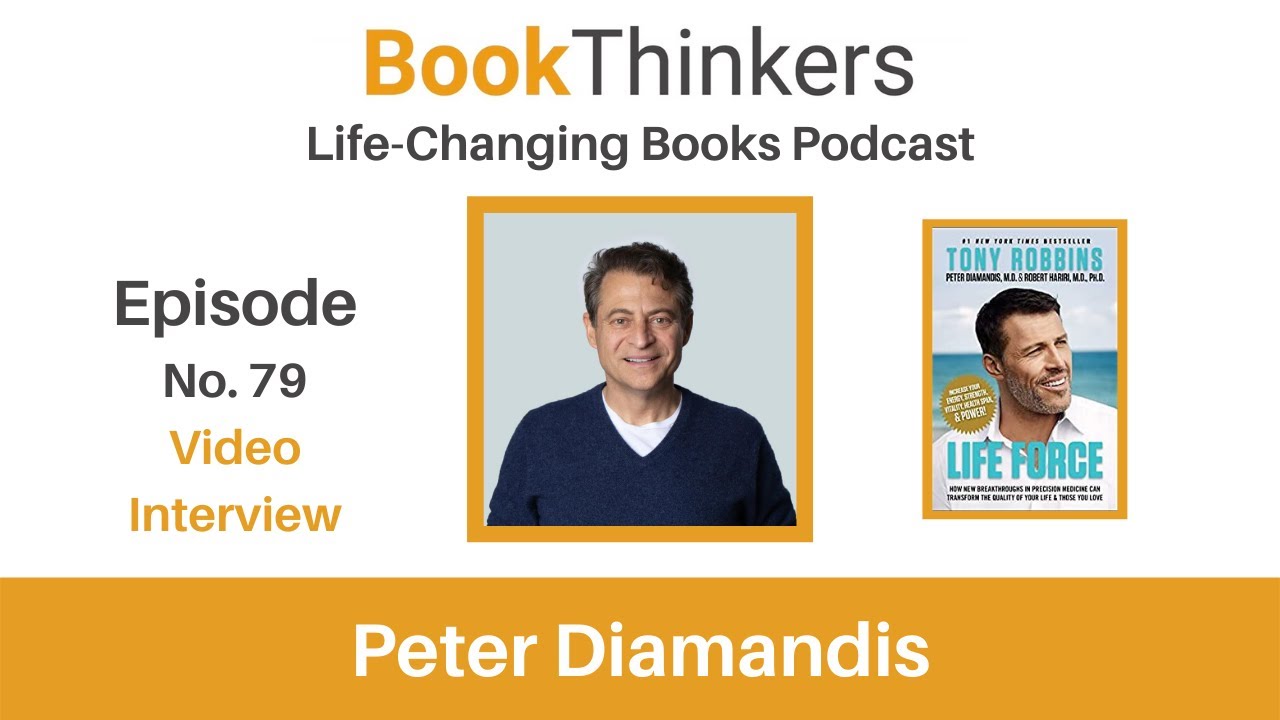
In this episode of the Life‑Changing Books Podcast, host Nick Hutchison interviews futurist Peter Diamandis, co‑author of the New York Times bestseller Life Force (with Tony Robbins). The conversation weaves together Diamandis’s personal backstory, his role as founder and chairman of the XPRIZE Foundation, and the central themes of the book: a "longevity mindset" and practical pathways to extend healthspan. They discuss precision medicine, digital biology, and the emerging industry of full‑body health‑uploads offered by Fountain Life, including cost, insurance models, and the shift from reactive to proactive care. Practical lifestyle advice is covered—sleep hygiene (Oura Ring, eye mask, ChiliPad, 8 h target), intermittent fasting (19 h fast/5 h eating window), diet (low‑sugar, Mediterranean), and the "vitality pharmacy" (metformin, NAD⁺ precursors, peptides, hormone optimization, nutraceuticals). The dialogue delves into cutting‑edge biotechnologies: CRISPR gene editing, stem‑cell therapy and Cellularity’s placental stem‑cell banking, organ‑regeneration via 3D printing, and the upcoming $101 M XPRIZE for age‑reversal. They explain biological vs. chronological age, epigenetic clocks, and the importance of a positive longevity mindset, highlighted by Diamandis’s AI‑driven Longevity Insider platform. The episode ends with resources (lifeforce.com, diamandis.com, xprize.org) and a call to action for listeners to explore the book and related services.
Chapters
Peter, welcome to the Book Thinkers Life-Changing Books Podcast. How are you doing today?
A pleasure, Nicholas. Good morning. Good afternoon. Good evening, depending where folks are.
I'm really excited for today's conversation. But before we jump into it, I'd love to have you introduce yourself to those in the audience that are not familiar with you or what you do or the books that you've been a part of.
Sure. I like to say I'm a 9-year-old kid having a blast. I am Basically passionate about a number of subjects, solving the world's biggest problems. I've been making a deep dive of late into the last 8 years into longevity and age reversal, opening the space frontier. I went to medical school in my 20s, but became really a serial entrepreneur pursuing my dreams. Built a number of space companies, Built a couple universities, International Space University and Singularity University. Started the XPRIZE Foundation that really focuses on solving the world's biggest problems. Author of now 4 books. My first book was called Abundance. Next one was called Bold. Third was The Future Is Faster Than You Think. And then the subject of our conversation today is a book called Life Force that I wrote with Tony Robbins.
Now, before we jump into Life Force, I'd love to dive into your younger years a little bit. Is it true that when you were 8 years old, you were giving lectures to family and friends on space, and then at the age of 12, you won a rocket design competition?
Yeah, so it was interesting, right? My parents were both born on the island of Lesbos in Greece and moved here. And I was— my dad was a physician, my mom ran his office, and I was in the medical medical family. And back then, it was just expected I would become a doctor, and that was just all there was to it. And it was the Apollo program and Star Trek that really got me going, got me excited. And so while it was sort of like medicine and biology was sort of like the understood background conversation, space was what my passion was. And I remember sitting down and giving my parents a lecture on the planets. And my dad afterwards came over and gave me a $5 bill, which was like a lot of money. And I was like, oh my God, you can make money doing this. This is great. And then if anybody's ever built model rockets, there was the premier model rocket company was called Estes Rockets. And I won with my best friend Billy won a rocket design competition, and that was fun too. Yeah.
And then you went on to study at both MIT and Harvard. Like I shared with you before we started, I'm originally from the Boston, Massachusetts area. I'm down in Panama avoiding the cold weather. Where do you currently reside?
I'm in Santa Monica, 70 degrees and sunny every day. Yeah.
Yeah, you can't beat it. You can't beat it. And so you're the founder and chairman of the XPRIZE Foundation. Can you tell everybody a little bit about that and then we'll dive into the book?
Yeah, sure. So I got, like I said, very enamored about space and then I wanted to become an astronaut. I went to medical school as part of that journey. If you weren't a fighter pilot, the next best thing you could do was get a medical degree statistically to get into the astronaut corps. And then I I ended up learning that the chances of me becoming a NASA astronaut were like 1 in 1,000. I had a better chance of becoming an NBA All-Star at 5'4 than I did at becoming an astronaut. And I read one day about Lindbergh that in 1927, he crossed the Atlantic not on a whim, but to win a $25,000 prize. And I said, I'm going to create a prize for private spaceflight. to open up the space frontier. And lo and behold, I did. I didn't have $10 million, which was the amount that I figured was needed, but I created the prize, announced it under the arch in St. Louis, and called it the XPRIZE as sort of X was a variable to be replaced by the name of the donor who put up the $10 million. And that took me 5, 6 years to raise the capital, which I did. from an amazing woman, Anousheh Ansari. And the XPRIZE was won. We called it the $10 million Ansari XPRIZE, named after the person who funded it. And it was won in 2004. And the winning team had to build a private spaceship that could carry 3 adults up to 100 kilometers, land, and then within 2 weeks with the same ship, make the trip again. And That started an incredible journey. We turned the XPRIZE into a platform in which we have launched about $300 million of prizes. Our latest and greatest prize was a $100 million prize that Elon Musk funded for removing gigatons from the atmosphere. And we're working on prizes for fixing the, you know, the die-off of the coral reefs, of preventing wildfires, of even age reversal, which comes to the book here. So the XPRIZE puts up large cash prizes and says, I don't care where you went to school, what you've ever done before, if you solve this thing, not talk about it, not write about it, actually demonstrate how to solve it, you win the money and humanity wins the benefits of that solution.
Yeah, it's truly amazing what you're doing. I was poking around the XPRIZE website before we jumped on today, and it was, it was mind-boggling what you're able to incentivize people to do with the right amount of cash. So, thank you for your worldly contributions. And now we'll dive into the book. So, Life Force, instant New York Times number 1 bestseller. When did the project originally start? How did you get involved with this?
It started roughly 3 years ago. Tony Robbins is a dear friend and a business partner. Absolutely brilliant. And he had injured himself in a skiing accident, and, and he came to me for advice. I had been very involved in the stem cell world and the regenerative medicine world and started some companies in that arena. And I introduced him to Bob Hariri, who's another dear friend, and he's involved in the, in this book project. And Tony went down to Panama, where you are right now, to get stem cell treatments. And on the heels of that, I invited him— I hold an adventure trip every year with some of my biggest benefactors. And back 3 or 4 years ago, I had invited him to come to the Vatican where we held a longevity and rejuvenation conference. And Tony got a chance to meet these amazing people. And on the heels of that, He became enamored with sharing what he was learning with the world about regenerative medicine. And I ended up introducing him to everybody I knew. And he said, listen, I'm going to write this book. Would you join me on this journey? And so my publisher, Simon& Schuster, is the same as his. And so I joined on this book writing journey. which was incredible. And what we've done is documented in the 700 pages, and the book can be written, can be read in chapters and in segments. You don't need to read it front to back, though many, many people have. But I wanted to do was we wanted to document and give people hope, get people excited about the breakthroughs that are happening right now and just the potential for, you know, adding 20, 30, 40 healthy years onto your lifespan.
I'm fascinated by these subjects. When you were writing the book with Tony, who was the target reader? And really, what was the mission for the book? What's the desired outcome?
Yeah, so we had a little bit of a disagreement on that. Tony wanted to focus really on people in their midlife, you know, probably 30s, 40s, 50s. and really around vitality and energy, which we do very much do. It's right. It's about how do you maintain your energy levels and vitality? And I wanted to really focus in on the whole longevity and age reversal realm, specifically, you know, people in their 60s, 70s, and 80s and giving them, giving them hope there. And we ended up doing both. And there is plenty for everybody, depending— independent of what age range you are or what you're facing.
Yeah, I mean, I'm in my 20s, but I'm fascinated by this. We had Dr. David Sinclair on the podcast maybe a year or two ago, and that started my longevity obsession. In the beginning of the book, you talk about how biology is now an information technology. So, Can you define precision medicine for everybody and talk a little bit about how data is now incorporated into personalized leverage?
Sure. So one of the things to realize is, first of all, our biology, who we are, is influenced by so many things. You have your genetics. And David Sinclair wrote a fantastic book called Lifespan, which you know. And we all have 3.2 billion letters from our mother and from our father, and that is that library of life. And if you stop and you think, Nicholas, around the notion that you've got the same genes that you were born as you have now in your 20s, you'll have the same genes in your 40s, 60s, 80s, 100. And the question is, if you have the same genes, why don't you look the same throughout your life? And it isn't necessarily what genes you have, it's what genes are turned on and which genes are turned off. It's called your epigenome, and epi for the Greek word above. And I think that understanding of what your code is, and then which of those genes are on or off, is part of this digital biology. It's understanding the control systems for your genes that control your proteins. The other thing is, understanding your physiology. So most everybody listening right now, you've, you know, very few of us truly know what's going on inside our bodies. You know, if I ask people, are you absolutely sure you don't have a cancer or heart disease or an aneurysm or dementia going on in your body? Most people, if they're honest, would say no. And we're kind of naive about what's going on inside our bodies. We hopefully feel good, we feel alert, we feel in good shape, but we don't actually. And we've all heard of people who keel over or die in their sleep or whatever, and it's like, oh my God, what happened? Well, whatever happened didn't happen that morning. It'd been going on for some period of time. So part of what digital biology And information science is around being able to monitor your body 24 hours a day, 7 days a week. And so we're going to move medicine out of the hospital, which is an emergent situation, out of the doctor's office where you go maybe once a year for a checkup, and into your— Into your home, onto your body, into your body, right? I've got my or a ring I'm wearing. I've got my Apple Watch. Yeah, there you go. I usually wear a continuous glucose monitor, but these are just the early days. We're eventually all going to have sensors that are measuring our biochemistry all the time and saying, listen, you need to hydrate more, you need more protein, you need more vitamin D, whatever the case might be. So we can turn that loop and AI is monitoring your physiology all the time and helping you optimize it 24/7. And when we do that, the cost of healthcare is going to diminish dramatically because today healthcare is after you're sick. It's really sick care after something bad has happened, having to pay for those bills, paying for the surgery, paying for whatever it is, versus catching disease at the very beginning. when it's most, you know, addressable. So there's a diagnostics revolution. One of the things that we write about in the book is a company that Tony and I, Bob Hurry, Bill Capp, and a number of other individuals started called Fountain Life. And there's a sister company called Human Longevity, But Fountain Life has got facilities throughout the US and into Canada, Europe, and Asia over the next few years. And what we talk about is going for an annual upload where I just did mine a month ago, I think. And what you do is I go for 5 hours and I'm fully digitized, full body MRI, high resolution, looking at all the vessels in the body and the brain, my brain, my heart, my lungs, everything, looking for any cancer, looking for any aneurysms, looking for any deviation from norm. And then I do an AI-enabled coronary CT looking at the heart, DEXA scan for muscle and bones, looking at my gut, my genomics, my blood chemistries, everything. And it's looking for anything that's off. Is there anything that is not in that in great shape. And, and there will eventually be, you know, I just got my return of results, my review of results. I'm clean as a whistle, which is fantastic. Someday something will pop up and I'm going to want to catch it at the very beginning. Right. So all of this is digital biology.
There might be some people listening today that are intimidated by what you're saying because they live in a state of ignorance. They think that ignorance is bliss. One of the main lessons in this book is that ignorance is not bliss, that preventative care is, number one, a lot less expensive. But also a lot less deadly than reactive care. And so for somebody that's listening today and they go, well, I want a full body upload, how much does something like that cost? And is it covered by insurance? How does the Fountain Life team—
Great question.
Yeah.
So, first of all, the question ultimately is, when do you want to know that something's wrong in your body? You're going to find out eventually. Do you want to know upfront? Or do you want to find out after the fact? What I tell people all the time is like, bullshit, of course you want to know because you can finally do something about it. This is really, we're going from reactive healthcare to proactive and preventative healthcare. That's the big idea. These kinds of services are not cheap right now. The full body upload is like $11K. It's not covered by your traditional health insurance. Fountain Life offers also a year-round membership which includes a concierge physician, and that's $20K, and then the second year is about $15K, and then from then on. But one of the things that we did that I'm very proud of is we're trying to flip the model. So right now, insurance, you know, fire insurance pays you after your house burns down, right? Life insurance pays your next of kin after you're dead. Health insurance pays you after you're sick and you've had to go through surgeries, whatever the case might be. So we created something called Fountain Health, and it's an insurance program that's being offered right now to companies that have 50 or more employees. And for the same price as the normal insurance, everyone insured under Fountain Health gets all of the testing for free. So it's— the goal is to test everybody who's insured by the company and catch disease at the very beginning when it's cheaper and easier and more effective to treat versus down the line. And it's interesting, right? The numbers are pretty staggering. We did a study between Fountain Life and, and HLI that for— this is mostly men in their 50s and 60s— 2% have a cancer they don't know about, 2.5% have an aneurysm they don't know about, and 14.4% have something going on inside their body that requires immediate attention. And that's kind of, that's pretty, pretty crazy, right? So ultimately, this is about helping you living to live longer and healthier by catching disease at the beginning when it's most addressable.
On this podcast, we've had a lot of guests in the past talk about, you know, you work so hard, you sacrifice your health and your happiness to make money. And then you kind of wake up, you're 65, you're not physically able to travel like you thought you might be. And you maybe ruined relationships with family members because you put work first. And so my question to you is, at what age should we start paying attention to this? I mean, for me in my 20s, to spend $20,000 is, is a, is a big number, but I care so much about my health. Like, yeah, when does that debate start and when should people start paying attention to it?
So first of all, I'm not by any means recommending that everybody should should spend this amount of money. It really— there are steps you can take that are incremental along the way. But at the end of the day, you're going to spend the money somewhere sometime if you're sick. And the question is, how do you make it upfront? And the entire book, which is an investment of, you know, $25 and your time really is about what you can do right now to maximize your health, right? And it really is the basics. It's 8 hours of sleep, it's exercise, it is diet, it is mindset. I put the fountain of life element in the category of not dying from something stupid, preventable. And so we can talk about each of those. And I think it's, it's important for individuals to, to realize that you can take control of your health, that you can be the CEO of your own health, and that there is nothing more valuable than health. I love the saying, Nicholas, that the man or woman who has their health has 1,000 dreams. The man or woman who does not has but one dream. Anybody who's ever been sick knows how true that is.
Yeah, it really is. So before we get to some of the other fascinating advancements in technology around health, which I definitely want to talk about, let's dive into some of the more practical things that a listener today might be interested in learning more about from the book. So sleep is an important one. We both wear an Oura Ring. I use a chili pad as well. I read that you use a chili pad. So what are some of the things that you recommend for the average person to start paying more attention to?
So let's, let's set a target. First and foremost, the body does need 8 hours sleep genetically. There is a very small fraction, less than 1% of people who can get away with less. If you think about it evolutionarily, imagine there was one subset of humans that did great on 6 hours and one that did require 8 hours. The people who did 6 hours of sleep had 2 more hours to forage, to procreate, to defend themselves, they would have outcompeted everybody else. And so the reality is we need 8 hours of sleep. And how do you get it? Well, there are a number of tricks. First of all, there's a great— one of the people we interview in the book wrote an incredible book called Why We Sleep. And so what do you need? First of all, going— you can control typically when you go to sleep versus when you wake up. So for me, I'm trying to be in bed and asleep by 9:30. What does that mean? I'm not watching TV before that. I'm not on my computer before that. What I do actually is I listen to an Audible book for 20 to 30 minutes before I go to sleep. And it's like being read a bedtime story, and that really works. I've got a great eye mask that I use. I love the Manta, M-A-N-T-A eye mask. I use a chili pad. I set the temperature in the room down to 64, 65 degrees. And so those are the tricks that I use for getting a good night's sleep. And I really use my Oura Ring and measure it From the perspective of, I used to brag about being able to get by on 5, 5.5 hours of sleep. Now I brag about getting 8 hours of sleep.
Yeah, the Oura Ring has changed my life. I mean, we have that old Peter Drucker aphorism, you know, what you're not measuring, you can't manage. And so every time I make an improvement like the chili pad, I can really see the actual difference. And so I'm excited for technologies like this to continue to develop over time. And I use the— or my girlfriend uses that Manta eye mask, and we have a lot of those things put in place. And I like to tell people that sleep is one of my superpowers as well. I like to brag about how much sleep I get. Another one of the areas that you talk a lot about in the book is fasting and then the food that you consume. So I read that you fast 19 hours a day and you eat for 5. Is that accurate?
Yeah. That's My objective goal. So if I'm, you know, doing as much water, I try and do a couple of liters of water a day. And I will typically have dinner at 6, be done by 7, and then try to minimize any intake until the next day at lunch, typically around 1 o'clock. So, you know, it's about 6 hours, 5, 6 hours of eating. And then the rest is a fasting period. And fasting— and David Sinclair talks about this, and we talk about it in our book as well— fasting triggers a number of epigenetic elements that are longevity-promoting. So that's one. The other thing on diet that I think is the most important is minimizing sugar. Sugar is an inflammatory factor. Sugar causes heart disease, it causes neuroinflammation and degeneration. And it's really, how do you minimize sugar in your diet? And that, for me, I've been a vegan, I've been on keto, and I've settled back in sort of on a Mediterranean diet as much whole plants as I can and some fish, some eggs. And that's— that is my, my diet. How about you?
Well, it's a great question. I've been doing a 16:8 style intermittent fast for years now. And sometimes people tell me I'm a little bit young to be paying attention to that stuff, but I get a lot of great energy in the morning, especially when the caffeine hits on an empty stomach. And so I care a lot about clarity in the early working hours.
That's a really important point just to note. I mean, if you've ever been in a morning fast, by the time you're hitting 12, 1 o'clock, super high energy, right? And then if you ate a large meal, it like puts you to sleep because all the blood is going from your brain to your digestive system. And, you know, if I need mental clarity, I'm pounding water and coffee and I'm not eating food.
And you mentioned this earlier about sleep as well, but eliminating snacking before you go to bed also removes the blood from trying to digest food while you're trying to sleep and fall into the deeper states. So, you know, eliminating food in the morning and at night is really important to me. And you asked about diet. My diet's interesting. I definitely try to avoid sugar. I'm a pretty healthy eater. Based on the book's recommendations, I definitely eat quite a bit more red meat than what was recommended, but I feel great. And I've done some food sensitivity testing a few times, probably 5 times now, and I've eliminated foods that cause excess inflammation. I pay a lot of attention to that.
Yeah. Cool.
And in the book, you talked about the vitality pharmacy. And so I think listeners will find some of this information interesting. There were really 5 categories. I'll read them. They were peptides, metformin, hormone optimization therapy, NAD+, and nutraceuticals. So is there a specific category that you're excited to talk about when you're recommending things to friends and family out of those 5?
So listen, all of those are well documented in the book, and I don't want to speak about them too loosely because whenever you're making recommendations on any kind of medicines or nutraceuticals, you need all the appropriate disclosures. What I can say is there's some incredible studies going on on metformin right now. Metformin, also known as Glucophage, it's one of the cheapest medicines out there. It reduces your blood glucose levels. I take a gram of extended-release metformin every day. A lot of people do. Glucose in the bloodstream is what feeds cancer, and it's thought to— metformin is thought to have a cancer protective element. It also, again, blood sugar causes glycosylation of cholesterol that leads to heart disease. It causes neuro— inflammation. So there's a lot of benefits. There is a big study that's being done right now out of Albert Einstein Medical School on metformin, hopefully to show its longevity impact. And it's like, these are pennies per pill, so it's not expensive. You do need a physician's prescription to get it. The idea of NAD precursors— NAD, nicotinamide adenine dinucleotide. NAD is an energy currency in the cells. And it's NAD and ATP, if you remember from your high school biology, adenosine triphosphate. These are the mitochondrial currencies for powering molecular interactions in the cell. And as we get older, our NAD levels drop and can cut by a factor of 2. And so NAD is important for controlling your epigenome. It's also important for DNA repair, a series of 7 proteins and genes called the sirtuins. And David Sinclair is the expert in this. Anyway, long story short, there are a number of precursors. NMN is one of them. I have a supply of NMN I take right here called Elevant. And then there is, and then nicotinamide riboside, NR. Here's another basis by Elysium. Anyway, these are some of the supplements that I'll take. We ended up creating a website where folks who are interested in these supplements and peptides and One of the other things we talk about is hormone optimization, right? When you're in your 20s, you're in optimum state of physiology and hormone levels and so forth. But after the age of 30, there begins a very quick sort of disequilibration of your hormonal levels because we were never designed to live past age 30 as a human species.
Right.
We would have our babies at age 13, and by the time you were 26, 27, your baby was having a baby. And before Whole Foods, McDonald's were around, the last thing you wanted to do was steal food from your grandchildren's mouths. So you would die and give back your bits to the environment. Well, we want to get ourselves back to optimal hormone levels. And so if you go to lifeforce.com, which is where you can learn about the book, Down below, you can learn about Fountain Life where you can get your full body scans. You can learn about MyLifeForce, which is where a lot of the supplements that we recommend in the book are accessible. And ultimately, it's really a matter of how much do you want to take control back of your life? It's up to you. All I can say is the things that I do as I've learned About these areas?
Yeah, it's fascinating. There are a lot of, there are a lot of people that are very skeptical of these subjects, which is really interesting. And I always tell people that 4 or 5 years ago, when I was not paying attention to my health, you know, I would crash towards the end of the day, I'd have burnout, my workouts weren't as great. And from a cognitive perspective, I would fail a lot earlier in the day. And so paying attention to all of this has elevated almost every area of my life. And there's a lot of unfulfilled potential in all of us. Peter, I heard on another podcast you mentioned that you have an internal mental age of 28, but a biological age of 49 and a half, even though you're 60. So I'd love to have you tell everybody what that means.
Well, so my chronological age is, you know, your birth date, you know, month and year minus, you know, what you are today. So I'm 60 years old. my biological age, there are a number of different mechanisms for measuring your biological age. And this goes back to more on the epigenome of which genes are turned on and which genes are turned off. And there's a number of different tests you can do. And a lot of these are blood tests or saliva tests. One's called TruAge. And they look at what are called your methylation sites on your genome. And The last test I did put me at 49.5, thereabouts. And then mentally, I feel like I'm at the top of my game. And I feel like I felt in terms of hunger, energy, desire to go make a dent in the universe as I did in my late 20s. So that's sort of where I put myself these days.
Which is really optimistic, I think, for anybody reading or watching or listening today, because we have so much potential. And as we continue to make breakthroughs related to healthspan, our potential increases exponentially. Do you think it will ever reach a time where humans can live forever? I mean, I talked to David a little bit about this, but it's a fascinating—
I'd be curious what he, what he said. So when I was in medical school years ago, uh, I remember watching a television show on long-lived sea life that certain species of whales and sharks and turtles could live 200, 300, 400, 500 years old. And I was like, if they can live that long, why can't we? And I remember thinking to myself, Nicholas, that it's either a hardware problem or a software problem. And we're eventually going to figure this out. And I believe that this next decade or 2 is the time when we're going to really begin to understand at its most fundamental level what's going on, why we age, how to slow it, stop it. And as we've discussed vis-à-vis David Sinclair and folks like George Church, how do you reverse it? So I'm in the middle right now. We mentioned the XPRIZE Foundation earlier where we're running— I'm running these large cash prize and offering money to the team that can pull gigatons of carbon out of the atmosphere or map the ocean floor or launch rockets into space. And I'm very close to a prize today on age reversal. And this would be a $101 million XPRIZE for the team who can reverse the age of an individual by 20 years or more, right? So that's the conversation that I think is, is fascinating to have.
Yeah, I do too. There was some conversation in Life Force about telomere lengthening and stuff, which is super fascinating. These subjects— now I'm a total rookie here, but gene therapy and gene editing, it's a huge subject in the book, and it's somewhat confusing to the average person like me. But maybe you could give everybody a little taste by describing CRISPR, Maybe what is the technology and how is it currently being used? I— most people aren't aware of it, I don't think.
Yeah, so it was— CRISPR technology, and CRISPR is an acronym. I won't try and properly recite the acronym, but it won the Nobel Prize in 2020. 2 amazing women, Jennifer Doudna here in the US and her partner in France, won the Nobel Prize for their work. And CRISPR is a gene editing system. It's a technology that allows you to go in and accurately edit the genes inside of a living cell. And we've been able to make single-letter replacements, like turn— you know, there are 4 letters in the DNA alphabet, A, T, C, and G. And being able to switch out a letter, but it's also allowed to switch out multiple nucleotides and even potentially an entire gene. And so all of a sudden, this is— we think about a word processor and editing a Word document. You can search, you can cut, you can paste, you can edit. The same is going on right now in life. You can search for a particular gene sequence, you can cut it out, you can replace it with something, you can write an entire gene sequence of letters and, and generate a new gene. And so it's extraordinary, um, what's possible there.
There is a little 3-line segment of the book that said there are a few ways to fix a cell. Gene therapy replaces defective or missing DNA inside of a cell. Gene editing like CRISPR allows you to repair the DNA inside of a cell, and then stem cell therapy has replaced the cell entirely. So when we kicked off the podcast, you told me that the book sort of started because Tony came down here to Panama. He had some stem cell therapies for the torn rotator cuff and back problems, some IVs. So what are stem cells? Um, could you give a little introduction on that subject? Sure.
So I want you to imagine that you build a beautiful mansion, 50-room mansion, multiple stories, extraordinary complex capabilities, and you've got the designs for that mansion. But more importantly, you have a staff of like 50 people who are maintaining that mansion for you. And for 20 years, it's going great. But over time, what occurs is the the maintenance staff starts becoming senile or dying off, and their ability to read the instructions and maintain the mansion starts to slowly fall off, and the mansion over the course of 100 years goes into disrepair. Well, our stem cells are that maintenance staff. It's the regenerative engine of the body. And when you're born, You have a large supply of stem cells in your skin, in your brain, in your muscle, in your bones, in your fat, in your liver, in all of the different cellular compartments. And those stem cells have the ability to, under certain conditions and stress, differentiate from a— what's called a pluripotent stem cell to a specific kind of cell that can become a muscle cell, that can become a liver cell, a bone cell. heart cell, connective tissue cell, whatever is required to maintain the integrity and structure of the body. And in your earlier years, your stem cells are, are the regenerative engine of your body. But as you get older, your stem cell population falls off rapidly, could fall off 100-fold or 1,000-fold. And the other thing that occurs is they undergo a number of mutations and degradation, so your stem cells are not as, as strong as they were once before. So the question is, can— and it's called stem cell exhaustion. It's one of their 9 hallmarks of aging, and stem cell exhaustion is one of them. And so, the question is, can you revitalize your stem cell population? Can you restore it? So, one of the companies that I'm very proud to be a founder of, or co-founder along with Bob Hariri, is a company called Cellularity. So, there's a chapter on Bob. We have these hero chapters. David Sinclair is a is a hero, Bob Houri is a hero, and others in the book, Martine Rothblatt. And so Bob is an MD-PhD, a brain and spinal cord surgeon, but when his daughter was born, he realized that the placenta, which is, you know, part of the the birth process of an embryo, that the placenta grows much larger than the embryo. And what he realized was that the placenta is the organ that generates all of the stem cells that create the fetus. I think of the placenta as a 3D printer that manufactures the baby, right? Generates all the stem cells for it. And when a baby goes to full-term growth, and you deliver the baby, then the placenta is delivered in the afterbirth. Typically, the placenta is thrown away. You actually pay for it to be incinerated. But it turns out that the placenta is very rich in cells. It's rich in stem cells, natural killer cells, and T cells. These are immune cells. And so Bob built a company as part of a much larger pharmaceutical company called called Celgene. He built a company, and we spun it out about 5 years ago to form a company called Cellularity. And Cellularity is one of the largest cellular manufacturing companies, and we have over 100,000 placentas in storage, and we are able to extract the stem cells from those and the T cells and natural killer cells. And the ability for you to replenish a person's stem cell supply is at the very early stages of these therapeutics. So it isn't legal in the United States yet, which is why Tony went down to Panama. Fountain Life has a couple of facilities that we partner with outside the United States, but we're now beginning to do the FDA-approved research for the purpose of being able to get the data to show safety and to show efficacy.
So, do you think there will be a time in the near future where every time a baby is born, the placenta is frozen to be accessed later for stem cell therapy?
I think that, well, first of all, it's a service you can buy right now. There's a company which is part of Cellularity called LifeBank USA. Anybody who's pregnant or knows someone who's pregnant, I highly commend it. I have 2 10-year-old boys, their placentas are, uh, their, their cells from their placentas are stored in the deep freeze. Um, it's like having your original software for the child, uh, without any kind of aberration, uh, saved, uh, for the long term. And so, uh, I do believe that this is going to become more and more likely, uh, and I think that these placental-derived stem cells and natural killer cells and T cells will become important for augmenting your immunity and augmenting your regenerative process.
Yeah, some of these subjects at first glance sound like science fiction, but one of my biggest takeaways from the book, or mindset shifts, was that things are getting better. I'm optimistic for the future. All of the technologies that you talk about in the book are well-researched, well-funded, They seem very— they seem like they'll become commonplace very soon. So I'm really optimistic about that.
Yeah, no, they— I'm, I'm super pumped about it as well. You know, one of the things I talk about that's so important for people to have for their, uh, maximizing their longevity is what I call a longevity mindset. Um, you know, I think you can will yourself to life and will yourself to death. And I think if you believe that these technologies are extraordinary and that they're coming more and more powerfully, you have something to live for, you have something to hope for, you have a reason to keep yourself in better shape. And so the challenge is most people don't have access to this information. So the book was written as a means to extend people's longevity mindset. And then one of the other things that I did was to create an AI engine, Nicholas, called Longevity Insider. And it's something that I feel really powerful about because there's so many breakthroughs occurring all the time that we don't know about. And I read all through the day, I'm just consuming data. And then I turn around with that data I consume and I I'm teaching, I'm writing on it. But the ability to maintain— because the amount of progress in biotech, health tech, and longevity is exploding exponentially, the ability for me to stay on top of it was really hard. So I built an AI engine and built a platform called longevityinsider.org. It's free for anybody who wants to go. If you go to longevityinsider.org and register, you'll get every day a summary of the 15 most powerful breakthroughs going on in longevity and health tech. And it just blows me away at what's going on. It's extraordinary. And so in stem cells, in exosomes, in Wnt pathways, in senolytic medicines, in nutraceuticals, in, you know, all of these areas. And the AI generates a very readable, understandable paragraph summary of those breakthroughs. And for me, the most important thing is just being able to stay on top of it and maintain a positive mindset about the future.
Yeah, it's incredibly important. So, I subscribed earlier today when you sent it over to me, thelongevityinsider.org. So, I'll make sure, by the way, for anybody listening, that there are links in the show notes for everything that we covered today. But yeah, I think it's incredibly important to have a positive mindset, and subscribing to something like this can replace a little bit of the negative news cycle that maybe somebody listening is consuming today, and replace that with positivity. And there are so many other subjects, Peter. I know we have to wrap up here in just a moment. There are so many other subjects in the book, like you mentioned, the spotlight of Martine and the organ regeneration, 3D printing organs. Let me hit on—
let me Let me hit on that just because it's so extraordinary.
It is.
So there are 2 incredible heroes, Martine Rothblatt and Dean Kamen, in the book. And what I want people to take away is that there are multiple companies working on the idea of giving you an extra backup set of organs. Like today, if you, God forbid, need a kidney, a liver, a lung, a heart, you've got to wait for someone to die to give you that and hope that someone has a tissue match to your genetics. And even then, you're on immunosuppressants, you know, while you have this, this transplant. Well, there are a number of technologies— I won't go into the details, they're in the book— on being able to generate a an abundant number of backup organs. And for me, it's amazing. And I don't think it's a matter of if, it's only a matter of when. And I think the when is this decade. So it's great news for the hundreds of thousands of people who are waiting on organ transplant lists for a heart or kidney. It's amazing stuff.
It truly is. That section of the book was mind-blowing for me. I was actually listening to the book in the gym a couple of weeks ago, and I was listening to that section, and I just kind of stopped for a minute. I'm like, life is incredible. This world is incredible. People like Martine and Dean, like, they're incredible. And so, Peter, I'm happy that we were able to give my listeners a little introduction to some of the subjects in the book. There's so much to touch on. But for people that want to buy a copy of the book, or learn a little bit more about you and what you do, where should they go? What should they do?
Sure. I mean, if you just go to lifeforce.com, uh, you can order the book there. On that same site, there are a number of resources, uh, from Fountain Life to the nutraceuticals we talk about, uh, you know, all the things we talk about in the book, from the Manta Mask to OneSkin to Multitude.
They're all—
there are links to all those, uh, there. If you're interested in the work that I do, I put out 2 blogs a week. Typically one's on longevity and one's on exponential technology. You can go to diamandis.com, my last name, and you can get the blog there. And then the XPRIZE is xprize.org. And yeah, it's ultimately for me, I believe this is the most extraordinary time ever to be alive. My mission is helping entrepreneurs create a hopeful, compelling, and abundant future for humanity. And that's where I get my hope and my excitement.
Well, you're doing an amazing job at that. And today, I mean, I'm going to have to go back and listen to this conversation. There's so much to draw from. So one more time, a big thank you. And I look forward to our next conversation.
I look forward to it as well, Nicholas. Enjoy Panama.
Thanks.
Be safe.
More from Nick

Napoleon Hill’s “Think and Grow Rich” is a timeless classic #selfhelp #personaldevelopment

4 Books to Help You Get Better at Decision Making #selfhelpbooks #bookrecs #nonfictionbooks


Have you read this book yet? 📖: The 5AM Club by Robin Sharma #selfhelpbooks #robinsharma

Dan Sullivan on Listening to Your Customers Instead of Watching Your Competitors

5 Books That Will Boost Your Financial Intelligence #financialfreedom #nonfictionbooks

The People That Preach the Loudest About Virtue are Usually the Most Power Hungry



Books are the greatest mentors you can find #selfhelpbooks #businessbooks #successmindset

Let’s fight this toxic instant gratification culture together 📖 #selfhelpbooks #jimkwik