Life-Changing Books Podcast Episode 83. Kristen Boss: Author of Pivot to Purpose
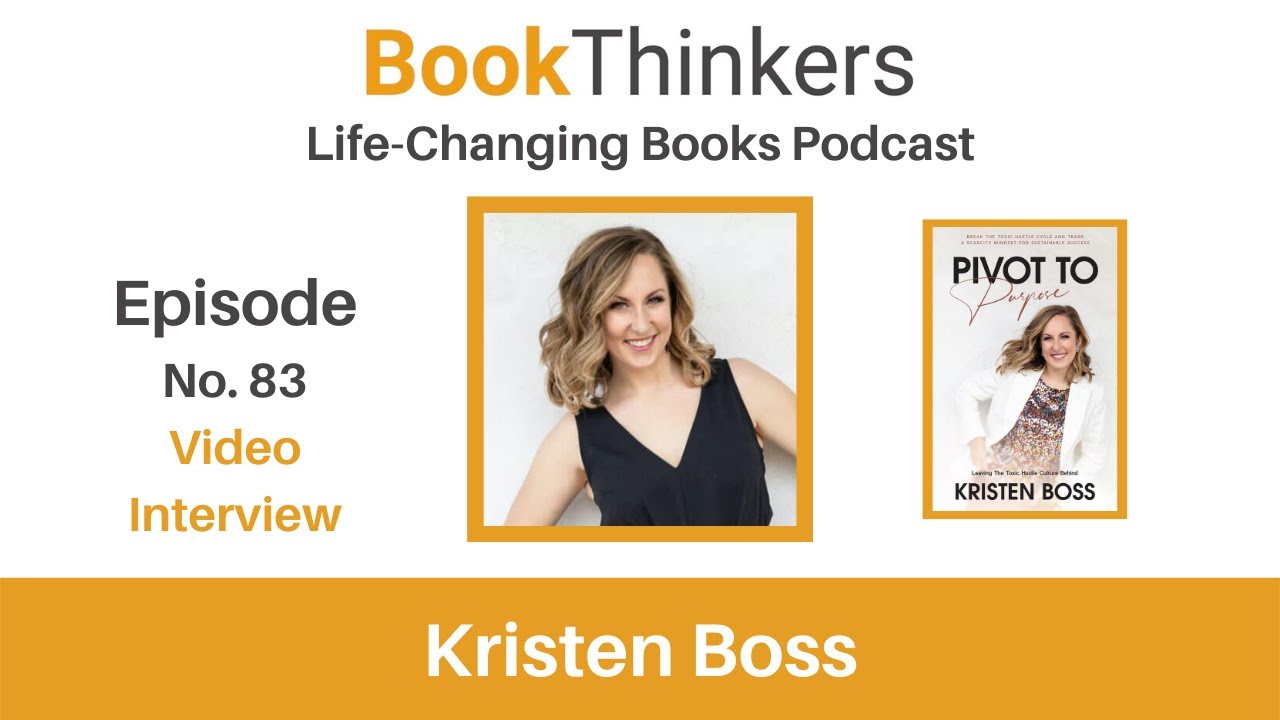
In this episode of the Book Thinkers Life‑Changing Books Podcast, host Nick Hutchison interviews Kristen Boss, a sales‑and‑mindset coach and author of Pivot to Purpose. The conversation walks through the genesis of the book—how the title existed since 2019, the three‑draft outline process, and the decision to write for the version of herself five years ago who entered entrepreneurship with naïve hustle ideals. Kristen breaks the book into four parts: The Harm of Hustle, Healing from the Hustle, Leaving the Hustle, and Pivot to Purpose. She explains why relentless hustle is a form of self‑harm, linking it to shame, desperation, and a dopamine‑driven “hustle cycle” that spikes adrenaline and cortisol, leading to chronic stress, burnout, and what she calls “creeping normality.” The discussion expands to gendered impacts of hustle culture, noting that hustle is often framed as masculine energy, forcing women to work twice as hard while also juggling domestic expectations. Social media’s role in glamorising the hustle lifestyle and distorting reality is examined, as is the importance of shifting from working for external validation (hustle) to working from a place of purpose and self‑worth. Kristen shares practical habits—breathwork, circadian‑aligned work blocks, Pomodoro timers, hydration, and deliberate rest—to regulate stress hormones. She introduces concepts such as talent bias (recognising innate strengths that feel “easy” but are marketable), the futility of relying on motivation, and the necessity of clear personal and professional boundaries. The episode also covers the value of an origin story, the paradox of a book launch during illness as a lived example of purpose‑first work, and provides listeners with Kristen’s contact points (Instagram, podcast, website).
Chapters
Kristen, welcome to the Book Thinkers Life-Changing Books Podcast. How are you doing today?
I'm doing great. Thanks so much for having me here.
I'm really excited for our conversation. And for those in my audience that are not familiar with you or your business or your new book, could you please introduce yourself to everybody?
Sure. So I'm a keynote speaker and a coach for social selling or the network marketing industry. However, my book speaks to the entrepreneur audience as a whole. I'm a sales and mindset coach. So So yeah, that's who I am.
Now, when did Pivot to Purpose come out?
It came out April 19th. So it hasn't even been a month yet. We are fresh on the release.
Yeah, we are. And I'm really excited to talk about it today. When did the process start? When did you decide like, hey, I want to write a book?
Yeah, great question. So I actually knew the book, the title, probably 3 years ago in 2019. I knew, I always knew there was a book in me. I just wasn't sure what the book was going to be about. Who was it going to be for? I just didn't realize I was still living out my book in the moment. And then it was 2019 when I launched my coaching business, when I saw a real need in the world. And I'm like, yeah, it's time to talk about Pivot to Purpose. And then just kind of waiting for the right time, right place. And then sure enough, the pandemic happens. And I've had people like make jokes. They're like, oh, we're all so tired of the word pivot. I'm like, well, that was— that's always been the book title. It's always been that way.
No, I thought I like it. I think it's catchy. And in a few minutes, I'm sure we'll dive into my journey with the word purpose and what that means to me and how everything shifted for me when I pivoted to a place of purpose. So we'll definitely get into those stories. But my audience loves to hear about some of those early stages in the writing process, and maybe some of the early feedback stages too, because there are a lot of young professionals in my audience that are also aspiring writers. And so when you were first starting the process, like, what were the first couple pieces that you put place? Did you do an outline? Like, what did that look like?
Yeah, so I started with an outline. And I feel like that is the hardest part, because you're essentially creating the roadmap of your book. Like, where are we starting? Where are we going? How's it ending? And I just remember the outline feeling extraordinarily painful. And I probably did 3 different outlines. But once I had that in place, then it really did just become a matter of filling in the blanks, filling in the spaces. And that That worked out really well for me.
And so you've broken down your book into 4 parts. We have The Harm of Hustle, Healing from the Hustle, Leaving the Hustle, and then Pivot to Purpose. So that was part of the original outline for you?
Yes, it was.
Awesome. And then who is the target reader for this book? So when you were writing it, did you have somebody in mind? Like, was it a past version of yourself or something like that?
It was a past version of me. I wrote the book for the version of me that really, that actually went into entrepreneurship. And I went in with such, you know, bright eyes, bright-eyed and bushy-tailed. And I just had, I think, this sense of naiveness when it came to being an entrepreneur. And I just bought into so many ideologies without thinking to question them. And so I wrote the book for that person, the version of me 5 years ago. In the book, is what, what I needed then.
So yeah. Yeah, no, I kind of feel the same way. So we'll jump into some of the subjects. In the introduction of the book, you said that at one point early in your process of entrepreneurship, that you thought being exhausted was a sign of success. And there are probably a lot of people listening today, like I've got a very motivated group of people, we'll talk about how motivation is crap later, which is another subject in the book. But People wear burnout as a badge of honor. And, and I also find that to be toxic. So can you share with us why self-harming— why, like, hustle is actually self-harming instead of something that's contributing to success?
Yeah, and I think it might be really good for your audience to know that this is coming from somebody who was the most hardcore, ambitious, goal-getting achiever. I went hard in the paint, 70 to 80 hours a week. I've always been a really hard worker. And so just, I think it helps to understand that it's coming from someone that deeply empathizes with wanting to achieve and goal set and all of that. But it was when I burnt out so badly where I thought, this is horrible. This burnout, like if this is how it's supposed to be, maybe I'm not cut out for entrepreneurship. Maybe this isn't for me. And so this concept of burnout is a badge of honor. I mean, it kind of, it kind of the narrative that's peddled out there to entrepreneurs. It's like, if you want to get anywhere, blood, sweat, tears, hours, and all those things. But I think there is always a measure of truth to that. But I took it to such an extreme where I did burn out. I'm like, there has to be a different way to approach entrepreneurship that's not all about 24/7 hustling, sleep when you're dead mentality. And that is why hustle is a form of self-harm if you aren't being self-aware in your entrepreneur journey. And I wasn't because all I could think about was the next thing, the next goal, and it was never enough. And eventually all of those decisions to sacrifice sleep, work harder, work more, all of those things eventually compounded into burnout. And I realized, Maybe this isn't as glamorous as we thought it was.
Yeah, I think you hit a home run with that point. I mean, this even applies outside of entrepreneurship, because when I was a recent college graduate, I was working with a software company in a sales position. And I had a lot of great mentors that taught me a lot at the time. But there was this funny line that was tossed around too frequently. That was, oh, 40 hours. I remember my first part-time job, And it was like, you had to work, you had to work a lot more than 40 hours in order to be successful. And so there were years that I did what others wouldn't so I could do what others couldn't. Like, that's another one of those aphorisms that you hear all the time. And yeah, I can, I can totally see how I got enveloped into that space. You know, it happens to a lot of people.
I think there's a difference when we're adopting it for a season. a necessary season and when it becomes a lifestyle and our way of life. And I am going to say, like, there are seasons in entrepreneurship where you're going to have to put a little more oomph, a little more gusto, and a little more hours. But if it is your way of life, it is your way of being, you're in hustle for sure.
Yeah, I love that you say that. It's— it can be a season, and as long as it has some sort of defined endpoint, then it just doesn't become a way of life. And, uh, I'm happy that I went through that season because I learned what not to do, but I also got a lot done, you know what I mean? I'm sure you— I'm sure you feel that same way too.
Yeah, yeah. And you said something very key. You said a defined end point. And a lot of people— I know for me, if you had asked me in that season, I would have told you that there was an end point. I would have been like, yeah, when I get the revenue goal there. But there was no timeline. There was no concept of like, okay, we're going to give this 6 months. I didn't look through my goals through the lens of sustainability. I didn't ask myself, is this something I can be doing a year from now, 3 years from now, 5 years from now? It was just like, yeah, I'll rest when I hit the revenue goal. And you're betting on things happening within a timeline, hoping that you don't burn out before then. And very, very few people will have that happen. Most will burn out before the timeline, almost always.
Oh yeah, I see it. I see it happen a lot. You know, Michael Gerber in The E-Myth Revisited says that 95% of small businesses fail within the first 5 years. And I'm sure a really big piece of that is setting the wrong expectation around hustle and goal setting and all of that kind of stuff.
Yes, I even have a chapter of that in the book, Great Expectations, where I talk about like you willing to extend your timeline? And if you aren't, if you are thinking, I don't want to be doing this, like I always tell people, I'm like, okay, take your goal. If it's a year in your mind, and if you double it to 2 years or 3 years and you're like, no, I don't want it, I'm like, entrepreneurship might not be for you then. You're not in it with the right mindset.
Well, let me ask, what— I've got a lot of people in my audience that are aspiring entrepreneurs that have not yet taken that first step into entrepreneurship, but maybe want to, or that's why they're reading these books. So will your book help with that? Or what are some of your recommendations for people who, who are aspiring entrepreneurs?
It is especially for aspiring entrepreneurs, because I feel like it is a cautionary tale of like, hey, there's, there's option A that you can enter into this space with. But let me present you with option B that people aren't talking about yet. But if you want to be able to be failure resilient and be able to weather the hard and come back after disappointment and stay in the long game, because listen, if you're exhausted and you deal with disappointment, you might just walk away entirely. But if you're in this for the long game and you have the right mindset, disappointment doesn't feel fatal. But if you're on the edge of burnout, disappointment is absolutely fatal. So I would encourage any aspiring entrepreneur to read this book.
There's a line a little bit later in the book, and then I'll go back to some of my earlier questions that I wanted to bring up, where you say that hustle is when we are striving for success. Purpose is when we are striving from a place of worth and significance. So what your book helps the reader to do is define that place of worth and significance so that you're not working for hustle, but you're working from a stable foundation. And I know that when I was first starting my entrepreneurship journey, I didn't have that stable foundation. And so I almost gave up like dozens of times. And thankfully, I was eventually able to find it. And now I know that there's nothing that could rock my boat and kick me out of entrepreneurship. Like, I'm in it for the long run because my expectations are more realistic. But my foundation is also set in a place that doesn't feel exhausting. Like, I could work in it all day long and it feels good.
Yes. Yeah, I would just say, you know, part of the reason why it's so important to be working from a place of worth instead of working for your worth. And that's kind of what I say that hustle is. It's when you're working for your worth, for recognition, for other, for the world to view you in a certain way. And what happens is this is when I see people, when you aren't working from a place of already knowing your worth, everything feels very fragile in your business. So if you don't have a launch or you don't hit your revenue goal, you tend to think, something must be wrong with me or something that some people must not see something in me. And then we get into that self-deprecating place. And that is when people are like, I quit, I don't want to do this. Instead of like, hold on, I know what I'm bringing to the table here. I know my worth. I know my value. I just haven't communicated it in a way that resonates with my audience yet, or they haven't bought yet. And it's fine. I'm still here. I'm still in it. But when your identity And your sense of worth as a human being is on the line when it comes to entrepreneurship and thinking, I can believe this or feel this way about myself when I, when I finally have that business hit that revenue goal. Everything is going to feel so fragile getting there, and it's going to be a much harder, emotionally exhausting experience.
Yeah, it really is. And my next question is, what role has social media played in amplifying all of this? Because My feed half the time is just full of, you know, hashtag entrepreneurship type stuff. And, ugh, I mean, I can't get rid of it. You know, it's always there.
I would say social media is a huge part of what normalized, glamorized the hustle culture because we have people, like, think about it. When people look at entrepreneurship, there are very few people are looking at like, oh yeah, the business, the grit, the hard. Yes. They actually look at the lifestyle. of entrepreneurship. And they're like, yes to the lifestyle. And they see entrepreneurship as a means to the lifestyle. So when we see it's all over social media promoting the lifestyle and you're seeing, and also you just can't trust, you cannot trust what's on social media. And like, I think that's why I wrote this book. I'm like, people need an honest conversation about entrepreneurship because if you aren't being aware of your social media feeds, it can look very glamorizing, very, and it, and when we talk about expectations, It's very hard to manage your expectations when you aren't seeing reality on your social media and you're just seeing everybody's chapter 20. And remember, they're curating that in order to sell you something. We have to remember that.
Yeah, no, it's very true. And early in the book on page 20, you say that it's no longer about keeping up with the Joneses. It's about keeping up with your own personas. And I'm so guilty of this. I think I posted about it on Instagram. when I posted about your book, because I said, yeah, like, I create this expectation for myself based on my own social media that I have to live up to. And sometimes it gets a little bit difficult to keep up with the momentum. Like, it sometimes it spirals out of control.
Very easily. And I think that's when— I think that's when people tend to feel more isolated. They, you know, studies are showing we're more connected than ever with our society, with social media, but also we have a loneliness epidemic. People are feeling more lonely than ever. They're feeling disconnected. And so this idea of how we present ourselves online, it's very easy to, I would say, post aspirational content of like, this is who I am, who I want to be, more than inspirational content of like, this is the truth of who I am and I'm going to serve from that place. It's very easy to be like, I'm going to be aspirational and my audience is going to respond to that version of me. Rather than like, hey, this is the messy, imperfect work in progress version I am. I think because it just feels too vulnerable, to be honest.
Yeah, I need to do, I need to do a better job at that. I've actually talked with, uh, Sean on my team who helps with a bunch of this stuff that I've got going on behind the scenes. And I told him recently, like, I want to communicate the difficulties of running a small business more than I am today. So like, how can we integrate that? And sometimes it has to come with a little bit of humor, but sometimes it's just an honest conversation. And that's why I love your brand is now, hey, this can be toxic. And let me tell you why and hear some stories about how it was toxic for me. And I don't know, I wish more people would do that. I really do.
Yeah. And I think it's, you know, what's so funny is just my book launch itself felt— it was kind of ironic what happened with my book launch. If you saw like, here I went, here I am releasing a book about releasing the toxic hustle culture, pivoting to Purpose. And so much of my book is like learning to create rhythms of rest and work and all those things. And literally 2 days before my book releases, I have never been so sick in my life. I came down with the flu and I actually got like pneumonia. And like I didn't know it was possible to have pneumonia and bronchitis, but alas, I had both. I was literally in bed, could not do, I could not produce at all. Like I couldn't put a post out. I couldn't write emails. Like I was so sick and I thought, man, isn't this just perfect that here I am with my book launch releasing and I'm so sick that I cannot be out there hustling and going hard. And so it was a lesson for me. And actually, it was a bunch of my audience and I had a Facebook group of a couple thousand in there. And they're just, they all said, hey, thank you for actually showing us that you're applying what you're talking about in your book. Like It's not the launch you thought, but you're resting. And like, I literally just, I actually posted a reel of me in bed being like, this is it. This is the reality of it. And take, take, take what you can from it. But yeah, it was just, it was incredibly timely and hilarious and ironic.
Yeah, it is. I think we actually rescheduled our podcast as a result of that. Yeah. No. And I'm happy that you bring up that story. It reminds me of a podcast that I had maybe a year ago with, uh, author Guy Raz. He's also a podcast host, How I Built This. And he said that one of his missions when interviewing entrepreneurs is to take the superhero cape off of them and show the world that they're just normal people because it lowers the barrier to entry for realistic small business entrepreneurship. Like if you think these people are superheroes and like a Grant Cardone or something that posts 50 times a day and it's all private jets, like it just, it seems so impossible to create a sustainable form of entrepreneurship for yourself. But what you're doing is you're exposing it for what it really is, but saying at the same time, like, hey, this is totally possible and you don't need to work 12 hours a day. You know? So—
Yeah. I love that you just said like it lowers the barrier of entry because, you know, I think it is easy to look at huge figures like Grant Cardone and seeing those things and other things. And most beginning entrepreneurs, when they're just starting out, they don't know that Grant Cardone, he's not running his own social media. He has a team that runs it for him. He doesn't even touch his social media. I'm actually like thinking about expanding that in my own company. But like, I think it's important that, you know, I don't want to call them baby entrepreneurs, but starting out, like the beginning entrepreneurs, they just need to know like, yes, taking off the cape, hearing that this is the real truth. And yes, it's hard and it's so unglamorous in the beginning. Like again, the glamour of the lifestyle, everyone wants the chapter 20 that we see online, but very few people are willing to do chapters 1 through 10 to get there when no one's applauding, nobody cares, no one's picking up your book. Like, we tend to forget that, right?
Yeah, no, totally true. And, and guys like Grant, you know, in his late 20s, he went to drug rehab, and now he's in his 60s. Like, there's 40 years in between there of really hard work behind the scenes, and, and people often forget that. So those overnight successes are never really overnight. My next question has to do with female entrepreneurship. Do you think that this toxic hustle culture impacts female entrepreneurs differently than it impacts male entrepreneurs?
It does. And I think depending on who you're talking to, they would say hustle, hustle is actually a kind of a masculine energy, a masculine movement. And it's the concept of like being able to go 24/7. And I think, I think as women, there's some social conditioning we have. Like if you want a place at the table, if you want a place in the boardroom, you have to work twice as hard, twice as much as your male counterpart. And there's the concept of like, I would say, you know, 80% of my audience, they are moms who are, you know, running the home. And like women, we're asked if we're working, well, who's watching the kids? No one is asking men like, well, who's watching the kids? Like that conversation isn't coming up. So like hustle is kind of embedded in women kind of much more strongly, especially when it comes to work, being like, okay, I'm going to have to work twice as hard and do these things. Now I feel like the hustle narrative for men, I feel like that's just been normalized of like, this is what it takes. This is like working overtime. No one bats an eye at it. This is who it is. And I grew up with a dad that he was an entrepreneur as well. And he was gone a lot. And I think that kind of— I saw his narrative as well as an entrepreneur, and it's just, it's just what you do. It's expected of you. I do feel like there's like the, the badge of honor for men with like, yeah, you putting in 80-hour weeks? Of course. With women, it's more like, this is what we have to do. This is if we want to stand a chance, this is what's required of us.
Yeah, that's a great point. So what are some of the solutions to that? What advice would you have specifically for a female listener or a male listener who needs to maybe change the way that they approach their language when talking to female entrepreneurs?
Man, I feel like that could be a whole nother episode. I think it's more so like, yes, we all receive it differently, but I feel like at the end of the day, we share the same core issue. And it's just like, where am I finding my worth? And who am I? And I think we both strive for it in different ways. But it still comes down to the same, like, same identity, purpose, where I'm finding my meaning. And I think we have to, we do have to question where we were handed these stories. Where did I hear this? Who told me this? Why do I think this? And we might, for women, they might have a different answer of like, okay, well, where was I taught this? Well, I saw this or heard this from here. Same with men. It's like, and also like, who exemplified this for you? Where are you getting the story that this is how it's supposed to be? And what if it wasn't? But at the end of the day, we're all just striving for the same thing. We're all striving for meaning and for worth and to, uh, you know, learn more about ourselves. But when we're not being self-aware, we do it in really self-harming ways.
Yeah, no, I think that's a really important point. And, and it kind of ties in nicely with my next question, which was that you say that the real name of hustle is shame. And you say that hustle preys on the desperate. So what do you mean by that? Like, the real name of hustle is shame? Yeah, self-worth. Yeah.
Yes. So I want— some of the hardest things, and I think my book launch was a really great example, is do you believe you have inherent value and worth when you are not out there producing and crushing goals and having output and looking at metrics? And when we are not believing that we are worthy as we are, and that we do not have to produce in the world to be seen as valuable, worthy, or loved, that is a form of shame. It's just like, I don't know if I like who I am when I'm not raking in all the money and hitting all the goals. I'm not sure if I'm going to like who I am in the moments of silence. So, it's very easy to go out and produce and crush goals because it's a happy distraction. And I talk about the neuroscience of that in the book, as well. It's like, I'd rather go out and find a quick dopamine hit in doing those things than being in the still quiet moments with myself wondering, what do I think of me when nobody else, when, you know, my business isn't crushing it, when I'm not doing all these goals and not hitting all these things? And if we— yeah. So it is shame that drives that, being like, hey, you're not enough as you are, so go out and do more. And the desperate piece it is kind of the idea, again, it's like this concept of, well, if you don't like the life you have now, if you don't like what you want now, fix it now and be in a hurry to get there as quickly as possible. And it kind of takes on this like, you don't like these things, then you better hustle to change them. So it does kind of feed on desperation. I remember I came to entrepreneurship feeling desperate to see things differently in my life, to have things differently. And it wasn't like It wasn't from curiosity or fun or compassion or inspiration. It was like, I'm desperate because I got to pay bills. I don't like how this feels. I'm working 3 jobs. And I think hustle, this concept of get there faster and sooner and work harder and put more hours in, yeah, the desperation and hustle, they kind of feed off of each other for sure.
Yeah. Later in the book, you say that speed does not equal success. And I think a lot of people, when they get into entrepreneurship, they have unrealistic expectations and they think that the answer answer is more hours faster. And that's not always the truth. I remember reading the first time that I really became aware of this toxic hustle culture in my own life was reading Essentialism by Greg McKeown. And Greg said that there was a tipping point where more hours actually equals less output. And I thought, no way. And I started to test this a little bit. And I scaled back how much I was working, I focused more on higher impact activity, and the output was better, even though I was working less. And I thought, Wow, like speed and the number of hours does not equal success. They're not directly related. Sometimes it actually creates less success.
Yes, the more we work, we end up having— we reach a threshold of productivity, and then we have diminished returns. So it's like, at some point, you have diminished returns when you are going beyond the threshold. And like, there's so much neuroscience to that. And I love that you brought up essentialism, because I'm a huge fan Greg's awesome.
So the neuroscience piece, you know, let's talk a little bit about, you call it the hustle cycle. So what does that cycle look like and how is dopamine related? I love this subject too.
Okay. So yes. So I talk about the neuroscience of hustle and just how it's like, actually, we wouldn't be in it if it didn't feel so good. So what happens is you see, you know, you see a goal, you see an object, you have a desire for something. And you go out, you pursue it, and you make a measure of progress. And with that measure of progress, your brain's like, boo, dopamine, this feels so good. And you're like, well, dang, that feels great. Let's do some more. So now let's add more output, more measurement. Okay, now we've seen even more progress. Amazing. More dopamine, more dopamine. We become creatures who just keep chasing the next dopamine hit in our business. And then eventually, and it's again, it's kind of, Simon Sinek calls dopamine the reward neuron. Like it's just, it keeps, And it keeps us going towards progress. But eventually what happens is if we are not in check with that, we end up burning out. We end up experiencing lack. And then when we get to lack, we're like, oh no, hold up, I need more dopamine. I'm going to go out there and get it. And we just keep staying in this like, okay, I'm going to— I feel a need. I'm going to go out there and work hard, or I'm going to hustle however long it takes. And then I'm going to get my dopamine fix. And then I'm going to— experience a desire for more, then dopamine's gone, and I'm gonna stay in that, stay in that cycle. We become dopamine chasers.
Yeah, no, we do. I experienced this recently, and then when I was going back through my notes from your book, I was able to put new language to this, which is why I read so many of these books. But I had, uh, a few weeks ago I had back-to-back weeks at Book Thinkers where I just had the best revenue weeks ever. Like, we're selling this new service, I'm selling a lot of them, It felt so great. And then I had a week where I was focused on other priorities, sort of executing the work that I had sold, but there was not as much new money coming in. And I thought, oh man, you know, there's something lacking here. And so I totally get it. And when you're aware of it, you can break the cycle and you can sort of push yourself back to a better headspace. Like, where are you working from? What's your mission? Instead of just, where's the money? You know, I need the money for the dopamine. Yeah.
Yes, exactly. And you probably noticed, like, it's same for me. There's ebb and flow in business. So like, there's, and there's even months, like when you're running a huge company, there's months where it's like negative profit and it's just like, it's fine. This is business. It's not a problem. We're out there serving. It's okay. But when you have built a business based on dopamine and always more and better and more and better, you are setting yourself up for exhaustion and burnout. No question.
Yeah, and social media amplifies that too. You know, I find myself in a position where my business is centered around social media, and as platforms change and become less valuable or more valuable, and you're newer on a platform and you're not getting the same level of dopamine from thousands and thousands of people engaging with your stuff, like, yeah, you've got to become more aware of it. So I think this book is a great fit for social media entrepreneurs especially. I think that— Everybody needs a little slap.
Yes. And that's— I would say that's, you know, 80% of my audience anyways. They're all building businesses online.
Yeah.
And there is definitely new— definite nuances to making sales through social media and having an online business based on that.
Now in chapter 4, you talk about adrenaline, you talk about cortisol, anything can become familiar. So what are— you know, can you expand on that a little bit? Like, A lot of people end up normalizing hustle, even though it's really unhealthy.
Yeah. So going back to neuroscience and how our brain is wired, we still, even though we are not in the Paleolithic caveman days, we still have a brain that is very much operated to be wired for survival. And it still thinks about like, I have to go out there and hunt and gather. And, you know, it's all about my survival and those things. So So here's what happens in our business. When we are operating from stress and going to the next goal, the next thing, what's so interesting is for me in the early seasons, I wouldn't have told you I was stressed. I didn't feel stressed. I was out there having fun, crushing goals, hitting things. I would never have told you I'm stressed. However, when your body is out, when you are thinking of like, okay, how can I drive revenue? How can I get followers? How can I do those things. Like there is something as low-grade chronic stress. And what happens when you're out there and hitting the goals, chasing the revenue, chasing the customers, that is our form of hunting and gathering. That is what our brain equates as survival. Because when I make the money, that's my food, that's my shelter, that's my sense of safety. So it's very easy to be out there doing that when you are constantly and your body's pumping out a bunch of adrenaline. However, Adrenaline, we are not supposed to be pumping out adrenaline 24/7. But when we are out there and we are not taking rests or breaks and we aren't working purposefully and we are in the full-blown hustle, what happens is we start running on adrenaline. And then when we are running on adrenaline, our body is also pumping out the stress hormone cortisol. And what the cortisol does is it shuts down what is considered nonessential functions like digestion or even your sex drive, all of those things. It's like, well, that doesn't help us, you know, gather food and survive. That's all we need. And it's great for a time. However, we are not wired to be constantly in that heightened state of survival. And your brain, even though we're not being chased by a grizzly bear, it's no different being like, okay, I don't have time to rest because if I rest, I'm going to die. That's literally how your brain sees taking a pause from hunting and gathering, because it's like, well, if I'm not hunting and gathering and there's a bear chasing me, I'm gonna die. So it's this concept of when you are constantly running on adrenaline and cortisol, what happens is your body starts to lose function and it becomes extremely fatigued. And that was part of my story, is I just noticed like I started having major health issues. And I bring up in the book the concept of creeping normality. And it's concept of, and I can't remember who said it, I have it in my book where I credit it, but if you were to drop a frog in a pot of boiling water, it would immediately jump out. However, if you were to drop it, that same frog in a pot of room temperature water and slowly bring the temperature up, it would get used to its environment until it was slowly boiled to death because it's this concept of creeping normality. And we do the same in entrepreneurship. We make these little decisions like, I'll work a little bit longer, or that concept, kind of like you were saying, where I'm like, hey, you need to have a deadline of your season. But if you're in a prolonged season where it's infinite, where I'm just going to be going hard all the time, you are putting yourself in a place of creeping normality. And eventually your body is going to say, hey, we can't run on 5 hours of sleep. forever. Hey, we can't like not eat and not hydrate and not take breaks for our walk. Like eventually the body's going to quit. But most entrepreneurs kind of are in the creeping normality until they realize, oh, now I have a health condition. Now I have an autoimmune issue. Now I'm not sleeping. Now I have insomnia. That's a perfect example of creeping normality and letting your body run on cortisol and adrenaline for long periods of time.
This is an extremely interesting subject for me, and I think it's extremely important too. I'm curious, obviously at a macro level with the subject of your book, the solution to this is to work from a place of purpose and, and self-worth and everything like that. But at a micro level, are there any habits or routines or, or things that you'll do like meditation to relieve some of that cortisol and bring the stress level down? Like, do you participate in any of that on a daily basis? Yeah.
So it's so funny. If you have an Apple Watch, there's, you know, it has that reminder like, hey, you should probably breathe. And that used to like annoy me, be like, I don't want to breathe. I don't have time to breathe. But actually like breathwork is super important to regulate your nervous system, to get you out of a stress response. So doing that, getting sunshine, I just make sure to actually work my business hours in my most productive peak times during the day, identifying like, what are my high energy hours where my capacity is quite high? Where's my low energy hours? And like really designing my workflow around my natural, my body's natural circadian rhythms, understanding who I am, how I'm wired, and honoring that. So I do that. Also just taking breaks. And I love kind of like, just to get really tactical, you could do the Pomodoro method. You could like, okay, I'm going to work 40, off 20.
Yep.
Setting timers. Those things are so helpful in like, okay, I'm going to stand up. I'm going to take a breath. I'm going to drink water. And I even talk about this in my book where I had to hire somebody where they're like, Kristen, you should drink water and feed yourself and breathe. I'm like, wait, what? And sleep.
Yeah. No, I mean, listen, I think a lot of people listening right now can probably identify with where you were at those times. And I read a stat recently that something like 80% of Americans drink less than the recommended amount of water every day. I mean, it's ridiculous. Water has literally an infinite number of healthy benefits to it, but we can't get ourselves to drink enough water. So that's a big one. And this subject in the book reminds me of the fact that the price of hustle, your health, is contradictory because so many people are hustling so that they can have time freedom and have the big house and have time to relax. And then once you get to that point, you're not healthy, you can't take advantage of it anymore. You know, you're, you're older now and you've beat up your body for so many years that you can't endure the, the long plane rides, the change in time zones, the new foods, because you just beat yourself up. So it's very contradictory.
Uh, yes. And that was when I was coaching. I had a lot of clients that by all means, like, had the income of their dreams and had all the things, but like their health was shot, their relationships in their marriage, with friends or family, everything was suffering because they put living on hold in pursuit of their dreams. They create a life that is quite painful to live. And I'm like, well, you're kind of hoping, you're hoping that you're going to be in good health by the end of this. You're hoping that you're going to be okay. And I would say with burnout, this concept that concept of like, I'm going to work so hard to get there. And I've even heard people say like, rest later, rest when you're dead. I'm like, well, that's toxic ideology. But this concept of, I'll enjoy it later. Well, I hope you do. But most people actually end up walking away from their business entirely because they end up resenting the business. They're like, I hate this business. It costs me everything. I'm not sleeping. My marriage sucks. So maybe it's not so great. I can't tell you how many people end up walking away from business, even when they're making millions. They're like, it's not worth it.
Yeah. No, I mean, this is a subject that I give book recommendations out on quite a bit. And so I'll be adding your book. I don't have that many. You know, like Die with Zero by Bill Perkins is one of my favorites. And also The Top 5 Regrets of the Dying by Bronnie Ware. So your book will be added into that recommendation list for everybody.
Yes.
Awesome. Moving on, we'll do a couple, a couple pieces from part 2 of the book. A reminder to everybody, there's 4 parts of the book, and everybody knows this podcast is to introduce you to the book to see if it's going to be a good fit. So we'll do a couple from part 2 and, and then let everybody else decide if this is going to be a good book for them. So chapter 8, I loved your thoughts on someone's origin story. The book is full of questions that the readers can use to help articulate and define, uncover their story. But what is an origin story? And why is that important?
Yeah, your origin story is essentially, if you are the hero of your own life, it's understanding what are all the unique life experiences that I have had that have shaped me into the person I am today that would contribute and add value to others. And what's interesting is I say unique life experiences, and most people get very tripped up on the word unique. They think, well, nothing about my story is unique. It's kind of boring. I'm sure there's 20,000 other people that have had the same exact story. And a lot of people tend to have a lot of drama thinking, my story's not that special. In fact, it's probably kind of boring. And most people just walk through life thinking they have nothing to offer others. So that whole chapter is really helping you understand, like, what you have to offer to people and owning that and seeing it as significant.
What is your origin story?
Oh man. Of course, you had to ask that. I think part of my origin story was being a hairstylist for 15 years before I stepped in to become an entrepreneur and just how many conversations I heard and listened to and also just kind of, I feel like my 20s, man. That was my origin story. How I survived my 20s. That could have been a book in and of itself. But essentially just understanding like every experience I've had as a hairstylist, as a boutique owner, as an online business owner, like every single thing mattered. But I would say Pivot to Purpose, that book, part of the origin story for the book was my season of deep burnout. It was like, okay, How does this experience of burnout, how might it actually serve others? What if I'm not alone in this? What if other people feel the same way?
Yeah, I'll share with you mine a little bit. When I was in my late teens and early 20s, I was operating from a place of sort of ego on one side of the spectrum, but a lot of insecurity and fear on the other end of the spectrum. And those were 2 very confusing places to operate from. And Thankfully, I was introduced to a couple of good books that totally changed my life. And so now I'm here to help introduce books to other people. I always say that the right book at the right time can change your life. And so books changed my life. And I know that there are other people out there who need that mentor to sort of put a book in front of them or for it to pop up on their social feed and hit at the right point at the right time. I mean, that's why I've created this entire Book Thinkers brand. It's because my life has become so much happier and fulfilled as a result of these books. And anyway, you know, that's part of my origin story right there.
Books was for me too. Like I know for me, the whole start of entrepreneurship, I was at home with 2 kids under 2. I was exhausted. And I was thinking, is this it? Is this all there is for me? And I picked up my first— is that actually my first personal development book? It might have been. But it was like, oh, God bless it. It was Rachel Hollis' Girl, Wash Your Face. And like, it was what I needed at the time. When you talk about like books we need in the season, it was what I needed at the time to just wake up and realize maybe there could be more for me. Maybe there's a different way of seeing it. And I would call like that book was my gateway book. Then I was like, okay, what about this book? And what about this book? And then I just became a book junkie. And it's funny because I would look back at the, you know, the first book I picked up and be like, oh, if I were to pick up that book today, it wouldn't speak to me at all. Yeah.
How many books do you think you've read?
Oh my gosh. In personal development or in general?
Well, I guess maybe both personal development and in general.
Personal development, I would say probably a little over 100. In total, oh, we've got to be past 1,000, in the thousands.
Do you read a lot of fiction?
I do. It's actually, that's actually a form of self-care for me to like get my mind off of business. Just because I had to learn this, I could not keep personal development books on my nightstand because it would get my brain thinking and then I'd be up all night. So I'm like, personal developments are not allowed to be on my nightstand. They can be when I'm like What— because I always get ideas. So fictional books is— that's what goes on the nightstand.
Yeah, mostly for me, like fiction, it allows me to play in a more creative space. Like, and I always say in fiction, the impossible becomes possible instantly. And I think that's a really cool thing for our brains to experience. But moving on back to your book, there are a couple more things that I wanted to touch on to give everybody a preview. One was the idea of a talent bias. I hadn't really read about this before. So I thought it was an interesting thing to bring up. Could you tell everybody about that?
Yeah. So a talent bias is something you are naturally good at or comes easy to you, you have an affinity for, that you don't see as valuable to others because it comes so naturally to you. And that's hence why it's a bias, because you assume you're like, well, this is just how it is for me. Isn't it like this for everybody? It's like, no, no, no, that is actually your unique genius to offer the world. And so I even talk about this in the book. There are people out there who get spreadsheets, love them, get excited by them, and they understand the flow of it. Their brain operates a certain way systematically and all that. Bless them. I need those people. My brain is not. I'm like, it's— and I usually say a great measure to look at that is like, what is a task that you would accomplish faster or sooner than probably 90% of other people out there that would take them longer to figure out and acquire. That's actually a super skillset that you have that you likely have a talent bias around where you're not thinking this is valuable in the marketplace or valuable for others.
Yeah. And fulfillment is totally relative. I mean, if you don't think something is worth your time, it's a low-impact activity that you'd rather outsource, somebody else out there can't wait to do that. And they would love to take that off your plate. So, Also, on the flip side, like, don't feel guilty delegating. Sometimes people love it.
Oh my. Okay. Well, speaking of hustle and feminine, I have to talk to women all the time about not feeling guilty delegating out and asking for help in their business. They do the same thing in their homes. I can't ask for help with laundry. I can't ask for help with these things. I'm like, girl, how do you think I wrote a book and have a marriage and have a multimillion-dollar company? It is because I delegate and I'm delighted to do so because there are people out there, I'm talking the spreadsheet guru, I'm delighted to hire them. I'm delighted to pay them.
No, I bet. And one of the last subjects I wanted to talk about was you say that motivation is crap. And interestingly enough, I've really only heard one other author say that. And it's probably not an author that you would vibe with so much, David Goggins, the author of Can't Hurt Me, because He's like way into the toxic hustle culture, probably, at least from some perspective. But he also says motivation is crap. So, what do you mean by that when you say that? Yeah.
Because it's an unreliable emotion. Think about how often you're actually motivated or feeling good to do the necessary work in your business. It's only there. I'm like, it is the most fair-weather emotion, but we put so much value on it. We think it is the primary real estate emotion. Like, oh, you got to motivate yourself. And just think about motivational speakers. And I can't tell you how many people are like, well, if I was just more motivated. I'm like, you don't need motivation. What you need is an internal mission of why this work matters, even on your most garbage day when you don't feel like it. And what happens is people, they put such prime real estate on motivation thinking that's what I need in order to show up for my business and show up and do the things. So, what they end up doing is they go on a quest for motivation. They get lost in the podcast, lost in the books, lost in the vision boards and the meditation. And all they're doing is they're in a massive pursuit for motivation while taking zero action on where they want to be in their life and in their business. So, even when you were like, I have a lot of people that are listening and haven't taken that step, I'm like, it's because they're stuck looking for motivation, waiting to feel I'm ready, I'm inspired. I'm like, you cannot wait for that emotion.
Yeah, no, I agree completely. All of these books, they could be a form of procrastination. If you allow them to be.
Yes.
Yeah.
I call it productive procrastination because we feel productive. We think like, look at me, I'm learning, I'm researching, I'm learning something new. And I'm like, yeah, but are you actually moving the needle forward? If not, we got to talk about it.
Yeah. One of the things that I try to push with my community is to take action. Like, if you read a good personal development book and you take no action, then it's just a form of entertainment. There's no difference between that book and Netflix or video games or whatever else you've got going on. It's just a form of entertainment. Like, you need to implement what you're reading in order to create real behavior change. And so that's something that I'm trying to help a lot of people with. A lot of people are like, oh, I'm working on my mindset.
However, if you are not taking the action, I would say, okay, well, how is the mindset serving you if it's not changing what you're doing, if you're not taking inspired action from from the thought work, from the mindset, from the personal development, I'd be like, you're right. It's 100% just entertainment. It's fluff.
Yeah. Yeah. No, definitely happens to the best of us. Okay. Final question before we wrap up for today, a subject from a bit later in the book, boundaries. That's something that I need to focus more on. I need to set better boundaries. What advice do you have for everybody around boundaries?
You have to look at what is the business I want and what is the day I want. And for me, I have put, it's not just like personal boundaries around my time. I am very vigilant around my time because, because I don't tell myself I can do more hours, more time. What's been so interesting, if I'm like, okay, well, if more hours isn't allowed to be my solution, now I become a lot more creative and disciplined with the hours I have. And so I look at, okay, what's high impact? What moves the needle forward? And I put boundaries around like, okay, this is my work time. This is my work hours. This is what I'm getting done. So there's those boundaries, but then there's also the boundaries that protect your mental health as you are an aspiring entrepreneur, as you're getting your business off the ground. Like, you do have to put really healthy boundaries in place on who you are allowing to speak into your life. I would say, especially in the early stages of entrepreneurship, you have to be more vigilant with your boundaries because the dream does feel so fragile. Your mindset is quite fragile. So one person can come to you and say, good luck with that. I don't know if that's going to work out. And it can just derail you for days and months. So putting around boundaries of like, what are the conversations I'm going to allow? What are the conversations I need to redirect? Who do I want to surround myself with? And what do I want my days to look like? And really just, gosh, and even your social media, putting boundaries on those too and being like, okay, this is the type of content I'm going to consume. And I'm only going to consume after I've created something today. It's like kind of creating these boundaries with yourself being like, this is how I'm going to protect my time, protect myself, and protect my way of being.
I think that's, I think that's great advice. Well, Kristen, thank you so much for coming on the podcast today. For people that want to learn a little bit more about you or your book or your businesses, like, tell us, where can they go? What can they do? Where can they find you? Sure.
So they can find me on Instagram @thechristenboss. I also have a podcast. It's number 3 in marketing globally. It's called Purposeful Social Selling. And you do not have to be a network marketer or social seller to benefit from that podcast. It is truly for any entrepreneur. And then you can find my book, Pivot to Purpose, in any bookstore. It's also on Kindle Unlimited, and you can head to kristenboss.com to learn more.
All right. Thank you so much again for coming on today's show.
Thank you so much for having me. It was a blast.
More from Nick

Napoleon Hill’s “Think and Grow Rich” is a timeless classic #selfhelp #personaldevelopment

4 Books to Help You Get Better at Decision Making #selfhelpbooks #bookrecs #nonfictionbooks


Have you read this book yet? 📖: The 5AM Club by Robin Sharma #selfhelpbooks #robinsharma

Dan Sullivan on Listening to Your Customers Instead of Watching Your Competitors

5 Books That Will Boost Your Financial Intelligence #financialfreedom #nonfictionbooks

The People That Preach the Loudest About Virtue are Usually the Most Power Hungry



Books are the greatest mentors you can find #selfhelpbooks #businessbooks #successmindset

Let’s fight this toxic instant gratification culture together 📖 #selfhelpbooks #jimkwik