Life-Changing Books Podcast Episode 89. Brian Kurtz: Author Overdeliver
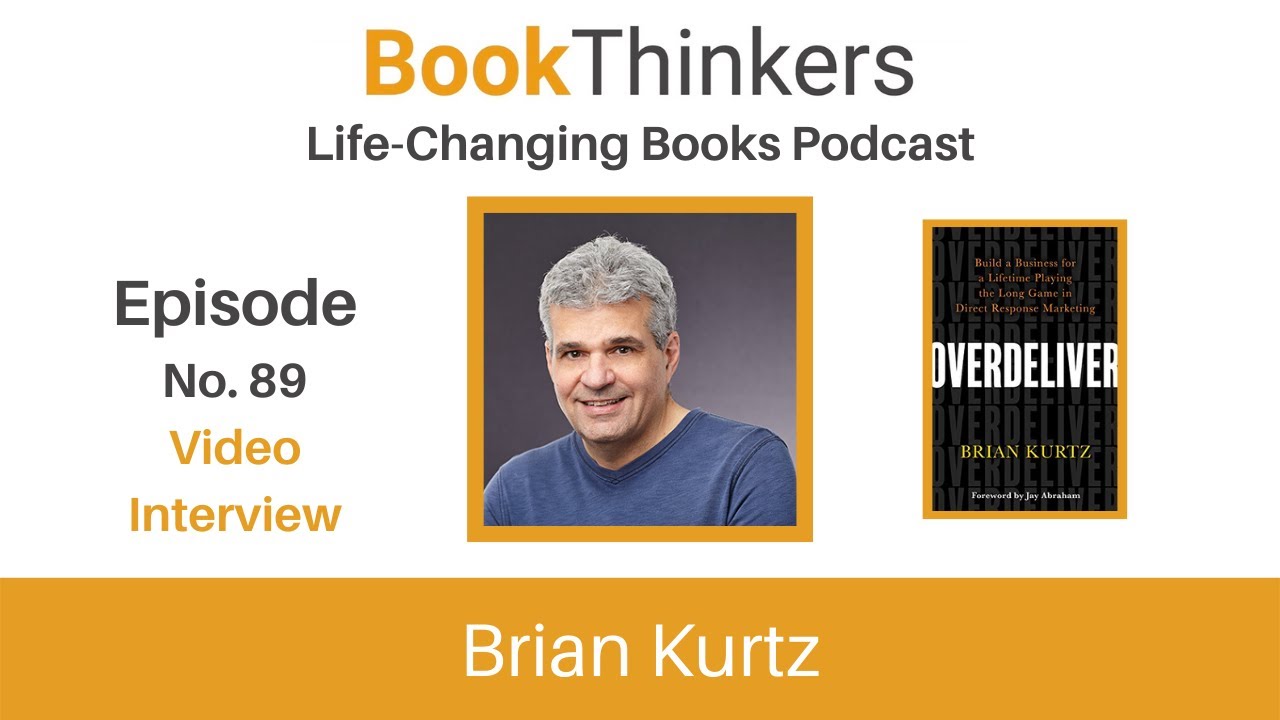
In this episode of the Life‑Changing Books Podcast, host Nick Hutchison interviews veteran direct‑marketing veteran Brian Kurtz. Kurtz explains his 34‑year tenure at Boardroom Inc., where he learned the fundamentals of measurable, accountable advertising, and his later venture, Titans Marketing, where he teaches and publishes classic direct‑marketing material. He defines direct‑response marketing as any channel that yields a measurable ROI, contrasts it with brand‑building advertising, and walks through core concepts such as list segmentation, offers, creative copy, fulfillment, continuity, and lifetime value. Kurtz shares his mentorship philosophy – that mentors choose you – and recounts relationships with Jay Abraham, Gene Schwartz, and other legends, illustrating how pro‑bono work built lasting relationship capital. He describes his new book, Overdeliver, which blends memoir with a practical guide, highlighting nine universal marketing lessons for entrepreneurs and a deeper dive into the nine pillars of a successful direct‑marketing business. The conversation also touches on the importance of relationship capital, the “double‑white‑belt” beginner’s mindset, the dangers of single‑channel marketing, and how modern marketers can leverage infinite advertising opportunities while staying ethical. Kurtz directs listeners to his website, the Overdeliver book site (overdeliverbook.com) for bonuses, and his blog at briankurtz.net, emphasizing the value of building an online family rather than a mere list.
Chapters
Brian, welcome to the Book Thinkers Life-Changing Books Podcast. How are you doing today?
Nicholas, I'm looking for some life-changing interviewing from, you know, a guy who knows books. I mean, you are a voracious reader, obviously, not just because you have books behind you. I know that this is, you know, a passion project of yours and I'm really honored to be with you today.
Well, I love the high standard that you've set, so we'll see if we can live up to it today. And I'm looking for some life-changing advice from you, but I'm sure you'll deliver So we'll see.
We'll see. I may hold back on the life-changing advice and make you, you know, beg for it or something.
I don't know. We'll see if I can pry it out of you. But for those in my audience that are not familiar with you or your books or your businesses, could you please introduce yourself to everybody?
So I'm Brian Kurtz. I'm basically, I call myself a serial direct marketer. I don't want to call myself a serial entrepreneur because I haven't been an entrepreneur my whole career. I was more of an intrapreneur, which is a different terminology, which is kind of being kind of free within a larger organization to create. And you have to earn that, you know, from the owner of the company and then get equity and then build it up. And that's what I did for 34 years at a company called Boardroom Inc., which was a publisher, iconic publisher and direct marketing company that published newsletters and books for consumers on health and taxes and consumer information. And I learned marketing from, you know, direct marketing from the ground up. And by direct marketing, I mean measurable marketing, not general advertising. So that's a, we could talk about that too. I talk about that in my book as well.
Yeah, we'll talk about that today for sure.
Yes. So, so I, I worked at Borden for 34 years. It was not 34 years experience. It wasn't, it wasn't one year's experience for 34 years. It was a cumulative 34 years where I learned, I grew, I had some of the best mentors. I worked with the best copywriters. I mean, I was privileged because I, our company, as I said, we were an iconic company and we were iconic because we always went looking for the best resources. So we only work with the best copywriters, the best consultants, the best media buyers, the best list people, everything that's involved in marketing. We would only go to the best of the best. And I just happened to benefit by working with them, you know, very closely. And many of them became my mentors. Many of them are gone, unfortunately, and some of them are gone and I'm, They're still my mentors because I publish their work now within my new business, which is not that new, but I left Boardroom in 2015 and launched Titans Marketing, which is, I never say it's a consulting company because when you say you're a consultant, it means you're unemployed in most circles. Like, you know, you go out, I go out to dinner with my wife and other couples and this one's a lawyer, this one's an accountant, this one's a financial planner. What do you do, Brian? Well, I'm a consultant. Oh, you're unemployed. Robin, that's my wife. Robin, when are you gonna be selling the house? You know, that kind of thing.
Yeah.
So I never call myself a consultant, but I'm a direct marketing educator and I subscribe to the theory that Jay Abraham taught me, one of my mentors. Jay Abraham is a world-renowned thinker in marketing and, you know, he partners with Tony Robbins and Daymond John and he, you know, he's my mentor as well. And he wrote the foreword to my book, Overdeliver. And he says, if you did it, you have a responsibility to teach it. And so I did it for 34 years. I'm still doing it too, to some degree, because you never stop learning, you never stop doing. But now I'm teaching everything I learned and I'm still learning new stuff. and then teaching that as well, or I'm learning it and bringing the experts to teach it to my groups, my consulting groups, which are mastermind groups. And so, you know, there's so much out there in marketing today. It's the best time in the world to be a marketer ever. And, you know, advertising opportunities that were once finite in the days of direct mail when I was doing it in the 1980s, it's, you know, the world's our oyster, right? I mean, you've got advertising opportunities are now infinite. And I talk about that in my book as well. And, you know, that doesn't mean that you have to be in every advertising opportunity, but knowing what's out there is a challenge. And so my, I feel my job is to bring forward experts in every single media channel, everything, and both offline and online. That's another thing that's one of my premises today is that, you know, it's not just one channel. It's not, it's a multi-channel environment and you need to take advantage of, and everything doesn't have to be digital. Everything doesn't have to be online. Online rules the day. I'm not a Luddite, but I am, you know, suspicious of marketers who think everything has to be digital. Everything has to be on Facebook. Everything has to be, you know, I wrote a blog post recently that I think it's in my book too. Facebook didn't invent everything, you know, and I have that story. Maybe I could tell that story during this interview. But, and I'm not playing grandpa at the picnic saying, you know, get off of my lawn, you know, you got, you young whippersnappers don't know anything about marketing and I—
Despite the T-Rex behind you.
Yeah, that's my T-Rex, right? But on the other hand, you know, there's a lot to know about the fundamentals of direct marketing before you can practice direct marketing today, online or offline. And so one of the advantages that I've had with my 34-year career at Boardroom and my, you know, 8-year career in Titans marketing Is that I'm in a position, whether it's enviable or not, I'll let your listeners decide that. But it's something that I become a bridge that connects the fundamentals of direct marketing, the eternal truths of direct marketing to everything that's state of the art today online. Now, I'm not an expert in everything online today as I was offline when I was learning it coming up in direct marketing. But I know enough to be dangerous online. And I also know who to go to. Like, I know, I know, I know the whats, you know, what's the what? The what is Amazon? The what is Facebook? The what is email marketing? The what is Google AdWords? All of those are whats in online marketing. But I know who the who is. Who is the who in each of those areas? And how can you get it done with the right who? That's like my— so that, and I have a unique perspective on that. At least that's what I sell myself as. Some people believe it, some people don't. The people that believe it join my mastermind groups and the people that don't join other people's mastermind groups that they believe it from. But I think I'm, I have some, I am unique in that, you know, most of the people that I grew up with, in the early days of Boardroom either are dead figuratively or literally. So literally, some of them died young, some of them died old, but a lot of them are not with us anymore. The ones who died figuratively are the ones who saw the internet coming and email coming. And I'm not gonna say they were scared, but they didn't see it as an opportunity. They saw it as a threat. And I think one of my advantages was I said, wow, this is good. This is direct marketing with immediate results as opposed to direct mail where we had to wait 8 weeks when you do a mailing to get results. You know, the idea of getting— because direct marketing is all about measurability and accountability and getting immediate feedback. But immediate in 1980 could be 8 to 12 weeks on a mailing. Today, immediate could be You know, 8 hours. Now, sometimes too fast is no good either. You need to have reliable, you know, data, statistical significance in what you're doing to really read results. But if it's not 8 hours, it's not 8 weeks either. So I thought the internet and email and everything that has come since is the ultimate direct marketing medium. And I always was thinking in terms of how do I relate that to what I did and what I wanna do going forward in my, in my educate— direct marketing education business. And that's kind of me in a nutshell. I've written 2 books. The one we're gonna talk about today is Overdeliver. It's behind you and it's, it's here. And it's, I'm really proud of it. You know, it's a book that kind of chronicles my career. In, but it's still got talking about the guiding principles of direct response marketing with examples and storytelling, which is so important in nonfiction. You know, people say storytelling, that's fiction. No, storytelling in nonfiction is, we were talking before you hit record today, we were both kind of in sync very much in both of our businesses. on the idea that, you know, telling stories about your experience to get a concept to your readers that they may not have known or they knew of but were not— they didn't really comprehend it. They didn't get it yet. And so, and you've had that experience and I've had that experience and I just had it recently. Someone wrote to me and said, you know, in chapter 4, you wrote about RFM, which is like, you know, RFM, recency, frequency, monetary value, is not a rule of thumb in direct marketing. It's actually a behavioral model that says this is how customers behave in the marketplace in any medium, in any medium. And he wrote back to me and he goes, you know, did you invent RFM, Brian? Because you just explained it so well. And I was quick to tell him, I didn't invent anything. In fact, I've written blog— I think that, I think I have a line in Overdeliver saying, I'm proud of the fact that I didn't invent anything, but I have taken what I've learned and applied it to things that have been invented before me and put my spin on it. And we were talking about that before you turned record on. And I think it's an important thing, you know, and I said to you that the most satisfying, like, critique or review of my book is someone who got it. From me because they didn't get it before and I put it into language or an example, or I put a story on it that got them to get the concept so then they could apply it to their business and their life. And that to me is the most satisfying thing that I do in my business. It's what keeps me going and I don't invent anything. I don't have to invent anything. I can still get tremendous satisfaction from that. So Overdeliver is my most recent book. I did a previous book, The Advertising Solution, which I did with a co-author, Craig Simpson. And that book basically profiled 6 legends of advertising, not direct marketing, advertising, general advertising, Mad Men advertising. And, but they were 6 legends of advertising because they lived between the 1930s and the 1970s. Yet they were, they, I always, I think I say in that book that they were direct marketers trapped in general advertisers' bodies. And that's why the book was so attractive to work on with Craig because, you know, we profiled David Ogilvy, Claude Hopkins, John Caples, Robert Collier, Gary Halbert, and Gene Schwartz. Whether you've heard of these 6 guys or not, they were, they were just advertising men who understood that accountable and measurable advertising was not the wave of the future. It should be the wave of the present in 1930, '40, '50, '60, back then. And they were sort of the precursors of, you know, state-of-the-art direct marketing when I got into the business in the '80s. And it's still prevalent today. So that book was really, and that got me going to Do Over Deliver because I said, I wanna write a book from my own experiences more closely and really chronicle those principles of direct marketing through my career. And so, and I also, part of my business now in Titans Marketing is it's an educational business, is I publish classic books on direct marketing that were out of print, like Breakthrough Advertising by Gene Schwartz. And I also publish swipe files of great copywriters, which are swipe files is something copywriters use. Not, you know, I always say stealing is a felony and stealing smart is an art. And so you don't just, you know, rip people, a copywriter's copy off. That's not what you use. That's not what a swipe file does. A swipe file is the works of the great copywriters and how they can inspire you to write copy today. So I sell that kind of stuff. I do I have mastermind groups. I have an expensive one. I have a not so expensive one. I do live events. I do Zoom events. I do boot camps. And it's a fairly simple business, Titans Marketing, but I'm having a blast teaching what I did. And that was inspired by Jay Abraham.
Speaking of Jay Abraham, he gave you Quite the foreword to this book, Overdeliver. I mean, it was probably the strongest foreword I've ever read and I've read 500 nonfiction business books.
So that's saying a lot.
Yeah. Tell us a little bit about your relationship with him and why you decided to pick him for the foreword. Yeah.
I mean, he was a no-brainer for the foreword, but I'll tell you why in a second. But basically, He's an example of someone that, and I have this concept that, you know, people say that, you know, you could go find a mentor. You have a lot of books that talk about finding a mentor, finding somebody to teach you the ropes, all of that. And I maintain that your mentors choose you. You don't choose your mentors. And what I mean by that, and Jay is someone who chose me as a mentee, basically. But it didn't happen overnight. I didn't write to him one day and say, Jay, will you be my mentor? And I get a lot of that. I mean, I get a lot of emails today now that I'm on the other side of 60. You know, when I was 23 years old or 25 years old when I met Jay, you know, I was, you know, I was, and he's not that much older than me, but he was already very established. He was getting $25,000 a day for consulting and all of that. But he was, He was basically doing a lot of consulting in the newsletter business with, and the newsletter business was one of the newsletters being publications that don't take advertising, that are higher priced. Usually a lot of stuff in the investment field are in newsletters. A couple of the big companies back then were Agora, which is still around, and Phillips Publishing, which is not still around, but their newsletters are still floating around. And Jay was a consultant in that business. Now, our newsletters at Boardroom were not as high priced and they were more consumery, but I used to hobnob with Agora and Phillips and I got to meet Jay through them. And I just basically learned at his feet and what I did with him that I did with anybody who I saw had incredible wisdom, incredible smarts, I didn't go to them and say, will you be my mentor? What I instead, I say, what can I contribute to them that might be helpful? At 23, 24 years old, I wasn't gonna have that much to offer, but good thing I was a quick learner because I learned the list business at a very early age. List business meaning that it was all direct mail. There was no internet in 1985, '86, '87, but the lists, mailing lists that people mailed, it was a big business. Like anybody who wanted to do direct mail and direct mail was king back then. So the lists were the most important element of direct mail. And so Boardroom had the best lists. So I was basically selling the Boardroom lists and I became a, I don't wanna say a list savant, but I became like so obsessed with list segmentation and looking at audiences and how audiences responded and what promotions got the names onto the list. And then looking at the copy that got, that was written to get the name. So I was like becoming like this list scientist of sorts. And most people who were in the list business were just selling or renting lists to each other. And I became more of a scientist of it. And people like Jay Abraham and Gene Schwartz, who was one of the great copywriters back then. They used to come to me for list advice, like, and I was like pinching myself. It's like, wow, I developed this knowledge and now I can just give it to them. I mean, all pro bono. I mean, I mean, I mean, I don't— Boardroom wasn't paying Jay as a consultant. We were working with Gene Schwartz. We also had Dick Benson who was a direct mail guru at the time. He was a consultant for Boardroom, and all of them would come to me for list advice because they all had publishing businesses. So they all wanted to know where— what are the best lists for my product? And because I, I studied all the lists, both that Boardroom mailed and everybody else was mailing, I was able to do list plans for them that were better than what they could get from their list brokers. And I would do that all for free because I wanted to. And, and I had no expectation of anything in return. And what I got was the best mentors on the planet. And Jay was an early one, but Gene Schwartz, the same thing. I mean, Jay, so Jay, this is in the '80s and '90s, me helping him with no expectation of return. Fast forward 20— 2019, he writes the foreword for my book. That's a foreword that you think is as outstanding as any foreword you've ever read. Okay. That says a lot. Gene Schwartz writing copy for us. I'm helping him with his list plans for his publishing business. He used to invite me to his house for lunch. He, we'd hang out. And then fast forward to 2015 when I launched Titans Marketing. Breakthrough Advertising was out of print basically, and Gene was gone, but his wife was around. And I went to his wife Barb and I said, let's publish Breakthrough Advertising big. Like, let's go for it. And like, she had total trust that I would be the shepherd of Gene's books. Why? Because Gene had chosen me as his mentee. She knew she and I, It wasn't done with any manipulation on my part. It's just that she trusted me because Gene trusted me and Gene trusted me with his list plans. I trusted Gene for all of his wisdom. And now, you know, I've sold probably 900 copies, which is saying a lot at $125 each, 900 copies of Breakthrough Advertising in over 60 countries.
Wow.
since I started publishing it. Now it's just, but it's all about the relationships that you develop early on. So to answer your question, long-winded answer to your question, but I also wanted to get some things about mentors in there and, you know, how, and that's a big, it's big in my book too. I talk about it a lot, but I do believe that your mentors choose you. You don't choose your mentors.
No, listen, I like the way that you answer questions, although they are long answers. You pack a lot of different value and perspective in there. And that's why, like we were talking about, storytelling is important. Because you can't just say, hey, 1+ 1= 64. You need to give some context around why that works. So I'm happy that you do it that way. And mentorship is a question that my audience asks about a lot because our average listener is a young professional, 18 to 34. You know, they're using these books to improve their lives. And so this type of stuff really helps. And I wanted to make a comment that, Brian, I see a lot of I see a lot of similarities between your journey and my journey because I'm in this place.
Yours is a lot short. Yours isn't as long. You're so young.
Well, yeah, I am in my, I'm in my late 20s now, but I'm in this position where I've taken, I've taken a career path where I'm able to work with ideal mentors, experts in every industry, and I'm allowed to interview them. And I shouldn't say I'm allowed, I'm fortunate enough to interview them. And introduce them to my audience and ask questions that I'm genuinely curious about. And I get to be mentored by people like you that have high-ticket masterminds that charge a lot of money for this type of stuff. So it's really cool.
Yeah, I think, yeah, you got a good gig and, but you earned it. Like, you know, you're earning it and you're earning it every day because, you know, the way you just, people don't have to know what's behind the curtain here, but, you know, you got, you approached me, you know, I guess your brother approached me and said, you know, we have these services that we provide and we may do business together and we may, or we may not. But I said, you know, you have a podcast, would you like me to be on it? And we'll start there. And you could have said no and it would've been fine. I would've been fine with that. I wouldn't have been insulted. But you said yes immediately. And the way you said yes was like with enthusiasm. And I don't think that, I think, and it felt genuine. And I'm sure it was now that I've read it.
It was.
Yeah.
And it takes a few hours to prep for these podcasts, right? Because I'm interviewing authors. So it's not like I can just turn on the mic and have a conversation. It requires the purchase of a book or it requires hours of time invested in learning about the material. But for me, it's all worth it because I'm not just talking about, you know, news media gossip or something that won't actually improve my life. I mean, I've genuinely learned stuff from your book. And then I get to talk to you about it. So, and then the fact that you did pro bono work for these guys and it pays off later down the road, I think I'm in a similar position where I'm willing to do discounted work or I'm willing to do pro bono work for the right type of person because who knows where I'm gonna be 10 years from now, but it'll probably pay off in some way, shape, or form.
Yeah, it's sort of like, I call it the scrubbing the bathroom with a toothbrush mentality. And it's not that you always wanna scrub the bathroom with a toothbrush, much. That's not what I'm saying. But you understand that actually a better way to put it is like always go to earn a double white belt. And what I mean by that, I just wrote about it in my blog last week. I blog every Sunday, which actually my blogs, you know, basically created the book from 2015 through 2018. But the idea of a double white belt is always have a beginner's mentality. So if you have a 10th degree black belt, I'm using martial arts, but You know, it could be in anything. But once you achieve, you know, a height or a goal or a pinnacle of some sort, then you have to go reverse. It's like a reverse funnel. You go back in and say, okay, now that I can kill some using martial arts, now that I can kill somebody with one flick of my wrist, or that I know so much about this particular martial arts area. Now I've got to go in and say, okay, I— that comes with a responsibility. And it goes back to what Jay taught me about now that you did it, you have to teach it. But it's also having a beginner's, student's mentality all the time. And so you're in your 20s, I'm 64, and I still have that mentality. Like, I don't know what— this podcast is an adventure for me. I didn't know you. I knew— It looked like a really good— the idea, I think you call it Book Thinkers, right? Yeah. Which caught my attention. It's like, you know, that's an interesting title for a podcast. That's all you need. Like, you had me at hello. You had me at Book Thinkers. And then we explore and we see where we go. And, you know, it— but that— and the thing that, going back to what I said, you know, not I don't have 40 years experience. I have one— I don't have one year's experience for 40 years. I have 40 years cumulative experience. So every year, you know, it snowballs. It's like what you learn in year 1 gets added on to year 2, and then it's 1+ 1= 3 in year 2, and 1+ 1= 64. It doesn't happen automatically, right? In addition, as far as people go, and I have this in my book, I think it's in chapter 10, which is playing the long game about relationship capital. Like, I got that from Jay Abraham. You know, I think in chapter 10 of Overdeliver, it's my last chapter, it's the last chapter. And basically it's playing the long game. And then I have a quote from Marty Edelston, who was the founder of Boardroom. And the quote is, life is long, which is kind of a play on life is short. But life is long because you only have one. So it's long, whatever it is, whether you live to be, you know, 40, whether you live to be 100, it's long. It's what you're living, right? We could talk about that too, because I had a near-fatal stroke in 2019. But so, you know, you're looking at life being long all the time. So everything is about— it's not about having the most friends on Facebook. It's not about having, you know, a huge list and bragging about it. It's about quality over quantity, but it's about relationship capital that building your list. I, in fact, I blog every week. I have about 15,000 names on my list. I don't call them my list. Like, I have trouble saying you're on my list. I never say that. I say you, my online family, just to keep in mind that these names have been curated. They haven't just been slapped onto the list, right? They've been curated through podcasts, for instance. Like today, I'll give a link to someone if they want to opt into my list, my online family, they will get my blog every week. I don't sell. I don't do affiliate deals. I sell my own products in it once in a while, but it's not, it's a content-driven blog post every Sunday. And that to me is because I'm developing relationship capital, not a list, not Facebook friends. And I always say that the most valuable asset in your In your toolkit or toolbox or your balance sheet of assets versus liabilities, your number one asset is your relationship capital and it compounds. It's compound interest because of the not being year to year and going from friend to friend. You develop the relationship, you go a mile deep with people instead of going a mile wide with very few people. And that's been my strategy. Some people don't go with that and that's fine. You know, Tony Robbins doesn't go with that strategy and he's done fine and he's great. You know, even a guy like Grant Cardone who's a big marketer, he doesn't subscribe to that philosophy. He's going for numbers and he's got a different mission in life and that's great. I'm not slighting anybody else, but that's what to me overdeliver is about. It's about You know, the subtitle is Build a Business for a Lifetime, Playing the Long Game in Direct Response Marketing. And that's what I've done. And, you know, it's not like it or leave it. It's like, just take what you can out of it and see if you can apply it to your business in your life.
Yeah, I've been calling my audience the Book Thinkers family for probably like 4 years now, almost since the community started.
You are enlightened.
I like that a lot. And in the same way that you became a list scientist, which was something that your mentors Gene and Jay needed and they could leverage because you had done more work than anybody else, I'm starting to do that with turning books into social media content, which is what we talked a little bit about before. I mean, I'm becoming an expert in leveraging social media to sell books, which is something that traditional publishers They don't want to touch because it's so volatile and it's so scary. And yeah, I mean, in the same way that you became a scientist with it, I'm trying to become a scientist with video content on social media, how to prepare the right hook, how to deliver value in 30 seconds and what's a proper call to action look like at the end of your piece of content. What's the angle, the lighting, the messaging, the props in the background? How should that be? How should that look so that we can sell books which might work into a funnel So that somebody ends up at a mastermind, you know, at the end of the day. So yeah, that's the books as a business card type thing. Now, we've talked a lot about direct response marketing today, but I'm sure there are a number of people in my audience that don't know what that terminology means. So could you define that for everybody?
Yeah. So direct response marketing is any marketing in any channel that has a measurable response. An ROI, a return on investment of the advertising. So for example, an ad for McDonald's on TV that tells you to go to McDonald's tomorrow is not a direct response ad. An ad for McDonald's that has a QR code at the end or a website, a dedicated website to go for a coupon to take to McDonald's has a direct marketing component, because you can read the results of that ad, theoretically. I mean, it's sort of like, you know, advertising in the Super Bowl. You know, as time has gone on, when you're paying whatever, $1 million for 30 seconds or more, it's more than that now, but you're paying that kind of money. You saw over the years, many more of these big advertisers actually have some call to action or some direct response mechanism so that the viewer of the commercial, they could read a response, even if it's just people who click. Not a great metric because you want people to buy, but they have to click before they buy. You're not gonna— I remember there was an ad once from like one of the car manufacturers and it was a, there was a QR code or something to basically, you know, opt into the site and they could capture an email address or something like that. At least you get something for your money, right? And not just, you know, and when you watch, I referred to Mad Men before, that was a series on AMC. I guess they had 8 or 9 seasons and it was all about the advertising men of the 1950s and '60s, you know, smoking cigarettes, you know, 3 or 4 martini lunches, And non-measurable advertising. You know, you have these pitches, you know, for Lucky Strike cigarettes, and they have all the Lucky Strike and the Marlboro Man and all of that. And they show the, they show the shots of the ads they're gonna run and the billboards they're gonna run, and the client approves it and it goes out. And so then that year, Lucky Strike's sales go up. Oh, it must have been the advertising. Well, maybe, maybe not. Maybe more people learned to smoke, who knows? So I think that, um, direct— and I got into the business in 1981. Boardroom was all direct marketing. It was all direct mail with key codes on every order card so that we did a mailing. We knew where there was, what list every response came from, how much we made on the mailing, what the P&L, the profit and loss was on every list. Every mailing to the penny, to the penny. And so I said, now this is cool. This is immediate. This is feedback. It's feedback that you have to take it. You're taking it to the bank. Either you're taking it to the bank with no money or you take it to the bank with money. So it was, it, it, I said, why would you do advertising any other way? Like, why would you do marketing any other way? And so, and it was interesting because when I got into the business in 1981, The big agencies, like the big agencies that the Mad Men worked at, you know, Ogilvy and Mather and Doyle Dane Bernbach and Wunderman Ricotta and Klein, big, big agencies like advertising agencies on Madison Avenue. They all started developing direct divisions. There was Wunderman Direct, Ogilvy and Mather Direct. And the direct marketing divisions of those agencies started just skyrocketing, because you can understand, if I'm an advertiser and I know I can get— I can find out if the advertising's really working, like, wow, how refreshing, right? My money is actually being spent wisely. Imagine that. So I'm being kind of, you know, a little tongue-in-cheek here, but that's what turned me on. And that— so to really think about direct marketing as measurable and then accountable advertising, I think is the way to think about it. So everything I ever did, and so when I talked about being a bridge between, you know, everything that was eternal truths when I came into the business and everything that's state of the art today, it's still all direct response marketing. And so that's what, that's the underlying thing. that says if you're gonna spend something on ad— you're gonna spend something on advertising. I'm talking, I'm not talking about organic advertising, like organic search, but if you're gonna pay for Google AdWords, you're gonna pay for Facebook ads, you're gonna pay for direct mail, you're gonna pay for TV or radio advertising. I wanna know, I spent this, what came back, and is that acceptable? And that, that gets— and I have a lot of stuff in my book about what's acceptable for one company is not acceptable for another. I talk about bogeys, which is something we talked about in direct mail, which is how much you can afford to lose on your first order to make it back on the second or third order. That was something that's been around for a while. Now they call it something else online. They call it, you know, but it's still, you gotta make the money back eventually or else you're gonna go broke. And so I oversimplified the definition of direct response marketing. But I think I defined it pretty well.
Yeah, no, I think you did too. So for people listening today that are thinking, okay, I mean, I like this guy Brian, he sounds like he's got a ton of good information. He's been around the block, spent 34 years doing it for other people, now 8 years doing it for himself. The book sounds cool, but I'm kind of on the fence. Like, what would you say to that person? I mean, who is the target reader for this book? What's the main takeaway that you're hoping somebody's going to walk away with?
So for someone who's not a marketer or a copywriter, I think it's an incredibly valuable book because even in the introduction I talk about, I think it's in the introduction where I talk about the 9 things you need to know about marketing even if you're not doing the marketing. And so that's from an entrepreneur's perspective and they're critical things. I mean, we could just do a podcast on those 9 things. But that would be a critical, even just if you, if everybody read the introduction to Overdeliver and looked at those 9 things, I'll just, I'll just rattle them off quickly so you can get a sense of what I'm talking about. So one is be involved in all of your marketing efforts, even if you outsource everything. 2, marketing is not evil. A lot of people think about marketing as evil and they're people trying to grift me and steal from me. It's not. 3, no one spends enough time on lists. A little self-serving because I was the list scientist, but it's not just lists, it's media. It's again, accountable advertising, knowing the audience before you do create an offer and before you create your messaging, you have to know the audience. 4, customers refund transactions, not relationships. So what I talked about in terms of your relationship capital, Applies to everything you do in marketing. And it's all about the relationship you talk about. We talked about the kind of things you're gonna do, like the snippets of video to create, you know, a call to action and all of that. Developing a relationship in 15 minutes or, or in 15 seconds or 30 seconds or even 10 minutes, it's tough. And that's a talent. If you can pull that off, it's not a deep relationship, but at least you're trying to develop a relationship. I'm talking about relationships that go on for years and years, which get people to stay with you forever, whatever your product or service is. 5, credibility and transparency trump all. Always be credible in your advertising. Always be transparent in your advertising. Tell the story behind the product. Tell the story behind why you're in business.
Tell—
don't just like throw out a product and throw out the price. That's a commodity. Make it specialty. 6, always think direct marketing, which we already defined. Direct response marketing, measurable, accountable. 7, use your personal brand in your marketing when applicable. You know, however your brand plays, use it. Uh, Jay Abraham wrote a book, Getting Everything You Can Out of All You've Got. If you've got something, use it in your marketing. 8, advertising opportunities are now infinite. I kind of told you that with, you know, they were finite in the days of, in the 1980s. Now they're infinite. How do you know what to look for? What to use? You don't have to be in everywhere. You just wanna make it look like you're everywhere. And there are ways to do that. And then 9, I own a website that's called, I own this URL, singlechannelmarketingissoboring.com. If you go to single channel, nobody's gonna do this, but if you go to www.singlechannelmarketingissoboring.com, you will go to my website, RyanKurtz.net. I bought it for the reason that I can emphasize that single channel marketing, whether you're just on Facebook or just in Amazon or just selling on Google AdWords, just selling in direct mail, big mistake. The most dangerous number in business is one, one of anything and one medium. that you're advertising in is a death sentence eventually. So those are the, those are 9 things that every entrepreneur can use, adapt, whatever. Now the rest of, for the rest of the audience, if they wanna go deeper in any of those and even further, then the rest of the book talks about the elements of what makes a successful direct marketing business. And it's for copywriters, marketers, any agency owners, media buyers. And I have chapters. I have a chapter on lists, of course. I have a chapter on offers. I have a chapter on creative and copy. I have a chapter on fulfillment and customer service. And by the way, fulfillment and customer service of your product is a marketing function. Never forget that. I have something, I have a chapter on continuity and lifetime value. Lifetime value is an incredible concept that is just embedded in everything we do in direct marketing. And I even have a chapter, How Paying Postage Made Me a Better Marketer, which talks about the discipline of direct mail when you had to pay postage and printing to marketing today where media is cheap and it doesn't cost you as much, but that doesn't mean that you can be sloppy. So there's a chapter on that. There's a chapter on original source. The importance of original source. So the book is kind of like my journey through direct marketing, but broken up into the elements that all make up a successful direct marketing company. And frankly, you know, I have something in there about marketing isn't everything, it's the only thing.
Yeah, that was a good line in the intro.
Yeah, it's so important. And I'm not saying that You know, you have to be a marketing whore. That's not what I'm saying. You know, you're not gonna, you're not looking to gouge customers left and right, but if you're not marketing driven, even if you're a nonprofit fundraiser, you need to understand marketing and getting people to move to the wallets. And, you know, how do you get people? And that's why copywriters are considered magicians because they get people to reach into their wallet and pay money. and pull out their credit card. And it is a magical, I mean, you can use it for evil too. That's why marketing gets a reputation sometimes of being evil because you can use the same techniques that are the most successful marketing techniques for good or for evil. And I, you can safely say that I've only emphasized the good in this book.
Yes, you can. Well, I can't believe we've already been talking for 45 minutes.
Yeah, I can talk, I can talk for hours on this topic.
Time flies. I know that for anybody still listening, this book is definitely great for marketers, but like Bryan just mentioned, I think anybody can benefit from it. And there are lessons that I took away that I can apply to my personal life too. Like you say that you proactively reach out to friends who don't have the energy to reach out to you. And even though it's not 50/50, you are proactive, you keep the relationship alive. and it ends up being a lifelong friendship. And I think about that in my own personal life. Now you go to relate that to direct response marketing, but it's a great like life lesson in general. So there's a lot of that stuff built into the book, which is nice.
Well, marketing, that's why I say marketing isn't everything, it's the only thing you can, I can relate anything to a marketing problem or issue. And it's interesting because you can If you give, you don't have to give everything 100/0, but if you think in terms of 100/0 and not meeting people halfway and not being 50/50 and matching them, I talk about Adam Grant's book, Give and Take, wonderful book, really. I had a lot of epiphanies reading that book and it was, you know, one of the interesting things in that book is that there are 3 types of people in the case of giving and taking. There's givers, matchers, and takers. A giver is a giver. A matcher is like you give me, I give you in equal amounts. And a taker is just someone who takes without any regard. And the interesting thing is that he says at the beginning of the book that who are the— who do you think are the most— who do you think are the most— who do you think are the most People who have the worst business track record? And, you know, you'd assume it would be the takers. And he says, no, it's the givers. And then he says, who do you think has the most success? It's also the givers. And then he goes into how you give. He's not a big— I don't know if he's in sync with me completely about 100/0 giving, but he does say that, you know, you can't be— it's like, you know, champ or chump, he talks about in another chapter. You know, you can, like, I've been a chump many times by giving 100/0, but I'd say over 40 years in business that net-net, I'm way ahead by going 100/0, getting screwed a few times with all the benefits of Jay Abraham being in my life in a big way, or Gene Schwartz being in my life. That's where, you know, that makes up for being a chump with somebody who would end up being a taker. When you were giving 100 zero.
Yeah. And I kind of like the, kind of like a VC model where you invest in 20 businesses and one carries the boat, but that one, I mean, it pays 1,000 to 1. Yeah. Yeah.
I mean, I look at that a lot. I mean, I look at also the idea that, you know, I can eventually write somebody off if I blew it. It's usually after I get hurt multiple times because, you know, I give people benefit of the doubt. But I'm okay. I can live with that.
Yeah. Man, I had so many other questions, so maybe we'll have to do another podcast sometime, but you delivered an incredible amount of value today. So thank you for taking the time to do that. And for my audience, for the people that want to learn a little bit more about you and what you do, where should they go? You mentioned briankurtz.net. Is there anywhere else that we should point people to?
Yeah. So briankurtz.net is, you know, that's my modest site. I have my blog posts on there. There's an opt-in page to opt into my online family and you get my blog if you opt in. And there's also a lot of free content on the site itself. There are the products I sell, the books, the educational books in direct marketing. Everything is kind of congruent and consistent with everything I talked about today. Now, if you're willing to, and I don't make any money on this, but if you're willing to invest $27 or maybe it's $20 and buy Overdeliver, don't go to Amazon to buy it directly. Go to overdeliverbook.com. And at that site, I basically, I think I said before we turned the recording on, I said, you write a book called Overdeliver, you better overdeliver on the bonuses if people buy the book. So go to overdeliverbook.com and you'll see these amazing bonuses on that page. It's from all my mentors. I have stuff from Gene, interviews with Gene Schwartz about Gene Schwartz. I have a swipe file from Dan Kennedy, one of the great marketers of all time. I've got 2 PDFs, full PDFs of 2 books out of print from 2 of my mentors in direct mail, Gordon Grossman and Dick Benson. And the books are out of print. You can print the PDFs. And there are universal truths of direct marketing today, even though they're about direct mail. It shows you that again, the fundamentals really live on. There's 18 or 19 keynote speeches from Jay Abraham on the site. So that's the Overdeliver book site. And you go there, you have to go buy the book. It gives you choices. You go to Amazon, Barnes& Noble, It opens up a new window. You buy the book, come back to the site, you put in your order number, and then you get to access all of the bonuses for the price of the book. And you also get on my— you become a member of my online family as well. So if you basically can become a member of my online family for free at briankurtz.net, and if you want to pay $20 to $25, become a member and get thousands of dollars worth of bonuses. you can do it that way too.
Amazing, man. Well, thank you so much again for coming on the show, and I look forward to our next conversation and, and whatever we end up doing offline. There's a lot that I can learn from you. So thank you.
And I learned a lot today too, Nicholas. Thank you.
More from Nick

Napoleon Hill’s “Think and Grow Rich” is a timeless classic #selfhelp #personaldevelopment

4 Books to Help You Get Better at Decision Making #selfhelpbooks #bookrecs #nonfictionbooks


Have you read this book yet? 📖: The 5AM Club by Robin Sharma #selfhelpbooks #robinsharma

Dan Sullivan on Listening to Your Customers Instead of Watching Your Competitors

5 Books That Will Boost Your Financial Intelligence #financialfreedom #nonfictionbooks

The People That Preach the Loudest About Virtue are Usually the Most Power Hungry



Books are the greatest mentors you can find #selfhelpbooks #businessbooks #successmindset

Let’s fight this toxic instant gratification culture together 📖 #selfhelpbooks #jimkwik